Introduction
It is estimated that by 2030 about 65 million people will be affected by dementia worldwide (Prince et al., Reference Prince, Bryce, Albanese, Wimo, Ribeiro and Ferri2013). AD is the most frequent cause of dementia (Ferri et al., Reference Ferri2005; Reitz et al., Reference Reitz, Brayne and Mayeux2011) and characterized by cognitive impairment, functional decline and neuropsychiatric symptoms (Burns and Iliffe, Reference Burns and Iliffe2009). As a consequence, AD has substantial effects on the quality of life of patients and their caregivers (Schölzel-Dorenbos et al., Reference Schölzel-Dorenbos, Draskovic, Vernooij-Dassen and Olde Rikkert2009).
Unfortunately, there is no cure for AD. The ChEIs galantamine, rivastigmine, and donepezil are recommended for the symptomatic management of mild to moderate AD (Kwaliteitsinstituut voor de gezondheidszorg CBO, 2005; National Institute for Health and Clinical Excellence, 2006; 2011). Some guidelines on the management of AD propose to evaluate the effect of ChEI treatment three or six months after the ChEI is started (Kwaliteitsinstituut voor de gezondheidszorg CBO, 2005; Ministry of Health Singapore, 2007; Qaseem et al., Reference Qaseem2008). In case of deterioration of global, cognitive, functional or behavioral function during the first months of treatment, the patient is considered to be a non-responder and discontinuation of treatment is recommended (Kwaliteitsinstituut voor de gezondheidszorg CBO, 2005; Ministry of Health Singapore, 2007; Rabins et al., Reference Rabins2007). However, the evidence demonstrating that it is appropriate to stop treatment in non-responders is limited (Qaseem et al., Reference Qaseem2008). In contrast, it has been shown that beneficial effect of ChEIs disappear within six weeks after discontinuation (Gaudig et al., Reference Gaudig, Richarz, Han, van Baelen and Schäuble2011). Some guidelines make no statements about the evaluation of treatment effect (Scottish Intercollegiate Guidelines Network, 2006; Hort et al., Reference Hort2010). The National Institute for Health and Clinical Excellence recommends that treatment should be continued only when it is considered to have a worthwhile effect (National Institute for Health and Clinical Excellence, 2006; 2011).
Understanding the relation between the initial response to ChEI treatment and the subsequent course of AD is important given the potential negative consequences of stopping treatment. This study aimed to investigate the relation between the initial cognitive response to treatment with ChEIs and the subsequent long-term course of cognition of AD patients in a “real-life” setting.
Methods
Study design
The Frisian Alzheimer's Disease Cohort study is a retrospective longitudinal study of AD patients treated with ChEIs in a “real-life” setting. To evaluate the relation between the initial cognitive response to treatment with ChEIs and the subsequent course of cognition, we investigated whether there is a difference in the subsequent long-term course of cognition between non-responders and responders. Absence of an initial response was defined as a lower MMSE score after the first six months of treatment compared to baseline (i.e. the period in which the diagnosis AD was made and patients started with a ChEI), a positive response as the same or higher MMSE score compared to baseline. Because the evidence demonstrating that it is appropriate to stop treatment in non-responders is limited (Qaseem et al., Reference Qaseem2008) and the potential negative consequences of stopping treatment (Gaudig et al., Reference Gaudig, Richarz, Han, van Baelen and Schäuble2011), patients from our clinic continued treatment, even in the absence of a treatment response after the first six months of treatment.
Setting and participants
The study was conducted with data from 576 AD patients seen at a memory clinic of the Medical Center Leeuwarden, situated in the north of the Netherlands, during the period 2002 to 2012, though most patients were diagnosed with AD between 2006 and 2010 (87.3%). All patients were diagnosed in accordance to the criteria of the National Institute of Neurological and Communicative Diseases – AD and Related Disorder Association (NINCDS-ADRDA) (McKhann et al., Reference McKhann, Drachman, Folstein, Katzman, Price and Stadlan1984). Additional inclusion criteria were, age 65 years or older, start with a ChEI and living at home or in residential care during the period the diagnosis AD was made. Since the definition of response is based on the change in MMSE score between baseline and the first six-month assessment, patients had to have both a baseline and the first six-month assessment. Various patient characteristics were recorded during the outpatient clinic visits. The first control visit (i.e. follow-up visit) was planned six months after the start of a ChEI and subsequent control visits were annually. The total number of visits per patient ranged from 1 to 11, the median number was 3 (25th–75thpercentile 2–5). When treatment with ChEIs was discontinued, the outpatient visits ended. The initial assessments were carried out by physicians of the multidisciplinary team of the memory clinic. The control visits were carried out by experienced dementia nurses under supervision of geriatricians. Data were retrospectively collected and entered into the study database. The study was approved by the local ethics committee of the Medical Center Leeuwarden.
Measurements
Socio-demographic characteristics
Age, gender, social status, comorbidity, weight, use of informal care and number of types of professional care were recorded (i.e. five types of professional care were distinguished: dementia case management, household help, home nursing, respite care (i.e. daycare center), and meals at home services). Comorbidity was evaluated by the Cumulative Illness Rating Scale (CIRS). The total CIRS score ranges from 0 (no impairment) to 56 (extremely severe impairment) (Salvi et al., Reference Salvi2008). AD as index disease was not included in the CIRS score. The number of medications beside the ChEI was recorded; polypharmacy was defined as total use of 4 or more medicines beside the ChEI.
Cognitive functioning
Cognitive functioning was assessed by the MMSE (Folstein et al., Reference Folstein, Folstein and McHugh1975) and the clock-drawing test (Shulman et al., Reference Shulman, Gold, Cohen and Zucchero1993).
Behavioral and psychological symptoms (bps) of dementia
Based on self-reported patient and caregiver information, we recorded whether BPS were present or absent. Since BPS was not operationalized with a measurement instrument, it was not possible to report the severity, nature or frequency of BPS.
Type and dosage of ChEI
At each outpatient clinic visit, type and dosage of ChEI were recorded. If applicable, adding of memantine or switch to memantine was recorded. At our memory clinic, the extended release form of galantamine is the treatment of first choice for patients with mild to moderate AD. The extended release form of galantamine is prescribed since 2005 at our memory clinic. Before 2005, galantamine was given twice daily. Patients start with 8 mg galantamine per day for at least four weeks, followed by a maximum dose of 16 mg/day for at least four weeks and, if necessary (for example in case of severe BPS), then the dose was increased to the maintenance dose of 24 mg/day.
Statistical analysis
Data were analyzed with Statistical Package for the Social Sciences (SPSS) 16.0 and Statistical Analysis Software (SAS) 9.2. All hypothesis tests were two-tailed. A probability (p) value of less than 0.05 was considered statistically significant. Descriptive statistics are presented as means ± standard deviations for normally distributed variables. For skewed distributed variables, median and 25th–75th percentiles are given. We used the Kolmogorov–Smirnov test to establish the distribution of the variable. Number and proportion are given for categorical variables.
To investigate whether there is a difference in the subsequent course of cognition between non-responders and responders, we applied a repeated measures analysis using a marginal model (population based averaged model) and SAS proc mixed procedure with time as repeated statement and unstructured covariance structure. The repeated measures analysis has been developed for the analysis of longitudinal, continuous, dependent data. It gives an estimate of change in the dependent variable over time. In the present study, MMSE score was used as dependent variable, time (i.e. the number of measurement moments) and the response group (responder or non-responder after the first six months of treatment) were included as independent variables. The analyses were performed with all available data from patients with a baseline assessment and the first six-month assessment, over a period of maximally 3.5 years (five measurements). From the 6th measurement moment, it was not possible to give a reliable estimate of change in MMSE due to the small number of patients at that moment.
Various characteristics were compared between responders and non-responders, respectively between patients included in the repeated measures analysis and patients who could not be included in the repeated measures analysis and between patients immediately treated with a ChEI and patients not immediately treated with a ChEI. The independent sample t-test was performed to compare normally distributed variables. We employed the Mann–Whitney U test to compare skewed distributed variables. The Pearson χ2 or Fisher's exact test were used to compare categorical variables
Results
Patient characteristics
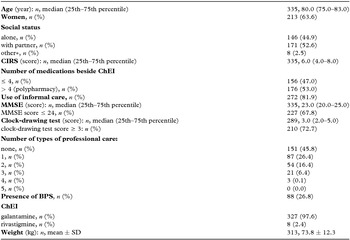
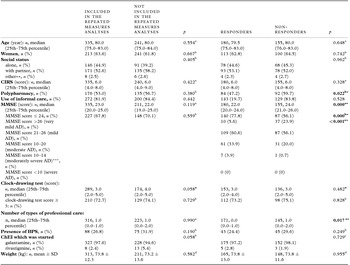
Three hundred thirty-five patients were included. Two hundred forty-one patients were excluded because they did not have a baseline assessment or the first six-month assessment. At baseline, median age was 80 years (25th–75th percentile 75.0–83.0) and median MMSE score 23 (25th–75th percentile 20.0–25.0) (Table 1). Almost half of the patients (45.8%) were independent of professional care, but the majority (81.9%) received informal care. Of the included patients, 97.6% started with galantamine and 2.4% with rivastigmine. No differences in baseline characteristics were found between patients included (n = 335) and excluded (n = 241) in the repeated measures analyses (Table 2). In addition, no differences in baseline characteristics were found between patients immediately treated with a ChEI (n = 519, 90.1%) versus patients not immediately treated with a ChEI (n = 57, 9.9%). During follow-up, memantine was added in 81 (14.1%) patients of whom 38 were included in the repeated measures analysis (18 non-responders and 20 responders). Eighteen patients (3.1%) switched to monotherapy with memantine of whom 12 were included in the repeated measures analysis (3 responders and 9 non-responders).
Patients’ characteristics at baseline

Abbreviations: CIRS: Cumulative Illness Rating Scale, ChEI: cholinesterase inhibitor, MMSE: Mini-Mental State Examination, BPS: behavioral and psychological symptoms, SD: standard deviation, n: number of patients.
*Other, i.e.: with son or daughter, brother or sister.
Patient characteristics at baseline: patients included in the repeated measures analyses versus patients who could not be included in the repeated measures analyses, respectively responders versus non-responders

Abbreviations: CIRS: Cumulative Illness Rating Scale, BPS: behavioural and psychological symptoms, ChEI: cholinesterase inhibitor, MMSE: Mini-Mental State Examination, SD: standard deviation, n: number of patients, aMann–Whitney U test, bPearson χ2 test, cFisher's exact, dIndependent sample t-test, eOverall Pearson χ2 test, * = significant (p < 0.05), **Other, i.e.: with son or daughter, brother or sister, ***These patients are also included in the “moderate AD” group.
Course of cognition: non-responders versus responders
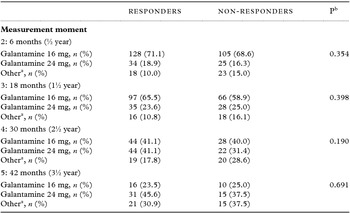
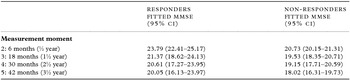
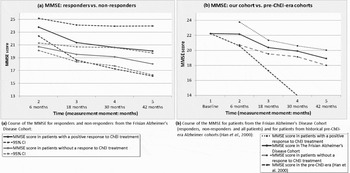
An initial response was absent in 155 patients (46.3%; non-responders) and present in 180 patients (53.7%; responders) (Table 2). Baseline MMSE score was higher in non-responders than in responders due to the higher number of patients with very mild AD and the lower number of patients with moderate AD in non-responders compared to responders (Table 2). During the three subsequent years (i.e. from measurement moment 2), the fitted MMSE score of non-responders was lower than of responders (Figure 1(a), Table 4). The rate of cognitive decline, however, was slower in non-responders than in responders, with a mean annual MMSE decline of 0.9 points versus 1.2 points respectively (p < 0.0001) (Table 4, Figure 1(a)). Non-responders used more medications and had more types of professional care at baseline (Table 2). No differences were found in the dosage of galantamine between responders and non-responders during 42 months of follow up, nor in the use of other medication (i.e. rivastigmine, galantamine in a dosage of 8 mg/day, memantine or a combination of memantine with rivastigmine or galantamine) (Table 3).
Dosage of galantamine: responders versus non-responders

aOther; rivastigmine, galantamine in a dose of 8 mg/day, memantine or a combination of memantine with rivastigmine or galantamine.
bPearson χ2 test.
Course of cognition (MMSE): responders versus non-responders (results from the repeated measures analysis)

MMSE: Mini-Mental State Examination, CI: confidence interval.
Discussion
To our knowledge, this is one of the largest studies examining the relation between the initial cognitive response to ChEI treatment and the subsequent long-term course of cognition in AD patients. Our results show that non-responders had a slower rate of cognitive decline during the subsequent three years than responders. The rate of decline in MMSE score in non-responders is also slower compared to the rate of decline in historical cohorts with untreated patients. In these cohorts, the estimated annual rate of decline in MMSE score was 3.3 points (Han et al., Reference Han, Cole, Bellavance, McCusker and Primau2000) (Figure 1(b)). This estimated rate of decline is based on a meta-analysis of 37 studies, involving 3,492 untreated AD patients, and is applicable to the course of AD during the first 1 or 2 years after initial examination (Han et al., Reference Han, Cole, Bellavance, McCusker and Primau2000), like the patients from our cohort. Contrary to the recommendations in most current guidelines (Kwaliteitsinstituut voor de gezondheidszorg CBO, 2005; Ministry of Health Singapore, 2007; Rabins et al., Reference Rabins2007), our findings suggest that despite absence of an initial response to treatment with a ChEI, treatment can be beneficial in reducing the rate of decline during subsequent long-term course of cognition in AD patients.
As far as we know, no other studies investigated the relation of the initial cognitive response to the subsequent rate of cognitive decline in the way we did. Five Italian studies, all part of the Cronos project, investigated whether a cognitive response at three months predicted cognitive outcome (i.e. absolute MMSE score) at 9, 15, and 21 months (Mossello et al., Reference Mossello2004; Raschetti et al., Reference Raschetti, Maggini, Sorrentino, Martini, Caffari and Vanacore2005; Caffarra et al., Reference Caffarra2007; Rota et al., Reference Rota, Ferrero, Ursone and Migliaretti2007; Calabria et al., Reference Calabria, Geroldi, Lussignoli, Sabbatini and Zanetti2009). They showed that patients with a response at three months had a better cognitive outcome at all three endpoints than patients without a response (Mossello et al., Reference Mossello2004; Raschetti et al., Reference Raschetti, Maggini, Sorrentino, Martini, Caffari and Vanacore2005; Caffarra et al., Reference Caffarra2007; Rota et al., Reference Rota, Ferrero, Ursone and Migliaretti2007; Calabria et al., Reference Calabria, Geroldi, Lussignoli, Sabbatini and Zanetti2009). This confirms our result that the mean MMSE score of responders was higher than that of non-responders during the subsequent disease course. The authors of the Italian studies suggest that if cognitive improvement is not detectable during the first three months, treatment should be reconsidered (Mosello et al., Reference Mossello2004; Raschetti et al., Reference Raschetti, Maggini, Sorrentino, Martini, Caffari and Vanacore2005; Rota et al., Reference Rota, Ferrero, Ursone and Migliaretti2007). However, they looked at absolute MMSE scores (i.e. disease severity), not at the rate of decline (i.e. disease progression). Given the slower rate of cognitive decline in non-responders in our study, a treatment effect in non-responders cannot be excluded and therefore, we think that it is not justified to reconsider treatment in case of absence of an initial response. It must be taken into consideration that comparison with our results is hampered by differences in patient characteristics (i.e. patients in the Italian studies were younger (mean age 72–78 years) and more cognitively impaired at baseline (mean baseline MMSE 18–19, i.e. moderate AD)). In addition, the length of follow-up was shorter in the Italian studies, ranging from 9 to 30 months (Mossello et al., Reference Mossello2004; Raschetti et al., Reference Raschetti, Maggini, Sorrentino, Martini, Caffari and Vanacore2005; Caffarra et al., Reference Caffarra2007; Rota et al., Reference Rota, Ferrero, Ursone and Migliaretti2007; Calabria et al., Reference Calabria, Geroldi, Lussignoli, Sabbatini and Zanetti2009). Most importantly, the definition of treatment response differed between our study and the Italian studies, and between the five Italian studies; none of the Italian studies used the same definition.
In the present study, the baseline MMSE score of non-responders was higher than of responders. This is in accordance with results from studies identifying factors affecting ChEI treatment response (Pakrasi et al., Reference Pakrasi, Mukaetova-Ladinska, McKeith and O’Brien2003; Van der Putt et al., Reference Van der Putt, Dineen, Janes, Series and McShane2006; Caffarra et al., Reference Caffarra2007; Calabria et al., Reference Calabria, Geroldi, Lussignoli, Sabbatini and Zanetti2009; Wallin et al., Reference Wallin, Hansson, Blennow, Londos and Minthon2009), showing that patients with a lower baseline MMSE score were more likely to respond. One explanation may be that the MMSE is not able to detect an increase in MMSE score in patients with high MMSE scores, i.e. a ceiling effect. Another explanation put forward has been that patients with lower MMSE scores have a larger cholinergic deficit (Perry et al., Reference Perry, Tomlinson, Blessed, Bergmann, Gibson and Perry1978) and that the effect of increasing cholinergic levels with ChEIs in these patients is larger (Van der Putt et al., Reference Van der Putt, Dineen, Janes, Series and McShane2006). This could also explain the slower rate of decline in MMSE score in non-responders, because the mean MMSE score of non-responders was lower compared to responders during the subsequent course. Our result of a slower cognitive decline in non-responders might also be explained by the difference in disease stage between responders and non-responders, i.e. more patients in the non-response group had very mild AD and less patients had moderate AD compared to the response group. Since MMSE in AD is known to follow a curvilinear, downward-accelerating course (Mendiondo et al., Reference Mendiondo, Wesson Ashford, Kryscio and Schmitt2000), it is possible that the difference in rate of cognitive decline between responders and non-responders reflects a difference in rate of decline at different stages of AD. Moreover, the difference in rate of decline between responders and non-responders might be explained by a difference in the dose of galantamine between responders and non-responders, because the efficacy of ChEIs is dose dependent (Cummings et al., Reference Cummings2012). Though, no differences were found in the dose of galantamine between responders and non-responders.
Course of cognition described by changes in the Mini-Mental State Examination (MMSE). (a) Course of the MMSE for responders and non-responders from the Frisian Alzheimer's Disease Cohort. (b) Course of the MMSE for patients from the Frisian Alzheimer's Disease Cohort (responders, non-responders and all patients) and for patients from historical pre-ChEI-era Alzheimer cohorts (Han et al., Reference Han, Cole, Bellavance, McCusker and Primau2000).

Some limitations of the present study must be considered when interpreting the findings. We did not have a control group that was not treated with a ChEI. Hence, we were restricted to evaluate the rate of decline in MMSE score in responders and non-responders with data derived from historical pre-ChEI-era AD cohorts. These comparisons have shortcomings, such as differences in methodology and clinical characteristics. Since this was a retrospective study, we were dependent on available data collected in the past. As a consequence, some data were not available, for instance information on activities of daily living measured with a valid scale. Hence, the change in MMSE score was the only measure available to determine treatment response. The MMSE has shortcomings such as an inability to detect change in severely patients with dementia (Han et al., Reference Han, Cole, Bellavance, McCusker and Primau2000). However, the MMSE performs well in mild to moderate AD patients (Han et al., Reference Han, Cole, Bellavance, McCusker and Primau2000). Our definition of response is based on an outcome measure most often used in clinical practice and as described in the Dutch guideline regarding the management of AD (Kwaliteitsinstituut voor de gezondheidszorg CBO, 2005). Though, it cannot be assumed that this definition of treatment response correlates with what is considered a relevant outcome by patients and their caregivers. Moreover, this definition includes changes that lie within the margin of error for test-retest reliability on the MMSE (Hensel et al., Reference Hensel, Angermeyer and Riedel-Heller2007). Unfortunately, no consensus exists regarding the definition of treatment response. Development of scales that can describe the overall course of AD in terms of patient-relevant outcomes are needed. Recently, such a scale was developed: the Relevant Outcome Scale for Alzheimer's Disease (ROSA) (Holthoff et al., Reference Holthoff2011). The ROSA may possibly be helpful in defining a patient-relevant treatment response. Furthermore, patients without a baseline assessment or first six-month assessment could not be included in the repeated measures analysis. The fact that there were no differences in baseline characteristics between patients who could be included versus those who could not be included in the repeated measures analysis, makes the probability of selection bias unlikely. Though, the absence of differences in baseline characteristics between patients included and excluded in the analyses does not mean that their disease course over the first six months was similar. Therefore, the probability of selection bias cannot fully be excluded. In addition, the decision to start the patient on a ChEI was made by the physicians of the memory clinic, which may also have contributed to selection bias.
A major strength of the present study is its “real-life” setting, thereby avoiding the limitations of most AD clinical trials, such as the use of strict inclusion and exclusion criteria that could limit the external validity (Cummings, Reference Cummings2003; Rothwell, Reference Rothwell2005; Fortin et al., Reference Fortin, Dionne, Pinho, Gignac, Almirall and Lapointe2006). In addition, we used data from a properly defined cohort. Another strength is the use of the repeated measures analysis. Statistical analysis of longitudinal data is complicated because of interdependency of measurements and, particular in older AD patients, drop out of patients (Mohs et al., Reference Mohs, Schmeidler and Aryan2000). A repeated measures analysis is specifically developed for the analysis of longitudinal dependent data. All data contribute to the longitudinal analysis and even data from patients who dropped out can be used. This way we could include a large number of patients with a long length of follow up. However, the applied repeated measures analysis using a marginal model also has limitations. Since for the marginal model Missing Completely At Random (MCAR) assumptions apply, missing data should be completely at random. We think that our data meets the MCAR assumption since the main reason for missing data in our cohort is that patients were still waiting for their next outpatient clinical visit at that moment of data collection. However, due the nature of our population (i.e. elderly patients with AD), it cannot be fully excluded that all the missing data in our study was completely at random. In addition, since time was treated as categorical variable, variability in visit scheduling was ignored, potentially limiting the statistical power of our study. However, due to our strict follow-up program, the variability in visit scheduling was very limited.
Conclusion
In this study, the long-term cognitive decline in patients without an initial cognitive response to ChEI treatment is slower compared to patients with a positive initial response. In addition, the rate of cognitive decline is slower compared to the rate of decline in historical pre-ChEI-era cohorts. Therefore, a beneficial effect of treatment in initial non-responders cannot be excluded. These results suggest that discontinuing ChEI treatment solely based on the absence of an initial cognitive response might not be appropriate.
Conflict of interest declaration
Erika Droogsma received funding from the “Wetenschapsfonds MCL” (science institute of the Medical Center Leeuwarden (MCL)) and Frision (the research foundation of the department of geriatric medicine of the MCL). For the remaining authors none were declared. The funding institutes had no role in study design, data collection, analysis, or interpretation or in preparation of the manuscript for publication.
Description of authors’ roles
Erika Droogsma: conception and design of the study, data collection, analysis and interpretation of the data, writing of the manuscript.
Dieneke van Asselt: conception and design of the study, interpretation of the data and review and critique of the manuscript.
Marjolein Diekhuis: data collection, analysis and interpretation of the data and review and critique of the manuscript.
Nic Veeger: analysis and interpretation of the data and review and critique of the manuscript.
Cornelis van der Hooft: interpretation of the data and review and critique of the manuscript.
Peter Paul De Deyn: interpretation of the data and review and critique of the manuscript.
All authors read and approved the final manuscript.