


In this book, according to the announcement from the publisher, Gregory Stump and Raphael A. Finkel (S&F henceforth) ‘set out new and explicit methods for the typological classification of languages’, proposing ‘innovative ways of measuring inflectional complexity’.
I have not found the book easy to review. The dense and quite technical line of argument does not always follow a straight line and its level of abstraction can make it hard to follow. The authors introduce a large number of new notions – the reader is grateful to find at the end of the book a glossary of terms, most definitions of which are specific to this work, even if the terms themselves are not. Even this glossary alone is almost twice as long as this review is allowed to be, so it is clear that I can only skim the surface here. I will also refrain from trying to follow the linear order of the chapters and instead organize the review according to some of the major strands of the plot, whose treatment tends to be dispersed over different parts of the book.
The authors start out pedagogically enough by a comparison to Sudoku puzzles whose filled-in squares make it possible to deduce the rest of it. Similarly, there tend to be certain forms in an inflectional paradigm from which the others can be derived. These forms are called principal parts (henceforth PPs) in traditional grammar. Thus, to identify the conjugation of a Latin verb, it is sufficient to specify four forms, the 1st person singular of the present and perfect indicative, the supine, and the present infinitive, as in capiō ‘take’, cēpī, captus, capere.
Although PPs have been more salient in language pedagogy than in theoretical grammar, S&F argue for their theoretical relevance because ‘they hint at – and to an extent reify – the complex network of implicative relations affiliating the different cells in a lexeme's paradigm’ (p. 1). Consider the fact that the 1st and 2nd person singular of the Latin active perfect indicative always follow the pattern exemplified by dixī:dixistī ‘I said:you said’, allowing the derivation of the second form from the first by replacing -ī by -istī, which can be formulated as the implicative rule in (1).
(1) <Xī, {1sg perf ind active}> → <Xistī, {2sg perf ind active}>
Accordingly, PPs are described as ‘a skeletal representation of those aspects of a lexeme's inflection that remain unpredictable once the effects of such exceptionless patterns have been factored out’ (p. 16), and the traditional PPs of capiō ‘take’, as listed above, ‘predict all of its other forms, yet are themselves unpredictable’. As a consequence, S&F attribute a central role to PPs in the study of the complexity of inflection-class systems. An inflection class (abbreviated as IC) is a set of lexemes whose members follow the same pattern of inflections, and an inflection-class system is a set of ICs such that every member of a part of speech belongs to one of them. The complexity of an IC system is defined as ‘the extent to which it inhibits motivated inferences about a lexeme's full paradigm of forms from subsets of such forms’ (p. 9).
Analyses where all lexemes in a word class have the same set of PPs are referred to in the book as following a static PP scheme (p. 25). In an adaptive scheme (p. 29), PPs are ordered in a sequence such that the earlier ones determine the latter ones. In a dynamic scheme, the set of PPs can vary from lexeme to lexeme. Even in those cases, the implicative rules apply uniformly, but the set of PPs is less predictable. (The impression given in the book is that non-static schemes are relatively rare in traditional treatments. However, in Latin dictionaries, it seems to be common practice to differentiate the number of PPs of adjectives depending on the declension they belong to.)
The authors say that the theoretical and typological significance of PPs ‘has generally received little attention’ (p. 15). This suggests too simple a picture. One work that would deserve being mentioned is Bybee (Reference Bybee1985), which contains a thirty-page chapter developing the idea that ‘paradigms consist of clusters of closely related surface forms, one of which is basic and the others are derived from it’ (p. 49). Although the term ‘principal parts’ is not used here, Bybee (Reference Bybee1985: 49) notes that ‘the only descriptive framework that confronts directly the relations between surface forms of a paradigm is traditional grammar, where paradigms are described by structured lists that group forms together according to how closely related they are to another’ and argues that this way of structuring paradigms ‘is often supported by data from child language, experimentation, historical change and universals’.
As already mentioned, the announcement text proposes ‘innovative ways of measuring inflectional complexity’. Likewise, the three linguists that are quoted on the back cover all speak of analyzing and typologizing inflectional systems and their complexity. However, the terms ‘inflectional systems’ and ‘inflectional complexity’ are not so often used in the text of the book; rather, the authors are primarily interested in ‘developing the notion of linguistic complexity as it specifically relates to inflection-class systems’ (p. 3). The difference between ‘inflectional complexity’ and ‘IC system complexity’ is of some importance. If the lexemes of each word class in a language all inflect in a uniform way, the language will essentially lack an IC system. This is the case for e.g. Turkish, as the authors note on page 11 (actually this presupposes that vowel harmony has been factored out) – but the total complexity of the Turkish inflectional system is far from negligible. I shall return to this issue below.
In addition to PPs, inflection classes and inflection class systems, a further notion is central in the book, namely that of a plat. A plat in the original sense (a.k.a. a ‘cadastral’ or ‘parcel map’) is a map showing the divisions of a piece of land. (Since this is not a very common English word, it might have been a good idea to explain it.) As used in the book, the term stands for a table where each row represents an IC and each column represents a set of values of inflectional categories such as ‘1 sg pres ind’ (called a morphosyntactic property set or MPS). Each cell then specifies how that MPS is realized in the respective IC – its exponence. The presentation of plats in the book is rather abstract and would have been helped by more concrete examples in addition to the ‘hypothetical systems of ICs’, where the inflectional categories are represented by Greek letters and the exponences by single Roman letters, as in the following example (Table 2.1, p. 41):
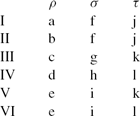
The authors introduce plats as ‘a format for the representation of IC systems’ and say that a plat ‘reveals implicative relations and provides a concrete basis for principal-part analysis’ (p. 41), suggesting that plats are the starting point rather than the outcome of the process. Still, the construction of a plat presupposes a considerable amount of morphological analysis: the establishment of morphosyntactic properties and ICs and the realization of the properties in each class. In addition, the columns in a plat normally do not include all the forms in a paradigm; if there is a one-to-one correspondence between two columns only one of them, called a distillation, needs to be included. Since a one-to-one correspondence, or isomorphism, is a two-way implicative relation, restricting the plat to distillations means factoring out some of those relations from the representation of the IC system. In fact, the difference between a distillation and a PP may not be obvious to the reader and would merit an explanation. It does seem that PPs will always be a subset of distillations, but they will be based on a broader class of implicative relations.
The central theme of the book – how to measure the complexity of IC systems – is taken up already in Chapter 3, but the discussion of how to understand the notion of complexity in general is postponed to Chapter 11, a bit late maybe. Mainly following Miestamo (Reference Miestamo, Kerge and Sepper2006, Reference Miestamo, Miestamo, Sinnemäki and Karlsson2008), S&F distinguish absolute and relative notions of complexity – where absolute complexity is an objective property of a system while relative complexity is its ‘cost’ for some agent, such as the user of a language. They also distinguish global and local complexity of languages, depending on whether the focus is on an entire language or a particular linguistic subsystem. The notion of complexity that is relevant in the book is said to be local and understood as absolute (p. 316).
A number of possible measures of the complexity of an IC system are considered in a discussion spread over several chapters, where partly the same measures show up in slightly different roles: in Chapter 3 as criteria in a typology of principal-part systems, in Chapter 4 as criteria and measures of IC transparency, in Chapter 5 as measures of the complexity of plats, and finally synthesized into a list of ten measures of IC system complexity in Chapter 11. These include measures such as number of distillations and PPs, how many cells are on average needed to predict a given cell and how many cells can be deduced from it, but also several other, more sophisticated measures, which cannot be discussed here due to lack of space. Interestingly, the number of IC classes does not seem to figure in computing the complexity of an IC system.
One theme that goes beyond the question of the complexity of IC systems is the place of implicative relations and inflection classes in a formal theory of morphology. The discussion is initiated in Chapter 1 and continued in Chapter 9. The authors contrast two possible approaches, which they call ‘canonical extremes for a theory of inflection’ (p. 263).
The first approach is said to embody the pure word-and-paradigm morphology (PWPM) hypothesis, which was introduced already in Section 1.2.1 (p. 17) and is formulated as three axioms: (i) a language's inflectional morphology is defined purely by implicative rules of the kind discussed above, (ii) a lexeme's entry in the mental lexicon includes a set of PPs, (iii) no reference to IC classes and inflectional stems is allowed in the mental lexicon and the realization rules, IC membership being represented purely by a list of PPs.
The second approach embodies the pure exponence-based morphology (PEM) hypothesis (p. 264). Here, a lexical entry consists of an IC diacritic and one or more lexically listed stems.
The authors argue that both approaches have their advantages, and that an optimal theory will involve both implicative rules and rules of exponence. In the approach they suggest and exemplify with Sanskrit nominal inflection, lexical entries minimally contain a default stem and an indication of IC membership represented diacritically. However, there may also be specifications of realized cells in the paradigm, possibly including PPs. Implicative rules ‘of the nonsyncretistic sort’, i.e. excluding ‘referral rules’ (rules that state the identity of exponences between cells), are ‘non-basic’, being deducible from the rules of exponence. Principal parts are also deducible from the default stem and IC membership, but play a role in determining the IC membership of newly encountered lexemes, and in deriving implicative rules that allow the inference of one cell from one or more others. This gives PPs a somewhat less salient role than one might expect from the introductory chapters of the book. It also raises a couple of questions about their usefulness: Given that PPs have a derived status, to what extent can properties of sets of PPs yield relevant measures of morphological complexity? In particular, to what extent can they be said to reveal the structure of IC systems?
As noted above, it is essential to distinguish the complexity of IC systems from that of inflectional systems in general. This issue is not discussed to a sufficient extent in the book. Moreover, the very notion of an IC system is not necessarily well understood. According to the definition cited above, an IC system is a set of inflection classes. But a system cannot simply be a set; it has to have some internal structure, with relations and connections between the members, and it is that structure that counts when we try to measure the complexity of a system. Discussing the application of Miestamo's definition to IC systems which says that a system is more complex the more parts it has (p. 315), the authors say that the parts ‘whose numerousness constitutes an IC system's complexity’ might be ‘a typical lexeme's optimal PPs’ (p. 317). But this equates the complexity of the system with the complexity of the members of its members.
Now, the authors go on to say that they favor a different conception of an IC system's complexity, where it is ‘inversely proportional to the number of motivated inferences afforded by the cells in its realized paradigms’ (p. 317). This is similar but not identical to the formulation ‘the extent to which it [the IC system] inhibits motivated inferences about a lexeme's full paradigm of forms from subsets of such forms’ (p. 9), which does not presuppose the possibility of actually counting inferences, but, on the other hand suggests that the IC system is something that actively inhibits inferences.
Another way of looking at the complexity of an object is to see it as the length of a recipe for re-creating it (see e.g. Dahl Reference Dahl2004). In the light of this idea, the inflectional morphology of a language embodies a recipe for re-creating the total set of inflectional paradigms of that language, or alternatively, as a way of representing that set in a way simpler than just listing it. The inflectional complexity of the language then corresponds to the length of that recipe. Some of the information contained in it will be generally applicable to all the paradigms; some of it will be specific to certain subsets of lexemes, which will make up the inflection classes of the language. A natural way of thinking of the IC system of a language is as the totality of the IC-specific information, and accordingly, ‘IC-system complexity’ would equal the amount of such information. A not fully optimal example of a representation of an IC-system understood this way could be the ‘plat’ shown as Table 9.10 (p. 290) in the book, which shows ‘schematic realized paradigms’ for nine Sanskrit declension classes, which is a condensation of the full paradigms in Table 9.5 (p. 269) and can in fact be further condensed, for instance, by merging identical cells.
Given such a representation of IC-specific information, we also need a way of linking the inflection classes with their members. It is stated in the book that ‘it is precisely a lexeme's membership in a particular IC that its principal parts allow one to infer’ (p. 11). From this point of view, it would be natural to equate PPs with the morphological information about each lexeme that is listed in the lexicon, and this would fit their role in traditional language teaching and in dictionaries. But PPs are in fact a redundant way of identifying inflection classes, in particular if we assume that they are a set of fully specified inflectional forms. This, as we have already seen, has been recognized by lexicographers, who are under pressure to eliminate redundancy in order to keep the size of dictionaries down. On page 263, S&F say that ‘a formal grammar of Latin might specify the [IC] membership of the noun frūctus “fruit” diacritically (as [4th declension]) or by means of the principal parts frūctus – frūctūs’. What we find in ordinary dictionaries, however, is neither one nor the other but frūctus ūs.
Given that the genitive ending ūs uniquely identifies the 4th declension, this in fact comes fairly close to what the authors propose in their hybrid model, where the lexical information consists of the default stem of the lexeme and an indication of its IC membership, although that might be done even more economically as fructu- 4. At the same time, frūctus ūs can be seen as a compressed form of the PP representation – but notice that this would not be possible if that representation only contained unpredictable information. The conclusion is that the difference between the two ways of specifying IC membership is less clear than one might think.
But frūctus ūs is no longer a PP representation if we insist on the idea that PPs are fully specified inflectional forms. Interestingly, however, it appears that the authors themselves do not take that idea too seriously. Thus, in Chapter 5, ‘Grammatically enhanced plats’, the authors argue, using data from Sanskrit nominal inflection, that adding grammatical information, such as gender, to cells in a plat, may serve to diminish inflectional class complexity. Given the close correlation in many languages between genders and inflection classes, this looks like a problem for the PWPM hypothesis, which disallows references to the latter. Chapter 7, ‘Stems as principal parts’, investigates the possibility that PPs are ‘a set of indexed stems that are used in the definition of its realized paradigm and that optimally distinguish its IC membership’ (p. 182). This again seems to go against the PWPM hypothesis which explicitly prohibits reference to stems. But the PWPM hypothesis is not mentioned in either of the two chapters. More seriously perhaps, we are now left with a rather different conception of PPs and how they work. In my view, the interesting aspect of the notion of PPs is suggested in the quotations from Bybee (Reference Bybee1985) above: the role of ‘surface forms’ in the mental structuring of inflectional paradigms. But this perspective is lost if PPs are redefined as something more abstract. The proposals in Chapters 5 and 7 also take us fairly far on the road towards the hybrid model presented in Chapter 9.
Curiously enough, there are no references to those proposals in Chapter 9. Rather, when PPs are mentioned there, they look more like they did in the beginning of the book. Somehow, it seems that the line of argument has forked and goes along two partly parallel paths in the later part of the book.
There has not been room for a discussion of all chapters in the book above and some of them will just be briefly mentioned here: Chapter 6, ‘Impostors and heteroclites’, treats ambiguities in IC membership and mixed paradigms; Chapter 8, ‘The Marginal Detraction Hypothesis’, treats the impact of ICs with very few members on the predictability of other ICs; Chapter 10, ‘Entropy, predictability, and predictiveness’, discusses the application of the notion of entropy, as defined in information theory, to the measurement of the predictability of paradigms; Chapter 12, ‘Sensitivity to plat presentation’, discusses further aspects of plat construction. The final chapter of the book, ‘The Principal-Parts Analyzer’, presents the software employed by the authors, available at multimediafluids.uam.elogim.com/stump_finkel.
The book lacks a concluding chapter; the section ‘Conclusion’ in Chapter 11 seems to be intended to play this role also for the whole work. The authors present two general conclusions – both reasonable, but perhaps not revolutionary: that the complexity of IC systems can be measured along more than one dimension, and that IC systems are not all identical in complexity.


