

I. Introduction
I write not to praise all tax-reductions but to bury one particular set of taxes. Over a decade ago I began writing on the subject of comprehensive tax reform, in a piece titled “The Uneasy Case for Wealth Transfer Taxes,”1
Edward J. McCaffery, “The Uneasy Case for Wealth Transfer Taxes,” Yale Law Journal 104, no. 2 (1994): 283–365 (hereafter cited as “The Uneasy Case”); this article advocates the abolishment of the gift and estate tax and the establishment of a progressive consumption-without-estate tax.
Walter J. Blum and Harry Kalven, Jr., “The Uneasy Case for Progressive Taxation,” University of Chicago Law Review 19, no. 3 (1952): 417–520 (later published as a book). Blum and Kalven found that most arguments for progressivity in tax burdens, such as those resting on the idea of the declining marginal utility of money income, are “uneasy” or unpersuasive; in the end, the case rests on little more than aesthetics and subjective value judgments.
Arnold C. Harberger, “The Incidence of the Corporation Income Tax,” The Journal of Political Economy 70, no. 3 (1962): 215–40; Martin Feldstein, “The Welfare Cost of Capital Income Taxation,” The Journal of Political Economy 86, no. 2 (1978): S29–S51; Joseph E. Stiglitz, “Notes on Estate Taxes, Redistribution, and the Concept of Balanced Growth Path Incidence,” The Journal of Political Economy 86, no. 2 (1978): S137–S150. The “fair tax,” a proposal for a progressive national sales tax, would also entail the elimination of all direct taxes on capital, including the gift and estate tax and corporate income taxes. See Laurence J. Kotlikoff, “The Case for the ‘Fair Tax,’ ” Wall Street Journal, 7 March 2005; see also www.FairTax.org.
I should clarify, from the outset, that mine is not any of the three most familiar arguments against capital taxation.4
See generally Barbara H. Fried, “Fairness and the Consumption Tax,” Stanford Law Review 44, no. 5 (1992): 961–1017.
Thomas Hobbes, Leviathan (1651; New York: Penguin Classics, 1985). Barbara Fried, in “Fairness and the Consumption Tax,” argues against this Hobbesian position, calling it the “foundational argument.” See also Liam Murphy and Thomas Nagel, The Myth of Ownership: Taxes and Justice (New York: Oxford University Press, 2002).
John Stuart Mill, Principles of Political Economy, Books IV and V (1848; reprint, New York: Penguin Classics, 1985), chap. 2, pp. 162–69.
See Louis Kaplow, “Horizontal Equity: Measures in Search of Principle,” National Tax Journal 42, no. 2 (1989): 139–54; but see also Murphy and Nagel, The Myth of Ownership; and C. Eugene Steuerle, Contemporary U.S. Tax Policy (Washington, DC: Urban Institute Press, 2004).
Rather, my argument is about progressivity, the very thing that Blum and Kalven found “uneasy.” The central, animating question is when judgments about progressivity in tax burdens should be made, which necessarily runs out to questions about how capital and its yield fit into a normatively attractive account of the fair distribution of tax burdens. I argue that, given that we are going to have a progressive tax system, in which the better-able-to-pay pay more, in percent terms, than the less-able-to-pay do—a proposition that I happen to accept as both factually accurate and normatively compelling, but, more to the point, one I simply assume to move forward the analysis of this essay—the next question for policymakers is when to levy such a tax. The goal of any comprehensive progressive tax is to effect a fair distribution of burdens among individuals; this calls for individuated judgment. “Genuinely progressive taxation is necessarily personal taxation,” as the Nobel laureate William Vickrey began his classic 1947 treatise.8
William Vickrey, Agenda for Progressive Taxation (New York: The Ronald Press Company, 1947), 3.
See Murphy and Nagel, The Myth of Ownership, 31–37, 90–93, and passim.
These thoughts lead out naturally enough—with the aid of insights gleaned from tax-policy tradition—to a specific form of comprehensive individuated tax: namely, a progressive postpaid consumption tax, a progressive spending tax in short. These are terms that I shall make clearer in due course. The critical understanding is to see that such a tax is a tax on capital, at the individual level, when (but only when) capital is used to finance enhanced lifestyles or greater consumption of material resources—spending—and not when capital is used simply to move around in time, within or between generations, uneven labor-market earnings. This is a compelling moral endpoint for taxation. Once we get the major comprehensive tax system down right—from a strictly moral point of view—there is no longer any compelling reason for, and there are good reasons against, any of the traditional direct taxes on capital.
It is time to better explain and defend these claims. In Section II, I set out the traditional view of taxation and a new understanding, using two types of consumption tax plus the income tax. In Section III, I develop two norms about the propriety of taxing capital and its yield: the ordinary-savings norm and the yield-to-capital norm. In Section IV, I set out two positive uses of savings: to smooth out consumption profiles over time, and to shift them up or down. Then, in Section V, I present the case against direct taxation of capital, pointing out that a consistent progressive postpaid consumption tax, alone among alternative tax forms, implements the two norms set out in Section III. In Section VI, I address the counterargument that direct taxes on capital are needed to correct the inequities of power that capital accumulation generates, and in Section VII, I address the argument that taxes on capital are good because they are “hidden.” I offer some concluding remarks in Section VIII.
II. Three Types of Tax
A. The traditional view
Much of tax policy in the United States and elsewhere has been consumed with debating the relative merits of an income tax versus a consumption tax.10
Noel B. Cunningham, “The Taxation of Capital Income and the Choice of Tax Base,” Tax Law Review 52, no. 1 (1996): 17–44; Fried, “Fairness and the Consumption Tax”; David A. Weisbach and Joseph Bankman, “The Superiority of a Consumption Tax over an Income Tax” (draft on file with author); Murphy and Nagel, The Myth of Ownership; Joel Slemrod and Jon Bakija, Taxing Ourselves: A Citizen's Guide to the Great Debate over Tax Reform, 2d ed. (Cambridge, MA: The MIT Press, 2001). For a brief look at tax policy in Canada, see David Duff, “Tax Policy in a Libertarian World: A Critical Review,” Canadian Journal of Law and Jurisprudence 18, no. 1 (2005): 23–45; and for a brief look at tax policy in the developing world, see Richard Bird and Eric Zolt, “Redistribution in Developing Countries,” UCLA Law Review 52, no. 6 (2005): 1627–95.
Henry C. Simons, Personal Income Taxation: The Definition of Income as a Problem of Fiscal Policy (Chicago: University of Chicago Press, 1938), 50.
Edward J. McCaffery, Fair Not Flat: How to Make the Tax System Better and Simpler (Chicago: University of Chicago Press, 2002).
In fact, however, there are three major choices of broad-based tax systems in ideal theory: the income tax, prepaid consumption taxes, and postpaid consumption taxes. We get to the three-view perspective when we see that the two broad types of consumption taxes are not created equal under progressive rates. First, however, let us understand the traditional view of matters, which equates the two forms of consumption tax.
An income tax, as we can see from the Haig-Simons definition, applies to all inflows into a household or taxpaying unit, whether from capital or labor (or, indeed, beneficence). This means, as Mill pointed out in his 1848 treatise Principles of Political Economy, that savings are “double taxed”: in order to have principal to invest, one has to have paid tax on some prior receipt, but the yield to capital is taxed again. In Mill's words, this is to “tax the same portion of the contributor's means twice over”; if a taxpayer “has the interest, it is because he abstains from using the principal.”13
Mill, Principles of Political Economy, 165.
Consumption taxes, in contrast, are single taxes on the flow of funds into and out of a household. This way of putting the matter allows us to comprehend the two basic forms of consumption tax, which are distinguished according to when the single tax is levied. In one model, the tax is imposed up-front and never again: a wage tax, or a so-called prepaid or yield-exempt consumption tax. Roth IRAs in the United States work on this model (pay tax now, never again).14
There are two types of individual retirement accounts (IRAs), tax-favored savings accounts in the U.S. for individuals' retirement contributions: traditional IRAs and Roth IRAs. A traditional IRA is an account to which individuals can make tax-deductible contributions. Tax on earnings is deferred until withdrawal from the account at the age of at least fifty-nine and a half. Contributions to a Roth IRA, in contrast, are not tax-deductible, but withdrawals are not taxed. For more information on traditional IRAs, see the Internal Revenue Code (“IRC”), 26 U.S.C. section 408; for Roth IRAs, see IRC section 408A.
Under flat or constant tax rates, the two principal forms of a consumption tax are in fact largely equivalent, a result that can be proven in relatively simple algebraic terms.15
Consider what happens to a principal sum, P, invested over time, for n periods, at a rate of return r. Untaxed, the sum grows at the rate of (1 + r), which gets compounded by the n periods. A single tax, t, is taken away from the taxpayer at one time, leaving her with (1 − t). Now, under the commutative principle of multiplication, which holds that ab = ba, it does not matter where, or, better, when, the (1 − t) is levied. Assuming constant t and r—assumptions to be discussed in the text—the following identity holds: {(1 − t)P}(1 + r)n = {P(1 + r)n}(1 − t).
Suppose that Ant and Grasshopper each earn $200 in wages, the tax rate is 50 percent, and the interest rate on savings is 10 percent. Grasshopper, as is his way, spends all of his available money at once. Under any tax—income, prepaid consumption, or postpaid consumption—the government takes its 50 percent cut, or $100, and Grasshopper consumes the remaining $100. This demonstrates an important point: the choice of income versus consumption taxation has no direct impact on most taxpayers, for the simple reason that they do not save. (If I = C + S, and S = 0, then I = C.) But, of course, patterns of progressivity, saving, borrowing, and spending across the entire income and wealth scale matter to all citizens, even if not directly so.
Ant, in contrast, does save, and so the choice of tax does matter directly to her. Suppose that Ant saves her initial wage-earnings for two years, at the conclusion of which she consumes these initial wages plus any interest received on account of her saving them. How do the three different taxes treat her?
An income tax reduces Ant's $200 to $100 right away, which she puts in the bank. Ant earns 10 percent on her savings, or $10, in year 1, but the income tax hits this, too—Mill's double tax—taking away $5, leaving her with $105 at the end of year 1. In year 2, this $105 again earns 10 percent, or $10.50; again the income tax strikes, taking $5.25. This leaves Ant with $110.25 to consume at the end of year 2. If the 10 percent interest rate simply compensated Ant for inflation—if the cost of goods were rising at 10 percent per year—Ant would be losing real value, actual purchasing power, over time under the income tax: $110.25 at the end of two periods of 10 percent inflation is worth—has the same real purchasing power as—$91 at the start of the two periods.16
Since the future value (FV) of a present sum, P, invested over time at a rate of return r is P(1 + r)n, the present value of any fixed future sum can be obtained by dividing such future sum by (1 + r)n. Dividing Ant's $110.25 of year 2 dollars by (1 + .10)2 or 1.21 yields approximately $91 in start of year 1 value.
Consider next the two forms of consumption tax. First, the prepaid model: Ant is taxed on initial receipt under this system, reducing her $200 to $100. But she is not taxed again: recall that consumption taxes are single taxes, escaping Mill's double-tax label. The $100 grows by the full 10 percent interest rate, to $110, after year 1. In year 2, the $110 earns another 10 percent, or $11, to $121, and Ant is left to consume this much at the end of year 2. Unlike the case with the income tax, this end of year 2 consumption is worth the same as $100 at the start of year 1, under a 10 percent inflation or discount rate.
Under the postpaid consumption tax model, Ant pays no tax up-front and thus can save her entire $200. This grows by 10 percent, or $20, in year 1, to $220. The $220 grows by another 10 percent, or $22, to $242 in year 2. When Ant goes to consume this, the government collects its 50 percent share, leaving Ant with $121 to consume. This is just as under the prepaid model. And it is more than the income tax. There is no smoke and mirrors here. There are only two critical assumptions needed to make out the equivalence of prepaid and postpaid consumption taxes: that the interest and tax rates have stayed constant in the two periods.17
For a fuller discussion, see Edward J. McCaffery, “A New Understanding of Tax,” Michigan Law Review 103, no. 5 (2005): 825–26. It may seem as if the need for constant inflation is a third assumption, but inflation is built into the interest rate; in the running example, if inflation were running at 10 percent per year, then Ant would be breaking even with inflation, before tax, but losing real value after it. See note 15 and accompanying text.
The Ant-Grasshopper example, or something rather like it, stands at the center of the traditional view of tax. The income tax is a double tax on value that is not immediately consumed, which has led many conservatives to oppose it as an unfair burden on the noble Ant, but has led many liberals to support it as a necessary means of capturing some of the return to capital, the nearly exclusive domain of the wealthy. Both forms of consumption tax get put on the other side of a divide, as not reaching the yield to capital at all. It becomes a matter of either indifference or administrative convenience which of the two forms is chosen. In this traditional view, the debate over income taxation versus consumption taxation is an all-or-nothing one over whether to tax capital (all capital) at all. This traditional view of taxation is flawed.
B. A new understanding
The traditional view's equivalence of prepaid and postpaid consumption taxes does not hold under nonconstant or progressive rates. Once we assume at least some progression in the rate structure, the traditional understanding of consumption taxes is no longer accurate.
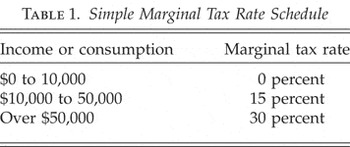
Progressive rates under most comprehensive tax systems work through a series of marginal rate brackets that form, in mathematical terms, a step-function. To have a simple and illustrative structure in mind, suppose that no tax is paid on the first $10,000, followed by a 15 percent marginal rate on the next $40,000, and a 30 percent rate on all value in excess of $50,000 (though further differentiation is, of course, possible). See table 1.
Simple Marginal Tax Rate Schedule

Such a system effects progression in average or effective tax rates. A taxpayer who has $100,000 subject to this tax, for example, will pay total taxes of $21,000 ($6,000, or 15 percent of $40,000, plus $15,000, or 30 percent of $50,000), for an average tax rate of 21 percent. This is a higher average tax rate than the one faced by someone who makes $50,000, who pays $6,000 (15 percent of $40,000), or 12 percent in average tax.
The two forms of consumption taxes differ in their effects under progressive rates. Now there are three—not two—alternatives for the tax policymaker to choose. The differences depend on when the tax is imposed; this impacts choices of work, savings, education, and so on, and, most important, it determines how the tax redistributes material resources. The time-path of earnings and spending, inflows and outflows—and with them, the role of capital transactions—now matters critically to the total tax burden, given these progressive rates. Consider each tax in turn.
First, an income tax falls on all labor-market earnings and on the yield to savings, at the time they come into a household. Savers are hurt by the “double taxation” of savings, whatever their intended or actual use. Individuals, like the athletes, artists, and highly educated persons who see their earnings come in relatively short, concentrated bunches, are also hurt by the timing of the imposition of progressive rates.
Second, a prepaid consumption tax falls on labor-market earnings alone, again at the time they come into a household. Once more, people whose earnings profiles are uneven throughout their lifetimes are hurt by the timing of the imposition of the progressive rate structure. However—and here is the rub for most liberals and even moderates—those who live off the yield to capital are never taxed.
Third, a postpaid consumption tax does not come due at the time of initial inflows, but rather at the time of outflows, when money is spent in consumption. This means that a progressive postpaid consumption tax stands between an income tax, which double-taxes all savings, and a prepaid consumption tax, which ignores all savings. A consistently progressive postpaid consumption tax treats savings differently depending on their use, as I shall continue to explore in the following sections.
III. Two Norms of Capital
Before continuing with an exploration of how individuals in the normal course of their lives use capital and its yield, a matter that is critical to the new three-tax perspective on tax policy, let us pause and reflect on the norms of capital—that is, our ordinary moral intuitions about capital. Mill's claim that the income tax is a double tax on savings is descriptive, an analytic fact. It is true both within the income tax's own base, where savers are penalized vis-à-vis spenders, and relative to a hypothetical no-tax world, where the income tax destroys the equivalence, in present value terms, between savers and spenders, Ants and Grasshoppers. Yet neither of these facts exerts a strong pull on our moral intuitions; it is hard to get from Mill's is to any compelling ought. This tension featured prominently in an extended debate that began in the 1970s between the American law professors William Andrews and Alvin Warren, over income taxation versus consumption taxation. Andrews first pressed Mill's position, arguing that “the most sophisticated argument” for consumption taxation rested on preserving the pretax equality of spenders and savers.18
William D. Andrews, “A Consumption-Type or Cash Flow Personal Income Tax,” Harvard Law Review 87, no. 6 (1974): 1113–88.
Alvin C. Warren, Jr., “Fairness and a Consumption-Type or Cash Flow Personal Income Tax,” Harvard Law Review 88, no. 5 (1975): 931–46; see also Alvin C. Warren, Jr., “Would a Consumption Tax Be Fairer Than an Income Tax?” Yale Law Journal 89, no. 6 (1980): 1081–1124. See also Barbara Fried, “Ex ante/Ex post,” The Journal of Contemporary Legal Issues 13, no. 1 (2003): 123–60.
Arguments like Warren's had prevailed, decades before Warren actually made them, at the dawn of the creation of comprehensive individual taxation systems in the United States in the early years of the twentieth century, and elsewhere later in the century. Reformers actively desired an income tax because it included the yield to savings, and thus would impose an added burden on financiers and the like.20
Consider, for example, the argument of Senator William E. Borah in the debates leading up to adoption of the Sixteenth Amendment in 1913, permitting the modern income tax in the United States. Referring to the founding fathers, Senator Borah claimed that “it was a republic they were building, where all men were to be equal and bear equally the burdens of government, and not an oligarchy, for that must a government be, which exempts property and wealth from all taxation.” Quoted in Steven R. Weisman, The Great Tax Wars (New York: Simon and Schuster, 2002), 224. See also Steven A. Bank, “The Progressive Consumption Tax Revisited,” Michigan Law Review 101, no. 6 (2003): 2238–60.
Carolyn C. Jones, “Class Tax to Mass Tax: The Role of Propaganda in the Expansion of the Income Tax during World War II,” Buffalo Law Review (Fall 1988/1989): 685–737.
For an extended discussion of these and other deviations from the U.S. income tax's theoretical commitment to taxing savings, see McCaffery, “A New Understanding of Tax,” 885–907.
See Edward J. McCaffery, “A Voluntary Tax? Revisited,” National Tax Association Papers and Proceedings (2000): 268–74.
Consider a simple example, drawn from my earlier work on this subject.24
See McCaffery, Fair Not Flat, 33–34.
IRC section 101 exempts the proceeds of life insurance from income taxation; IRC section 102 exempts gifts.
On reflection, the schisms in contemporary tax systems between income tax and consumption tax elements are not random. Looking back to the Andrews-Warren, income-versus-consumption debate, settled reflection reveals that ordinary moral intuitions reasonably reach different normative judgments about different uses of savings. On the one hand, many citizens are indeed sympathetic to the noble Ant, especially when she is manifest as a middle-aged wage-earner, struggling to make ends meet while paying her taxes and setting aside some funds for her later retirement, or for medical or educational needs within her family. Why should we punish her, with a second tax, for her prudence? Thus, we observe tax-favored retirement, medical, and educational savings accounts. On the other hand, many citizens are also bothered by the specter of the socially privileged, such as a second- or third-generation rich child, like Artful Dodger, living well off the fruits of someone else's prior capital accumulation. Surely this “trust fund baby” should be taxed, at least as much as the hard-working Ant. Surely his income, in the form of rents, royalties, interest, dividends, and the like, should count in the tax base, at least as much as the product of noble Ant's blood, sweat, and tears.
These simple insights and intuitions cash out into two discrete norms about capital. Not all uses of savings are the same. One norm I call the “ordinary-savings norm”: Capital transactions (borrowing, saving, investing) that are simply used to move around uneven labor-market earnings in time, allowing people to save for their retirement, or for periods of high spending needs/low earnings, such as times of education or medical urgency, should not be double-taxed or otherwise discouraged and burdened. The second norm I call the “yield-to-capital norm”: Capital that enables a higher, better—more costly—lifestyle than the yield to labor, alone, should bear some burden, one at least commensurate with normal wage earnings.
Ordinary moral intuitions thus agree with both Andrews's horizontal equity position and Warren's vertical equity one, and this agreement is revealed through these two norms, the ordinary-savings norm and the yield-to-capital norm. Savers should not be penalized for saving, rather than consuming, in the ordinary course of their lives, so as to provide for rainy days or times of greater need or urgency. But the yield to capital is also an increment of value that should not be simply and completely ignored in the tax base. The trick is to design a tax system that implements both norms, simultaneously, without undue complexity. It turns out that, with the right understanding of taxation—mirabile dictu—this is surprisingly easy to do.
IV. Two Uses of Savings
With this new normative vocabulary in hand, we can now return to the discussion of the uses of material resources, focusing especially on the uses of capital. Consider in financial terms how most of us live out our lifetimes. As any parent knows full well, we spring forth into the world nearly fully formed as consumers: we cost money from the get-go. As any parent also knows, however, we do not earn anything for quite some time. When we do start earning, we have to earn more than we spend (let us hope!), to pay off the debts of our youth, including school loans, and to set aside funds for our retirement, so that we do not have to keep working all the days of our lives. Our lives look like one fairly steady consumption profile, from cradle to grave, financed by a lumpy period of labor-market earnings concentrated in midlife. If we lived as islands, unto ourselves, we would have to balance the books on our own account, borrowing in youth, first paying off our debts and later saving for retirement in our midlife, and spending down in old age. Financial intermediaries such as banks and insurance companies would help us to effect these results. In practice, many families work as more or less informal annuities markets, between generations. Thus, our parents pay for our youths, and we pay for our children's youths; we also stand ready to pay our parents back, should their needs exceed their resources in their old age.26
See, e.g., Laurence J. Kotlikoff and Avia Spivak, “The Family as an Incomplete Annuities Market,” The Journal of Political Economy 89, no. 2 (1981): 372–91; and Laurence J. Kotlikoff and Lawrence H. Summers, “The Role of Intergenerational Transfers in Aggregate Capital Accumulation,” The Journal of Political Economy 89, no. 4 (1981): 706–32.
In this stylized depiction of a typical life, note two broad uses of savings. One is to smooth out consumption profiles, within lifetimes or across individuals—to translate uneven labor-market earnings into even consumption flows. We do this by borrowing in youth and saving for retirement (and/or other times of special need, such as health and education demands) in midlife. We can do this using third-party financial intermediaries, or within the family, as noted above: perhaps we pay for our children's youth, and they pay for the youths of their children, our grandchildren, in a recurring “overlapping generations” model.
A second use of savings is the analytic complement of smoothing: capital transactions can shift consumption profiles, up or down. An upward shift occurs when the fruits of our own or another's savings (via beneficence) allow us to live a “better” lifestyle than we could on the basis of our own labor-market earnings alone, smoothed out over time. Suppose that the noble Ant has gotten wondrously lucky on the $200 of wage-earnings that she has saved; some investment has yielded her millions of dollars. Ant can then, quite simply, enjoy a “better”—more costly—lifestyle than other ants or grasshoppers earning the same amount of labor-market wages. The progressive postpaid consumption tax would thus tax her, on her spending. A downward shift, in contrast, occurs when our Ant's beneficence or bad fortune means that she will live at a lower—less costly—lifestyle than she otherwise could, all measured against the baseline of her smoothed-out labor-market earnings profile alone.
The two norms considered in the prior section map up perfectly with these two uses of capital. Smoothing effects the ordinary-savings norm; shifting effects the yield-to-capital one. Ordinary moral intuitions, reflected in nearly a century of experience with actual taxation systems, suggest that society ought not to burden smoothing transactions with a double tax, but that the yield to capital is an element of value that can properly be taxed when used to enable a “better,” more expensive lifestyle. This is not envy. That is, it is not the concept that the rich should be penalized, or that those who earn wealth from capital should be brought down and laid low. It is, rather, the sensible thought that the yield to capital is an increment of value that deserves to be counted in one's resources available to pay tax, except when savings are used simply to move values around in time. Such movements in time are one thing; greater material enjoyment is another thing. It is all, in essence, about the fair timing of taxation.
Return now to the three basic tax systems: income, prepaid consumption, and postpaid consumption. Under progressive rates, these three basic tax systems affect different patterns of savings and spending differently. An income tax double-taxes all savings, come what may, and makes its judgments of progression on the basis of inflows, however uneven. A prepaid consumption or wage tax ignores all capital transactions, again whatever their use, and also makes its judgments of the fair degree of progression on the basis of inflows, burdening the uneven wage earner. But a consistent progressive postpaid consumption tax, wondrously enough, implements the ordinary-savings and yield-to-capital norms, simultaneously, seamlessly, and by design.
A simple example helps to make these points clearer. One taxpayer, Steady Earner, makes and consumes $50,000 a year for the relevant years of comparison, say beginning in her early twenties. A second taxpayer, Lumpy Earner, stays in school until he is thirty, and then makes $100,000 a year. But Lumpy Earner spends $50,000 a year, too, using prudent borrowing and saving to effect this result.27
My simple example ignores interest, which I discuss at greater length in McCaffery, “A New Understanding of Tax,” 864, note 159 and accompanying text.
An ideal progressive income tax burdens all three taxpayers, but falls most heavily on Lumpy Earner, because of the timing of the imposition of the progressive rates. In the simple rate structure posited above, Lumpy Earner pays 21 percent of his earnings in income tax (as calculated from table 1), whereas Steady Earner and Trust Fund Baby each pay 12 percent.
A progressive prepaid consumption tax also burdens Lumpy Earner most heavily, at a 21 percent level, given the same rate structure. Such a tax continues to burden Steady Earner at the 12 percent level, but it altogether ignores Trust Fund Baby—taxing him at 0 percent, and thereby accepting the tax, if any, on some prior generation of labor earnings as sufficient for his contribution to society.
A progressive postpaid consumption tax, in contrast, falls equally on all three taxpayers, at the 12 percent level. Note, moreover, that if any of the three taxpayers should get lucky in the capital markets—win the lottery, say, or simply get extra high returns from investments—then the progressive postpaid consumption tax stands ready to tax that good fortune when and as it is used to enhance, or elevate, that taxpayer's lifestyle.
In sum, whereas an ideal income tax double-taxes all savings, whatever their use, and a prepaid consumption tax ignores all savings, again whatever their use, a consistent progressive postpaid consumption tax splits the difference, in a principled way and by design. It allows taxpayers to lower their taxes by smoothing, but it falls on the yield to capital when such yield is used to enhance lifestyles. This reflects simple, commonsensical attitudes about life, income, and savings. These attitudes are reflected imperfectly under the status quo in the United States and other advanced Western democracies, with a nominal income tax rife with pro-savings provisions for retirement, health, and education.
V. The Case against (Direct) Capital Taxation
The better understanding of the analytics of taxation that we have now attained can lead to a dramatically simpler tax system that is, at the same time, far fairer, one that perfectly incorporates our ordinary moral intuitions about savings—namely, that savings for some purposes, which we can broadly call “smoothing,” should not be burdened twice over, but that savings that enable a higher material lifestyle can and should be subject to tax: some positive tax burden commensurate with all other sources of material enjoyment or private preclusive use. The central insight is that a consistent progressive postpaid consumption tax is a tax on the yield to capital, under just the circumstances in which ordinary moral intuitions suggest taxing such yield, and no other. Such a tax can be implemented easily enough, taking advantage of the rearrangement of the Haig-Simons definition of income noted above: consumption equals income minus savings (C = I − S). This handy formula shows that a consistent postpaid consumption tax can be obtained by tallying up sources of income as under current law, and systematically subtracting savings (and adding in dissavings).28
See McCaffery, Fair Not Flat, 97–111.
The tax law would thereby, however surprisingly, look much like it does today, in the United States at least. There would be annual wage reporting from one's employers and annual income tax returns like the dreaded 1040 forms used in the U.S. Instead of the myriad of tax-favored accounts we observe today, however, there would be a single, unlimited savings account for every individual, which we can call, to make things clear, a “trust account.” All contributions to these accounts would be deductible, and all withdrawals from them would be includable in taxable “consumed income.” Debt that was used to consume, as dissavings, would likewise be taxable; repayments of principal, as positive savings, would be deductible. In such a fashion, the law would work out the logic of “income minus savings.” Ordinary saving for retirement would lower the burden of taxation, by changing the time of taxation from one's high-earning, midlife years, to the smoother, lower levels of one's consumption. Saving for medical needs or other special circumstances, such as education, could also lower the burden of one's taxes, especially if the law imposed a lower (or no) taxation on these uses, parallel to the United States' current limited deduction for extraordinary medical expenses.29
IRC section 213.
The important point to see is that this progressive postpaid consumption tax would, in and of itself, make for an individuated tax on capital, when, but only when, capital is used to enhance lifestyles. No other tax on capital would therefore be needed—and, in part because any other tax on capital is not so individuated, and hence risks falling on ordinary savings as well as on the yield to capital, all “direct” taxes on capital should be eliminated.
Consider first the role of “second” taxes on the yield to capital under the basic individuated tax system, such as capital gains under the income tax. These are simply not needed under a consistent progressive postpaid consumption tax. On the one hand, if a taxpayer sells an asset and reinvests the proceeds, she has continued to save, and there is no reason to tax her. This can all be done inside her trust account. On the other hand, any mechanism to finance her lifestyle—wages, the ordinary yield to capital (interest, dividends, and the like), someone else's beneficence, the proceeds of sales of capital assets or, for that matter, borrowing against present assets or future earnings—is taxed, at the moment of private preclusive use, when withdrawn from the trust account. Whether or not to sell an asset can be left to the personal decisions of investors, for the sake of efficiency. How to tax the proceeds of investments can be left to the moment of consumption, when society can better judge what kind of lifestyle these investments enable.
Consider next the gift and estate tax. The current system in the United States at least aims to “backstop” the income tax, which tax is (in ideal theory) supposed to burden savings, by levying a hefty tax on those decedents who die with large estates or those persons making large inter vivos gifts. This tax is obviously desired as a matter of fairness. But its very existence encourages the rich to consume more, and die broke, whether they spend on themselves or on their heirs.30
See Stephan M. Pollan and Mark Levine, Die Broke (New York: Harper-Collins, 1997). For my own thoughts on estate or wealth transfer taxation, see McCaffery, “The Uneasy Case”; Edward J. McCaffery, “The Political Liberal Case against the Estate Tax,” Philosophy and Public Affairs 23, no. 4 (1994): 281–312; and McCaffery, Fair Not Flat, 62–77.
IRC section 1011 (basis); I define “basis” in McCaffery, Fair Not Flat, 161, as after-tax dollars.
Finally, parallel—though indeed stronger—arguments can be made against a separate corporate income tax. The problems with this tax begin with its uncertain incidence: since corporations are not real people, they do not really pay taxes. They must pass these on. A corporate tax falls on workers and consumers, on capital generally, or on some combination thereof.32
See generally the sources cited above in note 3.
The elimination of these other taxes follows from the principle of a consistent progressive postpaid consumption tax: to tax individuals as they spend, not as they work, save, give, or die. Such a tax will enhance simplicity, transparency, and efficiency while promoting fairness. Specifically in terms of capital, the tax would apply to the yield to capital, when (but only when) it is appropriate to do so. The rich would not be let off the social hook; their tax would come due when, as, and if they spent wealth on themselves. Progressivity could be maintained, even strengthened.
VI. Capital as Power
An argument that supports direct capital taxation, manifest in a recent rise in scholarly reflection over a separate freestanding wealth tax,33
See generally the articles in Tax Law Review 53, no. 3 (2000): 263–498; and Tax Law Review 53, no. 4 (2000): 499–696.
McCaffery, “The Uneasy Case”; McCaffery, “The Political Liberal Case.”
One possibility is that the capital today represents potential consumption, or spending tomorrow: capital qua potential use. But the consistent progressive postpaid consumption tax, best understood, exerts a present lien on capital for any future use. Such a tax redefines property rights, what it means to be “private” or “public.” A taxpayer cannot use “her” capital without running through the gauntlet of the tax system; that tax system stands ready to exercise a greater toll on higher, less urgent private use. Thus, this argument rests on a confusion.
A second possibility is that capital today represents use, or power, today; there is the problem, as I have called it, of capital qua present use. This is a question of what one does with “his” capital. It is possible to save in a way that exercises power, or confers pleasure, as by buying up newspapers, sports franchises, or, for that matter, elected offices. The response to this problem tracks the response to the first. Once again, the tax system defines or redefines property rights, what it means to be “private” or “public.” Problems with how capital is used are best met by regulation, as we have today in all advanced capitalist countries, for “private” endowments, pension plans, IRA accounts, and so on. Simply forbidding taxpayers from using “their” trust-account money to affect political outcomes without first withdrawing the funds from the account and paying a tax will go a long way—farther than any mechanism we have in place in the U.S. today—toward curbing the power of capital qua capital. Therefore, this argument, too, is misplaced as a criticism of a consistent progressive postpaid consumption tax. In practice and in theory, such a tax creates a structure in which capital is, indeed, a common pool, and can be regulated as such—though it bears noting, again, that this is not the only or the best justification for the tax, Hobbes notwithstanding. It is, rather, a happy by-product of doing the right thing—getting the fair timing of taxation down right on an individual level.
VII. One Last Uneasy Argument
Another argument for direct capital taxation, pressed particularly vis-à-vis the corporate income tax, bears noting. It is that these taxes are desired precisely because they are “hidden.” People do not notice the true incidence of the corporate tax, and this allows governments to have a higher revenue base than they otherwise might.
This may at first seem a weak argument to press in the name of fairness, resting as it does on trickery, and coming in the face of the near-certain regressive incidence of the tax. But recent research that I and others have conducted does indeed suggest that perhaps the best way to effect redistribution of material resources to the poor is to have large and relatively flat taxes, accompanied by progressive redistributive expenditure programs.35
See Jonathan Baron and Edward J. McCaffery, “Unmasking Redistribution (Or Its Absence),” in Edward J. McCaffery and Joel Slemrod, eds., Behavioral Public Finance (New York: Russell Sage Press, 2006); and Bird and Zolt, “Redistribution in Developing Countries.”
In the end, this might be a compelling practical political argument for corporate taxation, though not for gift and estate taxes or capital taxes more generally, and though it bears noting that corporate taxes have been declining as a source of revenue in all advanced states, and may not, in the end, be worth the candle. As philosophers and scholars, however, we should know this argument for what it is and label it as such. It bears noting that “hidden” taxes have real costs: the corporate income tax affects prices, distorts decisions, and effects no compelling distributive goal, once a suitably designed progressive spending tax is in place at the individual level. Thus, maintaining it, even to get funds for doing “good,” is not without cost; in a perfect world, we could generate all the revenues we need for just social spending programs by just social taxation schemes. In public finance as in life, we can pay a dear price for our illusions.
VIII. Conclusion
Advocates for fairness in taxation have long supported an income tax, precisely because it gets at the yield to capital, and because, they think, consumption taxes do not. In fact, a better understanding of the analytics of taxation shows otherwise. Under progressive rates, the two canonical forms of consumption taxation, prepaid and postpaid, are not equivalent. An income tax is a double tax on all savings, come what may. A prepaid consumption or wage tax does indeed ignore the yield to capital, everywhere and anywhere. But a postpaid consumption tax splits the difference, by design. It falls on the yield to capital when (but only when) this yield is used to elevate lifestyles, not when it is used to smooth out in time, within or between generations, uneven labor-market earnings.
It turns out that this is the right thing to do. Not only can we derive that from first principles, and the ordinary-savings and yield-to-capital norms, but we can also observe it from a century of practice with a so-called income tax. Whatever one thinks of ideal taxation, we ought to note well the fact that we have never had, and almost certainly never will have, an ideal income tax in practice, or anything close to it, at all. The real debate in practical tax politics is and always has been over what form of consumption taxation to have. Here the stakes are large and dramatic for the fate of progressivity in taxation, and point toward a consistent progressive postpaid consumption tax.
The final insight is that, once we have gotten the comprehensive tax system down right, strictly from a fairness point of view—by adopting a consistent progressive postpaid consumption tax—we no longer need any direct taxes on capital. This is not because capital per se is good, or because of a naive horizontal equity approach to policy. Rather, it is because we are now taxing the yield to capital, in an individuated way, at the right time. We can and should repeal all capital taxes under the income tax, the separate gift and estate tax, and corporate taxes of all forms. This will add considerably to the simplicity, administrability, and efficiency of the tax system, but these are side effects. The principal and principled reason we should take this approach is that it is the fair thing to do.