Anomalous aortic origin of the coronary arteries is a rare congenital cardiac anomaly with a prevalence of 0.1–0.3%, characterised by an unusual course, size, or origin of the coronary arteries.(Reference Cheezum, Liberthson and Shah1) An increased risk of myocardial ischaemia, syncope, arrhythmia, and sudden cardiac death has been associated with anomalous aortic origin of the coronary artery, although most patients are asymptomatic.(Reference Rahmouni and Bernier2)
An increasing number of anomalous aortic origin of the coronary artery patients have been identified in recent years.(Reference Mainwaring, Murphy and Rogers3) Although the true prevalence of congenital coronary anomalies in the general population is difficult to find, there are some studies reporting this with estimates ranging from 0.1 to 1.0% in both the adult and children.(Reference Tuo, Marasini, Brunelli, Zannini and Balbi4,Reference Davis, Cecchin, Jones and Portman5) The estimated incidence of anomalous aortic origin of the right coronary artery ranges from 0.1 to 0.9% and has been reported to occur more frequently than its left-sided counterpart (Reference Law, Dunne, Stamp, Ho and Andrews6).
The American Society of Thoracic Surgery (AATS) expert consensus guidelines recommend surgical repair in all patients with ischaemic symptoms and in patients who had an anomalous aortic origin of the left main coronary artery with an interarterial course.(Reference Brothers, Frommelt, Jaquiss, Myerburg, Fraser and Tweddell7) Several surgical techniques have been used for the treatment of the anomalous aortic origin of the coronary artery, with unroofing, coronary artery translocation and reimplantation, pulmonary artery translocation, and coronary artery bypass grafting.(Reference Ghraibeh, Rahmouni, Hong, Crean and Grau8)
The aim of this study was to present our surgical experience with early and mid-term results in patients operated for anomalous aortic origin of the coronary artery. To the best of our knowledge, pulmonary root anterior translocation and coronary artery unroofing procedure were performed for the first time in the literature for patients with anomalous aortic origin of the left main coronary artery from right sinus of valsalva with a subpulmonic myocardial course.
Materials and methods
Medical records of seven consecutive patients who were diagnosed with anomalous aortic origin of the coronary artery between January 2019 and January 2022 were retrospectively reviewed. The data were collected retrospectively from patientsʼ previous hospital records. Our study was approved by the institutional ethics committee on 29 November, 2022 (numbered E-28001928-604.01.01-331) and was conducted in accordance with the principles of the Declaration of Helsinki.
This study included all patients with anomalous origin of the right coronary artery or the left main coronary artery originating from the opposite sinus of valsalva. Patients with left main coronary artery atresia and anomalous origin of the coronary arteries from the pulmonary arteries were excluded from the study.
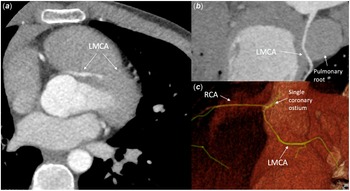
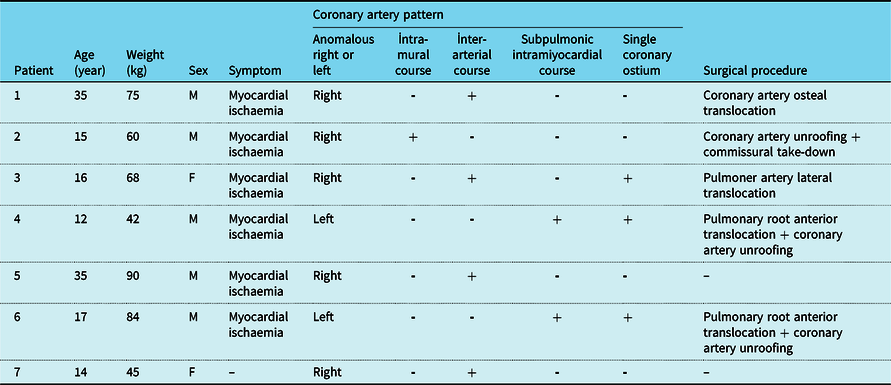
Preoperative transthoracic echocardiogram and coronary CT angiography were performed in all patients to define coronary artery anatomy (Fig 1). In the echocardiographic examination, a modified parasternal short-axis view is more imported view with rotating clockwise for the left coronary artery and counterclockwise for the right coronary artery ostia and proximal segments. In this view, you can deliniate the left coronary artery arising from the right sinus of valsalva or right coronary artery arising from the left sinus of valsalva or the non-coronary sinus. It is very impartant to use the highest frequency transducer appropriate for body size to deliniate the origins of the coronary arteries. Besides 2D images, colour images are also important. Proximal coronary anatomy is further defined using low-velocity Doppler colour flow mapping to detect flow origin and direction as well as to screen for stenosis. Stress echocardiography and nuclear perfusion tests were performed on suspicious cases. Demographic and surgical data of the patients are shown in Table 1.
a ) The transversal plane of the preoperative cardiac CT showing AAOLCA taking a subpulmonic intramyocardial course (arrows) below the right ventricular outflow tract. b) The sagittal plane of the pre-operative cardiac CT showing the abnormal course (arrow) of the LMCA below the pulmonary root. c ) Pre-operative CT angiogram showing 3D reconstruction of an AAOLCA originating from the right coronary sinus. AAOLCA, anomalous aortic origin of the left main coronary artery; LMCA, left main coronary artery.

Demographic characteristics and operative data of the patients.

Surgical technique
All operations were performed via median sternotomy using cardiopulmonary bypass. Cardiac arrest after aortic cross-clamping was achieved with antegrade del Nido cardioplegia solution. Patients were treated with intramural coronary artery unroofing, pulmoner artery lateral translocation, coronary artery osteal translocation, and pulmonary root anterior translocation with coronary artery unroofing procedures.
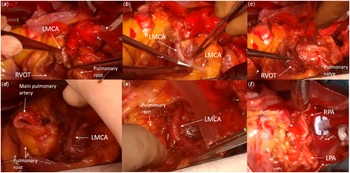
Patients with anomalous aortic origin of the left main coronary artery from the right sinus of valsalva from the single ostium with a subpulmonic intramiyocardial course underwent pulmonary root anterior translocation with coronary artery unroofing procedure. The left main coronary artery was excessively elongated and was penetrating the myocardial muscles of the right ventricle infundibulum. We transected the main pulmonary artery 3–4 mm above the commisures and harvested the pulmonary root leaving 3–4 mm muscle beneath the pulmonary valve annulus by avoiding injury to the first septal perforator artery. We completely separated the left main coronary artery from the surrounding myocardial muscle fibres along its long conal course. The pulmonary root was anastomosed more anteriorly to the right ventricular outflow tract. Distal pulmonary artery was reanastomosed to the proximal main pulmonary artery, and the right pulmonary artery was transected. The right pulmonary artery was advanced anterior to the aorta and reanastomosed to the main pulmonary artery by reconstructing with pericardial patch (Fig 2).
a-b ) The images of the course of the LMCA and its separation from the myocardial muscle fibres after removal of the pulmonary root. c ) The image of the more anteriorly anastomosis of the pulmonary root to the right ventricular outflow tract. d - e ) The images of course of LMCA detached from the surrounding myocardial muscle fibres and have sufficient space from the pulmonary root. f ) The image of reconstructing the anterior wall of the RPA with a pericardial patch after advancing anterior to the aorta. LMCA, left main coronary artery; RPA, right pulmonary artery.

Patients with aortic origin of the right coronary artery from left sinus of valsalva with seperate ostium and intramural course underwent an unroofing procedure. Partial transverse aortotomy was performed above the sinotubuler junction, and the coronary ostia was inspected for the location. A probe was inserted in the right coronary artery ostium, and the intimal tissue between the aortic lumen and the anomalous right coronary artery ostium was seperated with a scalpel. Commissural take-down was performed to protect commisures during the right coronary artery unroofing to reach neo-ostium. The right coronary artery neo-ostium was constructed by using interrupted 7–0 polypropylene sutures securing the right coronary artery ostium to the aortic wall. Finally, the commissure was reinforced to the aortic wall with a pericardial pledgeted suture.
Patients with aortic origin of the right coronary artery from the left sinus of valsalva with single ostium and interarterial course underwent pulmoner artery lateral translocation procedure. The tissue between the aorta and the pulmonary artery was released, and the distal main pulmonary artery was transected at the pulmonary artery bifurcation. An incision was made from the pulmonary artery bifurcation to the left pulmonary artery hilum. The main pulmonary artery was reanastomosed to the left side of the left pulmonary artery to prevent compression to the right coronary artery. A fresh pericardial patch was sutured to the right side of the reanatomosed main pulmonary artery to widen the pulmonary arteries and prevent right pulmonary artery stenosis.
Patients with aortic origin of the right coronary artery from the left sinus of valsalva with separe ostium and interarterial course underwent coronary artery osteal translocation procedure. After transverse aortotomy was performed, the right coronary artery was transected as a button along with the surrounding aortic tissue from the aortic wall. A new proximal region was created using an aortic punch in the correct sinus of valsalva, and the transected right coronary artery ostium was reimplanted above the correct sinus with 7–0 polypropylene suture. The original location of the transected right coronary artery ostium was closed with a small gluteraldehit treated pericardial patch.
Statistical analysis
Continuous variables were reported as median ± interquartile range (IQR). Categorical variables were reported as n (%). IBM SPSS Statistics Software 21 (SPSS Inc., Chicago, IL, USA) was used for statistical analyses.
Results
A total of seven patients were diagnosed with anomalous aortic origin of the coronary artery, including five males and two females. The median age of the patients were 16 years (IQR, 14.5–26 years), and the median weight of the patients were 68 kg (IQR, 52.5–79.5 kg). Five patients had aortic origin of the right coronary artery, and two patients had anomalous aortic origin of the left main coronary artery.
Six patients were symptomatic and had ischaemic chest pain. The remaining one patient, who had aortic origin of the right coronary artery, was asymptomatic and diagnosed incidentally. Coronary CT angiography was performed when a coronary anomaly was suspected in the echocardiographic examination on this patient who was admitted to the hospital with the complaint of atypical chest pain. Since stress echocardiography and nuclear perfusion tests were negative for this patient, it was decided to follow up without surgery. One of the symptomatic patient who had aortic origin of the right coronary artery from the left sinus of valsalva with seperate ostium and interarterial course refused surgery. Thus, a total of five patients were treated surgically. Three (60 %) of them had aortic origin of the right coronary artery, and two patients (40 %) had anomalous anomalous aortic origin of the left main coronary artery. Two patients (40 %) had interarterial course between the aorta and the pulmonary artery, two patients (40 %) had anomalous aortic origin of the left main coronary artery with subpulmonic intramyocardial course, and one patient (20 %) had intramural course.
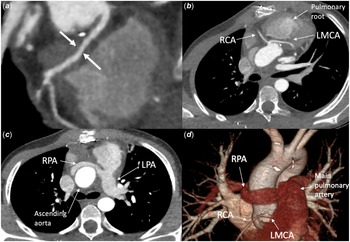
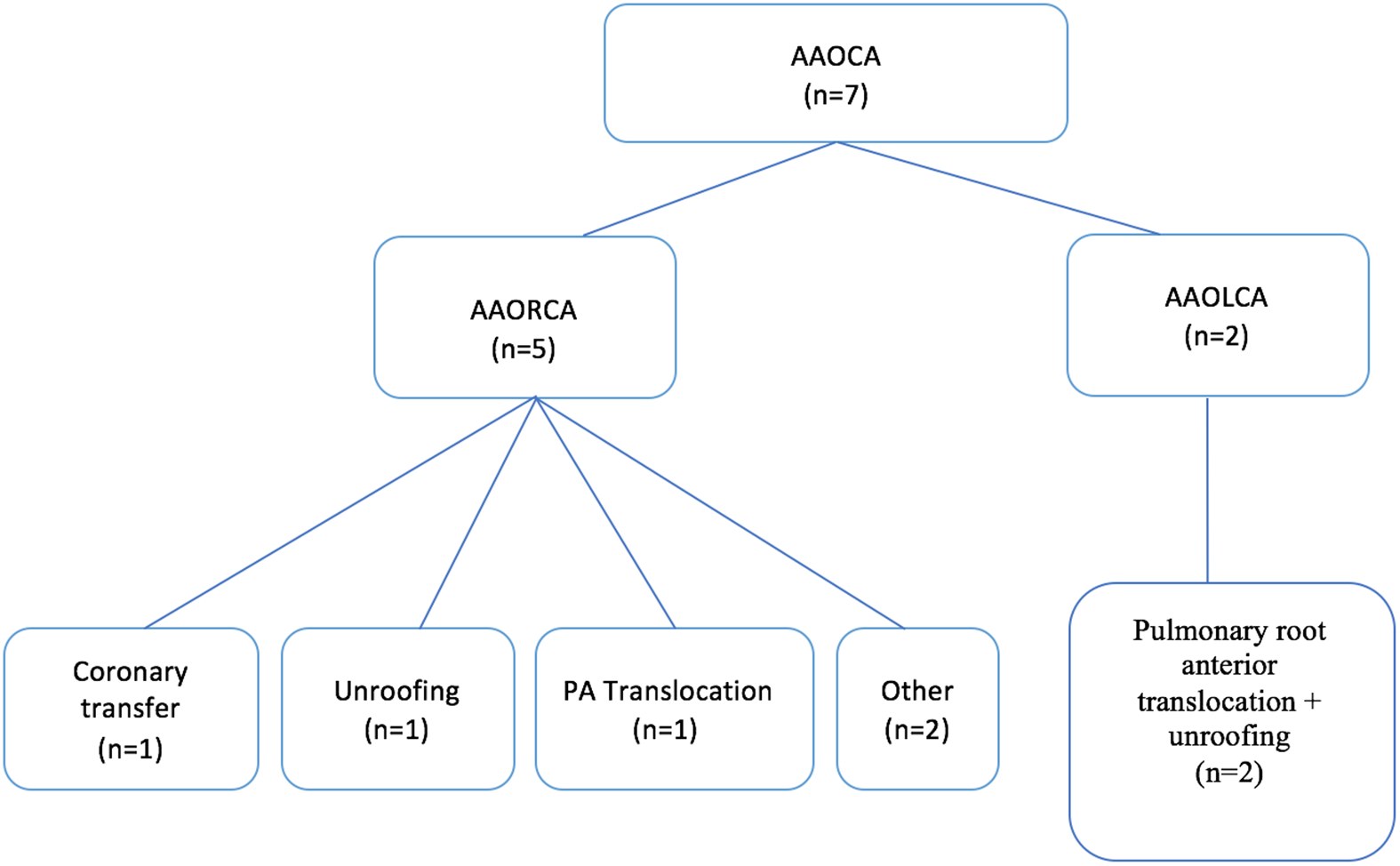
Two patients (40 %) who had anomalous aortic origin of the left main coronary artery from the right sinus of valsalva with the single ostium and subpulmonic intramiyocardial course underwent pulmonary root anterior translocation with coronary artery unroofing procedure (Fig 3). One patient (%20) underwent right coronary artery unroofing procedure, another patient (%20) underwent pulmonary artery lateral translocation procedure, and the last patient (%20) underwent right coronary artery osteal translocation procedure. Only one patient underwent commissural take-down procedure due to coronary artery unroofing, and post-operative aortic valve regurgitaion was not observed in this patient.
a ) The sagittal plane of post-operative cardiac CT showing the wide diameter and without myocardial bridges course (arrows) of AAOLCA. b ) The transversal plane of post-operative cardiac CT showing the space between the LMCA and the pulmonary root. c - d ) The transversal plane and 3D reconstruction of post-operative cardiac CT showing the reconstructed RPA. AAOLCA, anomalous aortic origin of the left main coronary artery; LMCA, left main coronary artery; RPA, right pulmonary artery.

The median duration of ICU stay after operation was 1 day (IQR, 1–1 day), and the median duration of hospital stay after operation was 5.5 days (IQR, 4.75–6.25 days). Post-operative early mortality, myocardial infarction, and arrhytmia were not observed in the series, and all patients discharged from hospital uneventfully.
The median of follow-up for the patients was 10 months (IQR, 6.75–20.5 months). No symptoms were observed in four patients (80%) during the follow-up, and only one patient had chest pain on the post-operative ninth month. This patient who underwent right coronary artery osteal translocation procedure had negative cardiopulmonary exercise test, and the repaired coronary artery was widely patent in the control CT angiography. In our series, there was no late death, myocardial infarction, or myocardial wall motion abnormalities during the follow-up period.
Discussion
Anomalous aortic origin of the coronary artery is a rare congenital cardiac anomaly primarily associated with sudden death in young athletes.(Reference Feins, DeFaria Yeh and Bhatt9) In recent years, the frequency of anomalous aortic origin of the coronary artery seems to be increasing due to the improved diagnostic quality and advanced imaging to evaluate patients with suspected anomalous aortic origin of the coronary artery diagnosis.(Reference Feins, DeFaria Yeh and Bhatt9) This report presents our experience with seven patients who had anomalous aortic origin of the coronary artery and five of them treated surgically (Fig 4). The primary goal of surgical treatment in anomalous aortic origin of the coronary artery patients is to relieve symptoms of myocardial ischaemia by obtaining patent coronary arteries.
Flow chart of coronary anomaly types and preferred surgical techniques.

The indication for surgical intervention in anomalous aortic origin of the coronary artery patients can be difficult as patients may present with different coronary anatomies. The recent American Association for Thoracic Surgery (AATS) expert consensus guideline recommends surgery in individuals with ischaemic chest pain or syncope due to ventricular arrhythmias.(Reference Brothers, Frommelt, Jaquiss, Myerburg, Fraser and Tweddell7) In addition, surgery is recommended for anomalous aortic origin of the left main coronary artery with interarterial course originating from the right sinus of valsalva.(Reference Brothers, Frommelt, Jaquiss, Myerburg, Fraser and Tweddell7) On the other hand, individuals with aortic origin of the right coronary artery should undergo exercise stress testing with additional imaging to assess inducible ischaemia.(Reference Brothers, Frommelt, Jaquiss, Myerburg, Fraser and Tweddell7) In our study, a patient with aortic origin of the right coronary artery was not operated because stress echocardiography and nuclear perfusion tests were negative.
Different surgical techniques can be used according to anomalous coronary artery arising sinus, coronary artery location, ostium type, takeoff level, length of narrowed segment, and proximal vessel morphology.(Reference Cheezum, Liberthson and Shah1) In our study, four different surgical procedures (coronary artery unroofing, pulmonary artery lateral translocation, coronary osteal translocation, and pulmonary root translocation with left main coronary artery unroofing) were performed in five patients according to the coronary artery anatomy.
Coronary artery unroofing, which is first described by Mustafa et al. in 1981 is the most common surgical procedure for the treatment of the intramural segment of the coronary artery.(Reference Mainwaring, Murphy and Rogers3,Reference Mustafa, Gula, Radley-Smith, Durrer and Yacoub10,Reference Reul, Cooley and Hallman11) Some surgeons prefer routine patch augmentation in the coronary ostium to avoid the risk of residual stenosis in the distal intramural segment.(Reference Alphonso, Anagnostopoulos and Nölke12) On the other hand, some centres have reconstructed neo-ostium using fullthickness sutures without patch.(Reference Feins, DeFaria Yeh and Bhatt9) In our study, one patient who had anomalous right coronary artery arising from left sinus of valsalva with seperate ostium and intramural course underwent unroofing procedure without patch augmentation. Commissural take-down was performed to protect commisures during the unroofing, and commisure was reinforced to the aortic wall with a pericardial pledgeted suture. Although, aortic valve competency after unroofing requiring commissure reinforcement has been an apprehension, we have not encountered aortic valve regurgitation in this patient. Reference Brothers, Gaynor, Paridon, Lorber and Jacobs(13,Reference Phoon, Van Son, Moore, Brook, Haas and Higgins14)
Coronary artery translocation is one of the surgical methods commonly used in anomalous aortic origin of the coronary artery patients by some surgeons in the past.(Reference Sharma, Burkhart and Dearani15) This technique is still used in anomalous aortic origin of the coronary artery especially with intra-arterial course. However, the right coronary artery translocation procedure remains challenging, especially in younger patients, as the size of their coronaris complicates the anastomosis and must prevent tension and kinking of the anastomosis.(Reference Ghraibeh, Rahmouni, Hong, Crean and Grau8) We performed coronary artery translocation on a 35-year-old patient with intra-arterial right coronary artery originating from the left sinus of valsalva with seperate ostium. This patient was the oldest of the patients we operated due to anomalous aortic origin of the coronary artery in our study.
Unroofing and translocation procedures are convenient and effective for definite coronary artery morphologies, but not all. Alternatively, Gulati et al. developed the pulmonary artery translocation procedure for coronary arteries coursing between the aorta and the pulmonary artery without an occlusive coronary lesion.(Reference Gulati, Reddy and Culbertson16) In this technique, the pulmonary artery is translocated laterally or anteriorly, depending on the coronary anatomy, without moving the coronary artery itself.(Reference Gulati, Reddy and Culbertson16) They suggested that right coronary artery arising from left sinus of valsalva can be benefit from lateral pulmonary artery translocation and left main coronary artery arising from right sinus of valsalva can be benefit from anterior pulmonary artery translocation.(Reference Gulati, Reddy and Culbertson16) Mainvaring et al. conducted a study on 115 patients who were operated for anomalous aortic origin of the coronary artery. In this study, pulmonary artery translocation procedure was performed in 20 patients who had single coronary ostium without intramural coronary artery segment. Thirteen of them underwent lateral pulmonary artery translocation and seven underwent anterior pulmonary artery translocation.(Reference Mainwaring, Murphy and Rogers3) In our study, we performed lateral pulmonary artery translocation procedure in a patient with aortic origin of the right coronary artery from left sinus of valsalva with single ostium and interarterial course.
Mainwaring et al. described anterior pulmonary artery translocation technique by transecting the right pulmonary artery, moving anterior to the aorta, and reanastomosing to the main pulmonary artery with an anterior patch (modified Lecompte maneuver).(Reference Mainwaring, Murphy and Rogers3) In our study, we performed anterior pulmonary root translocation and left main coronary artery unroofing from muscular fibres in two patients who anomalous aortic origin of the left main coronary artery from right sinus of valsalva with single ostium and subpulmonic intramyocardial course. In these patients, left main coronary artery was exceedingly elongated and penetrated directly myocardial muscles of the right ventricle infundibulum. We completely removed the pulmonary root to separate all myocardial bridges compressing the left main coronary artery along the pulmonary conus. Thus, we were able to completely release the left main coronary artery from the surrounding muscle fibres. We reanastomosed the pulmonary root more anteriorly and into the right ventricular outflow tract so that it would not compress the left main coronary artery during systole. We also prevented main pulmonary artery compression on the left main coronary artery by applying the modified Lecompte maneuver described by Mainwaring et al. To the best of our knowledge, pulmonary root anterior translocation and left main coronary artery unroofing procedure were performed for the first time in the literature.
Coronary artery bypass grafting was the mainstay of surgery and is still preferred by some surgeons.(Reference Reul, Cooley and Hallman11) Some studies reported early graft failure because of competitive flow from the native coronary artery.(Reference Reul, Cooley and Hallman11,Reference Fedoruk, Kern, Peeler and Kron17,Reference Tavaf-Motamen, Bannister, Corcoran, Stewart, Mulligan and DeVries18) Mainwaring et al. reported a patient who underwent coronary artery bypass grafting due to myocardial bridge. They stated that this patient’s mammary bypass graft was involved in the post-operative period and the patient’s symptoms continued. As a result, they provided coronary flow by myocardial unroofing procedure.(Reference Mainwaring, Murphy and Rogers3) We did not perform coronary artery bypass grafting to any patient in our study.
This nature of the single-center, limited-patients, and retrospective study are major limitations of the study. Studies with multiple centres and long-term outcomes are needed to demonstrate the surgical results of anomalous aortic origin of the coronary artery.
In conclusion, this study shows that surgical repair of anomalous aortic origin of the coronary artery, which can be seen with different anatomical variations, can be performed safely using different surgical techniques and is highly effective in relieving myocardial ischaemia symptoms. We think that the pulmonary root anterior translocation with coronary artery unroofing procedure, especially anomalous aortic origin of the left main coronary artery from the right sinus of valsalva and the subpulmonic intramyocardial course, completely relieves the pressure on the left main coronary artery and provides a wide area along the long course of the left main coronary artery.
Acknowledgements
None.
Financial support
This research received no specific grants from any funding agency in the commercial or not-for-profit sectors.
Conflict of interest
The authors declare no conflicts of interest concerning the authorship or publication of this article.
Ethical standards
The authors assert that all procedures contributing to this work comply with the ethical standards of the relevant national guidelines on human experimentation and with the Helsinki Declaration of 1975, as revised in 2008, and have been approved by the institutional ethics committee on 29 November 2022 (numbered E-28001928-604.01.01-331). The authors assert that all procedures contributing to this work comply with the ethical standards of the relevant national subject to the Cambridge Core terms of use available at guides on the care and have been approved by the institutional committee.