I. INTRODUCTION
Molecular crystals are a broad category of materials that include energetics, foods, nonlinear optics and pharmaceuticals. Many have noncubic structures and assessing their physical and mechanical properties is of wide interest. Reference Duncan-Hewitt and Weatherly1,Reference Armstrong and Elban2 The formability of powders into tablets Reference Wu, Ruddy, Bentham, Hancock, Best and Elliot3,Reference Sun4 is often evaluated using qualitative or semiquantitative mechanical properties such as compactibility and brittleness, which are related to industrial processes like comminution. Quantifiable mechanical properties (e.g., elastic modulus, yield strength) must be measured and understood if molecules are ever to be engineered to provide an optimal range of performance. Reference Malla Reddy, Rama Krishna and Ghosh5 However, these are difficult to measure for low-symmetry, fragile molecular crystals.
Nanoindentation is a common method for evaluating the mechanical properties of small volumes. In addition to properties extracted from load–depth curves, such as hardness and modulus, Reference Malla Reddy, Rama Krishna and Ghosh5 the technique can provide direct observations of slip systems, Reference Jing, Zhang, Blendell, Koslowski and Carvajal6 phase changes, dislocation nucleation and/or activation, Reference Schuh7 and fracture. Reference Li, Diao and Bhushan8 For molecular crystals, specific advantages include probing polymorphism, anisotropy, and crystal orientation. Reference Varughese, Kiran, Solanko, Bond, Ramamurty and Desiraju9 The elastic–plastic transition during nanoindentation can also be used to determine a “window of plasticity”; the expected range in which plastic deformation will begin to occur in low-defect materials. This allows for an estimation of the yield point based only on the modulus and may be dominated by the nucleation of dislocations from either a homogeneous solid or via nucleation at preexisting defects. For many high symmetry metals with low dislocation density the onset of plastic deformation is ≈10% of the reduced modulus Reference Chen, Wang, Qian and Lu10 (approaching the theoretical shear strength Reference Cottrell11 ). However, the window of plasticity for many organic molecular crystals has yet to be determined. If the maximum elastic stresses approach the theoretical strength, the nucleation of plasticity is likely dominated by dislocation nucleation, whereas if the maximum elastic stresses are lower the onset of plasticity is more likely dominated by activation of dislocation sources, implying a higher defect density than in the defect free case. Nucleation phenomena in indentation can be separated from hardness, which is controlled by the motion, rather than nucleation, of dislocations.
There are many examples of nanoindentation of pharmaceuticals and molecular organics. Reference Duncan-Hewitt and Weatherly1,Reference Masterson and Cao12,Reference Varughese, Kiran, Ramamurty and Desiraju13,Reference Liao and Wiedmann15 Nanoindentation requires smooth, level surfaces on typically mm-sized samples to minimize measurement error, Reference Xu and Li14 but most applications of molecular crystals use crystalline powders. These smaller sample volumes cause difficulty in finding suitable surfaces and orienting them properly for indentation. The most common method of overcoming this obstacle is to synthesize large crystals with “well-behaved” surfaces that are easily manipulated and aligned. This introduces the question: do large, carefully grown samples accurately reflect the properties of the material in its as-used state? Reference Liao and Wiedmann15 Not all materials can be grown as large crystals and morphological modifiers are sometimes added to increase the stability of the crystal. Reference Zhou, Lu, Zhang, Chen, Li, Nie and Zhang16 In these cases the sample being tested is no longer chemically identical to the powder version, and the properties may be impacted by the impurities. Another method used to handle small crystals is to embed them in a polymer binder and then polish the surface to expose the crystals. Reference Bouma, Duvalois and Van der Heijden17 While this does limit roughness, the binder may influence the elastic properties measured during indentation because the binder itself is compliant, and the polishing may alter the defect density through the creation of dislocations. Reference Ramos, Bahr and Hooks18
The current study aims to quantify the mechanical properties of a selection of pharmaceutical and energetic molecular crystals with minimal processing to broadly define the window of plasticity for multiple molecular crystal structures and determine if the onset of plasticity in these materials is particularly sensitive to structure. Demonstrating the utility and accuracy of the technique on materials for which data can be compared to accepted measurements using minimally processed samples provides a method to obtain properties for which no experimental data has previously been available. In addition, as these materials exhibit limited ductility with only a few slip systems, they inhabit a space where at some scales and stresses plasticity is viable but fracture may also occur. Separating where contact loading leads to permanent deformation in molecular organic crystals Reference Ramos, Bahr and Hooks18,Reference Ramos and Bahr19 including cases where phase transformations and polymorphs may lead to deformation, Reference Varughese, Kiran, Ramamurty and Desiraju20 is needed to understand deformation during tableting.
II. EXPERIMENTAL
A. Materials
Crystals of cyclotetramethylene tetranitramine (HMX), 1,3,5-triamino-2,4,6-trinitrobenzene (TATB), 1,1-diamino-2,2-dinitroethylene (FOX-7), azodiaminoazoxyfurazan (ADAAF) and a trinitrotoluene and 2,4,6,8,10,12-hexanitro-2,4,6,8,10,12-hexaazaisowurtzitane cocrystal (TNT/CL-20) were used in their as-received condition. HMX, FOX-7, Reference Bellamy, Latypov and Goede21 and ADAAF Reference Hiskey, Chavez and Naud22 crystals were used as synthesized and had no additional processing other than drying. TATB Reference Son, Asay, Henson, Sander, Ali, Zielinski, Phillips, Schwarz and Skidmore23 was prepared by recrystallization from hot diphenyl ether. Reference Foltz, Ornellas, Pagoria and Mitchell24 Cooling from 215 to 50 °C over 20 h with butylated hydroxytoluene added as a free radical scavenger minimized the incorporation of decomposition impurities. Quasihexagonal plate-like crystals of up to 1 mm width were obtained, yellow in color, indicating minimal impurity content. This process is different than the typical manufacturing method for TATB, but using these crystals as prepared will provide some of the first measurements of mechanical properties for TATB. The crystals were generally between 200 and 600 μm, within specification for most plastic-bonded explosive particle size distributions (e.g., Skidmore et al. Reference Skidmore, Phillips, Son, Asay, Schmidt, Dandekar and Forbes25 ). TNT/CL-20 was synthesized and received from the South Dakota School of Mines (Prof. Lori Groven, South Dakota School of Mines, Rapid City, South Dakota). Analytical grade aspirin (acetylsalicylic acid) was purchased from Sigma Aldrich (St. Louis, Missouri) and samples were recrystallized from a saturated ethanol solution.
Samples were mounted using the procedure described by Maughan et al. Reference Maughan, Carvajal and Bahr26 In brief, single crystals with dimensions ≈100 µm were mounted on 1 cm steel disks using Crystalbond 555. The tilt of surfaces to be indented was assessed through optical microscopy and verified using in situ scanning probe microscopy in conjunction with a Hysitron TI950 (Hyistron Inc., Eden Prairie, Minnesota). All measurements in this paper were collected from regions tilted less than 3° from the indentation plane and the local surface roughness was less than 10% of the resulting indentation contact depth.
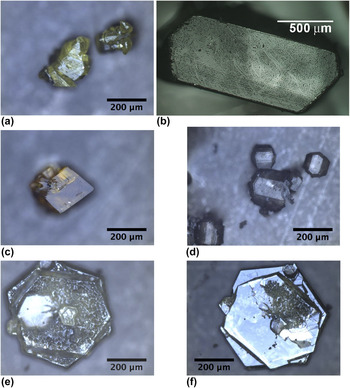
Figure 1 shows optical microscopy images of typical crystals tested. The as-received TATB had a rough surface that was not conducive for indentation. To resolve this with minimal additional processing the surface was lightly touched with an adhesive strip to exfoliate the material and produce a smooth surface [Figs. 1(e) and 1(f)]. No other materials received any surface treatment. Of the materials tested HMX, FOX-7, and ADAAF are monoclinic P21/n crystal structures,
Reference Veauthier, Chavez, Tappan and Parrish27–Reference Bemm and Ostmark29
TATB is triclinic P
 $\bar 1$
, and TNT/CL-20 is orthorhombic Pbca.
Reference Cady and Larson30,Reference Zhang, Xue, Cao, Zhou, Zhang, Li, Zhou, Xu and Gao31
Optical microscopy images of (a) FOX-7, (b) HMX, (c) ADAAF, (d) TNT/CL-20, (e) TATB before surface layer removal, (f) TATB after surface layer removal.

The pyramidal Berkovich tip is a common probe used in nanoindentation. Therefore, both the indentation plane normal orientation and the in-plane rotation of the tip may influence perceived properties, particularly for highly anisotropic materials. Reference Maughan, Carvajal and Bahr26 Indentations in different orientations can be used to determine available slip systems in molecular crystals. Reference Ramos, Hooks and Bahr32 By indenting a single face of a single crystal aspirin (a material which has been previously studied in the literature and selected here as a model for molecular crystals due to its ease of handling and the existing literature based on the materials) and rotating the sample between indentations, the magnitude of the differences in measurements based on the orientation of the tip relative to a given surface can be determined.
B. Nanoindentation
Nanoindentation was performed with a Berkovich tip in a Hysitron 950 Triboindenter using a quasistatic mode transducer in open loop control. Indents had a 30 s linear loading segment, a 5 s hold at peak load, and a 5 s linear unload. The maximum load was 1000 µN, however several indents were also performed at loads of 5000 µN in the aspirin sample. Several low-load quasistatic indents (less than 50 µN) were used to verify elastic deformation during the initial loading. Indents were done with at least 20 µm spacing to ensure that there was no overlapping of the plastic zones.
The Oliver–Pharr method was used to determine the hardness and reduced modulus of each sample. Reference Oliver and Pharr33 The hardness, H, is
 $$H = {{{P_{\max }}} \over A}\quad ,$$
where P max is the maximum load and A is the contact area as a function of indentation depth. The reduced modulus, E r, is found using the initial elastic unloading slope, S,
 $${E_{\rm{r}}} = {{S\sqrt \pi } \over {2\beta \sqrt A }}\quad ,$$
where β is ≈1. The Hertzian elastic contact model can also be used to describe elastic loading, and is a good approximation for the elastic contact during indentation at shallow depths. Reference Bahr, Kramer and Gerberich34 According to the Hertzial model
 $$P = {4 \over 3}{E_{\rm{r}}}\sqrt R {\delta ^{{3 \mathord{\left/ {\vphantom {3 2}} \right. \kern-\nulldelimiterspace} 2}}}\quad ,$$
where δ is the depth and R is the tip radius. Equation (3) can be used with R as a fitting parameter to determine the tip radius, or if the tip radius is known it can predict the indent depth at a given load in the elastic regime. The effective radius of the tip used was on the order of 500 nm, found by calibrating the tip in other materials (iron, quartz) of known modulus.
Elastic loading in relatively dislocation free solids, where nucleation or source activation dominates the transition from elastic to plastic deformation, can lead to the development of stresses which greatly exceed bulk flow stress. The Hertzian model also provides the maximum shear stress at a given load, if the indentation is elastic:
 $${\tau _{\max }} = 0.31{\left( {{{6E_{\rm{r}}^2} \over {{\pi ^3}{R^2}}}} \right)^{{1 \mathord{\left/ {\vphantom {1 3}} \right. \kern-\nulldelimiterspace} 3}}}{P^{{1 \mathord{\left/ {\vphantom {1 3}} \right. \kern-\nulldelimiterspace} 3}}}\quad .$$
Using Eq. (4) the maximum shear stress sustained prior to plastic deformation in these materials can be estimated (with the caveat that the Hertzian model assumes isotropic elastic properties, which are likely violated here). This maximum shear stress is only a first order indication of the stress required to nucleate dislocations, as the actual resolved shear stresses under an indenter probe will be a combination of the orientation of the crystal and a lack of achieving the ideal Hertzian conditions due to both tip imperfections, surface roughness, and in some cases surpassing the small strain approximations in the Hertz model. Eq. 4 is only used for materials which exhibit a clear transition between elastic loading and plastic deformation (i.e. show a “pop-in”).
III. RESULTS AND DISCUSSION
A. The effects of in-plane rotation on the measured mechanical properties of molecular crystals
The mechanical properties of acetylsalicylic acid (aspirin, C9H8O4 monoclinic, P21/c space group Reference Wheatley35 ), have been studied using indentation. Reference Ridgway, Shotton and Glasby36 Nanoindentation has been reported on both aspirin single crystals Reference Varughese, Kiran, Solanko, Bond, Ramamurty and Desiraju9,Reference Olusanmi, Roberts, Ghadiri and Ding37 and tableted aspirin. Reference Mohammed, Briscoe and Pitt38 The hardness and modulus in the literature for the (001) faces of aspirin ranges from 0.11 to 0.24 GPa and 2.81–9.57 GPa, respectively. The (100) faces range from 0.11 to 0.28 GPa and 4.73–7.16 GPa, while compression tests give values in between these. Reference Haware, Kim, Ruffino, Nimi, Fadrowsky, Doyle, Boerrigter, Cuitino and Morris39
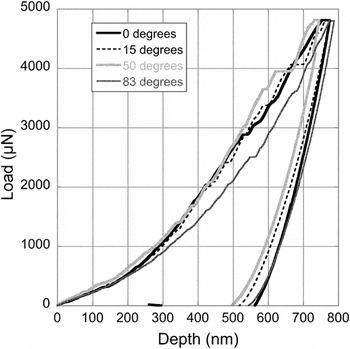
To quantify the effects of in-plane rotation on the perceived properties, an array of 9 indents was performed. The sample was rotated clockwise relative to the indentation plane and the array of indents was repeated. The angles of rotation relative to the tip were 0, 15, 50, and 83°. The spacing between indents was 30 µm. One representative load–depth curve from each angle is given in Fig. 2 showing the variations that occur within a single crystallographic face due to the rotational orientation.
Representative load–depth curves of indents in aspirin showing the response at various angles of the tip relative to the indentation axis on the same crystallographic plane.

The hardness at each angle, starting from the initial orientation, was 0.32 ± 0.01, 0.32 ± 0.03, 0.34 ± 0.03, 0.28 ± 0.02 GPa. Likewise 7.2 ± 0.6, 7.4 ± 0.9, 7.4 ± 0.6, 6.8 ± 0.4 GPa were the reduced moduli at each angle. A statistical analysis on each array was done using the Wilcoxon rank sign test, a common statistical analysis to determine population uniqueness. P-values were compared for the data sets of hardness and modulus for each angle to all other angles; if the P-value was less than 0.05 the data sets were considered statistically different. The data from indents at 83° relative to other angles gave a P-value of 0.0039 for H and 0.020 for E. P-values for data at 0, 15, and 45° to each other showed statistical equivalence with values of 0.055 and greater. There is no significant change in properties for the first three angles (H and E are statistically the same) however indents done at 83° show a statistical decrease in both H and E r. This is possibly because the stress distribution with this particular arrangement is more favorable for slip. The modulus of aspirin falls in the range reported by Varughese et al. Reference Varughese, Kiran, Solanko, Bond, Ramamurty and Desiraju9 and Olusanmi et al. Reference Olusanmi, Roberts, Ghadiri and Ding37 ; however, the hardness is slightly higher. The maximum difference in mean value of the measured properties is approximately equal to the coefficient of variation for any of the given data sets. To first order this suggests that for comparisons between subsequent materials in this study rotating each individual crystal is not needed, and tests of several randomly oriented crystals [Fig. 1(d)], will be sufficient to identify differences between the materials which exceed the effect from variations in the tip’s rotational orientation.
B. Properties of specific organic molecular crystals
1. HMX
β-HMX (C4H8N8O8 monoclinic, P21/n space group) is the stable polymorph of HMX at low temperatures. Reference Cady, Larson and Cromer28 HMX is one of the easier energetic materials to grow as large single crystals, and there have been several studies of HMX with crystals that were grown to millimeter Reference Kucheyev, Gash and Lorentz40 and even centimeter scales. Reference Li, Jun Tan, Kang, Juan Xu and Tang41 This allows for a direct comparison on the properties of specific faces of large single crystals to the averaged properties given in this study of multiple crystals.
Studies on large HMX used evaporative methods to crystallize HMX from an acetone solution. Kucheyev et al. Reference Kucheyev, Gash and Lorentz40 used Berkovich and spherical tips to indent the (010) surface to 50 and 100 mN. The Berkovich tip gave a modulus of 17.6 GPa and a hardness of 0.7 GPa. Cracking was observed primarily along [100] after indents with both tips. Li et al. used a Berkovich tip to indent the (010) and a nonindexed face using 600 µN as the maximum indent load. Reference Li, Jun Tan, Kang, Juan Xu and Tang41 They also performed indents to 4 mN to compare values at different depths. The average reported modulus and hardness for the (010) face was 23.18 and 1.13 GPa respectively. The modulus of the random face indented was 26.05 GPa and the hardness 0.95 GPa. Kucheyev comments that the values obtained were lower than the values reported by Li’s group, and notes the presence of cracks in the residual indent impressions could cause this. Li’s group used much lower loads than Kucheyev’s, and while they suspected cracking occurs they do not show visible cracks in their indents. Pop-ins in the load–depth curve are not necessary indicative of cracks in the sample, as has been shown to be the case with RDX. Reference Taw and Bahr42 600 µN may not be a sufficient load to induce cracking in HMX as loads of 1000 µN were used in this study and no cracking was observed. However at much higher loads, such as 50 mN, it is possible that cracks will form in the samples. The results presented here match more closely those measure by Li’s group, which are most likely attributed to the similar loading conditions (both in rate and in maximum load) between their and the current work.
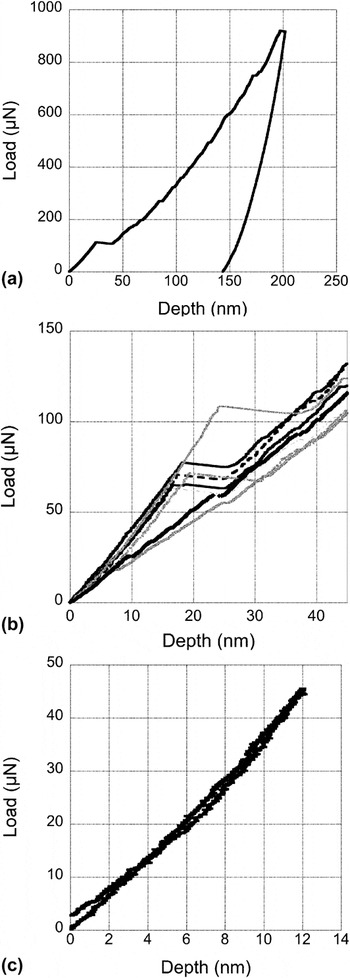
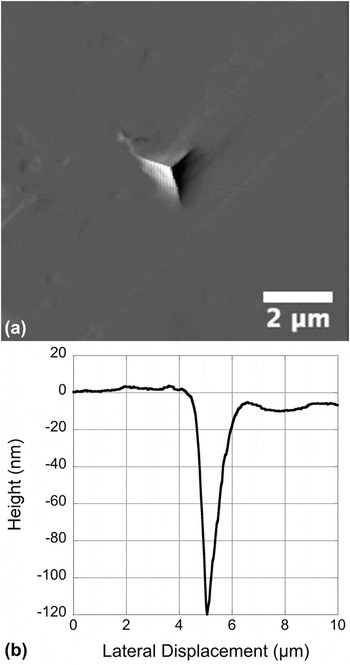
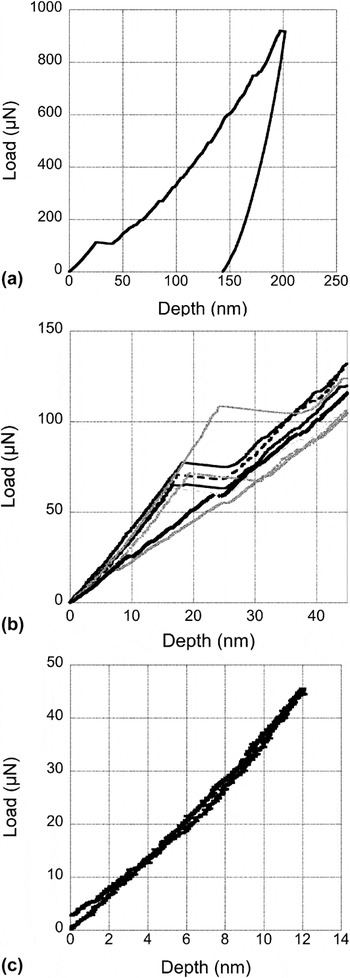
Ten indents were done on each of three HMX crystals. Figure 3(a) gives a representative load–depth curve in HMX, while Fig. 3(b) shows multiple load–depth curves illustrating the initial yield point, where the sharp change in displacement, or pop-in, at a given load indicates a transition from elastic to plastic deformation. A low load indent, Fig. 3(c), shows deformation prior to pop-in is purely elastic. The average modulus and hardness over all crystals indented was 24.5 ± 1.3 and 0.99 ± 0.06 GPa respectively. This is in good agreement with Li’s group. A residual indent impression is shown in Fig. 4, with no evidence of any surface cracks at these loads. All residual indents on HMX showed no signs of cracking.
(a) Representative load–depth curve of indent in HMX. (b) Inset in multiple HMX load–depth curves showing initial yield (“pop-in”) behavior. (c) Low load indent showing purely elastic behavior in HMX prior to pop-in.
(a) Representative AFM gradient residual indent impression of indent in HMX showing no signs of surface cracks. (b) Indent height profile from corner to opposite edge showing and indentation depth of about 120 nm.

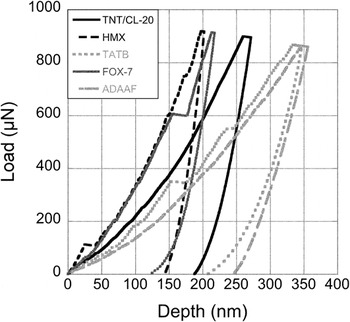
The shear stress at initial yield in HMX was calculated using Eq. (4) and the load at which the first pop-in phenomena occurred. The average shear stress was 0.83 GPa with the lowest and highest maximum shear stresses 0.63 and 1.18 GPa respectively. For the remaining materials examined in this study (FOX-7, TATB, TNT/Cl20) data similar to Fig. 3 is available in the Supplementary Material, Figs. S1–S3, and will be summarized in Figs. 5 and 7.
Representative load depth curve of each material demonstrating variation in depth, pop-in behavior, and measured mechanical properties.

2. FOX-7
FOX-7 (C2H4N4O4 monoclinic, P21/n space group
Reference Bemm and Ostmark29
), is difficult to grow as large crystals, however Zhou et al. has performed nanoindentation on FOX-7 crystals grown with a morphological modifier.
Reference Zhou, Lu, Zhang, Chen, Li, Nie and Zhang16
Their study, while useful as the first of its kind on FOX-7, used an unspecified additional crystal growth agent that could change the mechanical properties. They also subject the surface of their samples to cutting and polishing that can alter surface properties. Zhou’s group used a Berkovich tip and indented the (020), (
 $\bar 1$
01), and (002) faces with loads of 8 mN. The modulus for all three faces was 11.09, 16.65, and 21.34 GPa respectively and the hardness values were 0.52, 0.63, and 0.67 GPa. They also observe pop-ins in indentations on each face that are signs of “intermittent plastic flow”, and describe the depth and loads at which some of these occur.
Six FOX-7 crystals were selected for indentation, and six indents were performed on each crystal. Qualitatively the FOX-7 was similar to HMX, with distinct pop-ins signifying yield, and very minor plasticity prior to pop-in. No cracking was observed in the FOX-7 for loads up to 1000 µN.
The average hardness and modulus for FOX-7 are 0.86 ± 0.08 and 19.6 ± 4.0 GPa respectively. The modulus falls into the range reported by Zhou, however the hardness is higher. Two possible explanations for higher hardness on these as-grown samples are viable. First, since no morphological modifier was added to the samples in this current study, it is possible that the modifier decreases the hardness. Secondly, the crash precipitation used to form most molecular crystals may lead to stresses or defects from the processing, which could increase the hardness. The average shear stress at yield in FOX-7 was 0.38 GPa and the lowest and highest maximum shear stresses at yield were 0.24 and 0.48 GPa.
3. TATB
TATB (C6H6N6O6 triclinic, P
 $\bar 1$
space group
Reference Cady, Larson and Cromer28
) is an insensitive secondary explosive. Mathew et al. simulated indentations on the (001), (010), and (001) planes of TATB using a spherical indenter at 77 K and reported moduli of 27.7, 26.0, and 10.7 GPa.
Reference Mathew and Sewell43
The simulation results show the highly anisotropic nature of TATB, having nearly a factor of two difference on the modulus between different faces. Their hardness was 1.02 GPa for the (001) face, but could not be computed for the other faces due to the depth of the indentation.
Five indents were performed on each of three TATB crystals. The hardness and modulus was 0.41 ± 0.04 and 9.6 ± 1.5 GPa respectively, the modulus is similar to the simulation [10.7 GPa for (001)]. The shape of the indented crystals [Fig. 1(f)] generally corresponds to the (001) basal plane morphology. The pop-ins were less dramatic and the change in displacement occurred over a shorter length scale than the other materials tested, but yield was still distinctly identifiable. No cracking was visible in any indents on TATB. From the initial pop-ins in TATB the shear stress at yield was similar to FOX-7 with an average 0.38 GPa and the smallest and largest maximum shear stress was 0.24 and 0.48 GPa respectively.
4. TNT/CL-20
Cocrystals are of great interest to the pharmaceutical and energetics community. Reference Karki, Friscic, Fabian and Laity44–Reference Zhang and Shreeve47 Many cocrystal formulations exist and nanoindentation has been used in determining their mechanical properties, particularly in pharmaceuticals. Reference Ghosh, Mondal, Kiran, Ramamurty and Reddy48,Reference Karunatilaka, Bucar, Ditzler, Friscic, Swenson, MacGillivray and Tivanski49 Nanoindentation of energetic cocrystals has received less attention. TNT/CL-20 (orthohombic, Pbca space group Reference Zhang, Xue, Cao, Zhou, Zhang, Li, Zhou, Xu and Gao31 ) is an energetic cocrystal that seems to maintain some of the energy density of CL-20 but is less sensitive than CL-20. While forming cocrystals does not necessitate that the properties are an average of the pure components, for TNT/CL-20 this seems to be the case. Reference Zhang and Shreeve47,Reference Guo, An and Huang50 Simulations of TNT/CL-20 predict a Young’s Modulus of 17.9 GPa, Reference Li, Jie Shu, Gao, Chen, Ma and Ju51 while this is slightly different from the reduced modulus it is a comparable reference value.
The reduced modulus, determined from a total of eleven indents on three different TNT/CL-20 cocrystals was 14.2 ± 1.2 GPa. The hardness was 0.63 ± 0.13 GPa. The similarity of experimental values to the simulation supports that methods used for simulating these materials are sufficient for first approximations.
5. ADAAF
ADAAF (C8H4N16O6 monoclinic, P21/n space group Reference Veauthier, Chavez, Tappan and Parrish27 ) is a recent energetic material with few reports of its properties. The first paper on the synthesis and characterization of ADAAF was published in 2010, Reference Veauthier, Chavez, Tappan and Parrish27 and subsequent studies have focused on the heat of formation using density functional theory. Reference Zheng, Chu, Xu, Wang, Lei, Xia and Gong52 There have yet to be any nanoindentation studies or simulations for ADAAF.
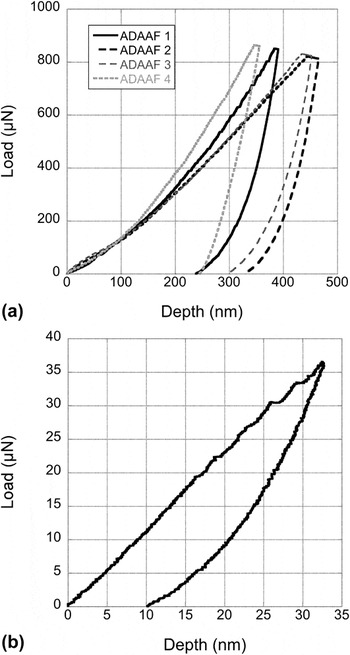
An average of five indents were performed on eight ADAAF crystals, Fig. 6 shows representative load–depth curves for four of these crystals. Figure 6(b) shows a low load indent into ADAAF; clearly ADAAF behaves differently than the other molecular crystals in this study. Most previous materials exhibited distinct pop-ins, yield points, and elastic behavior prior to yield except TNT/CL-20. ADAAF and TNT/CL-20; however, shows no elastic regime, instead plastically deforming even at loads below 50 µN. There are no visible pop-ins during indents done to higher loads.
(a) Representative load–depth curves on four different ADAAF samples showing smooth loading segments and a lack of discrete pop-ins or yield points. (b) Low load indent showing large amounts of plastic deformation from the onset unlike previous materials.

ADAAF is softer and more compliant than the other materials in this study, with an average hardness and modulus of 0.23 ± 0.09 and 6.7 ± 1.3 GPa, respectively. The hardness of ADAAF is about a third the hardness of other materials tested. The plastic behavior of ADAAF means that it falls outside of the assumptions made by the Hertzian model and cannot be interpreted in the same manner as the previous materials. There is no analogous, simple contact model for plastic behavior suitable for application to indentation mechanics. This limits the measurement of mechanical properties to the hardness and modulus of ADAAF, which have been reported here for the first time.
IV. SUMMARY AND CONCLUSIONS
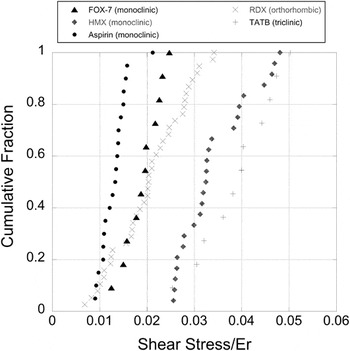
A list of all relevant properties for each material in this study is given in Table I, with comparison to previously reported values when applicable. Reference Scott Weingarten and Sausa53 Figure 7 presents the cumulative fraction of yield events against the shear stress at yield normalized by the modulus for the molecular crystals that showed distinct pop-in yielding as well as the measurements made on RDX in previous work. Reference Taw and Bahr42 For the wide range of molecular crystals assessed in this study, the window of plasticity at which yield typically occurs is approximately 1–5% of the reduced modulus. Therefore, estimations of the yield behavior for monoclinic, triclinic, and orthorhombic molecular crystals may begin with an estimation of 1–5% of the average elastic modulus (which can be calculated using computational tools).
Summary of mechanical properties of molecular crystals, where τavg is the average maximum shear stress required for a yield point. E and H measured in this study reported at loads of ≈5 mN (asprin) or ≈1 mN (all other materials).

Shear stress at yield normalized by reduced modulus shows the window of plasticity is between 1 and 5% of the reduced modulus for multiple molecular crystals.

The ratio of hardness to modulus for the suite of materials ranged from 0.039 to 0.044. The model for fully plastic indentations is that hardness is approximately three times the uniaxial yield strength, but the ratio of hardness to yield stress will vary between 1 and 3, with lower values indicative of more elastic indentations. Reference Johnson54 The “indentation strain” parameter from Johnson, (E r tan β)/Y, where β is the angle of the indentation, will reach “fully plastic” at ≈35 for conical indentations; with β from a Berkovich tip being 19.7°, and our average H/E r ratio being 0.042, the indentation strain parameter will be somewhere between 8 and 25 (as we do not know a priori the uniaxial yield strength the conversion between H and yield strength is between 1 and 3). Therefore, it is very likely that indentation hardness in organic molecular crystals using Berkovich indenter tips does not reach a fully plastic condition, and for future modeling processes the uniaxial yield strength of this class of materials is better approximated by one-half, rather than one-third, the hardness. Consideration of phase transformations, cracking, and other quasiplastic deformation aspects during contact loading will remain critical in developing holistic views of deformation in this class of materials.
Plastic deformation in organic crystalline compounds is far-reaching in terms of downstream processing and ultimately performance (i.e., energetic and pharmaceutical applications). Mechanical stresses applied during widely used processes (e.g., milling and compaction) often result in vaguely defined issues such as “stickiness”, and lead to changes in dissolution or thermo–mechanical behavior. Assessing the properties of small powders of molecular crystals in their as-produced form provides the ability to elucidate ambiguous properties while providing microstructure-based insight to performance differences where defects such as dislocations could be present.
Supplementary Material
To view supplementary material for this article, please visit https://doi.org/10.1557/jmr.2017.219.
ACKNOWLEDGMENTS
We acknowledge the financial support of the US Air Force Office of Scientific Research under grant FA9550-16-1-0101. We thank Bryce Tappan, David Chavez, Ernie Hartline and Jackie Veauthier (LANL) and Prof. Lori Groven (South Dakota School of Mines) for providing some of the materials. Los Alamos National Laboratory, an affirmative action equal opportunity employer, is operated by Los Alamos National Security, LLC, for the National Nuclear Security Administration of the U.S. Department of Energy under contract DE-AC52-06NA25396.