Introduction
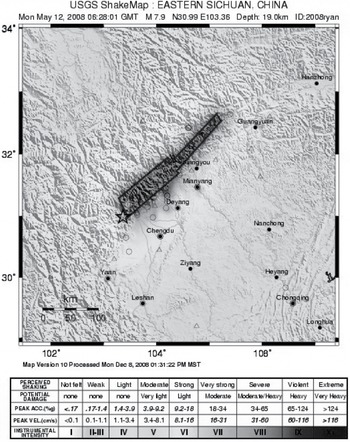
On 12 May 2008, an 8.0-Richter earthquake struck the southwest parts of China, mostly in Sichuan Province. The area affected by this earthquake is vast, including eight provinces and 852 counties, with a population of 348 million people (Figure 1). Improvements in living conditions and rescue techniques in the past few decades have reduced the risk of communicable disease outbreaks following disasters and attention has now turned to disaster effects on persons with chronic disease. Prior research has suggested that earthquake exposure is associated with adverse consequences for coronary heart disease.Reference Katsouyanni, Kogevinas and Trichopoulos1–Reference Nakagawa, Nakamura and Oyama7 However, the natural history and prognostic significance of new-onset angina related to earthquakes have not been characterized.
Instrumental intensity of 2008 Sichuan earthquake. This map is from the United States Geological Survey (USGS) Earthquake Hazards Program, permission required.

This one-year follow-up study of patients with new-onset angina before and after the 2008 Sichuan earthquake, assessed patients for depression upon first admission to the hospital, in order to determine whether earthquake-related, new-onset angina is associated with an adverse prognosis when patient history, depression score, Canadian Cardiovascular Society (CCS) angina class, and medical characteristics are known, and to identify factors which contributed to this outcome.
Methods
Patient Population
The study was designed as a prospective, cohort, observational study. The research protocol was approved by the Research Ethics Committee of the People’s Hospital of Deyang City. Written informed consent was obtained from each patient.
Patients were included if they met the following criteria: (1) first admission to the hospital following the earthquake with a principal diagnosis of angina, including those who were inpatients during the earthquake and inpatients during the first three months after the earthquake; (2) first episode of angina two months from first admission; (3) signed, informed consent; and (4) >18 years of age.
Patients were excluded if they met any of the following criteria: (1) a history of myocardial infarction, coronary revascularization, heart failure, or lethal dysrhythmia; (2) current use of antidepressants or antipsychotic medications; (3) pregnancy or lactation; and (4) severe, life-threatening renal, liver, or lung function impairment.
Participants were assigned to one of two groups according to the time of their first episode of angina. The Pre-Earthquake Group included patients first hospitalized for new-onset angina with first episode of angina between 12 March 2008 and 12 May 2008 (two months before the Sichuan earthquake). The Earthquake-Related Group included patients hospitalized for new-onset angina with their first episode of angina one month after the Sichuan earthquake.
Measure of Depression
Depressive symptoms were measured using the standardized psychometric scale (SDS), which has 20 items describing depressive symptoms, and has been shown to be reliabile and valid.Reference Zung, Satorius and Ban8 Patients were assigned to one of three groups according to their SDS scores: (1) those with scores <50 were classified as “non-depressive”; (2) those with scores from 50–59 were considered to have “mild depression”; and (3) those with scores ≥60 were classified as having “moderate/severe depression”.
Follow-Up
Patients were contacted 12 months following their first hospitalization after their first admission, and were contacted monthly by researchers who were blinded to all initial medical and psychiatric assessments. All of the patients were encouraged to actively provide their own medical information with guaranteed free medical advisory service. Patients were questioned as to whether they had experienced a myocardial infarction, revascularization, the time and duration of hospitalization resulting from their heart disease, diagnosis of depression and use of antidepressant medication, and other medical procedures. Cause of death during this period was identified by hospital records whenever available, or by an interview with a close relative.
Statistical Methods
Statistical comparisons were performed using SPSS software (version 13.0, SPSS Inc., Chicago, USA), and a p-value <0.05 was considered statistically significant. The baseline characteristics among all patients were compared using the t-test for continuous variables and the χReference Trevisan, Celentano and Meucci2 test for categorical variables. The association between baseline variables and readmission after the earthquake was calculated using Cox proportional hazards models with time-dependent covariates.
Baseline Medical Characteristics
Participants underwent a baseline examination that included a comprehensive health interview, physical examination, medical history questionnaire, psychosocial questionnaire, blood sample tests, electrocardiogram and 24 hour ambulatory electrocardiogram, x-ray, echocardiography, echocardiography, and head computed tomography (CT) scan and electroencephalography (EEG) for some patients.
Results
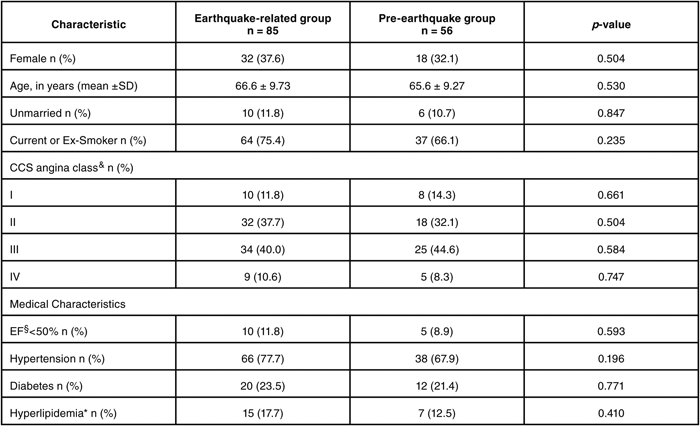
After 12 May 2008, a total of 152 participants were enrolled in the study, and 143 completed the diagnostic interview for identifying the presence of depression. The follow-up evaluations ended 25 August 2009. As of that date, follow-up was 141 (97.2%) complete with only two (1.4%) in the earthquake-related group lost to follow-up from the study (Table 1).
Baseline characteristics of the patients
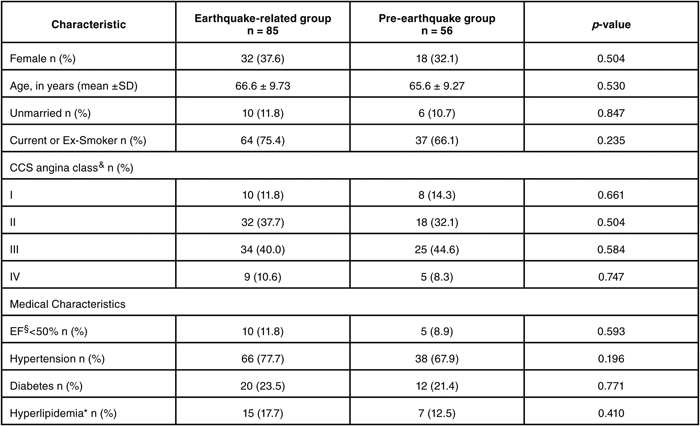
&Canadian Cardiovascular Society Angina Class
§ejection fraction
*Hypercholesterolemia or (and) high Low-density lipoprotein lipidemia.
Severity of Depression
The SDS score was a continuous variable. However, patients were assigned to one of three groups using standard criteria for purposes of calculation. The most notable difference between the earthquake-related and pre-earthquake group was a higher prevalence of moderate/severe depression in the earthquake-related group (23.7% vs. 8.9%, p = 0.026; Table 2).
Baseline characteristics by severity of depression

*The moderate and severe depression were combined for purposes of calculation.
Outcomes
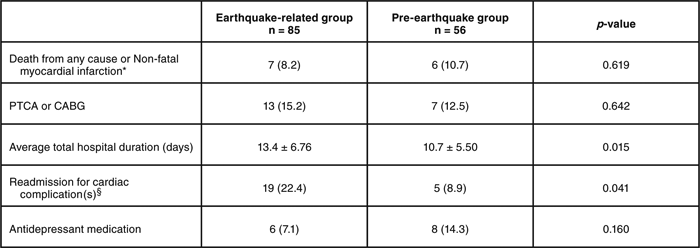
During the one-year follow-up, patients with new-onset angina after the Sichuan earthquake had a higher risk of readmission (21.4% vs. 8.2%, p = 0.029), and a longer total hospitalization (average of 13.0 ±6.8 vs. 10.7 ±5.50 days, p = 0.015; Table 3). However, there were no differences between the two groups in terms of other cardiac complications, such as nonfatal myocardial infarction. Patients with new-onset angina after the Sichuan earthquake also had slightly higher rates of using antidepressant medications during the follow-up period, but without statistically significant differences. There were no statistically significant differences for non-fatal myocardial infarction or for PTCA or CABG between the two groups.
Incidence of cardiac complications and death among patients with new-onset angina before or after the Sichuan earthquake. (CABG = coronary artery bypass graft; PTCA = percutaneous coronary angioplasty)
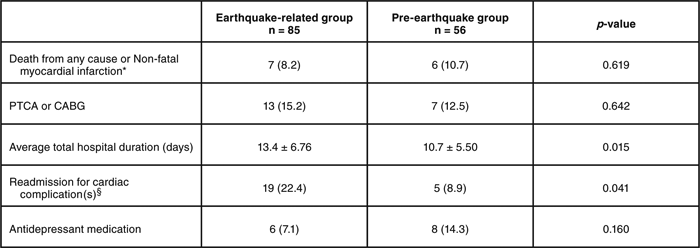
*The death from any cause and non-fatal myocardial infarction were combined for purposes of calculation.
§Readmission for cardiac complication readmission to hospital because of unstable angina, acute myocardial infarction, pulmonary edema, arrhythmia or congestive heart failure
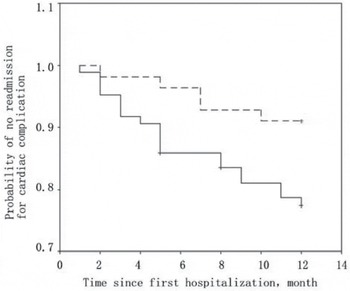
The survival curve (Figure 2) demonstrates that in the year following the first admission, a larger percentage of pre-earthquake group patients remained free of hospital readmissions or were hospitalized for a shorter time compared with the earthquake-related group (Table 2). The Log-rank statistic differences between the two curves were statistically significant.
Kaplan–Meier survival curves showing cumulative probability of patients not readmitted for cardiovascular disease in the year follow-up following the first admission to hospital after earthquake between the pre-earthquake group (broken line) and the earthquake-related group (heavy solid line). The Log-rank statistic differences between two curves was p = 0.037.

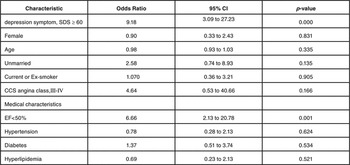
The association of moderate/severe depression and low ejection fraction (EF) value (<50%) with risk of readmission over one year derived from Cox modeling was statistically significant (Table 4). With moderate/severe depression vs. non depression, the relative risk was 9.18 (95%CI = 3.09–27.23, p = 0.0000); and with low EF value (<50%) vs. EF ≥ 50%, the relative risk was 6.66 (95%CI = 2.13–20.78, p = 0.001). Other baseline variables (such as gender, patient history, CCS angina class, hypertension, etc.) were not associated with a risk of readmission.
Relationship between baseline variables and readmission after earthquake (CCS = Canadian Cardiovascular Society; EF = ejection fraction; SDS = standardized psychometric scale)

Discussion
In this study, subsequent cardiac events were identified for one year following the initial hospital admission.
Earthquakes are unique, unpredictable events that cripple communications, transportation infrastructure, and medical and other services, and have an adverse effect on somatic and psychiatric morbidity. In recent years, investigators have been focusing on the effects of earthquake on cardiovascular diseases. However, the number of reports published is limited. Katsouyanni et al Reference Katsouyanni, Kogevinas and Trichopoulos1 reported a threefold increase in cardiac deaths and a 1.6-fold increase in risk for deaths from all causes after the 1978 earthquake in Thessalonika, Greece. Similar results were reported following the Athens earthquake of 1981, Armenia earthquake of 1988, Hanshin-Awaji earthquake of 1994 in Japan, and the Northridge earthquake in Los Angeles in 1994.Reference Trichopoulos, Katsouyanni and Zavitsanos3–Reference Armenian, Melkonian and Hovanesian6 Nakagawa et al Reference Nakagawa, Nakamura and Oyama7 reported the increased long-term mortality from acute myocardial infarction after 2004 Niigata-Chuetsu earthquake in Japan. Trevisan et al Reference Trevisan, Celentano and Meucci2 reported higher heart rates and serum cholesterol and triglyceride levels within the first few weeks after the 1980 earthquake in Naples, Italy. However, the natural history and prognostic significance of new-onset angina (<2 months in duration), which was defined as unstable angina by Braunwald,Reference Salcioğlu and Başoğlu9 following the earthquake have not been characterized adequately.
Stress-related mental disorders occur within one month after serious physical or psychological trauma. In this study, there is a higher proportion of patients with moderate/severe depressive symptoms in the earthquake-related group than their counterparts, which was consistent with findings from previous studies.1,9,10 The increased incidence of moderate/severe depression among those with cardiovascular disease could be explained by an increase in heart rate and blood pressure produced by mental stress, which increased myocardial oxygen demand and plaque disruption.2,11 However, such increase in heart rate, blood pressure, or serum cholesterol and triglyceride levels were not found in this study. Therefore, depression may make angina easier to attack through other mechanisms, such as an excessive release of inflammatory mediators, or dysfunction of the autonomic nervous system.
Prior research has suggested that depression may play a significant role in increased readmissions of patients with cardiovascular disease.Reference Jiang, Alexander and Christopher12–Reference Lauzon, Beck and Huynh14 In this study, there was a higher incidence of readmission among patients with new-onset angina who also reported a higher incidence of depressive symptoms after the earthquake. Higher depression score and New York Heart Association (NYHA) class were associated with higher rates of readmissions during the 12 months of the current study. These readmissions appeared to be attributable to: (1) patients with higher NYHA class may represent a greater deterioration in cardiopulmonary function, increased fluid retention, or both; (2) some direct effect of depressive symptoms on the cardiovascular system, mediated by endogenous neurohormonal activation, endothelium dysfunction, decreased heart rate variability, or other unknown mechanisms;11,15 and/or (3) patients with higher depression scores were in a higher NYHA classes.
There was no differences in mortality, non-fatal myocardial infarction, or other cardiac complications between the two groups over the one-year follow-up period, which was different from previous studies.Reference Katsouyanni, Kogevinas and Trichopoulos1–Reference Nakagawa, Nakamura and Oyama7 Possible speculation includes: (1) patients with new-onset angina were younger and associated with less severe coronary anatomic abnormality, and lower frequency of peripheral and cerebrovascular disease than other acute coronary syndrome; (2) some patients in both groups received antidepressant treatment; and (3) both groups were exposed to the Sichuan earthquake, which was different from previous studies that compared subjects with to those without earthquake exposure.
This study had several limitations. First, the study was non-randomized and had a limited sample size. Second, the efficacy and safety of antidepressants in the prognosis of patients with new-onset angina should be assessed in future studies. Finally, the study population was limited to hospitalized patients.
Conclusions
Among patients hospitalized for new-onset angina, patients with their first episode of angina after the Sichuan earthquake were more likely than those with angina before the Sichuan earthquake to produce depressive symptoms and more likely to be readmitted to the hospital in the year following their first admission, with an associated higher depression score and NYHA class. However, the Sichuan earthquake did not appear to have an impact on the incidence of other cardiac complications. Depressive symptoms upon admission and low ejection fractions were significant predictors of 12-month risk for readmission, which indicates that antidepressants should be prescribed. A larger, multi-center study to determine the prognostic impact of earthquake on new-onset angina is warranted.
Acknowledgments
The authors thank Prof. Debarati Guha-Sapir, Department of Public Health, Louvain School of Medicine, University of Louvain for her contributions to this paper.
Abbreviations:
SDS = standardized psychometric scale
CT = computed tomography
USGS = United States Geological Survey
EF = ejection fraction
NYHA = New York Heart Association
The work was supported by grants from the National High-tech Research and Development Program of China (2008AA022601)