Introduction
Late preterm (LP) infants are defined as infants born between 34 0/7 and 36 6/7 weeks of gestation. Delivery during LP is sometimes deemed necessary by clinicians for several reasons (e.g., maternal, fetal, or placental/uterine). Reference Sharma, Padmavathi, Tabatabaii and Farahbakhsh1 A recent study indicated that LP infants experience several problems in the perinatal period, as well as ongoing development. For example, these infants were at a higher risk of respiratory distress syndrome, hypoglycemia, hypothermia, prolonged jaundice, and feeding problems. Reference Engle, Tomashek and Wallman2 Furthermore, the risk of neurological impairments in LP infants was higher than that of term infants, who were delivered after 37 0/7 weeks of gestation. Reference Romeo, Ricci, Picilli, Foti, Cordaro and Mercuri3 However, because LP infants are delivered early for different reasons, they might not share the same risks during the perinatal period and in terms of ongoing development.
During risk evaluation, infants are also evaluated by birthweight. Low birthweight (LBW, birthweight <2500 g) infants experience the same problems as LP infants. Reference Gu, Wang and Liu4,Reference Jornayvaz, Vollenweider, Bochud, Mooser, Waeber and Marques-Vidal5 In Japan, LBW frequency is higher than that in other developed countries. We previously reported that both modifiable and non-modifiable factors were independently associated with LBW in Japanese term neonates according to multiple regression analysis. In this regard, modifiable maternal factors were pre-pregnancy underweight (pre-pregnancy body mass index [BMI]<18.5 kg/m2), inadequate gestational weight gain (GWG), and smoking during pregnancy, whereas non-modifiable maternal factors were younger maternal age at delivery, nulliparity, hypertensive disorder of pregnancy (HDP), cesarean section (CS) delivery, female neonates, and congenital anomalies. Reference Kasuga, Iida and Tanaka6 While many LP infants are LBW (of 798,224 singletons born with LBW between 2013 and 2017, 82,810 were born preterm [10.4%]), Reference Kasuga, Iida and Tanaka6 data regarding risk factors of LBW in Japanese LP singleton infants are scarce.
LP infants experience several adverse outcomes similar to those experienced by LBW infants. However, while LBW is common in LP deliveries, the association between LP and LBW is still unknown. Therefore, we conducted a retrospective study using a national perinatal database to examine factors associated with LBW among LP singleton births in Japan. This study aimed to investigate LBW rates and independent risk factors in LP singleton neonates.
Methods
Study design and participants
This study retrospectively collected obstetrical data, including maternal and neonatal data, registered in the Japan Society of Obstetrics and Gynecology Successive Pregnancy Birth Registry System. This data was received from approximately 400 secondary and tertiary hospitals throughout Japan. This database included information about maternal characteristics, perinatal complications, and delivery outcomes, which were extracted from the medical records of each institution using a standardized format to understand various issues that need to be resolved at the national level. LP birth was defined as neonates born between 34 0/7 and 36 6/7 weeks of gestation. Reference Sharma, Padmavathi, Tabatabaii and Farahbakhsh1 Data cleaning was performed as previously described. Reference Kasuga, Iida and Tanaka6 In total, 56,160 LP singleton births were registered in the system between January 1, 2013, and December 31, 2017 (Fig. 1). Thereafter, we used the data of term singleton births from our previous report. Reference Kasuga, Iida and Tanaka6
Flow diagram describing the study population and exclusions.

Measures
Large for gestational age (LGA, birthweights ≥90th percentile) and small for gestational age (SGA, <10th percentile) were calculated by Japanese standard sex- and parity-specific birthweight percentile curves. Reference Itabashi, Miura, Uehara and Nakamura7 Pre-pregnancy BMI was calculated as the woman’s self-reported pre-pregnancy body weight divided by the square of height (kg/m2). The expected GWG at 40 weeks of gestation (kg/40 weeks) was calculated using the method previously described, Reference Morisaki, Nagata and Jwa8 and the mothers’ BMIs were categorized as “inadequate,” “appropriate.” and “excessive.” Reference Kasuga, Iida and Tanaka6,Reference Rasmussen and Yaktine9 Premature labor, premature rupture of membranes, gestational diabetes (GDM), overt diabetes mellitus (DM), HDP including gestational hypertension (GH), chronic hypertension (CH), preeclampsia (PE), superimposed preeclampsia (SPE), and anemia during pregnancy were diagnosed and managed by each obstetrician, based on the clinical recommendations of the Japan Society of Obstetrics and Gynecology guidelines. Reference Minakami, Maeda and Fujii10 HDP represents hypertension during pregnancy, which is defined as a systolic blood pressure ≥140 mmHg and/or a diastolic blood pressure ≥90 mmHg observed on at least two occasions. Furthermore, it is classified into hypertension without proteinuria (GH and CH) and with proteinuria (PE and SPE). Lastly, congenital anomalies included all types of anomalies diagnosed before birth by obstetricians using ultrasonography and after birth by neonatologists. The severity of congenital anomalies was unknown because it was not registered in this database.
Statistical analysis
Data were presented as mean ± standard deviation or number of cases (%). Multiple logistic regression analysis was performed to evaluate the relative contributions of various obstetrical factors to LBW in singleton neonates born at LP. The following independent variables were included in the multivariate model based on prior knowledge, Reference McCowan and Horgan11 clinical relevance, and univariable screening: maternal age at delivery, nulliparity, in vitro fertilization and embryo transfer (IVF-ET), pre-pregnancy BMI category, GWG category, smoking during pregnancy, CS delivery, hypertension without proteinuria (GH and CH), hypertension with proteinuria (PE and SPE), anemia during pregnancy, and offspring sex. Reference Kasuga, Iida and Tanaka6 Multicollinearity was assessed for each independent variable using variance inflation factors; all values were <2. Adjusted odds ratios (aOR) and 95% confidence intervals (CIs) were evaluated to investigate the association between LBW and this study’s features. Statistical analyses were performed using the JMP software (ver. 15, SAS Inst. Inc., Cary, NC, United States).
Results
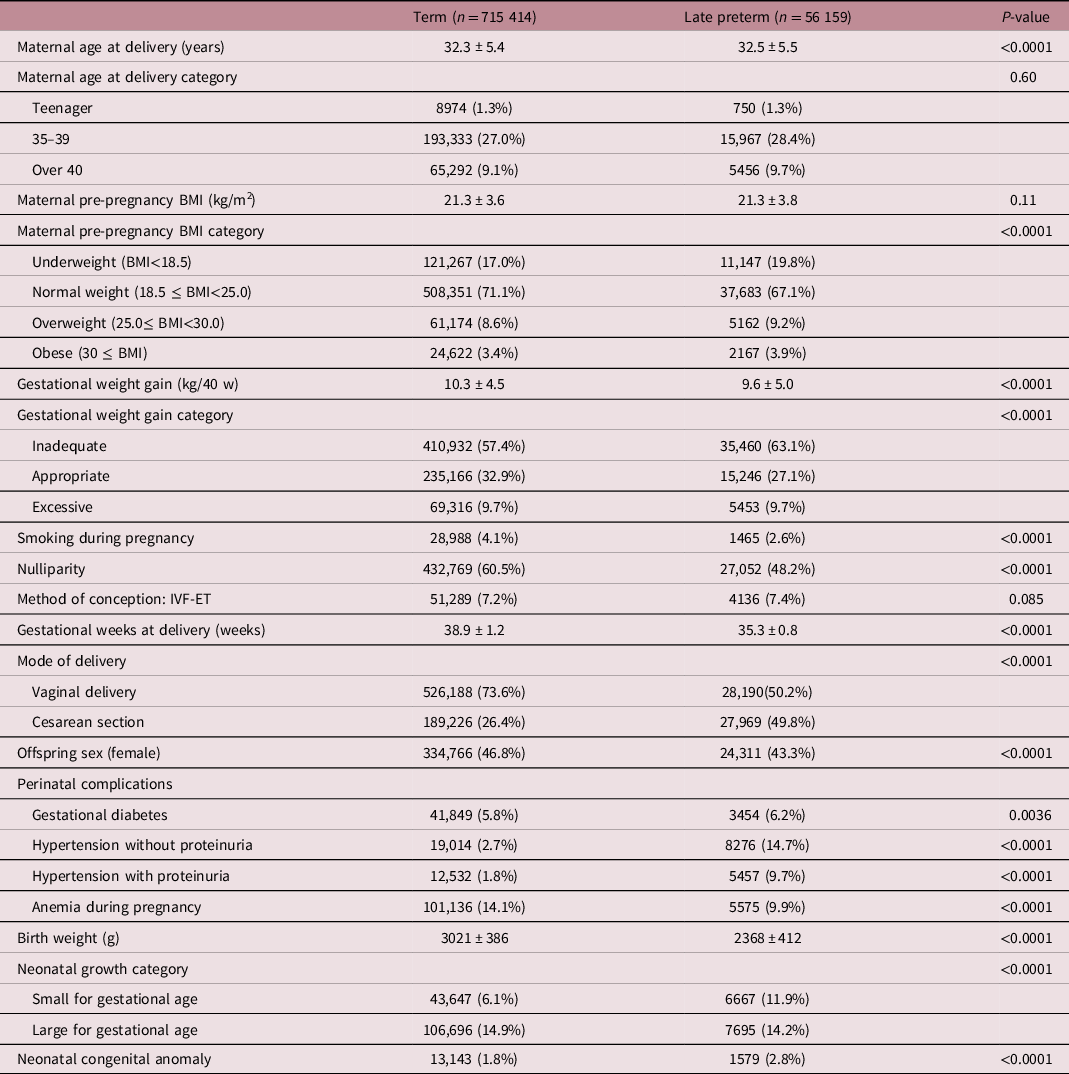
Comparisons of maternal, perinatal, and neonatal characteristics in term and LP births are summarized in Table 1. Late preterm delivery had a higher frequency of poor perinatal outcomes than term delivery.
Comparison of maternal, perinatal and neonatal characteristics between term birth and late preterm birth

Data are mean (SD) or n (%). BMI, body mass index; IVF-ET, in vitro fertilization-embryo transfer; LBW, low birthweight.
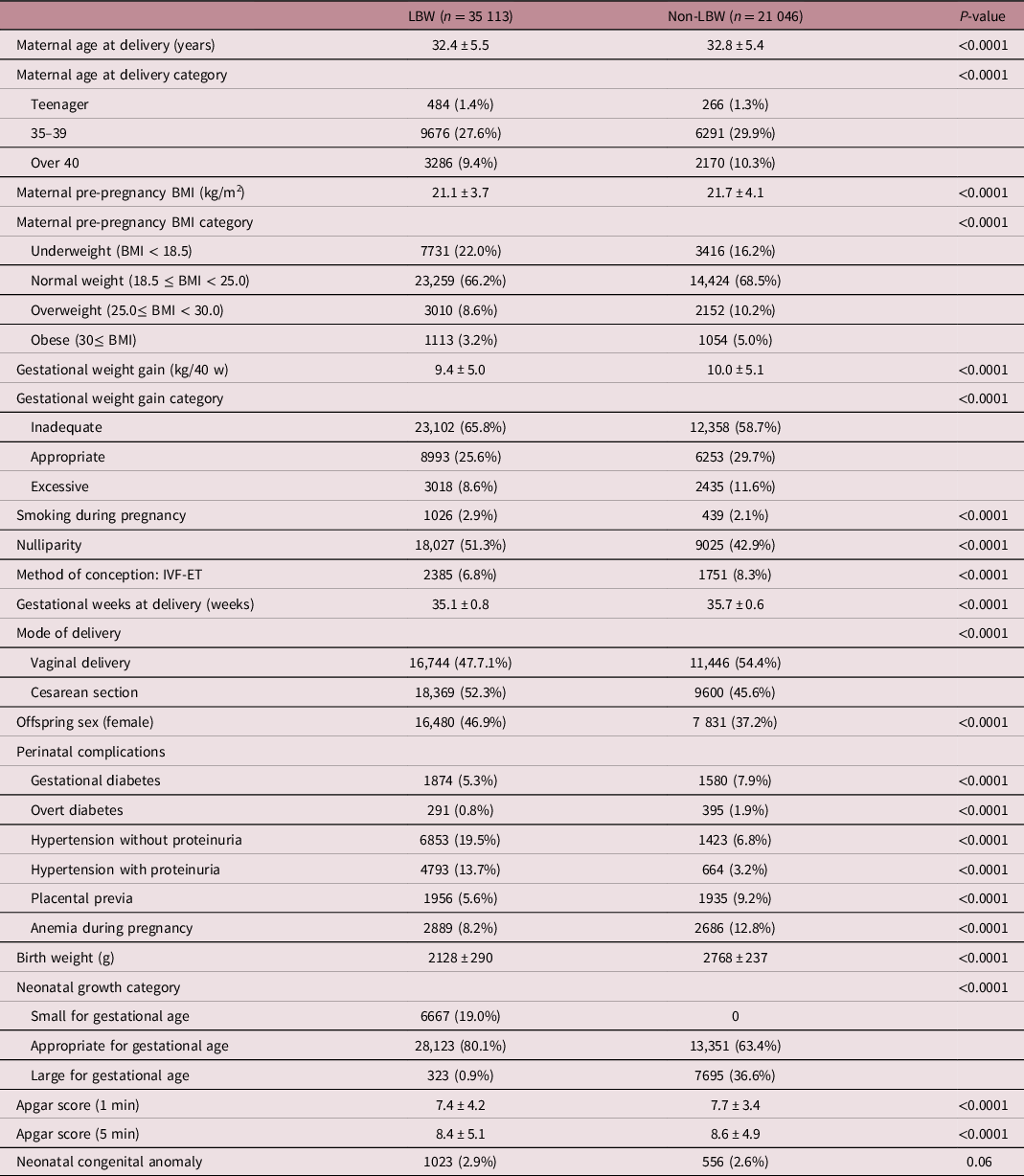
LBW was observed in 62.5% (n = 35,113) of the 56,160 LP singleton births (Fig. 2). The comparison of maternal, perinatal, and neonatal characteristics in LBW and non-LBW infants with LP births are shown in Table 2. The mothers of LBW neonates were younger, leaner before pregnancy, and had a lower GWG than those of non-LBW neonates. Furthermore, rates of smoking during pregnancy, nulliparity, HDP, PE, and female offspring were higher in the LBW group than in the non-LBW group. Rates of IVF-ET, GDM, overt DM, and anemia during pregnancy were lower in the LBW group than in the non-LBW group. Next, gestational age at delivery, birthweight, and Apgar score (1/5 min) were lower in the LBW group than in the non-LBW group. However, the proportions of congenital anomalies, including aneuploidy, did not differ between two groups, and there was no SGA in the non-LBW group. Furthermore, comparisons of maternal, perinatal, and neonatal characteristics for LBW with LP births and non-LBW infants with term births are summarized in Supplementary Table 1, and those for non-LBW with LP births and non-LBW infants with term births are summarized in Supplementary Table 2.
Low birthweight incidence in late preterm neonates. The gray area represents neonates born at late preterm, and the shaded area represents neonates with low birthweight.

Comparison of maternal, perinatal and neonatal characteristics between LBW and non-LBW in mothers delivered at late preterm birth

Data are mean (SD) or n (%). BMI, body mass index; IVF-ET, in vitro fertilization-embryo transfer; LBW, low birthweight.
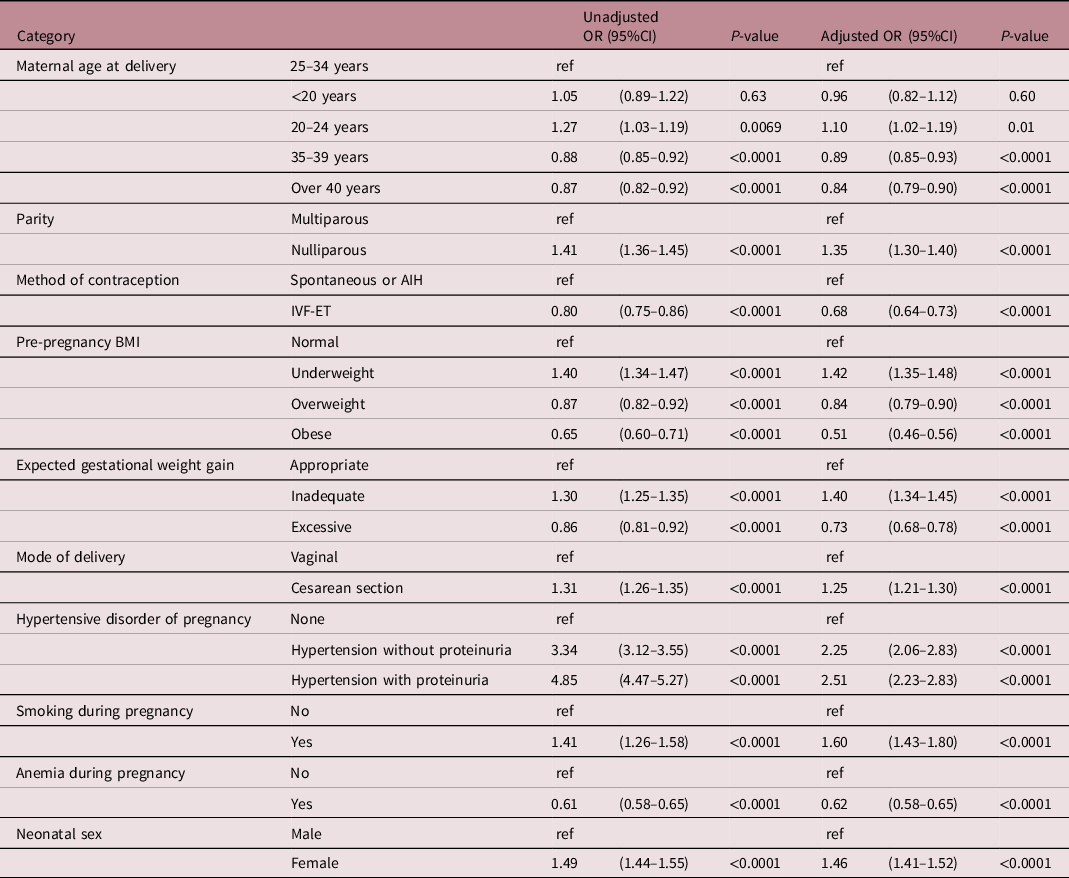
The association between clinical information and LBW in singleton LP neonates is shown in Table 3. After adjustment for other risk factors, the OR was 1.10 (95% CI: 1.02–1.19) for those aged 20–24 years. In contrast, older mothers had a lower LBW risk after adjustment for other risk factors. Pre-pregnancy underweight and inadequate GWG also independently contributed to LBW. LBW risk for pre-pregnancy underweight was 1.42 (95% CI: 1.35–1.48) compared to normal pre-pregnancy weight. LBW risk for those with inadequate expected GWG was 1.40 (95% CI: 1.34–1.45) compared to those with expected appropriate GWG. Nulliparity (aOR: 1.35, 95% CI: 1.30–1.40), smoking during pregnancy (aOR: 1.60, 95% CI: 1.43–1.80), CS (aOR: 1.25, 95% CI: 1.21–1.30), and female offspring (aOR: 1.46, 95% CI: 1.41–1.52) also independently contributed to LBW risk in LP singletons. Compared to the non-HDP condition, hypertension without proteinuria (GH and CH) was associated with an increased LBW risk (aOR: 2.25, 95% CI: 2.06–2.83). Moreover, LBW risk in LP singletons was even higher for those with hypertension with proteinuria (PE and SPE) (aOR: 2.51; 95% CI: 2.23–2.83).
Associations of maternal and perinatal factors with low birthweight in late preterm singletons

AIH, artificial insemination with husband’s semen; IVF-ET, in vitro fertilization-embryo transfer; BMI, body mass index; CI, confidence interval; OR, odds ratio.
Discussion
To the best of our knowledge, this is the first report to evaluate the risk factors associated with LBW in Japanese LP infants. According to Japanese pregnancy birth registry data, this study showed that 62.5% of singleton LP births occurred in LBW infants. Multiple independent risk factors for LBW singleton infants born between 34 0/7 and 36 6/7 weeks of gestation were identified, including age, parity, conception mode, pre-pregnancy BMI, GWG, and smoking during pregnancy. Furthermore, perinatal factors included HDP, PE, anemia during pregnancy, delivery mode, and female offspring. These risk factors for LBW were largely the same as those for term singleton infants. Reference Kasuga, Iida and Tanaka6
Sharma et al. reported that maternal, fetal, or placental/uterine factors were associated with LP birth. Reference Sharma, Padmavathi, Tabatabaii and Farahbakhsh1 However, different reasons for LP birth, including preterm premature rupture of membrane (PROM), placental previa, vasa previa, HDP, and PE, were not considered during risk evaluation of LP infants. Since there are several risks for infants born at LP, delivery selection at LP is challenging. While either expectant management or immediate delivery could be chosen for patients with preterm PROM at LP, according to recent guidelines, 12 immediate delivery was recommended because of the infection risk during this study period. 13 While scheduled CS at 37–38 weeks of gestation could be selected because of the low adhesion risk of placenta previa, Reference Vintzileos, Ananth and Smulian14 patients with placenta previa often undergo emergency CS because of abnormal bleeding at LP. Reference Grobman, Gersnoviez and Landon15 Furthermore, according to several guidelines, vasa previa should be performed with scheduled CS at 34–36 weeks of gestation. Reference Sinkey, Odibo and Dashe16-Reference Gagnon18 However, some guidelines recommend that patients with SPE and severe hypertension diagnosed at or after 34 weeks of gestation should be considered for delivery. Reference Minakami, Maeda and Fujii10,19,20 Delivery at LP may occur for several reasons, and each is associated with different risks in LP infants. Therefore, we suggest that maternal, fetal, or placental/uterine factors are considered upon risk evaluation in LP infants.
Furthermore, 62.5% of singleton LP births in this study were LBW neonates, and several risk factors for LBW were revealed in LP infants. Our study also showed that LP and LBW were connected in many ways (Fig. 2). Additionally, all SGA infants were classified into the LBW group. SGA has several risks in terms of ongoing development, including cardiovascular disease, obesity, and metabolic syndrome. Reference Barker, Winter, Osmond, Margetts and Simmonds21,Reference Boney, Verma, Tucker and Vohr22 Therefore, the relationship between LP and LBW should also be considered during risk analysis for LP. The risk factors for LBW in LP infants were similar to those in Japanese term infants. Reference Kasuga, Iida and Tanaka6,Reference Kasuga, Ikenoue and Tamagawa23 However, as compared to term infants, there might be severe conditions for LP infants, such as SPE, HELLP syndrome, and placental abruption. Since the incidence of LBW in LP was higher than that in term, obstetricians should not easily select termination during LP. However, since LBW in LP had more adverse outcomes, when obstetricians detect small fetus for gestational age in LP using ultrasonography, they should pay careful attention to avoid developing adverse maternal complications, such as SPE and HELLP syndrome. Moreover, congenital neonatal anomaly was associated with LBW in term singleton infants, but not in LP infants, possibly because the incidence of neonatal congenital anomaly was similar between LBW and non-LBW in LP infants unlike that in term infants. Mothers are often depressed about having infants at LP or with LBW; Kaplan et al. reported that mothers were shocked after giving birth to a small child, expressed feelings of guilt and remorse, and had negative feelings toward their child. However, they gradually regained their confidence as mothers and accepted reality. Reference Kaplan and Mason24 Furthermore, mothers who give birth prematurely may suffer from psychological issues due to damage to their self-esteem and self-confidence. Reference Taylor and Hall25 Although recent parents of preterm births were less stressed than their 1980s counterparts, Reference Schappin, Wijnroks, Uniken Venema and Jongmans26 we need to accurately assess the risk for neonates’ future health and provide information to mothers and learn with them.
This study had several limitations. First, the Japan Society of Obstetrics and Gynecology Successive Pregnancy Birth Registry data were not collected from all institutions that perform deliveries in Japan, and much of the data were collected from secondary and tertiary hospitals. However, it was expected that most LP infants were born at secondary and tertiary hospitals, since mothers going into labor at LP are usually transferred to hospitals that care for high-risk mothers and neonates, according to the Japanese perinatal care system. Therefore, most LP infants born in Japan might have been included in this database. Second, this database included several missing data because it did not allow data querying. Moreover, this database did not have details of maternal and paternal information to further discuss LBW risk factors (such as the socioeconomic status of the patients and environmental/behavioral risks and paternal BMI and age). If this information could be obtained, we might be able to further assess LBW risk factors in LP neonates. Lastly, we could not check the number of repeated entries that were included in the database, because it lacked a linkage between the identification number of the mother and the child. Therefore, statistical methods, such as multi-level models, might have been more suitable. Nevertheless, because few large-scale examinations to assess factors of LBW in LP births exist, our results would be valuable to appropriately assess the several perinatal and future health risks in LP infants by understanding the relationship between LP and LBW.
In conclusion, according to the Japanese pregnancy birth registry data, more than half of LP neonates had LBW. Since there are many causes of LBW, we previously discussed the issue of LBW regarding infants with different backgrounds. We believe that several risk factors should be subdivided and considered for the risk of LP and LBW.
Supplementary material
The supplementary material for this article can be found at https://doi.org/10.1017/S2040174423000235.
Acknowledgements
We would like to thank Editage (www.editage.jp) for English language editing.
Funding statement
None.
Competing interests
The authors declare none.
Ethical standard
This study was approved by the Ethics Committee of Keio University School of Medicine, Tokyo, Japan (number: 20190220, approval date: November 25, 2019) and the Clinical Research Review Board of the Japan Society of Obstetrics and Gynecology, Tokyo, Japan (number: 2019-15, approval date: September 14, 2020).