Introduction
There is a growing interest in the nature and role of wisdom in organisations (Rowley & Slack, Reference Rowley and Slack2009), particularly in light of the current global business climate which is increasingly exposed to new challenges and complexities (Kessler, Reference Kessler2006). Concern over these complexities and the turbulence within and beyond organisational boundaries has provoked a discussion of the role of wisdom in organisations and management (Kessler, Reference Kessler2006; Rowley & Slack, Reference Rowley and Slack2009). In response, organisational theorists have started to look beyond knowledge and are looking to better understand the role of organisational and managerial wisdom (Small, Reference Small2004; Rowley & Gibbs, Reference Rowley and Gibbs2008; Rowley & Slack, Reference Rowley and Slack2009).
Rowley and Gibbs (Reference Rowley and Gibbs2008) argue that there is a growing need to explore how wisdom is understood and practised at the individual level across organisations, while Malan and Kriger (Reference Malan and Kriger1998) urge management researchers to further explore how managerial wisdom manifests and how it can be developed in organisations. As far back as 1992, Bigelow (Reference Bigelow1992) called for more research to see how managerial wisdom is applied. In-depth studies are required if wisdom is to be understood through a person’s own real-life experiences (Yang, Reference Yang2001; Gibson, Reference Gibson2008). The development of research on how wisdom is seen by managers is still in its infancy (Rowley & Slack, Reference Rowley and Slack2009) and, therefore, more research is required.
The concept of wisdom has been explored empirically amongst students (Hershey & Farrell, Reference Hershey and Farrell1997; Rowley & Slack, Reference Rowley and Slack2009), different cultures (Yang, Reference Yang2001; Takayama, Reference Takayama2002), university professors (Sternberg, Reference Sternberg1985), older adults (Montgomery, Barber, & McKee, Reference Montgomery, Barber and McKee2002), and individuals nominated as wise (Yang, Reference Yang2008) among others. In the management literature, McKenna, Rooney, and Liesch (Reference McKenna, Rooney and Liesch2006) propose that managerial wisdom is needed if businesses, especially those in competitive and complex environments, want to succeed. In addition, within management development programmes, it is argued by Small (Reference Small2004) that there is now an urgent need to comprehensively understand the nature of wisdom and managerial wisdom. Rowley (Reference Rowley2006) maintains that wisdom has a great impact on the success of individuals, organisations, and communities as a whole. Yet, most publications to date in management wisdom have been conceptual, with empirical studies only being done recentlyFootnote 1 .
In response to the lack of empirical studies, this exploratory study reports on research into the meanings attached to the concept of wisdom by senior managers by asking the question: What is the conception of wisdom as perceived by senior managers in large businesses? To answer this question, the study interviewed senior managers in New Zealand, asking them to discuss their perception of wisdom. Using narrative analysis, themes of managerial wisdom emerged within the organisational context.
The paper continues with a literature review of wisdom and managerial wisdom, followed by the research methodology. The findings and the discussion of the study will then be presented. The paper concludes with implications, and the significance and limitations of the study.
Literature Review
Wisdom
Writing about wisdom has appeared throughout history in a variety of guises (see Birren and Svensson [Reference Birren and Svensson2005] for a historical account). It appeared in philosophy in the work of Plato and Aristotle, in religion in the work of Thomas Aquinas, and during the Enlightenment in the work of Kant and Descartes (Small, Reference Small2004). In recent times, the subject of wisdom has been taken up by psychology with much of the recent research being undertaken in the United States and Germany (Small, Reference Small2004).
The concept of wisdom has been studied extensively in psychology since the 1970s. There are three distinct schools concerning the study of wisdom. First, and the most influential (Sternberg, Reference Sternberg2004b; Craft, Reference Craft2006), is the psychological work of the Berlin School, popularised by Baltes and Staudinger (Reference Baltes and Staudinger2000). Baltes and Staudinger see wisdom ‘as an expert knowledge system concerning the fundamental pragmatics of life’ (Reference Baltes and Staudinger2000: 122). In other words, it is the ability to coordinate, weigh, and balance knowledge and judgement about important practical matters in life (Rooney & McKenna, Reference Rooney and McKenna2007). The Berlin group follows the explicit-theoretical approach to understanding wisdom, in which they have a common formal theory of wisdom that they propose accounts for wisdom (Sternberg, Reference Sternberg2001). The second school is the balance theory of wisdom (Sternberg, Reference Sternberg1998). Sternberg defines wisdom as the ‘application of intelligence, creativity, and knowledge to the common good’ (Reference Sternberg2004b: 287). In the balance theory, participants are judged to be wise by their ability to balance their intrapersonal, interpersonal, and extrapersonal interests over the long term (Staudinger, Dörner, & Mickler, Reference Staudinger, Dörner and Mickler2005: 196). The balance theory of wisdom follows the implicit-theoretical approach to understanding wisdom, in which they try to understand the people’s conception of wisdom rather than imposing their own conception (Sternberg, Reference Sternberg2001). The third school of thought is a school that explores various personal traits (e.g., age, gender, occupation) as attributes of wisdom, that is, seeing wisdom as a property of a person (Sternberg, Reference Sternberg2004b). Ardelt (Reference Ardelt2004) has defined it as a property of a person, in particular, as an integration of cognitive, reflective, and affective characteristics.
These schools of wisdom mostly share a commonality, which indicates that wisdom is interwoven with values and ethics, whether expressed as the common good, value relativism, or lifespan contextualism (Pasupathi & Staudinger, Reference Pasupathi and Staudinger2001). A comprehensive review and critique of these schools can be found in Sternberg (Reference Sternberg2004b) and Ardelt (Reference Ardelt2004).
Implicit wisdom studies
As the purpose of this study was to provide a conception of wisdom from the practitioners’ point of view, it was therefore based on the implicit-theoretical approach due to the study’s objective and methodology. Sternberg (Reference Sternberg1998), in his classic work in the field of implicit theories of wisdom, saw the common good as the goal of wisdom, and values as an integral part of wisdom. Sternberg defines wisdom as:
[T]he use of one’s intelligence and experience as mediated by values toward the achievement of a common good through a balance among (1) intrapersonal, (2) interpersonal, and (3) extrapersonal interests, over the (1) short and (2) long terms, to achieve a balance among (1) adaptation to existing environments, (2) shaping of existing environments, and (3) selection of new environments. (Reference Sternberg2004a: 164)
Western implicit studies on wisdom have been conducted since the 1970s (Sternberg & Jordan, Reference Sternberg and Jordan2005). Efforts to identify implicit theories of wisdom are exemplified by such seminal works as those by Clayton and Birren (Reference Clayton and Birren1980), Clayton (Reference Clayton1982), Sternberg (Reference Sternberg1985), and Holliday and Chandler (Reference Holliday and Chandler1986), among many others. Clayton and Birren (Reference Clayton and Birren1980), for example, after asking subjects to rate descriptors of wise people, found that wisdom had affective, reflective, and cognitive dimensions. Another example is Sternberg’s (Reference Sternberg1985) study on college students that found reasoning ability, sagacity, learning from ideas and environment, judgement, expeditious use of information, and perspicacity to be attributes of wisdom.
Several Eastern studies have been conducted to establish the implicit theories of wisdom. Examples of Eastern studies include those by Takayama (Reference Takayama2002) and Yang (Reference Yang2001, Reference Yang2008). These studies and others, as one might expect, agree that wisdom is not a unitary but rather a multidimensional construct, and that it is different across different populations (Takahashi & Overton, Reference Takahashi and Overton2005). While Takayama’s (Reference Takayama2002) study concluded that the Japanese see wisdom as ‘practical’ and ‘experience-based’, Yang’s (Reference Yang2001) study concluded that the Taiwanese perceive wisdom as a combination of cognitive ability and reflection.
Taken together, studies on implicit theories of wisdom suggest that wisdom in the West is a combination of reflection, cognitive ability, insight, compassion for others, and equanimity (Bluck & Gluck, Reference Bluck and Glück2005). Similar to the Western implicit conceptualisation of wisdom, Eastern implicit theories also emphasise cognitive ability, reflection, and compassion for others. However, and in contrast to the Western version, the layperson in the East places equal importance on social unobtrusiveness (Ardelt, Reference Ardelt2011).
Managerial wisdom
Wisdom has usually been discussed outside the field of management; however, recent financial scandals make management seem particularly in need of incorporating wisdom (Small, Reference Small2004). There has been a series of published conceptual studies on wisdom in relation to management and organisational studies including these focussing on managerial decisions (Melé, Reference Melé2010; Intezari & Pauleen, Reference Intezari and Pauleen2013), strategy and strategy as practice (Nonaka & Toyama, Reference Nonaka and Toyama2007; Chia & Holt, Reference Chia and Holt2009), leadership (McKenna, Rooney, & Boal, Reference McKenna, Rooney and Boal2009; Pauleen, Rooney, & Holden, Reference Pauleen, Rooney and Holden2010), knowledge management (Rowley, Reference Rowley2006), education (Sternberg, Reference Sternberg2001; Roca, Reference Roca2008), organisational learning (Rowley & Gibbs, Reference Rowley and Gibbs2008), and social science (Flyvbjerg, Reference Flyvbjerg2001). Kilburg (Reference Kilburg2006) published a book that focusses on developing wisdom in executives through coaching, and Küpers and Pauleen (Reference Küpers and Pauleen2013) edited the first book of its kind on practical management wisdom in an academic framework (Prusak, Reference Prusak2013).
The recent interest in managerial wisdom, sometimes referred to as executive wisdom (Kolodinsky & Bierly, Reference Kolodinsky and Bierly2013), has also been due to the realisation that there is something perhaps more important than knowledge (Kessler, Reference Kessler2006), and the recent demonstrated lack of wise practices by managers that led to unwise organisational decisions and actions documented in newspapers (see Small [Reference Small2004] for a list of examples illustrating unwise managerial decisions and Kriger [Reference Kriger2013] for wise decisions). Management theorists (including those cited here) concerned with strategy, leadership, and management development have now started to explore the notion of managerial wisdom (Chia & Holt, Reference Chia and Holt2009; McKenna, Rooney, & Boal, Reference McKenna, Rooney and Boal2009), a key element of organisational wisdom. They argue that whilst rational judgement is necessary, managerial wisdom has been suggested as a precondition for the capacity for vision, humanity, and counter-intuitive thinking, and as a philosophical frame that will enhance an organisation’s capacity to act successfully in a competitive environment (McKenna, Rooney, & Boal, Reference McKenna, Rooney and Liesch2006).
Malan and Kriger define managerial wisdom as ‘the ability to detect those fine nuances between what is right and what is not’ (Reference Malan and Kriger1998: 242). McKenna, Rooney, and Liesch (Reference McKenna, Rooney and Liesch2006), after reviewing Western philosophy, the work of Malan and Kriger (Reference Malan and Kriger1998) and Bigelow (Reference Bigelow1992) on managerial wisdom, developed the following overarching elements of practically wise managers which, taken together, comprise the social practice wisdom theory (McKenna & Biloslavo, Reference McKenna and Biloslavo2011): reason, nonrational, directed to human and virtuous outcomes, and practical and articulate. On the other hand, Hammer (Reference Hammer2002) suggests the following as dimensions of what wisdom means in management or leadership: strategic thinking and reasoning, envisioning and being able to take the long view, being able to effectively engage in dialogue with others, and effective self-management. In addition, Intezari and Pauleen (Reference Intezari and Pauleen2013) proposed a model of wise management decision making. They suggested that a decision might be considered wise if it comprises at least three factors: epistemic virtue, practical virtue, and moral virtue. Recently also, Kolodinsky and Bierly (Reference Kolodinsky and Bierly2013), after drawing from different academic fields, argue that (1) knowledge, (2) moral maturity, (3) managing uncertainty, and (4) reflective strategic decision making comprise the four foundational characteristics of executive wisdom.
Despite such encouraging growth in the area of managerial wisdom, empirical research is still needed to develop a better sense of situated managerial wisdom (Gibson, Reference Gibson2008; Rowley & Slack, Reference Rowley and Slack2009; Kriger, Reference Kriger2013; Rooney, Reference Rooney2013). According to Kolodinsky and Bierly (Reference Kolodinsky and Bierly2013), research on wisdom that focusses on organisations and business management remains overwhelmingly theoretical. Therefore, it is the intent of this study to empirically explore the concept of managerial wisdom as perceived by senior managers in large businesses.
The Research Method
The main purpose of this research was to serve as an introductory investigation into the concept of wisdom as held by managers. The research question, ‘What is the conception of wisdom as perceived by senior managers in large businesses?’ is an interpretive-explorative question as it sought to explore the meanings attached to the concept of wisdom by managers. Qualitative research allows the researcher to access meaning and people’s experience and perceptions (Taylor & Bogdan, Reference Taylor and Bogdan1998). Holliday and Chandler (Reference Holliday and Chandler1986) suggest that understanding how the concept of wisdom is commonly held constitutes the first step in achieving a better understanding of it. Yang (Reference Yang2001) also proposes that determining how the notion of wisdom is commonly understood through communication and daily interaction is a key step in understanding wisdom.
Furthermore, the researcher was interested in capturing the participants’ perspectives and interpretations of the subject. Therefore, rather than confirming or testing a hypothesis as in quantitative studies, the research aimed at exploring patterns (Collis & Hussey, Reference Collis and Hussey2009). Moreover, a qualitative approach is recommended when little is known about a particular area of study (Eisenhardt, Reference Eisenhardt1989b), as is the case with the concept of managerial wisdom (Gibson, Reference Gibson2008; Rowley & Gibbs, Reference Rowley and Gibbs2008; Rowley & Slack, Reference Rowley and Slack2009).
Research design
A narrative process is suggested when the researcher is interested in capturing the views and perceptions of the participants in a particular situation (Patton, Reference Patton2002; Creswell, Reference Creswell2003). This research employed a narrative approach, aiming to build a picture of managerial wisdom through the experiences and perspectives of those who have encountered what they believe to be managerial wisdom. This is consistent with capturing the concept of wisdom as suggested by Glück, Bluck, Baron, and McAdams that ‘autobiographical memory acts as a storehouse of complex, integrated information about our life experiences, including the experience of having acted wisely. Tapping memory, through narratives, is a rich source of data on wisdom in individuals’ lives’ (Reference Glück, Bluck, Baron and McAdams2005: 198). In addition, Bluck and Gluck (Reference Bluck and Glück2005) suggest that findings from narrative studies contribute to implicit theories of wisdom as they detail when people perceive wisdom. Gibson (Reference Gibson2008) also suggests that narratives have the potential to display wisdom and wise characteristics that can also be used as sources for novice managers (and academics) to learn from.
Therefore, by listening to the stories of the participants themselves and how they relate these stories to what is important, a perspective of managerial wisdom was constructed. Moreover, the narrative process reduces, somewhat, the bias of the researcher over what issues are raised and highlighted.
Participants and sampling
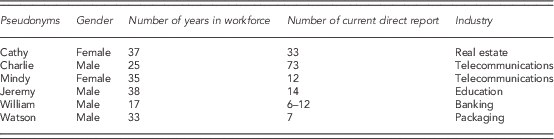
Participants were selected based on both their work experience (15+ years) and their position level (senior positions). Interview invitations were sent via email to 20 senior managers in large businesses in Auckland, New Zealand. Participants were identified by referring to the businesses’ websites and were asked to participate in a study of managerial wisdom. Only six replied and indicated their willingness to participate. The participants were relatively diverse in work experience, positions, and industry. A list of the participants interviewed is provided in Table A1 (pseudonyms were used to ensure anonymity).
Such a small response rate may be due to the nature of the study and the sample chosen. Senior managers in large organisations are extremely busy and may not wish to be involved in academic studies. They may also be reluctant to acknowledge themselves as wise, or believe they have nothing to contribute to such a study. Nonetheless, studying a relatively small sample can still result in a good source of lessons learned as the quality of insight is what matters, not the number of participants (Patton, Reference Patton2002). In addition, researchers have suggested that conducting qualitative research, even on a single firm, may provide rich and detailed data to help avoid the simplification of complex constructs such as wisdom (Malan & Kriger, Reference Malan and Kriger1998; Kolodinsky & Bierly, Reference Kolodinsky and Bierly2013). Therefore, the focus of this study was on providing in-depth data on the understanding of the concept of managerial wisdom as has been done by other studies (Montgomery, Barber, & McKee, Reference Montgomery, Barber and McKee2002; Gibson, Reference Gibson2008).
Interviews
An open-ended, semistructured interview style was utilised throughout the interviews, helping the researcher to understand the world as seen by the participants, and enabling the capture of their points of view (Patton, Reference Patton2002). This interview technique is useful for accessing attitudes, values, interpretations, and views (Byrne, Reference Byrne2004), and follows other studies exploring the concept of wisdom (Valdez, Reference Valdez1993; Levitt, Reference Levitt1999; Bluck & Glück, Reference Bluck and Gluck2004).
Data collection, analysis, and validation
Each interview was conducted at the participant’s place of work during the participant’s usual working hours. The interviewer generally asked each participant to primarily describe an unwise/wise manager and some of the unwise/wise decisions they have made. Participants were encouraged to respond in a narrative form and to talk about their own life as managers. From the beginning, careful probing of their answers was used to help elicit detailed and concrete descriptions of how and why they learned such a concept, and why they think these decisions were wise.
Following accepted narrative and qualitative methods (Creswell, Reference Creswell2003), the data was transcribed and coded. The researcher (first author) read through each transcription, highlighting and underlining what seemed to be significant phrases and descriptors used by the participants, as well as assigning open codes (concepts). These concepts were categorised and these categories were then used to generate higher-level conceptual themes. These themes were interpreted and developed with the help of the extant literature. After arriving at general themes and patterns, the information was returned to the participants to determine the accuracy of the qualitative findings and whether it reflected what they said. Codes, categories, and themes are supported and illustrated by the narrative in the Findings and Discussion section.
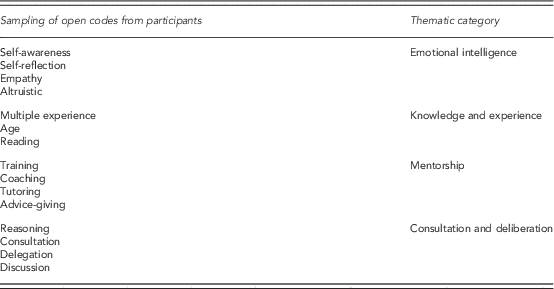
Table A2 provides the themes identified and a sample of the open codes. These initial concepts were placed in columns according to the participants’ names and the interview questions. Each column was then given a colour code according to the various concepts as they emerged. Once that was complete, the content was compared across the columns in order to extract major themes. The final step was to use the narrative passages to illustrate the findings of the analysis (Creswell, Reference Creswell2003).
Findings and Discussion
The conceptions of wisdom presented an image that is predominantly positive and practical. Based on the themes identified, a picture of a wise manager has emerged. A summary of these themes is provided in Table A2.
The identified themes were woven throughout the descriptions and are discussed below. The themes are recurring in the participants’ descriptions of wise managers. However, the various themes are not mentioned by everyone and should not be generalised nor be seen as a type of checklist of what makes up a ‘wise’ manager. These themes are an endeavour to understand what is possible as ‘the ideal of wisdom which can be aspired to and can be used as a standard to measure and evaluate’ (McKenna, Rooney, & Boal, Reference McKenna, Rooney and Boal2009: 178). With the acknowledged caveat that ‘[w]isdom as a theoretical and cultural construct is more than any given empirical method can achieve’ (Baltes & Staudinger, Reference Baltes and Staudinger2000: 124), we proceed.
Emotional intelligence
Almost all participants identified emotional intelligence as a requirement when asked to describe a wise manager. Emotional intelligence is defined as ‘the subset of social intelligence that involves the ability to monitor one’s own and others’ feelings and emotions, to discriminate among them and to use this information to guide one’s thinking and actions’ (Salovey & Mayer, Reference Salovey and Mayer1989: 189).
Participants discussed emotional intelligence as not only being knowledgeable about people’s emotions, but also being aware of their very own emotional state and being able to manage it. When asked to describe a wise manager, one participant, Watson, stated that ‘you cannot be considered wise unless you deal with a very [high] level of emotional intelligence’. Charlie stated that an ‘[u]nwise manager is one who can’t read and understand the emotion or the way their people are actually thinking’. Indeed, emotional intelligence is an integral part of wisdom because it involves regulating your emotion, judgement, and understanding (Sternberg, Reference Sternberg1998); a positive correlation has been found between the level of emotional intelligence and a person’s wisdom (Zacher, McKenna, & Rooney, Reference Zacher, McKenna and Rooney2013).
Self-awareness and self-reflection, both part of emotional intelligence (Goleman, Boyatzis, & McKee, Reference Goleman, Boyatzis and McKee2002), were referred to frequently during the descriptions of wise managers. Self-reflection is an integral part of wisdom as discussed in the literature (McKenna, Rooney, & Boal, Reference McKenna, Rooney and Boal2009). The issue of self-awareness was discussed during the interviews in the context of knowing your own limitations, strengths, and weaknesses. To William, the mark of wisdom ‘is knowing yourself well enough, know what you are good at and what you are not so good at … And that takes self-awareness, you have to be self-aware’. Watson expressed this recognition by stating that managerial wisdom ‘is a very [high] awareness of your emotional state and of the state of the people around you’.
McKenna, Rooney, and Boal (Reference McKenna, Rooney and Boal2009) observe that self-awareness at the organisational level allows managers to recognise and manage uncertainty because they are aware of the limits of reason-based cognition. One participant, William, confirmed this observation when he was discussing the global financial crisis. William noted that ‘because they [managers] are not used to that self-reflection and that self-awareness, it has all come as a bit of a shock and a bit of a surprise to them’. The importance of self-awareness stems from the nature of organisations, in which situations, people, and the environment within organisations change, so being aware of what is different is very important.
Empathy, another basic aspect of emotional intelligence, was regularly brought up during the descriptions of wise managers. Participants in another narrative study report empathy as an important part of wisdom (Glück et al., Reference Glück, Bluck, Baron and McAdams2005). Empathy was described as being able to understand people’s feelings, their positions, reasoning, and the impact of your decisions on them. This empathetic approach seems to create a comfortable and supportive environment for employees, because it sensitises managers to the dispositions and needs of others above and below them (McKenna, Rooney, & Boal, Reference McKenna, Rooney and Boal2009). As William said, ‘I was very careful to make sure they [the staff] understood the reasonings why, that I empathised [with] how they must have been feeling’.
From the descriptions of a wise manager, it seems that participants place a high value on emotional intelligence and its related constructs, and it is something that they daily practise and engage in, in their decisions, actions, and relations with others.
Experience and knowledge
While it has been suggested by McKenna, Rooney, and Boal (Reference McKenna, Rooney and Boal2009) that the focus of wisdom research is more concerned with how individuals act rather than what they know, in this study participants made significant reference to what wise people know. This can be seen when the participants describe wise managers as being both knowledgeable and experienced. Nonetheless, this could indicate that wise managers are distinguished not just for their knowledge and experience, but by the way they process these and then apply them.
Without exception, participants described wise managers as experienced and knowledgeable. This should not come as a surprise as knowledge and experience are both vital parts of wisdom in the implicit and the explicit theories of wisdom discussed in the literature. As Watson reflected, ‘people that can offer wisdom …, tend to be older, more experienced, and have a lot of knowledge’. Mindy agreed by saying ‘I guess wisdom comes from having experienced multiple things with multiple people over a period of time, so that you develop a depth, I guess, of knowledge’. Participants did not expect wise managers to be the best at every aspect of the business; however, they felt that what wise managers were able to do was to be ‘good’ at knowing what they knew, and knowing what they did not know.
It was suggested during the descriptions of wise managers that they are able to accept that they make mistakes, learn from them, and move on. This is reminiscent of Senge (Reference Senge1990) suggestion that we do not learn from our mistakes unless we are prepared to analyse and assess them. To the participants, knowledge and experience are useless if a wise manager does not learn from them. A wise manager should pause and think about past experiences, to reflect and extract lessons from these experiences. William explains it so clearly that it is important to quote him at length here:
I think learning is a key part of wisdom; I do not think, if you are not self-reflective, if you do not [look] back on your experience, and take from that new understanding and consider how you would do things differently if you are in the same situation again, I do not think you [have] much chance of gaining a lot of wisdom.
It was emphasised by some interviewees that in order to gain wisdom, you have to undergo what a few participants labelled as having ‘multiple experiences’. That is, a wise manager should experience multiple situations with multiple people in multiple environments, over a long period of time. Charlie, for example, attributed a high level of emotional intelligence to ‘experience over many, many years and in many different environments, both extremely high pressured and very diverse in terms of multicultural diversity and internationally’. Having multiple experiences may aid in developing a person’s ability to contextually understand a phenomenon, which is the ability to move beyond techné and to contextually understand a certain situation. Rooney and McKenna (Reference Rooney and McKenna2005) characterise this ability as one criterion for judging a person’s wisdom in practice.
Few participants referred to wise managers as being ‘intelligent’. While intelligence can be beneficial to managers, nonetheless, intelligence is not directly linked to wisdom (Webster, Reference Webster2003). The reason is that wisdom is a multifaceted concept so that possessing one aspect of it while lacking the others will not qualify you as wise. Possessing intellect while lacking virtue will make you smart, but not wise (Webster, Reference Webster2003). That is why when asked to describe an unwise manager, Mindy stated that some unwise managers are ‘highly intellectual but without actually having a degree of emotional intelligence’.
A few participants felt the need to stress that not all experienced and old managers are wise. Indeed, as Charlie said, ‘there [are] very poor managers who had a lot of experience’. This observation is confirmed by Webster (Reference Webster2003) who noted that age has not been shown to have an impact on measures of wisdom. This is because age is an independent variable that depends on, for example, your ability to learn from experience (Sternberg, Reference Sternberg2005). Of course, the participants believe that wisdom tends to increase with experience and age; however, while they think that age is significant for gaining wisdom, it did not appear as a prerequisite for wisdom. This is in line with Sternberg (Reference Sternberg2005) view that age is necessary for wisdom but not a sufficient condition for the development of wisdom. As Mindy suggested, ‘I can think of people I know who have experienced a lot in their very short lives and who I think are very wise’. Mindy also stated that there are even ‘very small children who may … have a terminal illness or have just had a lot of big experiences in their very short lives, who I think are very wise’.
From the descriptions of wise managers, it can be concluded that knowledge and experience are considered important qualities of wise managers. However, experience in and of itself is not necessarily effective. It is the lessons learned from the successes and failures that make it useable. In addition, it is important that both this knowledge and this experience are shared with other members of the organisation and used for development.
Mentorship
Generativity is the interest ‘in establishing and guiding the next generation’ (Erikson, Reference Erikson1959: 103). Generativity is a proto-concept used in the wisdom literature to measure the ‘caring attitude toward others or toward work’ (Wink & Helson, Reference Wink and Helson1997: 8). However, whether mentorship and generativity denote the same thing is an open debate. Baltes and Staudinger (Reference Baltes and Staudinger2000), for example, list generativity and mentoring as two different characteristics of wise persons.
Regardless, the theme of mentorship came up frequently during the interviews. This was somewhat surprising as it was not anticipated to be emphasised based on the literature. For example, Moberg (Reference Moberg2008) found no correlation between mentoring and wisdom. That is, no evidence was found that those who mentor have more wisdom than those who do not. However, participants in a study conducted by Montgomery, Barber, and McKee (Reference Montgomery, Barber and McKee2002) on older adults thought mentoring (or guidance) was part of being a wise person.
Mentoring is defined as ‘a process in which a more senior person assumes responsibility for the development of a junior person’ (Moberg, Reference Moberg2008: 835). Mentoring is discussed in the literature as a facilitator of wisdom, or something that wise people generally enjoy, such as openness to new experience (Wink & Helson, Reference Wink and Helson1997). Therefore, mentoring is more of a manifestation of wisdom, not a prerequisite of it.
Almost all participants believed that being a mentor for people around you is a key aspect of wise managers. However, they did not see mentoring as an opportunity for moral and ethical education, rather as a method of technical and social education. The participants described a mentoring manager as caring, giving advice, tutoring, and supportive. Mindy spoke of her experience, saying that ‘I do a lot of coaching and mentoring, so I coach and mentor others … and I coach and mentor other people in other different situations’. To Mindy, this is about ‘helping people’ and ‘bringing the wisdom and experience that I have’. Cathy, when asked, immediately stated that a wise manager ‘is somebody who can grow and develop people’. This view is consistent with Moberg’s (Reference Moberg2008) characterisation of mentoring as the disposition of a senior worker to advance the career prospects of the ‘protégé’. Such an approach would seem to create an enabling and supportive environment for the organisation.
Participants did not see mentoring as purely training and coaching your staff. It was seen as a constant process of investing time in explaining things to them, and making sure they are in the right career or path. Jeremy talked about how he sometimes encourages his staff to leave the organisation if an opportunity presents itself elsewhere. ‘I encourage, honestly, encourage my staff to leave’, Jeremy said. ‘I don’t mean to push them out of the place, but if there is opportunity coming up elsewhere, I direct them to it’. This approach is consistent with Moberg (Reference Moberg2008) in that mentoring is about giving advice to your staff in regard to advancing their career prospects.
Although mentoring was not found to be a prerequisite to wisdom in the literature, it seems that participants in this study strongly believe that mentorship is a mark of wise managers. Mentorship is seen as more than purely coaching and training staff. It is seen as a constant process of investing time and resources and showing concern for others.
Consultation and deliberation
During the interviews, participants kept referring to wise managers as being consultative and deliberative in their decisions and actions. That is, wise managers consult, reason, deliberate, and reflect, so they can reach a fully ‘conscious’ decision. Burke, Sims, Lazzara, and Salas argue that leaders who create a consultative environment for their staff ‘will be seen as more benevolent and potentially as having more ability in that they are consultative and not threatened by suggestions from team members’ (Reference Burke, Sims, Lazzara and Salas2007: 622).
In making a decision, Mindy spoke of how she ‘seeks out other people’s perspectives and viewpoints’. Before making any important decision, Watson indicated that ‘one of the most important things that I can do is to be consultative and to draw from the knowledge of the people around me’.
The term ‘consultative’ came in contrast to someone who completely ignores staff, makes impulsive decisions, and then imposes them, someone who only gives orders, and thinks that he or she knows all the answers. Jeremy, in his answer, stated that ‘a good manager, a wise manager, is someone who thinks about his or her employees, because they need to be empowered’. An unwise manager, for Watson, is ‘[s]omebody who works alone, thinks that they know all the answers …, does not seek involvement from the people that he or she works with’.
Wise managers consider stakeholders and any other person who will be affected by the decision. Every decision must be fully explained and articulated to those parties who are affected. All the reasoning and consequences must also be explained to them. William spoke passionately about always considering people involved in making a decision. He explains that ‘I do not think it is fair to anybody involved to make a snap decision on something as important as somebody’s career’.
Wise managers were also described as not hesitant to delegate where appropriate. Participants saw this delegation strategy as a powerful tool for empowering staff. To Mindy, ‘even if you think in your own way that they [the staff] probably are going to get it wrong’, a wise manager ‘lets them go and have a go at it and then coaches them’. In contrast, unwise managers were described as controlling, directive, and micromanaging. Nonetheless, a wise manager should be vigilant about how and when delegation is suitable. Sometimes in high-risk situations or industries, a wise manager should be directive and authoritative. Therefore, it seems that a wise manager is someone who has the ability to know when to apply a certain managerial style. This is perfectly consistent with the definition of managerial wisdom, namely the ability to detect those fine nuances in a given situation before acting.
It is interesting that wise managers were described as not needing to know everything and not afraid to admit their weaknesses and limitations. This approach seems to create a safe environment for staff to work in productively because they are not afraid to make mistakes, and it also suggests that their manager is honest and able to learn from their mistakes.
Summary
The findings show that senior managers in these large organisations have a practical and a well-informed conception of wisdom that consists of at least four factors: experience and knowledge, emotional intelligence, mentorship, and deliberation and consultation. The conceptions of wisdom present an image that is predominantly positive, even though a few participants included some unfavourable descriptions (e.g., autocracy). In addition, the descriptions of the wise managers did indeed indicate a particular personality type. That is, there were no instances where wise managers were described by some as strict and by others as flexible, or by some as quiet and by others as outgoing. We, therefore, believe that there is a fundamental aspect to the practice of managers that is worth investigating, for ‘[w]ise persons are approximations to wisdom, but they are not wisdom’ (Baltes & Kunzmann, Reference Baltes and Kunzmann2004: 290).
Conclusion
If we go back to the research question seeking the conception of wisdom as perceived by senior managers in large businesses, then we can answer it, based on the findings, as follows: managerial wisdom, as embodied by a manager, includes a substantial base of knowledge and experience, a high level of emotional intelligence integrating reasoning and deliberation and a mentoring perspective with respect to employees.
The findings indicate that senior managers consider wisdom, combined with scientific knowledge, as relevant within the organisational context. In addition, the findings show that concepts of ‘spirituality’, ‘religiosity’, and ‘ethics’, are all absent from the participants’ descriptions of wise managers. Following Rowley and Slack (Reference Rowley and Slack2009), this implies that participants are more inclined towards the practical aspects of wisdom (in contrast with transcendental wisdom), wisdom that has to do with reasoning and deliberation, making good decisions, and taking action based on experience-based knowledge. Nonetheless, while rational and practical judgement is necessary, vision, humanity, and counter-intuition will enhance the organisation’s capacity to act successfully in competitive environments (McKenna, Rooney, & Liesch, Reference McKenna, Rooney and Liesch2006).
The outcome of the study seems to be similar to some previous implicit studies on wisdom. In regard to the balance theory of wisdom (Sternberg, Reference Sternberg1998), participants seemed to indicate that one should try to balance one’s own interest with the interests of others and the whole organisation. Participants discussed how one should balance intrapersonal interests (achieving personal goals), with interpersonal interests (mentoring other people), and extrapersonal interests (bringing harmony to the organisation).
The cognitive (knowledge and experience), affective (emotional intelligence), and reflective (consultative and deliberative) components of wisdom correspond to what was found in Ardelt’s (Reference Ardelt2004) study. Moreover, the criteria of knowledge and experience entail rich factual and procedural knowledge in the fundamental pragmatics of life as discussed by the Berlin School of Wisdom.
Significance and implications
Perhaps, the most significant aspect of this study is that it is an early step in the development of an understanding of the conceptions of ‘wisdom’ as held by managers who have important roles in shaping organisations and communities. Such understanding will broaden and deepen our views on managerial wisdom and allow for informed discussion regarding managerial wisdom. This study also provides an opportunity for novice managers to learn from the wise judgement and action displayed by senior managers.
Moreover, while all senior managers interviewed have a positive well-established view on wisdom, nonetheless, ethics never featured in their descriptions of wise managers. This is a somewhat surprising finding and at odds with the implicit wisdom school, which includes the importance of values and ethics in wisdom. This could be due to several factors including a lack of prompting or context for ethics in the interview questions, or, perhaps more disturbingly, these managers did not perceive ethics to be part of wisdomFootnote 2 .
Nonetheless, ethics might be thought of as an abstract concept, and not concrete or applied, and therefore people may have different interpretations of just what ethics is or how it manifests in practice. Politicians, artists, and businesspeople are all entitled to their own manual of conduct; abstract ethics then might be thought of as a subject of curiosity about what ought to exist (Whittaker, Reference Whittaker1916). Even though participants did not mention ethics directly, in some cases participants did mention other terms that could be interpreted as aspects of ethics. For example, some participants mentioned ‘empathy’ and ‘helping people’, which can be interpreted as ethics.
Agency theory may explain why participants did not mention ethics directly. Agency theory is directed towards the relationship between one party (the principle) towards another party (the agent) who performs work (Ross, Reference Ross1973). An agency problem is said to occur when the desired outcomes of the principle and the agent are in conflict, and when it is difficult for the principle to verify what the agent is doing (Eisenhardt, Reference Eisenhardt1989a). Agency theory is founded on the assumption that self-interested opportunism is driving the agent and it is concerned with how to decrease the managerial opportunism in an organisational setting (Eisenhardt, Reference Eisenhardt1989a).
According to Roberts (Reference Roberts2005), in a business agent–principal relationship, shareholders’ value and protecting their ownership can become the principle by which managers come to judge their own ethics. This may explain in part why participants in this study did not directly recognise ethics as part of managerial wisdom because they believe that just protecting shareholders’ value and ownership is a form of ethical statement in itself.
Agency theory might be central to managerial wisdom and might help us understand the common contradiction between what wisdom is thought to be and what managers do. Agency theory therefore might provide a needed perspective in understanding managerial wisdom in practice.
Nonetheless, the fact that the concept of ethics was not raised by the participants may arouse concern among academics and researchers who may well wonder why ethics is not being associated with wisdom by practitioners and what, if anything, business schools can do to address this. This view mirrors Roca (Reference Roca2008) and Moberg (Reference Moberg2001) calls to introduce ethics and practical wisdom in business schools.
Participants in this study also did not mention other features of managerial wisdom discussed in the management wisdom literature. For example, strategic thinking (Hammer, Reference Hammer2002), spirituality (Zaidman & Goldstein-Gidoni, Reference Zaidman and Goldstein-Gidoni2011), and moral maturity (Kolodinsky & Bierly, Reference Kolodinsky and Bierly2013) were not mentioned by the participants in this study. This has an implication for any future development of managerial wisdom frameworks or models, and for researchers to be mindful as to what elements are to be attached to managerial wisdom.
Limitations and Future Research
The findings from this study are not meant to be generalised due to the study’s small sample. Rather, the study is meant to provide a foundation for future research and to provide additional information to further develop the concept of managerial wisdom. Future research that focusses on exploring the concept of managerial wisdom further can include a larger and more diverse sample, for example, managers and owners of small- to medium-sized enterprises or those in professional practices such as law or health and medicine.
Acknowledgements
This manuscript is an original work that has not been submitted to nor published anywhere else. All authors have read and approved the paper and have met the criteria for authorship. This paper builds on and contributes to the theoretical and still nascent empirical studies on wisdom. The paper provides a foundation for future research and provides additional information to further develop the concept of managerial wisdom. The paper also contributes to managerial theories by providing an empirical conceptualisation of managerial wisdom. In addition, the findings of this paper provide a look at the diversity of management practices and show how context may shape managerial practices. Finally, the findings provide a practical management perspective for educators, scholars, and novice managers to benefit and learn from.
Financial Support
This research received no specific grant from any funding agency, commercial, or not-for-profit sectors.
Conflicts of Interest
None.
Appendix
List of participants

Emerging themes based on categorising participants’ coded statements