Statement of Research Significance
Research Question(s) or Topic(s):
-
We investigated differences in cognition between variants of progressive supranuclear palsy (PSP), including PSP-Richardson syndrome and cortical and subcortical PSP variants in 140 participants.
Main Findings:
-
Participants with cortical variants of PSP performed worst on visual attention/working memory and executive function compared with PSP-Richardson syndrome and subcortical PSP variants.
Study Contributions:
-
These findings suggest cognitive distinctions between PSP clinical variants that are detectable with comprehensive neuropsychological assessment, which may aid in earlier identification and diagnosis of PSP.
Introduction
Progressive supranuclear palsy (PSP) is a rare parkinsonism-type neurodegenerative disease characterized neuropathologically as a 4-repeat tauopathy (Dickson, Reference Dickson2008; Steele et al., Reference Steele, Richardson and Olszewski1964) impacting subcortical and cortical brain structures along the dentatorubrothalamic tract (Gatto et al., Reference Gatto, Martin, Ali, Clark, Duffy, Utianski, Botha, Machulda, Dickson, Josephs and Whitwell2022; Whitwell et al., Reference Whitwell, Avula, Master, Vemuri, Senjem, Jones, Jack and Josephs2011). PSP presents clinically with a combination of motor, cognitive, and emotional/behavioral changes, with the most classic symptoms of PSP including vertical supranuclear gaze palsy, axial greater than appendicular rigidity, and postural instability with falls (Litvan et al., Reference Litvan, Agid, Calne, Campbell, Dubois, Duvoisin, Goetz, Golbe, Grafman, Growdon, Hallett, Jankovic, Quinn, Tolosa and Zee1996). This presentation is known as PSP with Richardson syndrome (PSP-RS) and is the most common form of PSP (Ali et al., Reference Ali, Martin, Botha, Ahlskog, Bower, Masumoto, Maraganore, Hassan, Eggers, Boeve, Knopman, Drubach, Petersen, Dunkley, van Gerpen, Uitti, Whitwell, Dickson and Josephs2019). However, there is wide variability in clinical presentations of PSP beyond PSP-RS. As such, the Movement Disorders Society released updated clinical diagnostic criteria for PSP in 2017, referred to as the MDS-PSP criteria, which outlined eight clinical variants of PSP based on differing clinical presentations (Hoglinger et al., Reference Höglinger, Respondek, Stamelou, Kurz, Josephs, Lang, Mollenhauer, Müller, Nilsson, Whitwell, Arzberger, Englund, Gelpi, Giese, Irwin, Meissner, Pantelyat and Rajput2017). These variants include PSP-RS, PSP with predominant parkinsonism (PSP-P), PSP with progressive gait freezing (PSP-PGF), PSP with predominant ocular motor dysfunction (PSP-OM), PSP with predominant postural instability (PSP-PI), PSP with predominant corticobasal syndrome (PSP-CBS), PSP with predominant speech/language disorder (PSP-SL), and PSP with predominant frontal presentation (PSP-F; Hoglinger et al., Reference Höglinger, Respondek, Stamelou, Kurz, Josephs, Lang, Mollenhauer, Müller, Nilsson, Whitwell, Arzberger, Englund, Gelpi, Giese, Irwin, Meissner, Pantelyat and Rajput2017).
All PSP clinical variants demonstrate some degree of deterioration of brain structures along the dentatorubrothalamic tract including the dentate nucleus of the cerebellum, superior cerebellar peduncle, midbrain, thalamus, subthalamic nucleus, striatum, globus pallidus, and frontal cortex (Whitwell et al., Reference Whitwell, Avula, Master, Vemuri, Senjem, Jones, Jack and Josephs2011; Whitwell et al., Reference Whitwell, Tosakulwong, Botha, Ali, Clark, Duffy, Utianski, Stevens, Weigand, Schwarz, Senjem, Jack, Lowe, Ahlskog, Dickson and Josephs2020), but research investigating the neuroanatomical and neuropathological differences between PSP clinical variants has demonstrated they can be grouped into “cortical” and “subcortical” designations based on brain regions most impacted for each variant. PSP clinical variants including PSP-CBS, PSP-SL, and PSP-F tend to demonstrate more gray and white matter atrophy in frontal brain regions, including premotor, supplementary motor, and motor cortex and increased levels of tau on anti-mortem neuroimaging (Whitwell et al., Reference Whitwell, Tosakulwong, Botha, Ali, Clark, Duffy, Utianski, Stevens, Weigand, Schwarz, Senjem, Jack, Lowe, Ahlskog, Dickson and Josephs2020) and post-mortem pathology (Orlandi et al., Reference Orlandi, Carlos, Ali, Clark, Duffy, Utianski and Whitwell2024), as well as more severe hypometabolism in these regions (Black et al., Reference Black, Pham, Ali, Machulda, Lowe, Josephs and Whitwell2024) compared with other clinical variants, aligning these as cortical PSP variants. Conversely, variants including PSP-P, PSP-PGF, PSP-OM, and PSP-PI demonstrate more atrophy and tau deposition in brain regions including the midbrain, putamen, and pallidum on neuroimaging (Whitwell et al., Reference Whitwell, Tosakulwong, Botha, Ali, Clark, Duffy, Utianski, Stevens, Weigand, Schwarz, Senjem, Jack, Lowe, Ahlskog, Dickson and Josephs2020) and pathologically (Williams et al., Reference Williams, Holton, Strand, Pittman, de Silva, Lees and Revesz2007; Williams et al., Reference Williams, Holton, Strand, Revesz and Lees2007), classifying these as subcortical PSP variants. PSP-RS demonstrates its own pattern of gray and white matter atrophy, as well as tau deposition that extends across both cortical and subcortical structures (Whitwell et al., Reference Whitwell, Tosakulwong, Botha, Ali, Clark, Duffy, Utianski, Stevens, Weigand, Schwarz, Senjem, Jack, Lowe, Ahlskog, Dickson and Josephs2020) and as such is typically investigated independently from the other cortical and subcortical PSP variants.
While prior work has distinguished differential patterns of gray and white matter atrophy (Whitwell et al., Reference Whitwell, Tosakulwong, Botha, Ali, Clark, Duffy, Utianski, Stevens, Weigand, Schwarz, Senjem, Jack, Lowe, Ahlskog, Dickson and Josephs2020; Whitwell et al., Reference Whitwell, Tosakulwong, Clark, Ali, Botha, Weigand, Sintini, Machulda, Schwarz, Reid, Jack, Ahlskog and Josephs2021), tau deposition (Whitwell et al., Reference Whitwell, Tosakulwong, Botha, Ali, Clark, Duffy, Utianski, Stevens, Weigand, Schwarz, Senjem, Jack, Lowe, Ahlskog, Dickson and Josephs2020), and hypometabolism (Black et al., Reference Black, Pham, Ali, Machulda, Lowe, Josephs and Whitwell2024) among PSP clinical variants, less work has focused on understanding differences in cognition between variants. Broadly, the majority of individuals with PSP develop cognitive dysfunction as part of the disease process (Brown et al., Reference Brown, Lacomblez, Landwehrmeyer, Bak, Uttner, Dubois, Agid, Ludolph, Bensimon, Payan and Leigh2010; Jellinger, Reference Jellinger2025; Koga et al., Reference Koga, Parks, Kasanuki, Sanchez‐Contreras, Baker, Josephs, Ahlskog, Uitti, Graff‐Radford, van Gerpen, Wszolek, Rademakers and Dickson2017; Raimo et al., Reference Raimo, Gaita, Cropano, Mautone, D’Iorio, Trojano and Santangelo2023), and the pattern of cognitive impairments is typically characterized as “frontal-subcortical” most typically involving deficits in complex attention, verbal fluency, and executive functions (Albert et al., Reference Albert, Feldman and Willis1974; Bak et al., Reference Bak, Crawford, Hearn, Mathuranath and Hodges2005; Koga et al., Reference Koga, Parks, Kasanuki, Sanchez‐Contreras, Baker, Josephs, Ahlskog, Uitti, Graff‐Radford, van Gerpen, Wszolek, Rademakers and Dickson2017). However, less is understood regarding whether specific cognitive differences exist between variants and, if so, what the nature of those differences is across cognitive domains. Prior work has investigated differences in cognitive performance across PSP clinical variants via screening measures, with one study showing cortical variants had worse performance on the Montreal Cognitive Assessment (MoCA) compared to PSP-RS, PSP-P, and PSP-PGF (Campagnolo et al., Reference Campagnolo, Weis, Fogliano, Cianci, Garon, Fiorenzato, Carecchio, Ferreri, Bisiacchi, Antonini and Biundo2023), another showing worse performance on Addenbrooke’s Cognitive Examination (ACE-III) in cortical compared to subcortical PSP groups (Street et al., Reference Street, Jabbari, Costantini, Jones, Holland, Rittman and Rowe2023), and another showing worse performance for cortical variants compared to PSP-RS and subcortical variants on the MoCA, ACE-III, and the Edinburgh Cognitive and Behavioral Amyotrophic Lateral Sclerosis screen (Jabbari et al., Reference Jabbari, Holland, Chelban, Jones, Lamb, Rawlinson, Guo, Costantini, Tan, Heslegrave, Roncaroli, Klein, Ansorge, Allinson, Jaunmuktane, Holton, Revesz, Warner, Lees, Zetterberg, Russell, Bocchetta, Rohrer, Williams, Grosset, Burn, Pavese, Gerhard, Kobylecki, Leigh and Morris2020). More limited research has investigated differences between variants using a more comprehensive neuropsychological assessment. In one study that included 49 PSP participants, those diagnosed with PSP-RS and PSP-CBS performed worse than PSP-PGF on a semantic verbal fluency task, and PSP-CBS performed worse on an ideomotor apraxia task compared to PSP-RS and PSP-F; no other differences between variants were found across other neuropsychological measures (Picillo et al., Reference Picillo, Cuoco, Tepedino, Cappiello, Volpe, Erro, Santangelo, Pellecchia and Barone2019). Other work that included 63 PSP participants with either PSP-RS, PSP-P, PSP-PGF, or PSP-SL showed few cognitive differences overall, with limited findings demonstrating that phonetic and semantic verbal fluency were worse in PSP-RS compared to PSP-P and that Free and Cued Selective Reminding Test total free recall and delayed free recall were more impaired in PSP-RS and PSP-PGF relative to PSP-P (Horta-Barba et al., Reference Horta-Barba, Pagonabarraga, Martínez-Horta, Busteed, Pascual-Sedano, Illán-Gala, Marin-Lahoz, Aracil-Bolaños, Pérez-Pérez, Sampedro, Bejr-Kasem and Kulisevsky2021). In this study, PSP-SL participants had more impaired semantic verbal fluency, and PSP-RS had worse performance on the Frontal Assessment Battery (FAB) compared to PSP-P, as well (Horta-Barba et al., Reference Horta-Barba, Pagonabarraga, Martínez-Horta, Busteed, Pascual-Sedano, Illán-Gala, Marin-Lahoz, Aracil-Bolaños, Pérez-Pérez, Sampedro, Bejr-Kasem and Kulisevsky2021). Another study examined differences between PSP-RS and PSP-PGF variants specifically and found worse performances on the Mini Mental State Examination (MMSE), Hasegawa Dementia Rating Scale-Revised, and Trail Making Test A in the PSP-RS group with no differences in rate of cognitive decline between groups over twelve months (Tsuboi et al., Reference Tsuboi, Tatsumi, Kobayasi, Hashimoto and Aiba2025). Work that investigated differences in cognition at baseline and longitudinally between 73 PSP-RS and 44 non-PSP-RS participants (primarily consisting of PSP-PGF and PSP-P subtypes) found poorer performances on the MMSE and cognitive domains of executive function, memory, attention, and language as well as faster decline on the MMSE and visuospatial function in the PSP-RS group (Li et al., Reference Li, Yang, Jiao, Tang, Chen, Yao, Zhao, Liang, Shen, Sun, Wu, Wang and Liu2025). Another investigation of 112 participants split into PSP-RS, PSP-Cortical, and PSP-Subcortical groups showed the PSP-Subcortical group was significantly less cognitively affected, particularly for executive functions, but pairwise comparisons between groups were not conducted (Nasri et al., Reference Nasri, Sghaier, Neji, Gharbi, Abida, Mrabet, Gargouri, Djebara, Kacem and Gouider2024).
The objective of our study was to investigate whether cognitive function differed between PSP-RS and cortical and subcortical variants of PSP using a comprehensive neuropsychological test battery examining global cognition and five cognitive domains with two or more neuropsychological tests per domain in a large sample of participants diagnosed with PSP. We hypothesized that participants diagnosed with cortical variants of PSP would demonstrate relatively more cognitive dysfunction than PSP-RS and subcortical PSP variants in cognitive domains of attention, executive function, and language, given more direct involvement of the frontal cortex in cortical PSP variants. Conversely, we hypothesized that the PSP-RS and subcortical PSP variants would show relatively more psychomotor slowing than the PSP cortical group given more involvement of subcortical structures in these variants.
Method
Participants
We included 140 participants diagnosed with PSP in a clinical setting according to MDS-PSP criteria (Hoglinger et al., Reference Höglinger, Respondek, Stamelou, Kurz, Josephs, Lang, Mollenhauer, Müller, Nilsson, Whitwell, Arzberger, Englund, Gelpi, Giese, Irwin, Meissner, Pantelyat and Rajput2017) who were enrolled in longitudinal studies as part of the Neurodegenerative Research Group (NRG) from the Department of Neurology at Mayo Clinic in Rochester, MN, for this study. The NRG recruited these participants between 2009 and 2023, and all individuals participating in NRG studies agreed to annual neurological, neuropsychological, and speech and language examinations, as well as neuroimaging studies. For the purposes of the present cross-sectional study, we included participants who had undergone at least one concurrent neurological evaluation and neuropsychological assessment; we selected data from the first available visit where both assessments were completed. For most participants, we utilized data from their initial baseline evaluations (82%), but for a minority of participants, the first administration of both neurological and neuropsychological data occurred at later visits (18%). These differences were due to variation of initial enrollment date for participants and inclusion of neuropsychological assessment as part of annual visits, as neuropsychological assessment was incorporated into study visits at a later time.
This study was approved by the Mayo Clinic Institutional Review Board in accordance with the Declaration of Helsinki, with informed consent obtained from all participants.
Neurological examination
All participants underwent a neurological examination that was conducted by a neurologist (KAJ, HB, FA) or a physician assistant (YCS) who specializes in movement disorders. All participants were stratified into a PSP clinical variant according to MDS-PSP criteria (Hoglinger et al., Reference Höglinger, Respondek, Stamelou, Kurz, Josephs, Lang, Mollenhauer, Müller, Nilsson, Whitwell, Arzberger, Englund, Gelpi, Giese, Irwin, Meissner, Pantelyat and Rajput2017). Specifically, participants were diagnosed with probable PSP-RS (n = 62) if the patient had slowing of vertical saccades/palsy and multiple spontaneous falls; PSP-P (n = 27) if the patient had asymmetric features suggestive of Parkinson’s disease and at least an early moderate response to levodopa prior to developing slowing of vertical saccades/palsy; PSP-PGF (n = 11) if the patient had progressive gait freezing early in the course of the disease; PSP-PI (n = 6) if the patient had multiple unprovoked falls or postural instability with a positive pull test without slowing of vertical saccades/palsy; PSP-CBS (n = 9) if the patient had slowing of vertical saccades/palsy and prominent features of CBS (ideomotor limb apraxia, alien limb, limb rigidity, akinesia, dystonia, or myoclonus); and PSP-SL (n = 25) if the patient had slowing of vertical saccades/palsy and prominent progressive apraxia of speech and/or agrammatic aphasia. For all PSP-SL patients, speech/language features were the earliest presenting clinical feature. We grouped the PSP-P, PSP-PGF, and PSP-PI variants as PSP-Subcortical (n = 44), and we grouped the PSP-CBS and PSP-SL variants as PSP-Cortical (n = 34) in a similar fashion to prior work from our group (Pavone et al., Reference Pavone, Weigand, Ali, Clark, Botha, Machulda, Savica, Pham, Grijalva, Schwarz, Senjem, Agosta, Filippi, Jack, Lowe, Josephs and Whitwell2023). Additionally, overall PSP disease severity was quantified for all participants at their neurological examinations using the PSP rating scale (PSP-RS; Golbe & Ohman-Strickland, Reference Golbe and Ohman-Strickland2007).
Neuropsychological tests
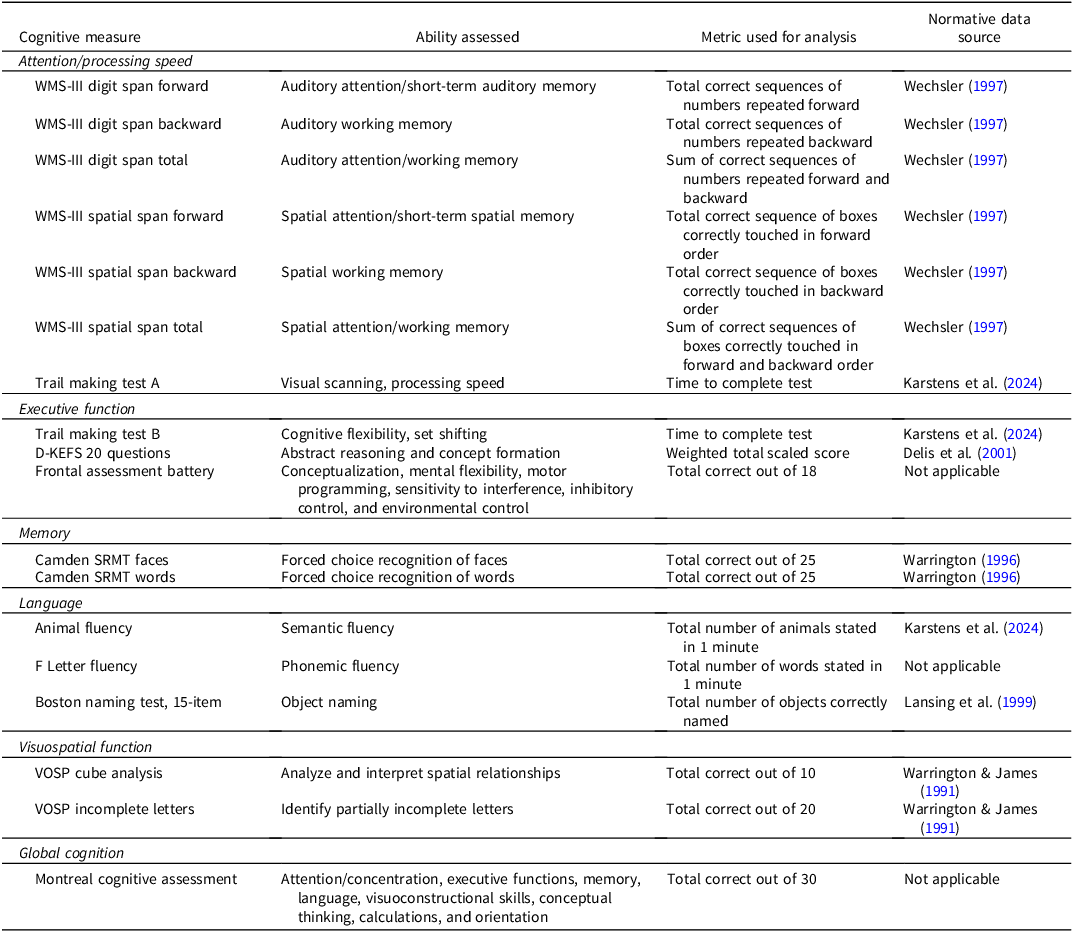
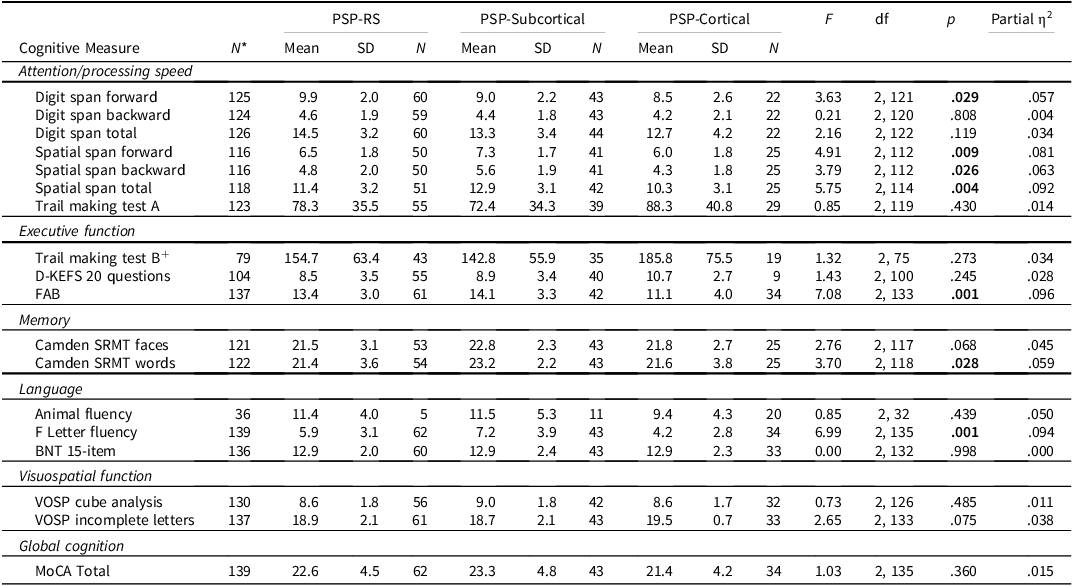
Study participants underwent a comprehensive neuropsychological evaluation conducted by a trained psychometrist under the supervision of a licensed and boarded clinical neuropsychologist (MMM). We assessed five cognitive domains as well as global cognitive function using the following neuropsychological tests: Attention/Processing Speed – Wechsler Memory Scale, 3rd Edition (WMS-III; Wechsler, Reference Wechsler1997) Digit Span Forward, Backward, and Total Score, WMS-III Spatial Span Forward, Backward, and Total Score, and Trail Making Test A (seconds to complete; Army Individual Test Battery, 1944); Executive Function – Trail Making Test B (seconds to complete; Army Individual Test Battery, 1944), Delis–Kaplan Executive Function System (D-KEFS) Twenty Questions Weighted Total Scaled Score (Delis et al., Reference Delis, Kaplan and Kramer2001), and the Frontal Assessment Battery (FAB; Dubois et al., Reference Dubois, Slachevsky, Litvan and Pillon2000); Memory – Camden Short Recognition Memory Test (SRMT) for Faces and for Words (E.K. Warrington, Reference Warrington1996); Language – Animal Fluency (Kertesz, Reference Kertesz1982), Letter Fluency (for words starting with F; Nasreddine et al., Reference Nasreddine, Phillips, Bédirian, Charbonneau, Whitehead, Collin, Cummings and Chertkow2005), and the 15-item Boston Naming Test (BNT; Kaplan et al., Reference Kaplan, Goodglass and Weintraub1983); Visuospatial Function – Visual Object and Space Perception Battery (VOSP) Cube Analysis and Incomplete Letters (E.K. Warrington & James, Reference Warrington and James1991); Global Cognition – Montral Cognitive Assessment (MoCA; Nasreddine et al., Reference Nasreddine, Phillips, Bédirian, Charbonneau, Whitehead, Collin, Cummings and Chertkow2005). Please see Table 1 for a complete list of cognitive measures, ability assessed, and the metrics used for analyses. Unless otherwise specified, raw test scores were used for analyses. Given variability in the neuropsychological test battery over time, differences in batteries across parent research studies, and differences in participant ability to complete certain tasks due to their neurological symptoms, the number of participants who completed each neuropsychological test varied (see Table 3 for details).
Description of cognitive measures and specific metrics used in the present study

Note. WMS-III = Wechsler Memory Scales, 3rd Edition, D-KEFS = Delis–Kaplan Executive Function System, SRMT = Short Recognition Memory Test, VOSP = Visual Object and Space Perception Battery.
Statistical analysis
All analyses were conducted in SPSS Version 28 with a two-tailed p-value of ≤ .05 for significance. Figure visualization was conducted in R Version 4.4.0. Descriptive analyses for participant demographics and other characteristics were quantified for continuous data by using means and standard deviations and for categorical data by using counts and percentages. We used one-way analysis of variance (ANOVA) to compare continuous background characteristics and Fisher exact tests to compare categorical background characteristics across the three PSP clinical variant groups (i.e., PSP-RS, PSP-Subcortical, and PSP-Cortical).
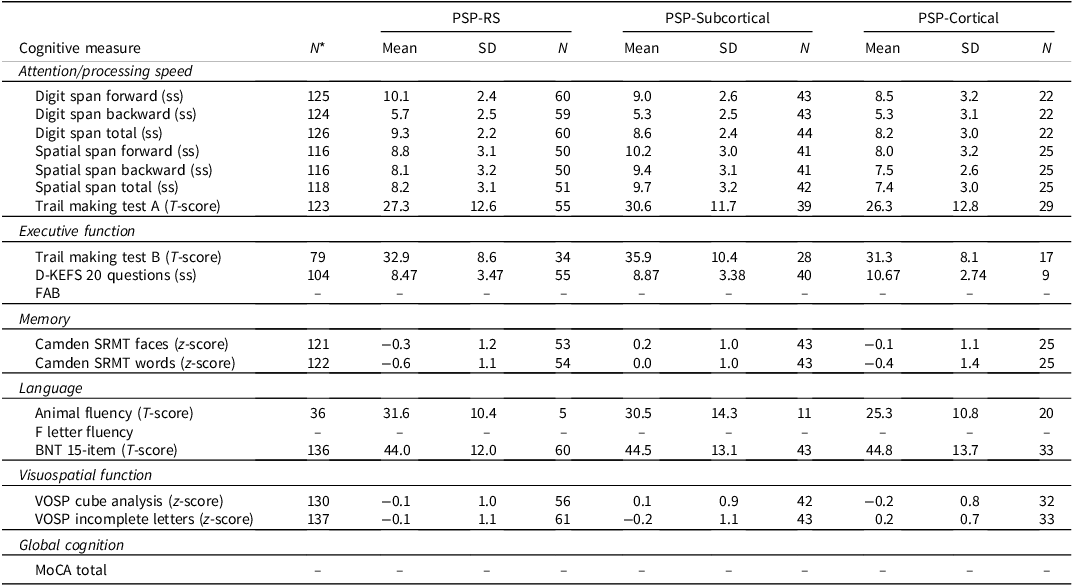
For our main analyses, we used analysis of covariance (ANCOVA) adjusted for age at visit to assess for differences in raw neuropsychological performance between PSP-RS, PSP-Subcortical, and PSP-Cortical variants across cognitive tests. We did not adjust for sex or education because there were no significant differences between groups for either of these variables. When the overall ANCOVA for a neuropsychological test was significant, we conducted post hoc pairwise comparisons with a Bonferroni correction to discern specific differences in raw neuropsychological test performance among the three PSP diagnostic groups. In exploratory analyses, we conducted the same ANCOVAs as above while additionally adjusting for disease duration (i.e., the length of time between report of symptom onset and visit date). We additionally provide descriptive information regarding normative data performance to assist with the interpretation of test performances across groups, though no analyses were conducted using normative data. Where normative data are discussed, we used descriptors recommended in the American Academy of Clinical Neuropsychology Consensus Statement (Guilmette et al., Reference Guilmette, Sweet, Hebben, Koltai, Mahone, Spiegler, Stucky and Westerveld2020).
Results
Participant characteristics
For the 140 participants included in our study sample, the average age was 71.3 years, and 49.3% of the sample was female. Additionally, 95.7% of the sample was comprised of White participants with 98.6% who identified as non-Hispanic. Participants had 15.0 years of education on average. When comparing participant characteristics between PSP-RS, PSP-Subcortical, and PSP-Cortical groups, there were significant differences in age, where participants in the PSP-Cortical group were older than the PSP-Subcortical and PSP-RS groups at the time of the visit. Additionally, there were significant differences in disease duration (i.e., years between symptom onset and study visit), where the PSP-Subcortical and PSP-Cortical groups had more years between symptom onset and visit compared to the PSP-RS group. There were no group differences for sex, years of education, or other characteristics. Please see Table 2 for participant background characteristics in the full sample and by PSP diagnostic group.
Participant characteristics for the full sample and by PSP diagnostic group

a Post hoc pairwise comparisons indicate a significant difference between the PSP-Cortical and PSP-RS groups specifically (p = .01).
b Post hoc pairwise comparisons indicate significant differences between the PSP-Cortical and PSP-RS groups (p = .003) and the PSP-Subcortical and PSP-RS groups (p < .001).
c Based on four self-identified racial categories within the sample: White (N = 134); American Indian/Alaska Native (N = 1); Asian Indian (N = 4); and Middle Eastern (N = 1).
Note. The table depicts means (standard deviations) unless otherwise noted. Comparisons between continuous variables were conducted using analysis of variance, and comparisons between categorical variables were conducted using Fisher’s exact tests. Significant p-values are in boldface. Higher scores on the PSP rating scale indicate greater symptoms of PSP. PSP = progressive supranuclear palsy, PSP-RS = progressive supranuclear palsy-Richardson syndrome, N = count, p = p-value.
Neuropsychological performances across PSP variant groups
Global cognition
Age-adjusted ANCOVAs did not reveal any significant differences between PSP diagnostic groups for overall global cognition (MoCA).
Attention and processing speed
Age-adjusted ANCOVAs demonstrated significant differences between PSP diagnostic groups for all three WMS-III Spatial Span indices (see Table 3). Post hoc pairwise comparisons showed the PSP-Cortical group performed worse than the PSP-Subcortical group for WMS-III Spatial Span Forward (estimated marginal mean [EMM] ± standard error [SE]: 6.0 ± 0.4 vs. 7.3 ± 0.3, respectively, p = .012), WMS-III Spatial Span Backward (EMM ± SE: 4.4 ± 0.4 vs. 5.6 ± 0.3, p = .035), and WMS-III Spatial Span Total (EMM ± SE: 10.4 ± 0.6 vs. 12.9 ± 0.5, p = .005). Additionally, the PSP-Cortical group performed worse than the PSP-RS group on WMS-III Spatial Span total (EMM ± SE: 10.4 ± 0.6 vs. 11.3 ± 0.4, p = .048); see Figure 1. Normatively, the PSP-Cortical group tended to perform in the low average range, whereas the PSP-RS and PSP-Subcortical groups performed in the average range (see Table 4). Visual examination of performances for subtypes within the PSP-Cortical group (i.e., PSP-SL and PSP-CBS) suggests that both subtypes show lower performances on these measures, rather than one subtype accounting for the significant findings (see Supplemental Table 1 and Supplemental Figure 1). While there were overall significant differences between groups for WMS-III Digit Span Forward, post hoc comparisons did not reveal any specific significant differences between groups, although the PSP-Cortical and PSP-Subcortical appeared to be performing worse than the PSP-RS group, with all performances in the average range (see Table 4). There were no significant group differences for the other tasks of attention/processing speed; see Table 3 and Figure 1. For all groups, performances were normatively below average or exceptionally low for WMS-III Digit Span Backward and Trail Making Test A, and within normal limits for other measures (see Table 4).
Pairwise comparisons between PSP diagnostic groups for attention/processing speed and executive function. Note: Figures depict post hoc pairwise comparisons using Bonferroni correction, including the estimated marginal means and 95% confidence intervals for performances measures of attention/processing speed (Panel A) and executive function (Panel B) across diagnostic groups of PSP-Richardson syndrome, PSP-Subcortical, and PSP-Cortical while adjusting for age at visit. Significant differences between specific groups are indicated with brackets and asterisks. PSP = progressive supranuclear palsy. WMS-III = Wechsler memory scale, 3rd edition, D-KEFS = Delis–Kaplan executive function system.* p < .05; **p < .01; ***p < .001.

Overall differences in cognitive performance across neuropsychological measures for PSP-RS, PSP-Subcortical, and PSP-Cortical diagnostic groups

*Participant N’s vary across neuropsychological tests primarily due to differences in neuropsychological test batteries between different research studies that participants are enrolled in and within research studies as test batteries have evolved over time.
+ We conducted a sensitivity analysis in which we analyzed Trail Making Test B performance across groups using parametric survival analysisadjusted for age so that we could include individuals who discontinued the task after 300 s. This resulted in a total N of 97 participants for this task, and results similarly did not show significant differences between PSP variant groups.
Note. The table depicts the raw mean and standard deviation of performance for each neuropsychological test by PSP diagnostic group, as well as results from the overall analysis of covariance, including the F-value, degrees of freedom (presented as degrees of freedom for the effect, degrees of freedom for the residual), p-value, and partial η2 value. The overall count of participants who completed each test is also included. Significant p-values are in boldface. PSP = progressive supranuclear palsy, PSP-RS = progressive supranuclear palsy-Richardson syndrome, N = count, F = F-value; df = degrees of freedom, p = p-value, η2=eta-squared, SD = standard deviation, MoCA = Montreal Cognitive Assessment, D-KEFS = Delis–Kaplan Executive Function System, FAB = Frontal Assessment Battery, SRMT = Short Recognition Memory Test, BNT = Boston Naming Test, VOSP = Visual Object and Space Perception Battery.
Differences in normative performance across neuropsychological measures for PSP-RS, PSP-Subcortical, and PSP-Cortical diagnostic groups

*Participant N’s vary across neuropsychological tests primarily due to differences in neuropsychological test batteries between different research studies that participants are enrolled in and within research studies as test batteries have evolved over time.
Note: The table depicts the normative mean and standard deviation of performance for each neuropsychological test by PSP diagnostic group. The overall count of participants who completed each test is also included. PSP = progressive supranuclear palsy, PSP-RS = progressive supranuclear palsy-Richardson syndrome, N = count, SD = standard deviation, MoCA = Montreal Cognitive Assessment, D-KEFS = Delis–Kaplan Executive Function System, FAB = Frontal Assessment Battery, SRMT = Short Recognition Memory Test, BNT = Boston Naming Test.
Executive function
For executive function, age-adjusted ANCOVAs revealed significant differences in performance on the FAB between PSP diagnostic groups (see Table 3). Specifically, the PSP-Cortical group performed worse than both the PSP-Subcortical (EMM ± SE: 11.2 ± 0.6 vs. 14.0 ± 0.5, p = .001) and PSP-RS (EMM ± SE: 11.2 ± 0.6 vs. 13.4 ± 0.4, p = .011) groups as indicated from post hoc pairwise comparisons depicted in Figure 1. Visual examination does not show clear indications of differences in performance on the FAB between the subtypes that comprise the PSP-Cortical group (i.e., PSP-SL and PSP-CBS; see Supplemental Table 1 and Supplemental Figure 2). Significant group differences were not observed for the other executive function indices. For all groups, performance was below average for Trail Making Test B and within normal limits for other measures (see Table 4).
Proportion of participants performing at or below frontal assessment battery scores for each PSP diagnostic group. Note. scores of 12 and 13 are highlighted with gray bars as these are most commonly accepted cut points for the frontal assessment battery. PSP = progressive supranuclear palsy, PSP-RS = PSP-Richardson syndrome.

Because the functions assessed by the FAB are particularly relevant to deficits observed in PSP, we additionally evaluated the proportion of participants in the PSP-RS, PSP-Cortical, and PSP-Subcortical groups that fell at or below different scores, with a visual emphasis on cut scores of 12 and 13, which are the most commonly recommended for discriminating between frontal dysexecutive type dementias and Alzheimer’s dementia on this instrument (Aiello et al., Reference Aiello, Verde, Milone, Giacopuzzi Grigoli, Dubini, Carelli and Poletti2022; Appollonio et al., Reference Appollonio, Leone, Isella, Piamarta, Consoli, Villa, Forapani, Russo and Nichelli2005; Dubois et al., Reference Dubois, Slachevsky, Litvan and Pillon2000). As shown in Figure 2, there was a higher proportion of the PSP-Cortical patients meeting this threshold than in the PSP-RS and PSP-Subcortical groups.
Memory
Age-adjusted ANCOVAs showed significant group differences on performance for the Camden SRMT for Words, but not for the Camden SRMT for Faces (see Table 3). As depicted in Figure 3, post hoc pairwise comparisons showed the PSP-RS group performed worse on the Camden SRMT for Words compared with the PSP-Subcortical group (EMM ± SE: 21.4 ± 0.4 vs. 22.8 ± 0.4, p = .030), although performances across groups were all in the average range normatively (see Table 4). For performances by subtype, please see Supplemental Table 1 and Supplemental Figure 3. All performances were within the average range (see Table 4).
Pairwise comparisons between PSP diagnostic groups for memory, language, and visuospatial function. Note: Figures depict post hoc pairwise comparisons using Bonferroni correction, including the estimated marginal means and 95% confidence intervals for performances measures of memory (Panel A), language (Panel B), and visuospatial function (Panel C) across diagnostic groups of PSP-Richardson syndrome, PSP-Subcortical, and PSP-Cortical while adjusting for age at visit. Significant differences between specific groups are indicated with brackets and asterisks. PSP = progressive supranuclear palsy.* p < .05; **p < .01; ***p < .001.

Language
Age-adjusted ANCOVAs showed significant differences in performance between PSP diagnostic groups for F Letter Fluency, where post hoc comparisons indicated that the PSP-Cortical group performed worse than the PSP-Subcortical group (EMM ± SE: 4.3 ± 0.6 vs. 7.2 ± 0.5, p < .001; see Table 3 and Figure 3). As shown in Supplemental Table 1 and Supplemental Figure 4, PSP-SL and PSP-CBS subtype performances were comparable to one another when visually examining group differences. There were no group differences for Animal Fluency or 15-item Boston Naming Test performance (see Table 3). Performances for Animal Fluency were below average or exceptionally low across all groups, whereas performance for the 15-item Boston Naming Test was average across all groups (see Table 4).
Visuospatial function
There were no significant differences in performance across PSP diagnostic groups for VOSP Cube Analysis or Incomplete Letters; see Table 3 and Figure 3. For performances by subtype, please see Supplemental Table 1 and Supplemental Figure 5. All performances were within the average range (see Table 4).
Considering disease duration
Given there were significant differences between PSP-RS, PSP-Subcortical, and PSP-Cortical groups for the length of time between the onset of PSP symptoms and their study visits, we conducted exploratory analyses to see whether additionally adjusting for disease duration impacted study results. Overall, ANCOVAs adjusted for both age at visit and disease duration showed substantially unchanged findings compared with ANCOVAs adjusting for age alone with a few exceptions. Specifically, when adjusting for both age and disease duration, ANCOVA showed significant differences in performance for Trail Making Test A, an attention/processing speed task, F (2, 118) = 3.10, p = .049, partial η 2 = .050. Post hoc comparisons indicated that the PSP-RS group performed worse on the Trail Making Test A than the PSP-Subcortical group (EMM ± SE: 85.6 ± 4.7 vs. 67.7 ± 5.4, p = .049). Additionally, when adjusting for age and disease duration, there were no longer significant differences in performance between PSP diagnostic groups for the attention/processing speed measure WMS-III Digit Span Forward, F (2, 120) = 3.02, p = .053, partial η 2 = .048, or the memory measure Camden SRMT for Words, F (2, 117) = 2.88, p = .060, partial η 2 = .047.
Discussion
In this study of 140 participants with PSP, we found differences in cognitive performance between PSP-RS, PSP-Cortical, and PSP-Subcortical clinical variants using a comprehensive neuropsychological assessment. In support of our hypothesis, we found that the PSP-Cortical group performed worse than the PSP-Subcortical group on measures of attention (Spatial Span) and executive function (FAB, F letter fluency). To a lesser extent, we similarly found that performances were worse for the PSP-Cortical group on attention (Spatial Span) and executive function (FAB) measures compared to the PSP-RS group. Additionally, the PSP-RS group performed worse than the PSP-Subcortical group on one attention task (Spatial Span Total) and one memory task (Camden SRMT for Words). The PSP-Subcortical group tended to have better performances than PSP-Cortical and PSP-RS across cognitive domains, and in contrast with our hypothesis, we did not see psychomotor slowing within this group. Additionally, adjusting for disease duration as well as age only minimally altered these results. Together, these findings demonstrate that there are detectable differences in cognitive performance between PSP clinical variants, particularly as related to attention and executive function.
PSP-Cortical versus PSP-Subcortical group performances
The PSP-Cortical group’s poorer performances on frontally mediated cognitive tasks of attention and executive function are aligned with prior neuroimaging studies of PSP-Cortical variants (Black et al., Reference Black, Pham, Ali, Machulda, Lowe, Josephs and Whitwell2024; Whitwell et al., Reference Whitwell, Tosakulwong, Botha, Ali, Clark, Duffy, Utianski, Stevens, Weigand, Schwarz, Senjem, Jack, Lowe, Ahlskog, Dickson and Josephs2020). It is established that the tasks the PSP-Cortical group performed worse on relative to the PSP-Subcortical group, including a spatial attention task (Spatial Span), phonemic fluency, and the FAB, are linked with dysfunction of frontal brain regions. Specifically, spatial attention performance has been linked with dorsolateral prefrontal cortex involvement bilaterally, particularly in the right hemisphere (Barbey et al., Reference Barbey, Koenigs and Grafman2013; Bor et al., Reference Bor, Duncan, Lee, Parr and Owen2006). Poor performance on the FAB has been associated with dysfunction in various frontal lobe regions across multiple imaging modalities, including the dorsolateral and orbitomedial frontal areas (Black et al., Reference Black, Pham, Ali, Machulda, Lowe, Josephs and Whitwell2024; Hurtado-Pomares et al., Reference Hurtado-Pomares, Carmen Terol-Cantero, Sanchez-Perez, Peral-Gomez, Valera-Gran and Navarrete-Munoz2018). Phonemic fluency is aligned with left supplementary motor area and lateral superior frontal cortex involvement (Isella et al., Reference Isella, Licciardo, Ferri, Crivellaro, Morzenti, Appollonio and Ferrarese2022). Notably, all these frontal regions have been implicated in neuroimaging studies of PSP cortical variants. Specifically, the PSP-SL variant has shown greater gray and white matter loss in premotor and motor cortex compared to PSP-RS and PSP-P, as well as smaller supplementary motor area volumes than other variants (Whitwell et al., Reference Whitwell, Tosakulwong, Botha, Ali, Clark, Duffy, Utianski, Stevens, Weigand, Schwarz, Senjem, Jack, Lowe, Ahlskog, Dickson and Josephs2020). The PSP-CBS variant has also shown greater gray and white matter loss in the frontal lobe compared to PSP-P (Whitwell et al., Reference Whitwell, Tosakulwong, Botha, Ali, Clark, Duffy, Utianski, Stevens, Weigand, Schwarz, Senjem, Jack, Lowe, Ahlskog, Dickson and Josephs2020). Diffusion tensor imaging studies have similarly revealed lower fractional anisotropy and greater mean diffusivity in frontal white matter tracts including the body and genu of the corpus callosum, superior longitudinal fasciculus, and superior fronto-occipital fasciculus for PSP-SL (Whitwell et al., Reference Whitwell, Tosakulwong, Clark, Ali, Botha, Weigand, Sintini, Machulda, Schwarz, Reid, Jack, Ahlskog and Josephs2021). Additionally, PSP-SL and PSP-CBS variants showed the most severe levels of hypometabolism in frontal regions compared to other variants, particularly in lateral and medial premotor, lateral and medial prefrontal, and sensorimotor cortex (Black et al., Reference Black, Pham, Ali, Machulda, Lowe, Josephs and Whitwell2024). On tau imaging, PSP-SL has shown greater tau uptake in the precentral cortex and supplementary motor area compared to PSP-RS and PSP-P, and on autopsy examination, tau burden is greatest in the superior frontal and motor cortices for both PSP-SL and PSP-CBS (Whitwell et al., Reference Whitwell, Tosakulwong, Botha, Ali, Clark, Duffy, Utianski, Stevens, Weigand, Schwarz, Senjem, Jack, Lowe, Ahlskog, Dickson and Josephs2020). Given these clear links between frontal lobe dysfunction in PSP-Cortical variants, it is not surprising that we saw specific cognitive deficits in cognitive tasks directly associated with dysfunction in these regions. This could also lend support for the use of the FAB over the MoCA as a screening tool for differentiating PSP variants, given differences found in performance for the PSP-Cortical group compared with PSP-RS and PSP-Subcortical, which we did not see for the MoCA.
While at first glance it may be surprising that the PSP-Cortical group did not have more differences in language performance, given one of the variants within the group is PSP-SL, closer examination reveals a clear brain-behavior related explanation for these findings. As stated earlier, there were differences between PSP-Cortical and PSP-Subcortical groups on phonemic fluency, which is not surprising and even expected given most individuals with PSP-SL present with apraxia of speech or agrammatic aphasia that is highly associated with dysfunction of the premotor and supplementary motor frontal areas (Josephs et al., Reference Josephs, Duffy, Strand, Machulda, Senjem, Master, Lowe, Jack and Whitwell2012; Valls Carbo et al., Reference Valls Carbo, Reid, Tosakulwong, Weigand, Duffy, Clark, Utianski, Botha, Machulda, Strand, Schwarz, Jack, Josephs and Whitwell2022), and individuals with PSP-CBS also typically present with frontal systems dysfunction (Isella et al., Reference Isella, Licciardo, Ferri, Crivellaro, Morzenti, Appollonio and Ferrarese2024). By contrast, semantic fluency and confrontation naming tasks, which make up the rest of our language domain, are temporal lobe-mediated processes (Melrose et al., Reference Melrose, Campa, Harwood, Osato, Mandelkern and Sultzer2009; Schmidt et al., Reference Schmidt, Nitschke, Bormann, Römer, Kümmerer, Martin, Umarova, Leonhart, Egger, Dressing, Musso, Willmes, Weiller and Kaller2019). Given that overall, all PSP variants show neuroanatomical changes along the dentatorubrothalamic tract, it makes sense that we would not see differences in cognitive performance for temporally mediated language tasks. It is also worth noting that the PSP-SL and PSP-CBS subtypes, which comprise the PSP-Cortical group, did not clearly differ from one another in their performances across language measures, which we would expect given these brain-behavior relationships.
PSP-Cortical versus PSP-Richardson syndrome group performances
There were not as many differences in cognitive performance between PSP-Cortical and PSP-RS groups compared with PSP-Cortical and PSP-Subcortical groups, but worse performances were still seen for the PSP-Cortical group on attention (Spatial Span) and executive function (FAB) measures compared to the PSP-RS group. PSP-RS tends to have more cortical involvement than PSP-Subcortical variants and, as a whole, demonstrates more widespread deterioration from the cerebellum up through the midbrain and into the thalamus, basal ganglia, and frontal cortex (Gatto et al., Reference Gatto, Martin, Ali, Clark, Duffy, Utianski, Botha, Machulda, Dickson, Josephs and Whitwell2022; Whitwell et al., Reference Whitwell, Avula, Master, Vemuri, Senjem, Jones, Jack and Josephs2011; Whitwell et al., Reference Whitwell, Tosakulwong, Botha, Ali, Clark, Duffy, Utianski, Stevens, Weigand, Schwarz, Senjem, Jack, Lowe, Ahlskog, Dickson and Josephs2020). This is also apparent as the PSP-RS group performed worse than the PSP-Subcortical group on a few tasks, including spatial attention and memory (although the memory result was no longer significant when additionally adjusting for disease duration). The PSP-Subcortical group seemed to have the least amount of cognitive dysfunction compared to the other groups, which is similar to findings reported by Nasri and colleagues (2024) and supported by imaging studies that relegate neurodegeneration and tau deposition to brainstem and subcortical regions compared to the other variant groups (Whitwell et al., Reference Whitwell, Tosakulwong, Botha, Ali, Clark, Duffy, Utianski, Stevens, Weigand, Schwarz, Senjem, Jack, Lowe, Ahlskog, Dickson and Josephs2020). Together, our findings suggest a continuum of cognitive dysfunction, particularly for attention and executive function measures, with least preserved cognition in PSP-Cortical variants, middling cognition in PSP-RS, and most preserved cognition in PSP-Subcortical variants that is aligned with patterns of neurodegeneration in these groups.
It is also important to note that where PSP variant groups did not significantly differ in performance on a task or within a domain, this did not necessarily imply that performance was normal across variants. Indeed, this was the case for Digit Span Backward, Trail Making Test A and B, and Animal Fluency, where performance was below average or worse across all PSP variant groups. Further, even when there were significant differences between groups, those performances were still in the normal range for some tasks (i.e., WMS-III Spatial Span, Camden SRMT for Words). Overall, the lack of difference between groups is also a useful indicator that specific cognitive tasks and domains are either impaired across variants or normal across variants, which is also useful information in terms of differential diagnosis when compared with other neurodegenerative diseases.
Effect of disease duration
We saw differences in disease duration (i.e., the difference between self-reported symptom onset and study visit) between the three PSP variant groups, with PSP-Subcortical having the longest disease duration (about 5.5 years), followed by PSP-Cortical (about 5 years), and PSP-RS having the shortest disease duration (about 3.5 years). One potential reason for the differences in disease duration is differences in symptom presentation and related lack of recognition/diagnostic acuity for the variants given the PSP-Subcortical and PSP-Cortical were the variants with longer disease duration. PSP-RS is much more readily recognized and more quickly diagnosed. Additionally, we cannot rule out whether accuracy for self-report of symptom onset contributed to these differences. It is important to note that while disease duration differed between groups, overall disease severity as measured by the PSP-RS did not, making it clear that disease duration is not a surrogate for disease severity. Nevertheless, for studies such as ours that investigated cognitive differences between variants, disease duration poses as a challenge. Given the cortical predominance in the PSP-Cortical variants, we might expect cognitive symptoms to develop sooner in these individuals. Thus, adjusting for disease duration in analyses may remove variability that should be included in understanding cognitive differences between groups. When we additionally adjusted for disease duration in exploratory analyses, most of our findings were unchanged, with one measure of processing speed becoming significant (Trails A) and showing worse performance for PSP-RS compared with PSP-Subcortical, and two findings that no longer remained significant (Digit Span Forward and Camden Words). These findings highlight that disease duration may account for some limited variance in cognitive differences between PSP groups, but that overall, it does not remove the majority of effects seen, particularly for the PSP-Cortical group in regard to poor attention and executive function compared to other variants. It is also possible that our somewhat longer overall disease duration in this sample may have allowed us to see differences between groups that may not have been as apparent earlier in the disease process (Horta-Barba et al., Reference Horta-Barba, Pagonabarraga, Martínez-Horta, Busteed, Pascual-Sedano, Illán-Gala, Marin-Lahoz, Aracil-Bolaños, Pérez-Pérez, Sampedro, Bejr-Kasem and Kulisevsky2021).
Strengths and limitations
One strength of this study was the use of comprehensive neuropsychological assessment, rather than predominantly cognitive screening tools, to aid in a better understanding of domain-by-domain differences in cognition between PSP clinical variants with more nuance than screening tools are able to provide. We additionally included normative data, which provides further insight into the level of impairment on neuropsychological test performance across PSP groups. Another strength of this study was our large sample of participants with PSP, which may have allowed for greater ability to detect differences in performance between cortical variants. It is possible that smaller sample sizes may have difficulty detecting cognitive differences in other studies (Picillo et al., Reference Picillo, Cuoco, Tepedino, Cappiello, Volpe, Erro, Santangelo, Pellecchia and Barone2019). Additionally, we were able to examine a variety of clinical variants, with six of eight clinical variants named in the MDS-PSP criteria (Hoglinger et al., Reference Höglinger, Respondek, Stamelou, Kurz, Josephs, Lang, Mollenhauer, Müller, Nilsson, Whitwell, Arzberger, Englund, Gelpi, Giese, Irwin, Meissner, Pantelyat and Rajput2017) included. However, despite our large sample size, two clinical variants – PSP-OM and PSP-F – were not present in this sample. Given that PSP-OM would have been classified as “PSP-Subcortical” and PSP-F as “PSP-Cortical,” it is possible that our results may have changed had these variants been included. While post hoc pairwise comparisons were Bonferroni corrected, overall ANCOVAs in each domain were not corrected for multiple comparisons due to sample size variability. The sample size variability across neuropsychological tests may also limit the generalizability of our findings. Further,our sample was not based on autopsy-confirmed PSP cases, so it is possible that other neuropathological diagnoses could account for some participants’ symptom presentations. Finally, it is possible that each PSP clinical variant has its own defined cognitive profile that is slightly different than what we observed when grouping PSP-Cortical and PSP-Subcortical variants together. Further exploration of cognition within individual variants using larger sample sizes for each variant would be warranted to best examine this question.
Conclusions and future directions
This study showed that there are differences in cognition between PSP-Cortical, PSP-RS, and PSP-Subcortical variants, with PSP-Cortical demonstrating the worst performances across measures of attention and executive function, including visual attention, letter fluency, and an executive function screening measure, compared with other groups. PSP-RS also demonstrated some lower performances on measures of attention and memory, including visual attention and word recognition memory, and PSP-Subcortical tended to show the best cognitive performances relative to the other two variant groups. Together, our findings highlight that distinctions in cognition are present among PSP clinical variants, which have important clinical diagnostic implications that may hopefully aid in more accurate and timely diagnosis of PSP, especially for those with PSP variants that are less common. Future directions of this work include examination of longitudinal cognitive trajectories within this sample and integration with neuroimaging – particularly white matter tractography and functional connectivity – to better understand the exact nature of the brain-behavior relationships resulting in the cognitive differences between PSP clinical variants identified in this work.
Supplementary material
The supplementary material for this article can be found at https://doi.org/10.1017/S1355617725101215
Acknowledgments
We would like to thank study participants and their families for their continued dedication to this research.
Funding statement
This research was funded by the National Institutes of Health (K.A.J., grant numbers R01 NS089757and R01 DC014942; J.L.W., grant number R01 DC012519).
Competing interests
The authors declare no conflicts of interest.