Introduction
Enhancing rice (Oryza sativa L.) production is an important requirement for the global food security. It is mainly cultivated in the flooded–puddled field by transplanting. However, raising seedling requires additional efforts, nursery materials and capital. On the other hand, the direct seeding is well recognized as a labor and cost-saving cultivation system (Parameswari et al., Reference Parameswari, Srinivas, Prakash and Narendar2014; Sudhir-Yadav et al., Reference Sudhir-Yadav, Evangelista, Faronilo, Humphreys, Henry and Fernandez2014). Especially in tropical regions, this cultivation practice is propagating and being extensively practiced due to the recent introduction of new cultivars and advancement in cultivation techniques (Balasubramanian and Hill, Reference Balasubramanian, Hill, Pandey, Mortimer, Wade, Tuong, Lopez and Hardy2002; Farooq et al., Reference Farooq, Siddique, Rehman, Aziz, Dong-Jin and Wahid2011; Malabayabas et al., Reference Malabayabas, Kajisa, Mazid, Palis and Johnson2014).
Well-drained (upland field), and flooded–puddled field are two different field preparation methods predominantly practiced for direct sowing of rice. Although the direct sowing in the upland field is less laborious compared to that in the flooded–puddled field (Liu et al., Reference Liu, Hussain, Zheng, Peng, Huang, Cui and Ni2015; Mahajan and Chauhan, Reference Mahajan and Chauhan2016), water management during the rice cultivation is difficult due to the leakage and seepage from the upland field. Such water loss could be minimized in the flooded–puddled field, because the fine soil particles could block the soil pore space during the precipitations after the puddling in flooded soils (Adachi, Reference Adachi, Murty and Koga1992; Singh et al., Reference Singh, Gajri, Gill and Khera1995). From the water-saving point of view, the flooded–puddled paddy-based direct sowing is a better option than that of the upland field (Tao et al., Reference Tao, Chen, Peng, Wang and Nie2016).
A major problem encountered with direct sowing in a flooded–puddled paddy field is inconsistent seedling emergence (Yamauchi et al., Reference Yamauchi, Aguilar, Vaughan and Seshu1993). The seedling emergence in puddled paddy soils was observed to decline dramatically when the seeds have gone below 10-mm mainly due to poor oxygen concentration (Sato and Maruyama, Reference Sato and Maruyama2005). Identification of low oxygen tolerant rice germplasm with better seedling emergence would, therefore, be more beneficial under flooded paddy fields. Since the flooded–puddled paddy is such a unique emergence environment (watery soil with very less oxygen availability), it would be worth to have a diversity study not only for identifying the rice germplasm with better seedling emergence, but also for identifying agro-geographies and ecotypes (indica, japonica and tropical japonica) that could provide potential promising germplasm from the rice core collection. In this process, it would be also relevant to know the influence of different endosperm starch structures on the seedling emergence as it had been reported to affect the hypoxia seed germination in rice (Furuhata et al., Reference Furuhata, Iwaki and Arima2007a). Such a relationship may provide the clue for subsequent searching of promising germplasm among the entire germplasm collection of rice comprising more than 0.12 million accessions. However, effective and simple large-scale screening method for this advantage has not been established yet, because it is difficult to maintain precise sowing depth in flooded–puddled fields (Inoue et al., Reference Inoue, Amano and Khoko1997).
Thus, the objectives of this study were (1) to develop an effective and simple screening method for rice seedling emergence rate in flooded paddy field; (2) to identify promising rice germplasm suitable for direct sowing from the world rice core collection; and (3) to analyse the relationship between the promising genotypes and their agro-geographies, ecotypes and endosperm starch structure.
Materials and methods
Rice germplasm
A world rice (O. sativa L.) core collection developed by National Institute of Agrobiological Sciences (NIAS), Japan was used in this study (Kojima et al., Reference Kojima, Ebana, Fukuoka, Nagamine and Kawase2005). This NIAS world rice core collection comprises of 69 rice germplasm accessions from 19 countries (https://www.gene.affrc.go.jp/databases-core_collections_wr_en.php) selected through molecular marker (RFLP)-based diversity representation from 300 rice accessions, and those 300 accessions were pre-screened by the passport data from a total of 37,000 rice germplasm collected across the world. In addition to the NIAS collection, six Japanese local rice cultivars (O. sativa L.), ‘Daichinohoshi’, ‘Hoshimaru’, ‘Hoshinoyume’, ‘Kirara397’, ‘Nanatsubosh’ and ‘Yumepirika’, developed in Hokkaido, northern Japan were also included.
Seedling emergence rate in pot-based evaluation system
The experiments were conducted at Hokkaido University, Japan (43° 04′ N) in 2010 and 2011. We evaluated the rice seedling emergence in flooded conditions by a pot-based screening method. In this evaluation, PVC ring plates which had 25 cm in diameter (3 cm in width of ring part), 5 mm in thickness and 135 g in weight with 16 holes of 1.5 cm diameter were used (Supplementary photo 1). Rice seeds were placed in the holes of the plate and were sandwiched by nylon mesh which was of the same ring shape as that of the PVC plate, and the mesh was fixed with the plate by water-proof tape. The plate with the seeds was put in the alluvial soil collected from a puddled paddy field in a cylindrical PVC pot with a volume of 13.5 litres. The evaluation plates were covered with the fine-uniform and watery puddled paddy alluvial soil prepared through 5 mm sieve. Periodically, manual irrigations were provided with a watering-can to maintain the pots in a flooded condition. In a previous evaluation for the seedling emergence of rice in flooded paddy conditions, the difficulty had been experienced to fix the seeds at any particular depth as the seeds tend to float to the soil surface immediately after the soils were flooded (Yamauchi et al., Reference Yamauchi, Aguilar, Vaughan and Seshu1993). In this system, the PVC plates with retained seeds were heavy enough to stay in intended position of the target sowing depth. The seedling emergence rates were evaluated by placing seeds at two different depths, viz., shallow, and deep depths. In 2010, the evaluation plates were set at 0.5 cm in depth as shallow depth evaluation, and 1.5 cm in depth as deep depth evaluation. In 2011, the sowing depth remained the same for the shallow depth, but the plates were set at 2.0 cm for deep depth so as to impose a still severe condition. These pots were placed in a split-plot design with three replications in a water pool (7.58 m × 3.5 m × 17.5 cm in water depth) in a polyethylene house.
The water temperature in the pool was monitored by thermocouples at four points to control the water temperature. If the water temperature went beyond 20°C, then cool tap water with ca. 16°C automatically flew into the water pool to maintain the water temperature at 20–23°C. The air temperature in the polyethylene house was controlled by opening and shutting the polyethylene sidewalls sheets manually according to the outside weather conditions. The air temperature was relatively constant during the experimental seasons at 20 ± 3°C. Through these automatic and manual environment management efforts, the soil temperature at the target depths in the pots could be maintained at 22°C in 2010 and 21–24°C in 2011.
To evaluate the seedling emergence in this system, pre-germinated rice seeds were used. The seeds were soaked in water at 11°C for 5 d, and then pre-germinated in warmer water at 28°C for 14 h by using a sprouting machine (SHL90, Yamabiko, Co., Ltd). In 2010, two pre-germinated seeds for each genotype were used for the evaluations, and in 2011 it was increased to six as more seeds were provided by NIAS. Since only pre-germinated seeds were selectively used for this evaluation, the seed viability was considered 100%. The seedling emergence was defined as the coleoptile appearance on the soil surface, and the number of seedlings emerged was recorded every day from one day after sowing (DAS) to 21 DAS. Based on the final seedling emergence recorded at 21 DAS, the seedling emergence rate was calculated for all germplasm accessions as per the following formula.
 $$\eqalign {{\rm Seedling}\,{\rm emergence}\,{\rm rate} =& {\rm Number}\,{\rm of}\,{\rm seedlings}\,{\rm emerged}/{\rm Number} \cr &\,{\rm of}\,\hbox{ pre-germinated}\,{\rm seeds}\,{\rm used}}$$
Seedling emergence evaluations in field condition
In 2011, a field trial was also conducted at the experimental farm of Field Science Center for Northern Biosphere of Hokkaido University (FSCNB), Japan (43° 04′ N) on the alluvial soil to confirm the relationship on seedling emergence rate between the pot evaluation system and the field condition. For this trial, six Hokkaido local cultivars, ‘Daichinohoshi’, ‘Hoshimaru’, ‘Hoshinoyume’, ‘Kirara397’, ‘Nanatsubosh’ and ‘Yumepirika’ were used as their seed quantities were enough for a field trial. Their seedling emergence rates were recorded by the pot-based evaluation system. In addition to this, they were sown in an experimental field at FSCNB. The filed was puddled and levelled on 11 May, and the residual water was drained just before sowing. For the direct sowing, seeder-tapes were prepared to put the seeds at the target soil depths. The seeds were wrapped in a thin biodegradable cloth in 2 cm intervals and twisted into a string by a seeder-tape processor. The seeder-tapes with seeds were soaked into the water at 12°C for 5 d and continued soaking in warmer water at 28°C for 14 h by using a sprouting machine (SHL90, Kyoritsu, Co., Ltd) for pre-germination. The trial was conducted in a completely randomized block design with three replications. The plot size for each cultivar was 1.2 m × 3.0 m (width × length) with six rows (the interrow distance was 20 cm). The seeder-tapes were placed on the rows and placed manually at 0.5 cm (shallow sowing) and 2.0 cm (deep sowing) in depth. The paddy field was covered with a net (20 cm × 20 cm meshes) to protect from bird damage immediately after sowing. The seedling emergence rate was evaluated once at 21 DAS.
Statistical analysis
Analysis of variance (ANOVA) was performed using statistical software (SPSS 14.0 for Windows, IBM, USA) following the procedure of McIntosh (Reference McIntosh1983) for combining the data across 2 years for the seedling emergence rates in this study. The years and replications were treated as a random effect and depth treatments and cultivars as fixed effects. Simple ANOVA was also performed for field trial as it was conducted in an only 1 year.
Results
Screening method for seedling emergence rate in flooded paddy conditions
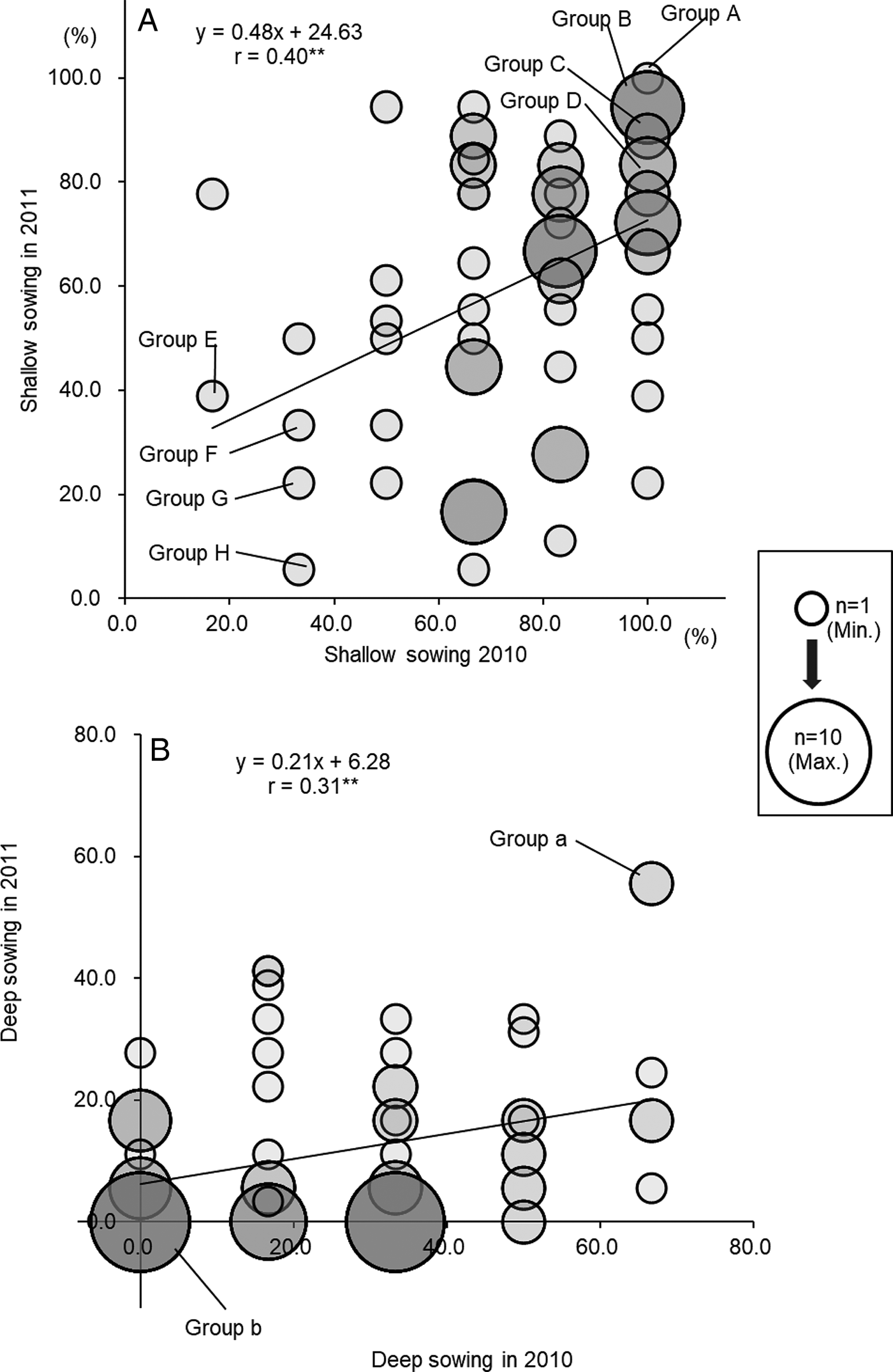
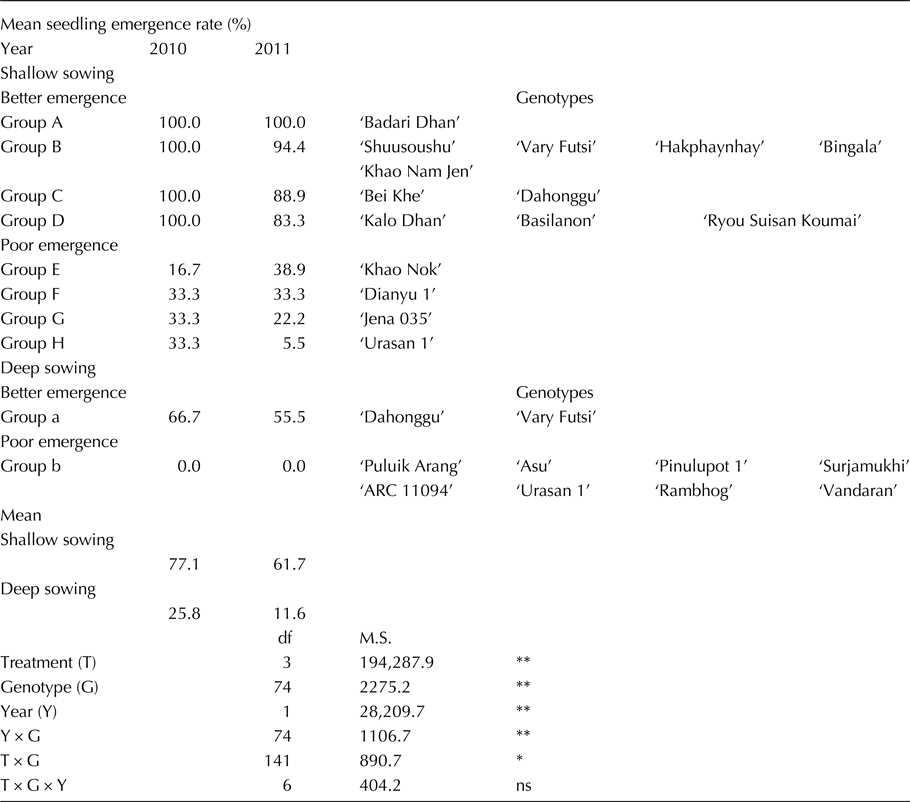
Though a significant genotype by year (G × Y) interaction was observed (Table 1), there was a significant correlation in the seedling emergence rates between years in both sowing depths (P < 0.01 in both depths) (Fig. 1A and B). In addition, a significant correlation in the seedling emergence rates was detected between the pot and the field conditions in both sowing depths in 2011 (P < 0.05 in both depths) (online Supplementary Fig. S1). These show that the pre-germinated rice seeds could exhibit relatively stable emergence rates without much influenced by the growing environments. Since the pre-germinated seeds have already developed the coleoptiles and roots, and it could minimize the error created by the nonviable seeds.
Relationship of the seedling emergence rate at different depths between 2 years. (A) shallow sowing treatment, (B) deep sowing treatment. The evaluations were made in the pot-based system. The size of the circles indicates the number of genotypes involved. The details of each group were shown in Table 1. ** Indicates significant differences at 0.01 probability level.

The rice genotype groups based on contrasting seedling emergence rates in different sowing depths in 2 years

*Significant at P < 0.05; **Significant at P < 0.01; ns, not significant.
Screening promising rice germplasm for direct sowing
A large diversity was observed in the seedling emergence rate (Table 1 and Fig. 1A and B). In the shallow sowing, it ranged from 16.7 to 100.0% in 2010 and 5.5 to 100.0% in 2011. In the deep sowing, it ranged from 0.0 to 66.7% in 2010 and 0.0 to 55.5% in 2011. In both the years, the seedling emergence rates in deep sowing were always lower compared to those in shallow sowing (Table 1). Although significant G × Y interaction was detected, in shallow sowing, 10 genotypes, ‘Badari Dhan’ (Nepal), ‘Shuusoushu’ (China), ‘Vary Futsi’ (Madagascar), ‘Hakphaynhay’ (Laos), ‘Bingala’ (Myannmer), ‘Khao Nam Jen’ (Laos), ‘Bei Khe’ (Cambodia), ‘Dahonggu’ (China), ‘Kalo Dhan’ (Nepal), ‘Basilanon’ (Philippine) and ‘Ryou Suisan Koumai‘(China) showed consistently higher seedling emergence rates in both the years (Table 1). Among these 10 superior genotypes, two genotypes, viz., ‘Vary Futsi’ and ‘Dahonggu’, showed consistently the highest seedling emergence rates even in deep sowing as 66.7% in 2010 and 55.5% in 2011.
Comparison of seedling emergence rate in different classifications
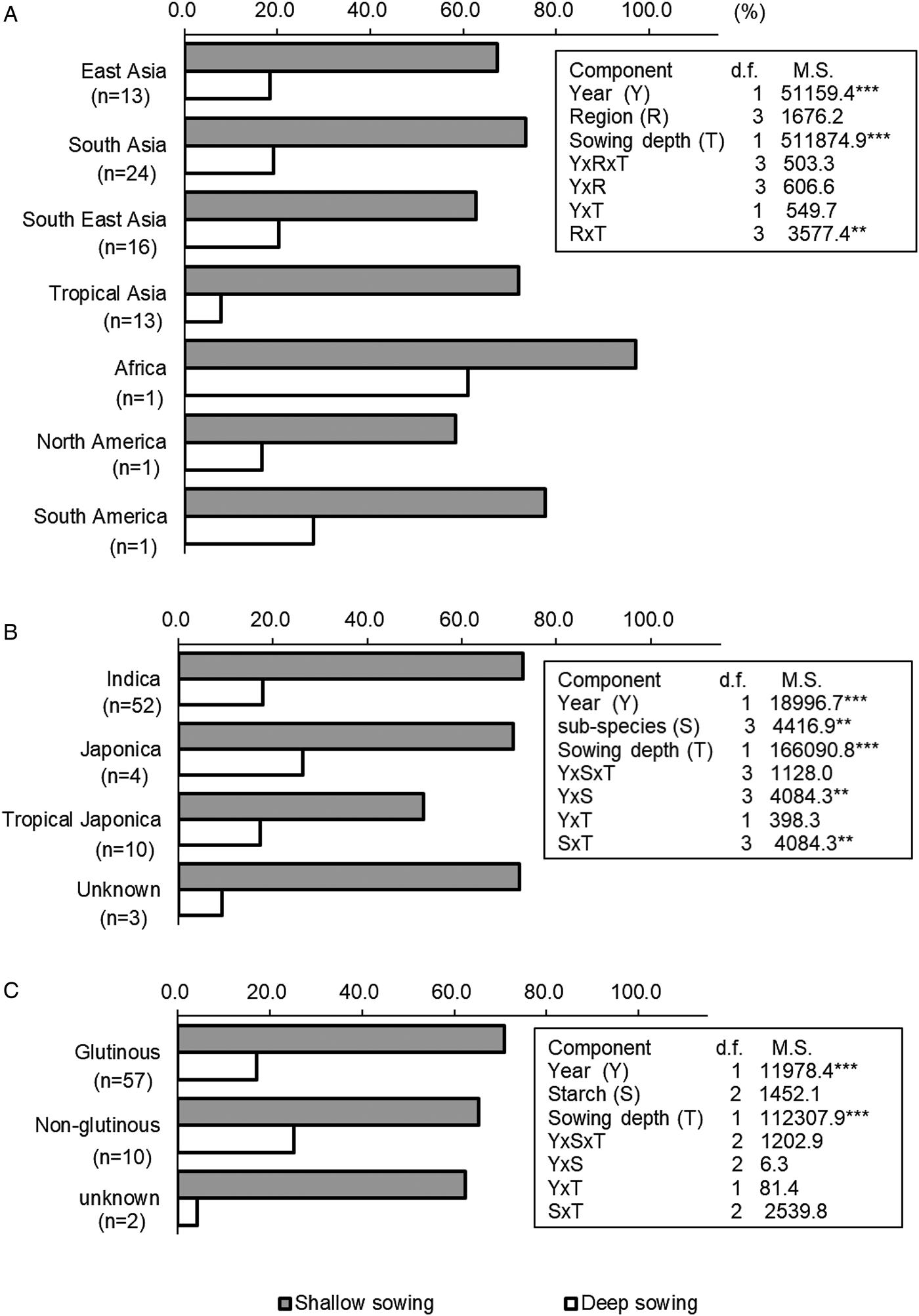
To compare the seedling emergence rate among the agro-geographical regions, the genotypes were classified into four groups based on their even distribution across regions (East Asia: n = 13, South Asia: n = 24, South East Asia: n = 16 and Tropical Asia: n = 13), the genotype groups of different regions did not differ in seedling emergence rate in both sowing depths and years (Fig. 2A). Although the number of genotypes comprised in each of the taxonomy-based groups was not so even among the groups (indica: n = 52, japonica: n = 4 and tropical japonica: n = 10), there was a significant difference in the seedling emergence rates among the groups (Fig. 2B). Tropical japonica group showed relatively poor seedling emergence rate compared to indica and japonica. There was no significant difference between the groups for the endosperm starch structure (glutinous: n = 57 and non-glutinous: n = 10) (Fig. 2C).
The seedling emergence rate at different depths among different classifications. (A) agro-geography, (B) taxonomy and (C) endosperm starch structure. The mean values of two years were shown. (n) indicates the number of germplasm involved in each group. The ANOVA results were shown in a rectangular box. **, *** Indicate significant at 0.01 and 0.001 probability levels, respectively.

Discussion
The evaluations for seedling emergence rate under actual puddled and flooded paddy fields would allow us to obtain results of high practical value but the trial preparations and management such as accuracy in field levelling, and controlling the seed floating in the watery soil, etc. were unavoidably laborious and time-consuming. Mechanization might provide a solution to these difficulties. Nishimura et al. (Reference Nishimura, Hayashi, Goto, Horio, Toriyama, Heong and Hardy2005) and Ohta (Reference Ohta2007) had reported that they could successfully manage the direct rice seed sowing with a proper depth control by a tractor attachable prototype of seeder-tape planter. However, the majority of the farmers would not be able to procure it as it is quite expensive. Alternatively, to avoid difficulty in field preparation for this evaluation, this screening can also be done in soil-filled pots or containers (Yamauchi et al., Reference Yamauchi, Aguilar, Vaughan and Seshu1993; Hagiwara and Terashima, Reference Hagiwara and Terashima2001; Ohta et al., Reference Ohta, Imbe and Yoshida2003).
The evaluation system we introduced was a simple and reliable screening method for the rice seedling emergence rate even in puddled and flooded paddy soils. In addition, the results suggested that this evaluation method could be utilized as an alternative for the field-based evaluation systems. This system provides for an easy and precise placement as well as the retention of the seeds at any particular soil depth, as the nylon mesh covering the PVC plates will prevent the seeds from floating. By this method, 16 rice genotypes could be evaluated at one time in a pot, and the seed quantities can be increased for the evaluation as a single hole on the plate can accommodate more seeds. Since the field-based evaluations on the seedling emergence rate were fairly time-consuming and laborious, it was difficult to have large-scale germplasm screening. This pot-based screening system can handle large population size for the screening, and allow us to repeat the screening without much difficulty. In addition, as it was a cost-effective system it could work as a powerful germplasm screening method, especially, in developing countries. Further improvements are needed as the correlation coefficients were not very high despite that pre-germinated seeds were used.
In paddy field after puddling, the oxygen concentration had drastically reduced at even a few mm below the soil surface as the presence of very small and fine soil particles in a well-puddled paddy field could block the oxygen diffusion into the soil (Furuhata et al., Reference Furuhata, Iwaki and Arima2007b). This could be one of the major constraints suppressing the seeding emergence rate at deeper soil depth. Due to technical issues in 2011, the water temperature could not be controlled very well. It brought relatively warmer water in 2011 than in 2010. Higher water temperatures could facilitate greater respiration of the germinating seeds. In addition, it would also reduce the dissolved oxygen concentration in water. Those could be the reasons why the seedling emergence rates in both sowing depths in 2011 were poor than those in 2010, apart from the deeper sowing (2.0 cm) in 2011 than that (1.5 cm) in 2010. This also supports that the hypoxia tolerance would be an important factor to improve the seedling emergence rate for direct sowing in a puddled paddy field.
Testing 302 rice genotypes, a large genetic diversity in the seedling emergence rate (0–95%) was reported when it was evaluated in pre-germinated seeds sown at 2 cm in nursery boxes at a room temperature of 20°C (Ohta et al., Reference Ohta, Imbe and Yoshida2003). Among them, most of the genotypes originated in Japan exhibited a seedling emergence rate of 50–80%. The landrace tended to have relatively better seedling emergence rate than the modern bred cultivars. They also found some rice genotypes with better seedling emergence rate (more than 60%) in the American, Italian and Russian genotypes. On the other hand, most of the genotypes from India, Sri Lanka and Bangladesh showed lower (<20%) seedling emergence rate. Yamauchi et al. (Reference Yamauchi, Aguilar, Vaughan and Seshu1993) also reported a large diversity in the seedling establishment (7–85%) among 660 rice genotypes. They found rice genotypes with better seedling establishment to originate from India, Vietnam, Philippines, Madagascar, Bangladesh, Japan, Nepal, Bhutan and Turkey, and in which one Madagascar landrace ‘Rojofotsy 738’ and three Chinese landraces ‘Guan-Yin-Tban’, ‘Ta Hung Ku’ and ‘Keng’ were identified as superior ones. Interestingly, two genotypes showed the best performance on seedling emergence rate in our studies were ‘Vary Futsi’ and ‘Dahonggu’, and Vary Futsi’ was a landrace from Madagascar (non-glutinous, subspecies Indica) and ‘Dahonggu’ was a landrace from China (non-glutinous, subspecies Indica).
There was no significant superiority in the seedling emergence rate in puddled paddy conditions among the genotypes of various agro-geographical regions in the world rice core collection in our studies. This indicates that the seedling emergence rate has remained as a constitutive trait under various growth environments subjected during the world diffusion and domestication process of O. sativa. However, the japonica and indica rice showed better seedling emergence rate compared with the tropical japonica rice. It indicates that this trait is likely to be of greater importance for success in their adaptation to the growth environments in regions where the japonica and indica are grown, but not so much in the tropical japonica dominant regions. Although there is little information available in the difference in seedling emergence rate among the subspecies of O. sativa., Ohta et al. (Reference Ohta, Imbe and Yoshida2003) reported the existence of difference for this trait between japonica rice and indica rice. The difference in endosperm starch characteristics did not show any specific advantage in seedling emergence rate in our studies although glucose content in the endosperm had positive effects on this trait (Furuhata et al., Reference Furuhata, Iwaki and Arima2007a).
Supplementary material
The supplementary material for this article can be found at https://doi.org/10.1017/S1479262118000011
Acknowledgements
Authors express their deep appreciation to Mr. S. Ichikawa, Hokkaido University and Mr. T. Kawai, ex-Hokkaido University staff, for their technical support to conduct the experiments. Authors appreciate Iwamizawa Agricultural Experiment Station (Hokkaido Research Organization) for sharing their knowledge and practical techniques for rice direct sowing. Authors also thank the National Institute of Agrobiological Institute (NIAS) for providing their world rice core-collection to conduct this study. Finally, authors appreciate Dr L. Krishnamurthy, former Crop physiologist, ICRISAT for his help in improving this manuscript.