Introduction
In a taxi, on my way to the UNITA-led “II Conferência Nacional sobre a vida e obra do Dr. Savimbi” (II National Conference about the life and work of Dr. Savimbi), on March 13, 2019, at the Hotel Centro de Convenções de Talatona in Luanda, I found myself discussing with the driver UNITA’s revisionist portrayal of its late leader. I told the driver that, based on my survey of newspapers, social media, and television, the creative reimagining of Jonas Savimbi’s memory appears to be gaining traction among a lot of young people. The driver quickly responded that Angolan “youth have no idea,” and, indeed, “they don’t even want to know the real truth.”
Did you know UNITA made parents kill babies with a mortar and pestle and eat them? Once UNITA soldiers stumbled upon the funeral of a baby, they made the parents dig up the body, cook it and eat it. These youngsters have no idea of the demon [Savimbi was].Footnote 1
The driver’s hyperbolic account of extreme violence was indicative of the solidly binary dichotomy that characterizes Savimbi’s memory and legacy in Angola.
Similar stories circulate not only in the private sphere of Luandan families and communities but, perhaps because they are not uncommon, they have also made their way into the Angolan national imaginary. Yet, as Stuart Hall outlines, no message reaches a collective without the “work” of signification (Hall Reference Marschall2005:73). Hall provokes us to ask, how have stories of such horror pertaining to events that took place in rural and sparsely habited bush areas amid a protracted war become widely disseminated public discourse in urban environments? Wulf Kansteiner contends that collective memory results from the interaction of three overlapping elements: media of memory, makers, and the users of memory (Kansteiner Reference Kansteiner2002:197). A memory broker, some sort of entrepreneur or articulator of a narrative, provides meaning and signification to an event not experienced in the first person. In the case of the mnemonic narrative of Jonas Savimbi, the MPLA government has been that broker of imagination and memory for decades.Footnote 2
A broad array of scholars have long been interested in the political memory of heroes and villains, either researching the historical rehabilitation of Chairman Mao (Berry, Thornton, & Sun Reference Berry, Thornton and Sun2016) and Joseph Stalin (Adler Reference Adler2012) or studying the legacies of Kwame Nkrumah (Ahlman Reference Ahlman2017) and Thomas Sankara (Harsch Reference Harsch2013). In Southern Africa, the independence of Angola and Mozambique in 1975, Zimbabwe in 1980, Namibia in 1990, and the end of apartheid in South Africa in 1994, events no more than fifty years past, mean memories of liberation are still fresh on the agenda, even in the face of rapid demographic growth. This makes the region one of the most fertile grounds for critically questioning the political uses of memory. In circumstances in which political parties base their legitimacy on claims of having fought liberation struggles that led to independence from colonial rule (see, for example, Ranger Reference Ranger2004), memory becomes valuable political capital.
As Richard Werbner argued after declaring a crisis of memory in postcolonial Africa, in southern Africa “a struggle is on (…) to give the very right of information a novel sense.” This struggle requires a focus on “politicised memory,” on the “continuing struggles whose outcome is yet to be decided, struggles in which the political cannot meaningfully be studied apart from the moral” (Werbner Reference Werbner and Werbner1998a:15). Contemporary discussions and polemics concerning heroes and villains, foundational dates and national holidays, monuments and statues, or the losses and gains of independence are indeed not mere political contestation but rather denser debates on morality and virtue. This article contributes to such debates about the political memory of heroism and villainy by exploring elements of morality and control in the southern African region.
While the interdisciplinary fields of African studies and memory studies do intersect in the research of African liberation (see MacArthur Reference MacArthur2017; Lentz & Lowe Reference Lentz and Lowe2018), colonialism (see Ball Reference Ball2018; Alexander, McGregor, & Ranger Reference Alexander, McGregor and Ranger2000), post-colonialism (see Kössler Reference Kössler2010; Werbner Reference Werbner and Werbner1998b), monumentalization (see Becker Reference Becker2011; Marschall Reference Marschall2005), and the political uses of memory (see Baba & Freire Reference Baba and Freire2019; Pearce Reference Pearce2015a; Igreja Reference Igreja2008; Pitcher Reference Pitcher2006), there is scarce understanding of the political memorialization of heroes and villains in public thought (exceptions include, for example, Rantala Reference Rantala2016; Fouéré Reference Fouéré2014; Becker Reference Becker2013). Specifically, there is little on the correlation between the “villain-ization and hero-ization of certain individuals” and political attitudes (Gugushvili et al. Reference Gugushvili, Kabachnik and Kirvlidze2017:2). To unpack this task, a focus on the politics of memorialization can assist in unravelling the construction of historical figures, how they are remembered, forgotten, or silenced, and in which socio-political context this takes place. That is to ask, how is the memory of heroes and villains appropriated and for what political and moral purposes?
In attempting to answer this question, I analyze memories of Jonas Savimbi in Angola to explore two particular domains: on the one hand, the invocation of the persona of Jonas Savimbi and the memory of his time as a technology of political control and implantation of fear exercised by the Popular Movement for the Liberation of Angola (MPLA) government, and on the other hand, as a blueprint of virtue and morality for a different state and social order. The article is divided into three sections. The first section explores the finer points of morality and virtue in UNITA’s national imaginary as constructed by Jonas Savimbi, resting on ideas of citizenship, dignity, and belonging. It then shows how both UNITA and the MPLA put in place political campaigns to discredit one another and how Savimbi came to be feared and considered a warlord. The remaining sections analyze the two domains referenced above, the memories of violence and war harnessed as technologies of socio-political control by the MPLA regime and the legacies of the political and moral aspirations Savimbi left in Angola, today recovered as narratives of contestation. Primary sources collected during fieldwork in the province of Luanda between 2017 and 2019, namely newspaper reports and interviews, letters, biographies, speeches, political cartoons, and several other products and practices of memory, provide the empirical basis of this article. Together, these materials constitute an important contemporary archive to read how Jonas Savimbi continues to be invoked in an assortment of political messages. These diverse messages build layers of different narratives upon the life and heritage of a man who profoundly shaped the history of postcolonial Angola.
Over the years, I have had the opportunity to talk to many Angolans in various informal conversations, listening to them speak about their recent history, engaging in lively debate about the history of Angolan ideas, or participating in conferences, gatherings, and various other public discussions. These encounters are a window onto the social perceptions that circulate fluidly in the public space. Although I have not recorded these multiple encounters and only provide one citation from a recorded semi-structured interview, it is noteworthy to point that they have done much to refine my thinking not only about morality and virtue in Angola but also on how Jonas Savimbi enters this conversation. This has helped to better frame and understand the issues here discussed concerning Savimbi’s memory.
Jonas Savimbi and UNITA’s national imaginary
Jonas Savimbi was born in Munhango, Bié, on August 3, 1934 (see Figure 1).Footnote 3 The son of a Protestant pastor who went to work with the Benguela railway, Savimbi spent much of his youth studying at the Protestant mission of Chilesso, which was run by the Evangelical Congregational Church of Angola (IECA). Having won a scholarship from IECA to study medicine in Lisbon, Savimbi rapidly began socializing with other African nationalists. After negative encounters with the Portuguese secret police—the International and State Defense Police (PIDE)—he fled to Switzerland, where he began making contacts with already established Angolan nationalist organizations, namely the Union of the Populations of Angola/National Front for the Liberation of Angola (UPA/FNLA) and the MPLA. Savimbi exchanged letters with the MPLA but eventually joined the UPA/FLNA.Footnote 4 That is the point when Savimbi’s political career took off, as he joined the FNLA and its Revolutionary Government of Angola in Exile (GRAE) in 1962 as Secretary-General and Minister of Foreign Affairs, respectively.

But Savimbi’s growing disillusionment with the strategy that UPA/FNLA’s leader Holden Roberto had delineated, specifically in relation to issues of nepotism, ethnic preference, and the refusal to commit troops and to position the leadership inside Angola, led him to break with this organization and form his own anti-colonial nationalist movement in 1966, the National Union for the Total Independence of Angola (UNITA). As a liberation movement, UNITA’s contribution to the Angolan struggle tells a somber story, marked by a non-aggression pact made with the Portuguese armed forces in the 1970s.Footnote 5 For his part, Savimbi always denied the pact, as other key UNITA figures still do today.
Grounded on the ideals that resulted in the Muangai Declaration upon its foundation in 1966, UNITA’s nationalist project really began taking shape just before independence, when it began mobilizing people in urban areas for its cause. Savimbi masterfully invoked people’s anxieties not only before but particularly after independence, as I have detailed elsewhere (Martins Reference Martins2016). Through speeches that nurtured imaginaries about the state and government, labor and education, civic participation and dignity, UNITA was able to appease uncertainty and fear by presenting a solid alternative in a time of profound change and doubt. For those following UNITA, ideas about citizenship, external political leadership, and the political imagination of an independent Angola began to rest entirely upon the ideals of its leadership, particularly shouldered by Jonas Savimbi. This was the situation well into the late 1980s. It was Savimbi who began adapting and translating UNITA’s vision of a post-independence Angolan citizenship, with its core in Africanity, language, tradition, equality, and liberty; it was he who contested external political leadership by denouncing the new forms of inequality the MPLA would supposedly implement; and it was certainly he who began crafting the nation-building myth that drew significantly from aspects of “traditional” and often ethnic experience and imagination to conjure an Angola deeply contrary to that of the MPLA (Martins Reference Martins2016).Footnote 6 His speeches about citizenship and the rights of Angolans, warnings of the MPLA’s corruption and lack of traditional African credentials, external political meddling, and “true” independence from imperialism, all with a southern and Ovimbundu ethnic ring, resonated strongly with the people of Angola (Martins Reference Martins2016; Péclard Reference Péclard2015; Reference Péclard and Mourier2012:172–73; Messiant Reference Messiant1994:183–87). Savimbi argued that the MPLA’s one-party Marxist-Leninist state ideology, its ignorance or very basic command of African languages, and especially the fact that it had white and mestizo leaders, which UNITA saw as a continuation of colonial rule, represented far too many foreign aspects for the assurance of the rights of the people in UNITA’s regions. Savimbi was an outstanding communicator when it came to deepening the divide between the two movements, by nurturing UNITA’s national project through his own discursive imaginary.
In the mid-1980s Savimbi also became known in conservative sectors of the United States as a democratizer.Footnote 7 In 1985, he turned to Paul Manafort to revamp his image in Washington as a freedom fighter. Manafort’s lobbying produced the ultimate prize, a meeting in the Oval Office with then-President Ronald Reagan. By this time, Savimbi was already shrouded in the image of a well-educated African leader fighting for democracy in a continent being invaded by what Savimbi called Russian and Cuban imperialism. This was also the image he sold to UNITA supporters with immense success. Depictions of his meetings in Washington, D.C., were stamped on posters and flags at Jamba, the capital of UNITA, where Savimbi received many foreign visitors.Footnote 8 By the electoral campaign of 1992, Savimbi was able to claim he had forced the MPLA government to abandon the one-party system while presenting himself as the bringer of democracy to Angola, an image that still lingers today, particularly after several controversial MPLA governments since the end of the civil war.
For its part, the MPLA produced its own campaign to discredit Savimbi, often referring to episodes of violence, internal purges, and the burning of witches (Guerra Reference Guerra2002:174), events that severely tarnished his reputation.Footnote 9 By drawing on reports of violence committed by UNITA, during the 1992 electoral campaign, the MPLA was able to draw attention to Savimbi’s deep contradictions, turning Angolans’ attention to his warmongering ways (see Bittencourt Reference Bittencourt2016).Footnote 10 To accentuate such an image, the MPLA pointed to several of Savimbi’s electoral campaign speeches, which contained bellicose references at a time when Angolans were exhausted with war. His warnings from the time, “se me provocarem isto vai ficar feio” (if they provoke me it will be ugly) and “os ninjas estão a levar no focinho” (the ninjas are being beaten up), are still remembered and repeated in present-day Angola.Footnote 11
The dominant epithet that defines the public memory of Jonas Savimbi today is indeed that of the warlord, the man who brought death and destruction to Angola. This image consolidated in the early 1990s as MPLA accounts placed sole blame on him for the return to war in 1992. In addition to the MPLA government’s political campaign against Savimbi, there was also a change in the international scene. The Cold War had ended, and Savimbi became a nuisance, a relic from the past. When confirmation of his death arrived in 2002, many people, especially in Luanda, celebrated effusively. “Shots were fired in the air and yelling in jubilation was heard saying ‘Savimbi is dead! Savimbi is dead!’”Footnote 12 The widespread sentiment was that Savimbi’s death would bring not only peace but also order and prosperity to Angola.
Around 2014, toward the end of the economic boom that marked the country’s immediate post-conflict years, Jonas Savimbi began reappearing in a positive light outside UNITA circles. This occurred as the façade of Angola’s economic development began to crack, revealing massive corruption, severe and increasing inequality, and lack of social mobility for the overwhelmingly poor population. If Savimbi’s memory was kept alive after his demise by UNITA and its militants, many of his ideals are now being discovered and consequently re-popularized by those seeking within the Angolan nationalist blueprint a moral order and narrative to provide an escape from their debilitating status quo. As Pedro Neto notes, “Television, newspapers, governmental communications, but also discussions in public transportation or in local markets, implicitly or explicitly, keep on nurturing the shadow of UNITA’s founder” (Neto Reference Neto2017:318). Feared and hated by the majority, Savimbi still echoes in the hearts and minds of many Angolans. Why are his ideas still reverberating in Angola, and why is it important to examine his political memory? Through readings of Savimbi’s public memory, it is possible to ascertain not only the politics of fear and social control but also of opposition and morality.
A technology of fear and control
To maintain control and keep expectations of social mobility low, the Angolan government appeals to the proximity—both spatial and temporal—of recognizable national threats. It frequently instrumentalizes two key events/figures to instill fear and control any sign of revolt: the civil war and Jonas Savimbi as the bringer of death, through the articulation of the phantom of war, and the May 27, 1977, purge, the fraccionistas, and Nito Alves.Footnote 13 Through the national media, rumors, public speeches, and pronouncements on historical dates or at politically sensitive times such as elections, the MPLA has actively constructed an image of Savimbi as dangerous and violent. The purpose of such tactics has historically been to intimidate the large swaths of shantytown dwellers who form the traditional ecosystem of the MPLA but have become disenfranchised by it.
The brutality with which UNITA became known to treat civilians (see Pearce Reference Pearce2015b:107–42; Brinkman Reference Brinkman2000; HRW 2003) provided the MPLA with an abundance of evidence to craftily engineer and popularize the notion that equated Savimbi with death, misery, and confusão and portrayed UNITA as the party of the confusionistas. Footnote 14 This was a message the MPLA fed into its socio-political ecosystem, ubiquitously noting that without its protection and leadership everyone would fall prey to Savimbi’s murderous intents.Footnote 15
Ricardo Soares de Oliveira writes that, as regards UNITA, the MPLA likes to “remind Angolans of that movement’s brutality and Savimbi’s responsibility for the war” (Soares de Oliveira Reference de Oliveira and Ricardo2015:102). The MPLA regime skillfully reconstitutes the UNITA menace by constantly suggesting that any political activity outside the scope of its purview and approval carries the possibility of a return to war. Jon Schubert called this the discourse of stability, a tactic he notes resonates well with “widespread popular anxieties” (Reference Schubert2018:170–71). And it is Savimbi who is popularly known to be at the center of instability. It was he who came to represent the suffering of the past and the fear of future repetition. As Pedro Neto argues, “Savimbi personified a mental frontier which synthesized many of the lived events and fears during wartime” (Neto Reference Neto2017:318). This mental frontier was fluid enough to allow the popularization of the idea that if Savimbi was ever to control the government in Angola, he would begin an assassination spree that would spare none.Footnote 16 To plant this belief, the MPLA resorted to media products that consistently vilified anything related to Savimbi and silenced people who mentioned him by accusing them of planning to bring war back to Angola. In essence, the MPLA successfully transformed the legacy and memory of Savimbi into a technology of social and political control, and the phantom of war became a key element in this.
Angolan national media has since 1975 referred to Savimbi in dualistic fashion, either completely silent about UNITA and Savimbi or openly referring to him as a criminal and armed bandit. In fact, the first time the silencing of UNITA and Savimbi gave way to a flood of references was during the 1992 electoral campaign. The MPLA’s campaign was rich in references to war, with José Eduardo dos Santos (JES) leading audiences in chanting “abaixo o ditador da Jamba” (down with the dictator of Jamba). Songs echoed from radio and television, often with metaphorical statements such as “of broken bridges I don’t want to talk/ wounds remain even on sight/ and since I want to make sure past struggles will never come back/ it is in Zedu [JES], it is in Zedu that I will vote.” MPLA speeches followed the same logics. One segment on television showed Kundi Pahiama speaking in Umbundu, stating, “If they are chosen, they will kill again. They are not in government and already they are killing. Tomorrow or after, when they are in power, how will it be?”Footnote 17 This depiction of UNITA and Savimbi continued throughout the late 1990s. For example, the 1999 Human Rights Watch report on Angola stated that the MPLA government instructed the media that “Savimbi’s UNITA was to be identified in reports as ‘armed bandits’ or the ‘forces of the criminal Savimbi’” (HRW 1999).Footnote 18 Much of this discourse still echoes today.
UNITA’s former president Isaias Samakuva recognizes that Savimbi has been and continues to be vilified through “intrigue, calumny and insult,” and that this alleged vilification continues to be conducted through media production and political propaganda.Footnote 19 Indeed, Savimbi quickly became the target of the MPLA government’s most prized tactic: the invocation of the phantom of war. News coverage and interviews, either in newspaper, radio, or television, are constantly shown ahead of politically sensitive periods, usually elections. The use of the threat of war is so prevalent that UNITA is obliged to reply, often by appealing to the electorate’s wisdom so that “ideas from the past and worn-out speeches” about war don’t turn them away from voting for UNITA.Footnote 20 The case of a video put into circulation during the campaign for the 2012 elections is indicative of these politics of fear and control.Footnote 21 In a cartoonish way, a jingling figure appeared with a photograph of Isaias Samakuva’s face on its head. Showing the red and green colors of UNITA and the black cockerel in the background, the symbol of the party, a feminine voice started singing:
Burning flags and verses of Angola’s national anthem being scratched out were shown, followed by a series of explosions and lightning striking from the eyes of the cockerel. The clip ended with the photograph of Samakuva’s head on the cartoon falling, revealing Savimbi’s head, signaling the true nature of UNITA.
Such apparatuses of fear and control were again used after the polemical 2017 elections. Days after the election, it was reported that a small plane had dropped pamphlets over neighborhoods in Luanda. The pamphlets stated the elections were free and fair and that everyone should remember that “in 1992, UNITA also did not accept the results and engulfed the country in a war which caused thousands of deaths, pain, grief and much destruction.” It ended by telling people not to protest or join those who don’t respect the will of the people and to report disturbances to the police.Footnote 23 The dropping of pamphlets with historical references exemplifies perfectly the use of this technology of fear and control. If the reference to 1992 serves to instill fear, the suggestion that people report others to the police clearly signifies popular control, something the MPLA has historically excelled at (see Mabeko-Tali Reference Mabeko-Tali2018:413–17).
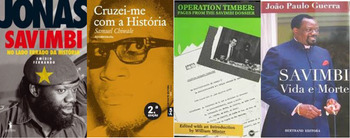
Technologies of fear and control invoking Savimbi have been continuously sustained by a series of products in various formats that summon a universe of memories uncontestably positing Jonas Savimbi as the ultimate villain. From the already-mentioned songs, videos, and state sanctioned media coverage to autobiographical and memory books, cartoons, and even videogames, all have contributed to paint a picture of Savimbi that, albeit with solid evidence, have largely depicted him as the ultimate evil in Angola. Examples abound. Authors such as R. Sotto Maior, Fernando Emídio, William Minter, João Paulo Guerra, or even UNITA’s own Samuel Chiwale all refer to fear and assassination, authoritarian rule, and personality cult (see Figure 2). Even in Chiwale’s book, which contains notorious attempts to provide a laudatory praise to Jonas Savimbi, negative issues emerge.
From left to right: Emídio Reference Emídio2012; Chiwale Reference Chiwale2008; Minter Reference Minter1988; Guerra Reference Guerra2002.

Curiously enough, Jonas Savimbi made his way into a videogame titled Call of Duty: Black Ops II produced by Activision (see Figure 3). There the player plays an American special forces soldier helping Savimbi, who is holding a grenade launcher, to fight off MPLA soldiers with Brazilian Portuguese accents.
Jonas Savimbi as represented in Call of Duty: Black Ops 2 by Activision.
Source: https://www.dn.pt/sociedade/savimbi-aparece-no-jogo-call-of-duty-familia-esta-chocada-4980457.html

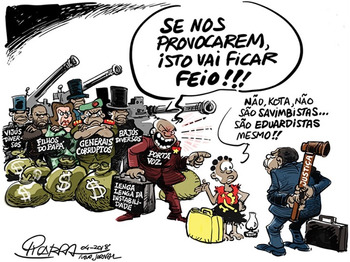
Savimbi is so strongly equated with belligerence that even caricatures use him as a reference to make other points. Sérgio Piçarras’ April 2018 cartoon did exactly that.Footnote 24 The cartoon shows President João Lourenço holding a baton in his hand with the word “justice” written on it. Opposite him are displayed a series of other characters symbolizing the various sectors of the MPLA government surrounded by large bags of money and military tanks. The “speaker” of this group says “se nos provocarem isto vai ficar feio” (if they provoke us it will be ugly), a reference to Savimbi’s already mentioned threat during the 1992 electoral campaign. Amidst the confusion appears Piçarra’s caricature of the povo, the people, explaining to the president “Não kota, não são Savimbistas, são Eduardistas mesmo!!” (No elder/older one, they are not Savimbistas, they are really Eduardistas).”Footnote 25
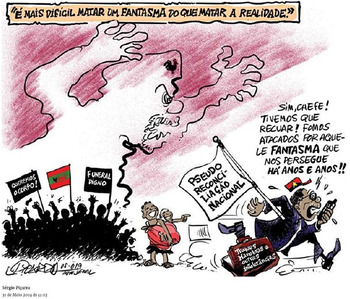
A cartoon illustrating the conflict between the new president of the country, João Lourenço, and the members of the old regime of JES (who are still members of the MPLA), pivoted around making a reference to Savimbi and the phantom of war (see Figure 4). Another of Piçarra’s cartoons depicting the conflict over Savimbi’s June 2019 reburial clearly exemplifies the embeddedness of Savimbi’s memory with the phantom of war (see Figure 5). In this piece, the ghost of Savimbi appears to frighten the MPLA character holding a flag with the inscription “pseudo national reconciliation” and a briefcase which reads “tricks, maneuvers and other intolerances.” The character says “Yes boss, we had to retreat. We were attacked by that ghost that’s been pursuing us for years and years!!” On the other side, UNITA supporters protest for a dignified funeral and the povo (‘the people’) in the middle laughs at the MPLA. The title says, “It is harder to kill a ghost than to kill reality.”


Cartoons may not be drawn with strict analytical purposes in mind, and the character povo’s laughter is certainly misguided. In fact, the violence and numerous bellicose and totalitarian characterizations attributed to Savimbi’s person have greatly influenced how people imagine him and his organization. One artist and NGO worker interviewed in Huambo framed this around a politics of hatred:
This politics of hatred began a long time ago, even the city has it in its head. It absorbs one person and discriminates, calls him bandit, even if it’s a pregnant woman almost giving birth. They won’t help because of this mindset that this person is UNITA, kills people and only does wrong. People grew almost always like this. The others [UNITA] knowing this also said, if you go there the MPLA will kill you, will beat you, will boil you.Footnote 26
Violence, fear, and control were always present during the civil war and remain key elements invoked by the mechanisms here explored. As Lisa Malkki’s work on Hutu refugees in Tanzania shows, “Everyday events, processes, and relations (…) were spontaneously and consistently interpreted and acted upon by evoking a collective past” (Reference Malkki1995:53).
The spontaneous and consistent interpretation of figures and events explains how a young Angolan father who did not fight in Angola’s recent wars can turn to his unruly son and call him a “Savimbista” because of the confusão he was creating at the dining table.Footnote 27 More importantly, it explains why Angolans understand the meaning of “Xé menino não fala política” (Hey boy, don’t talk politics), referring to the popular song Velha Chica by Waldemar de Bastos which summarizes the politics of fear and control: in Angola you don’t talk politics.Footnote 28 It is through a distinct yet shared collective past of violence that fear and control were built into the narratives produced by the government, with the persona and legacy of Jonas Savimbi as the prime instigator. Nevertheless, it is also clear that the Angolan government could easily manufacture a narrative without resorting to much fabrication. It has done this by simply recovering and strategically invoking the violence and destruction of the war years as a direct consequence of Savimbi’s and UNITA’s actions, while completely downplaying its own responsibility for war-related violence. Here, the so-called vilification of Jonas Savimbi appears nothing more than a politically intelligent public relations strike turned usable technology through narrative dissemination and fixation, ultimately made factual by accounts of UNITA’s violence.
A politics of opposition and morality
From politically ambiguous heroes like Mau-Mau leader Dedan Kimathi (MacArthur Reference MacArthur2017; Coombes Reference Coombes2011) to mythologized struggle heroes like Nelson Mandela, Julius Nyerere, Agostinho Neto, Samora Machel, and others, heroes are an essential ingredient in the building of nations. But anti-heroes, particularly villains, also possess a vital role, that of warning “of the dangers of socially recognized threats,” which is why “much depends on the perspective brought to bear by potentially competing moral and political communities” (Lentz & Lowe Reference Lentz and Lowe2018:77–78). Savimbi is one such case where the binary oscillation between villainy and heroism is directly connected to competing moral imaginaries and to the political struggles produced by the contemporary social circumstances of Angolans.
Savimbi’s memorialization began shortly after his death in February 22, 2002, backed by UNITA supporters and other long-time opponents of the MPLA regime. As early as its August 24, 2002, edition, the newspaper folha8 published a picture of Jonas Savimbi on its cover under the title “Savimbi resurrected.” Reporting on the meeting of UNITA’s national political committee on August 20 and 21 of the same year, the piece states that “six months after his death Savimbi’s supporters swore fealty to his ideals and eternal fidelity until the party takes over power in Angola.”Footnote 29 Yet, still unsure about how to deal with the legacy of Savimbi, the Political Commission officially discussed his legacy at a meeting that took place between January 29 and February 3, 2003, less than a year after his death. Newspapers of the time printed dozens of pages on how UNITA was debating whether to rehabilitate the image of Jonas Savimbi. As stated by the weekly Angolense, for UNITA to “think less about the passivo left by Savimbi and much more on his activo is still more rewarding.”Footnote 30 During this meeting, the party entertained the idea of building a foundation, to be called Fundação Jonas Malheiro Savimbi, and a house museum, the Casa Museu Jonas Savimbi.Footnote 31 But the first order of work was to ask state authorities for the exhumation of Savimbi’s body, a request that was denied during the presidency of JES. Savimbi’s body was not moved to Lopitanga until June 1, 2019, where his family and UNITA organized a funeral. Contrary to Werbner’s findings for the Zimbabwean case, Savimbi’s funeral did not become an “event for passionately nationalist speech in moral condemnation of the regime” (Werbner Reference Werbner and Werbner1998b:91). The party’s president, Isaias Samakuva, simply gave a brief laudatory speech, thanking him for liberation, democracy, and the hope he left for generations of Angolans who did not know him.Footnote 32
There was little time left for healing, particularly since it was UNITA’s own members who suffered most with Savimbi’s internal repressions. Immediately after the war, UNITA began a post-mortem process that further fixed an overall unchanged narrative, one that re-solidified Savimbi as the soul of the party with no room for internal rearrangements or the promotion of other figures. This speaks not only of the weight and presence of the man but also of persistent divisions in Angolan society in the post-war period. The fact that the mnemonic persona of Jonas Savimbi began reappearing mere months after the signing of the Memorando de Luena (April 4, 2002), which put an end to the conflict, also speaks to the politics of national reconciliation, or lack thereof, and of the nature of UNITA’s internal democratization. Precisely because no process of national reconciliation was endorsed, political dichotomies of old were left unchecked with no reason to subside.
UNITA had good reason to continue invoking the memory of Savimbi, as the numbers underscore. In the 1992 presidential elections, the year Angola returned to war and Savimbi was seen as the figurehead responsible, Savimbi gained 40.07 percent of the popular vote against 49.57 percent for JES. Although Savimbi lost the election, his votes amounted to 1.579.298 to JES’s 1.953.335, while UNITA scored 1.347.636 against the MPLA’s 2.124.126 votes in the legislative vote. Despite the fact that UNITA kept crying fraud, it is clear that Savimbi had substantial popular support, especially since he won more votes than his party did. UNITA’s popular support oscillated heavily throughout the 1990s and early 2000s, as subsequent electoral results in 2008, 2012, and 2017 show, but it does not appear to have subsided enough for Savimbi’s memory to diminish today, even though the plan for the redemption of his figure was not unanimous within UNITA after the war.
As early as eight years after his death in combat and eighteen years after those 1992 elections, the Semanário Angolense newspaper on August 7, 2010, published a large picture of Jonas Savimbi on its cover page under the title “Savimbi, o morto está a mexer-se” (Savimbi, the dead is moving). A small description of the piece said,
It is true. Peasants in the central plateau watch videos of Savimbi as they would watch football matches on TV. In Luanda his speeches are already being used as cell phone ringtones.
The Semanário Angolense had already produced an exposé on the use of mnemonic products related to Savimbi’s legacy on February 23, 2008, under the title “Savimbi: de vilão na vida real a herói do audiovisual” (Savimbi: from villain in real life to audio-visual hero).
The author, Dani Costa, claims,
there are circulating in this moment in Luanda various video cassettes and DVDs that picture part of his political and military career, with information that these are the most wanted by the public of the capital and probably in other parts of the country.
The DVD in question, entitled “O Muata da Paz e da Democracia em Angola 1992–1993” (The Muata of Peace and Democracy in Angola 1992–1993), is not a feature film but rather a series of clips of speeches and political rallies made in Jamba in the late 1980s and in Huambo, Lubango, Benguela, and Luanda during the 1992 electoral campaign.Footnote 33 The news article observes that while many might expect an incarnation of the devil with horns and a tail, the DVD presents a Savimbi unknown to large swaths of the public, a patriotic figure whose commitments and preoccupations had only to do with the supreme interest of Angolans. As he often said, and UNITA members still sing, “First the Angolan, second the Angolan, third the Angolan, the Angolan always.”
This sort of memory product speaks of how vivid Savimbi’s memory is in Angolan society. Today there still exist websites online where users can download dozens of Savimbi’s speeches and use them as cell phone ringtones. In one of these titled “Lessons on administration, speech by Jonas Savimbi,” the leader of UNITA is heard saying to its cadres,
But why do you divert funds? You divert! You are an administrator, you are in the service of the people. Yet you divert? An Angola of tomorrow, one equivalent to the Angola of today, where men and women don’t have confidence in tomorrow (…) that Angola does not interest me. Because those who trust tomorrow will exist do not steal. Do they steal? [audience: no!] They don’t steal. They work so there exists a union of efforts, justice in distribution, a community of action. Isn’t that so? [audience: yes!].Footnote 34
This is the type of message that finds much ampler resonance in today’s corrupt post-economic boom Angola than it did during the poor and war-torn years. It represents a narrative of opposition and morality open for appropriation, provided by the only Angolan ever in a position to liberate the country from what many consider the MPLA’s corrupt and immoral ways. But such popular readings of Savimbi’s rhetoric must be unpacked. It is essential to understand which people follow—the man or the moral ideals. In this, the picture becomes more complex and ambiguous. For one, it is clear that UNITA supporters follow both the person and the ideals. In these circles, Savimbi is always o presidente (the president), o mais velho (the elder), o Doutor Savimbi (Doctor Savimbi), the great sanctified, wise leader. And they recognize that UNITA still carries what they call passivo, the “bill” Savimbi left behind, the war, the destruction, and the assassinations. Nonetheless, UNITA still uses Savimbi as a great mobilizer of people. The party organizes official celebrations on his birthday with events where immense crowds of thousands of people congregate, carrying UNITA flags and portraits of Savimbi and Samakuva. In poor rural settings outside Luanda there still are people who don’t believe Savimbi is dead (see Neto Reference Neto2017:318).
But for many people outside UNITA, Savimbi has begun to symbolize a politics of opposition and morality that has been cheated and disposed of in post-war Angola. This discourse of morality, however, is not new. The first section of this article showed how Jonas Savimbi and UNITA had already in the 1970s begun to develop a political program and national idea for Angola that was different from that of the MPLA. When people who had been with UNITA during the war spoke of the movement’s national project, whether or not they remained sympathizers, they spoke of inclusion, representation, and citizenship (Martins Reference Martins2016). The conclusions of their moral debates, rooted in Savimbi’s speeches, seem to inform the basis upon which conceptions of social virtue can be used to criticize themes such as injustice, corruption, and inequality in contemporary Angola. Here resides an old source of morality for opposition-making that continues to be open for appropriation. This appropriation, as Felicitas Becker states with reference to Julius Nyerere, “is not about the man but about what he can be made to stand for” (Reference Becker2013:261), a blueprint “for constructing a claim to a collective moral and political project” (Fouéré Reference Fouéré2015:34).
Yet, if the representation of Savimbi as a moral articulator of social, political, and economic anxieties is not an original phenomenon but simply a re-appropriation of old political content, what is driving his mnemonic rise? The answer resides in the unprecedented economic growth registered in Angola in the post-war period, which produced an eccentrically multimillionaire elite amid an overwhelmingly poor population. The complete dismantling of a communist centralized economy in the 1990s and its progressive transformation into oligarchic rentier capitalism disrupted the balance of equality between people and redefined conceptions of personal and communal virtue. It is in such circumstances that Savimbi began appealing to a disgruntled populace, offering a moral solution to those who look for a narrative mechanism to defuse inequality and weave a politics of morality.
There is a parallel here with Janne Rantala’s findings on the uses of Samora Machel’s memory among rappers in Mozambique, particularly in the way that Machel’s voice is mobilized “in order to amplify criticism of the present day administration” (Rantala Reference Rantala2016:1176). Savimbi’s voice, too, is mobilized to “valorise equality and criticise current politics” (Rantala Reference Rantala2016:1176). As Justin Pearce noted, the youth measure the government’s narrative of post-war reconstruction against their own personal experience, much aware of “the government’s strategic use of history” (Reference Pearce2015a:115). The historical narrative that informs contemporary socio-political protest in Angola turns the government’s narrative backward, while alluding to the same events: the repression of May 27, 1977, under the motto “we have been living with war since 1977”; and UNITA, Savimbi, and the phantom of war, as “in the last ten years we have seen that it is not UNITA who made Angolans suffer” (Pearce Reference Pearce2015a:115). Claudia Gastrow also noted how growing anti-MPLA sentiment due to housing demolitions in Luanda helped to overturn previous stereotypes about Savimbi, who went from being “half-human” to “defender of the cause of the people” in one of Gastrow’s interviews (Reference Gastrow2014:16). As Marie-Aude Fouéré found when studying Julius Nyerere’s memory, Jonas Savimbi also appears to many as an icon of integrity and incorruptibility “in the face of present socioeconomic and political conditions, especially the disillusionment, disenchantment and demoralization of the political space” (Reference Fouéré2014:3).
The notion that “at least” neither Savimbi nor his family accumulated wealth is often presented to establish a contrast with the Dos Santos regime. Some point to Savimbi’s speeches and loosely extract elements not only of virtue and morality, but also of firmness and strength they believe are lacking in Angola, rarely engaging critically with his historical practice. A piece in the Seminário Angolense titled “Porque interessa relembrar Savimbi? A força do homem morto” (Why does it matter to remember Savimbi? The strength of the dead man) exemplifies this:
People are looking for new references, at a time of great disenchantment with the political situation of the country, urgently looking for something that renews hope (…) And that, perhaps, could be due to his [Savimbi’s] fiery speeches, which transmitted a strong sense of Angolanity, nationalism and, above all, a fight to injustice.Footnote 35
Others are more adamant in pointing to what they call the demonization (vilification) campaign the MPLA undertook to discredit Savimbi. Surprisingly, this demonization story has captured the curious rhetoric of some anti-MPLA activists today. This can be read in Nuno Dala’s article “Carta aberta aos angolanos que festejaram a morte de Jonas Savimbi” (Open letter to the Angolans who celebrated the death of Jonas Savimbi).Footnote 36 Dala writes that for years the group who abused power in Angola—meaning the MPLA—used the state to demonize Jonas Savimbi; his deeds as a maker of independence were silenced, and his errors strongly emphasized. To those who celebrated his death it should be clear that “the hegemonic group who made you viscerally hate a nationalist who prioritized Angolans, made you love the engineer [JES] of hunger, plunder, corruption and social apocalypse, the architect of peace [JES] that still smells of gunpowder.”Footnote 37
Savimbi’s memory is invoked as the piece required to maintain balance, to keep the MPLA in check and to fight the regime if need be. It is the search for the “big man” who would enforce order in what many recognize as the immoral and corrupt regime of the MPLA. “Since Angolans allowed the MPLA to kill Savimbi, who is left to fight their corrupt and oppressive ways?” This is a question and statement I have heard countless times in public and private conversation with Angolans everywhere, from taxis to marketplaces, living rooms, and street bars. For a growing number of Angolans who distrust the memory of Savimbi as it was propagated by the MPLA, UNITA’s founder looks more like a progressive thinker who may hold answers.
Yet, narratives that allude to Savimbi may not necessarily entail a link to UNITA. There is a difference between looking into Savimbi’s memory in search of a political and moral compass and blindly following his often deadly political pragmatism. The summoning of Savimbi’s memory is indeed a politically charged activity, but only insofar as it provides a familiar template upon which people can articulate narratives of contestation and position themselves with reference to the current state of affairs. Although this always appears to entail the option of the strong man, it does not assure that man should be Jonas Savimbi.
Conclusion
A piece written by Paulo Sérgio for the newspaper AGORA titled “Boataria nacional” (National rumors) noted that “UNITA was also victim of the rumors created by the MPLA. (…) One of the most visible rumors of the time was that Savimbi killed children, ordered their bodies smashed in a mortar and made parents eat them.”Footnote 38 Had it really been a rumor conjured by the MPLA to denigrate the image of Jonas Savimbi? As the story of the taxi driver mentioned in the introduction shows, in the dissemination of memories for political purposes, it is not necessary that a story be true or false. But it is essential that people believe it and act accordingly.
The reimagining of deceased leaders is today a global trend. Southern Africa has much to add to this conversation. The memorialization of Jonas Savimbi in Angola today provides an opportunity to identify and unpack two paradigms: on the one hand, the invocation of the memory of Jonas Savimbi as a technology of fear and control that assists the MPLA government in asserting its hold over Angolan society, and on the other as a blueprint of a moral order that many believe has been lost in Angola. UNITA’s nationalist narratives of morality and virtue differed significantly from the MPLA’s national project. As efforts by both parties to discredit one another gained traction, Savimbi became known globally as an archetypal warlord.
The return of the late Savimbi to Angola’s political and social consciousness points to two interventions. First, the MPLA government successfully conflated the phantom of war with the memory of Jonas Savimbi, who still represents the rebel leader for the majority of Angolans. This narrative was disseminated through a series of products and practices of memory, as the regime understood Savimbi could be continuously cast as a “socially recognized threat” (Lentz & Lowe Reference Lentz and Lowe2018:77). But contrary to the alleged demonization campaign put in place to vilify him, it becomes clear that the MPLA linked the memory of Savimbi with rebellion and war without recurring to significant fabrication. Although the regime did develop a technology through the invocation of Savimbi’s legacy and memory that permits it to instill fear and assert control over a largely disenfranchised, poor Angolan population, this has been no more than an astute public relations strike, not a well-planned vilification campaign. Second, the invocation of the memory of Jonas Savimbi provides a template for criticizing current socio-political circumstances in Angola. The ways, however, in which UNITA militants and other Angolans looking for political alternatives invoke his memory differ in format and objective. While the former continue following his political ideals and pragmatism, for others the quest for the memory of Jonas Savimbi is essentially a search for a sensible moral order rather than a blind following of his political practice. The use of his speeches and political positions in their search for a moral compass permits imagining a different, less unequal Angola. For them, it is not the person but rather the ideals that are informative. Werbner was indeed right in asserting that the outcome of political memory struggles cannot be disentangled from their moral dimensions.
A broader conclusion is that memory plays an important role in the politics of southern African countries due to the contemporaneity of the region’s struggles, as it continues to provide templates for rethinking and refusing current social, political, and economic circumstances. The passage of time blurs historical details, and heroes and villains become generically associated with the nation’s greatest deeds or tragedies through binary interpretations. But as the imaginaries that upheld liberation struggles are unfulfilled, and history becomes strategic for the maintenance of political power, people return to the political thought of their national heroes and villains in search of answers. Through this, political narratives become ripe for appropriation, as memory holds the very emotional and dynamic power of shaping what is true and false, while evidence for the responsibility of tragic events fades into the pages of history books and international reports. “A nossa lâmpada não se apaga,” the quote referenced in the title (our lamp/light cannot be dimmed), one of UNITA’s most popular mottos, is indicative of this exact phenomenon.
Acknowledgments
The author would like to thank Inês Rodrigues and Ana Lúcia Sá, as well as three anonymous reviewers and the ASR editorial team for their revisions of this paper. The author would also like to thank Wanda Lara and the Associação Tchiweka de Documentação for their kind availability in providing access to the Lúcio Lara Archive, from which some of the empirical data in this article was collected. The research leading to these results has received funding from the European Research Council (ERC) under the European Union’s Horizon 2020 research and innovation programme (Grant Agreement No 715593: “CROME - Crossed Memories, Politics of Silence: The Colonial-Liberation Wars in Postcolonial Times”).