Introduction
Schizophrenia has long been regarded as a progressive brain disease that leads to severe cognitive and behavioural decline (Jablensky, Reference Jablensky2007; Zipursky et al. Reference Zipursky, Reilly and Murray2013). Hence, there is a wealth of literature related to cognitive functioning in patients with schizophrenia. On average, these individuals show cognitive deficits at a level approximately 1–2 standard deviations (s.d.) below the mean for healthy individuals (Heinrichs & Zakzanis, Reference Heinrichs and Zakzanis1998; Michie et al. Reference Michie, Kent, Stienstra, Castine, Johnston, Dedman, Wichmann, Box, Rock, Rutherford and Jablensky2000; Fioravanti et al. Reference Fioravanti, Carlone, Vitale, Cinti and Clare2005). Brain-imaging studies have confirmed this by demonstrating that alterations in brain structure and presumably function may occur at some point in the transition to full-blown psychosis (Zipursky et al. Reference Zipursky, Lambe, Kapur and Mikulis1998; Shenton et al. Reference Shenton, Dickey, Frumin and McCarley2001; Pantelis et al. Reference Pantelis, Velakoulis, McGorry, Wood, Suckling, Phillips, Yung, Bullmore, Brewer, Soulsby, Desmond and McGuire2003). Researchers have proposed that different neuroregressive processes, such as excessive pruning or inflammation starting in adolescence and early adulthood, are the neurobiological substrate for this cognitive deterioration (Insel, Reference Insel2010; Bora & Murray, Reference Bora and Murray2013).
Undoubtedly, a substantial portion of patients with schizophrenia show a chronic course leading to a high degree of disability (van Os & Kapur, Reference van Os and Kapur2009). It has been suggested that after illness onset both patients with schizophrenia and patients with bipolar disorder may exhibit a decline in cognitive function. Thus, a meta-analysis revealed widespread general cognitive deficits in both disorders, with quantitative rather than qualitative differences between the diagnostic groups (Stefanopoulou et al. Reference Stefanopoulou, Manoharan, Landau, Geddes, Goodwin and Frangou2009). However, the view that this illness is inevitably progressive may have emerged from a referral and sample bias (Zipursky et al. Reference Zipursky, Reilly and Murray2013). That is, research on cognition in schizophrenia may be biased toward those who have been ill repeatedly or for many years (i.e. a prevalence sample) while those who have only brief periods of illness are underrepresented (i.e. an incidence sample) (Cohen & Cohen, Reference Cohen and Cohen1984). In addition, findings regarding the progression of cognitive deficits over the course of the disorder may be conversely discussed due to a heightened prevalence rate of confounding variables associated with chronicity, such as other co-morbid psychiatric diagnoses, antipsychotic medication, institutionalization, or poor physical health (Fusar-Poli et al. Reference Fusar-Poli, Bonoldi, Yung, Borgwardt, Kempton, Valmaggia, Barale, Caverzasi and McGuire2012a ). Those variables might equally contribute to a negative course as might the progressive nature of schizophrenia. Some researchers have critically questioned whether schizophrenia is inherently progressive and have suggested that the disability may result – unless referral and sampling biases exist – from stable deficits that are established before the onset of the illness (Becker et al. Reference Becker, Nieman, Wiltink, Dingemans, van de Fliert, Velthorst, de Haan, van Amelsvoort and Linszen2010; Bora & Murray, Reference Bora and Murray2013; Zipursky et al. Reference Zipursky, Reilly and Murray2013). In line with a neurodevelopmental model of schizophrenia, recent studies have provided evidence that cognitive and intellectual deficits are apparent early in neurodevelopment, several years before the onset of psychosis (Cannon et al. Reference Cannon, Moffitt, Caspi, Murray, Harrington and Poulton2006; Giuliano et al. Reference Giuliano, Li, Mesholam-Gately, Sorenson, Woodberry and Seidman2012; Fusar-Poli et al. Reference Fusar-Poli, Bonoldi, Yung, Borgwardt, Kempton, Valmaggia, Barale, Caverzasi and McGuire2012a ; Müller et al. Reference Müller, Vetter, Weiser, Frey, Ajdacic-Gross, Stieglitz and Rossler2013; Bora et al. Reference Bora, Lin, Wood, Yung, McGorry and Pantelis2014). Birth cohort and conscript studies report strong associations between poor performance on cognitive batteries and increased risk of later schizophrenia (MacCabe, Reference MacCabe2008; MacCabe et al. Reference MacCabe, Lambe, Cnattingius, Torrång, Björk, Sham, David, Murray and Hultman2008). Moreover, a systematic review and meta-analysis confirmed the presence of a premorbid IQ deficit of around 0.5 s.d. among young people who will later develop schizophrenia (Woodberry et al. Reference Woodberry, Giuliano and Seidman2008). By contrast, premorbid deficits seem to be absent, or even reversed, in bipolar disorder (Koenen et al. Reference Koenen, Moffitt, Roberts, Martin, Kubzansky, Harrington, Poulton and Caspi2009; MacCabe et al. Reference MacCabe, Lambe, Cnattingius, Sham, David, Reichenberg, Murray and Hultman2010).
Evidence supporting cognitive deterioration in schizophrenia is often based on indirect cross-sectional comparisons among individuals at different symptomatic phases, e.g. chronic schizophrenia, first episode, or at risk for psychosis (Bora & Murray, Reference Bora and Murray2013). Such observations of considerably less severe cognitive deficits in at-risk individuals than in first-episode or schizophrenia samples suggests a continuous decline potentially related to neurobiological changes. However, persons at risk may display fewer deficits either because they are ‘earlier’ along the continuum for psychosis or simply because of methodological problems, such as heterogeneous inclusion criteria (basic symptoms, high-risk, ultra-high risk) or moderate transition rates in at-risk psychosis samples (Ruhrmann et al. Reference Ruhrmann, Schultze-Lutter and Klosterkotter2010; Simon & Umbricht, Reference Simon and Umbricht2010; Yung et al. Reference Yung, Nelson, Thompson and Wood2010; Keshavan et al. Reference Keshavan, DeLisi and Seidman2011; Fusar-Poli et al. Reference Fusar-Poli, Yung, McGorry and van Os2014). Furthermore, research related to the course of cognition after a first episode of psychosis is inconsistent (Kahn & Keefe, Reference Kahn and Keefe2013). Some have reported that cognitive ability remains stable or even improves by the time of the follow-up assessment (Becker et al. Reference Becker, Nieman, Wiltink, Dingemans, van de Fliert, Velthorst, de Haan, van Amelsvoort and Linszen2010) while others have noted deterioration in certain cognitive abilities (Brewer et al. Reference Brewer, Wood, Phillips, Francey, Pantelis, Yung, Cornblatt and McGorry2006; Addington & Barbato, Reference Addington and Barbato2012) or a relative cognitive decline compared to healthy control subjects (Hedman et al. Reference Hedman, van Haren, van Baal, Kahn and Hulshoff Pol2013).
Investigations to identify clinical or neurocognitive markers in help-seeking individuals at risk for progression to bipolar disorder are still limited and inconsistent. A recent systematic review and meta-analysis from Trotta et al. (Reference Trotta, Murray and MacCabe2015) comparing premorbid and/or post-onset global cognitive function between schizophrenia and bipolar disorder found that compared to healthy controls, schizophrenic patients showed a significant premorbid cognitive impairment and a large post-onset impairment. The bipolar disorder group exhibited only small significant deficits in premorbid intellectual function when this was assessed retrospectively but not prospectively, and a moderate cognitive impairment after onset. Results from an earlier prospective birth cohort study showed that, early in the developmental course of schizophrenia but not bipolar disorder, impairments can arise in tasks that involve psychomotor speed as well as attentional and executive abilities (Cannon et al. Reference Cannon, Moffitt, Caspi, Murray, Harrington and Poulton2006). The conclusion has been that these impairments may be specific to schizophrenia-related rather than affective-disorder outcomes. Other deficits in certain neurocognitive domains, such as verbal memory and executive functioning, are also potential predictors of bipolar disorders Olvet et al. (Reference Olvet, Burdick and Cornblatt2013). Thus, at-risk criteria for bipolar disorder are still in an early stage of development (Bechdolf et al. Reference Bechdolf, Ratheesh, Wood, Tecic, Conus, Nelson, Cotton, Chanen, Amminger, Ruhrmann, Schultze-Lutter, Klosterkotter, Fusar-Poli, Yung, Berk and McGorry2012). Because the presence of hypomanic symptoms in adolescence is strongly predictive of later bipolar disorders, Angst et al. (Reference Angst, Adolfsson, Benazzi, Gamma, Hantouche, Meyer, Skeppar, Vieta and Scott2005) have hypothesized that applying an instrument for self-assessment of those symptoms might increase the detection of such disorders.
Our study objective was to analyse the course of cognition and psychopathological symptoms in help-seeking individuals who initially met ultra-high-risk (Yung & McGorry, Reference Yung and McGorry1996) and/or basic symptom criteria (Huber, Reference Huber1966; Klosterkotter et al. Reference Klosterkotter, Hellmich, Steinmeyer and Schultze-Lutter2001), defined as being at high risk for schizophrenic psychosis (HRSchiz) at the time of the baseline examination (reported in Metzler et al. Reference Metzler, Dvorsky, Wyss, Müller, Traber-Walker, Walitza, Theodoridou, Rössler and Heekeren2014). These subjects were compared with help-seeking individuals who met only the risk criteria for affective psychosis (high-risk bipolar; HRBip). Individuals at risk of psychosis who did not convert were then compared with the group of individuals actually converting to psychosis during the follow-up period.
The following hypotheses were evaluated: (1) based on the assumption that different neuroregressive processes, such as excessive pruning or inflammation starting in adolescence and early adulthood, are the neurobiological substrate for the cognitive deterioration in schizophrenia (Insel, Reference Insel2010; Bora & Murray, Reference Bora and Murray2013) a decline in cognitive function with progression over time in prodromal individuals could be assumed; (2) during baseline testing, individuals converting to psychosis already exhibit a lower level of cognitive performance compared with non-converters; and (3) individuals at risk for affective psychosis show a less severe decline than individuals at risk for schizophrenic psychosis.
Method
Subjects
Individuals from the canton of Zurich, Switzerland, were recruited within the context of a study on early recognition of psychosis (ZInEP; in German: Zürcher Impulsprogramm zur nachhaltigen Entwicklung der Psychiatrie; www.zinep.ch). Potential participants either had learned about this study from a project website, flyers, or newspaper advertisements, or were referred to our staff by general practitioners, school psychologists, counselling services, psychiatrists, or psychologists. All subjects spoke proper German and had normal or corrected-to-normal vision, normal hearing, and normal motor limb function. Those aged ≥18 years provided informed consent, while minors (<18 years) gave assent in conjunction with parental informed consent. The study was approved by the canton's Ethics Committee and was performed in accordance with the Declaration of Helsinki.
Participants completed the neurocognitive assessment shortly after inclusion (t0, baseline assessment) and, on average, 12.8 (s.d. = 1.5) months later (t1, follow-up assessment). Subjects who had experienced a psychotic episode were tested when stabilized. In the follow-up assessment, the same neurocognitive tests were again performed. At baseline, neuropsychological data were available from 207 participants who fulfilled the inclusion criteria (see psychopathological assessment below) for high-risk (HR), ultra-high-risk (UHR) or at-risk bipolar (HRBip). Exclusion criteria for study participation were manifest schizophrenic, substance-induced, or organic psychosis; current substance or alcohol dependence; or an estimated verbal IQ <80. For comparison, 50 healthy persons, comprising our control group (CG), completed the neurocognitive assessment (for socio-demographic descriptions see Metzler et al. Reference Metzler, Dvorsky, Wyss, Müller, Traber-Walker, Walitza, Theodoridou, Rössler and Heekeren2014). Their qualifying data suggested they were comparable in verbal intelligence, level of education and gender to persons in the other groups. Controls were screened with the Mini International Neuropsychiatric Interview (MINI; Sheehan et al. Reference Sheehan, Lecrubier, Sheehan, Amorim, Janavs, Weiller, Hergueta, Baker and Dunbar1998) based on DSM-IV criteria to exclude persons with any past or present psychiatric disorder. Moreover, control subjects with a neurological or somatic disorder that might bias their cognition were excluded from the study. None of the controls were using psychotropic medication or illicit drugs.
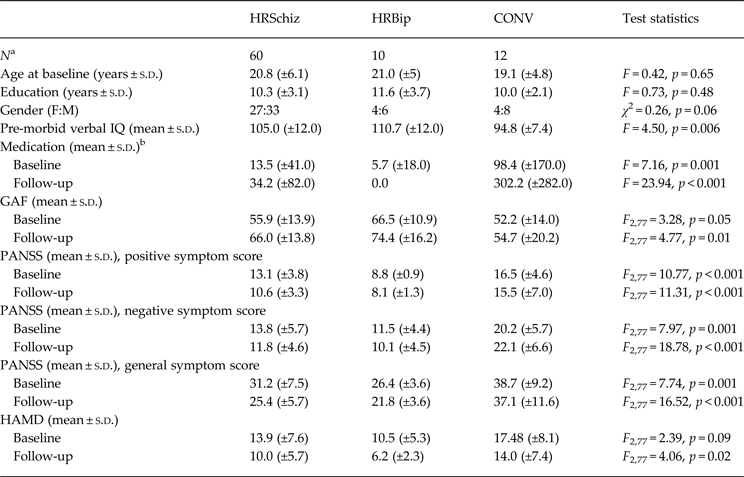
At follow-up, complete psychopathological and neurocognitive assessments were retrieved from 86 participants. In total, 34% of the individuals meeting risk criteria were receiving psychotropic medication at baseline and 47% were receiving at least one medication at follow-up. These medications included atypical antipsychotic medications (19% at baseline, 32% at follow-up), mood stabilizers (1%, 1%), and antidepressive medication (19%, 25%). Demographic data for individuals in the follow-up analysis (N = 86) are given in Table 1. Due to project-specific issues a follow-up assessment of the CG could not be performed.
Demographic and clinical characteristics

HRSchiz, High risk of schizophrenic psychosis; HRBip, high risk for bipolar disorder; CONV, Converter; GAF, Global Assessment of Functioning; PANSS, Positive and Negative Syndrome Scale; HAMD, Hamilton Depression Scale.
a Four converters to bipolar disorder are not displayed.
b Chlorpromazine equivalents.
Psychopathological assessment
To qualify for inclusion, participants were required to fulfil at least one of the following criteria at the baseline examination.
-
(1) HR: high-risk status for psychosis, as assessed by the Schizophrenia Proneness Interview, SPI-A (Adult version) or SPI-CY (Children-Youth version) (Schultze-Lutter et al. Reference Schultze-Lutter, Addington, Ruhrmann and Klosterkotter2007; Schultze-Lutter & Koch, Reference Schultze-Lutter and Koch2009), having at least one cognitive-perceptive basic symptom or at least two cognitive disturbances, and not meeting any of the UHR inclusion criteria listed below.
-
(2) UHR: ultra-high-risk status for psychosis, as rated by the Structured Interview for Prodromal Syndromes (SIPS; Miller et al. Reference Miller, McGlashan, Rosen, Cadenhead, Cannon, Ventura, McFarlane, Perkins, Pearlson and Woods2003), having at least one attenuated psychotic symptom, or at least one brief limited intermittent psychotic symptom, or a state-trait criterion [reduction in global assessment of functioning (GAF; Endicott et al. Reference Endicott, Spitzer, Fleiss and Cohen1976) of >30% in the past year, plus either a schizotypal personality disorder or a first-degree relative with psychosis].
-
(3) HRBip: high risk for bipolar disorder, as defined by a score either ≥14 on the Hypomania Checklist (HCL), a self-report measure of life-time hypomanic symptoms (Angst et al. Reference Angst, Adolfsson, Benazzi, Gamma, Hantouche, Meyer, Skeppar, Vieta and Scott2005), or a score ≥12 on the Hamilton Depression Scale (HAMD; Schutte & Malouff, Reference Schutte and Malouff1995); and not meeting any of the at-risk psychosis inclusion criteria listed above.
A transition to schizophrenia or bipolar disorder was diagnosed according to the International Classification of Psychiatric Symptoms, version 10 (ICD-10). Quantitative measures of psychopathology were further obtained as follows: psychotic symptoms (Positive and Negative Syndrome Scale, PANSS; Kay et al. Reference Kay, Fiszbein and Opler1987), current Axis I co-morbidity via MINI (Sheehan et al. Reference Sheehan, Lecrubier, Sheehan, Amorim, Janavs, Weiller, Hergueta, Baker and Dunbar1998), general functioning per GAF, and satisfaction with their psychosocial domains of life (Manchester Short Assessment of Quality of Life, MANSA; Priebe et al. Reference Priebe, Huxley, Knight and Evans1999). All assessments were conducted by trained, experienced psychiatrists or psychologists.
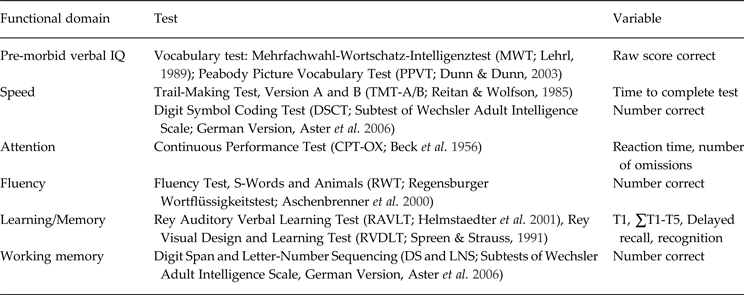
Neurocognitive assessment
A set of well-established neuropsychological tests was administered in a fixed order at baseline and follow-up (Table 2). The psychopathological and neurocognitive assessments were conducted by different investigators; hence neuropsychological testing and scoring were performed blind to diagnostic status. Verbal IQ was estimated with a German word recognition test (MWT-B; Lehrl, Reference Lehrl1989) for adults or a test of receptive vocabulary for minors (PPVT; Dunn & Dunn, Reference Dunn and Dunn2003). Test scores were standardized by computing z scores based on the performance of the CG. To reduce the amount of data and examine generalized and specific deficits across cognitive domains, scores were calculated for the independent domains of speed, attention, fluency, learning and memory, and working memory, as identified from the factor analysis described by Metzler et al. (Reference Metzler, Dvorsky, Wyss, Müller, Traber-Walker, Walitza, Theodoridou, Rössler and Heekeren2014).
Neurocognitive assessment

Statistical analysis
The dropout analysis was performed on the 207 individuals who participated in the baseline assessment. All other analyses were performed with data obtained from the 86 persons who participated in both baseline and follow-up assessments. Subjects classified as HR or UHR at baseline who did not convert during the follow-up period were grouped together as at risk for schizophrenic psychosis (HRSchiz, N = 60) and were compared with those in the HRBip (N = 10) and converter to schizophrenia (CONV) (N = 12) groups. The group of converters to bipolar disorder (N = 4) was considered too small and was excluded from analysis.
Demographic and clinical characteristics were compared between groups, using χ 2 and Fisher's exact tests for categorical variables or one-way analysis of variance (ANOVA) with a Bonferroni post-hoc test for continuous variables. Group comparisons of demographic and clinical variables were performed using Pearson's χ 2 tests for categorical variables and one-way ANOVAs for continuous variables. Two-way repeated ANOVA was performed for all cognitive variables and cognitive domains as well as for the clinical variables with longitudinal data of interest (Medication, GAF, PANSS positive, PANSS negative, PANSS general symptom score). ‘Group’ (HRSchiz, HRBip, and CONV) was entered as the between-subjects factor while ‘Time’ (baseline and follow-up) was the repeated measure. Chlorpromazine equivalents (Andreasen et al. Reference Andreasen, Pressler, Nopoulos, Miller and Ho2010) were added as a covariate in all models. Paired t tests were used to compare baseline and follow-up data within each group.
One-way ANOVA with post-hoc LSD tests were used to compare the performance in the baseline assessment between the three groups (HRSchiz, HRBip, and CONV).
Bivariate correlations were conducted to examine the relationships of score changes (endpoint score minus baseline score) for both neurocognitive domains and clinical symptoms, with the alpha level adjusted using the Bonferroni procedure.
To analyse possible dropout features (sex, age, IQ, psychopathological and cognitive variables), subjects participating at both, baseline and follow-up assessment (‘No drop-out’, nodrop: N = 86) were compared with subjects missing the follow-up assessment [‘drop-out’, drop: N = 121 (207 − 86)]. All analyses were done with SPSS v. 20.0 (SPSS Inc., USA).
Results
Demographic and clinical characteristics
Based on their demographic and clinical characteristics, the participants within all groups had comparable educational levels, ages, and gender (Table 1), but differed in their pre-morbid IQs and neuroleptic medications. That is, the HRSchiz and HRBip groups had comparable IQs while the CONV group scored significantly lower. Likewise, the amount of neuroleptic medications utilized was comparable between HRSchiz and HRBip but significantly higher for CONV. At baseline, the three groups were not yet significantly different in their GAF total scores, but they were at follow-up. The CONV group displayed a significant lower GAF score than HRSchiz and HRBip. By 1 year after completing the initial assessment, 15 of the 177 HRSchiz subjects (8.4%) had converted to schizophrenic psychosis. Considering only HRSchiz subjects with follow-up neuropsychological testing, the transition rate within 1 year is 16%, as 12 of the 76 HRSchiz subjects had converted to schizophrenic psychosis.
Psychopathological assessments
Repeated-measures analyses were used to examine changes in psychopathological scores when Time and Time × Group interactions were considered. Significant effects for Group were found for PANSS positive, negative and general symptom score as well as for the GAF score. A significant main effect for Time was found for the PANSS positive symptom score (F 1,77 = 4.84, p = 0.03), PANSS general symptoms (F = 1,77 = 8.45, p = 0.005), and GAF (F 1,77 = 7.48, p = 0.008). For the negative symptom score, no significant Time or Time × Group interaction was identified (all p > 0.15). Post-hoc analysis revealed that, during follow-up assessment, all groups showed improvements in positive symptomatology, but only the improvement by the HRSchiz group reached a statistically significant threshold (t = 4.92, p = 0.001). Whereas HRSchiz and HRBip improved in negative symptom scores (t = 2.40, p = 0.02), CONV displayed more negative symptoms at follow-up. The general symptoms of CONV remained unchanged (t = 0.03, p = 0.97) while HRSchiz (t = 5.20, p = 0.001) and HRBip (t = 3.24, p = 0.01) significantly improved. The GAF scores for both HRSchiz and HRBip were significantly improved (t = −4.44, p = 0.001, and t = −2.61, p = 0.02, respectively), while that of CONV remained unchanged (t = −0.48, p = 0.63).
Neurocognitive domains
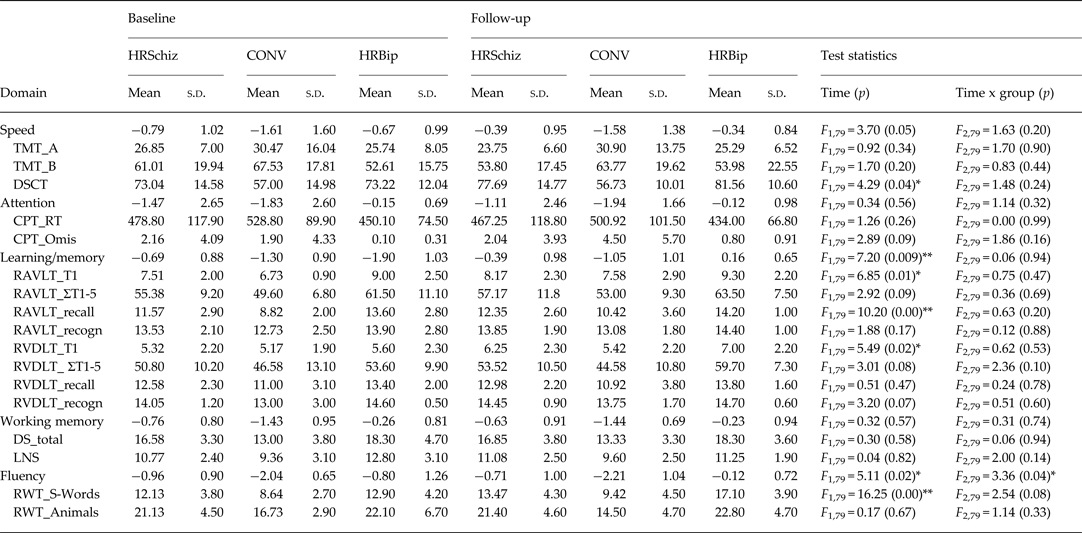
The neuropsychological profiles for the three clinical groups at baseline and follow-up are displayed in Fig. 1. Repeated-measures analyses were used to examine Group, Time, and Time × Group interactions. Significant effects for Group were found for the domains of speed, learning/memory, working memory, and fluency. Effects for Time were found for the domains of learning/memory and fluency, while a significant Time × Group interaction effect was noted for the fluency domain (Table 3). Post-hoc analysis revealed that, in the speed domain, HRSchiz showed improvement (t = 5.33, p = 0.0001) while the HRBip and CONV groups remained stable. In the attention domain, HRSchiz showed a slight improvement over time (t = −2.07, p = 0.04), while the HRBip (t = −0.42, p = 0.67) and CONV groups had equal and consistent performances (t = 1.32, p = 0.22). In the fluency domain, the HRSchiz (t = −2.92, p = 0.005), and HRBip (t = −2.37, p = 0.04) groups improved significantly over time, while the CONV group remained stable (t = 0.61, p = 0.55). In the learning/memory domain, HRSchiz improved over time (t = −3.13, p = 0.003), while those improvements were not statistically significant in either the HRBip or CONV groups (all p > 0.05). In the working memory domain, no significant improvement was noted for any group (all p > 0.05).
Mean z scores for high risk of schizophrenic psychosis (HRSchiz), converter (CONV), and high risk for bipolar disorder (HRBip) groups at baseline (t0) and follow-up (t1).

Domain scores (z scores) and test scores (raw score) for the three clinical groups at baseline and follow-up

HRSchiz, High risk of schizophrenic psychosis; CONV, Converter; HRBip, high risk for bipolar disorder; TMT_A, Trail-Making Test, Version A; TMT_B, Trail-Making Test, Version B; DSCT, Digit Symbol Coding Test; CPT, Continuous Performance Test (_RT, reaction time; _Omis, number of omissions); RAVLT, Rey Auditory Verbal Leaning Test (T1, trial 1; ΣT1-5, sum of trials 1-5; recogn, recognition); DS, Digit Span; LNS, Letter-Number Sequencing; RWT, Verbal Fluency Test (Regensburger Wortflüssigkeits-Test); s.d., standard deviation.
A repeated-measures ANOVA was performed for each measure, using group (HRSchiz, CONV, and HRBip) as between-subject factor and medication as covariate.
At baseline, the level of performance differed in the domains of speed (F = 4.30, df = 2, p = 0.04), attention (F = 3.18, df = 2, p = 0.04), learning/memory (F = 4.19, df = 2, p = 0.01), working memory (F = 5.77, df = 2, p = 0.005), and fluency (F = 7.68, df = 2, p = 0.001). Post-hoc analyses revealed that CONV performed at a significantly lower level than HRSchiz and HRBip in the domains of speed (p = 0.04), learning/memory (p = 0.03), working memory (p = 0.01), and fluency (p = 0.002).
Bivariate correlations between neurocognitive and clinical change scores across all groups revealed a negative association of the fluency domain with the PANSS positive symptoms scale (r = 0.306, p = 0.006). The results of other comparisons did not survive the Bonferroni correction.
With regard to our analysis of dropout features, a χ 2 test showed that the genders were equally distributed in the nodrop and drop groups (χ 2 = 1.71, df = 1, p = 0.19). No significant differences were found between those groups in terms of mean age at intake and mean premorbid IQ (t = 1.27, df = 205, p = 0.20, and t = −1.32, df = 205, p = 0.18, respectively). For the baseline assessment, none of the other psychopathological features (GAF score, HAMD, HCL, MANSA, PANSS) or cognitive domains differed significantly between nodrop and drop (all p > 0.05).
Discussion
In this study, the range of neurocognitive performance was examined in a sample of individuals at risk for schizophrenic or affective psychoses, and subjects converting to psychosis during the follow-up period. Our findings suggested that first, non-converting individuals at risk for schizophrenic psychosis and converters to schizophrenia may show a diverging course as members in the former group improved in all cognitive domains except working memory while performance by those in the latter group remained stable. Second, the group of individuals who were later identified as converters to schizophrenia was already displaying a significantly lower level of general performance at the baseline assessment compared to the other two groups. Third, preliminarily, the performance by HRBip individuals began at a higher level than either HRSchiz or CONV participants, and showed stable or improved performance from baseline to follow-up. Across all groups, a reduction of positive symptoms was strongly associated with improvements in the fluency domain. In addition, it is important to emphasize that methodological challenges, such as the relatively short follow-up period or the small size of HRBip group limit our interpretations.
In contrast with the assumption of a progressive deteriorating path to psychosis, our sample of subjects at risk for psychosis did not show a significant decline in functioning but rather improvements that reached a statistical threshold in the domains of speed, attention, fluency, and learning/memory. Scores within the working memory domain remained stable for all three clinical groups. In subjects at risk for psychosis who did not convert during the follow-up period, improvements were observed over time in multiple cognitive domains, specifically in processing speed, verbal and visual learning, and memory. This has also been reported previously (Keefe et al. Reference Keefe, Perkins, Gu, Zipursky, Christensen and Lieberman2006; Becker et al. Reference Becker, Nieman, Wiltink, Dingemans, van de Fliert, Velthorst, de Haan, van Amelsvoort and Linszen2010; Barbato et al. Reference Barbato, Colijn, Keefe, Perkins, Woods, Hawkins, Christensen and Addington2013; Bora & Murray, Reference Bora and Murray2013). One might explain these improvements as a result of practice or placebo effects, such as increased motivation or decreased anxiety, upon being exposed to the same test a second time (Goldberg et al. Reference Goldberg, Keefe, Goldman, Robinson and Harvey2010). In the learning and memory domain persons from all groups demonstrated improvements during the follow-up assessment, although this change was not statistically significant in the CONV group. Most likely in this domain, a paradigm, as well as content-specific, practice effect had occurred, i.e. familiarity with testing instructions/demands or explicit learning of the same words on a list. Likewise, an investigation by Crespo-Facorro et al. (Reference Crespo-Facorro, Rodriguez-Sanchez, Perez-Iglesias, Mata, Ayesa, Ramirez-Bonilla, Martinez-Garcia and Vazquez-Barquero2009) found that healthy control subjects had pronounced improvements in their Rey Auditory Verbal Learning Test (Helmstaedter et al. Reference Helmstaedter, Lendt and Lux2001) and Visual Design and Learning Test (non-verbal memory) (Spreen & Strauss, Reference Spreen and Strauss1991) [effect sizes (ES) up to 0.97] that contrasted with smaller improvements in tests of attention (ES up to 0.2). In addition to such practice effects, a reduction or stabilization in the severity of symptoms at follow-up may substantially contribute to cognitive improvements (Bora & Murray, Reference Bora and Murray2013). In our study, the observed association between diminished positive symptoms and improvement in fluency tasks across all groups may support this proposition.
By contrast, CONV individuals did not show any significant improvement in cognitive functioning from baseline to follow-up but only consistencies in performances over time. Similar findings have been reported before (Keefe et al. Reference Keefe, Perkins, Gu, Zipursky, Christensen and Lieberman2006; Wood et al. Reference Wood, Brewer, Koutsouradis, Phillips, Francey, Proffitt, Yung, Jackson, McGorry and Pantelis2007; Bora & Murray, Reference Bora and Murray2013). It is debatable to what extent a practice effect can be abolished by an underlying progressive cognitive decline related to pathophysiological changes. It is also conceivable that those in the CONV group displayed the same level of performance because they were immune to practice effects. The neuronal systems relevant for practice and implicit learning may be specifically impaired in individuals converting to psychosis. Besides, Bowie et al. (Reference Bowie, McLaughlin, Carrion, Auther and Cornblatt2012) have noted that second-generation antipsychotic medications in UHR individuals are associated with relatively negative effects on cognition at follow-up when compared with UHR subjects who are either untreated or taking antidepressants. However, in our study, the effects were still observable after carefully controlling for neuroleptic medication.
Individuals classified as HRBip exhibited a higher performance than the HRSchiz group. In line with that, earlier studies found that premorbid deficits seem to be absent, or even reversed, in bipolar disorder. This was shown in two longitudinal studies where individuals with better cognitive functioning in childhood or adolescence had an increased risk for later bipolar disorder (Koenen et al. Reference Koenen, Moffitt, Roberts, Martin, Kubzansky, Harrington, Poulton and Caspi2009; MacCabe et al. Reference MacCabe, Lambe, Cnattingius, Sham, David, Reichenberg, Murray and Hultman2010). However, the small size of the HRBip group restricts the extent to which our finding can be generalized. In addition, efforts to create diagnostic tools for early detection of bipolar disorder have only recently begun. This study applied recommended cut-off scores in self-assessment instruments like HCL-32 as diagnostic criteria (Angst et al. Reference Angst, Adolfsson, Benazzi, Gamma, Hantouche, Meyer, Skeppar, Vieta and Scott2005). A next essential step would be to critically verify the validity and sensitivity of our approach and to compare it with the meanwhile available scale for early recognition of bipolar disorder (Correll et al. Reference Correll, Olvet, Auther, Hauser, Kishimoto, Carrión, Snyder and Cornblatt2014).
Cognitive dysfunction has been regarded as a possible latent marker, or endophenotype, of genetic risk for schizophrenia (e.g. Heinrichs & Zakzanis, Reference Heinrichs and Zakzanis1998; Cosway et al. Reference Cosway, Byrne, Clafferty, Hodges, Grant, Abukmeil, Lawrie, Miller and Johnstone2000). According to the neuro-developmental model, cognitive deficits are already evident before the onset of psychosis. During baseline testing, our sample group of ‘true’ at-risk individuals with later conversion was exhibiting significantly lower performances on the domains of processing speed, fluency, learning/memory, and working memory, as well as a lower estimated pre-morbid IQ. Thus, our results may confirm the assumption that neurocognitive deficits are present prior to the development of psychosis (Cannon et al. Reference Cannon, Moffitt, Caspi, Murray, Harrington and Poulton2006; Giuliano et al. Reference Giuliano, Li, Mesholam-Gately, Sorenson, Woodberry and Seidman2012; Fusar-Poli et al. Reference Fusar-Poli, Bonoldi, Yung, Borgwardt, Kempton, Valmaggia, Barale, Caverzasi and McGuire2012a ; Müller et al. Reference Müller, Vetter, Weiser, Frey, Ajdacic-Gross, Stieglitz and Rossler2013; Bora et al. Reference Bora, Lin, Wood, Yung, McGorry and Pantelis2014).
The findings regarding improvement in cognitive function by individuals at risk of psychosis tend to contradict the idea of a progressive decline in schizophrenia. It is questionable whether there is a continuum that defines these reportedly smaller but distinctly reduced performances by at-risk, but non-converting individuals (Hambrecht et al. Reference Hambrecht, Lammertink, Klosterkotter, Matuschek and Pukrop2002; Brewer et al. Reference Brewer, Francey, Wood, Jackson, Pantelis, Phillips, Yung, Anderson and McGorry2005; Keefe et al. Reference Keefe, Perkins, Gu, Zipursky, Christensen and Lieberman2006; Niendam et al. Reference Niendam, Bearden, Johnson, McKinley, Loewy, O'Brien, Nuechterlein, Green and Cannon2006; Pukrop et al. Reference Pukrop, Schultze-Lutter, Ruhrmann, Brockhaus-Dumke, Tendolkar, Bechdolf, Matuschek and Klosterkotter2006) and the intermediate deficits in ‘true’ positive individuals. The at-risk psychosis state is characterized by a marked impairment in psychosocial functioning (Velthorst et al. Reference Velthorst, Nieman, Linszen, Becker, de Haan, Dingemans, Birchwood, Patterson, Salokangas, Heinimaa, Heinz, Juckel, von Reventlow, French, Stevens, Schultze-Lutter, Klosterkotter and Ruhrmann2010), many co-morbidities (Yung et al. Reference Yung, Nelson, Stanford, Simmons, Cosgrave, Killackey, Phillips, Bechdolf, Buckby and McGorry2008), and multiple mental and functional deficits (Ruhrmann et al. Reference Ruhrmann, Schultze-Lutter and Klosterkotter2010). Furthermore, a meta-analysis has revealed a modest effect toward reduced transition risks in the most recently published studies (Fusar-Poli et al. Reference Fusar-Poli, Deste, Smieskova, Barlati, Yung, Howes, Stieglitz, Vita, McGuire and Borgwardt2012b ). Accordingly, the transition rate apparently decreases to 10–18% within 1 year (Yung & Nelson, Reference Yung and Nelson2013); our results fell within this range. This means that, for a substantial proportion of the subjects initially labelled as at-risk, their conversion to psychosis may never happen. Likewise, better performances by the at-risk group than the converter group may hypothetically be a result of a subset of ‘false positives’ within the sample (Bora & Murray, Reference Bora and Murray2013; Zipursky et al. Reference Zipursky, Reilly and Murray2013). From a critical view, the cognitive deficits observed in at-risk compared to healthy individuals at baseline may reflect low psychosocial functioning in general rather than a compelling degradation associated with the path to manifestation of a disorder. It should be noted that our study plan did not involve any therapeutic intervention. One part of the participants in our study was treated by their resident psychiatrists and psychologist in the sense of a treatment as usual. Another part of the participants was not enrolled in any therapeutic offers. For our study we documented only the number and type of therapeutic contacts ant the received medication. However, regardless of treatment, non-converting subjects improved in positive and negative symptomatology.
Above all, the declining transition rate in subjects at risk for psychosis is a controversial issue, especially because a potential unnecessary diagnosis might give rise to unintended consequences such as stigma and discrimination (Yung et al. Reference Yung, Nelson, Thompson and Wood2010). In particular, self-labelling and perceived public stigma can be related to heightened stress through stigma-associated cognitions that delicately reduce the well-being of young individuals diagnosed as at-risk (Rüsch et al. Reference Rüsch, Corrigan, Heekeren, Theodoridou, Dvorsky, Metzler, Muller, Walitza and Rossler2014). Therefore, more research is urgently needed concerning the possible side-effects of identifying a person as being ‘at-risk of psychosis’ (Yung et al. Reference Yung, Woods, Ruhrmann, Addington, Schultze-Lutter, Cornblatt, Amminger, Bechdolf, Birchwood, Borgwardt, Cannon, de Haan, French, Fusar-Poli, Keshavan, Klosterkotter, Kwon, McGorry, McGuire, Mizuno, Morrison, Riecher-Rossler, Salokangas, Seidman, Suzuki, Valmaggia, van der Gaag, Wood and McGlashan2012).
The results of this study should be considered in the context of several limitations. The CONV and HRBip groups were relatively small, therefore the statistical power may be limited. The study project enabled only a relatively short follow-up period and it cannot be excluded, in fact, that a longer follow-up duration would have provided on the one hand more transitions, and on the other, evidence for a progressive cognitive decline instead of stability in the converter group. The duration of the follow-up would have been needed to extend for several years to clarify if the improvements represent a complete remission of symptoms, how long the improvements will continue, and to be sure that none of the individuals is falsely diagnosed, which is quite challenging to realize. Additionally, due to project-specific issues a follow-up assessment of the healthy CG, which would have provided further insights, was not performed. Further, there was a loss of 59% of individuals missing the 1-year follow-up assessment. A drop-out analysis found no differences in demographic and clinical baseline variables between subjects participating (nodrop) and not participating (drop) at the follow-up assessment. However, it cannot be excluded that with a smaller drop-out rate the study's results would be modified. However, our study benefited from the relatively large group of HRSchiz subjects in a longitudinal design, and the fact that we could control for confounding variables.
In summary, the at-risk psychosis sample comprised a heterogeneous group of individuals who performed at a lower level on neurocognitive tests when compared with healthy individuals. The neurocognitive performance in HRSchiz and HRBip improved over the duration of the follow-up period, and remained stable in the CONV group. Generally, in the help-seeking individuals, a substantial degree of recovery and spontaneous remission of psychopathological symptoms was observed over the duration of the study. Further studies with longer follow-up periods are needed to clarify the continuing course of their psycho-social functioning and neurocognitive performance. Moreover, further research is needed to verify and advance the approaches to create diagnostic tools for early detection of bipolar disorder.
Acknowledgements
This work was supported by the Zürich Impulse Program for the Sustainable Development of Mental Health Services (www.zinep.ch). Beyond funding, this Foundation had no further role in the experimental design; collection, analysis, and interpretation of data; the writing of this report; or the decision to submit this paper for publication. We thank the ZInEP team and the participants for enrolling in this study.
Declaration of Interest
Professor Dr Walitza has received lecture honoraria from Janssen Cilag, AstraZeneca and Eli Lilly in the last 5 years. Her work was partially supported in the last 5 years by the Swiss National Science Foundation (SNF), Deutsche Forschungsgemeinschaft, EU FP7, HSM Hochspezialisierte Medizin of Kanton Zurich, Switzerland, BMBF Germany.