Introduction
Two challenges are identified when investigating the provision of professional care for dementia patients. First, how can the largest possible number of patients be provided with the appropriate care (Gräßel et al., Reference Gräßel, Wiltfang and Kornhuber2003; NICE, 2006) which positively influences the progressive course of the illness and raises the affected person's quality of life? Secondly, how can support for the family caregivers be optimized? Which factors influence the decision whether offers to provide respite care (Gallagher-Thompson and Coon, Reference Gallagher-Thompson and Coon2007; Pinquart and Sörensen, Reference Pinquart and Sörensen2006; Thompson et al., Reference Thompson, Spillsbury, Hall, Birks, Barnes and Adamson2007) – assuming area-wide availability – are actually utilized or not? This study deals with the second question, looking specifically at short-term residential care (SRC).
“Institutional respite refers to temporary care provided by a long-term care facility . . . for a frail elderly person living in the community to give the familial caregiver a break from the routine of care” (Hegeman, Reference Hegeman1988). Under German healthcare regulations the costs of using SRC are either met entirely by the users themselves or they receive a partial payment from their long-term nursing care insurance which is an obligatory insurance in Germany.
Insurance benefit is paid when a patient has been dependent on regular assistance in carrying out activities of daily life (ADLs) and housekeeping for at least six months. Assistance with ADLs is restricted to personal hygiene, preparation and eating of food and to physical mobility. Any assistance required due to psychological symptoms such as fear, depression or agitation is not taken into account. Therefore, within the framework of long-term nursing care insurance, the care requirements of dementia patients in Germany are not taken into consideration to the same extent as physical disabilities (Gräßel et al., Reference Gräßel, Donath, Lauterberg, Haag and Neubauer2008). Insurance benefit can only be claimed when the daily care requirement of ADLs and housekeeping together total at least 1.5 hours per day (Level 1). The insured can claim either financial assistance of €215 per month (equivalent to US$299 in January 2009) or receive professional home nursing care or day care to the value of €420 (US$584). When the daily care requirement exceeds 3 hours (Level 2) the insurance benefits increase (€420/$584 or €980/$1,363). The maximum benefit (€675/$939 or €1,470/ $2,045) is paid when care requirements have reached a minimum of 5 hours per day (Level 3). In addition to these monthly benefits, SRC is subsidized for a maximum of four weeks per year to the sum of €1,470 ($2,045) for all levels when the family caregiver is on holiday or is ill.
SRC has proved itself to be effective in reducing caregivers' subjective burden and depression (Adler et al., Reference Adler, Ott, Jelinski, Mortimer and Christensen1993; Pinquart and Sörensen, Reference Pinquart and Sörensen2006; Lee et al., Reference Lee, Morgan and Lindesay2007). However, the degree of usage of SRC according to international studies is only between 3% and 26% (Philip and Ghosh, Reference Philip and Ghosh1992; Gräßel, Reference Gräßel1997; Toseland et al., Reference Toseland, McCallion, Gerber, Dawson, Gieryic and Guilamo-Ramos1999; Lamura et al., Reference Lamura2006; van Exel et al., Reference van Exel, Morée, Koopmanschap, Schreuder Goedheijt and Brouwer2006). In order to change this low level of usage it is important to know the predictors for utilization and particularly those that represent the perspective of the family caregivers. This constitutes the first objective of this study; namely, which variables concerning the family caregiver's point of view influence the utilization of SRC?
Fulfillment of quality standards is the main characteristic of a professional service. These quality standards normally reflect expert opinion. It is argued that the quality of SRC as regards “user-friendliness” would be improved if the “customer's” – i.e. family caregiver's – concept of quality was systematically taken into consideration. To date, no scientific study of the quality of SRC that includes the quality requirements of dementia caregivers has been published.
Therefore, the second objective is: which quality characteristics of SRC from a family caregiver's point of view, should be fulfilled, dependent on whether SRC has already been used (“user”) or not (“non-user”)?
Methods
Design
The data source of this study is a written anonymous survey of family caregivers of dementia patients living in the community. The cross-sectional study was carried out in four regions in Germany – in Erlangen and district (southern region), in Dortmund and district (west), in Kassel and district (north-central), and in the Federal State of Brandenburg, specifically in the region around Potsdam (north-east). Each study region comprises urban and rural areas with a minimum number of 250,000 inhabitants and therefore at least 2,500 dementia patients.
Survey of family caregivers
The survey papers consisted of a letter, the questionnaire, a stamped addressed envelope and an information brochure entitled “Das Wichtigste über die Alzheimer-Krankheit” (“The most important facts about Alzheimer's disease”) (DAlzG, 2001). The anonymity of the study was emphasized in the letter. The objective was, on the one hand, to reach family caregivers who had no previous experience of SRC facilities (“non-users”) and, on the other, to gain information from those who had already used or were using the facilities (“users”).
In order to reach the non-users, 200 questionnaires were distributed in each study region within the recruitment period of six months, through the Medical Services of the Health Insurance offices at the initial appraisal, within the framework of the long-term nursing care regulations. The “initial appraisal” means that a level of care is defined and financial support from the Health Insurance is applied for. If one of the two care diagnoses made at the initial appraisal was “dementia” the survey papers were given to the family caregiver. As this group of patients was not yet in receipt of insurance benefits, the probability was high that they were non-users.
In order to reach caregivers where there was a high degree of probability that SRC had already been used, 300 questionnaires were distributed through the regional offices of the Alzheimer's Society and other caregiver counseling services.
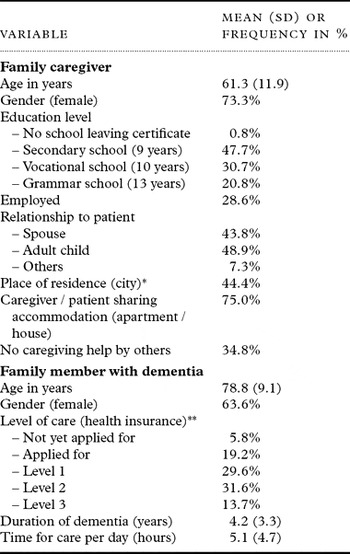
Out of the 2,000 questionnaires (500 in each region) sent to the distributors, 404 were returned (see Table 1), giving an inter-regional response of at least 20.2%. Divided into regions, the response was N = 152 for the Brandenburg region (30.4%), N = 87 for the Dortmund region (17.4%), N = 83 for the Kassel region (16.6%) and N = 82 for the Erlangen region (16.4%). This response rate is based on the questionnaires which were sent to the distributors, not on those that actually reached the caregivers. It can be assumed that Brandenburg, being a federal state and the largest of all the regions involved, was able to distribute more questionnaires than the other regions. The fact that its Alzheimer's Society is centrally organized at the federal level rather than the municipal level as in the other regions would also have influenced this figure.
Sample characteristics of the family caregivers and their family member with dementia

* 100,000 or more inhabitants (= city).
** the higher the level the more help necessary.
Instruments
Caregivers' questionnaire
The nine-page questionnaire was tested on 12 family caregivers for comprehensibility and acceptability in a pilot phase.
Quantitative data: Besides the socio-demographic variables (see Table 1), characteristics of the care situation were collected. The care situation is fundamentally characterized by the amount of care time required by the caregiver, whether he/she gets help from others and whether the patient has been classified within the health care insurance system. First, SRC was described briefly. Then the questions “Do you know about SRC?” and “Do you use SRC?” were to be answered dichotomously (yes/no). The assessment of how helpful SRC would be to the family caregiver in his/her care situation was carried out on a five-step Likert scale (from “0 = I don't need it” to “4 = I need it urgently”) with the addition of “irrespective of whether or not you have previously used SRC.” In addition, family caregivers were asked to grade their local accessibility to SRC facilities by answering the question “Is there an SCR facility in your vicinity and how accessible is it to you?” according to three categories of “Don't know”, “Not easily accessible” or “Accessible.”
Qualitative data: The data for qualitative analysis were collected using an open question: “Whether or not you have already used SRC, what would you personally expect from a “good” SRC facility?” The collection of data on the quality of SRC was carried out using open questions for two reasons: (a) a standardized, validated questionnaire that included all relevant quality aspects did not exist; and (b) the “free recall” of one's own reflections represents the family caregiver's concept of quality without being influenced by extrinsic arguments.
Statistical procedure
Quantitative data analysis
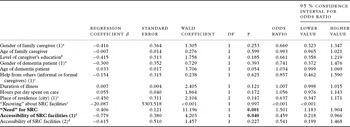
The quantitative questions were answered by 97.2% of the 404 family caregivers. In order to ascertain which variables significantly influence the utilization of SRC, binary logistic regression analysis was carried out. The dichotomous dependent variable was the “use” (code = 1) or “non-use” (0) of SRC. The coding of potential predictors is shown below Table 2. A multicollinearity test was carried out before the regression analysis in order to exclude confounding variables because of a significant correlation of moderate strength (r > 0.40). Therefore the following variables were not included in the multivariant regression analysis: relationship between caregiver and dementia patient, shared accommodation, employed caregivers and level of care (health insurance). The explained variance in the regression model is given in the form of Nagelkerke's R2. The significance of potential predictors was measured using Wald's coefficient (α = 0.05).
Binary logistic regression analysis with use of SRC as dependent variable Two significant predictors can be identified: When the degree of “need” increases, the probability of using SRC increases at high significance (p = 0.001). In contrast, the probability of utilizing SRC significantly reduces when the nearest facility is unknown (p = 0.04) compared to the evaluation “it is accessible for me.”

a Gender: 0 = male, 1 = female.
b Level of caregiver's education: 0 = secondary school or no school leaving certificate, 1 = vocational school or grammar school.
c 0 = yes, 1 = no.
d Accessibility of SRC facilities: 1 = don't know, 2 = not easily accessible, reference value: accessible.
df = degrees of freedom.
Qualitative data analysis
Questions about the quality of SRC were evaluated using Morgan's content analysis method (Morgan, Reference Morgan1993). In the first step, passages with the same or very similar content were paraphrased. In the second step, similar statements were merged into categories, modeled on the choice of words used by the interviewees, in order to keep the level of abstraction to a minimum. Two researchers independently undertook the task of assigning statements to individual categories. In cases of divergence, consensus was sought.
The design respects general performance criteria of qualitative research as described by Mayring (Reference Mayring1993); for example, the research process should follow clear rules, be exactly documented and the interpretation be well founded.
Finally, the individual conclusions were assigned to the three quality categories “Structure”, “Process” and “Quality of results” by two researchers working independently of each other.
Results
Quantitative analysis
The existence of SRC is well known to 75.6% of family caregivers, and about a quarter of the respondents have used it or are currently using it (27.3%). In the assessment of how important the availability of this service is, two-fifths of the responding family caregivers stated that they need SRC facilities very urgently (16.4%) or urgently (22.8%), while more than one-third stated that they do not need them at all (19.8%) or hardly ever (17.0%). The remaining 24.0% were undecided (“might need it”).
More than half of the family caregivers (57.1%) stated that there was an accessible SRC facility in their locality. One-third (33.8%) knew nothing about the distance to or the accessibility of their nearest SRC facility. Less than a tenth (9.1%) of the respondents stated that SRC facilities were not easily accessible to them.
In order to ascertain which variables influence the utilization of SRC, binary logistic regression analysis was carried out. It showed that with an explained variance of 48.7% (R2) a significant regression model (χ2 (11) = 90.415; p < 0.001) characterized by two significant predictors could be identified (Table 2). Thus, 90.1% of the respondents can be correctly assigned to the categories “user” or “non-user”. The probability of using SRC increases significantly (p = 0.001) by about one and a half times when the degree of “need” increases. Furthermore the probability of utilizing SRC is significantly reduced when the nearest facility is unknown (p = 0.040) compared to the evaluation “it is accessible for me.” The probability of utilization tends to increase with the age of the dementia patient (p = 0.054). Utilization is not associated with age of the family caregiver, gender of both dementia patient and caregiver, level of education, rural versus urban living, help from others or to specific parameters of the illness such as the length of the patient's illness or the hours per day spent on care.
Qualitative analysis
Of the 108 family caregivers already using SRC, 91 gave answers to the question on quality; of the 288 non-users, 163 gave details of their quality requirements. The difference in the response rate between users and non-users is understandable as it is easier for users to comment on the quality of a service they have already used than for non-users who have no experience of it.
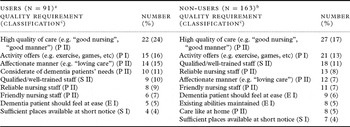
The family caregivers' top three quality requirements concerning SRC are identical for users and non-users: the top requirement is the global wish for “good care” (24% and 17%, Table 3) followed by “suitable activities for the dementia patient”, in particular physical exercise and games (16% and 13%). In third place, the users expect an “affectionate manner” (15%) while the non-users would like “well-trained nursing staff” (11%).
Family caregivers' quality requirements: ranking of most frequently cited requirements (≥ 4%)* The family caregivers' top three quality requirements concerning SRC are identical for users and non-users in the first and second places (wish for “good care” and “suitable activities for the dementia patient”); in third place the users expect “affectionate care” while the non-users would like “well-trained nursing staff.”

* Multiple answers were possible.
a 108 family caregivers (26.7%) were users; of these 91 supplied details of quality requirements (= 100%).
b 288 family caregivers (71.3%) were non-users; of these 163 supplied details of quality requirements (= 100%); 8 family caregivers (2.0%) gave no details about utilization.
c Classification of quality criteria: Structural quality (S): Non-personal factors (S I); person-related factors (S II). Process quality (P): Content aspects of procedure (What is done?) (P I); formal aspects of procedure (How is it done?) (P II). Quality of result (E): Aims concerning dementia patients (E I); aims concerning family caregivers (E II).
Discussion
Although the objectives of this study – utilization and quality – are highly relevant when developing the content of respite offers, a systematic search of three databases, Medline®, PsychINFO® and Cinahl®, shows that there has been little scientific research in these areas to date. There are very few empirical studies about utilization and only one about quality. Specific studies regarding SRC for dementia patients alone are absent. Therefore, with this scientific study, we are breaking new ground.
The sample of family caregivers was taken from four regions across Germany, comprising a mix of urban and rural settings, and thus incorporating various degrees of exposure to SRC facilities. By using various recruiting pathways, the medical services of health insurance companies, regional offices of the Alzheimer's Society and other caregiver counseling centers, it was possible to reach family caregivers with varying experiences of SRC. The response rate to the questionnaires sent to the distributors was more than 20%. This value corresponds exactly with the empirically established response for anonymously written surveys of family caregivers who received no reward for answering (Gräßel, Reference Gräßel2002; Georges et al., Reference Georges, Jansen, Jackson, Meyrieux, Sadowska and Selmes2008). However, ours was not a representative sample and a recruitment bias cannot be excluded. There are many possible reasons why responses were not received from the other 80%, ranging from lack of time due to a heavy caring burden to a lack of interest in the respite possibilities mentioned. In the first case (lack of time) we would estimate knowledge and usage of SRC is probably higher than we found; in the second case (no interest in SRC), the numbers are probably lower than we found. The frequencies of the individual quality criteria should therefore be regarded as an initial orientation. But by using various recruiting pathways it was possible to affirm that a substantial fraction of the family caregivers had never used SRC facilities previously as would be expected in a representative sample. The fact that over 70% were non-users has also been seen in other studies concerning offers of respite care (Philip and Ghosh, Reference Philip and Ghosh1992; Toseland et al., Reference Toseland, McCallion, Gerber, Dawson, Gieryic and Guilamo-Ramos1999; Brodaty et al., Reference Brodaty, Thomson, Thompson and Fine2005; Lamura et al., Reference Lamura2006).
In this study, we were able to establish that SRC is very well known (awareness level 76%), although large variations in awareness (7–90%) have been reported in other studies (Roelands et al., Reference Roelands, van Oost and Depoorter2008; Toseland et al., Reference Toseland, McCallion, Gerber, Dawson, Gieryic and Guilamo-Ramos1999; van Exel et al., Reference van Exel, Morée, Koopmanschap, Schreuder Goedheijt and Brouwer2006). With the comparatively high level of awareness of SRC in our study, the main prerequisite for utilization was fulfilled. Brodaty et al. (Reference Brodaty, Thomson, Thompson and Fine2005), however, reported that the utilization of respite care by family caregivers was low, even though it was well known and even when the services were free-of-charge (Kosloski and Montgomery, Reference Kosloski and Montgomery1993). This means that there must be other more significant variables that determine utilization. In our study, the family caregivers' assessment of the helpfulness of SRC (“I need it”) is a highly significant predictor for using it.
In a study by Toseland et al. (Reference Toseland, McCallion, Gerber and Banks2002) it was demonstrated that this assessment of helpfulness is not a significant predictor for utilization of all the services. Utilization which depends on how well known the facility is, is significantly moderated by the assessment of helpfulness when the utilization refers to a single service, as in our study. Here 39% said that they needed SRC urgently or very urgently. This percentage is markedly higher than the 8% reported by Toseland et al. (Reference Toseland, McCallion, Gerber, Dawson, Gieryic and Guilamo-Ramos1999) or the 13% of van Exel et al. (Reference van Exel, Morée, Koopmanschap, Schreuder Goedheijt and Brouwer2006). The following conclusion can be drawn: if there are plans to provide respite to as many family caregivers as possible, not only should the service be made known to the caregivers but the advantages of utilizing SRC should also be pointed out.
Only 9% of respondents maintained that it was difficult for them to access SRC facilities. Toseland et al. (Reference Toseland, McCallion, Gerber, Dawson, Gieryic and Guilamo-Ramos1999) found a similarly low proportion of such respondents (2%). However, a lack of knowledge about the nearest SRC facility was more frequent in our study (34%; 10% in Toseland et al. (Reference Toseland, McCallion, Gerber, Dawson, Gieryic and Guilamo-Ramos1999)). As in other studies (Kosloski and Montgomery, Reference Kosloski and Montgomery1993; Toseland et al., Reference Toseland, McCallion, Gerber and Banks2002), easy physical access to respite care is positively associated with utilization. A key practical objective should therefore be the provision of clear information about the location of the nearest SRC provider and how to get there. The results of our regression analysis also favor this approach as it shows that the probability of utilizing SRC is significantly reduced if the means of accessing it are unknown.
In the study presented here, we also found a tendency (p < 0.10) to use SRC more often when the dementia patient was older. While the study by van Exel et al. (Reference van Exel, Morée, Koopmanschap, Schreuder Goedheijt and Brouwer2006) indicated a significant connection between this variable and the utilization of SRC, the study by Gräßel (Reference Gräßel1997) did not. None of the other variables analyzed – i.e. gender of the dementia patient, age and gender of the family caregiver, help from others, hours per day spent on care, duration of illness, education of family caregiver, and place of residence – was a significant predictor for using SRC.
Although in reviews (Cooke et al., Reference Cooke, McNally, Mulligan, Harrison and Newman2001) and in meta-analytical studies (Sörensen et al., Reference Sörensen, Pinquart and Duberstein2002) the moderately positive effects of respite on subjective burden and depression of family caregivers has been proven, little is known about the exact form that effective intervention should take. Aspects of “process quality” (i.e. what and how) are most frequently cited. The caregivers generally would like the patient to be “well cared for.” This agrees with the findings of a study by Neville and Byrne (Reference Neville and Byrne2007), which was not, however, specific to dementia. They asked 100 family caregivers of dependent older people for their expectations of residential respite care six weeks prior to residential respite admission. The leading expectation (37%) was that the residential respite care recipients would be well cared for; followed by expectations of “happiness” (31%) and “socialization” (28%). The last two were not found among the most frequently cited quality requirements in our study. Some of the 21 dementia family caregivers interviewed in a study by Winslow (Reference Winslow2003) were concerned about “generally poor care.” However, these facts are non-specific and refer to community services generally.
As no empirical studies have been published exclusively on SRC and the expectations of family caregivers of dementia patients concerning quality, our study is important in promoting a scientific discussion of the family caregivers' views this regard. In research into community services for patients who are cared for at home, more consideration of the “unmet needs” of family caregivers is required (dello Buono et al., Reference dello Buono1999). This is important because consideration of the family caregivers' quality requirements helps to remove barriers to utilization (Winslow, Reference Winslow2003).
Conclusion
In order to increase the utilization of SRC to relieve the burden on family caregivers, it is suggested that they are informed about the advantages they themselves will experience when asking “Do I need such a support?” Furthermore, information about the location and accessibility of the nearest SRC facility should be provided to family caregivers, which would help to reduce another barrier to utilization.
With regard to the quality of care, family caregivers expect not only good nursing in SRC facilities but also appropriate activities that contain both cognitive and motor elements.
Conflict of interest
None.
Description of authors' roles
C. Donath designed the study and its questionnaires, was responsible for the statistical design and data analysis and took part in writing the paper. A. Winkler assisted with designing the study, organised the data collection and gave important hints for interpretation and discussion. E. Gräßel designed the study, supervised data collection, was responsible for the interpretation of data and took part in writing the paper.
Acknowledgments
We would like to thank the family caregivers who contributed to the success of this study by giving their opinions. The staff of the regional offices of the Alzheimer's Society, other caregiver counselling services and the Medical Services of the Health Insurance companies are also thanked for their kind help in distributing the questionnaires. A special thank to Ms H. Römer (Alzheimer's Society Dortmund), Ms A. Trilling (Kassel) and the Alzheimer's Society Mittelfranken for their support. This study was financed from the German Alzheimer Society's Research Prize. The authors participated in a call for papers and following the review process, the study design was accepted. We would like to thank the German Alzheimer's Society for awarding us this prize.