Introduction
Publication of a revision frequently spawns further interest in the revised taxon and results in new discoveries that warrant further consideration. This is the case with the shore-fly genus Oedenopiforma Cogan (Diptera: Ephydridae), the subject of this review. Although recently revised (Mathis and Zatwarnicki Reference Mathis and Zatwarnicki2002), we are again reviewing this genus because new and taxonomically valuable information has become available to us. The new information largely stems from study of specimens we recently collected or otherwise became available to us. Field work, including work in collections, continues to be crucial to studies on the systematics of shore flies and ought to be supported.
Oedenopiforma was first described as a subgenus of Paralimna Loew and initially included only two species (Cogan Reference Cogan1968): the type species Oedenopiforma madecassa (Giordani Soika) and Oedenopiforma argentea (Cogan). Other than the Afrotropical catalog (Cogan Reference Cogan1980), our world catalog and revision (Mathis and Zatwarnicki Reference Mathis and Zatwarnicki1995, Reference Mathis and Zatwarnicki2002), and a faunistic study from China (Zhang et al. Reference Zhang, Yang and Mathis2009), there are no further references to the genus. Consistent with our previous treatments, we continue to accord generic status to this taxon.
Because this is not a comprehensive revision, we have only included species for which new information has become available since the group was last revised (Mathis and Zatwarnicki Reference Mathis and Zatwarnicki2002), such as new species, new combinations, new distributional records, etc. We have included a diagnosis for the tribe and a key to genera to facilitate their identification (many genera of Dryxini are uncommon in collections and are not easily recognized or well known).
We dedicate this review to the monumental effort that was initially led by a group of Canadian dipterists to produce the three volumes of the Manual of Nearctic Diptera. That manual set the precedent for a succession of faunistic manuals on Diptera (western Palearctic, Central American, and a forthcoming Afrotropical manual) that have substantially fostered research on this large and economically important order, established a pattern for faunistic manuals, and stabilized morphological terminology. The morphological terminology is now essentially used universally in papers dealing with Diptera that are written in English. We name the new species described in this paper after J. Richard Vockeroth who coauthored the chapter on shore flies in the Nearctic Manual (Wirth et al. Reference Wirth, Mathis and Vockeroth1987).
Materials and methods
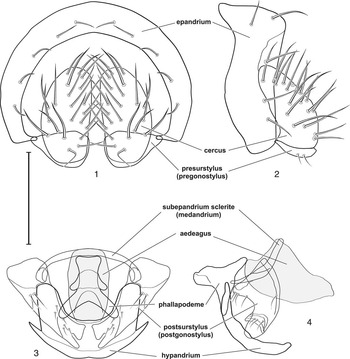
The descriptive terminology, with the exceptions noted in Mathis (Reference Mathis1986) and Mathis and Zatwarnicki (Reference Mathis and Zatwarnicki1990a), follows McAlpine (Reference McAlpine1981). Because specimens are small, usually less than 3.5 mm in length, study and illustration of the male terminalia required use of a compound microscope. We have followed the terminology for most structures of the male terminalia that other workers in Ephydridae have used (references in Mathis Reference Mathis1986; Mathis and Zatwarnicki Reference Mathis and Zatwarnicki1990a, Reference Mathis and Zatwarnicki1990b), such as surstylus. Zatwarnicki (Reference Zatwarnicki1996) suggested that the pre- and postsurstylus correspond with the pre- and postgonostylus and that the subepandrial sclerite is the same as the medandrium. The terminology for structures of the male terminalia is provided directly in Figures 1–4.
Male terminalia of Oedinopiforma argentea (Rwanda, Kisenyi): 1. epandrium, cerci, and presurstyli, posterior view; 2. same, lateral view; 3. internal male terminalia (aedeagus, phallapodeme, postsurstylus, subepandrium sclerite, hypandrium), ventral view; 4. same, lateral view. Scale bar = 0.1 mm.

Dissections of male and female genitalia and descriptions were performed following Clausen and Cook (Reference Clausen and Cook1971) and Grimaldi (Reference Grimaldi1987). Abdomens were removed with microforceps and macerated in a potassium hydroxide solution. Cleared genitalia were rinsed in distilled water and 70% ethanol and then transferred to glycerin for observation. If necessary for proper orientation, the specimen was transferred from glycerin to glycerin jelly. The glycerin jelly was heated, and the specimen appropriately oriented. Subsequent cooling immobilized the specimen. An abdomen was placed in a plastic microvial filled with glycerin and attached to the pin supporting the remainder of the insect from which it was removed.
The species descriptions are composite and not based solely on the holotypes. Head and two venational ratios used in the descriptions are based on three specimens (largest, smallest, and one other): gena-to-eye ratio – genal height (immediately below maximum eye height)/eye height; costal vein ratio – the straight line distance between the apices of R2 + 3 and R4 + 5/distance between the apices of R1 and R2 + 3; M vein ratio – the straight line distance along vein M between crossveins dm–cu and r–m/distance apicad of dm–cu.
Many specimens examined for this study are in the National Museum of Natural History, Smithsonian Institution, Washington, District of Columbia (USNM). We also borrowed and studied numerous specimens, especially primary types from the following museums:

Systematics
Tribe Dryxini Zatwarnicki
Dryxini Zatwarnicki Reference Zatwarnicki1992: 85. Type genus: Dryxo Robineau-Desvoidy Reference Robineau-Desvoidy1830.—Mathis and Zatwarnicki Reference Mathis and Zatwarnicki1995: 115–127; 2002: 1–101.
Discussion. In addition to the synapomorphies listed in the tribal diagnosis that indicate a sister-group relationship for Dryxini and Notiphilini (Mathis and Zatwarnicki Reference Mathis and Zatwarnicki1995), Dryxini are further characterized by the following autapomorphies that establish the monophyly of the tribe: (1) gena high (secondarily short in some species of Paralimna); (2) face wide, transversely arched, and generally projected anteriorly; (3) male terminalia with surstylus divided into a presurstylus (clasper) and postsurstylus (surstylus); presurstylus with apex angulate and bifurcate; (4) pregonite and postgonite reduced and/or lacking; (5) hypandrium connected basally with postsurstylus, not with epandrium.

Oedenopiforma Cogan
Oedenopiforma Cogan Reference Cogan1968: 319 (as a subgenus of Paralimna; type species: Paralimna madecassa Giordani Soika Reference Giordani Soika1956, original designation).—Cogan Reference Cogan1980: 663 (as a subgenus of Paralimna).—Mathis and Zatwarnicki Reference Mathis and Zatwarnicki1995: 117 (accorded genus status); 2002: 42–51.
Diagnosis
This genus is distinguished from other Dryxini by the following combination of characters: small to moderately small shore flies, body length 1.65–2.85 mm; densely microtomentose, gray to brown dorsally, usually becoming darker ventrally.
Description
Head. Proclinate fronto-orbital setae greatly reduced and subequal, setulalike. Arista bearing eight or more dorsal rays. Facial setae two to three, if two, these well spaced, dorsal seta at about midheight, ventral closer to oral margin than to dorsal seta.
Thorax. Dorsocentral setae 4 (1 + 3), anterior seta well developed; presutural supra-alar seta present; notopleuron bearing two large setae (anterior notopleural seta well developed); anepisternal and katepisternal setae well developed. R stem vein bearing one to three (usually two; lacking in O. javana) setulae on dorsum. Forefemur bearing anteroventral row of very short, stout, spinelike setae (difficult to see) along apical half (lacking in O. javana); mid- and hindfemora normally developed, much shorter than length of abdomen.
Abdomen. Lacking pattern of fascia. Male terminalia: epandrium in posterior view, a broad to moderately narrow inverted U, bearing setulae toward posterior margin; cercus ovoid, dorsum slightly narrower in posterior view than venter, bearing numerous setulae, especially on medial portion; presurstylus in posterior view wider than high, bearing few to many short to long setulae; postsurstylus slightly curved anteriorly in lateral view, base wider than apex, especially in lateral view, with preapical notch, bearing setulae in patches along inner curvature; subepandrial sclerite present, sometimes with separate, lateral structures; aedeagus simple, usually wider basally, apex pointed to truncate; phallapodeme with conspicuous, moderately deep to deep keel; gonite apparently lacking; hypandrium wider than long (best seen in posterior view), shallowly and sometimes irregularly curved in lateral view.
Distribution
Australasian/Oceanian: Australia (New South Wales, Northern Territories, Western Australia). Afrotropical: Kenya, Madagascar, Namibia, Nigeria, Rwanda, South Africa (Transvaal), Sudan, Zaire. Oriental: Bangladesh, Brunei, China (Hainan, Yunnan), India (Haryana, Karnataka, Rajasthan), Indonesia (Java), Sri Lanka, Taiwan (Tainan), Viet Nam. Palearctic: Iran, United Arab Emirates.
Discussion
Oedenopiforma is characterized by several synapomorphies that confirm the monophyly of the genus. Among derived character states that we have discovered are the following: (1) face bearing two to three long facial setae, length subequal to combined length of pedicel and basal flagellomere; (2) forefemur bearing comblike row of short, stout, spinelike setulae along apical half of anteroventral surface (lacking in O. javana); (3) R stem vein bearing one to three (usually two) setulae (lacking in O. javana); (4) abdomen mostly lacking a distinctive pattern of transverse fascia.
Most congeners have the combination of synapomorphies noted previously and their congeneric status is well documented. An exception is O. javana, which lacks synapomorphies two and three.

Oedenopiforma argentea (Cogan)
Paralimna (Oedenopiforma) argentea Cogan Reference Cogan1968: 322; 1980: 663.
Oedenopiforma argentea.—Mathis and Zatwarnicki Reference Mathis and Zatwarnicki1995: 117 (genus recombination); 2002: 45–47.
Distribution
Afrotropical: Kenya, Namibia, Nigeria, Rwanda, South Africa (Transvaal), Zaire.
Remarks
The distribution of this species currently includes only localities in the Afrotropics. Previous records from Iran (Mathis and Zatwarnicki Reference Mathis and Zatwarnicki2002) are probably not this species.
Based on structures of the male terminalia (Figs. 1–4), especially the shape of the postsurstylus (Fig. 4), this is the sister species of O. vockerothi. Externally, these two species are also similar, especially the sexually dimorphic facial coloration (female whitish gray, male yellowish tan) and the peg-like row of short setulae on the apical half of the anteroventral surface of the forefemur. The reporting here of the sexually dimorphic facial coloration for this species corrects an error in our previous key and description of this species (Mathis and Zatwarnicki Reference Mathis and Zatwarnicki2002), wherein the face of males and females was incorrectly stated to be the same.
Oedenopiforma javana (Wulp), comb. nov.
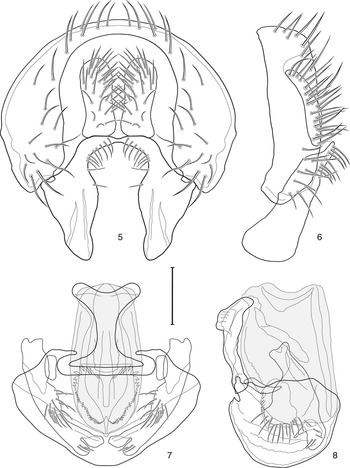
Male terminalia of Oedinopiforma javana (Taiwan, Tainan): 5. epandrium, cerci, and presurstyli, posterior view; 6. same, lateral view; 7. internal male terminalia, ventral view; 8. same, lateral view. Scale bar = 0.1 mm.

Paralimna javana Wulp Reference F.M. van der1892: 215.—Cogan and Wirth Reference Cogan and Wirth1977: 334.—Bock Reference Bock1988: 891–893.— Mathis and Zatwarnicki Reference Mathis and Zatwarnicki1995: 121.
Paralimna biseta Hendel Reference Hendel1914: 105.—Hennig Reference Hennig1941: 160 (synonymy).
Paralimna atrimana Malloch Reference Malloch1925: 326.—Bock Reference Bock1988: 891 (synonymy).
Oedenopiforma orientalis Zhang et al. Reference Zhang, Yang and Mathis2009: 201. syn. nov.
Diagnosis
This species is distinguished from congeners by the following combination of characters: moderately small shore flies, body length 2.85–3.30 mm, wing length 2.50–3.00 mm.
Description
Head. Black; frons rusty brown microtomentose except ocellar triangle and fronto-orbits bluish gray; face yellowish gray microtomentose, area between antennae with bluish gray microtomentum, but with a narrow brown median stripe; antenna black with brownish yellow microtomentum. One large lateral vertical seta; one large medial vertical seta; paravertical setae well developed, about 1/2 length of medial vertical seta; one pair of large ocellar setae; one large, reclinate fronto-orbital, proclinate fronto-orbital seta greatly reduced and subequal, hair-like; face with two large setae; gena with one large seta. Gena-to-eye ratio 0.23–0.33.
Thorax. Black with bluish gray microtomentum, base of setae with brown spots. Legs black with bluish gray microtomentum except tarsomeres one to two brownish yellow and tarsomeres three to five brown. Four strong dorsocentral setae (1 + 3); one large presutural supra-alar seta; one large postpronotal seta; two large notopleural setae; anepisternum bearing one large seta, two slightly small setae and some small setulae along posterior margin; katepisternal seta well developed; two pairs of large scutellar seta. Forefemur with row of long, fine, pale anteroventral setae, these about as long as width of forefemur; midfemur with three strong anteroventral setae at apex. Wing light yellow; R stem vein without setulae dorsally along posterior margin; costal vein ratio 0.33–0.35; M vein ratio 1.00–1.06.
Abdomen. Male genitalia (Figs. 5–8): epandrium in posterior view (Fig. 5) wider than high, ventrally extended lateral arms broad, in lateral view (Fig. 6) subrectangular; cercus in posterior view (Fig. 5) elongate, narrowly subtriangular to subrectangular, with dense setae, especially medially, truncate ventrally, in lateral view (Fig. 6) elliptical to lenticular; presurstylus robustly developed, in posterior view (Fig. 5) height slightly more than twice width, basal half over twice width of apical half, medial margin shallowly sinuous, basomedial arm of presurstlyus narrow, bearing row of setae along ventral margin, ventral apex of presurstylus pointed, in lateral view (Fig. 6) widest ventrally, about 3× higher than wide, ventral margin almost truncate, very shallowly arched; postsurstylus wider at middle in lateral view (Fig. 8) with a short, anterior, setose projection, apex moderatelly pointed, slightly curved, bifurcate (Fig. 7); aedeagus in lateral view (Fig. 8) with anterior margin rounded, posterior margin nearly straight, posteroventral portion truncate, anteroventral portion round and darkened, in ventral view (Fig. 7) subrectangular, very slightly wider apically, basal margin almost truncate, apical margin rounded; phallapodeme in lateral view (Fig. 8) with keel wide and moderately shallow, truncate, apical process longer than basal process in lateral view; subepandrial sclerite as two separate, lateroventral bars; hypandrium in ventral view (Fig. 7) almost twice as wide as long, anterior margin very broadly V-shaped, without short projection externally toward anterior margin, posterior margin medially concave, nearly flat, both posterior apices oriented medially, in lateral view (Fig. 8) pocket-shaped, rounded.
Type material
The holotype male of Paralimna javana (Indonesia. Java, in RNM) is apparently lost (Bock Reference Bock1988) and a neotype should be designated. We are unaware, however, of any good specimens from Indonesia for such a designation. We have examined a headless male (in RNM) from Indonesia that is labeled “Semarang Java VIII 05 [August 1905] Jacobson [handwritten]/Paralimna javana det. Dr. [perhaps ‘De’] Meijere [handwritten]” but because of its condition, we are hesitant to designate it as a neotype. We await the collection of a conspecific male from Indonesia for designation as a neotype.
The holotype male of Paralimna atrimana is from Australia, New South Wales: Belaringar, CIH (now in AM).
The holotype male of Oedenopiforma orientalis is from China, Hainan, Danzhou, Nadalianyuan (19°31′N, 109°35′E), May 14, 2006, Gang Yao (in CAU). Six male paratypes bear the same label data as the holotype (CAU, USNM). Other paratypes are as follows: CHINA. Hainan: Haikou, Jiarihaitan (20°02′N, 110°20′E), June 9, 2006, Hui Dong (1♀; CAU); Jianfengling, Nantianchi (18°43′N, 108°50′E), May 22, 2006, Gang Yao (1♂; CAU). Yunnan: Jinghong, Jingshatan (22°01′N, 100°48′E), April 29, 2005, Xingyue Liu (1♂; CAU).
Other specimens examined
Oriental: INDIA. Karnataka: Madikeri (22 km E; 12°26′N, 75°53.5′E), November 26, 2003, I. Yarom (1♀; USNM). Rajasthan: Bap Lake, near Phalodi (26°43.7′N, 73°55.3′E), November 19, 2002, A. Freidberg (2♂, 3♀; USNM); Jaisalmer (26°54.8′N, 70°54.8′E; lake), November 20, 2002, A. Freidberg (1♂; USNM); Nagda Temple (25 km N Udaipur; 26°55.5′N, 73°46.9′E; lake), November 22, 2002, A. Freidberg (1♀; USNM).
SRI LANKA. Anuradhapura: Hunuwilagama, near Wilpattu (8°26.5′N, 79°59.4′E; black light; 61 m), October 28–November 3, 1976, G.F. Hevel, S. Karunaratne (2♀; USNM). Puttalam: Rajakadaluwa (7°38.6′N, 79°49.5′E), August 25, 1953, F. Keiser (USNM). Trincomalee: Kantalai (8°22.1′N, 81°1′E), November 12, 1953, F. Keiser (2♀; USNM).
TAIWAN. Tainan (23°0.4′N, 120°10.9′E), November 1909, H. Sauter (2♂; ANSP).
VIET NAM. Long Binh (10°56.5′N, 106°53.8′E; ditch bank), March–November 1969, W.H. Pierce (2♂, 1♀; USNM).
Distribution
Australasian/Oceanian: Australia (New South Wales, Northern Territory, Queensland, Western Australia). Oriental: Bangladesh, Brunei, China (Hainan, Yunnan), India (Haryana, Karnataka, Rajasthan), Indonesia (Java), Sri Lanka, Taiwan (Tainan), Viet Nam.
Remarks
This species is somewhat similar and apparently related to O. uniseta (Malloch). Both species, for example, (1) lack a subepandrial sclerite and (2) have an elongate presurstylus that abuts dorsomedially and has a row of setulae basomedially. This species can be distinguished from O. uniseta by the following combination of characters: (1) two large facial setae, (2) paravertical setae well developed, (3) basomedial arm of the presurstylus narrow, (4) apex of presurstylus moderately narrowly pointed, and (5) hypandrium lacking a short projection externally toward the anterior margin. Specimens of O. uniseta (Malloch) have three large facial setae, greatly reduced paravertical setae (or they are lacking), a wide basomedial arm of the presurstylus, a rounded apex of the presurstylus, and a short projection of the hypandrium that extends externally toward the anterior margin.
We also noted that the R stem vein of this species does not bear setulae on the dorsal surface, unlike congeners. The presence of these setulae on the R stem vein has been considered a synapomorphy for the genus (Mathis and Zatwarnicki Reference Mathis and Zatwarnicki2002), and the lack of them in this species is either (1) a character reversal or (2) this species is possibly the sister group to the remaining congeners.
The new combination for this species and the new synonymy presented above were initially overlooked (Mathis and Zatwarnicki Reference Mathis and Zatwarnicki1995, Reference Mathis and Zatwarnicki2002; Zhang et al. Reference Zhang, Yang and Mathis2009) in part because our concept of this species was based on Bock's illustration (1988), which differs from that shown by a standard preparation of a typical specimen of O. javana (presurstylus almost parallel sided in illustration). We have now studied specimens, including structures from dissected male terminalia, from throughout the Oriental Region and have found that this is apparently a relatively common, widespread species in the Australasian and Oriental Regions.
Oedenopiforma vockerothi sp. nov.
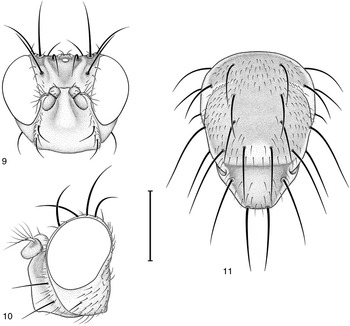
Oedinopiforma vockerothi (United Arab Emirates, Hatta Dam): 9. head, anterior view; 10. same, lateral view; 11. thorax, dorsal view. Scale bar = 0.5 mm.

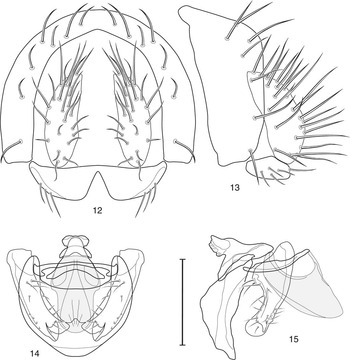
Male terminalia of Oedinopiforma vockerothi (United Arab Emirates, Hatta Dam): 12. epandrium, cerci, and presurstyli, posterior view; 13. same, lateral view; 14. internal male terminalia (aedeagus, phallapodeme, postsurstylus, subepandrium sclerite, hypandrium), ventral view; 15. same, lateral view. Scale bar = 0.1 mm.

Diagnosis
This species is distinguished from congeners by the following combination of characters: small to moderately small shore flies, body length 1.80–2.85 mm, wing length 1.95–2.25 mm.
Description
Head (Figs. 9–10). Paravertical seta moderately well developed, about 1/3 length of medial vertical seta. Frons brown across vertex and usually extended to ocellar triangle, anterior portion of frons whitish gray to gray. Antenna black; arista with six to nine dorsal rays. Face sexually dimorphic; face of male yellowish to brownish gray, especially dorsally, densely microtomentose, but not appearing velvety; face of female whitish gray to gray; two pairs of facial setae. Gena-to-eye ratio 0.29–0.30.
Thorax (Fig. 11). Mesonotum broadly brown to rusty brown medially, becoming grayer laterally through postpronotum and notopleural area; anepisternum concolorous with mesonotum or slightly lighter in coloration, otherwise pleural areas gray. Stem vein bearing two (rarely one or three) setulae dorsally along posterior margin, length of each about equal to width of vein at level of insertion; costal vein ratio 0.30–0.36; M vein ratio 0.95–0.97. Legs mostly black; tarsi blackish red ventrally; forefemur of female bearing row of tiny, toothlike setulae along apical half of anteroventral surface, male row inconspicuous, barely evident; forefemur of male lacking row of long, fine, pale, ventrally oriented setulae along anteroventral surface.
Abdomen. Male terminalia (Figs. 12–15): epandrium in posterior view (Fig. 12) slightly wider than high, dorsal portion with numerous, evenly scattered setulae, ventrally extended arms broad (Fig. 12), in lateral view (Fig. 13) subrectangular, wider dorsally than ventrally; cercus in posterior view (Fig. 12) semihemispherical to nearly obclavate with rounded corners, narrowly pointed dorsally, ventral margin rounded, densely setulose, especially medially, in lateral view (Fig. 13) semihemispherical; presurstylus in posterior view (Fig. 12) with sclerotized portion small, bar-like, horizontal, in lateral view (Fig. 13) horizontal, bar-like, length twice height, setulose; postsurstylus in lateral view (Fig. 15) large, robust, long, moderately narrow apically, nearly straight, not distinctly curved, apical half nearly parallel sided, digitiform, bearing setulae along lateral margins and especially ventrobasally, base wide; in ventral view (Fig. 14) subrectangular, length 4× width, nearly parallel sided, apex bifurcate; aedeagus relatively simple, in lateral view (Fig. 15) slipper-like with dorsobasal portion broad and deeply excavate, apex broadly pointed, in ventral view (Fig. 14) with apical half parallel sided, apex broadly rounded, basal portion parallel sided; phallapodeme in lateral view (Fig. 15) with keel irregular, pointed, extended processes about equal in length, relatively short; subepandrial sclerite in ventral view (Fig. 14) transversely elongate, very narrow, nearly straight, only lateral apices enlarged, in lateral view (Fig. 15) very narrow and shallowly curved; hypandrium in ventral view (Fig. 14) a moderately wide U-shaped process, narrowly sclerotized around margins only, in lateral view (Fig. 15) shallowly pocket-like, anterior and posterior apices pointed.
Type material
The holotype male is labeled “U. Arab Emirates. Hatta Dam (24°47.7′N, 56°06.3′E; 365 m), March 1, 2010[,] Wayne N. Mathis/USNM ENT 00285980 [plastic bar code label]/HOLOTYPE ♂ Oedenopiforma vockerothi Mathis & Zatwarnicki, USNM [red].” Two male and one female paratypes bear the same label data as the holotype. Other paratypes are as follows: United Arab Emirates. Wadi Maidaq (25°20.8′N, 56°05.5′E; 390 m), March 8, 2010, T. Zatwarnicki (1♀; PTZ); Wadi Shawkah (25°06.3′N, 56°02.8′E; 300 m; reservoir), February 27, 2010, W.N. Mathis, T. Zatwarnicki (3♀; PTZ, USNM).
Type locality
United Arab Emirates. Hatta Dam (24°47.7′N, 56°06.3′E; 365 m). We sampled behind the dam at Fort Hatta, especially where there were some short, emergent plants around isolated pools.
Distribution
Palearctic: United Arab Emirates.
Natural history
All specimens from the type series were taken by sweeping close to the surface of muddy to sandy shores associated with small, natural, freshwater oases or reservoirs in otherwise very arid habitats.
Etymology
The species epithet, vockerothi, is a genitive patronym to honor J. Richard Vockeroth, who contributed to the chapter on Ephydridae (Wirth et al. Reference Wirth, Mathis and Vockeroth1987) in the precedent-setting Manual of Nearctic Diptera.
Remarks
We anticipate that this species will be found in other countries of the Middle East. For example, we would not be surprised to discover that specimens from Iran that were previously listed as O. argentea (Mathis and Zatwarnicki Reference Mathis and Zatwarnicki2002) are this species.
Acknowledgments
We express our sincere thanks to our colleagues and their institutions listed previously who loaned specimens. Without their cooperation this study could not have been completed. For thoroughly reviewing and providing critical and insightful remarks, we thank A.G. Irwin, who also indicated to us the need for a neotype for O. javana. Recent field work in the United Arab Emirates (February–March 2010) was done in conjunction with a survey of the arthropods of that country with financial support coming from H.H. Sheikh Tahnoon Bin Zayed Al Nahyan. The arthropod survey is managed by Antonius (Tony) van Harten, who encouraged and facilitated all aspects of our field work and is gratefully acknowledged and thanked. We gratefully thank Karolyn Darrow for expert preparation of the habitus illustrations (Figs. 9–11) of O. vockerothi.