INTRODUCTION
Neurocysticercosis (NCC) is the most common parasitic disease of the nervous system in humans and is the main cause of adult-acquired epilepsy in areas in which infection with Taenia solium, also called the pork tapeworm, is endemic. The disease is acquired by accidental ingestion of tapeworm eggs shed in the feces of humans infected with an adult T. solium parasite. Once in the gastrointestinal tract, the eggs liberate hexacanth embryos or oncospheres. Oncospheres penetrate the intestinal wall and can migrate with the blood almost anywhere in the body, most often to the central nervous system where they transform into cysticerci and may cause NCC (Carpio, Reference Carpio2002; García et al. Reference García, Gonzalez, Evans and Gilman2003; Flisser, Reference Flisser, Labbé and García2013).
NCC is associated with significant morbidity and mortality. It has been suggested that several million people worldwide have an infection, while 50 000 of them die of it annually (Eddi et al. Reference Eddi, Nari and Amanfu2003). Epileptic seizures are the most common presentation of NCC occurring in up to 75% of infected patients. NCC can also be presented with intracranial hypertension, which develops in approximately 25% of cases, focal neurological deficits, meningitis, myelo-radiculopathy, mental status changes, encephalitis, dizziness and visual disturbances (Sinha and Sharma, Reference Sinha and Sharma2009).
NCC is endemic in Latin America, parts of Africa and Oceania and most of Asia (García et al. Reference García, Gonzalez, Evans and Gilman2003). It is presumed that NCC continues to be endemic in Eastern Europe as well (Del Brutto, Reference Del Brutto2012a ). Although transmission is absent or rare in most developed countries an increasing frequency of NCC in non-endemic areas due to international travel and migration has been observed (White, Reference White1997; Nash and García, Reference Nash and García2011; Del Brutto, Reference Del Brutto2012a ). Slovenia is not considered an endemic region for the infection. However, due to frequent immigration from countries of the former Yugoslavia with autochthonous NCC (Doder et al. Reference Doder, Madle-Samardzija, Canak, Vukadinov, Turkulov and Sević2002; Talan-Hranilovic et al. Reference Talan-Hranilovic, Sajko, Negovetic, Lupret and Kalousek2002; Titlic et al. Reference Titlic, Tonkic, Jukic, Lahman-Doric, Kolic, Buca, Milas and Dikanovic2007; Meštrović et al. Reference Meštrović, Sviben, Vilibić-Čavlek, Ljubin-Sternak, Tabain and Mlinarić-Galinović2012), cases of NCC are expected in Slovenia. The aim of this study was to examine whether patients with neurological disorders in Slovenia are infected with the larvae of T. solium.
MATERIALS AND METHODS
Between 1 January 2001, and the end of December 2012, 348 patients suspected of having NCC were examined serologically for the presence of anti-T. solium IgG antibodies at the Laboratory of Parasitology, Institute of Microbiology and Immunology, Faculty of Medicine Ljubljana. The suspicion of NCC was based on clinical data and/or imaging findings by ultrasound scanning or computerized tomography of brain lesions. The requirement for cysticercosis serology was left to the discretional criteria of the attending clinician. A total of 421 serum samples and 110 cerebrospinal fluid (CSF) samples were collected from patients of both genders and different ages. Sera and CSFs were first analysed by commercial qualitative enzyme-linked immunosorbent assay (ELISA) (T. solium IgG ELISA, NovaTec Immunodiagnostica GmbH, Dietzenbach, Germany; Cysticercosis (T. solium) – Serologie, Biotrin International, Lyon, France). ELISA positive or equivocal samples were confirmed by Western blot (WB) (Cysticercosis WB IgG, LDBIO Diagnostics, Lyon, France). According to the manufacturer's criteria, six bands on the membrane strip (6–8, 12, 23–26, 39, 45 and 50–55 kDa) bearing electrophoretically separated T. solium larval antigens have been especially chosen for their specificity for cysticercosis antibodies. When serum samples are tested for the presence of antibodies to T. solium larvae antigens, the presence on the strip of at least two well-defined bands among the six mentioned above is indicative of cysticercosis/NCC while in the case of CSF samples, the presence on the strip of one well-defined band among the six mentioned above is enough. The presence on the strip of the 6–8 kDa band has been described as indicative of active cysticercosis/NCC (Simac et al. Reference Simac, Michel, Andriantsimahavandy, Esterre and Michault1995). While, according to the manufacturer, a weak cross-reactivity of anti-Echinococcus antibodies with some of T. solium larvae antigens is possible, all WB confirmed cysticercosis positive samples were also tested for the presence of anti-Echinococcus IgG antibodies using the Echinococcus WB IgG (LDBIO Diagnostics, Lyon, France).
RESULTS
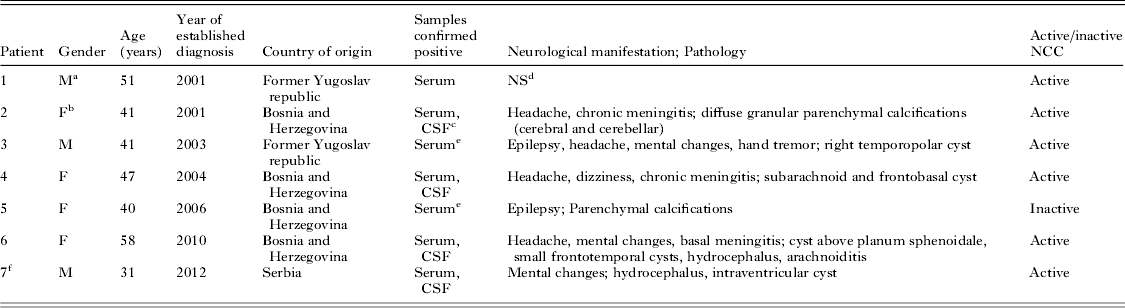
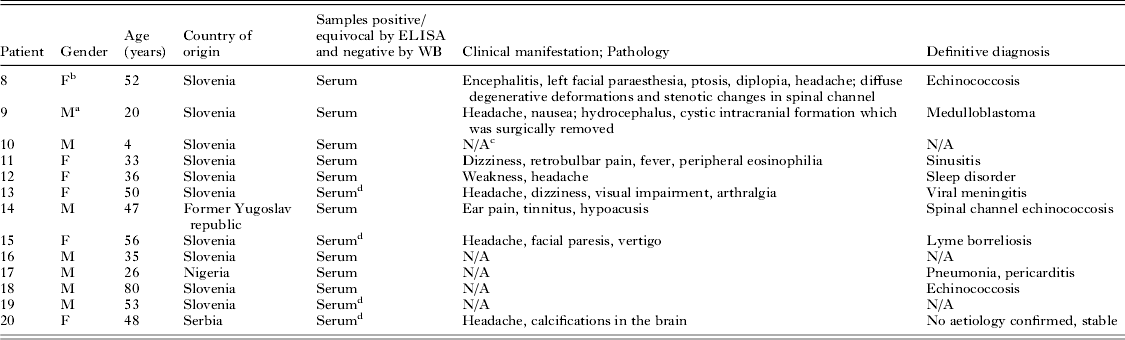
Of 421 serum samples and 110 CSF samples corresponding to 348 patients with neurological disorders, 39 sera from 20 patients and 7 CSF samples from 4 patients were tested positive or equivocal by ELISA for the presence of anti-T. solium IgG antibodies. Of the ELISA positive or equivocal samples 17 sera from 7 patients and 7 CSF samples from 4 patients were tested positive by WB. Altogether, 7/348 (2.0%) patients tested positive by WB (Table 1). Demographic and clinical data of patients confirmed to be NCC positive by WB and, for comparison, of patients tested positive or equivocal by ELISA but negative by WB are presented in Tables 1 and 2, respectively.
Demographic and clinical data of patients with neurocysticercosis

aM = male; bF = female; cCSF = cerebrospinal fluid; dNS = not specified; eCSF negative by WB; fNot a resident of Slovenia.
Demographic and clinical data of patients tested positive or equivocal by ELISA but negative by Western blot (WB) for the presence of anti-T. solium IgG antibodies

aM = male; bF = female; cN/A = data not available; dCSF negative by ELISA and by WB.
The mean age of NCC positive patients was 44.1 years. All of them were immigrants or came to Slovenia from countries of the former Yugoslavia. According to the manufacturer's criteria for the interpretation of WB results 6 patients suffered from active NCC, since their samples were positive for 6–8 kDa band and 1 patient had inactive NCC (Table 1, Fig. 1). All WB positive serum and CSF samples were negative for echinococcosis according to the Echinococcus WB assay, indicating that cysticercosis-positive WB results were not the reflection of anti-Echinococcus IgG antibodies in patients’ samples.
Positive results of Western blot (WB) assay of serum (S) and cerebrospinal fluid (CSF) samples from seven patients (P1–P7) with neurocysticercosis. Cysticercosis specific bands are: a (6–8 kDa), b (12 kDa), c (23–26 kDa), d (39 kDa), e (45 kDa) and f (50–55 kDa). Band a is indicative of active cysticercosis.

The mean age of patients tested positive or equivocal by ELISA but negative by WB was 41.5 years. Slovenia is the country of origin of 10/13 of these patients. Two were immigrants from countries of the former Yugoslavia and one was an immigrant from Africa. Clinical data and/or definitive diagnosis of 10/13 patients were successfully acquired. For nine of them NCC could be excluded on the basis of other definitive diagnosis but no aetiology was confirmed for the remaining one.
DISCUSSION
NCC is still endemic in Eastern Europe. Moreover, its prevalence is increasing in some non-endemic Western European countries so that the disease may become a public health problem in these countries in the next few years (Del Brutto, Reference Del Brutto2012a ). Indeed, in his review of the Western European literature on NCC over the past 40 years Del Brutto identified 779 cases of NCC. Of these, only 28 were diagnosed before 1985. This rise in prevalence is mainly due to immigration of carriers from endemic areas and tourists coming back from endemic countries. Portugal and Spain with 384 and 228 NCC patients, respectively, are the countries with the largest number of reported cases from 1970 to 2011, followed by France, the UK, Italy and Germany (Del Brutto, Reference Del Brutto2012a ). Recently, a systematic review on epidemiology and management of cysticercosis and T. solium in Europe from 1990 to 2011 was published by The COHEMI (COordinating resources to assess and improve HEalth status of MIgrants from Latin America) Project Study Group. Like Del Brutto, the authors find that imported cases of cysticercosis, of which 74.7% were diagnosed in migrants and 17.6% in European travellers, show an increasing trend (Zammarchi et al. Reference Zammarchi, Strohmeyer, Bartalesi, Bruno, Muñoz, Buonfrate, Nicoletti, García, Pozio and Bartoloni2013).
In Slovenia, T. solium taeniasis was virtually eliminated by adequate swine husbandry and improved meat inspection and therefore the country is not considered endemic for cysticercosis. Nevertheless, it has to be stressed that Slovenia played an important role in international migrations in the last two decades, and so imported cases of NCC are to be expected. The most important were the southeast to northwest migrations from the former Yugoslavia (made up of six republics: Bosnia and Herzegovina, Croatia, Macedonia, Montenegro, Serbia, Slovenia), especially from Bosnia and Herzegovina. There is no internationally published data on endemicity of human cysticercosis in Bosnia and Herzegovina. However, from 1991, when Slovenia declared its independence from Yugoslavia, until the end of 2000, five cases of NCC were detected in Slovenia, three of the patients being immigrants from Bosnia and Herzegovina (unpublished data), suggesting that this country could be endemic for the disease. In Croatia, Slovenia's neighbouring country, seven autochthonous cases of NCC were described by Talan-Hranilovic et al. between 1988 and 2000 (Talan-Hranilovic et al. Reference Talan-Hranilovic, Sajko, Negovetic, Lupret and Kalousek2002) and an additional case was reported by Titlic et al. (Reference Titlic, Tonkic, Jukic, Lahman-Doric, Kolic, Buca, Milas and Dikanovic2007). Apart from that, 11 out of 770 (1.77%) patients with epilepsy were found to be seropositive for NCC in a prevalence study conducted in Croatia from 2005 to 2009 (Meštrović et al. Reference Meštrović, Sviben, Vilibić-Čavlek, Ljubin-Sternak, Tabain and Mlinarić-Galinović2012). Serbia, another ex-Yugoslav republic, is also endemic for the disease with 78 autochthonous cases from 1990 to 2011 (Doder et al. Reference Doder, Madle-Samardzija, Canak, Vukadinov, Turkulov and Sević2002; Zammarchi et al. Reference Zammarchi, Strohmeyer, Bartalesi, Bruno, Muñoz, Buonfrate, Nicoletti, García, Pozio and Bartoloni2013). There are no data on endemicity of cysticercosis in Macedonia and Montenegro. In Slovenia's other neighbouring countries, Austria, Hungary and Italy, almost all of the reported cysticercosis cases were imported (Zammarchi et al. Reference Zammarchi, Strohmeyer, Bartalesi, Bruno, Muñoz, Buonfrate, Nicoletti, García, Pozio and Bartoloni2013). Moreover, immigrations to Slovenia from these and other European and world countries are scarce.
The overall seroprevalence rate of NCC in the present study which included patients with neurological disorders from the beginning of 2001 until the end of 2012 was 2.0%. Seven patients were found to be infected. All of them were immigrants or came to Slovenia from countries of the former Yugoslavia (Table 1). However, all but one of seven positive patients were residents of Slovenia at the time their samples were collected and the study was conducted. The youngest, a 31-year-old seropositive patient from Serbia (Patient 7, Table 1) came to Slovenia for medical consultation concerning his serious neurological condition. He was not a resident of Slovenia at that time. However, medical treatment at University Medical Centre Ljubljana, Slovenia, where NCC was diagnosed, had been recommended to him by his relatives, who had immigrated to Slovenia years before. Although Serbia is endemic for cysticercosis, he was believed to have acquired the infection while a shepherd in Bosnia and Herzegovina. Excluding Patient 7 for not being a resident of Slovenia, the incidence of NCC in Slovenia in the period from 2001 to 2012 was estimated to be 0.30/105 inhabitants, with a mean annual incidence of 0.025 cases per 105 inhabitants.
The diagnosis of NCC relies on the correlation of clinical features with the results of neuroimaging (Bale Jr., Reference Bale2000). Serology mostly has a confirmatory role and should be used in conjunction with neuroimaging (García et al. Reference García, Gonzalez, Evans and Gilman2003, Reference Garcia, Rodriguez, Gilman, Gonzalez and Tsang2012). Of serological techniques ELISA and WB are most commonly used (Carpio, Reference Carpio2002). In the present study, samples from 20/348 patients were tested positive or equivocal by ELISA. This gives the seroprevalence rate of 5.7% using ELISA. However, the seroprevalence dropped to 2% (7/348 patients) when the seropositivity of ELISA-positive or equivocal patients was confirmed by WB. Other authors had also reported lower specificity of ELISAs and recommended the use of WB as a confirmatory test in the laboratory diagnosis of cysticercosis (Gekeler et al. Reference Gekeler, Eichenlaub, Mendoza, Sotelo, Hoelscher and Löscher2002). WB is reported to have sensitivity of 98% and specificity approaching 100% for patients with two or more cystic or enhancing cerebral lesions (Tsang et al. Reference Tsang, Brand and Boyer1989). Therefore, the use of ELISA as a screening test and immunoblot as a confirmatory test contribute considerably to the diagnosis of the disease (Gekeler et al. Reference Gekeler, Eichenlaub, Mendoza, Sotelo, Hoelscher and Löscher2002). However, it has to be stressed that the sensitivity of WB is much lower (50% or even less) in patients with a single cerebral cyst or in those with calcifications alone (Wilson et al. Reference Wilson, Bryan, Fried, Ware, Schantz, Pilcher and Tsang1991; Rajshekhar and Oommen, Reference Rajshekhar and Oommen1997; Singh et al. Reference Singh, Rajshekhar, Murthy, Prabhakar, Modi, Khandelwal and Garcia2010). In light of this information it is possible that some patients with NCC might have been missed by serology in our study. To check the clinical status for patients tested positive or equivocal by ELISA but negative by WB we tried to collect their demographic and clinical data retrospectively from their clinicians. Clinical data and/or definitive diagnosis of 10/13 patients were successfully acquired (Table 2). For all but one of these 10 patients NCC could be excluded on the basis of other definitive diagnoses. For a 48-year-old female (Patient 20, Table 2) with headache and calcifications in her brain who immigrated to Slovenia from Serbia no aetiology was confirmed and therefore NCC could not be ruled out. We do not have the data on definitive diagnosis for serologically negative patients. Our laboratory is the only one performing serology on cysticercosis in Slovenia. Had cysticercosis been among the mandatory reportable diseases we could verify the accuracy of our test results by comparing the list of reported cases at the national Institute of Public Health with the list of patients tested serologically for cysticercosis.
As reported by Fleury et al. (Reference Fleury, Escobar, Fragoso, Sciutto and Larralde2010) the prevalence of NCC is age-dependent. Namely, in population-based epidemiological studies performed in Mexico, the prevalence of NCC was found to increase with age and reach a maximum in subjects 46–55 years old (Sarti-Gutierrez et al. Reference Sarti-Gutierrez, Schantz, Lara-Aguilera, Gomez Dandoy and Flisser1988; Sarti et al. Reference Sarti, Schantz, Plancarte, Wilson, Gutierrez, Lopez, Roberts and Flisser1992; Fleury et al. Reference Fleury, Gomez, Alvarez, Meza, Huerta, Chavarria, Carrillo Mezo, Lloyd, Dessein, Preux, Dumas, Larralde, Sciutto and Fragoso2003, Reference Fleury, Morales, Bobes, Dumas, Yánez, Piña, Carrillo-Mezo, Martínez, Fragoso, Dessein, Larralde and Sciutto2006). In a study conducted in Mbulu District, Tanzania, the highest prevalence rate was detected in the age group of 16–45 years (Mwang'onde et al. Reference Mwang'onde, Nkwengulila and Chacha2012). Moreover, the mortality rate due to cysticercosis was the highest between the ages of 15 and 54 with a mean age of 40.5 years in a study by Sorvillo et al. conducted in the USA (Sorvillo et al. Reference Sorvillo, DeGiorgio and Waterman2007). Seropositive patients in our study were from 31 to 58 years old, with a mean age of 44.1 years, which is in agreement with the above-mentioned studies.
Entering the central nervous system (CNS), cysticerci of the parasite are viable and as such they evoke minimal or no inflammatory responses in the surrounding tissues. After a variable time the parasite degenerates. Most symptoms in NCC are the direct result of the inflammatory process that accompanies its degeneration. This stage is called an active stage of NCC (Bale Jr., Reference Bale2000; Moskowitz and Mendelsohn, Reference Moskowitz and Mendelsohn2010; Del Brutto, Reference Del Brutto2012b ). The degenerative process ends with the transformation of the parasite into a calcified nodule. This inactive stage of NCC is associated with decreased inflammation. However, on the basis of recent data it has been hypothesized that calcifications may experience periodic morphological changes which may expose trapped parasitic antigens to the host immune system and result in recurrent seizures, focal neurological deficits or recurrent episodes of headache in some patients (Nash et al. Reference Nash, Pretell, Lescano, Bustos, Gilman, Gonzalez and Garcia2008; Ooi et al. Reference Ooi, Wijemanne, Thomas, Quezado, Brown and Nash2011; Del Brutto and Del Brutto, Reference Del Brutto and Del Brutto2012; Gupta et al. Reference Gupta, Awasthi, Rathore, Verma, Sahoo, Paliwal, Prasad, Pandey and Narayana2012; Rathore and Radhakrishnan, Reference Rathore and Radhakrishnan2012; Del Brutto, Reference Del Brutto2013). All but one of seven patients who were confirmed to be seropositive for cysticercosis in our study had active cysticercosis according to WB (Fig. 1). In these six patients active NCC was presented clinically as well (Table 1). For the patient with inactive NCC (Patient 5) presented by parenchymal calcifications and epilepsy, the 6–8 kDa band on the WB strip, described as indicative of active cysticercosis/NCC, was absent (Fig. 1). Moreover, this patient's CSF was negative for the presence of anti-T. solium antibodies.
This study provides important data on the prevalence of T. solium cysticercosis in patients with neurological disorders in Slovenia. Although the results showed that NCC cases are rare in Slovenia and are particularly due to immigrations from endemic countries, a search for a possible adult tapeworm carrier in the NCC patient's immediate environment or for an infestation by adult tapeworm in NCC patient himself should be considered. Namely, several studies have demonstrated that the presence of a tapeworm carrier in the household is the main risk factor for NCC (Sarti-Gutierrez et al. Reference Sarti-Gutierrez, Schantz, Lara-Aguilera, Gomez Dandoy and Flisser1988; Flisser, Reference Flisser, Craig and Pawlowski2002; Lescano et al. Reference Lescano, Garcia, Gilman, Guezala, Tsang, Gavidia, Rodriguez, Moulton, Green and Gonzalez2007). Moreover, even though the study by The COHEMI Project Study Group suggests that the risk of spreading cysticercosis in Europe from asymptomatic tapeworm carriers coming from abroad is quite low, as only five cases of T. solium immigrant carriers were found, its authors agree that the possibility of spreading cysticercosis this way cannot be ruled out (Zammarchi et al. Reference Zammarchi, Strohmeyer, Bartalesi, Bruno, Muñoz, Buonfrate, Nicoletti, García, Pozio and Bartoloni2013). To conclude, clinicians in Slovenia should include NCC in the differential diagnosis for each immigrant patient and returning traveller with CNS involvement. Moreover, the accuracy of epidemiological information which is currently inadequate due to the lack of specific surveillance systems should be improved. As proposed by The COHEMI Project Study Group this could be achieved by including cysticercosis among the mandatory reportable diseases in Europe.
FINANCIAL SUPPORT
The work was supported by Grant No. 0381-029, P3-0083, from the Slovenian Research Agency.