What role does sequential voting have on turnout? The US presidential nominating system, in 2016, has come under increased scrutiny as candidates, voters, and the news media have criticized its complicated legal design and how variation in state party rules may affect election outcomes. The current system was first implemented in 1972 when new party rules, among other things, connected outcomes at first tier selection events such as caucuses or primaries to candidate delegate counts and ensured that partisans wanting to participate had access to the selection process (Mandate for Reform 1970). This led to greater participation of rank-and-file party members and more internal party democracy in selecting the party nominee, in part, because many states moved from a caucus to a primary to satisfy the new rules resulting in grater turnout (Atkeson and Maestas Reference Atkeson and Maestas2009). However, the sequential nature of the presidential nomination process encourages or discourages primary participation depending on the dynamics of the race. We develop a theoretical framework for understanding how the dynamics of a sequential process influences state-level turnout and test our hypotheses using state and party level data from 1972–2016. In doing so, we advance our understanding of primary turnout over prior studies conducted in the early 1980s when the current system was still in its infancy (Norrander Reference Norrander1986c, Reference Norrander1992; Moran and Fenster Reference Moran and Fenster1982; Ranney Reference Ranney1977; Norrander and Smith Reference Norrander and Smith1985).
SEQUENTIAL NOMINATION CAMPAIGNS AND VOTER INCENTIVES
Explanations for voter turnout that are rooted in standard rational choice model are poorly suited for predicting turnout in presidential nomination contests at either the individual or aggregate-level because they treat elections as a one-shot contest in which the expected value of a vote cast is derived from the likelihood of it being pivotal in determining whether one’s candidate wins or loses. Sequential elections are different. Vote shares in earlier elections serve not only to determine winners and losers of specific contests, but also serve as signals to voters in subsequent contests about the viability, or nominatability, of candidates. Therefore, voters can be “pivotal” in a broader sense by contributing to a candidate’s momentum by helping a candidate to meet or exceed expectations set in the media or by helping a candidate to expand his or her delegate count.
The micro-foundation of aggregate nomination turnout is the individual-level decision to vote or abstain and depends on the expected utility of her vote at the time at which the vote is cast. This value differs for voters in different positions in the electoral sequence because the value of votes cast later in the sequence depends on the outcomes earlier in the sequence (Battaglini Reference Battaglini2005). Like other vote choice models, we assume that the institutional costs of voting and election mobilization influence the vote calculus as well, but the timing of the vote relative to the pool of candidates remaining is paramount to the choice to vote because the effective costs and benefits vary across the sequence of the election. Mobilization by active candidate organizations reduces the informational and time costs of voting, but the incentives for candidates to engage in mobilization change because the race is dynamic. In addition, the degree to which candidates other than the frontrunner still have a reasonable chance of winning affects their potential value as a voting signal. The dynamics of delegate accumulation across the sequential contests influence the chances that subsequent votes influence candidate viability.
The uniform exposure of voters in each state to the sequential position of their race in the overall nomination process allows us to form expectations for aggregate differences in turnout across states based on assumptions about the micro-level effects of sequential voting. When the race is new, every candidate has (at least in theory) a chance to win the nomination and the value in signaling is greatest. Early contests breathe life and momentum into the campaigns of some while deflating the campaigns of others. Momentum is an elevated chance of winning the nomination and results when early vote outcomes translate into resources and visibility that shape subsequent contests (Aldrich Reference Aldrich1980; Gurian Reference Gurian1990; Jackson and Crotty Reference Jackson and Crotty1996; Mutz Reference Mutz1995). It is important to emphasize that candidates need not win an early contest to reap electoral rewards, especially with proportional delegate rules that reward losers. Importantly, later voters respond to early vote outcomes as they consider whom to support (Bartels Reference Bartels1988; Popkin Reference Popkin1991; Kenney and Rice Reference Kenney and Rice1994; Mutz Reference Mutz1997). However, once the winner of the nomination has been declared, voters in any remaining states no longer have a meaningful choice at the polls. Their votes can only validate or protest an already known outcome, reducing incentives for participation.
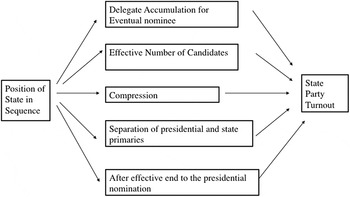
Figure 1 identifies five mechanisms through which sequential contests alter the incentives for aggregate voter turnout and form the core of our testable hypotheses. Each feature can be measured at the state level and each helps to create the primary election context to which all voters in each state are exposed. As the delegate accumulation builds towards a winner, the chances of a vote influencing the outcome or momentum declines, reducing turnout. Second, early contests often feature large pools of candidates, each intent on mobilizing their slice of the electorate. Eventually the race centers on two candidates or is winnowed to effectively a single candidate who then becomes the presumptive nominee (Norrander Reference Norrander2000). As the effective number of candidates decreases across the sequence of elections, so should turnout. Without the stimulus provided by active campaigns encouraging voters to contribute to their momentum, voters have fewer incentives to go to the polls.
It is important to emphasize that candidates need not win an early contest to reap electoral rewards, especially with proportional delegate rules that reward losers.
Hypothesized Relationship between Sequential Vote Context and Turnout

Party rules currently dictate the first four state positions in the sequence, but state-level choices determine the remainder of the sequence. Some states choose to combine their state primary contests with their presidential preference primaries. Other states do not want to combine them or traditionally have their state primary contest after the presidential nominating window. Having both types of events on the same day stimulates voter turnout because of the campaign associated with other ballot races, while separating them decreases voter turnout (Norrander Reference Norrander1986a; Norrander and Smith Reference Norrander and Smith1985). These choices also lead some states to hold nominating events on the same day as other states leading to primary compression. In particular, the earliest window for participating is usually quite popular, leading to large numbers of states going on the same day. Primary compression reduces voter turnout because candidates must strategically apportion their limited campaign resources across numerous nominating events. Different candidates make different strategic decisions, thereby reducing the overall amount of campaign activity in any particular state.
Finally, usually at some point in the process, the nomination campaign effectively ends because there is only one candidate left or because all of the other candidates have dropped out. For example, in 2016 Democratic candidate Bernie Sanders stayed in the race until the bitter end, but the campaign was effectively called on June 6 by the Associated Press the night before the last round of contests when they did a count of Superdelegate preferences (Bump Reference Bump2016). Once the media and voters recognize that one candidate has an insurmountable lead, incentives for participation decrease greatly. Voters see little value in casting a vote and candidates see little value in continued mobilization efforts.
Factors related to sequence, of course, are not the only influence on primary turnout. Past studies on primary turnout have relied on both aggregate and survey data to understand how state rules, candidate strategies, and the demographic characteristics of the electorate influence turnout (Geer Reference Geer1989, Moran and Fenster Reference Moran and Fenster1982; Norrander Reference Norrander1986a, Reference Norrander1992; Norrander and Smith Reference Norrander and Smith1985; Ranney Reference Ranney1977; Kenney and Rice Reference Kenney and Rice1985). We also control for these relevant factors.
DATA AND METHODS
We use aggregate state level primary voting data from 1972–2016 to test the various mechanisms through which sequential positioning influences turnout. Our unit of analysis is state party elections yielding up to two cases per state per election year. We measure our dependent variable, primary turnout, using a normal vote measure—the party’s share of the vote in the last general election multiplied by the voting eligible population—to identify the denominator (Norrander Reference Norrander1986b, Reference Norrander1992). Footnote 1
Independent Variables. The first variable, the percent of delegates accumulated by the eventual nominee prior to each state nomination contest, represents the sequential nature of the system by reflecting the degree to which votes are devalued as delegates accumulate for the eventual nominee. It ranges from 0% to 100%, where 100% equals the point at which an eventual nominee has enough delegates to win the party’s nomination. For years in which there was an incumbent president running essentially unchallenged we code this variable 100% throughout. We expect the rate of delegate accumulation to have a negative effect on state-party primary turnout.
To capture the effects of winnowing, we use a measure of the effective number of candidates (ENC) that reflects the number of active candidates in a race (Steger, Hickman, and Yohn Reference Steger, Hickman and Yohn2002). This measure represents a concentration index that estimates the number of effective candidates based on their relative vote share. We expect that as the effective number of candidates decreases, so should turnout.
Our third variable captures the compression that comes from multiple contests on the same day; we expect the number of primaries held to have a negative effect on turnout because candidates must spread their campaign resources across more states. However, turnout should increase in states that hold their presidential preference on the same day as other state primary elections. We control for this possibility with a dummy variable coded one if states hold their state primaries on the same date as the presidential preference primary and zero otherwise.
Finally, we identify whether or not the primary election occurred after the date a party nominee is known. This variable differs from our delegate accumulation measure because it recognizes that candidates need not have over 50% of the delegates for the race to be called by the media or other elite actors. Drawing upon multiple sources, we identify the earliest date at which a single candidate was considered the party nominee due to delegate totals and/or lack of challengers. We use a dummy variable that is zero before and a one after the nominee is known. For years in which there was an incumbent president running essentially unchallenged, we code this variable one throughout.
Of course, structural factors that shape the pool of eligible voters matter as well (See Holbrook and La Raja 2008). In a closed primary, only registered partisans can participate. In an open primary, citizens request the party ballot of their choice. In semi-closed primary states independents can choose to participate in the party of their choice, but may be required to register with one of the parties at the time they select a ballot. In California the Democratic Party accepts votes from independents, but the GOP does not, showing that sometimes there are differences in implementation within states. We include dummy variables in our model for semi-closed and open primaries, making closed primaries the comparison group, and theoretically expect both to be positive.
We also consider how the current party in power in the White House influences turnout. We identify four party/incumbent contexts possible in any given race and include them as dummy variables with the second category used as the reference: 1) the party is in power and the party incumbent is running 2) party is out of power and the opposite party’s incumbent is running 3) party is in power and the race is open 4) party is out of power and the race is open. Out party members may have greater uncertainty about who should be the nominee, which may lead to more competition over an extended period of time and hence greater turnout for the out-party than the in-party. Campaigns with incumbents running may be less exciting, especially for the party in power. Because there is no competition for the in-party, these contests should produce the least primary turnout.
We also control for the number of delegates at stake in each state primary. Conventional wisdom would suggest that states with more delegates should be more valued by candidates leading to greater mobilization efforts in those states and, therefore, greater turnout. However, we maintain that it is the state’s position in the sequence of events relative to nomination outcomes rather than its delegate size that stimulates candidates’ attention. Therefore, we do not expect to identify a significant effect.
State voting law dictates how long before an election a voter must be registered to participate. Research on general election campaigns shows that the further out the requirement from the election, the lower the turnout (Wolfinger and Rosenstone Reference Wolfinger and Rosenstone1980). We hypothesize a similar effect here and measure it as the number of days before the election an individual is required to register. We also include a dummy variable if the state had a favorite son in the race (coded one if yes, zero if no). We expect favorite sons to increase turnout and therefore expect a positive coefficient.
At the individual level, demographic characteristics (e.g. race, socio-economic status, and age) are associated with participation (Wolfinger and Rosenstone Reference Wolfinger and Rosenstone1980). To control for such factors at the aggregate level we include the state level demographics of percent black, percent college educated, percent over the age of 65, and state median family income. Because our unit of analysis is party elections in primary states we also control for party (zero for Democrats/one for Republicans).
RESULTS
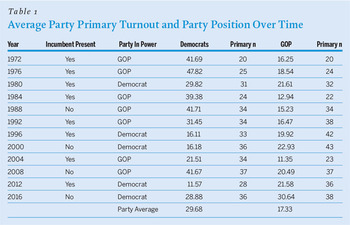
Table 1 shows average turnout and party position by party and by year. The table shows that, on average, Democrats have greater participation than Republicans, that the out-party has, on average, higher turnout than the in-party, and that contests with incumbents have, on average, lower turnout than open contests.
Average Party Primary Turnout and Party Position Over Time

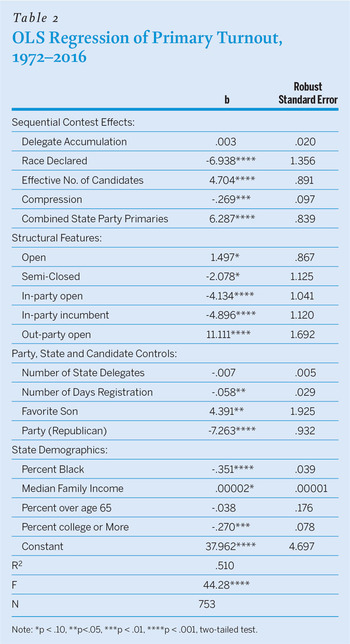
Table 2 presents the results for the OLS regression model including robust standard errors. Footnote 2 The model generally supports our hypotheses that as context shifts, more states are faced with conditions that inhibit, rather than enhance, turnout.
OLS Regression of Primary Turnout, 1972–2016

Note: *p < .10, **p<.05, ***p < .01, ****p < .001, two-tailed test.
First, the model shows how important candidate mobilization is to turnout. Both the effective number of candidates and the effective end of the campaign dramatically affect turnout. For each additional effective candidate in the race, turnout increases by 4.7%. There are between 1 and 6.7 effective candidates (with a mean of 2) in all contests. However, there are larger numbers of effective candidates during the earlier phases of the campaign leading to greater turnout compared to later contests. The effective end of the campaign reduces turnout substantially and, on average, by about 6.9%.
Interestingly the momentum variable, which measures how close the front-runner is to the finish line, has no appreciable effect on turnout. Compression, however, does play a role in reducing turnout by .27% for each additional state contest held on the same day. Compression ranges from 1 to 22 with a mean of 5 so the substantive impact of this variable has the potential to be somewhat large. Finally, state parties that combine the presidential primary with primary elections for other state and local races have, on average, higher turnout by 6.3%. Importantly, many states that combine their state and presidential primary have their contests later in the season, potentially offsetting some of the losses to turnout due to effective endings.
Other institutional effects also matter. Contests that allow voters to choose which party ballot they want to participate in increases turnout, on average, by 1.5%, but semi-closed primaries have lower turnout, on average, by 2.1%. Theoretically, the latter finding is unexpected, but has appeared consistently in early studies of turnout (Kenny and Rice Reference Kenney and Rice1985, Ranney Reference Ranney1977). Perhaps modified open primaries do not result in higher turnout because many independents are unaware that they can participate or do not want to declare a party allegiance and change their voter registration. Institutional context of the party or party position also is important. The out-party in an open contests increases turnout, on average, by 11.1%. The in-party with an incumbent running, on the other hand, displays, on average, the lowest turnout with declines of about 4.9%. Party also shows a negative effect indicating that Republican primary voters are less likely to turnout than Democrats by about 7.3%. We do not have a good explanation for why GOP turnout is, on average, lower than Democratic turnout, but it is a consistent and robust finding.
A favorite son increases turnout by 4.4%, while for each additional day required to register decreases turnout by .06%. The total number of delegates at stake is not significant, as expected, suggesting that delegate totals do not shape candidate behavior, but registration rules matter to citizens with longer registration requirements leading to lower turnout, also as expected. State demographics for percentage of African American and family income work in the expected directions, negative for percent black and positive for family median income, but age and percent college move in the wrong direction and age is not significant.
When contests end relatively early in the campaign, the reduced incentives for voting can disenfranchise millions of potential voters and the national party’s ability to attract new entrants declines.
DISCUSSION
We have identified five mechanisms associated with primary contest sequencing, four of which we find influence state-party turnout. Our findings bring into sharp focus the tension between party reformers’ goals to increase participation by connecting voter support to delegate counts and the realities of how sequential contests disenfranchise later voters as the race winnows and eventually effectively ends.
Finding differential incentives for participation in primary elections has important substantive implications for party building and party legitimacy. First, voters who participate in a presidential nominating contest, even for a losing candidate, are more likely to participate in the fall general election campaign (Stone, Atkeson and Rapoport Reference Stone, Atkeson and Rapoport1992). With the uneven turnout that results from a sequential process, party expansion and recruitment is less uniform and, therefore, less of a national phenomenon. Fewer voters are inclined to become involved in the electoral process because for most citizens the race is over before it ever reaches them. When contests end relatively early in the campaign, the reduced incentives for voting can disenfranchise millions of potential voters and the national party’s ability to attract new entrants declines.
Turnout is also important because it provides legitimacy and efficacy to cementing the party nominee’s selection. The winner wins because he or she has more votes and more support than other candidates. But, when certain voters are privileged in the process because they get to vote first, the process may seem rigged and unfair—potentially undermining the legitimacy of the party nominee in November. Recent polls suggest that voters are disenchanted with the current process, especially Superdelegates, caucuses, closed primaries, and the special place given to Iowa and New Hampshire as first in the nation (Lucey and Swanson Reference Lucey and Swanson2016). Our results directly speak to this policy debate by identifying the features that decrease or increase turnout.
One alternative to the sequential process is a national party primary and our results suggest that such a system could even out the imbalances in the participation incentives and lead to more equal weighting of voters by eliminating some of the factors we have shown reduce turnout. Of course, a national primary would likely reduce or eliminate the ability of relatively unknown candidates to gain momentum through early smaller contests, so there are negatives. Nevertheless it still may be preferable for meeting an array of party, candidate, and voter goals including promoting broader participation, a different set of benefits to underdog candidates, party building and expansion of its base, a test of a candidate’s appeal, and the quick and decisive determination of the party nominee.
A national primary for each party in the late spring of a presidential year would allow for meaningful campaigning while fostering a quick and decisive determination of the party nominee. Voters in some states would, no doubt, still get a different local campaign than voters in other states because candidates would still strategically deploy resources. However, national media and candidates would be incentivized to talk to national audiences rather than narrower state-based interests as is the case during the nomination. In the current system, voters in Iowa and New Hampshire face campaign saturation, while many voters in other states are engaged only when or if the local election environment heats up. In a national primary, media coverage would be more evenhanded across states, allowing voters the time to contemplate their choices. Most importantly a national primary would make every vote equal in value.
Although a national primary would have some downsides, even unknown candidates would get to make their case to a larger and more diverse electorate—one more similar to what they will have to face in the fall general election campaign—than they do in the current environment. Including a run-off process, perhaps as ranked choice voting, to ensure that plurality voting does not select a weak candidate would further legitimize the process and permit lesser known candidates a greater chance of winning. Party building efforts would be strengthened as voters across the nation respond to the excitement of national candidate campaigns. Candidates who win through a process with straightforward rules that are consistent both within and across states would have greater legitimacy as the process of selection would be viewed as transparent and fair. Importantly, party division would begin to heal as the race turns to the general election campaign and the real contest between the two parties begins (Atkeson Reference Atkeson1993; Atkeson Reference Atkeson1998). Thus, this alternative scenario may offer many advantages to the eventual nominee, also-rans, the party and, especially, to voters.
Recent discussions by political elites, party leaders, and political pundits question the effectiveness of the nomination process as it has evolved. The process in its current form is neither transparent nor consistent, prompting perceptions that it is unfair or rigged. As we look to the future, devising a less complex, more transparent, and consistent process may go a long way to improving the public legitimacy of presidential candidate selection.
ACKNOWLEDGMENTS
I would like to thank a number of students for their help in collecting the data for this project including Meg Edwards, Luciana Zilberman, Yann Kerevel, Alex Adams, Lisa Bryant, and Janelle Johnson. Of course, any errors are our responsibility.