Implications
Most donkey breeds, as well as local horse breeds, are vulnerable to extinction as mechanization of agriculture and the introduction of exotic breeds diminishes its economic importance. Their loss will be an irreversible setback in animals’ genetic resources available for the future and should be prevented because of their importance in the conservation of landscape and economic sustainability in remote regions. This work contributes to the clarification of some management practices and population and socioeconomic variables that are implicated on this process and suggests strategies for donkey livestock conservation.
Introduction
Changes in agricultural practices led to the risk or actual extinction of most donkey breeds. Of the 162 official donkey breeds worldwide, just five of them are not at risk and six are already extinct (Rischkowsky and Pilling, Reference Rischkowsky and Pilling2007). The Portuguese population in rural areas has decreased in the last few decades and is still declining, with human population leaving for the coastal and city areas (Instituto Nacional de Estatística, 2011), as in other countries with late industrialization. This trend reflects on abandoning traditional agricultural practices and the decrease in size of the existing donkey population and the sporadic use of these animals on reproduction. The introduction of new policies envisaging the recovery of peripheral rural areas, looking at the recovery of rural landscapes and of revitalizing isolated local social groups, draw once more the attention on the local livestock. This scenario deems for a better characterization of local livestock breeds’ genetic diversity, understanding the breeds’ dynamics and the reasons for their declining numbers, biologically and socioeconomically.
The Asinina de Miranda (RAM) is a classic case of a local donkey breed in a typical rural Mediterranean landscape, facing the same challenges for preservation as other local asinine and equine breeds in this area. The breed home region (HR) is the Planalto Mirandês and RAM is characterized by having a long bay coat, over 130 cm height and a characteristic calm temperament, which makes it especially apt for agricultural work, milk production, and leisure or asinotherapy activities. The donkey population decreased markedly by the end of 70s, throughout the 80s and 90s and is now vulnerable to extinction (INC, 2011). In 2002, the Association for the Study and Protection of Asinine Livestock (AEPGA) was founded and the Studbook was created as part of a global conservation effort, implementing the selection of the animals that filled the breed standard, the selection of those with best morphological and behavior traits for breeding and the recording of the animals’ pedigree.
Pedigree analyses proved to be a suitable method to analyze the genetic diversity within a population, enabling its estimation; these analyses have been performed for several horse and donkey breeds (Cecchi et al., Reference Cecchi, Ciampolini, Ciani, Matteoli, Mazzanti, Tancredi and Presciuttini2006; Rizzi et al., Reference Rizzi, Tullo, Cito, Caroli and Pieragostini2011; Vicente et al., Reference Vicente, Carolino and Gama2012). The maintenance of genetic diversity within a breed is of outmost importance (Bennewitz et al., Reference Bennewitz, Kantanen, Tapio, Li, Kalm, Vilkki, Ammosov, Ivanova, Kiselyova, Popov and Meuwissen2006), as inbreeding generally reduces performance, health and fertility (Falconer and MacKay, Reference Falconer and Mackay1996). The unequal contribution of founders and ancestors to the population decreases genetic diversity (Lacy, Reference Lacy1989; Boichard et al., Reference Boichard, Maignel and Verrier1997), the reason why one of the objectives for a breed conservation program should be to keep as many alleles as possible from the founding population.
The purpose of this study was to analyze the pedigree records and typify some of the socioeconomic features of herds and owners of the Asinina de Miranda breed and to identify the environmental and management factors that may affect the breed genetic variability in the future. Furthermore, the data gathered were used to discuss suitable strategies to minimize the loss of genetic diversity, based on identified variables, acting early in the beginning of the breed recovery project. This study and its results can apply to most of the donkey and horse breeds on the Mediterranean area, where several breeds are raised under similar social and demographic situations.
Material and methods
Breed data
The records for this study were retrieved from the RAM’s Studbook. The data set included all the available genealogical information for purebred animals, as well as for herds and owners, covering the period since the beginning of the records, in 2002, to the end of December 2012. The initial registering process is completed and the Studbook was closed at the end of 2011, precluding further registrations of animals of unknown origin. The data set was checked and validated to ensure data integrity and individual identification. It included the date of birth, and the progeny and ancestry for 681 females and 79 males from 353 herds. A survey of herd owners was also conducted during the second semester of 2012, to better access management practices and socioeconomic characteristics.
Pedigree analysis
The pedigree analysis was performed using ENDOG v4.8 (Gutiérrez and Goyache, Reference Gutiérrez and Goyache2005). To characterize the depth of the pedigree, the following values were calculated: (a) the average complete generation, computed as the maximum of average traced generations for each animal; (b) the maximum of fully traced generations, computed as the value separating the offspring from the farthest generation where the two ancestors of the individual are known; (c) the number of equivalent generations computed as the sum of (1/2) n where n is the number of generations separating the individual from each of the known ancestors.
To estimate genetic variability the following values were calculated: (a) individual inbreeding coefficient (F) and average relatedness coefficients (AR), which correspond, respectively, to the probability that both alleles, randomly selected, are identical by descent (Falconer and Mackay, Reference Falconer and Mackay1996), and the mean relationship of each individual with the rest of the animals of the breed; (b) parameters characterizing the concentration of gene origin, such as the effective number of founders (f e ), defined as the number of equally contributing founders (animals without known ancestors) expected to produce the same genetic diversity as in the studied population (Lacy, Reference Lacy1989); and the effective number of ancestors (f a ) defined as the minimum number of ancestors (not necessarily founders) explaining the complete genetic diversity of the population and accounting for the loss of genetic variability caused by the unbalanced use of ancestors on reproduction, leading to genetic bottlenecks (Boichard et al., Reference Boichard, Maignel and Verrier1997); (c) the effective population size (N e), taking into account the unequal contribution of founders, as the number of breeding individuals in an idealized population that would give rise to the rate of change in the variance of gene frequencies under random genetic drift as the population under consideration; yet this variable can overestimate the actual effective population size in small populations with a shallow pedigree and may be improved by calculating the individual inbreeding coefficient over the number of fully traced generations, the maximal number of generations and the equivalent complete generations. Taking into account the shallow depth of the pedigree, we included in the reference population all the animals with both known parents.
The genetic conservation index (GCI) for each animal was also calculated according to Alderson (Reference Alderson1992), with higher indexes corresponding to individuals on the reference population with a more balanced genetic representation from different founders; generation intervals were calculated for the four pathways parent–offspring for sires and dams of all foals and for the mean age of sires of sons, sires of daughters, dams of sons and dams of daughters (Gutiérrez and Goyache, Reference Gutiérrez and Goyache2005).
Herd analysis
On the basis of the destiny of their jacks, herds were classified into four levels: nucleus when only in-born jacks were used for reproduction or for selling; multipliers whenever breeding jacks are sold and bought; commercial if siring jacks were bought and in-born males were not sold; and isolated when they did not buy or sell jacks. For the purpose of herd classification according to its main objective, five types were considered: (i) traditional, with animals used for work; (ii) leisure, if animals are used as pets; (iii) touristic activities, when animals are integrated in touristic economic projects; (iv) production, when animals are used for foal and milk production; and (v) preservation, in the two cases of Non-governmental Organizations especially devoted to RAM preservation. In terms of geographical localization, herds were assigned as being located on the HR or on the dispersal regions (DR), in the continental territory of Portugal.
Statistic analysis
Statistic calculations for the data on herds and their population and foaling were carried out using IBM SPSS Statistics 19.0 (IBM Corporation, Armonk, NY, USA) and Microsoft Office Excel 2007 (Microsoft Corporation, Redmond, WA, USA). The values for offspring production and time in service for males are presented as mean±standard error. The evaluation of statistical association among the number of foaling and age of the owner and number of animals on the herd, and among the animal age and its GCI was obtained by the pairwise correlation coefficient (R); the Pearson’s χ 2 was used for the association between the management system and the localization of the herd in the HR or in the DR; the ANOVA test was used for associations among the number of foaling and the management system and localization in the HR or in the DR, using Bonferroni multiple test for comparison of the group means.
Results
Pedigree completeness and inbreeding
RAM Studbook comprises a total of 760 animals, from which 725 animals born between 1982 and December 2012 are still alive (aged 1 to 31 years old, for females, whereas the oldest male still in use is 21 years old). The sex ratio between females and males in the whole population was close to 9 : 1 (681 females and 79 males), 14 : 1 in adults (586 females and 41 males). The breeding rate was very low: the ratio of foaling/live animals is 0.18 (92/499) for the HR and 0.33 (86/261) for the total of DR (Supplementary Figure S1). The reference population (individuals with both parents identified) was 160, corresponding to 21.05% of RAM population, which lead to an effective population size (N e) of 360.63.
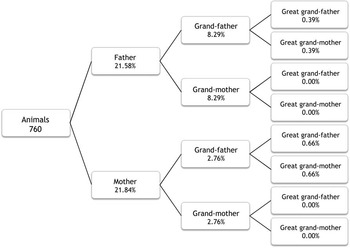
The greatest number of traced generations was three for the RAM breed. The mean average maximum generations were 0.33 and complete traced generations was 0.22, leading to an effective population size of 122.18 and 122.27, respectively, considering each with an increase in inbreeding of 0.41% for both maximum and complete generation. The mean equivalent generations’ value was 0.28 with a mean inbreeding increase by equivalent generation of 0.43%, which displaced the effective population size to 116.54. The percentage of known ancestors corresponded to 21.71%, 5.5% and 0.3% at the first, second and third generations, respectively. Only 9 animals (1.18%) presented 2 complete generations on the genealogy, whereas 7 presented 3 incomplete generations (0.92%). The remainder (72.5%) failed to present a full generation (Figure 1). It was only by 2007 that registered animals born with one or both unknown parents decreased below 50% (28/42); this number decreased to just 6 (36%) in 2011, the year preceding the closure of the Studbook.
The contributions of each type of ascendant for the Asinina de Miranda breed genealogy till third generation. In RAM, no parents are known before that generation. RAM=Asinina de Miranda.

The estimated number of ancestors and founders contributing to the reference population was 121 and 128, respectively. The number of ancestors explaining 50% of the genetic variability was 117. Yet, in the reference population, the effective number of ancestors and founders explaining the breed genetic variability was 34 and 38, respectively, with a ratio of 0.89 between the two indices. The mean inbreeding of the living population (F) and the average relatedness (AR) for the whole population were 0.08% and 0.33%, respectively. Only 3 consanguineous animals were identified, 2 of them resulted from the mating of a mother and son (0.26%) and the other from the mating of 2 siblings (0.13%). The effective size of the RAM population obtained from regression on the birth date was 394.21, whereas the effective size of the population obtained from Log regression on the birth date was 347.63. The average GCI for the entire breed was 1.30±0.02 (n=760) with it being 1.27±0.02 (n=671) for females and 1.53±0.09 (n=89) for males. The average GCI was negatively associated with the age of the animal (P<0.001).
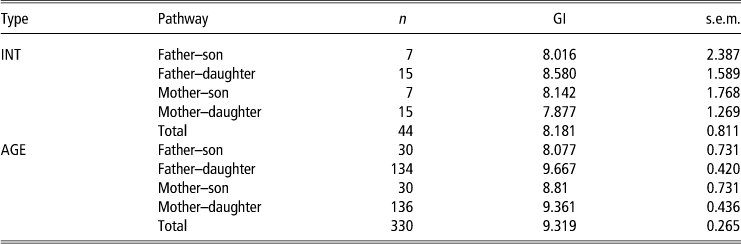
Of the 760 animals registered, only 33 males and 120 females produced registered offspring and their total offspring for the surveyed period was 160, with a sex ratio of 130 females to 30 males. Each stallion has been on service for an average of 3.33±0.18 years (ranging from 1 to 11 years) and produced 1±0.008 male and 3.94±0.030 female offspring. The contribution of each male to the breed genetic pool was unequal with over half (88/160) of the offspring originating from 6 males, with 3 of them being related, a father and 2 of his sons. The generation interval according to the 4 gene transmission pathways is presented on Table 1 for the average age of parents when the breeder descendants were born (8.181±0.811) and when all offspring was born (9.319±0.265).
GI for the four pathways parent–offspring in the Asinina de Miranda donkey breed for INT (average age of breeder parents at descendants’ birth) and for AGE (average age of parents at all offspring birth)

GI=generation intervals; s.e.m.=standard error of the mean.
Herd analysis
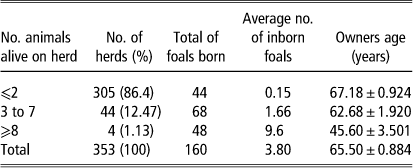
There were 353 registered RAM donkey owners, the majority of them (n=334) still keeping donkeys today. In the past 10 years, 5.38% of the herds were closed. Only 70 herds (19.83%) have registered foals on the Studbook in the same interval. The mean age of the herd owners was 65.50±0.884 years, with a negative association among the herd size and owners’ age (P<0.001). In contrast, the size of the herd and the ownership of a male were both positively associated (P<0.001) with the herd number of in-born foals. Both the owners’ age and the herd location (RAM HR v. DR) were negatively associated with the foaling number (P<0.001; Table 2).
Herd size, age of the owners (mean±s.e.m.) and inborn foals in Asinina de Miranda donkey breed

s.e.m.=standard error of the mean.
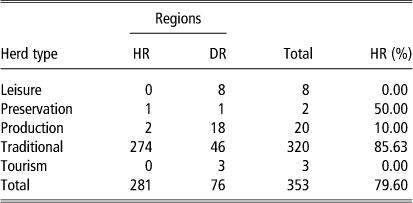
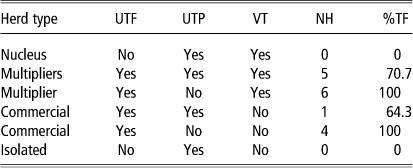
Herds dedicated to breed preservation (n=2) have a higher number of foaling than all other types (P<0.001), whereas the leisure and the traditional types showed the lowest number of foaling. Herds’ distribution by size (Table 2) showed a prevalence of the traditionally small-sized herds with one or two females. The type of herds significantly differed between RAM HR and the DR (P<0.001; Table 3). In RAM, two types of multipliers (n=11) and commercial (n=5) herds were found, whereas no nucleus or isolated herds were identified (Table 4). The number of founder herds in the reference population was 64, with an effective number of founder herds for the reference population of 7.6, with a ratio of 0.12 among these 2 values evidencing the reduced number of herds providing sires.
Herd type according to its geographical location and socio-economic & objectivein Asinina de Miranda donkey breed

HR=home region; DR=dispersal regions.
Herd structure for the Asinina de Miranda donkey breed based on the destiny of their jacks

UTF=use of bought stallions; UTP=use of in-born stallions; VT=sell males; NH=number of herds; %TF=percentage of males from outside to the farm.
Discussion
The overall number of RAM animals places the breed in the vulnerable breed category (Rischkowsky and Pilling, Reference Rischkowsky and Pilling2007). Because of the declining numbers in the population and the breeding rates, there is a real risk of inbreeding. The abandonment of the rural lands and the aging of the population remaining in peripheral, socially poor rural communities for the past four decades contributed to the marked reduction in the number of animals reproducing at regular basis, and to the decreased number of the actual RAM population. The number of animals in reproductive age still allows for the implementation of an effective conservation program. However, the low foaling rates demand for urgent action. Ninety-five per cent of the animals registered on the Studbook are still alive, and therefore a possibility still exists of getting offspring from most of them. The breed is expanding throughout Portugal and the number of births in the DR is proportionally higher than those for the home region. This indicates a trend of spreading of the breed from both the HR and its traditional utilization in agricultural work.
If the pedigree contains a large number of missing parents, as it was the case for RAM, the inbreeding could be underestimated because of the assumption that all founders are unrelated (Lutaaya et al., Reference Lutaaya, Misztal, Bertrand and Mabry1999), and thus the values found must be carefully analyzed. The low mean average maximum generations and complete traced generations indicate a very shallow pedigree, as it would be expected from a species with long-generation intervals and from a breed in which the Studbook started 10 years ago. Despite the pedigree shallowness, an important loss of founder genetic diversity was noticeable by the low effective number of founders and ancestors in comparison with the number of founders and ancestors of the reference population. The rates between these indices revealed that for each founder or ancestor contributing to the reference population, the genetic information for more than two other founders or ancestors was lost. This trend follows the one reported for the Catalonian donkey in Spain (Gutiérrez et al., Reference Gutiérrez, Marmi, Goyache and Jordana2005).
Of the animals with no known ancestors, only one quarter contributed to the reference population. This low ratio indicates that most of the potential genetic contribution will be lost if these animals are kept from breeding. The overuse of some jacks increases the risk for genetic bottlenecks, as does the fact that only around half the females remain barren and are only used for work or leisure, in the absence of incentives to breed. In the Amiata breed, a higher sex ratio exists, which may be because of the higher number of herds with siring males (Cecchi et al., Reference Cecchi, Ciampolini, Ciani, Matteoli, Mazzanti, Tancredi and Presciuttini2006), a variable that was shown to be associated with the RAM offspring production. In RAM, it would be desirable to broaden the use of different males in the same reproductive season, and to use them throughout several seasons, as it has been done with the small population of Sorraia in Germany. This strategy preserves a better allele variability than the system established in Portugal where one stallion stays in the herd alone throughout several reproductive seasons (Luís et al., Reference Luís, Cothran and Oom M do2007).
In comparison with the reported Amiata and Catalonian breeds (Gutiérrez and Goyache, Reference Gutiérrez and Goyache2005; Cecchi et al., Reference Cecchi, Ciampolini, Ciani, Matteoli, Mazzanti, Tancredi and Presciuttini2006), a longer generation interval was found for RAM; however, these data must be analyzed with caution, as the official records of foaling started after the opening of the Studbook, without being acknowledged those occurring previously. Nevertheless, the RAM generation interval is close to the one reported for the Martina Franca breed (9.09 years), which was estimated on the basis of a deeper breed pedigree (Rizzi et al., Reference Rizzi, Tullo, Cito, Caroli and Pieragostini2011). Prolonging the generation intervals by keeping the animals for longer periods in reproduction may be a suitable strategy to increase the number of RAM jack and jenny breeding, thereby increasing the effective population size and reducing the inbreeding (Meuwissen, Reference Meuwissen1999; Caballero and Toro, Reference Caballero and Toro2002).
The ratio herds/founder herds in RAM is lower than the ratio 0.139 of the Amiata breed, which presents 151 registered herds and an effective number of founder herds for the reference population of 21 (Cecchi et al., Reference Cecchi, Ciampolini, Ciani, Matteoli, Mazzanti, Tancredi and Presciuttini2006). For most of the RAM breed herds, only one or two animals are raised and the number of foaling reported by the few bigger herds is disproportionally higher and thus represents a higher genetic contribution. This might favor a genetic bottleneck, with few herds and their animals being genetically overrepresented in the future. The owners of RAM donkeys, namely, those from the small traditional herds within the HR, are elderly and giving up on breeding. They still represent the large majority of the herds, but their advanced age and the low foaling rates suggest a further decrease in the number of herds in a near future and a shift in the predominant herd type. An increase in the number of animals and of foaling in DR was also observed. The current trend being maintained, there will be bigger herds, namely, for production or leisure, with an increase in the importance of the DR into the genetics of the breed.
On mating choices, the identification of the most suitable pairs for the maintenance of genetic diversity must be achieved (Alderson, Reference Alderson1992; Gutiérrez and Goyache, Reference Gutiérrez and Goyache2005). The classification and use of the GCI and AR of the animals should be considered and made available to owners in breeding decisions, selecting the ones with the highest value on the first and the lowest in the second (Dunner et al., Reference Dunner, Checa, Gutiérrez, Martin and Canõn1998; Valera et al., Reference Valera, Molina, Gutiérrez, Gómez and Goyache2005). Breeding management should be conveyed by both the increase in the number of official, tested jacks and by reducing the inbreeding rate at mating, particularly in bigger, more isolated herds, away from the breed HR, as it has been suggested in other donkey breeds (Bordonaro et al., Reference Bordonaro, Guastella, Criscione, Zuccaro and Marletta2012).
Concluding remarks
This study identified several risk factors of upcoming genetic bottlenecks for RAM, such as: (a) the low number of males and the unequal contribution of them to the genetic pool; (b) the low breeding rates; (c) the unequal contribution of the herds to the genetic pool; (d) and the disappearance of most of the herds with the death of the owners in the next 20 years. It urges to increase the number of animals used into reproduction. A higher number of males should be introduced into reproduction seeking for an equal contribution of their genetic to the breed, especially of those less represented. The same applies for females in reproductive age. The main constraints for adequate breeding rates seem to be the aging of traditional owners and the change in agricultural practices, leaving the traditional herds with no incentive to breed. There must be additional incentives to breed and economic sustainability is a prerequisite for the preservation of the breed. New strategies for the sustainable use of the RAM breed, such as tourism, asinotherapy, as pets or sustainable milk production must be fomented.
Acknowledgments
The authors thank Dr Miguel Nóvoa and AEPGA for providing the data set of the Foal and Studbook of the Asinina de Miranda breed. This work was partially sponsored by the Portuguese Science and Technology Foundation (FCT) under the Project PEst-OE/AGR/UI0772/2011.