Introduction
The city of Medellín, Colombia's second largest, impresses the visitor. What was once the most dangerous city in the world has gone through a metamorphosis since drug lord Pablo Escobar's death in 1993. Indeed, in 2013, Medellín was named the World's Most Innovative City by the Wall Street Journal and the Urban Land Institute (ULI). ‘Few cities have transformed the way that Medellín… has in the past 20 years' reads the ULI's explanation (Wall Street Journal, 2013, online). Medellín is now poised to move forward with its innovative infrastructure projects, and looks to position itself as a center of international business, technology, and education (Alexander, Reference Alexander2015). One of the ways in which this new international outlook manifests itself is in the ever-increasing use of English in various areas of public life, notably in advertising and in shop names. Accordingly, this study explores and describes the use of English in shop names in a cross section of commercial areas in Medellín. First, we consider the use of English shop names in four shopping malls that serve customers from a variety of socioeconomic strata. Note that our use of ‘shop’ refers not only to stores but also restaurants, bars, travel agencies, and any other commercial enterprise. Second, we look at four public commercial corridors (retail streets or demarcated zones) in metropolitan Medellín through a similar lens. From these two commercial venues, we find that English use is common in Medellín's retail landscape and that it increases as the socioeconomic status of the target consumers increases.
Retail landscape and the use of English
This study is inspired by the principles of Linguistic Landscape (LL). The burgeoning field of LL examines the written language that surrounds us in public and commercial spaces, including store signs, billboards, safety instructions, directions, and other domains to which the general public has ready access (Landry & Bourhis, Reference Landry and Bourhis1997). Through the LL framework, researchers have studied language roles in multilingual environments as diverse as Jerusalem (Ben-Rafael et al., Reference Ben-Rafael, Shohamy, Amara and Trumper-Hecht2006; Spolsky & Cooper, Reference Spolsky and Cooper1991), Montreal (Landry & Bourhis, Reference Landry and Bourhis1997), and the Basque Country (Cenoz & Gorter, Reference Cenoz and Gorter2006), among others. Each of those LL studies examined questions of the social, economic, and political power of the languages at play in each of the regions studied.
The current study focuses on shop names, which are typically displayed on or near a storefront. Shop names are part of a store's signage and are consequently considered linguistic artifacts (Spolsky & Cooper, Reference Spolsky and Cooper1991). Like all signs, shop names are created and written for a specific purpose and with a target audience in mind. In multilingual areas, the language that is used is purposefully chosen with the intention of attracting the attention of the audience. Moreover, it is expected that sign writers choose a language they know well, that their audience reads, and with which they wish to be identified (Spolsky & Cooper, Reference Spolsky and Cooper1991).
Why use English in shop names? Colombia's official national language is Spanish. Moreover, Colombia's constitution officially recognizes the many Amerindian languages that co-exist with Spanish throughout the country (Article 10, Constitution of the Republic of Colombia). English has no official status in Colombia. Still, the vital role of English in international business, diplomacy, and other international sectors cannot be overlooked. For example, Colombia's Ministry of Education instituted its National Program of Bilingualism (Programa nacional de bilingüismo) (2004-2019) to improve curricular offerings in English at all educational levels in the name of producing a more competitive workforce in Colombia. Locally - given this study's focus on Medellín - the City of Medellín approved Statute (Acuerdo) 89, Languages for Medellín (Idiomas para Medellín) (2013), for the same purpose of increasing that city's competitive edge in the global world. As such, English plays an essential role in Medellín and nationally. It is possible that this official nod toward increased English proficiency fosters the use of English in shop names and advertising. Indeed, it is conceivable that businesses choose English names in an attempt to foster bilingualism. At the same time, it seems unlikely that that is the singular reason behind the use of English in naming businesses.
According to Edelman (Reference Edelman, Shohamy and Gorter2009: 142), the use of foreign languages in shop signs and names ‘often is not intended as a means of verbal communication but rather to appeal to people's emotions'. The appeal to which Edelman refers is part and parcel of advertisers' objective, that is, that consumers experience an emotional connection with a product or service and subsequently purchase it. The relationship between shop names and advertising is intimate. Indeed, naming a shop is considered part of its advertising since the shop name is often the first contact consumers have with the commercial enterprise (Dumanig & David, Reference Dumanig and David2011). Advertising has one goal: to sell. As such, the strategies that advertisers employ, including the language they use, result from the desire to persuade or otherwise affect the consumer.
The emotional connection that English language signage makes with global consumers is widely reported in international business literature. Some consumers, and therefore the cultures they represent, are highly ethnocentric and believe that buying foreign and/or foreign-named products is unpatriotic (Liu et al., Reference Liu, Murphy, Li and Liu2006). Still, the role of English in the global community is strong, due in some cases to changing views that were once unflattering, and due in large part to the unique role of English as the language of international communication. For example, in Uzbekistan, where English in advertising and commerce has a growing role, Hasanova (Reference Hasanova2010: 3) reports that although English was once considered the language of Western imperialism, it is now viewed as a symbol of advanced education, modernity, elitism, and prestige. In the case of Colombia, Vélez-Rendon (Reference Vélez-Rendon2003: 194) reports that attitudes toward English are ‘mixed and contradictory’: English on one hand is a symbol of exploitation, oppression, and imperialism; on the other hand, English represents development, modernity, and prosperity.
‘Modernity’ and ‘prosperity’ are referenced frequently in the literature on the role of English in commerce worldwide. Researchers agree that there is a particularly strong attachment to English in developing countries. Products with foreign names are associated with foreign-made products; consumption of foreign-made products is viewed as a way to claim status, especially in societies where there are great income disparities and status mobility is high (Batra, Ramsasway, Alden, Steenkamp, & Ramachander, Reference Batra, Ramaswamy, Alden, Steenkamp and Ramachander2000). Products with English names are seen as superior (Parsons, Ballantine, & Wilkinson, Reference Parsons, Ballantine and Wilkinson2012), fashionable (Vélez-Rendon, Reference Vélez-Rendon2003: 193), cosmopolitan (Haarmann, 1986: 110), and glamorous (Edelman, Reference Edelman, Shohamy and Gorter2009: 142), irrespective of the English proficiency level in the speech community in question. It is reasonable to surmise that the same reverence for foreign, English named products is extended to businesses with English names.
As previously referenced, Vélez-Rendon (Reference Vélez-Rendon2003) describes the high level of prestige and social status that is attached to English names in Colombia, particularly with regard to American clothing brands. She points out that Colombian soap operas commonly insert English words and expressions ‘for no discernible reason other than sounding fashionable’ (193). Alm (Reference Alm2003: 147) provides a similar account of the ‘seduction factor’ of English and how it relates to social class in Ecuadorian society. Specifically, she shows that the use of English in retail domains increases with the social class of the target clientele. Alm's (Reference Alm2003) positing of a direct positive relationship between the use of English and consumers' socioeconomic status lends perspective to the current study. Our analysis and discussion of the use of English in shop names in Medellín leads us to conclude similarly that the use of English is correlated to the socioeconomic class of the shops' target clientele.
English shop names in Medellín's malls
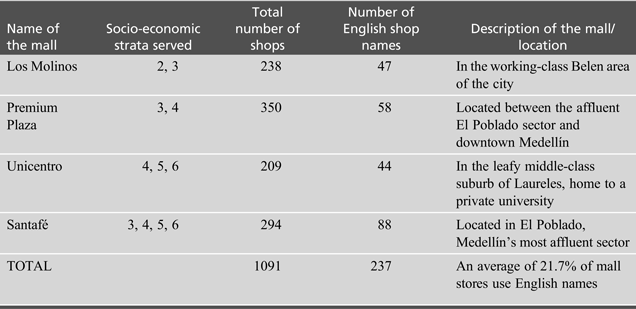
Medellín is peppered with modern shopping malls. In the affluent El Poblado district, for example, two large malls are separated by a major thoroughfare and just a few blocks. The typical mall in Medellín has at least three floors, a cinema, several full-service restaurants, a fast food court, and an elaborate play area for children, in additional to several national and international stores and boutiques. A typical mall in Medellín has an average of 250 retail establishments (see Table 1). Moreover, we find several of Colombia's chain stores and restaurants - many of which have English names - in most of the malls. Chains such as Crepes & Waffles (restaurant), Studio F (women's clothing), Yoyo Jeans, Color Blue (women's fashion), Vélez Accessories (who market their leather goods exclusively in English), and Ragged (young women's fashion) are found in all of Medellín's malls. Indeed, there is great similarity from mall to mall, the greatest difference being the mall's location. Medellín's malls serve an important community function, as they provide entertainment and commercial outlets for local residents. Malls vary throughout the city according to the socioeconomic status of the neighborhoods in which they are located.
Use of English names in Medellín's shopping malls

In the 1980s, Colombia implemented a national system of classifying urban neighborhoods by the socioeconomic makeup of their citizens. The national systems uses six strata (estratos), numbered 1-6, where 1 is the lowest strata and 6 is the highest (IFHP, 2012). Given the existence of this system, our presentation and analysis of the data collected at the four malls is accompanied by the socioeconomic strata of the clientele the four malls serve (http://www.marketmedios.com.co/seccion/19/medellin.html). Table 1 shows the tallies of English names in the four malls that were visited for this study.
A note on the reporting of the data is necessary. Only shops whose names contain English lexical items were considered. Any uses of English language symbols devoid of lexical items were discarded from the tally of English usage. For example, Crepes & Waffles (a national chain) is considered in our discussion since it uses English words; J & C Delicias (a national chain of arepa restaurants) was excluded since the ampersand is not a lexical item. Similarly, Mimo's (an ice cream chain) is not considered, while Tomato's (athletic shoes) is, applying the same rationale, here to the use of the apostrophe which in the latter case accompanies an English name. Foreign brand names like Subway and Dunkin’ Donuts form part of the final count of English shop names since they meet the lexical item criteria. Finally, stores that bear designer names are not included since proper names, whether Tommy Hilfiger or Carolina Herrera, are not considered lexical items.
Table 1 presents the data for the four shopping malls in ascending order according to the strata to which their clientele pertain. A note about the order of the last two is in order. At first glance, it would seem that Unicentro's clientele is of an overall higher stratum than Santafé's given that the latter serves strata 3 as well as the upper three (Table 1). The location of the two malls, however, is the deciding factor that leads to this ordering. Unicentro is located in suburban Laureles, across the street from the private Pontifical Bolivarian University. Laureles, including the university environs, is comprised of leafy middle-class neighborhoods that appear to this author relatively homogeneous and middle to upper-middle-class. Santafé, on the other hand, occupies a prime location in the city's elegant El Poblado area. El Poblado is Medellín's wealthiest area and its center of finances as well as tourism. El Poblado's main commercial avenue, known as the Golden Mile (Milla de Oro), is well known in the city and among tourists as an exclusive area. Santafé anchors the Golden Mile. It seems reasonable that strata 3 customers may travel to Santafé for its offerings, but the mall and the area in which it is located are more affluent than Laureles where Unicentro is located.
Figure 2 depicts the percentage of shops in the four malls that have English names. There, we identify a general upward trend that shows an increased use of English as the socioeconomic strata of their clientele increases. Even though Los Molinos presents an exception, since that lower strata mall features more English than Premium Plaza, the general upward trend is noteworthy.
Sample of a national chain store that uses an English name and advertising
Shopping malls: Percent shop names in English
English shop names in Medellín's commercial corridors
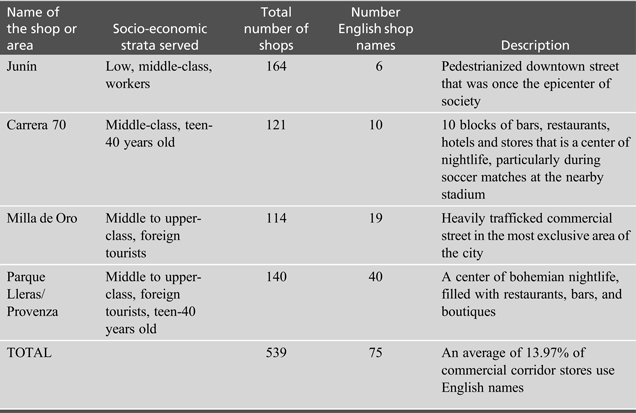
Downtown Medellín sees significant foot traffic during regular business hours. In the city center, there are pedestrianized streets that are lined with stores; moreover, the streets are filled with vendors manning their stands and fruit carts. Like many cities, the center of Medellín is a testament to its past. High end shopping and restaurants have relocated to the suburbs. Consequently, the city center is filled with memories of yesteryear, that is, boulevards that were once the center of elegant society in Medellín and are now active commercial areas for lower and middle strata consumers. The pedestrianized Avenue (Carrera) 40 - known locally as the Junín - is a fine example of this phenomenon. Outside of the city center, elegant malls and shopping areas coexist among the skyscrapers of Medellín's affluent sectors. As noted, El Poblado is home to the Golden Mile, luxurious hotels, apartment buildings, shops, bars, and the like. Poblado Avenue is a busy center of high-end commerce. A few blocks away from that main artery is the leafy area known as Lleras Park, surrounded by the Provenza district of bohemian shops, bars, and restaurants. Lleras Park is where Medellín's storied nightlife is found; the area bustles with a hip energy that natives and tourists provide daily. Finally, the Laureles area—home to the Unicentro mall—is a leafy suburb whose Avenue (Carrera) 70 is filled with sports bars, nightclubs, and casual restaurants that are seemingly always busy, particularly when one of the local soccer teams is playing on the multiple big screens that one sees from bar to bar along the avenue.
Unlike the shopping malls, specific target socioeconomic strata information is not available for comparison purposes for the four commercial corridors that are described in Table 2. Instead, the descriptions in Table 2 are based on what was outlined above and on personal observations. Table 2 shows the data collected from those four commercial corridors, presented in ascending order according to the socioeconomic strata of the areas' clientele.
Use of English names in Medellín's commercial corridors
The Lleras Park/Provenza area is particularly noteworthy for the abundance of English shop names (and advertising) that one finds there (see Figure 3). While it is certainly the case that this area is popular among foreign tourists who speak English, the shop names do not specifically cater to that group; it is more likely that they are aimed at the well-heeled, young Colombian crowd that frequents the area's businesses.
Samples of Lleras Park/Provenza businesses
As in our previous comparison of shopping malls, we find a positive correlation between the use of English in shop names and the socioeconomic level of the clientele of those businesses. Indeed, Figure 4 shows a more marked upward trend than was observed in Figure 2 above.
Commercial corridors: Percent shop names in English
Conclusion
English has a notable presence in the naming of shops in Medellín, Colombia. That 312 businesses identified in this study use English names may be a factor of Colombia's national push for increased bilingualism with English. At the same, it may be attributed to the City of Medellín's drive to increase the competitive edge of its workforce by promoting increased bilingualism. However, given what we see in Figures 2 and 4, it appears more likely that English names are chosen by businesses in Medellín as an appeal to their potential clientele's desire for higher social status. Given the nearly 30% of businesses in both the Santafé mall and the Lleras Park/Provenza sector – representing the most affluent areas of Medellín – we find that the socioeconomic status of the businesses' clientele appears to be the most likely catalyst in their choice of English over Spanish in determining a shop name. In this sense, we see that English has prestige among Medellín's middle and upper class and seemingly is viewed as a means to entice commerce.
JOSEPH R. WEYERS is Professor of Spanish at the College of Charleston, where he has taught since 1995. Professor Weyers' research focusses on the study of forms of address in Spanish, particularly in dialects in which three pronouns are used. For the past 10 years, he has studied the changing forms of address in Uruguay, and has currently shifted his attention to a similar situation in Colombia. The current study was borne of his recent fieldwork in Medellín. Email: WeyersJ@cofc.edu