INTRODUCTION
ATP-binding cassette (ABC) systems are described as comprising one of the largest protein families characterized to date (Dassa and Bouige, Reference Dassa and Bouige2001). In bacteria (Fath and Kolter, Reference Fath and Kolter1993; Tomii and Kanehisa, Reference Tomii and Kanehisa1998; Linton and Higgins, Reference Linton and Higgins1998; Dassa et al. Reference Dassa, Hofnung, Paulsen and Saier1999; Quentin et al. Reference Quentin, Fichant and Denizot1999; Braibant et al. Reference Braibant, Gilot and Content2000), yeast (Decottignies and Goffeau, Reference Decottignies and Goffeau1997; Bauer et al. Reference Bauer, Wolfger and Kuchler1999), Drosophila melanogaster (see Wu et al. Reference Wu, Budding, Griffin and Croop1991; Ewart et al. Reference Ewart, Cannell, Cox and Howells1994), humans (Borst et al. Reference Borst, Evers, Kool and Wijnholds1999; Broccardo et al. Reference Broccardo, Luciani and Chimini1999; Dean et al. Reference Dean, Rzhetsky and Allikmets2001) and parasitic protozoa (Légaré et al. 1994; Chow and Volkman, Reference Chow and Volkman1998; Maser and Kaminsky, Reference Maser and Kaminsky1998), these proteins have been well studied. ABC systems in helminths, particularly those that are parasitic, have not been studied as extensively as those in other organisms. However, amongst helminths, these proteins are best studied in nematodes, with the most complete analysis of the superfamily having been conducted for Caenorhabditis species (Sheps et al. Reference Sheps, Ralph, Zhao, Baillie and Ling2004; Zhao et al. Reference Zhao, Sheps, Ling, Fang and Baillie2004, Reference Zhao, Thomas, Chen, Sheps and Baillie2007). Studies of ABC systems in parasitic nematodes have focused largely on gene identification (e.g., Huang and Prichard, Reference Huang and Prichard1999) or on the use of ABC systems as a genetic marker to monitor drug selection (e.g., Ardelli et al. Reference Ardelli, Guerriero and Prichard2006a; Blackhall et al. Reference Blackhall, Prichard and Beech2008; Bourguinat et al. Reference Bourguinat, Ardelli, Pion, Kamgno, Gardon, Duke, Boussinesq and Prichard2008). Functional studies of ABC systems in parasitic nematodes are lacking and are thus needed.
Members of the ATP-binding cassette (ABC) protein superfamily utilize the hydrolysis of the terminal phosphate of ATP to power a variety of biological processes (Dassa, Reference Dassa, Holland, Cole, Kuchler and Higgins2003). ABC systems have 2 characteristic regions: a highly conserved ATP binding cassette (ABC_2 domain) found in all ABC systems and a less conserved transmembrane domain (ABC_TM1F domain) (Walker et al. Reference Walker, Saraste, Runswick and Gay1982) found in those that function as membrane transporters (i.e., class 1 and class 2 ABC systems). The ABC_2 domain contains several conserved sequences, known as the Walker A, that contains a phosphate-binding loop, the Walker B, that contains a magnesium binding site, the switch region, characterized by a histidine loop, the signature sequence (LSGGQ) that differentiates ABC systems from other proteins that utilize ATP and the Q motif which is located between the Walker A and the signature sequence. The Walker A, Walker B, Q-motif and switch region form the nucleotide binding site (Higgins, Reference Higgins1992, Reference Higgins2001; Schneider and Henke, Reference Schneider and Henke1998).
Within ABC systems 3 functional classes are recognized. Class 1 ABC systems are within membranes and function as importers. To date, class 1 systems have only been recognized in prokaryotes (Boos and Lucht, Reference Boos, Lucht and Neidhardt1996). Class 2 systems are also found in membranes but function as exporters. Class 2 ABCs are found in both prokaryotes and eukaryotes (Fath and Kolter, Reference Fath and Kolter1993). Class 1 and 2 systems are commonly referred to as ABC transporters as they function to transport a variety of substrates across membranes. Class 3 ABC systems are not involved in membrane transport but function in cellular processes such as DNA repair, translation and regulation of gene expression (Dassa, Reference Dassa, Holland, Cole, Kuchler and Higgins2003). Although class 1, class 2 and class 3 systems have different functions and cellular locations, they still share the defining feature of ABC systems, the ABC_2 domain with the signature sequence. The ABC_2 domain of class 3 ABC systems differs from that of class 1 and 2 systems in the location of the signature sequence. In class 3 systems, such as structural maintenance of chromosome (SMC) proteins, the signature sequence is remote from the Walker A and B motifs which comprise the ABC_2 domain (Hopfner and Tainer, Reference Hopfner and Tainer2003).
For Caenorhabditis species, the class 2 ABC systems, which are membrane transporters, were divided into 8 subfamilies based on the domain organization (Sheps et al. Reference Sheps, Ralph, Zhao, Baillie and Ling2004). Subfamilies B and D are classified as half-transporters and contain a single ABC_TM1F domain followed by a single ABC_2 domain. However, members of subfamily B may also appear as full-transporters. Subfamilies A, B and C are the full-transporters and are characterized by 2 ABC_TM1F domains that alternate with 2 ABC_2 domains; subfamily A may also appear with only a single ABC_2 domain. Subfamilies G and H have a single ABC_2 domain followed by a single ABC_TM1F domain; subfamily G may also appear as a full-transporter with 2 ABC_2 domains that alternate with 2 ABC_TM1F domains. Subfamily E does not have the ABC_TM1F domain, but is characterized by 2 ABC_2 domains. Similarly, subfamily F does not have the ABC_TM1F domain, but may contain 1 or 2 ABC_2 domains. Subfamily H is the most variable in terms of domain organization and may appear with a single ABC_TM1F domain and a single ABC_2 domain, or a single ABC_2 domain followed by a single ABC_TM1F domain or a single ABC_2 domain (Sheps et al. Reference Sheps, Ralph, Zhao, Baillie and Ling2004).
Using Brugia malayi as the model for parasitic nematodes, the objective of this paper was to classify ABC systems using a combination of genomic mining, PCR-based cloning and phylogenetic analyses. Once the family was catalogued, the constitutive expression of the superfamily was examined in adult males, adult females and microfilaria of B. malayi. An understanding of this protein superfamily, in terms of quantity, subfamily distribution and their constitutive expression, represents the first step in understanding how these proteins might function in the cellular physiology of parasitic nematodes and whether they play a role in drug tolerance and resistance.
MATERIALS AND METHODS
Live adult males, adult females and microfilariae of B. malayi were isolated from the abdominal cavity of infected jirds at the National Institutes of Health/National Institute of Allergy and Infectious Disease (NIH/NIAID) Filariasis Research Reagent Resource Centre (FR3 – College of Veterinary Medicine, University of Georgia, USA) and shipped overnight to Brandon University. Upon arrival in Brandon, adult worms and microfilariae were placed immediately in Roswell Park Memorial Institute (RPMI) 1640 medium supplemented with 10% foetal bovine serum (FBS) and 1% penicillin-streptomycin (5000 μg/ml) and allowed to acclimatize for 3 days before being used for experimentation. The parasites were held in an incubator at a temperature of 37°C supplemented with 5% carbon dioxide (CO2). Adults were maintained in individual wells of a microtitre plate containing 4·0 ml of the culture medium, while microfilaria were kept in 25 cm2 canted neck cell culture flasks containing 20 ml of the medium.
B. malayi ABC systems were identified using genomic mining and PCR-based cloning approaches. Initial identification and classification of B. malayi ABC systems involved a bioinformatic analysis of the genome to identify all potential ABC sequences. The Institute of Genomic Research (TIGR) (now the J. Craig Venter Institute – JCVI) assembled the genome sequence of B. malayi into large scaffolds (super-contigs) that contained ordered genomic fragments (Ghedin et al. Reference Ghedin, Wang, Spiro, Caler, Zhao, Crabtree, Allen, Delcher, Guiliano, Miranda-Saavedra, Angiuoli, Creasy, Amedeo, Haas, El-Sayed, Wortman, Feldblyum, Tallon, Schatz, Shumway, Koo, Salzberg, Schobel, Pertea, Pop, White, Barton, Carlow, Crawford, Daub, Dimmic, Estes, Foster, Ganatra, Gregory, Johnson, Jin, Komuniecki, Korf, Kumar, Laney, Li, Li, Lindblom, Lustigman, Ma, Maina, Martin, McCarter, McReynolds, Mitreva, Nutman, Parkinson, Peregrín-Alvarez, Poole, Ren, Saunders, Sluder, Smith, Stanke, Unnasch, Ware, Wei, Weil, Williams, Zhang, Williams, Fraser-Liggett, Slatko, Blaxter and Scott2007). The scaffolds and fragments were used in the analysis of the B. malayi genome to identify and catalogue ABC systems. To accomplish this, B. malayi BLAST searches were performed against the genomic fragment database that contained all fragments present in the sequenced genome. Known B. malayi ABC sequences as well as homologues from other nematodes were compared against the genomic fragment database using T-BLASTn. These results were used to create a database of potential transporters with an expected threshold value of e−2. The amino acid sequence of each potential ABC system was analysed using Prosite available at ExPASy (Gasteiger et al. Reference Gasteiger, Gattiker, Hoogland, Ivanyi, Appel and Bairoch2003) to identify the number and arrangement of the ABC_TM1F (PS50929) and ABC_2 (PS50893) domains. This information was then used to construct a molecular phylogeny, in order to divide the putative ABC systems into classes (i.e., class 2 or class 3 as class 1 systems are only recognized in prokaryotes) and subfamilies (for class 2 systems).
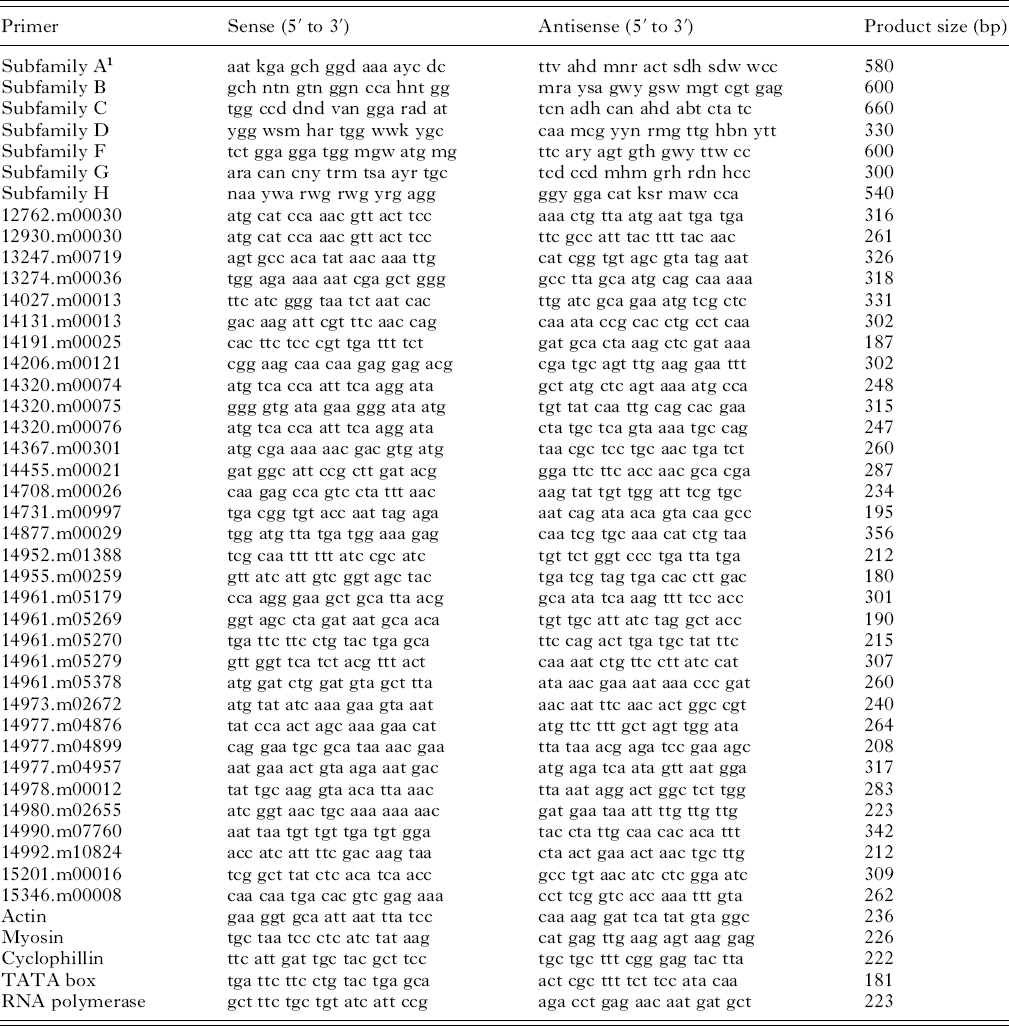
To identify B. malayi ABC systems by PCR-coupled cloning, the C. elegans ABC superfamily was used to design degenerate primers. C. elegans class 2 ABC systems were divided into subfamilies A, B, C, D, E, F, G and H, based on the organization of the transmembrane and ATP-binding domains (Sheps et al. Reference Sheps, Ralph, Zhao, Baillie and Ling2004). A multiple sequence alignment was performed for each subfamily and then used in the design of degenerate primers (Table 1). Total RNA was extracted from adults and microfilariae using the reagent Trizol (Invitrogen) followed by chloroform extraction and isopropanol precipitation. RNA extracts were treated with DNase I to remove any potentially contaminating DNA and then reverse transcribed using 10x buffer, 5 mm each dNTP, 10 μm of random primers, 10 units/μl RNase inhibitor, omniscript reverse transcriptase (Qiagen) and 2 μg of RNA to create complementary DNA (cDNA). The degenerate primers were used to amplify the B. malayi cDNA fragments (generated by reverse transcription PCR, RT-PCR). The amplified fragments were then cloned into the PCR 2.1® vector (Invitrogen), sequenced and analysed.
Primers used in the characterization of Brugia malayi ABC systems

1 For the primers designed for subfamilies A, B, C, D, F, G, H the following codes were used for the degenerate positions: V=A+C+G; N=A+C+G+T; D=A+T+G; B=T+C+G; H=A+T+C; W=A+T; S=C+G; K=T+G; M=A+C; Y=C+T; R=A+G.
Once the domain organization had been determined for each member of the B. malayi ABC systems superfamily, the number and arrangement of the domains were used to construct a molecular phylogeny. Only class 2 systems (i.e., ABC transporters) were used in the phylogenetic analysis. Where appropriate, all representatives from the C. elegans ABC transporter subfamily (Sheps et al. Reference Sheps, Ralph, Zhao, Baillie and Ling2004) and ABC transporter sequences from Haemonchus contortus and Onchocerca volvulus were included in the analysis. Two separate analyses were performed: (1) an analysis of the ABC_TM1F domain and (2) an analysis of the ABC_2 domain. For each analysis, all sequences from B. malayi, C. elegans, H. contortus and O. volvulus containing the ABC_TM1F and ABC_2 domains were used. The sequences corresponding to the ABC_TM1F and ABC_2 domains were aligned to identify regions of similarity or difference. For the alignment, gaps were introduced into the aligned sequences to find the best overall alignment for the sequences being compared. A CLUSTAL alignment (Bateman et al. Reference Bateman, Birney, Durbin, Eddy, Finn and Sonnhammer1999) of the sequences was used as the input for developing the phylogenetic tree and the neighbour-joining method was used to calculate the bootstrap values for 1000 replicates.
For the analysis of real-time RT-PCR data (i.e., ABC systems and endogenous controls) the method described by Pfaffl (Reference Pfaffl2001) was used. This method was used for the analysis of expression of nematode ABC transporters (Ardelli et al. Reference Ardelli, Stitt, Tompkins and Prichard2009) and is described as follows.
Internal reference amplicon
The use of an invariant endogenous control as an active reference amplicon was used for the quantitation of an mRNA target and was normalized to account for differences in the total amount of RNA added to each reaction. For this purpose, several endogenous controls (actin, cyclophillin, myosin, TATA box binding protein and RNA polymerase II) were tested. The endogenous control was required to be present at a constant level at different time-points and also across different pools of cDNA. An evaluation showed that that the actin gene performed the best as a normalizer.
Determination of real-time PCR efficiencies
The amplification efficiency for each of the ABC systems and the endogenous control was determined. The threshold cycle (CT) (i.e., the cycle at which there is a significant increase in amplification over that of background) was determined. The log-linear phase (i.e., period in which there is an exponential amplification of PCR product) was used to calculate slope, and the slope of the log-linear phase was used as an indicator of the amplification efficiency. To calculate the efficiency (i.e., slope) of each reaction (for each transcript), 2-fold serial dilutions of known amounts of cDNA were made, the PCR reaction was performed, and then the concentration of cDNA (in ng) was plotted against the CT value. The corresponding real-time efficiencies (i.e., slope) were calculated using the equation E (efficiency)=10[−1/slope]. The efficiency of the reaction was required to be between 90 and 100% or 3·6>slope>3·1 but as close to 100% as possible. The efficiency also had to be similar (i.e., not statistically significant) between the target (i.e., ABC system) and the endogenous control (i.e., actin). Any efficiency that was <90% was discarded and the reaction conditions were further optimized. The following equation was then used to calculate the relative efficiency: Ratio=(Etarget)ΔCpTarget Exp (control-sample)/(Ereference)ΔCpReference Exp (control-sample). The results presented on the graphs represent the relative efficiency; each efficiency was calculated 3 times from 3 separate pools of cDNA.
Preparation of RNA and cDNA
B. malayi males, females and microfilariae were maintained in the culture medium, as described previously. To assess whether culture conditions had any affect on the constitutive expression analysis, motility was assessed in adults and microfilariae as an indicator of stress (results not shown). In adults, motility was determined by counting the number of posterior end movements that occurred in 1 min. For microfilariae, the number of times a microfilaria bent its body such that the anterior and posterior ends met was considered 1 full body movement. The number of times a microfilaria performed this movement in 1 min was recorded (results not shown). Adults were moved to fresh culture medium every 2 days and microfilariae every 7 days. The worms were removed from culture when the motility differed significantly from that recorded in the previous sampling period, indicating that culture conditions were affecting the worms and potentially their gene expression. The latter worms were not used in the analysis of constitutive expression.
Life-cycle stages of B. malayi were removed from plates every 24 h, in either the morning or evening, and then immediately frozen for subsequent use in real-time RT-PCR to determine the constitutive expression of ABC systems. Total RNA was extracted from adults and microfilariae at each time-point, treated and used to synthesize cDNA. Amplicons were subjected to electrophoresis in 1% agarose gels and then stained with ethidium bromide and detected using ultraviolet light. To prevent false positives that could result from amplification of DNA, reactions that excluded the omniscript reverse transcriptase were included as controls.
Expression analysis
Relative quantification of changes in gene expression was analysed using Quantitect™ SYBR® Green (Qiagen). The reaction consisted of a final concentration of 1X SYBR Green PCR Master Mix, 0·3 μm of gene-specific sense and antisense primers and 200 ng of template per reaction. The initial activation step was for 15 min at 95°C, followed by 3 steps of denaturation (30 s at 95°C), annealing (30 s at 56°C) and extension (30 s at 72°C) for 50 cycles.
A total of 10 individual males and females and 10 pooled samples of 1000 microfilariae were used to quantify the constitutive expression of the 33 B. malayi ABC systems. For each ABC system, transcription was assessed 3 times for males, females and microfilariae with the same amount of cDNA from each life-cycle stage. A list of genes investigated, the sequence of the primers and the expected size of the PCR product are listed in Table 1. All PCR products were cloned and sequenced to confirm their identity. Preliminary analyses indicated that gene expression was not affected by the time of day or the time maintained in culture (results not shown). Constitutive expression was assessed for worms that had been in culture for 6 days.
To analyse the gene expression data, a one-way repeated measures analysis of variance (RM-ANOVA) was used to determine whether differences existed between the females, males and microfilariae. If the analysis was significantly different, a Holm-Sidak test was used for all pair-wise comparisons. A P-value of <0·05 was assumed to indicate a statistically significant difference.
RESULTS
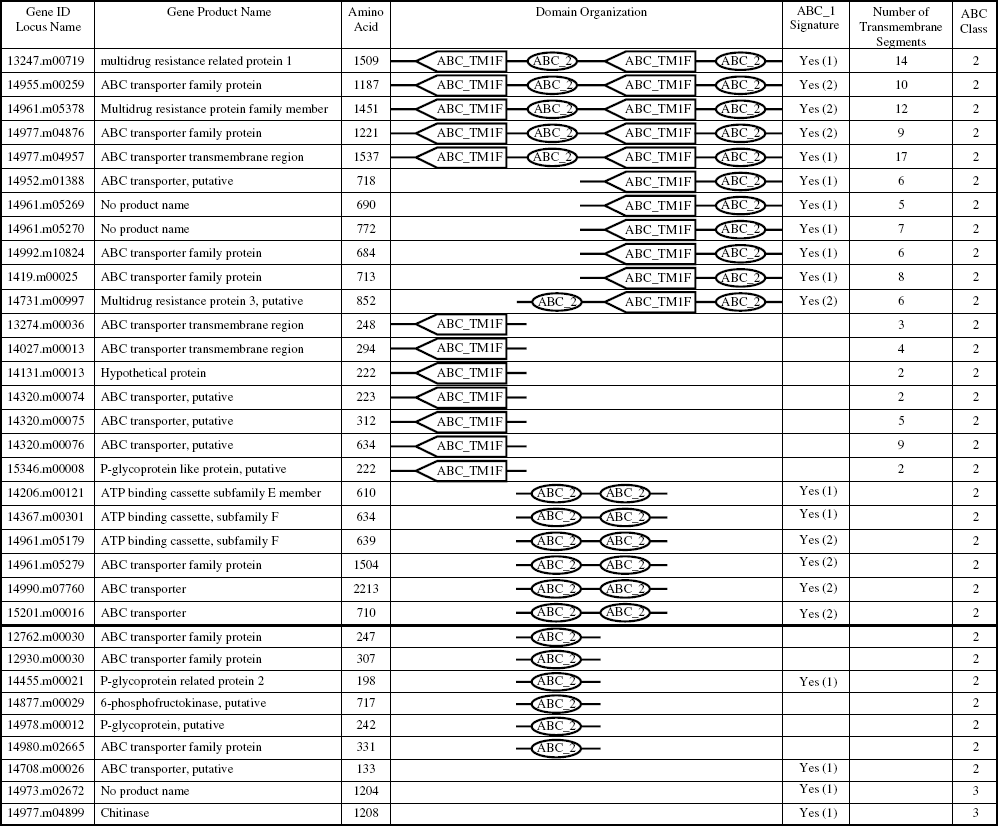
Using a combination of genome mining and PCR-based cloning, a total of 33 putative ABC systems were identified from the B. malayi draft genome (Table 2). Although a number of ABC systems were isolated using PCR cloning, none were unique and all were present in the annotated genome. Table 2 is organized according to gene/locus ID (as per the genome housed at JCVI), the gene product name (as per JCVI), the number of amino acids, the domain organization, the presence and number of ABC_1 signature sequences, the number of transmembrane helices and the ABC class. While only 21 of 33 ABC systems contained the signature sequence, which differentiates ABC proteins from other proteins that utilize ATP, the 12 molecules that lacked the signature sequence contained either the ABC_2 or the ABC_TM1F domains. In terms of domain organization, the B. malayi draft genome contains 9 transporters with a single ABC_2 domain, 6 with 2 ABC_2 domains but no ABC_TM1F domain, 7 with a single ABC_TM1F domain and no ABC_2 domains, 5 with an ABC_TM1F domain followed by an ABC_2 domain, 5 with 2 ABC_TM1F domains alternating with 2 ABC_2 domains and 1 with an ABC_2 domain, followed by an ABC_TM1F and a second ABC_2 domain. The 33 ABC systems consisted of 31 class 2 systems, which are commonly called ABC transporters, and 2 class 3 systems.
Domain organization of ABC systems in Brugia malayi

The B. malayi draft genome contains many gaps that have resulted in incomplete sequence information for some of the ABC systems. For example, 7 ABC systems contain the ABC_TM1F domain but lack the ABC_2 domain. Based on the known structure of ABC systems, it is likely that these 7 sequences are incomplete and should contain at least 1 ABC_2 domain. Also, 9 ABC systems contain a single ABC_2 domain. Based on information on ABC systems, it is probable that these 9 ABC systems have a second ABC_2 domain and possibly an ABC_TM1F domain.
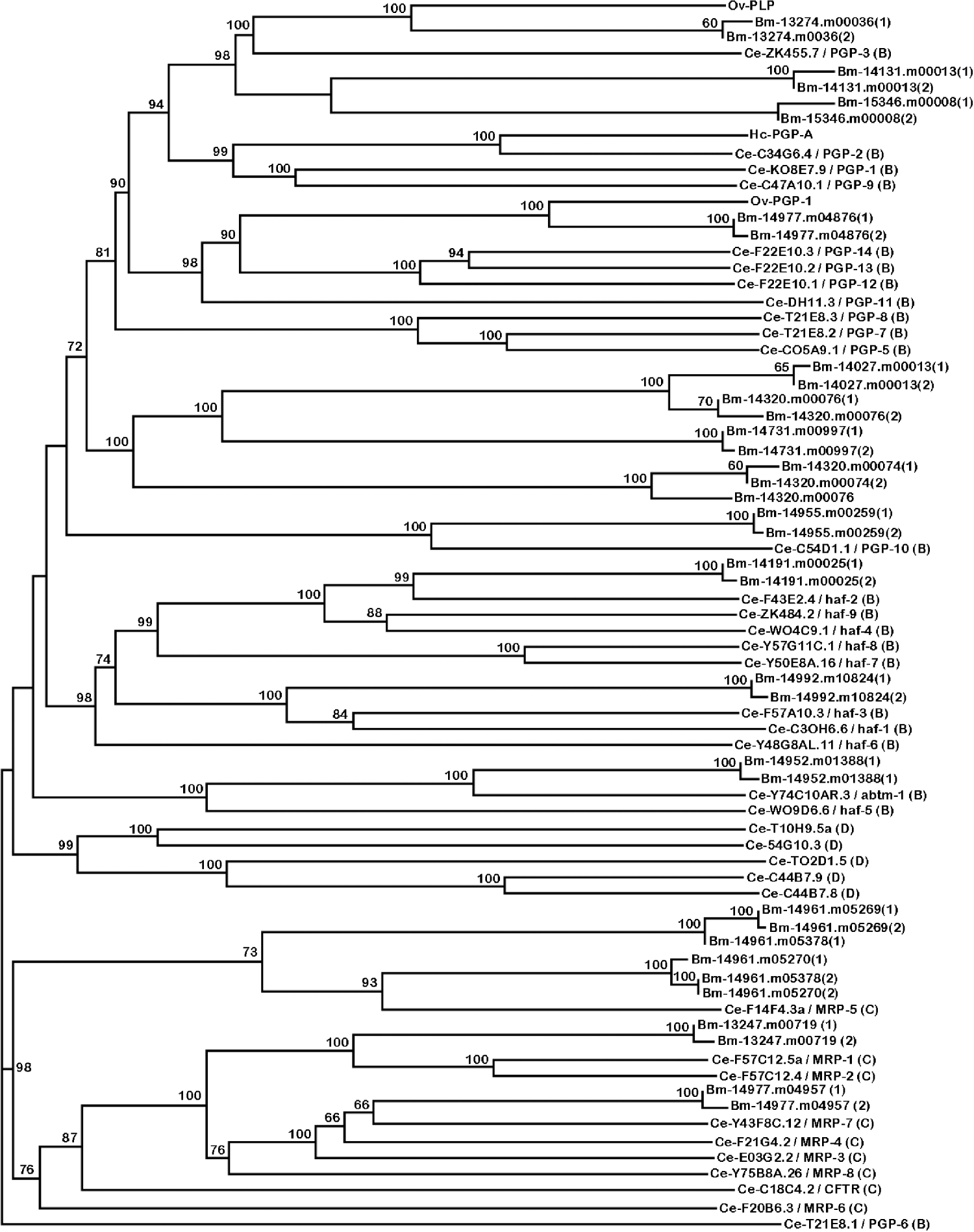
For each transporter with an ABC_TM1F domain, the numbers of transmembrane regions were predicted (Persson and Argos, Reference Persson and Argos1994) and were predicted to have 2-17 helices (Table 2). A multiple sequence alignment of the first ABC_TM1F domain was performed (Fig. 1). While the ABC_TM1F domain is characteristic of class 2 ABC systems, Fig. 1 shows that this motif is the least conserved. Fig. 2 displays a molecular phylogenetic analysis for the ABC_TM1F domain and includes all reported sequences from C. elegans, H. contortus and O. volvulus that contain this domain. For this analysis, B. malayi ABC sequences 13247.m00719, 14955.m00259, 14961.m05378, 14977.m04876 and 14977.m04957 contained 2 ABC_TM1F domains, both of which were used in the analysis. In every case, sequences with the first ABC_TM1F domain formed a cluster with the second ABC_TM1F domain with high bootstrap values. The O. volvulus P-glycoprotein-like protein (PLP) clustered with B. malayi 13274.m00036 and B. malayi 14977.m04876 formed a well-supported cluster with O. volvulus P-glycoprotein-1 (OvPGP-1). The P-glycoproteins and half-transporters in subfamily B formed a stable cluster, while members of subfamilies C and D formed clusters with high bootstrap support (Fig. 2).
Multiple sequence alignment of the ABC_TM1F domain. The top of the figure shows a schematic of an ABC transporter with the domain examined in the Clustal alignment indicated with a star ( ⋆). Amino acid sequences containing the ABC module were identified with the model ABC _ tran (Accession no. PF00005) of the pfam database (Bateman et al. Reference Bateman, Birney, Durbin, Eddy, Finn and Sonnhammer1999). A consensus line is shown at the bottom of the sequence with conserved residues highlighted.

An unrooted phylogenetic tree of the ABC_TM1F domain of Brugia malayi class 2 ABC systems. The analysis was performed with all the extracted B. malayi predicted protein sequences, all ABC sequences from the Caenorhabditis elegans genome and ABC sequences from Haemonchus contortus and Onchocerca volvulus. Proteins containing one or two ABC_TM1F domains are indicated by (1), for the first domain, and (2), for the second domain. The numbers on the branches indicate the percentage of bootstrap support from 1000 replicates. The C. elegans class 2 ABC systems are identified based on their GenBank Accession numbers and the subfamily designation is shown in parentheses. For proteins in C. elegans subfamilies B and C, whether they are classified as PGPs, half-transporters or MRPs is indicated.

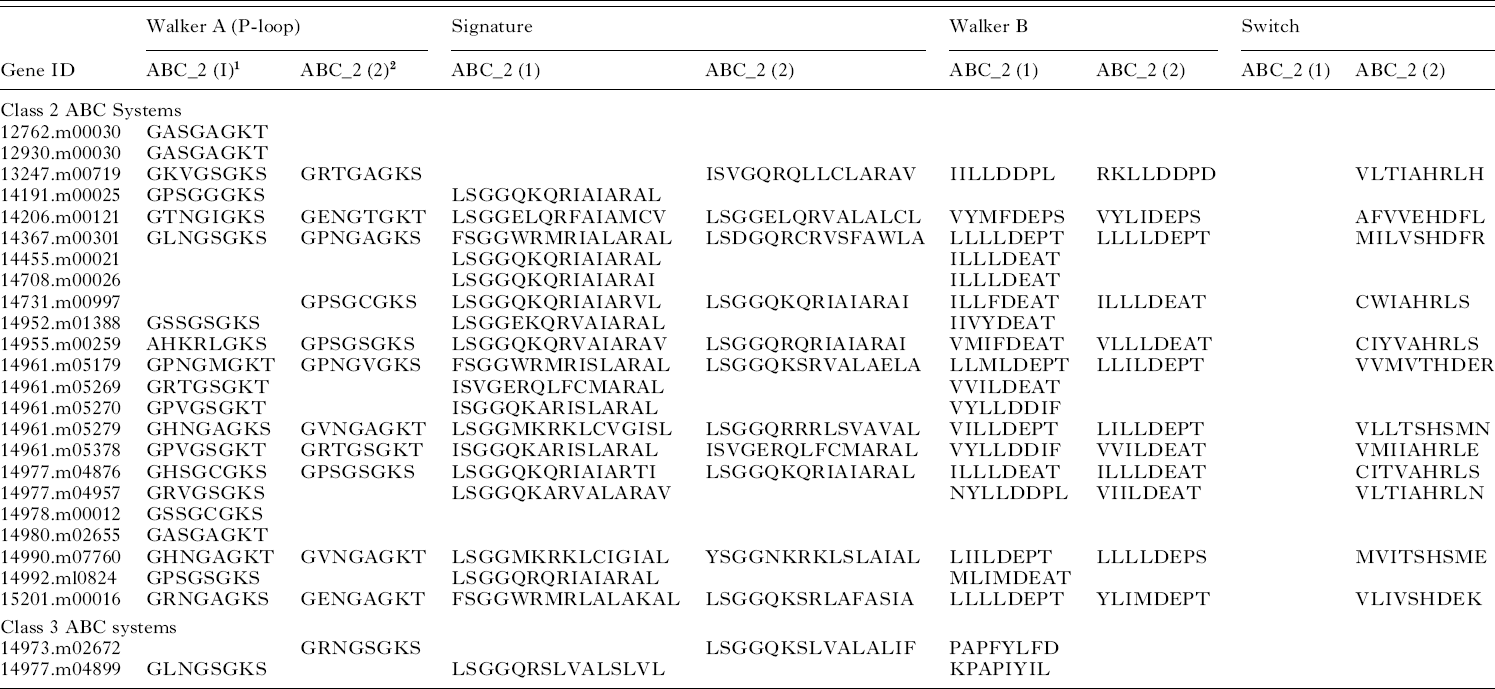
A detailed analysis of the ABC_2 domain was performed (Table 3), showing the amino acid sequence for the Walker A, the signature/linker region, the Walker B, the switch region and the ABC class. Figures 3 and 4 are multiple sequence alignments of the first ABC_2 domain (if only 1 ABC_2 domain was present, it was assumed that it represented the ABC_2 domain in the first half of the protein) and the second ABC_2 domain. Shown are the Walker A (consensus for the first ABC_2 GXXGXGKS; consensus for the second ABC_2 GXNGXGKST), the Q loop/lid (consensus for the first ABC_2 IGXVXQXEPLL; consensus for the second ABC_2 LQXLXQXDPLL), the signature sequence (consensus for the first ABC_2 LSGGXKXRLAIAR; consensus for the second ABC_2 LSGGQRQRVALARA), the Walker B (consensus for the first ABC_2 LLLLDE; consensus for the second ABC_2 LLLLDE), the D-loop (consensus for the first ABC_2 TGLDXXX; consensus for the second ABC_2 AGLDXE) and the switch region (consensus for the second ABC_ 2 VVMVAHXRL) are conserved.
Multiple sequence alignment of the ABC_2 domain. The top of the figure shows a schematic of an ABC transporter with the domain examined in the Clustal alignment indicated with a star ( ⋆). The analysis was performed with all extracted Brugia malayi predicted protein sequences containing the ABC_2 domain. The Walker A, Q loop/lid, signature, Walker B and D-loop are highlighted for the sequences. A consensus is shown along the bottom with conserved residues highlighted. The sequences used in this analysis contain only the first or a single ABC_2 domain.

Multiple sequence alignment of the ABC_2 domain. The top of the figure shows a schematic of an ABC transporter with the domain examined in the Clustal alignment indicated with a star ( ⋆). The analysis was performed with all extracted Brugia malayi predicted protein sequences and all Caenorhabditis elegans sequences containing the ABC_2 domain. Only proteins containing a second ABC_2 domain were used in this analysis. The Walker A, Q loop/lid, signature, Walker B, D-loop and switch regions are highlighted for the sequences. A consensus is shown along the bottom with conserved residues highlighted.

Summary of sequence motifs for the ABC_2 domain of Brugia malayi ABC systems

1 Amino acid sequence of the first (or single) ABC_2 domain.
2 Amino acid sequence of the second ABC_2 domain.
Figure 5 is a molecular phylogenetic analysis of the ABC_2 domain. The analysis included sequences with one [1] or two [2] ABC_2 domains and the subfamily designation for C. elegans sequences are indicated. Subfamilies A, B, C, D, E, F and G formed clusters that were supported by high bootstrap values. The sequences with a single ABC_2 domain tended to form clusters while those with a second ABC_2 domain tended to form clusters. In general, the half-transporters of subfamily B tended to cluster with the first ABC_2 domain of the P-glycoproteins. The P-glycoproteins, for which there was a second ABC_2 domain, also clustered together.
An unrooted phylogenetic tree of the ABC_2 domain of Brugia malayi class 2 ABC systems. The analysis was performed with all the extracted B. malayi predicted protein sequences, all ABC sequences from the Caenorhabditis elegans genome and ABC sequences from Haemonchus contortus and Onchocerca volvulus containing an ABC_2 domain. Proteins containing 1 or 2 ABC_TM1F domains are indicated by [1], for the first domain, and [2], for the second domain; for sequences with only 1 ABC_2 domain it was assumed that it represented the first ABC_2 domain. The numbers on the branches indicate the percentage of bootstrap support from 1000 replicates. The C. elegans ABC transporters are identified based on their GenBank Accession numbers and the subfamily designation is shown. For proteins in C. elegans subfamilies B and C, their classification as either PGPs, or half-transporters or MRPs is indicated.

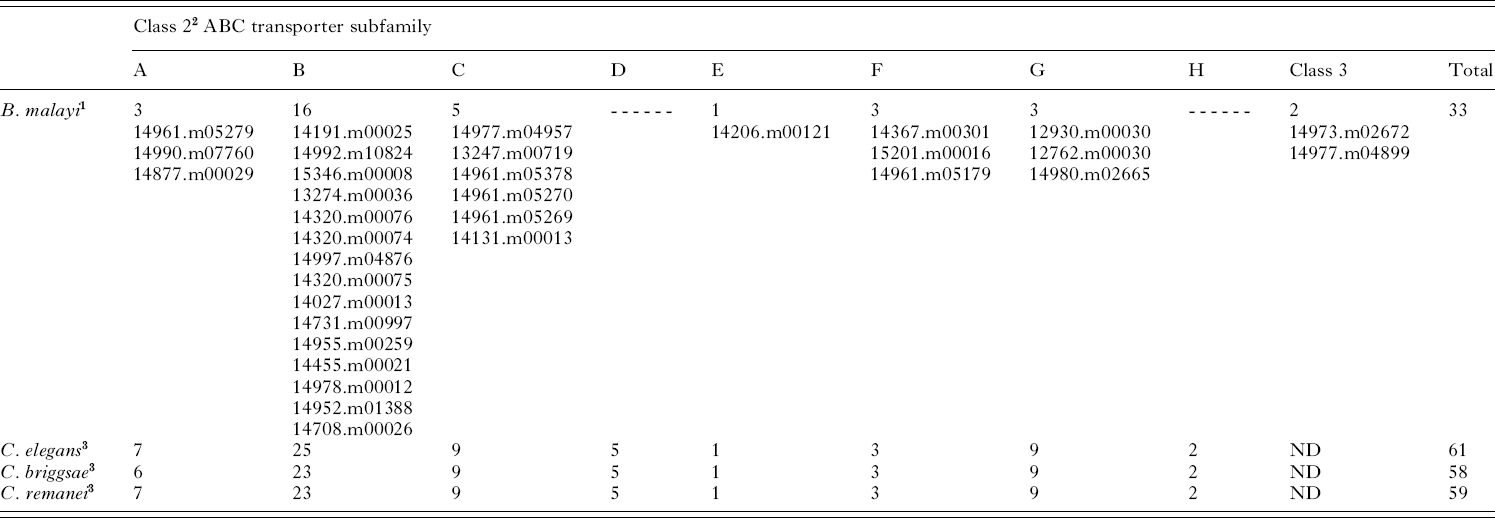
The 61 ABC transporters (i.e., class 2 ABC systems) identified from the C. elegans genome (Zhao et al. Reference Zhao, Thomas, Chen, Sheps and Baillie2007) were used to organize the B. malayi class 2 ABC systems into subfamilies. An analysis of the 33 B. malayi genes identified at least 1 representative from 6 of the 8 subfamilies; none of the ABC transporters could be placed into subfamilies D and H (Table 4). To identify the subfamily designation the ATP-binding domain (ABC_2 domain) and the transmembrane region (ABC_TM1F domain), amino acid sequences of B. malayi and C. elegans were used to perform phylogenetic analyses (Figs 2 and 5). An analysis of the ABC_TM1F domain demonstrated that members of the same C. elegans subfamily clustered together (Figure 2). The C. elegans subfamily grouping was confirmed when an analysis of the ABC_2 domain was carried out (Fig. 5). For each of the two independent phylogenetic analyses performed, the same B. malayi transporters clustered with the same C. elegans subfamily members with high bootstrap support. This clustering of the B. malayi transporters with the C. elegans subfamilies, as well as the domain organization, was then used to assign a subfamily designation. Based on the data obtained, B. malayi has 3 subfamily A members, 16 subfamily B members, 5 subfamily C members, 1 subfamily E member, 3 subfamily F members and 3 subfamily G members. Members of subfamilies D and H were not identified and 2 of the ABC systems were class 3 and were not assigned a subfamily designation (Table 4). Subfamilies B and C were further divided into the P-glycoproteins (PGP), the half-transporters (HAF) and the multidrug resistance proteins (MRP).
The distribution of ABC systems in Brugia malayi and Caenorhabditis elegans

1 This study.
2 Class 2 ABC systems are the membrane transporters and are divided into subfamilies.
3 Zhao et al. (Reference Zhao, Thomas, Chen, Sheps and Baillie2007).
ND – not determined.
For Table 2, the gene product name used was that originally assigned by TIGR. Based on the analysis of ABC systems in B. malayi, a number of these gene product names should be re-assigned. For example, gene 14977.m04957 is listed as an ABC transporter transmembrane region, but should be reclassified as an MRP. Genes 14961.m05269, 14961.m05270 and 14973.m02672 have no gene product name listed and should be classified as ABC transporters (for 14961.m05269 and 14961.m05270) or class 3 ABC systems (for 14973.m02672). Gene 14131.m00013 is assigned a hypothetical designation but should be classified as an ABC transporter. Gene 14877.m00029 is listed as 6-phosphofructokinase and contains the phosphofructokinase signature motif. However, matching protein sequences returned by BLAST analysis had only highly significant matches to ABC transporters but not ATPases. In addition, gene 14977.m04899 is listed as a chitinase, yet contains the ABC_2 domain, the ABC transporter signature sequence and the active site characteristic of chitinase family 18. This gene should be reclassified as a class 3 ABC system, as it is most likely to be an SMC protein. In the case of genes 14977.m04899 and 14877.m00029, functional studies should be performed to confirm their identity.
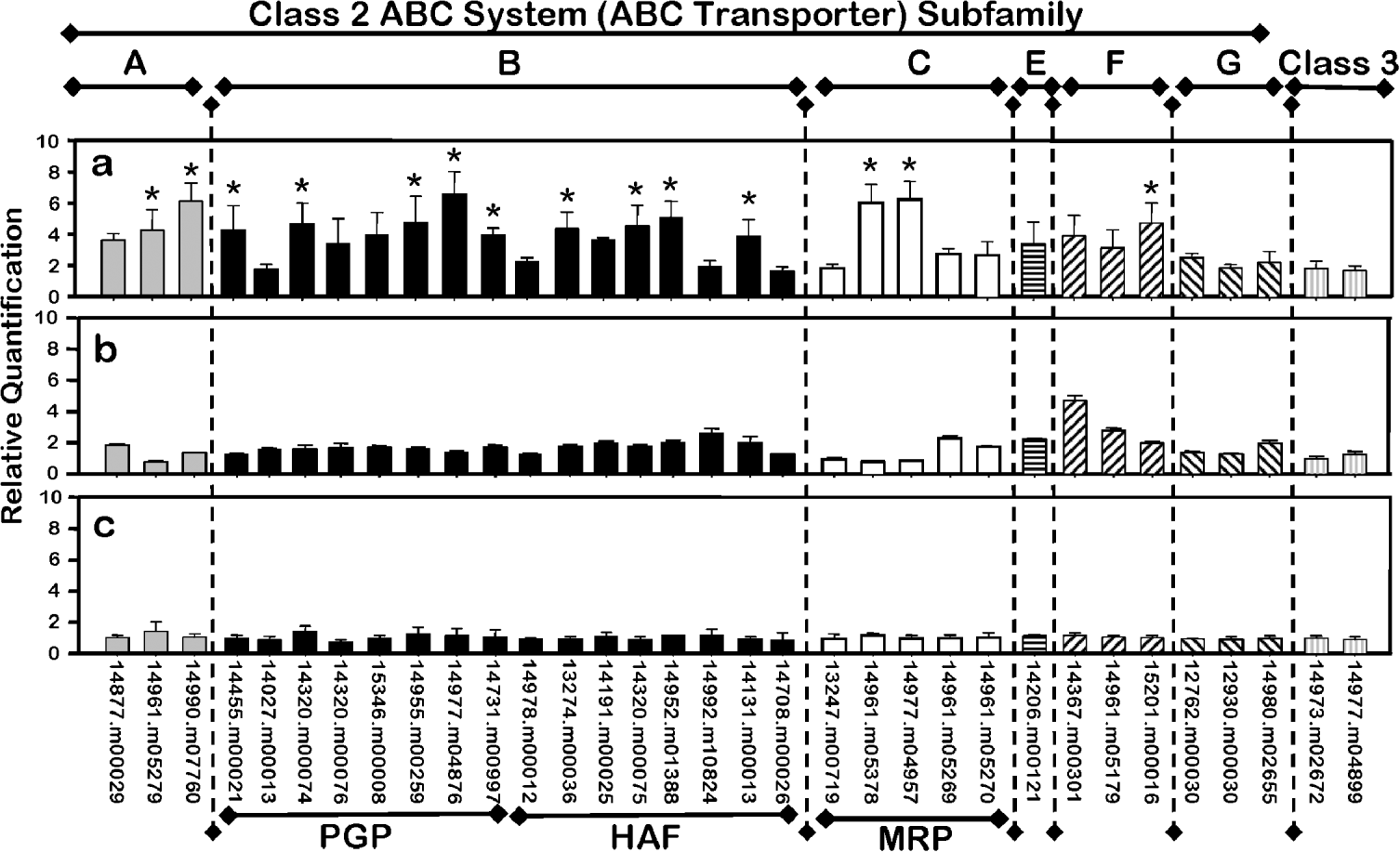
Figure 6 shows the constitutive expression of the 33 ABC systems in adult females, adult males and microfilariae of B. malayi. A comparison of the constitutive expression of each ABC gene was conducted for females, males and microfilariae. A number of ABC systems had a significantly higher (P<0·001) expression in females in comparison to males and microfilariae (Fig. 6). The ABC systems with the highest constitutive expression in females were found in subfamilies B and C. The constitutive expression in males was highest in subfamily F. In general, the expression of ABC transporters was low in all subfamilies in microfilariae of B. malayi.
Constitutive expression of ABC systems in adult females, adult males and microfilariae of Brugia malayi. The y-axis shows the relative quantification and the x-axis indicates the gene/locus ID. The expression of each of the class 2 ABC systems is organized according to subfamilies A, B, C, E, F and G. The expression of the two class 3 ABC systems is also indicated. For subfamilies B and C, those proteins that are PGPs, half-transporters or MRPs are indicated. A star (*) indicated a significant difference in comparison to males and microfilariae.

DISCUSSION
ABC systems are one of the largest described protein superfamilies and have gained a great deal of attention due to their medical significance. In filarial nematodes, they are mostly known for their association with ivermectin resistance (Ardelli and Prichard, Reference Ardelli and Prichard2004, Reference Ardelli and Prichard2007; Ardelli et al. Reference Ardelli, Guerriero and Prichard2005, Reference Ardelli, Guerriero and Prichard2006a, Reference Ardelli, Guerriero and Prichardb; Bourguinat et al. Reference Bourguinat, Ardelli, Pion, Kamgno, Gardon, Duke, Boussinesq and Prichard2008). An analysis of the B. malayi genome sequence identified 33 ABC genes, with at least 1 representative from 6 of the 8 described class 2 subfamilies. A phylogenetic analysis of the relationships of all identified B. malayi and C. elegans ABC genes showed that the nomenclature of B. malayi ABC systems is in agreement with that of Caenorhabditis species. In particular, all major ABC transporter subfamilies are represented in the Brugia tree by strongly supported clusters. The subfamily groupings were confirmed when the ABC_2 and the ABC_TM1F domains amino acid sequences were used for a phylogenetic analysis. These 3 separate analyses confirmed that genes from the same subfamily cluster together.
ABC systems are recognized for the highly conserved ATPase domain, ABC_2, which utilizes energy derived from the hydrolysis of ATP to power a wide variety of biological processes. The ABC_2 domain contains 3 characteristic motifs known as the Walker A and Walker B motifs, which are common to ATPases, and a signature motif, also known as the linker region or linker peptide, which differentiates ABC systems from other ATPases (Schneider and Henke, Reference Schneider and Henke1998). In addition to the highly conserved ABC_2 domain, these transporters may have the presence of 1 or 2 transmembrane domains (ABC_TM1F) that contain a number of transmembrane helices. The ABC_2 and the ABC_TM1F domains have been used to arrange ABC systems into 3 broad groups or classes (Dassa, Reference Dassa, Holland, Cole, Kuchler and Higgins2003). ABC systems that contain the 4 domains, 2 ABC_2 and 2 ABC_TM1F domains, encoded as 4 separate polypeptides are generally classified as importers. To date, importers have only been found in prokaryotes. Class 2 ABC systems function as exporters and are the most variable in terms of domain structure. The ABC_2 and ABC_TM1F domains may be fused or may exist as separate domains. Class 3 systems are not involved in the import or export of biological molecules, lack the ABC_TM1F domain but have 2 fused ABC_2 domains (Dassa, Reference Dassa, Holland, Cole, Kuchler and Higgins2003). Based on this broad classification of ABC transporters, and the available sequence data, B. malayi has at least 31 class 2 systems and at least 2 class 3 systems.
The B. malayi genes 14973.m02672 and 14977.m04899 are likely structural maintenance genes of chromosome (SMC) proteins. ABC systems function in transport (transport ABC ATPases) or in DNA repair and structural maintenance of chromosomes. For transport ABC ATPases, the energy derived from ATP hydrolysis is used to transport specific substances across membranes while ABC ATPases involved in DNA repair use energy derived from ATP to recognize and bind miss-paired DNA bases or DNA insertion loops (Hopfner and Tainer, Reference Hopfner and Tainer2003). Although membrane ABC proteins and DNA repair ABC proteins have different functions, they have a common structure in terms of the two ABC ATPases domains (ABC_2) and the signature motif. The major difference is that the Walker A and Walker B motifs of the ATP-binding domain are remote from the signature motif. A study of Caenorhabditis (Zhao et al. Reference Zhao, Thomas, Chen, Sheps and Baillie2007) reported class 2 ABC systems, but class 3 ABC systems were not identified.
The C. elegans genome has 61 ABC transporters, the C. briggsae genome has 58 and the C. remanei genome has 59 that represent 8 subfamilies (Zhao et al. Reference Zhao, Thomas, Chen, Sheps and Baillie2007). The 61 C. elegans ABC transporter genes are dispersed throughout the genome, and many are found in clusters and pairs of sister genes (Zhao et al. Reference Zhao, Sheps, Ling, Fang and Baillie2004). Sixteen C. elegans ABC genes on the X chromosome are arranged in tandem, forming 2 four-gene clusters and 4 two-gene clusters. Their tissue distribution was examined and all ABCs found within four-gene clusters showed differential tissue expression patterns, whereas those within two-gene clusters gave similar or overlapping expression patterns (Zhao et al. Reference Zhao, Sheps, Ling, Fang and Baillie2004). The first four-gene cluster, containing the PGP genes 5, 6, 7 and 8 were all expressed in different tissues. The assembly of the B. malayi genome is still in progress and has yet to be arranged into chromosomal units. Thus, the locations of the estimated 14 500–17 800 protein coding genes on the 5 chromosome pairs, including the XY sex determination pair, are not known. However, the B. malayi nuclear genome sequences have been assembled into 8180 super-contigs representing 70 837 048 base pairs of the assembled genome sequence (Ghedin et al. Reference Ghedin, Wang, Spiro, Caler, Zhao, Crabtree, Allen, Delcher, Guiliano, Miranda-Saavedra, Angiuoli, Creasy, Amedeo, Haas, El-Sayed, Wortman, Feldblyum, Tallon, Schatz, Shumway, Koo, Salzberg, Schobel, Pertea, Pop, White, Barton, Carlow, Crawford, Daub, Dimmic, Estes, Foster, Ganatra, Gregory, Johnson, Jin, Komuniecki, Korf, Kumar, Laney, Li, Li, Lindblom, Lustigman, Ma, Maina, Martin, McCarter, McReynolds, Mitreva, Nutman, Parkinson, Peregrín-Alvarez, Poole, Ren, Saunders, Sluder, Smith, Stanke, Unnasch, Ware, Wei, Weil, Williams, Zhang, Williams, Fraser-Liggett, Slatko, Blaxter and Scott2007). The 33 ABC systems identified in the B. malayi genome are represented by 25 contigs. Three of these contigs, 14320, 14961, and 14977, contain more than 1 ABC gene. The contigs 14961 and 14977 represent 2 of the 8 largest B. malayi scaffolds. These 2 scaffolds also contain a number of B. malayi-specific operons, and many genes not arranged in operons. Scaffold 14977 contains operons that show conservation with C. elegans. Both scaffolds 14961 and 14977 also contain a number of genes that have orthologues on each of the C. elegans chromosomes (Ghedin et al. Reference Ghedin, Wang, Spiro, Caler, Zhao, Crabtree, Allen, Delcher, Guiliano, Miranda-Saavedra, Angiuoli, Creasy, Amedeo, Haas, El-Sayed, Wortman, Feldblyum, Tallon, Schatz, Shumway, Koo, Salzberg, Schobel, Pertea, Pop, White, Barton, Carlow, Crawford, Daub, Dimmic, Estes, Foster, Ganatra, Gregory, Johnson, Jin, Komuniecki, Korf, Kumar, Laney, Li, Li, Lindblom, Lustigman, Ma, Maina, Martin, McCarter, McReynolds, Mitreva, Nutman, Parkinson, Peregrín-Alvarez, Poole, Ren, Saunders, Sluder, Smith, Stanke, Unnasch, Ware, Wei, Weil, Williams, Zhang, Williams, Fraser-Liggett, Slatko, Blaxter and Scott2007). The C. elegans ABC genes pgp-14 and pgp-15 are described as forming a two-gene operon (Zhao et al. Reference Zhao, Sheps, Ling, Fang and Baillie2004). A recent study (Liu et al. Reference Liu, Oliveira, Chauhan, Ghedin and Unnasch2010) confirmed that functional operons exist in B. malayi. Although an operon arrangement was not shown for B. malayi ABC genes, the similar gene rearrangements between C. elegans and B. malayi (see Scott and Ghedin, Reference Scott and Ghedin2009) suggest that such an arrangement is possible.
For Caenorhabditis species, the majority of ABC transporters are assigned to subfamilies B (almost 40% of those described), C and G, which contain both full and half-sized transporters. In C. elegans, subfamily B contains 25 members including 15 PGP genes and 10 half-size transporters (Zhao et al. Reference Zhao, Thomas, Chen, Sheps and Baillie2007). There are 16 ABC-B subfamily genes in the B. malayi genome, making this the most abundant ABC subfamily. Of these, 8 are likely PGPs with the remainder being half-transporters. This information is similar to the C. elegans, C. briggsae and C. remanei genomes but is in contrast to the Homo sapiens, Mus musculus and D. melanogaster genomes for which ABC-A is the most abundant subfamily (Dean et al. Reference Dean, Rzhetsky and Allikmets2001). A survey of the sequenced genomes of Caenorhabditis species shows that free-living nematodes tend to have more ABC genes than genomes of mammals and Drosophila (see Dean et al. Reference Dean, Rzhetsky and Allikmets2001; Zhao et al. Reference Zhao, Thomas, Chen, Sheps and Baillie2007). The ABC-B subfamily is also described as the MDR/TAP (multidrug resistance/transporter associated with antigen processing) subfamily, because it contains PGP, a protein that was first recognized for the ability to confer a multidrug resistance phenotype in cancer cells (Juliano and Ling, Reference Juliano and Ling1976). In parasitic nematodes, PGP or PGP-like homologues are the most extensively studied ABC transporters due to their suggested role in anthelmintic resistance, particularly those linked to ivermectin. Ivermectin resistance is common in nematodes of veterinary importance but less so for human infections (see Ali et al. Reference Ali, Mukhtar, Baraka, Homeida, Kheir and Mackenzie2002; Awadzi et al. Reference Awadzi, Boakye, Edwards, Opoku, Attah, Osei-Atweneboana, Lazdins-Helds, Ardrey, Addy, Quartey, Ahmed, Boatin and Soumbey-Alley2004a, Reference Awadzi, Attah, Addy, Opoku, Quartey, Lazdins-Helds, Ahmed, Boatin, Boakye and Edwardsb; Osei-Atweneboana et al. Reference Osei-Atweneboana, Eng, Boakye, Gyapong and Prichard2007). While control programs, such as the African Program for Onchocerciasis Control (APOC) and the Global Program to Eliminate Lymphatic Filariasis (GPELF) rely on mass distribution of ivermectin, it was not, until recently, that resistance was confirmed in populations of O. volvulus (see Ali et al. Reference Ali, Mukhtar, Baraka, Homeida, Kheir and Mackenzie2002; Awadzi et al. Reference Awadzi, Boakye, Edwards, Opoku, Attah, Osei-Atweneboana, Lazdins-Helds, Ardrey, Addy, Quartey, Ahmed, Boatin and Soumbey-Alley2004a, Reference Awadzi, Attah, Addy, Opoku, Quartey, Lazdins-Helds, Ahmed, Boatin, Boakye and Edwardsb; Osei-Atweneboana et al. Reference Osei-Atweneboana, Eng, Boakye, Gyapong and Prichard2007). In H. contortus, the expression of PGP has been reported to be highest in ivermectin-selected strains (Xu et al. Reference Xu, Molento, Blackhall, Ribeiro, Beech and Prichard1998), and the treatment of drug-resistant H. contortus with verapamil increased the efficacy of ivermectin (Molento and Prichard, Reference Molento and Prichard1999). Studies of O. volvulus removed from patients that had received multiple ivermectin treatments demonstrated that this macrocyclic lactone imposed a selection pressure on a PGP gene (Ardelli et al. Reference Ardelli, Guerriero and Prichard2006b), and other ABC transporter genes showed reduced polymorphism following ivermectin treatment (Ardelli et al. Reference Ardelli, Guerriero and Prichard2006a, Reference Ardelli, Guerriero and Prichardb; Ardelli and Prichard, Reference Ardelli and Prichard2007; Bourguinat et al. Reference Bourguinat, Ardelli, Pion, Kamgno, Gardon, Duke, Boussinesq and Prichard2008). While ivermectin resistance has not been reported for B. malayi, it has been confirmed in populations of O. volvulus (see Ali et al. Reference Ali, Mukhtar, Baraka, Homeida, Kheir and Mackenzie2002; Awadzi et al. Reference Awadzi, Boakye, Edwards, Opoku, Attah, Osei-Atweneboana, Lazdins-Helds, Ardrey, Addy, Quartey, Ahmed, Boatin and Soumbey-Alley2004a, Reference Awadzi, Attah, Addy, Opoku, Quartey, Lazdins-Helds, Ahmed, Boatin, Boakye and Edwardsb; Osei-Atweneboana et al. Reference Osei-Atweneboana, Eng, Boakye, Gyapong and Prichard2007). The selective pressure and reduction in polymorphism observed for O. volvulus ABC genes following ivermectin exposure suggest that similar studies of ABC genes are warranted in related filarioid parasites for which ivermectin is a part of the control program.
The 33 putative ABC systems identified within the B. malayi genome represents a significant reduction in comparison with Caenorhabditis species, the only other nematodes for which there exists a well-annotated study of ABC systems (Zhao et al. Reference Zhao, Sheps, Ling, Fang and Baillie2004, Reference Zhao, Thomas, Chen, Sheps and Baillie2007). However, the reduction in gene number is consistent with comparative studies of the two genomes (Scott and Ghedin, Reference Scott and Ghedin2009). For example, an examination of cys-loop receptors showed that B. malayi has ~44 genes that code for cys-loop receptors, with C. elegans having more than twice the number (Scott and Ghedin, Reference Scott and Ghedin2009). The tissue distribution of C. elegans ABC transporters has been examined; while not all genes are expressed in the same developmental stages, they are in the excretory cells, intestine, amphids, male tail, vulva, neurons, hypodermis, muscle, pharynx and spermatheca (Zhao et al. Reference Zhao, Sheps, Ling, Fang and Baillie2004). In constrast, the tissue distribution of B. malayi ABC transporters is not known.
The constitutive expression of ABC systems was assessed for adult males, females and microfilaria of B. malayi. For each stage and sex, the same amount of cDNA was used to determine constitutive expression. The analysis indicated that the constitutive expression of ABC systems was higher in females than in males and microfilariae. In particular, the expression of members of subfamilies A, B and C was highest in females. A study of gender-regulated gene transcripts in B. malayi demonstrated that there were more gene candidates up-regulated in females, although expression ratios for males were generally higher (Li et al. Reference Li, Rush, Crosby, Warren, Williams, Mitreva and Weil2005). In the current study, expression ratios were highest in females and lowest in males and microfilariae. Without knowing the function of these ABC systems, or where they are expressed, it is difficult to comment on the importance, if any, of higher expression ratios in females.
ABC systems, particularly ABC transporters, have gained some attention in recent years due to their association with ivermectin resistance in O. volvulus. In the present study, we have shown that, similar to observations made in other organisms, the B. malayi genome contains numerous ABC transporters and has at least 1 representative in 6 of the 8 recognized subfamilies. Future studies will involve identification of the function and tissue distribution(s) of these transporters in B. malayi.
ACKNOWLEDGEMENTS
Parasite material was kindly provided by the National Institutes of Health/National Institute of Allergy and Infectious Disease (NIH/NIAID) Filariasis Research Reagent Resource Centre (FR3 – College of Veterinary Medicine, University of Georgia, USA). We gratefully acknowledge Dr Mike Dzimianski for the collection and shipment of parasite material. This work was supported by the Natural Sciences and Engineering Research Council (NSERC) of Canada (B.F.A., grant numbers 293164-07, 359063-2008); the Canada Foundation for Innovation/Manitoba Research and Innovation Fund (B.F.A. grant number 12931); and the NSERC undergraduate research award program (L.E.S., J.B.T.).