


THE ARCTIC CHALLENGE
The extreme climatic conditions, seasonal changes in light availability, limited resources, and comparative isolation makes the Arctic a unique yet challenging environment, requiring specific cultural and biological adaptations for plants, animals, and humans to occupy these northernmost latitudes. Studying these regions is particularly important as dramatic environmental and social changes are underway, including melting of the permafrost, reduced sea ice, altered ocean currents, and human pressures from extractive industries, tourism, and settlement (Dickson et al., Reference Dickson, Osborn, Hurrell, Meincke, Blindheim, Adlandsvik, Vinje, Alekseev and Maslowski2000; Visbeck et al., Reference Visbeck, Hurrell, Polvani and Cullen2001; Driesschaert et al., Reference Driesschaert, Fichefet, Goosse, Huybrechts, Janssens, Mouchet, Munhoven, Brovkin and Weber2007; Fay and Karlsdóttir, Reference Fay and Karlsdóttir2011; Becker and Pollard, Reference Becker and Pollard2016). These changes are likely to have profound consequences for Arctic species, ecosystems, and the traditional human lifeways that rely upon them. Our ability to understand future responses, however, is limited by our knowledge of human-animal-environmental interactions. The nature of many such interactions remains obscure, as research traditionally separated between the humanities and natural and social sciences has focused on different time scales, and tended to artificially separate biological and human cultural components of Arctic ecosystems. Interdisciplinary research offers a unique opportunity to reveal the stories, past lives, and dynamics of people, animals, and plants at a critical time of change and uncertainty.
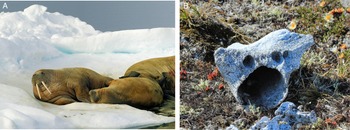
Museum collections and archaeological sites across the subarctic and Arctic hold “paleoarchives” of biological and cultural material that can provide insight into the characteristics and effects of human activities. The past can reveal the extent, rate, and nature of change likely to emerge. Knowledge of past interactions can ensure future decisions are well-informed, and may even mitigate against predicted environmental and ecological changes. A limited number of studies have already shown the dynamics of human-animal interactions for a few extinct and extant Arctic and subarctic species, such as mammoths (Mammuthus spp.; e.g., Drucker et al., Reference Drucker, Vercoutere, Chiotti, Nespoulet, Crepin, Conard and Muenzel2015; Metcalfe, Reference Metcalfe2017), musk ox (Ovibos moschatus; e.g., Campos et al., Reference Campos, Willerslev, Sher, Orlando, Axelsson, Tikhonov and Aaris-Sørensen2010; Markova et al., Reference Markova, Puzachenko, van Kolfschoten, Kosintsev, Kuznetsova, Tikhonov, Bachura, Ponomarev, van der Plicht and Kuitems2015) and bowhead whales (Balaena mysticetus; e.g., Borge et al., Reference Borge, Bachmann, Bjørnstad and Wiig2007; McLeod et al., Reference McLeod, Brown, Moore, Stevens, Barkham, Barkham and White2008), however much remains unknown. The aim of this paper is to highlight current knowledge, and key knowledge gaps in the historical ecology (sensu Stahl, Reference Stahl and Smith2014) of a single species—the Atlantic walrus (Odobenus rosmarus rosmarus)— in order to reveal the nature, scale, and duration of impacts on both humans and animals (Fig. 1). We begin with an introduction to walrus hunting in the North AtlanticFootnote 1, and then highlight four questions key to developing a holistic historical ecology of the species. Although we focus only on the Atlantic walrus, the questions, approaches, and methods explored could also be applied to a wide range of other species.
(A) Photograph of a group of live Atlantic walruses, hauled-out on Svalbard. Photograph courtesy of Frits Steenhuisen. (B) Photograph of a surface find from northern Foxe Basin during fieldwork, showing the cranial remains following ivory removal.

AN INTRODUCTION TO HUMANS AND WALRUSES
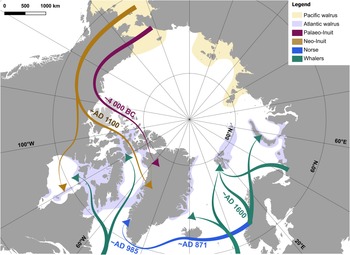
Human cultures occupying the North Atlantic have long utilised mammals, birds, fish, and bivalves for food, tools, clothing, fuel, and trade goods. In particular, Arctic marine mammals (AMMs) have played a central, albeit varied, role in human subsistence over at least six millennia of human population expansion, abandonment and recolonisation events (Fig. 3; Murray, Reference Murray2008). Most parts of the Arctic could not have been settled without maritime cultural and technological adaptations (Fitzhugh, Reference Fitzhugh, Friesen and Mason2016), but these took time to develop. Some of the earliest human Arctic maritime specialisations in the North Atlantic began in northern Europe, with hunting of AMMs from the Younger Stone Age (4450 BC–AD 150) around Varangerfjord, in what is today northern Norway (Renouf, Reference Renouf1986). Reliance on maritime resources slowly developed across Arctic Canada and Greenland following the first human migration wave by the Arctic Small Tool traditions around 4000 BC from the Bering Strait to Canada, and eventually Greenland (Ackerman, Reference Ackerman1998; Raghavan et al., Reference Raghavan, DeGiorgio, Albrechtsen, Moltke, Skoglund, Korneliussen and Grønnow2014).
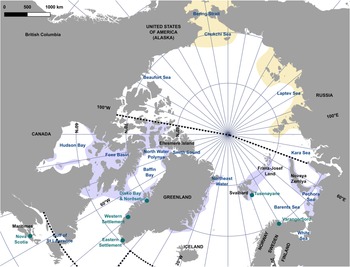
One AMM frequently found at archaeological sites across the North Atlantic is the walrus. Walruses are the largest extant Arctic pinniped, and were particularly important to early human maritime cultures lacking in social and technological developments for large whale hunting (Murray, Reference Murray1999). Walrus hunting by humans was widespread across the North Atlantic, however the intensity and location of activities has varied following changing motivations from subsistence hunting, long-distance trade, and eventually commercial exploitation. There are two currently recognised subspecies of walrus, the Atlantic (O. r. rosmarus [Linnaeus, Reference Linnaeus1758]) and the Pacific (O. r. divergens [Illiger, Reference Illiger1815]), with distinct geographic distributions (Fig. 2; Cronin et al., Reference Cronin, Hills, Born and Patton1994). The more abundant and generally larger Pacific walrus occurs in northern Russia and Alaska within the Bering, Chukchi, and Laptev seas (Fay, Reference Fay1982; Lindqvist et al., Reference Lindqvist, Bachmann, Andersen, Born, Arnason, Kovacs, Lydersen, Abramov and Wiig2009) and has been found at archaeological sites relating to the Old Bering Sea, Birnirk, Punuk, and Thule cultural periods (Hill, Reference Hill, T. J. Braje and Rick2011). In contrast, the Atlantic walrus is currently found across northeastern Canada, Greenland, Svalbard, Franz Josef Land, and the Kara and southern Barents seas (Born et al., Reference Born, Gjertz, Reeves and Brekke1995). Faunal remains and artefacts of the Atlantic walrus have been documented from Pre-Dorset, Dorset, Thule, Norse, and historical European archaeological sites across an expanded geographic area of the current distribution of the subspecies (Fig. 1; e.g., Møbjerg, Reference Møbjerg1999; Murray, Reference Murray1999; Hacquebord, Reference Hacquebord2001; Desjardins, Reference Desjardins2013). Prior to recent centuries of intensified hunting pressure, Atlantic walrus were also found in areas further south such as the southeastern Canadian Maritimes (North Atlantic Marine Mammal Commission [NAMMCO], 2005; McLeod et al., Reference McLeod, Frasier and Lucas2014). Walruses remain an important resource for many Arctic communities and are hunted across much of their range, subject to regulations and quotas (Wiig et al., Reference Wiig, Born, Stewart, Stewart, Kovacs and Acquarone2014; Born et al., Reference Born, Holm, Laidre and Iversen2017; Andersen et al., Reference Andersen, Heide-Jørgensen and Flora2018; NAMMCO, 2018).
Map of the Arctic showing all regions, places, and oceanographic features (coloured blue) mentioned in the text. Archaeological sites and specific places are marked with a point and coloured in aqua. The shading in purple and yellow represent the current distribution of Atlantic and Pacific walrus, respectively. The area within the black dotted lines represents the “North Atlantic” as defined within this article. All maps made using QGIS v.2.18.13 (QGIS 2018) and Inkscape v.0.48 (Inkscape 2011).

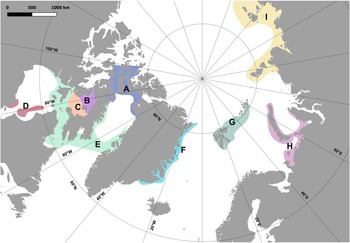
Distribution map of contemporary walrus, focusing on the North Atlantic and Arctic. Each of the ten recognised populations (or stocks) has been given a unique colour and label: (A) Baffin Bay (northwest Greenland and Canadian High Arctic), (B) northern Foxe Basin, (C) southern Foxe Basin, (D) southern and eastern Hudson Bay, (E) west Greenland–southeast Baffin Island (Hudson Bay–Davis Strait), (F) eastern Greenland, (G) Franz Josef Land–Svalbard, (H) Novaya Zemlya and east Laptev–Novosibirskie Islands, and (I) Pacific walrus (Odobenus rosmarus divergens). Adapted from Dietz et al. (Reference Dietz, Born, Stewart, Heide-Jørgensen, Stern, Rigét, Toudal, Lanthier, Jensen, Teilmann, Stewart, Kovacs and Acquarone2014), Lydersen and Kovacs (Reference Lydersen, Kovacs, Stewart, Kovacs and Acquarone2014), McLeod et al. (Reference McLeod, Frasier and Lucas2014), and Stewart (Reference Stewart, Born, Dietz, Ryan, Stewart, Kovacs and Acquarone2014b).

The distinction between the methods and topics of interest of various research traditions means that many of the cultural and ecological dimensions of human-walrus interactions remain unknown (Born et al., Reference Born, Gjertz, Reeves and Brekke1995; Murray, Reference Murray1999). Archaeologists and historians have considered walrus from an anthropocentric perspective. In particular, archaeological research has been concentrated on the role of walrus in local subsistence strategies; the use of bone, hide, and tusks for tools and equipment; the extent and nature of long-range trade or exchange; and the importance of walrus in local worldviews. Archaeologists have generally studied tools, settlement organisation, and faunal assemblages to reconstruct hunting strategies as well as carcass processing, storage, use, and exchange. Additional insights have been incorporated from anthropology, history, and literature that have drawn upon written records (e.g., catch records and exploration logs) and modern-day parallels (e.g., inference from contemporary hunting practices). Although it is well-established that walruses have been subjected to numerous phases of human hunting, it remains unclear what distinct or cumulative biological impacts this may have had on local walrus populations, and how this may be linked to known human cultural changes.
In contrast, biological research has typically focused on contemporary walrus populations to provide population size estimates, fundamental biological information, and stock characterisation to determine sustainable hunting quotas, appropriate conservation efforts, and management practices within frameworks such as NAMMCO (Stewart et al., Reference Stewart, Kovacs, Acquarone, Stewart, Kovacs and Acquarone2014a) and the Convention on International Trade in Endangered Species (CITES, 2017). Data have been obtained using a wide range of methods, including satellite telemetry, genetic analyses, behavioural observations, thermal imagery, and physiological examinations.
Thus, despite the knowledge of current walrus biology and ecology, the impact of human activities or environmental changes and details about local walrus populations in the past is comparatively poorly understood, particularly for deeper time scales.
THE NEED FOR INTERDISCIPLINARITY
Due to the disciplinary divide explored above, there are several key, as yet unanswered, questions relating to human-walrus interactions.
(1) How have human motivations for walrus hunting and utilisation varied across time and space? How has this been reflected in different hunting strategies, exploitation sites, as well as the trade and exchange of products such as ivory?
(2) Have there been substantial changes to prehistoric, historic, and contemporary walruses in terms of abundance, diversity, and distribution (including population crashes and local extinctions), associated with a particular human hunting or trade regime?
(3) Have there been particular morphological or demographic changes to walrus populations as a result of particular human hunting practices or strategies? Do any impacts show discrete or cumulative effects?
(4) Has the behavioural ecology of walruses, including migratory pathways, dispersal, haul-out sites, foraging, and mating behaviour, changed in response to differing phases of human exploitation and disturbance?
Emerging interdisciplinary methods now allow these questions to be investigated, as well as the potential impact of climatic and environmental conditions on walruses and humans. Integrated research approaches will make greater use of existing archaeological and historical collections, and create a shared point of reference for the humanities and natural and social sciences to understand human-walrus interactions through time. For archaeology, insights from new methodologies and ecological data will expand inference from a single site to broader geographical regions, and from an anthropocentric approach to a more comprehensive ecosystem scale. In contrast, biologists will now be able to extend the time depth of studies based upon greater sample material with contextual information about collection localities, possible human impacts, and sample ages.
CURRENT ARCHAEOLOGICAL AND BIOLOGICAL KNOWLEDGE
In order to adequately explore the key questions outlined above, this section provides a summary of current biological and archaeological research. The following content is not intended to serve as a comprehensive review, rather it is included to provide readers of any discipline with sufficient background knowledge to enable discussion of future interdisciplinary opportunities at the core of this paper.
Biology of contemporary walruses
Morphology
Walruses are one of the largest pinnipeds, and the only extant species of what was previously a rich and diverse family, the Odobenidae (Bouchard et al., Reference Bouchard, Harington and Guilbault1993; Boessenecker and Churchill, Reference Boessenecker and Churchill2013). Walruses are easily recognised by their characteristic tusks formed from elongated upper canines emerging from an upper snout covered in vibrissae (Fig. 1; Fay, Reference Fay1985). Atlantic and Pacific walruses share similar morphologies (Fay, Reference Fay1985), although the Pacific is generally heavier and possibly longer than the Atlantic (Fay, Reference Fay1982; Knutsen and Born, Reference Knutsen and Born1994). Within the Atlantic subspecies, adult males can reach up to 1300 kg and 3.2 m in length (Knutsen and Born, Reference Knutsen and Born1994; Wiig and Gjertz, Reference Wiig and Gjertz1996; Garlich-Miller and Stewart, Reference Garlich-Miller and Stewart1998), although there is some variation in size between populations. For example, walruses from Foxe Basin and Greenland are longer on average than animals from Hudson Bay (Mansfield, Reference Mansfield1958; McLaren, Reference McLaren1993; Knutsen and Born, Reference Knutsen and Born1994). Walruses are sexually dimorphic, with females typically 20% smaller than males (Fay, Reference Fay1985), with a higher proportion of blubber, fewer skin nodules or scarring, and smaller straighter tusks (Fay, Reference Fay1982; Knutsen and Born, Reference Knutsen and Born1994). Walrus morphology, particularly tusk size, also varies according to age, health, and population (Fay, Reference Fay1982; Knutsen and Born, Reference Knutsen and Born1994; Garlich-Miller and Stewart, Reference Garlich-Miller and Stewart1998). It is not known how representative contemporary morphological variation is for historic populations, with only a few studies that have characterised historic remains (e.g., Laptev walrus [Lindqvist et al., Reference Lindqvist, Bachmann, Andersen, Born, Arnason, Kovacs, Lydersen, Abramov and Wiig2009] and Maritimes walrus [McLeod et al., Reference McLeod, Frasier and Lucas2014]). Conducting such analyses is challenging due to small sample sizes and the potential for degradation to mask or be indistinguishable from physiological differences between animals or populations.
Subspecies and populations
The split between Atlantic and Pacific walruses has been confirmed by numerous genetic studies (e.g., Cronin et al., Reference Cronin, Hills, Born and Patton1994; Lindqvist et al., Reference Lindqvist, Bachmann, Andersen, Born, Arnason, Kovacs, Lydersen, Abramov and Wiig2009, Reference Lindqvist, Roy, Lydersen, Kovacs, Aars, Wiig and Bachmann2016) and estimated to have occurred almost one million years ago during the Pleistocene (Andersen et al., Reference Andersen, Jacobsen, Lydersen, Semenova, Boltunov, Born, Wiig and Kovacs2017). There is very limited gene flow between the two subspecies (Andersen et al., Reference Andersen, Jacobsen, Lydersen, Semenova, Boltunov, Born, Wiig and Kovacs2017), and substructure within the Atlantic shows distinct clades on the “eastern” and “western” side of the North Atlantic also with limited gene flow (Fay, Reference Fay1985; Cronin et al., Reference Cronin, Hills, Born and Patton1994; Andersen et al., Reference Andersen, Born, Gjertz, Wiig, Holm and Bendixen1998; Born et al., Reference Born, Andersen, Gjertz and Wiig2001; Andersen et al., Reference Andersen, Born, Stewart, Dietz, Doidge, Lanthier, Stewart, Kovacs and Acquarone2014; Star et al., Reference Star, Barrett, Gondek and Boessenkool2018). These two relatively isolated clades have numerous recognised populations as determined by genetic (e.g., Andersen and Born, Reference Andersen and Born2000; Andersen et al., Reference Andersen, Born, Doidge, Gjertz, Wiig and Waples2009, Reference Andersen, Jacobsen, Lydersen, Semenova, Boltunov, Born, Wiig and Kovacs2017; Lindqvist et al., Reference Lindqvist, Bachmann, Andersen, Born, Arnason, Kovacs, Lydersen, Abramov and Wiig2009), isotopic (Outridge and Stewart, Reference Outridge and Stewart1999; Outridge et al., Reference Outridge, Davis, Stewart and Born2003), trace element (Shafer et al., Reference Shafer, Davis, Coltman, Stewart, Stewart, Kovacs and Acquarone2014), and tracking studies (e.g., Dietz et al., Reference Dietz, Born, Stewart, Heide-Jørgensen, Stern, Rigét, Toudal, Lanthier, Jensen, Teilmann, Stewart, Kovacs and Acquarone2014). There are currently eight recognised populationsFootnote 2 (Fig. 4): Baffin Bay (northwest Greenland and Canadian High Arctic); west Greenland–southeast Baffin Island (Hudson Bay–Davis Strait); northern Foxe Basin; southern Foxe Basin; southern and eastern Hudson Bay; eastern Greenland; Franz Josef Land–Svalbard; and southern Novaya Zemlya and east Laptev–Novosibirskie Islands (Outridge and Stewart, Reference Outridge and Stewart1999; Stewart et al., Reference Stewart, Outridge and Stern2003; NAMMCO, 2005, 2018; Stewart, Reference Stewart2008; Andersen et al., Reference Andersen, Born, Stewart, Dietz, Doidge, Lanthier, Stewart, Kovacs and Acquarone2014). There may also be additional as yet unknown Russian populations, as population designation remains unclear given the limited data concerning their migratory behaviour, abundance, and distribution (NAMMCO, 2005; Andersen et al., Reference Andersen, Jacobsen, Lydersen, Semenova, Boltunov, Born, Wiig and Kovacs2017).
Map showing key cultural phases with large-scale population movement in the North Atlantic and Atlantic Arctic beginning with the earliest Pre-Dorset cultures until the most recent European and North American whalers and sealers. Arrows are colour-coded based upon culture and symbolically represent the origin, movement, and hunting/settlement localities of cultural complexes mentioned in the text. Numbers associated with each arrow represent the time at which each human migration or period of intensive hunting activities began. Adapted from maps by Raghavan et al (Reference Raghavan, DeGiorgio, Albrechtsen, Moltke, Skoglund, Korneliussen and Grønnow2014) and Star et al. (Reference Star, Barrett, Gondek and Boessenkool2018).

Measuring abundance
There have been ongoing attempts to obtain accurate abundance estimates across Atlantic walrus populations in order to infer population trends, conservation status, and calculate sustainable catch sizes. Historically, this typically involved visual survey from boats, on land, or by plane, with aerial surveys, in particular, still being used today (e.g., Heide-Jørgensen et al., Reference Heide-Jørgensen, Sinding, Nielsen, Rosing-Asvid and Hansen2016; Hammill et al., Reference Hammill, Mosnier, Gosselin, Higdon, Stewart, Doniol-Valcroze, Ferguson and Dunn2016b; NAMMCO, 2018). Newer, alternative methods such as thermal imagery and high-resolution digital photography have been tested (Burn et al., Reference Burn, Webber and Udevitz2006; Udevitz et al., Reference Udevitz, Burn and Webber2008), and developing technology, such as drones, may offer new insights into population size, health, and behaviour (for examples from other marine mammals see Panigada et al., Reference Panigada, Lauriano, Burt, Pierantonio and Donovan2011; Christiansen et al., Reference Christiansen, Dujon, Sprogis, Arnould and Bejder2016). Depending on the technology, survey design, geographical region, and season, appropriate correction factors must be applied to abundance counts to obtain realistic population size estimates, considering factors such as the proportion of animals hauled-out or demographic composition (Born and Knutsen, Reference Born and Knutsen1997; Lydersen et al., Reference Lydersen, Aars and Kovacs2008; Heide-Jørgensen et al., Reference Heide-Jørgensen, Burt, Hansen, Nielsen, Rasmussen, Fossette and Stern2013).
Current population estimates
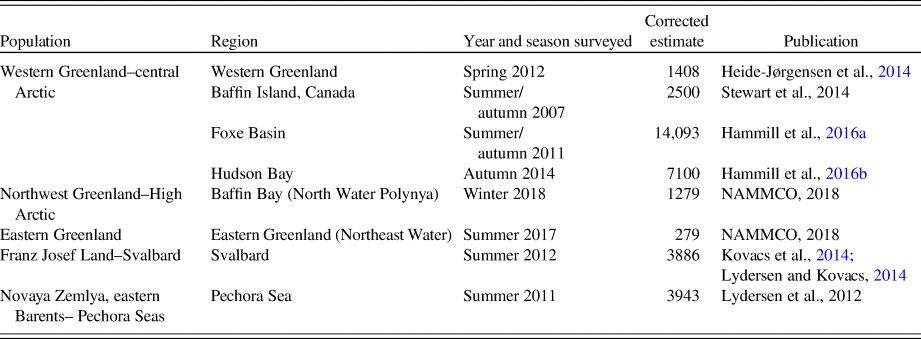
Based on recent surveys for each population, total abundance for the Atlantic walrus is estimated at approximately 40,000 animals (Table 1). Absolute numbers are impossible to determine, as surveys are not exhaustive and the same animal may be included multiple times when surveys are repeated in different geographic regions across different seasons. Despite this uncertainty, the Atlantic walrus population is substantially smaller than that for the Pacific walrus, which is predicted to be close to carrying capacity (Fay et al., Reference Fay, Eberhardt, Kelly, Burns and Quakenbush1997; Andersen et al., Reference Andersen, Jacobsen, Lydersen, Semenova, Boltunov, Born, Wiig and Kovacs2017), currently numbering between 129,000 and 283,000 animals (MacCracken et al., Reference MacCracken, Beatty, Garlich-Miller, Kissling and Snyder2017).
Corrected population estimates for each of the five populations of Atlantic walrus (O.r. rosmarus) separated by region surveyed, year, season, and publication. Depending on the study, correction refers to quantitative adjustment to allow for walruses submerged at the time of survey or missed from observation. Caution must be taken when interpreting numbers within a population due to connectivity between regions. As all surveys were not taken simultaneously, numbers cannot account for movement and may easily underestimate total population size or double count animals. For example, seasonal migration may result in animals from West Greenland being confounded in abundance estimates of Baffin Island during summer. Furthermore, not all haul-out sites are surveyed so the corrected estimates generally represent minimum abundances for each region.

Determining population trends and future trajectories
The current populations of Atlantic walrus show varying degrees of decline and growth over the last 100–150 years, according to population modelling based upon catch history records and life-history characteristics (e.g., Witting and Born, Reference Witting and Born2005, Reference Witting and Born2014). There have been substantial declines for populations such as west Greenland–southeast Baffin Island (estimated 80% decline during the first half of the twentieth century), but positive population growth for others, such as eastern Greenland (Witting and Born, Reference Witting and Born2005, Reference Witting and Born2014). Although data are limiting for certain populations thereby reducing confidence in the reconstructed population dynamics (NAMMCO, 2005), genetic information has also been used to infer similar trends. For example, genetic assessments suggest that west Greenland–southeast Baffin Island walruses underwent a substantial population decline (bottleneck; Shafer et al., Reference Shafer, Gattepaille, Stewart and Wolf2015), whereas populations across Svalbard, Franz Josef Land, and the Pechora Sea show population expansion (Andersen et al., Reference Andersen, Jacobsen, Lydersen, Semenova, Boltunov, Born, Wiig and Kovacs2017).
Movements and migrations
Walrus movements have been studied from daily to annual time scales, with movements found to often correlate with ice cover, food availability, and reproductive requirements (Born et al., Reference Born, Acquarone, Knutsen and Toudal2005, Reference Born, Holm, Laidre and Iversen2017; Dietz et al., Reference Dietz, Born, Stewart, Heide-Jørgensen, Stern, Rigét, Toudal, Lanthier, Jensen, Teilmann, Stewart, Kovacs and Acquarone2014). Some walruses follow the same migration each year between wintering and summering sites (Lowther et al., Reference Lowther, Kovacs, Griffiths and Lydersen2015). For example, many Baffin Bay walruses travel west following retreating ice during summer towards Canada's Ellesmere Island, where they remain for the warmer months before returning to winter along Greenlandic coasts (NAMMCO, 2013, 2018; Heide-Jørgensen et al., Reference Heide-Jørgensen, Flora, Andersen, Stewart, Nielsen and Hansen2017). In contrast, other walruses do not undertake any large-scale seasonal migration, such as females from eastern Greenland (NAMMCO, 2005). General habitat preference for walruses is sea ice or land suitable for hauling-out, close to shallow coastal water with easy access to bivalve prey (Sjare and Stirling, Reference Sjare and Stirling1996; Andersen and Born, Reference Andersen and Born2000; Heide-Jørgensen et al., Reference Heide-Jørgensen, Laidre, Fossette, Rasmussen, Nielsen, Hansen, Stewart, Kovacs and Acquarone2014). In winter, walruses can be found in areas with up to 97% ice cover (Born et al., Reference Born, Acquarone, Knutsen and Toudal2005), although most wintering sites are found near permanent open water, or “polynyas,” such as the North Water Polynya (Heide-Jøorgensen et al., Reference Heide-Jørgensen, Sinding, Nielsen, Rosing-Asvid and Hansen2016). Outside the breeding season of late winter and spring, females and males typically occupy different areas, potentially to minimise food competition (Born et al., Reference Born, Acquarone, Knutsen and Toudal2005; Krupnik and Ray, Reference Krupnik and Ray2007). Annual migration and choice of daily haul-out sites by walrus has changed over recent decades and centuries. Observations of migratory patterns, particularly by indigenous hunters, indicate changes to the timing and location of walruses across the Arctic with shortened migratory cycles and altered haul-out patterns (Krupnik, Reference Krupnik2000; Krupnik and Ray, Reference Krupnik and Ray2007; Born et al., Reference Born, Holm, Laidre and Iversen2017; Andersen et al., Reference Andersen, Heide-Jørgensen and Flora2018). The extent, variability, and rate of change, however, are difficult to quantify with limited empirical information.
Hauling-out behaviour
A combination of traditional ecological and scientific knowledge has revealed information about behaviours such as hauling-out, mating, and feeding. Walruses frequently group together in herds of three or more animals to swim or haul-out, although males in particular can also be found alone (Born et al., Reference Born, Gjertz, Reeves and Brekke1995; Sjare and Stirling, Reference Sjare and Stirling1996). Kinship groups commonly share haul-out sites, and numerous different haul-out sites can be used within a season by the same individuals (Andersen and Born, Reference Andersen and Born2000; Andersen et al., Reference Andersen, Born, Stewart, Dietz, Doidge, Lanthier, Stewart, Kovacs and Acquarone2014). Walruses spend approximately 25–30% of their time hauled-out (Sjare and Stirling, Reference Sjare and Stirling1996; Born and Knutsen, Reference Born and Knutsen1997; Born et al., Reference Born, Stefansson, Mikkelsen, Laidre, Andersen, Rigét, Villum Jensen, Bloch, Stewart, Kovacs and Acquarone2014), although where the population is highly mobile or there are only limited ice haul-outs (e.g., Smith Sound), this can fall to 15% (Garde et al., Reference Garde, Jung-Madsen, Ditlevsen, Hansen, Zinglersen and Heide-Jørgensen2018). The timing and duration of haul-outs has been linked primarily to temperature, wind speed, and precipitation (Born and Knutsen, Reference Born and Knutsen1997), rather than other factors such as diurnal patterns (Nyholm, Reference Nyholm1975; Mansfield and St Aubin, Reference Mansfield and St Aubin1991). Walruses spend most of their time concentrated within a few kilometres of a coast or fjord opening in shallow waters within 2 m of the surface (Born et al., Reference Born, Stefansson, Mikkelsen, Laidre, Andersen, Rigét, Villum Jensen, Bloch, Stewart, Kovacs and Acquarone2014; Dietz et al., Reference Dietz, Born, Stewart, Heide-Jørgensen, Stern, Rigét, Toudal, Lanthier, Jensen, Teilmann, Stewart, Kovacs and Acquarone2014), however individual walruses have also been recorded in areas of much deeper water, particularly in eastern Greenland (Born et al., Reference Born, Acquarone, Knutsen and Toudal2005).
Feeding behaviour
When not hauled-out, walruses spend the rest of their time diving for food, travelling between sites, or “milling” as a collective in a less-defined social activity (Sjare and Stirling, Reference Sjare and Stirling1996). Much of the diet of walruses is benthic bivalves (e.g., Mya truncata, Hiatella arctica, or Serripes groenlandicus) typically found at depths of less than 100 m (Vibe, Reference Vibe1950; Mansfield, Reference Mansfield1958; Fisher and Stewart, Reference Fisher and Stewart1997). To reach their prey, walruses dive repeatedly over several hours, with each dive lasting an average of 3–5 minutes depending on depth to prey (Wiig et al., Reference Wiig, Gjertz, Griffiths and Lydersen1993; Knutsen and Born, Reference Knutsen and Born1994; Acquarone et al., Reference Acquarone, Born and Speakman2006). A fully grown adult walrus must consume large number of bivalves to obtain enough energy, particularly during summer to ensure ample lipid stores are built up for the cooler months (Born and Acquarone, Reference Born and Acquarone2007). Metabolic studies support daily food requirements of approximately 4–6% of total body mass (Fay, Reference Fay1982; Born et al., Reference Born, Rysgaard, Ehlmé, Sejr, Acquarone and Levermann2003; Born and Acquarone, Reference Born and Acquarone2007; Garde et al., Reference Garde, Jung-Madsen, Ditlevsen, Hansen, Zinglersen and Heide-Jørgensen2018), meaning that an average fully grown adult can easily consume 95kg of bivalves a day (Acquarone et al., Reference Acquarone, Born and Speakman2006). Walruses not only remove large amounts of biomass but also structurally alter benthic communities through bioturbation, as they feed by selectively ripping off partial or whole bivalve bodies from the seafloor while moving their head and tusks laterally within the sediment (Vibe, Reference Vibe1950; Mansfield, Reference Mansfield1958; Oliver et al., Reference Oliver, Slattery, O'Connor and Lowry1983; Fisher and Stewart, Reference Fisher and Stewart1997; Born et al., Reference Born, Rysgaard, Ehlmé, Sejr, Acquarone and Levermann2003). Walruses have also been documented feeding on a wide variety of other prey items such as seals, squid, or polychaetes, probably allowing them to occur in areas with limited shallow water bivalve communities (Mansfield, Reference Mansfield1958; Fisher and Stewart, Reference Fisher and Stewart1997; Born et al., Reference Born, Acquarone, Knutsen and Toudal2005).
Reproduction and life-history traits
Walruses are relatively long-lived, attaining ages of 20–30 yr, and are slow to develop and reproduce. Breeding is typically between February and April, depending on ice cover (Born et. al, Reference Born, Gjertz, Reeves and Brekke1995; Born, Reference Born2001, Reference Born2003). Commonly used breeding areas feature open water, such as the North Water Polynya in northwest Greenland (Vibe, Reference Vibe1950; Born, Reference Born2001; Born, Reference Born2003), eastern Greenlandic polynyas (Born et al., Reference Born and Knutsen1997) or the northeastern islands of Svalbard (Lowther et al., Reference Lowther, Kovacs, Griffiths and Lydersen2015). At least for the Pacific walrus, breeding is highly associated with ice, and, according to traditional Yupik knowledge, fresh snow is thought to protect young calves from cold exposure on the ice (Krupnik, Reference Krupnik2000). The Atlantic walrus breeding season overlaps with the period of peak male fertility (primarily from late winter until early spring, irrespective of age; Born, Reference Born2003) and female oestrus (generally spring; Born, Reference Born2001). Breeding is initiated by numerous different male walruses “singing” underwater in rotation to groups of hauled-out females, with each mature male performing for several days at a time (Sjare and Stirling, Reference Sjare and Stirling1996). Calves are born after about 11 months of active gestation (Garlich-Miller and Stewart, Reference Garlich-Miller and Stewart1999), typically with an even sex ratio and already 1.1–1.6 m long (Born, Reference Born2001). Females suckle calves for 2–3 yr (Mansfield, Reference Mansfield1958). Walruses continue to grow past sexual maturity, approximately 11 yr for males and 6 yr for females (Born, Reference Born2001, Reference Born2003), until physical maturity, approximately 10–15 yr (Knutsen and Born, Reference Knutsen and Born1994; Born, Reference Born2003). Female walruses typically birth a new calf every 3 years, although it is possible every second year (Born, Reference Born2001).
Conservation and management concerns
The future prospects of walruses in the North Atlantic are likely to depend upon the extent of human hunting, anthropogenic disturbances, environmental pollution, and climate change. Climatic changes are predicted to affect not only ice cover, habitat availability, ocean productivity, and the availability of prey, but also walrus social structure, migration patterns, and vulnerability to pollutants and pathogens (Krupnik, Reference Krupnik2000; MacCracken et al., Reference MacCracken, Beatty, Garlich-Miller, Kissling and Snyder2017). Warmer temperatures and reduced ice cover will reduce sea-ice haul-out sites for many populations, increasing the use of terrestrial haul-out sites, in turn making walruses more vulnerable to predators such as polar bears or human hunters (NAMMCO, 2005). Walruses may also experience increased physiological stress by requiring greater daily energy expenditure if suitable ice haul-out sites are lost or are further away from feeding grounds (Krupnik, Reference Krupnik2000; NAMMCO, 2005). Conversely, environmental changes might lead to increased ocean productivity, hence improving prey availability for walruses (Krupnik, Reference Krupnik2000; NAMMCO, 2005). Current research shows negative impacts on health and social dynamics for the Pacific walrus due to changing ice floe movements, increased seasonal variability, and earlier ice breakup (Ray et al., Reference Ray, Hufford, Overland, Krupnik, McCormick-Ray, Frey and Labunski2016). This trend is not universal, however, as regular abundance estimates have shown increasing, rather than decreasing, population size despite substantial sea-ice loss, in areas such as Svalbard (Kovacs et al., Reference Kovacs, Aars and Lydersen2014; Laidre et al., Reference Laidre, Stern, Kovacs, Lowry, Moore, Regehr and Ferguson2015) and west Greenland (NAMMCO, 2018). This suggests a complex and challenging dynamic between changing climatic conditions and future walrus population size across the North Atlantic, with the overall effect still unclear. In addition to climate change, there are ongoing concerns regarding levels of environmental pollution in the Arctic, particularly polychlorinated biphenyls and heavy metals (Wiig et al., Reference Wiig, Renzoni and Gjertz1999, Reference Wiig, Berg, Gjertz, Seagars and Skaare2000; Wolkers et al., Reference Wolkers, van Bavel, Ericson, Skoglund, Kovacs and Lydersen2006; Rigét et al., Reference Rigét, Dietz, Born, Sonne and Hobson2007) as well as anthropogenic threats from settlements, waste management, extractive industries, shipping, and tourism (NAMMCO, 2005, 2015; Krupnik, Reference Krupnik2000).
Overview of prehistoric and historic trends in walrus hunting and utilisation
From the beginning of North Atlantic Archaeological research
Human occupation of the North Atlantic Arctic has been recorded in writing by Europeans since the sixteenth century with explorers including Sir Martin Frobisher (McGhee, Reference McGhee2001), Rasmussen (Reference Rasmussen1927), and Peary (Reference Peary2012) often gathering ethnographic descriptions, tools, and artefacts from the Arctic indigenous people they encountered (Hastrup, Reference Hastrup2009; Stewart et al., Reference Stewart, Higdon, Reeves, Stewart, Stewart, Kovacs and Acquarone2014d; Gulløv, Reference Gulløv, Friesen and Mason2016). Since the era of European explorations ended in the twentieth century, researchers across social sciences and the humanities have continued to investigate how past and present Arctic cultures survived, and in many cases thrived, in the extreme conditions and distances of the northernmost latitudes. Interpretations of archaeological material have sought to describe and interpret both temporal and spatial patterns of human activities and ways of life.
Important for our understanding of human-animal interactions, archaeological excavations, including those conducted in the North Atlantic, began to consider faunal assemblages from the second half of the twentieth century onwards. With time, unworked faunal remains have been increasingly collected, there is greater concern for site stratigraphy, sieves are increasingly used to retain small bones or fragments, and findings are now generally documented in official reports or international publications (McGovern, Reference McGovern1983; Kruse, Reference Kruse2017). These changes have led to a growing archaeological interest in hunting strategies (e.g., Norman and Friesen, Reference Norman and Friesen2010; Arneborg et al., Reference Arneborg, Lynnerup and Heinemeier2012; Monchot et al., Reference Monchot, Thompson, Patenaude and Houmard2016), prey availability, consumption, and the use and exchange of meat, skin, blubber, bone, and ivory (e.g., McGhee, Reference McGhee1977; Gotfredsen and Møbjerg, Reference Gotfredsen and Møbjerg2004; Alix, Reference Alix, Friesen and Mason2016; Gotfredsen et al., Reference Gotfredsen, Appelt and Hastrup2018).
Pre-Dorset and Dorset walrus hunting
Archaeological research on the use of AMMs, particularly walruses, has largely followed artefact- or site-feature-based approaches to infer hunting and storage practices, and the extent of resource sharing and exchange. Analyses of organic and lithic artefacts focusing on the style and function of tools such as harpoons, scrapers, and spears have revealed when tools best suited to marine mammal hunting were introduced and spread (Gotfredsen and Møbjerg, Reference Gotfredsen and Møbjerg2004). The earliest evidence for hunting of Atlantic walrus has been suggested from Paleo-Indian tools from as early as 7500 BC, from what is today eastern Canada, particularly Nova Scotia and the Gulf St. Lawrence (Keenlyside, Reference Keenlyside1985). Subsequent increases in the diversity of tools suitable for marine mammal exploitation coincided with the first phase of human occupation in the Atlantic Arctic (Pre-Dorset cultures; Fig. 2). The use of walrus bone, hide, teeth, and ivory to develop hunting tools amongst other items has also revealed much about how animals were hunted, how carcasses were processed, and their final use (e.g., Monchot et al., Reference Monchot, Houmard, Dionne, Desrosiers and Gendron2013). Bone, and particularly ivory, was used for a wide variety of tools including harpoon foreshafts, barbed spears, pressure flakers, and hand wedge tools (Gotfredsen and Møbjerg, Reference Gotfredsen and Møbjerg2004). Later, around 700–500 BC, tool use, settlement, subsistence patterns, and geographic distribution changed considerably, marking a shift to Dorset culture (Monchot et al., Reference Monchot, Houmard, Dionne, Desrosiers and Gendron2013; Ryan, Reference Ryan, Friesen and Mason2016). Ivory and baculum were both increasingly being used in western Greenland for spears, figurines, harpoon foreshafts, awls, show knives, and wedges (Gulløv and Appelt, Reference Gulløv and Appelt1999) as well as carvings, spatulas, sled shoes, and several projectiles in the eastern Canadian Arctic (LeMoine and Darwent, Reference LeMoine and Darwent1998). Changes in the utilisation of walrus by the Dorset are also evident from settlement patterns and debitage. The development of specialised tools and ivory extraction methods appears to have emerged at the same time as meat caches, more permanent settlements, and a growing focus on ivory carving (LeMoine and Darwent, Reference LeMoine and Darwent1998; Murray, Reference Murray1999).
Pre-Dorset and Dorset walrus utilisation
These patterns of walrus utilisations characterised from artefact analyses are supported by zooarchaeological evidence. Site-based quantification measures have revealed an overall trend of increasing consumption and utilisation of walrus from Pre-Dorset to early Dorset, before a decline until commercial hunting by the Norse and European whalers (Born et al., Reference Born, Gjertz, Reeves and Brekke1995; Murray, Reference Murray1999; Murray, Reference Murray2008; Monchot et al., Reference Monchot, Houmard, Dionne, Desrosiers and Gendron2013). Zooarchaeological assemblages show less than 1% walrus from early Pre-Dorset cultures of the North Atlantic, such as Saqqaq and Independence I (<1% of zooarchaeological assemblages; Dyke et al., Reference Dyke, Hooper, Richard Harington and Savelle1999; Murray, Reference Murray1999; Darwent, Reference Darwent, Mondini, Muñoz and Wickler2004). For sites with longer occupations, however, the reliance on walrus increases through time, as determined by the presence of blubber, waste materials, and tools (e.g., Gotfredsen and Møbjerg, Reference Gotfredsen and Møbjerg2004). Walrus use continued to increase during the early Dorset period (approximately 50 BC–AD 750), most likely due to communal hunting strategies, new hunting technologies, and more abundant walrus populations in response to changing climatic conditions (Dredge, Reference Dredge1992; Harington, Reference Harington2008). The increasing importance of walrus was not unique to the North Atlantic, with a similar trend in early Pacific maritime cultures such as the Choris and Ipiutak, suggesting ongoing knowledge sharing across the Arctic or widespread environmental changes (Krupnik, Reference Krupnik2000). Towards the Late Dorset, walrus hunting appears to have declined again, potentially due to unsustainable hunting, human disturbance, changing social settlement patterns, and a return to ringed seal hunting (Murray, Reference Murray1999).
Thule walrus hunting and utilisation
The declining use of walrus by the Dorset continued during the Thule culture (D.B. Stewart et al., Reference Stewart, Born, Dietz, Ryan, Stewart, Kovacs and Acquarone2014), which began following a second major human migration from the Bering Strait region around the twelfth to fourteenth centuries (Fig. 2; Friesen and Arnold, Reference Friesen and Arnold2008; Raghavan et al., Reference Raghavan, DeGiorgio, Albrechtsen, Moltke, Skoglund, Korneliussen and Grønnow2014; Gulløv, Reference Gulløv, Friesen and Mason2016). Walrus catches became less important as in many regions the Thule increasingly focused on hunting large whales, such as bowhead (Maxwell, Reference Maxwell1985; D.B. Stewart et al., Reference Stewart, Born, Dietz, Ryan, Stewart, Kovacs and Acquarone2014). However, a decline during the Thule period was not ubiquitous. In regions such as Foxe Basin, with abundant year-round access to small walrus herds and shallow waters potentially limiting whale abundance, zooarchaeological finds of walruses remained high (Murray, Reference Murray1999; Desjardins, Reference Desjardins2018). Indeed, walrus hunting increased in this region during the Thule period based upon evidence of walrus used as food, raw tool materials, and cached stores (Desjardins, Reference Desjardins2013).
Norse walrus hunting and the ivory trade
A major change in North Atlantic walrus hunting arrived with the expansion of the Norse (Vikings) during the medieval period, who introduced the first phase of international, long-distance commercial walrus hunting and trade. Walrus ivory was one of several luxury goods traded with Europe, the Baltic, and the Middle East and is one of the likely underlying reasons behind Norse expansion to Iceland, Greenland, and exploration of coastal North America (McGovern, Reference McGovern1983; Vebæk, Reference Vebæk1993; Keller, Reference Keller2010; Frei et al., Reference Frei, Coutu, Smiarowski, Harrison, Madsen, Arneborg and Frei2015). In Greenland, in particular, the Norse sought high-value prestige goods including walrus tusks and furs as commodities to pay tithes and to exchange for ornamental goods and raw materials not locally available (McGovern, Reference McGovern and Green1985; Keller, Reference Keller2010; Caldwell and Hall, Reference Caldwell, Hall, Caldwell and Hall2014). Despite the importance of ivory, knowledge about where and how the Norse hunted walrus in Greenland is still very limited, with only a single genetic (Star et al., Reference Star, Barrett, Gondek and Boessenkool2018) and a preliminary isotopic study to date (Frei et al., Reference Frei, Coutu, Smiarowski, Harrison, Madsen, Arneborg and Frei2015). Historical references suggest Norse walrus hunting was concentrated in western Greenland in the area of Disko Bay (McGovern, Reference McGovern and Green1985; Gulløv, Reference Gulløv, Friesen and Mason2016), known at the time as ‘Norðsetur’. Based on zooarchaeological evidence and historical sources, it appears walrus skulls were often brought back to the Eastern and Western settlements as part of an annual, long-distance summer hunt (Degerbøl, Reference Degerbøl1936; Vebæk, Reference Vebæk1993). Blubber and marine mammal meat were largely sourced from other species of seals found closer to settlements, such as harp (Pagophilus groenlandicus), ringed (Pusa hispida), and hooded seals (Cystophora cristata; Degerbøl, Reference Degerbøl1929, Reference Degerbøl1934, Reference Degerbøl1941, Reference Degerbøl1943). Remains from ivory extraction are most common in the Western Settlement (McGovern, Reference McGovern1983) or northerly parts of the Eastern Settlement (Vebæk, Reference Vebæk1993). Ivory was removed with specialised tools after any soft tissue had decomposed, or more rarely simply sawn off (Degerbøl, Reference Degerbøl1929; Frei et al., Reference Frei, Coutu, Smiarowski, Harrison, Madsen, Arneborg and Frei2015). There may also have been limited exchange of ivory between the Norse, Dorset, and, more likely, Thule (Gulløv, Reference Gulløv2008, Reference Gulløv, Friesen and Mason2016; Sutherland, Reference Sutherland, Appelt and Berglund2000; Park, Reference Park2008). According to both historical and archaeological sources, Norse Greenlandic human settlements began to decline in the first half of the fifteenth century, coinciding with a range of factors including declining walrus ivory demand in mainland Europe, an increased supply of alternative sources of ivory, environmental degradation in Greenland, climatic changes, and reduced contact with Europe (Rijkelijkhuizen, Reference Rijkelijkhuizen2009; Keller, Reference Keller2010; Frei et al., Reference Frei, Coutu, Smiarowski, Harrison, Madsen, Arneborg and Frei2015; Hambrecht, Reference Hambrecht, Leone and Knauf2015).
Industrial-scale commercial walrus hunting by whalers and sealers
Beginning around the sixteenth century, walrus hunting reached an industrial scale, with heavy exploitation in many regions by commercial European and North American whalers, sealers, and to a much lesser extent, Inuit communities. Walruses were sought after for their hide, oil, ivory, blubber, and meat, either for human consumption or to feed dog teams (Born et al., Reference Born, Gjertz, Reeves and Brekke1995; D.B. Stewart et al., Reference Stewart, Born, Dietz, Ryan, Stewart, Kovacs and Acquarone2014). Areas such as Svalbard were heavily impacted by numerous phases of intense commercial hunting by Dutch, English, and Basque whalers (Gjertz et al., Reference Gjertz, Wiig and Øristland1998; Hacquebord, Reference Hacquebord2001; McLeod et al., Reference McLeod, Brown, Moore, Stevens, Barkham, Barkham and White2008; Rijkelijkhuizen, Reference Rijkelijkhuizen2009), as well as subsequent Russian Pomor and Norwegian hunting expeditions (Fig. 2; Kruse, Reference Kruse2017). In some instances, hundreds of walruses were killed in single events, such as those on Tusenøyane during the 1850s (Lindqvist et al., Reference Lindqvist, Roy, Lydersen, Kovacs, Aars, Wiig and Bachmann2016). North American and European whalers and sealers also acquired walrus hides, ivory, and meat through trade, with substantial exchange of worked walrus ivory and furs with the Canadian Inuit during the nineteenth and twentieth centuries (Hastrup, Reference Hastrup2009; D.B. Stewart et al., Reference Stewart, Born, Dietz, Ryan, Stewart, Kovacs and Acquarone2014). Despite variation in the timing and geographic extent of hunting operations, historical records confirm a general trend towards intensification of hunting, particularly during the nineteenth and twentieth centuries, following the introduction of key technologies such as motorised boats and firearms (Born et al., Reference Born, Gjertz, Reeves and Brekke1995; Witting and Born, Reference Witting and Born2014). Since the 1950s, however, much of walrus hunting was restricted to Inuit communities, as the demand for walrus ivory from Europe collapsed and various governmental protection measured were introduced regarding the capture and trade of walrus (Born et al., Reference Born, Gjertz, Reeves and Brekke1995; D.B. Stewart et al., Reference Stewart, Born, Dietz, Ryan, Stewart, Kovacs and Acquarone2014; Wiig et al., Reference Wiig, Born, Stewart, Stewart, Kovacs and Acquarone2014).
Catch sizes and loss estimates during this most recent period of exploitation indicate removals of at least 41,000 from the Canadian North Atlantic (D.B. Stewart et al., Reference Stewart, Born, Dietz, Ryan, Stewart, Kovacs and Acquarone2014), over 12,000 for Franz Josef Land (Gjertz et al., Reference Gjertz, Wiig and Øristland1998) and 25,000–60,000 from Svalbard (Hacquebord, Reference Hacquebord2001; Kruse, Reference Kruse2017). These are likely to be underestimates, however, as existing reports are often vague, inconsistent, incomplete, or missing and do not account properly for poaching or loss rates (NAMMCO, 2004, 2005; Witting and Born, Reference Witting and Born2005; Kruse, Reference Kruse2017). Today, walruses are still hunted in areas across the Canadian North Atlantic and Greenland for their importance as dog food, human food, and as a source of income through ivory sales (Freeman, Reference Freeman1974; Born et al., Reference Born, Holm, Laidre and Iversen2017; Desjardins, Reference Desjardins2018). In 2015, catches including struck and loss totalled 131 across Greenland, concentrated on the northwest and west coast (NAMMCO, 2015). Hunting trends and catch sizes vary considerably between regions, with some areas experiencing increased hunting pressure as human populations grow and where ivory remains an income source, while in other areas the demand for walrus has fallen with the replacement of dog teams by motorised transportation (Freeman, Reference Freeman1974; Born et al., Reference Born, Holm, Laidre and Iversen2017; Andersen et al., Reference Andersen, Heide-Jørgensen and Flora2018).
HISTORICAL ECOLOGY OF WALRUSES
Greater information about past dynamics between walruses and humans is needed to aid conservation and management efforts. In particular, to find a balance that maintains the cultural and economic benefits of walrus hunting for Inuit communities but also ensures the survival of walrus populations.
This leads to the first question, namely;
(1) How have human motivations for walrus hunting, utilisation, and trade varied across time and space?
Humans have hunted walruses with a wide range of hunting practices and motivations, ranging from opportunistic scavenging, subsistence hunting, regional exchange, commercial international trade, and industrialised international commodification. Walrus ivory was valued and traded well before human expansion into the Arctic North Atlantic, as demonstrated by finds of walrus ivory in Paleo-Indian archaeological sites in British Columbia, well south of the expected prehistoric range of walruses (Dyke et al., Reference Dyke, Hooper, Richard Harington and Savelle1999). Once humans began to occupy areas across Greenland and the eastern Canadian Arctic, walruses were probably hunted locally, as well as being traded regionally. Although the presence of unworked bone, butchered bones, and juvenile remains are generally seen as evidence of local hunting, valuable worked tools and other artefacts may have had very different origins (LeMoine and Darwent, Reference LeMoine and Darwent1998; Murray, Reference Murray2008). Information regarding artefact origin, age, use, and eventual destination is vital to reconstructing past trade and economic networks, as well as the timing, location, and intensity of hunting efforts.
Using genetics to provenance samples
Palaeogenetic analyses (ancient DNA [aDNA]) allow genetic information of a particular artefact to be compared with a reference collection of walrus populations across the North Atlantic to identify the source population from which that animal was taken. One recent study using mitochondrial DNA has already attempted this, and found a haplotype unique to the eastern North Atlantic (Star et al., Reference Star, Barrett, Gondek and Boessenkool2018). Although Star et al. (Reference Star, Barrett, Gondek and Boessenkool2018) were able to show a likely shift from “eastern” to “western” North Atlantic walruses, the ability to determine more precise geographic origins will probably require entire mitochondrial or nuclear genomes. In order to assign any certainty to the provenance of an artefact, however, there must be sufficient spatial genetic variation in the putative ancient source populations. If Atlantic walruses were highly connected and showed little phylogeographical differentiation, it may not be possible to determine with genetic data alone if a particular tool, jewellery, game piece, or other artefact was carved from a walrus tusk hunted in Svalbard, eastern Greenland, Iceland, or northern Norway.
Using isotopes to provenance samples
An alternative approach to provenancing samples based on their DNA involves the use of stable isotopes. The potential for provenancing based on isotopes also looks promising, with a pilot study of modern and archaeological walrus yielding distinct isotopic signatures from Greenland, Iceland, and the White Sea (Frei et al., Reference Frei, Coutu, Smiarowski, Harrison, Madsen, Arneborg and Frei2015). Additionally, Norse Greenlandic material from the West Settlement shows a similar isotopic signature to contemporary west Greenland–southeast Baffin Island walruses found in Disko Bay, supporting the surrounding Nassutooq area of western Greenland as the famous Norse “Norðsetur” hunting grounds (Frei et al., Reference Frei, Coutu, Smiarowski, Harrison, Madsen, Arneborg and Frei2015). As with genetics, however, the resolution of a source locality depends upon the spatial variation in isotopic signatures of the underlying geology and sea water, meaning isotopes are likely to only reveal the broad geographic region where a walrus would have spent most of its life, or an extended period of time prior to death (Stewart et al., Reference Stewart, Outridge and Stern2003). Additionally, stable isotopic comparisons may be obscured if numerous locations have similar isotopic signatures, making it important to develop a more comprehensive North Atlantic “isoscape” to resolve finer isotopic variation.
Sampling considerations
The ability to reconstruct shared human-walrus histories using an interdisciplinary combination of zooarchaeological, isotopic, hormonal, ancient DNA, and dating approaches is dependent upon the distribution, abundance, and preservation of archaeological finds. Unfortunately, faunal material collected from much of the North Atlantic is limited in number, patchily distributed across space and time (McGovern, Reference McGovern1983), logistically challenging to excavate, and ranging in preservation quality (e.g., Graf and Buvit, Reference Graf and Buvit2017). Moreover, with ongoing climate change and thawing of permafrost, hitherto “frozen palaeoarchives” of archaeological samples and sites are currently deteriorating at increasing speed across the Arctic. Sample availability thereby limits, and in some cases prevents, certain research questions. Thus, although not currently possible, it would be ideal for multiple biomolecular analyses to be performed from a single destructive sampling event, allowing complementary lines of information to be obtained for key samples of good preservation quality.
Although the benefits of methods such as aDNA and isotopes have been explored above, it is important to consider some of the limitations of each of these approaches. For isotopes, the process of bone remodelling throughout an animal's lifetime can confound signals (Nelson et al., Reference Nelson, Heinemeier, Lynnerup, Sveinbjörnsdóttir and Arneborg2012) and bone chemistry may be affected by the depositional environment (Budd et al., Reference Budd, Montgomery, Barreiro and Thomas2000). Furthermore, isotopic signatures can be affected by a samples’ lipid content, lab pretreatment, the faunal element under consideration, and whether bulk or amino acid specific analyses are conducted (Boecklen et al., Reference Boecklen, Yarnes, Cook and James2011), making comparisons between studies, species, and sites challenging.
For genetic analyses using current methods, some samples must be excluded or yield very limited data if endogenous content (proportion of target DNA) is found to be too low. Depending on environmental conditions the quantity and quality of endogenous DNA decreases with time (Orlando et al., Reference Orlando, Gilbert and Willerslev2015). Although the cold, relatively stable subarctic and Arctic environments offer relatively good preservation conditions, treatments such as cooking, curation, and storage can lead to unpredictable decay patterns (Burger et al., Reference Burger, Hummel, Hermann and Henke1999; Nicholson et al., Reference Nicholson, Tomiuk, Czarnetzki, Bachmann and Pusch2002; Hansen et al., Reference Hansen, Mitchell, Wiuf, Paniker, Brand, Binladen, Gilichinsky, Rønn and Willerslev2006; Pruvost et al., Reference Pruvost, Schwarz, Correia, Champlot, Braguier, Morel, Fernandez-Jalvo, Grange and Geigl2007; Oskam et al., Reference Oskam, Jacomb, Allentoft, Walter, Paul Scofield, Haile, Holdaway and Bunce2011). Low endogenous content is particularly problematic for sequencing of nuclear DNA (O'Rourke et al., Reference O'Rourke, Hayes and Carlyle2000; Allentoft et al., Reference Allentoft, Collins, Harker, Haile, Oskam, Hale and Campos2012), although ongoing methodological developments aid in the retrieval of DNA from particularly contaminated, damaged, or small samples (Orlando et al., Reference Orlando, Gilbert and Willerslev2015). In cases where degradation makes genetic sequencing infeasible, other ancient biomarkers may be more suitable, such as ancient proteins (Cappellini et al., Reference Cappellini, Jensen, Szklarczyk, Ginolhac, da Fonseca, Stafford and Holen2012).
(2) What have been the changes to prehistoric, historic and contemporary walrus abundance, diversity and distribution associated with particular hunting or trade regimes?
The role of human hunting in the extinction, decline, conservation, and altered distribution or diversity of many species, including walrus, can be a controversial issue. Current debates range from the role of humans in terrestrial megafauna extinctions (e.g., Grayson and Meltzer, Reference Grayson and Meltzer2002), the conservation merit of commercial game hunting (e.g., Nelson et al., Reference Nelson, Lindsey and Balme2013), and contemporary whaling (e.g., Mangel, Reference Mangel2016). Evidence so far concerning human disturbance on walrus is largely from anecdotal observations, which have recorded the abandonment of haul-out sites by walruses (e.g., Stewart, Reference Stewart2002; Born et al., Reference Born, Holm, Laidre and Iversen2017) and the return of walruses to certain sites once humans have left (NAMMCO, 2015). In addition, from an archaeological perspective there has also been some consideration of the presence or absence of walruses from particular sites or during specific time periods as potential indicators of species relative abundance (e.g., Møbjerg, Reference Møbjerg1999; Murray, Reference Murray1999, Reference Murray2008). Across a shorter time scale of the last few centuries, biologists have reconstructed historical population sizes and some ecological interactions of walruses over the last few centuries using population models and genetics (e.g., Born et al., Reference Born and Knutsen1997; Gjertz et al., Reference Gjertz, Wiig and Øristland1998; Weslawski et al., Reference Weslawski, Hacquebord, Stempniewicz and Malinga2000; Andersen et al., Reference Andersen, Born, Stewart, Dietz, Doidge, Lanthier, Stewart, Kovacs and Acquarone2014; Heide-Jørgensen et al., Reference Heide-Jørgensen, Laidre, Fossette, Rasmussen, Nielsen, Hansen, Stewart, Kovacs and Acquarone2014; Witting and Born, Reference Witting and Born2014; Laidre et al., Reference Laidre, Stern, Kovacs, Lowry, Moore, Regehr and Ferguson2015). However much of the possible effects of human-walrus interactions over the last 6000 years have not yet been tested. Fortunately, new opportunities for the analysis of zooarchaeological material using ancient DNA, radiocarbon dating, and prehistorical modelling offer the possibility to provide empirical data on the shared history and prehistory of humans and walrus.
Genetic analyses
Ancient DNA can be used not only to provenance samples, but also to reconstruct population demographic trajectories and therefore test for population declines, bottlenecks, and extinctions. Additionally, population genetic analyses can examine the detailed mechanisms and changes through time in genetic diversity, population connectivity, effective population size, and the phylogenetic relationship of lineages. Some of these analyses have already been conducted using modern genetics and modelling approaches (e.g., Shafer et al., Reference Shafer, Gattepaille, Stewart and Wolf2015; Andersen et al., Reference Andersen, Jacobsen, Lydersen, Semenova, Boltunov, Born, Wiig and Kovacs2017), however the unique opportunity of aDNA is that, by directly analysing rather than reconstructing ancient genomes, evidence for past events cannot be hidden by more recent population dynamics (Shafer et al., Reference Shafer, Davis, Coltman, Stewart, Stewart, Kovacs and Acquarone2014; Lindqvist et al., Reference Lindqvist, Roy, Lydersen, Kovacs, Aars, Wiig and Bachmann2016).
Ancient DNA approaches can also uncover the origins, existence, and fate of extinct populations, such as the Atlantic “Icelandic walrus” and “Maritimes walrus” in Nova Scotia and Gulf St. Lawrence. As no modern Icelandic or Maritimes population exists, modern walrus genetics cannot determine if animals inhabiting those areas were part of an existing, larger population (see Petersens, Reference Petersens, Hersteinsson and Sigbjarnarson1993; Pierce, Reference Pierce2009), or a unique evolutionary lineage. The origin and fate of such “lost” walrus populations can only be determined genetically by comparing aDNA from (pre)historic walrus finds to past and present surrounding reference populations. Determining whether putative “lost” genetic lineages went extinct or dispersed, ending up interbreeding with neighbouring populations, is important to identify. Particularly whether diversity and adaptive capacity may have been lost entirely from the species. For example, walruses previously inhabiting sites south of the current range may have had local adaptations such as reduced ice dependency or heat tolerance, which, if lost or admixed into modern populations, could have important impacts on the future resilience of Atlantic walrus in a warming Arctic (Dyke et al., Reference Dyke, Hooper, Richard Harington and Savelle1999).
Recent new approaches to laboratory and analytical aDNA methods during the last decade allow the past distribution and relative abundance of species to be reconstructed even in cases where no faunal remains are found. Ancient DNA obtained from sediment samples (sedaDNA) can reconstruct ecosystems with respect to species composition and approximate relative abundance by recovering traces of faecal, hair, skin, and other physical remains that may not be visible but have become incorporated into the soil (Lydolph et al., Reference Lydolph, Jacobsen, Arctander, Gilbert, Gilichinsky, Hansen, Willerslev and Lange2005). Several studies have demonstrated the suitability of these methods in identifying species across numerous Arctic palaeoecosystems (Willerslev et al., Reference Willerslev, Hansen, Binladen, Brand, Gilbert, Shapiro, Bunce, Wiuf, Gilichinsky and Cooper2003; Hebsgaard et al., Reference Hebsgaard, Gilbert, Arneborg, Heyn, Allentoft, Bunce, Munch, Schweger and Willerslev2009), with findings that support traditional zooarchaeological abundances. For example, the declining importance of cattle relative to wild animals throughout Norse occupation of Greenland (Enghoff, Reference Enghoff2003; Hebsgaard et al., Reference Hebsgaard, Gilbert, Arneborg, Heyn, Allentoft, Bunce, Munch, Schweger and Willerslev2009) and changes in marine mammal use, including walrus, across four Greenlandic archaeological sites (Seersholm et al., Reference Seersholm, Pedersen, Søe, Shokry, Mak, Ruter and Raghavan2016). sedaDNA is particularly helpful in understanding the importance of species with heavy or bulky bones that may be butchered or processed off-site, such as bowhead whales (Seersholm et al., Reference Seersholm, Pedersen, Søe, Shokry, Mak, Ruter and Raghavan2016) or walrus (Freeman, Reference Freeman1974; Desjardins, Reference Desjardins2013, Reference Desjardins2018; Frei et al., Reference Frei, Coutu, Smiarowski, Harrison, Madsen, Arneborg and Frei2015).
It is essential to select an appropriate reference point, or reference points, for any method attempting to compare levels of genetic diversity, abundance, distribution, behaviour, selective pressure, or population structure through time. For example, to determine the cumulative impact of human hunting on walrus genetic diversity levels a suitable reference could be a “pre-Anthropocene baseline” or a series of snapshots through time. An appropriate baseline is particularly critical when using results for management and conservation efforts to prevent inferring false trends based upon shifting baselines (Pauly, Reference Pauly1995; Roman et al., Reference Roman, Dunphy-Daly, Johnston and Read2015; Betts, Reference Betts, Friesen and Mason2016). Reference points can be determined directly from ancient remains and historical records when available. In other cases, however, baselines may need to be modelled with corrections made for changes in climatic conditions, habitat, food availability, and life-history traits. Such (pre)historic ecological or biological reconstructions are likely to have inherently high uncertainties, or rely on overly simplistic assumptions such as constant life-history traits. Despite these limitations, however, they can still provide vital information as one of the few comparisons to contemporary populations.
Sample context
In order to gain a complete and accurate understanding of past ecological and cultural dynamics it is important to incorporate contextual information from each sample used in analyses of past abundance, distribution, or diversity. In particular, having accurate and reliable dates for samples is critical to accurately inferring the timing of population demographic events. For walrus samples, dating could either be through direct radiocarbon dating of faunal remains with appropriate local marine reservoir corrections (Dyke et al., Reference Dyke, Hooper, Richard Harington and Savelle1999), or through shared context with other dated material and/or clear cultural contexts (e.g., Møbjerg, Reference Møbjerg1999; Savelle et al., Reference Savelle, Dyke, Whitridge and Poupart2012). In the future genetic dating may also be possible once population and time-period specific substitution rates are known (Orlando et al., Reference Orlando, Gilbert and Willerslev2015). The possible impact of incorrect stratigraphic assignment due to factors as diverse as scavengers or sea level changes makes the integration of archaeological knowledge particularly important in determining the age of samples (Erlandson and Moss, Reference Erlandson and Moss2001). Additional information from site context, such as location of find, settlement seasonality, sea level, climatic conditions, and prey availability can also offer insights into human impacts and guide hypotheses about walrus availability, location, and human settlement characteristics.
(3) Are there any discrete or cumulative effects on walruses of human-mediated selection?
Accounts of hunters targeting walrus for meat or ivory support the occurrence of selective hunting of walruses, at least during certain cultural periods, and indicate that these patterns have changed over time depending on hunting regimes and motivations. For example, contemporary Inuit hunters subject to hunting quotas often aim to maximise resource gain from a kill by selecting larger walruses (e.g., Born et al., Reference Born, Holm, Laidre and Iversen2017; NAMMCO, 2018), whereas zooarchaeological evidence supports preferential hunting of juveniles by the Saqqaq (Pre-Dorset) of western Greenland (Gotfredsen and Møbjerg, Reference Gotfredsen and Møbjerg2004). These, and other periods of selective hunting may have resulted in population- or species-wide changes in characteristics such as average tusk length, body size, population demographics, or behaviour. The question therefore arises whether selective hunting of walruses has been sufficiently intensive and prolonged to have resulted in discrete or cumulative impacts, and whether walrus populations have had sufficient time or genetic capacity to recover. The outcome of selection as morphological or physiological changes can be tested from traditional osteological examination (e.g., Etnier, Reference Etnier2007) or possibly indirectly with a high quality annotated reference genome (e.g., Foote et al., Reference Foote, Liu, Thomas, Vinař, Alföldi, Deng and Dugan2015).
Sexing of walrus remains
Morphological and genetic analyses can also reveal the sex of (pre)historic walrus remains, indicating whether there has been any sex bias in hunting, or demographic changes within a population (e.g., Wiig et al., Reference Wiig, Born, Gjertz, Lydersen and Stewart2007; Fischbach et al., Reference Fischbach, Jay, Jackson, Andersen, Sage and Talbot2008). Modern Greenland catch records support a sex bias in walrus hunts, due to regulations limiting the hunting of females (NAMMCO, 2013), however in the past the sex ratio of catches and motivations behind these would have been different. For example, males have larger body and tusk sizes, but females typically have softer skin and flesh, more intact tusks and a higher percentage of blubber (Born et al., Reference Born, Holm, Laidre and Iversen2017; Hill, Reference Hill, T. J. Braje and Rick2011). Sexing of walruses with osteometric examination may be possible for recent or extremely well-preserved faunal assemblages, however diagnostic bones such as the baculum are rare and bone fragments commonly found at archaeological sites cannot be sexed (LeMoine and Darwent, Reference LeMoine and Darwent1998; Keller, Reference Keller2010). Relying solely upon differences in size of particular bones can also be problematic, particularly for small or degraded assemblages, as differences may reflect taphonomy rather than a walruses’ sex or development (Wiig et al., Reference Wiig, Born, Gjertz, Lydersen and Stewart2007). Indeed, morphological characterisation of the proposed “Laptev” subspecies by Chapskii (Reference Chapskii1940), have since been questioned by subsequent morphometric findings and molecular evidence (Lindqvist et al., Reference Lindqvist, Bachmann, Andersen, Born, Arnason, Kovacs, Lydersen, Abramov and Wiig2009).
(4) How has human hunting and disturbance altered the behaviour of walruses?
Human hunting and other disturbances may also have left more subtle impacts on walruses, particularly behaviours such as seasonal migration, daily dispersal, choice of haul-out sites, feeding, and mating. Historical documentation and anecdotal records support some relatively recent changes. However, studies using genetics, isotope or trace element signatures, and hormone concentrations are required to understand these changes in more detail and over a longer period of time.
Stable isotope analysis: carbon and nitrogen
Stable isotopes are particularly useful in revealing dietary patterns, life-history traits, and seasonal migratory behaviour (Newsome et al., Reference Newsome, Clement and Koch2010). Carbon and nitrogen isotopes are commonly used across taxa to compare dietary patterns such as trophic level and the relative contribution of terrestrial or marine components (Katzenberg and Harrison, Reference Katzenberg and Harrison1997; Boecklen et al., Reference Boecklen, Yarnes, Cook and James2011). As walruses primarily feed on bivalves, they typically have low levels of nitrogen compared with other marine mammals. Interestingly, some populations have enriched nitrogen values, suggestive of a higher trophic niche (Linnebjerg et al., Reference Linnebjerg, Hobson, Fort, Nielsen, Møller, Wieland, Born, Rigét and Mosbech2016), which is concordant with observations of walruses eating birds and other seals (Fay, Reference Fay1982). In cattle and humans, higher-trophic-level signatures are also noted in suckling infants (Nelson et al., Reference Nelson, Heinemeier, Lynnerup, Sveinbjörnsdóttir and Arneborg2012; e.g., Balasse and Tresset, Reference Balasse and Tresset2002), which, if also true of walrus, would allow weaning age and other life-history traits of (pre)historic populations to be determined (Nelson et al., Reference Nelson, Heinemeier, Lynnerup, Sveinbjörnsdóttir and Arneborg2012; e.g., Balasse and Tresset, Reference Balasse and Tresset2002).
Additional stable isotope and trace element analyses
In addition to diet, stable isotopes can assign a walrus to a particular geographic region based upon levels of other stable isotopes and trace elements in the underlying geology and local seawater (Katzenberg and Harrison, Reference Katzenberg and Harrison1997). The bivalve diet and haul-out site fidelity common to walruses creates highly localised, distinctive isotopic signatures in tissues such as bone and teeth (Outridge and Stewart, Reference Outridge and Stewart1999; Stewart et al., Reference Stewart, Outridge and Stern2003; Frei et al., Reference Frei, Coutu, Smiarowski, Harrison, Madsen, Arneborg and Frei2015). Unfortunately not all isotopes are appropriate for analysis. For example strontium signatures are typically uniform across marine systems and hence not suited for the study spatial patterns (Stewart et al., Reference Stewart, Outridge and Stern2003). Lead isotopes and trace elements have been successful in studies of contemporary walruses across Foxe Basin and the central Arctic, which revealed finer resolution of populations than genetic data (Outridge and Stewart, Reference Outridge and Stewart1999). Additionally, a preliminary study on ancient samples revealed distinct lead isotopic signatures between Iceland, Greenland, and White Sea walruses (Frei et al., Reference Frei, Coutu, Smiarowski, Harrison, Madsen, Arneborg and Frei2015). Isotopic signatures can also be determined sequentially throughout an animal's life, as elements such as lead are deposited annually in walrus tooth cementum in “growth layer groups” which, unlike bone, are not subject to remobilisation or remodelling (Garlich-Miller et al., Reference Garlich-Miller, Stewart, Stewart and Hiltz1993; Stewart et al., Reference Stewart, Outridge and Stern2003). These isotopic chronologies can reveal the location of early infancy, major dispersal events, migratory patterns, abandonment of particular haul-out sites, and the most recently inhabited area of a walrus. Trace element and stable isotope studies from contemporary Canadian walruses have revealed juvenile and older males as likely migrants based upon isotopic signatures that were different from the broader population (Outridge and Stewart, Reference Outridge and Stewart1999). Subsequent incremental lead isotope analyses of Foxe Basin walruses showed similar major long-distance dispersal primarily in males around the age of sexual maturity (around 7–10 yr) but also found some returned to their original location much later in life (Stewart et al., Reference Stewart, Outridge and Stern2003). If applied to (pre)historic walrus remains, these isotopic methods are likely to offer unique and detailed insights into walrus behaviour that has so far remained impossible to study. Detecting changes in the dispersal or seasonal migration of walruses in response to human disturbance, climatic changes, or habitat availability will be possible with fine-scale isotopic analyses as long as there is sufficient variation in local or regional background isotopic signatures.
When combined with sexing information, isotope and trace element studies into the movements of ancient walruses can reveal different sex-based responses to human hunting. For example, historical records and faunal remain distributions support the abandonment of certain haul-out sites, reduction in group size, and a strong demographic shift towards male-dominated herds across much of Svalbard following the intense hunting of the seventeenth to eighteenth centuries (Wiig et al., Reference Wiig, Born, Gjertz, Lydersen and Stewart2007; Rijkelijkhuizen, Reference Rijkelijkhuizen2009). Whether this is a common trend or a unique response to the intensity of hunting in these areas remains to be determined.
Stress and reproductive hormones
Human hunting is typically characterised as an acute period of stress in walruses, resulting in short-term fleeing of a haul-out site as well as long-term changes in distribution explored above. Additionally, prolonged periods of stress can also occur in walruses in response to additional disturbances or ecological conditions, such as extended periods of limited prey availability or high intraspecific competition (Charapata, Reference Charapata2016). These prolonged stress events can be determined in both contemporary and (pre)historic walrus populations by analysing steroid levels collected from both hard and soft tissues (e.g., Tryland et al., Reference Tryland, Lydersen, Kovacs and Thoresen2009; Muraco et al., Reference Muraco, Coombs, Procter, Turek and Muraco2012; Charapata, Reference Charapata2016; Charapata et al., Reference Charapata, Horstmann, Jannasch and Misarti2018). In the Pacific subspecies, ancient walruses were found to have similar levels of cortisol to modern walruses suggesting similar levels of chronic stress. Interestingly, however, cortisol concentrations rose between the 1950–2010s, most likely due to exponential population growth as Pacific walrus populations recovered (Charapata, Reference Charapata2016; Charapata et al., Reference Charapata, Horstmann, Jannasch and Misarti2018). Additionally, hormonal concentrations may a useful proxy for past population size, as there is an inverse correlation between population size and both progesterone and testosterone levels (Charapata, Reference Charapata2016; Charapata et al., Reference Charapata, Horstmann, Jannasch and Misarti2018), at least for certain populations.
CONCLUSION
Humans and walruses have interacted in the North Atlantic for thousands of years yet the reciprocal and cumulative effects on walrus evolution and human culture are poorly understood. To reveal the extent and impact of human-walrus interactions, new methods and interdisciplinary approaches are needed. These will extend the scale of biological studies and provide greater ecological context to archaeological and historical information about human activities. Using isotopes (Stewart et al., Reference Stewart, Outridge and Stern2003; Frei et al., Reference Frei, Coutu, Smiarowski, Harrison, Madsen, Arneborg and Frei2015), mitochondrial DNA (McLeod et al., Reference McLeod, Frasier and Lucas2014; Lindqvist et al., Reference Lindqvist, Roy, Lydersen, Kovacs, Aars, Wiig and Bachmann2016; Star et al., Reference Star, Barrett, Gondek and Boessenkool2018), and sediment aDNA (Hebsgaard et al., Reference Hebsgaard, Gilbert, Arneborg, Heyn, Allentoft, Bunce, Munch, Schweger and Willerslev2009; Seersholm et al., Reference Seersholm, Pedersen, Søe, Shokry, Mak, Ruter and Raghavan2016) a handful of recent studies have already demonstrated the potential of such approaches in provenancing artefacts, reconstructing walrus behaviour, and determining the relative importance of walrus for particular human settlements. Further interdisciplinary studies are required, however, to characterise the pace, timing, and impacts of human hunting on walrus populations, and to reveal patterns of human hunting, motivations, walrus utilisation, and trade. When framed within a well-defined cultural, biological, and palaeoclimatological chronology, the underlying causes and relationships behind observed changes in the cultural and biological past may finally emerge and offer a much more holistic historical ecology of walruses.
Although this paper specifically refers to Atlantic walrus, the approaches outlined here could be applied to a wide range of other species, each important to understanding the cultural history, ongoing management, and future ecology of the North Atlantic. In some cases, this will require modifying or developing new methodologies specific to the species or cultural context in question. The increased feasibility, affordability and application of many of the techniques explained above offers great promise in uncovering the human-animal interactions from all perspectives, while making the most of expertise within disciplines such as archaeology, history, and biology.
The wealth of archaeological and zoological material in museums, private, and institutional collections has major— yet untapped— research potential to reveal past human-animal interactions across the North Atlantic and Arctic more broadly. With ongoing methodological development and an abundance of archaeological material available, collections can be revitalised as a research resource to answer questions from the humanities and natural and social sciences, as well as their areas of overlap. Comprehensive interdisciplinary characterisation of human-animal interactions is a major undertaking, but this paper has highlighted the scope of opportunity, as well as the key rewards and challenges intrinsic to this endeavour.
ACKNOWLEDGMENTS
Thank you to Vicki Szabo for supporting the participation of Xénia Keighley in the 2017 Paleoeocosystems of Subarctic Seas (PESAS) meeting, from which this paper emerged. Thank you as well to the participants of the PESAS workshop for their initial input, and, in particular, Nicole Misarti, Ben Fitzhugh, and Miles Keighley for comments on an earlier draft. We also wish to thank two anonymous reviewers for incredibly detailed and helpful comments. Gratitude also to the participants of our annual Walrus Research Days for their interest and support throughout the period of research and writing of this manuscript. This paper is the output of a PhD project (XK, co-supervised by MTO and PJ) jointly hosted by the universities of Copenhagen and Groningen. Funding was provided by the European Union's EU Framework Programme for Research and Innovation Horizon 2020 under Marie Curie Actions Grant Agreement No. 676154 (ArchSci2020).