
I. INTRODUCTION
Aluminum possesses low density and good plasticity, as well as excellent electrical and thermal conductivity. Since a protective oxide film forms on its surface, aluminum resists corrosion well.Reference Rooy1 Pure aluminum in most cases does not meet available performance requirements; therefore, other elements must be added to produce alloys which produce the properties which are satisfactory in industry. Al–Si alloys possess good volume stability, low density, and excellent wear resistance and therefore are widely used in automobile engine blocks, pistons, rotors, and other key engine components.Reference Hamn, Talib and Daud2–Reference Sun, Wang and Geng4 Due to aluminum’s low density, its use in automobiles helps to improve engine efficiency by reducing vehicle mass, which improves fuel economy.Reference Meschut, Matzke, Hoerhold and Olfermann5 In spite of this, coarse primary Si and needle-shaped eutectic Si can have detrimental effects on the mechanical properties of Al–Si alloys.
In recent years, the process of aluminum silicon alloy casting has garnered much attention. The modification of the Si phase in Al–Si alloys can be achieved using several methods such as semisolid formation,Reference Nafisi and Ghomashchi6 electromagnetic stirring of the alloy melt,Reference Robles Hernández and Sokolowski7 and faster solidification of the molten alloy, as well as melt inoculation, which includes the use of small quantities of elements like Sr, Sb, and others.Reference Samuel, Doty, Valtierra and Samuel8–Reference Chen, Liu and Ren11 A eutectic Al–Si alloy is normally using Na,Reference Pacz12 Sr,Reference Sens, Eustathopoulos, Camel and Favier13 and Sb,Reference Uzun, Yılmaz, Kolemen and Basman14 and these produce coarse plate-like to fine fibrous eutectic Si changes. Sb mostly acts as a eutectic Si refining agent in Al–Si alloys within a 0.05–0.8% concentration range.Reference Comte and von Stebut15 Lu et al.Reference Lu and Hellawel16 determined that a value of about 1.65 is proposed as the ideal value for the ratio of atomic radius of modifier to that of silicon. The research of Li et al.Reference Li, Wang, Jie and Wei17 showed that elemental Y inclusion within an Al–7.5Si–0.5Mg alloy refines the eutectic Si phase due to its atomic ratio of r/r Si (1.55), which is close to the ideal value. In addition, T6 heat treatment could produce greater spheroidization of the Si phase. Haghdadi et al.Reference Haghdadi, Zarei-Hanzaki, Abedi and Sabokpa18 reported that the spheroidization of the eutectic Si phase in the nonmodified cast A356 aluminum alloy might be accelerated at higher temperatures with lower strain rates.
Although eutectic Al–Si alloy modification may be used to refine the flake or to promote the conversion of flake to fiber, the morphology of the eutectic Si phase has not been satisfactorily improved, and the mechanical properties of eutectic Al–Si alloys are still below industrial use standards. Selective laser melting and subsequent solution heat treatment were used to obtain Al–12Si alloys with controllable ultrafine microstructure and excellent mechanical properties. After solution heat treatment, submicron to micron-sized spherical particles embedded in an Al matrix.Reference Li, Wang, Saunders, Suvorova, Zhang, Liu, Fang, Huang and Sercombe19 Al–12Si alloys with extremely fine cellular structure could be produced by elective laser melting. The mechanical behavior of the Al–12Si samples can be tuned within a wide range of strength and ductility through proper annealing treatment.Reference Prashanth, Scudino, Klauss, Surreddi, Löber, Wang, Chaubey, Kühn and Eckert20 The researchers showed that comprehensive mechanical properties of eutectic Al–Si alloys would further be enhanced when the eutectic Si became granular. Recently, we proposed that eutectic Si in Al–12.6Si alloys might be spheroidized at the eutectic temperature for three hours.Reference Zhu, Liu, Peng, Wang and Su21 After annealing, the Si phase in the alloy could be altered from needle to ellipsoid-shaped particles. The surface shape factor of the Si phase was 0.8 with an average size of Si particles was only 3.3 μm. When it is compared with a cast eutectic Al–Si alloy, the tensile strength of the annealed alloy decreased by 8.2%; additionally, it had elongated by 79.4%. Since the casting process is prone to deformation when the annealing temperature is elevated, there is a consequent deficiency in the spheroidization process.
To investigate the effect of Si spheroidization on the comprehensive mechanical properties of the eutectic Al–Si alloy at lower temperatures, the eutectic Al–12.6Si alloy was annealed at 500 and 560 °C each for varying amounts of time. This research is of great practical significance in improving the industrial application of Al–Si alloys.
II. MATERIALS AND EXPERIMENTS
The materials used in the experiment include commercially pure (99.85%) Al and Al–50Si master alloys.
The specimens of Al–12.6Si were prepared as follows: commercially pure aluminum and Al–50Si were put into a graphite crucible, which was then placed in an electrical resistance furnace. The eutectic Al–Si alloy was heated up to 700 °C and this temperature was maintained for 30 min. The molten alloy was degassed using C2Cl6 during the melting process, and then it was poured into a 100 °C steel mold to obtain samples with the size of Φ12 mm × 100 mm.
The samples were put into a resistance furnace in which the annealing atmosphere was air. Then the furnace was heated at a speed of 30 °C/min to 500 °C and 560 °C, respectively. The fluctuation range of the furnace temperature was within a range of ±5 °C. To observe the morphological change of the Si phase in the annealed alloys, the samples were kept at these respective temperatures for 1, 2, 3, 4, 5, 7, and 10 h. Finally, the annealed samples were quenched into water with 25 °C. The metallographic specimens were prepared using a standard technique in which the samples were ground using SiC abrasive paper and then polished with a Al2O3 suspension solution. The samples were then etched using a 5 vol% solution concentrated HF in 95 vol% H2O.
The microstructure of the samples was then analyzed using a (Leica Camera AG, Solms, Germany). The microcharacteristics of the Si particles were measured with (Media Cybernetics, Rockville, Maryland), and the values which had been obtained were composed of three separate measurements. The morphology of the particles was described with surface shape factor (φ).Reference Wang, Li, Su, Tu, Liu, Wu and Li22 The quantities of the tensile specimens are shown in Fig. 1. The tensile tests were carried out using a WDT-300 (Shenzhen Kaiqiangli Experimental Instrument Co., Ltd, Shenzhen, China) with a strain rate of 10−3/s. The values of both the tensile strength and elongation were the average of the value of the three samples. Some samples were deep-etched with killer reagent (2.5 vol% HCl–1.5 vol% HNO3–1 vol% HF) for two hours and then analyzed using a scanning electron microscope to evaluate the morphology of eutectic Si.
Sizes of the tensile specimens.

III. RESULTS AND DISCUSSION
A. Microstructure of the eutectic Al–Si alloy annealed at 500 °C
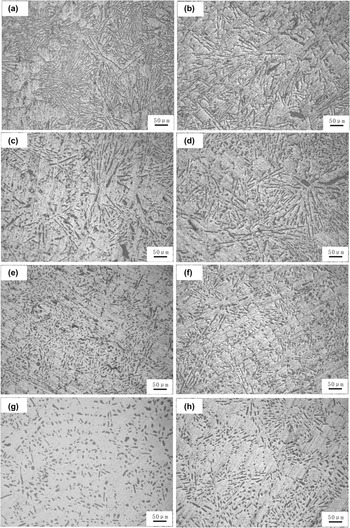
Figure 2 shows the microstructure of the eutectic Al–Si alloy which had been annealed at 500 °C at different times. Figure 2(a) is the microstructure of eutectic Al–Si before annealing. There were a number of needle-like structures found within the Al–Si alloy as shown in Fig. 2(a). After annealing at 500 °C for one hour, the quantity of needle-like Si has decreased along with an increase in thickness as shown in Fig. 2(b). After the alloy had been annealed at 560 °C for two hours, as shown in Fig. 2(c), the length of needle-like Si structures has decreased significantly, and some of the needle-like Si structures have changed into short rod-like Si. After annealing at 500 °C for three hours, the quantity and length of the needle-like Si has decreased further as shown in Fig. 2(d). The number of the rod-like structures increased and some small Si particles had been produced. After annealing of the alloy at 560 °C for four hours, a number of small Si particles in Al–12.6Si had been produced as shown in Fig. 2(e) with some flake-like Si particles within the alloy. After annealing at 500 °C for five hours, the number of flake-like Si particles had decreased with a concurrent increase in rod-like Si structures as shown in Fig. 2(f). The distribution of Si in the Al–Si alloy is more even than that shown in Fig. 2(e). After the alloy was annealed at 560 °C for seven hours, most of the Si structures had taken in the form of small granular particles which were evenly distributed within the alloy as shown in Fig. 2(g). The largest silicon particle was 13.9 μm with an average of 3.8 μm. Some rod-like Si structures persisted in the alloy. After ten hours of annealing at 500 °C, rod-like Si structures were most commonly found within the alloy, and there was an increase in the average size of the Si structures as may be seen in Fig. 2(h).
Microstructure of eutectic Al–12.6Si annealed at 500 °C for different times. (a) 0 h, (b) 1 h, (c) 2 h, (d) 3 h, (e) 4 h, (f) 5 h, (g) 7 h, and (h) 10 h.

Table I represents the microcharacteristics of Si and their standard deviations of the Al–12.6Si alloy in different states. The surface shape factor (φ)Reference Bouwman, Bosma, Vonk, Wesselingh and Frijlink23 of particles may be calculated as follows:
 $${\varphi _{{\rm{circularity}}}} = {{4\pi A} \over {P_{{\rm{rough}}}^2}}\quad .$$
The microstructural characteristics of Al–12.6Si at different states.

Here, A is the area of all particles in an alloy while P rough represents the perimeter of all the particles. The value of φ varies from 0 to 1. The shape of the particles is close to roundness with the increasing value of φ. If the value is equal to 1, the shape of the particles is round.
Table I shows that the surface shape factor (φ) of the Si particles was only 0.16 in the as-cast eutectic Al–Si alloy, which indicates that the shape of eutectic Si in the alloy had become flake-like. By increasing the annealing time, the shape factor φ was found to increase, meaning that the Si particles had gradually become rounded. After annealing of the alloy for seven hours, the value of the surface shape factor had reached 0.66, which indicates that Si particles had taken a more granular shape. However, the surface shape factor decreased to 0.64 after annealing for ten hours at 500 °C, which indicates that the Si phase tended toward rod-like shape. As stated above, we determined that an optimal microstructure may be obtained after the Al–12.6Si alloy had been annealed at 500 °C for seven hours.
B. Microstructure of the eutectic Al–Si alloy annealed at 560 °C
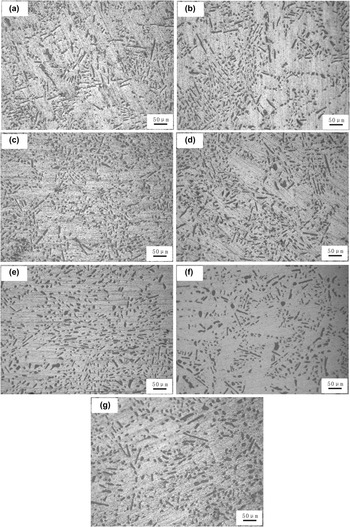
Figure 3 illustrates the microstructure of the eutectic Al–Si alloy which had been annealed at 560 °C for a different length of time. After annealing at 560 °C for one hour, more than half of the needle-like Si particles became apparent within the Al–12.6Si. The length of the needle-like Si particles had decreased and their thickness had increased as shown in Fig. 3(a). After annealing of the alloy at 560 °C for two hours, the quantity of the needle-like Si particles had increased with a decrease in length as can be seen in Fig. 3(b). Most of eutectic Si exist as rod-like or granular structures. After three hours of annealing at 560 °C, the quantity of needle-like Si particles had decreased further which may be seen in Fig. 3(c). After the alloy was annealed at 560 °C for four hours, some needle-like Si structures persisted within the Al–12.6Si alloy along with an increase in eutectic Si particles as shown in Fig. 3(d). After five hours of annealing at 560 °C, almost all of the eutectic Si particles are achieved either rod-like or granular in structure, which were evenly distributed in the eutectic Al–Si alloy as shown in Fig. 3(e). The maximum size of the Si particle was 18.2 μm with an average size of 4.5 μm. After annealing of the alloy at 560 °C for seven hours, the size of the Si particles had increased as shown in Fig. 3(f). After ten hours of annealing at 560 °C, the quantity and length of rod-like Si particles had increased significantly as shown in Fig. 3(g). Additionally, the size of granular Si particles continued to increase. In the present analysis, we determined that the optimized microstructure may be obtained after annealing of Al–12.6Si at 560 °C for five hours.
Microstructure of eutectic Al–12.6Si annealed at 560 °C for different times. (a) 1 h, (b) 2 h, (c) 3 h, (d) 4 h, (e) 5 h, (f) 7 h, and (g) 10 h.

By comparing Figs. 2 and 3, it may be inferred that the average size of the Si particles will increase with an increase in annealing temperature. Also, the optimal annealing time will decrease with an increase in annealing temperature. The possible reasons for this might be as follows: (i) the dissolution rate of small eutectic Si particles increases as the annealing temperature increases; (ii) Si atoms diffuse much more quickly in the Al matrix as the annealing temperature increases; (iii) the growth rate of large Si particles increases with an increase in the annealing temperature. In these three scenarios, the diffusion rate of Si atoms may be the control process for the spheroidization of the eutectic Si phase.
While the Si atoms are diffusing within the Al matrix, the diffusion flux becomes proportional to the Si atoms’ diffusion coefficient (D) as well as to the concentration gradient according to Fick’s first law. We also know that the diffusion coefficient of the Si atoms may be determined as follows:
 $$D = {D_0} \times \exp \left( { - {Q \over {RT}}} \right)\quad .$$
Here, D 0 is the diffusion constant while Q represents the diffusion activation energy of Si atoms. R is a gas constant and T is the absolute temperature. It may be inferred from the formula that the diffusion coefficient of Si atoms in the Al matrix will increase when the annealing temperature increases. As a result, the diffusion rate of Si atoms in the Al matrix at 560 °C is greater than that at 500 °C. This indicates that the optimal time for the spheroidization of eutectic Si should decrease when the annealing temperature for the Al–12.6Si alloy is increased from 500 to 560 °C.
When the spheroidization of the Si phase in eutectic Al–Si is at a temperature which is below solidus, the following mechanism may apply as explained below. The annealing process of Al–12.6Si at 560 °C is such an example.
The fluctuation of the annealing temperature over time is shown in Fig. 4. It can be seen that the actual annealing temperature of the Al–12.6Si alloy would vary following the law of sine curve, when the median temperature is 560 °C. When the annealing temperature was increased from 555 to 565 °C, the eutectic Si would be dissolved because the solid solubility of Si within the Al matrix increases with an increase of temperature. When the annealing temperature is decreased from 565 to 555 °C, the Si atoms in the Al matrix precipitate onto the eutectic Si. The outcomes regarding dissolution and precipitation of eutectic Si within the Al–12.6Si alloy at temperatures below the eutectic temperature are not the same as those outcomes when annealing occurs at 577 °C.Reference Zhang, Lia and Yang24
Fluctuation of annealing temperature with time.

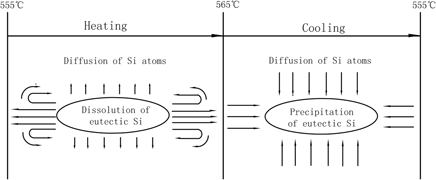
The schematic diagram of eutectic Si spheroidization is shown in Fig. 5. When the annealing temperature was increased from 555 to 565 °C, the Si atoms diffuse from the surface of eutectic Si into the Al matrix, while some Si atoms diffuse from the area near the tips of the flaky-shaped Si toward the flatter parts of the flaky Si. As is commonly known, a second phase consisting of a small radius of curvature might dissolve more quickly.Reference Wang, Zhang and Jie25 The smaller the radius of curvature, the greater the dissolution rate of the particles.Reference Ogris, Wahlen, Lüchinger and Uggowitzer26 When the annealing temperature is below the eutectic temperature, the Si phase becomes dissolved as the annealing temperature increases, and Si atoms will be precipitated onto the Si phase with a decrease in annealing temperature. During the dissolution process of eutectic Si, the dissolution rate on the tip of a flake of eutectic Si is greater than that on flat part of the Si flake due to a change in the radius of curvature. The concentration of Si near the tip of a flake of eutectic Si is greater than that of the flat section of a flake of eutectic Si. Due to the presence of this Si concentration gradient, the diffusion of Si into the Al matrix may occur. When the annealing temperature was decreased from 565 to 555 °C, the Si atoms in the Al matrix diffuse toward the eutectic Si, resulting in the precipitation of eutectic Si. During the precipitation process of the eutectic Si phase, the Si atoms will precipitate onto the surface of the eutectic Si. Since the quantity of dissolved Si atoms is much lower than the precipitated amount of the atoms on the flat part of the eutectic Si flake, the thickness perpendicular to the plane of eutectic Si flakes should be greater than at the tips. The length of the eutectic Si flakes should therefore be less because the amount of dissolved Si atoms is greater than the precipitated amount of Si atoms on the tips of the flake-shaped eutectic Si. As annealing continues, the flake eutectic Si should become granulized in a gradual fashion. Since the diffusion of Si atoms within the Al matrix is assimilated more quickly with an increase in annealing temperature, the spheroidization rate of eutectic Si at 560 °C is greater than that at 500 °C. Additionally, the spheroidization of the eutectic Si may be explained through Ostwald ripening of the Lifshitz–Slyosov–Wagner,Reference Kovacevic27,Reference Wang, Li, Yin, Li and Su28 too. During the heat treatment of the Al–Si alloy at the higher temperatures, the spheroidization of the eutectic Si is achieved by the following three steps: (i) Si plate fragmentation and disintegration, (ii) diffusional spheroidization of broken Si particles, and (iii) the coarsening of the Si particles. In step (iii), smaller Si particles are dissolved in the matrix, and the larger particles continue to grow, thereby and producing an increase in the average particle size. While annealing continues, the flake eutectic Si will gradually become spherical in shape. It can be determined from Figs. 1 and 2 that the average Si particles size within the Al–12.6Si alloy having annealed at 560 °C for five hours is slightly larger than the average particle size when annealed at 500 °C for seven hours.
Illustration of the spheroidizing process of eutectic Si.

Table II lists the microstructural characteristics of eutectic Al–12.6Si at different states. The results show that the surface shape factor of the Si phase in the eutectic Al–Si alloy is 0.66 after seven hours of annealing at 500 °C, which is slightly larger than that in the eutectic Al–Si alloy which was annealed at 560 °C for five hours. From the viewpoint of the surface shape factor of the Si particles within the eutectic alloy at different states, we can conclude that annealing at 500 °C is better than at 560 °C in promoting the spheroidization of eutectic Si.
Microstructural characteristics of eutectic Al–12.6Si at different states of matter.

Figure 6 shows the morphologies of eutectic Si within the eutectic Al–Si alloy. As indicated in Fig. 6(a), eutectic Si exists as a needle-shaped form within the as-cast eutectic Al–Si alloy. After five hours of annealing at 560 °C, most of the eutectic Si are small granular particles, but a few rod-like Si particles are present. After seven hours of annealing at 500 °C, almost all of the eutectic Si particles within the eutectic Al–Si alloy had become small granular particles. It may be determined that the average size of Si particles within the eutectic Al–Si alloy annealed at 500 °C for seven hours is less than those Si particles produced by annealing at 560 °C for 5 h. Also, Si particles within the Al–12.6Si alloy annealed at 500 °C for seven hours are more rounded than those produced with annealing at 560 °C for five hours.
Morphologies of eutectic Si in the Al–12.6 wt% Si alloy. (a) As-cast; (b) annealed at 500 °C for 7 h; (c) annealed at 560 °C for 5 h.

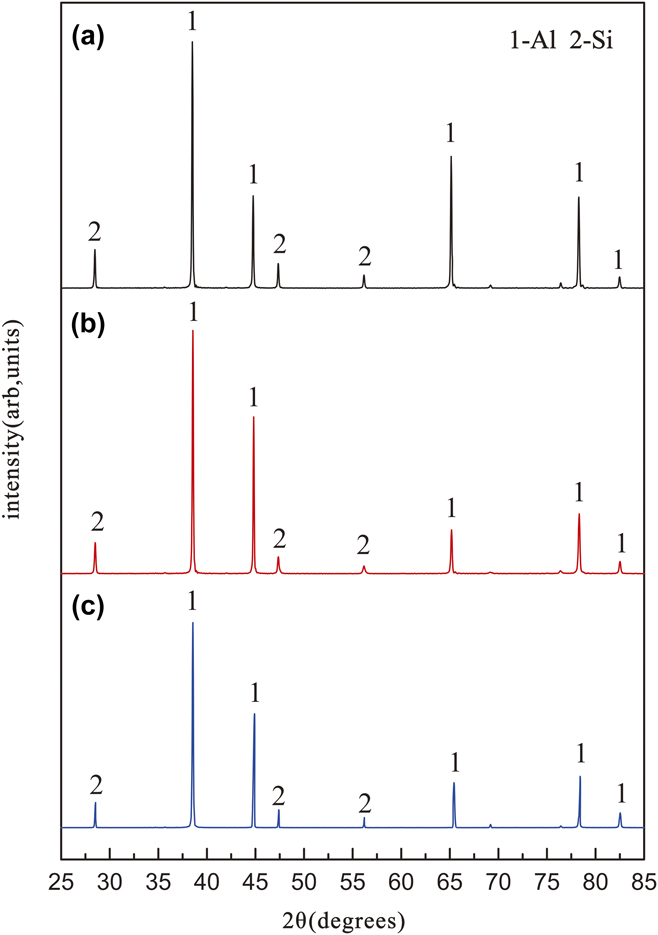
Figure 7 shows the XRD patterns of the as-cast Al–12.6Si and the alloys annealed at different temperatures. The results show that both the as-cast Al–12.6Si alloy and the alloys annealed at different temperatures consist of Al and Si phases. There is no phase transformation during the annealing process.
XRD patterns of the as-cast and annealed Al–12.6Si alloys. (a) As-cast; (b) annealed at 500 °C; (c) annealed at 560 °C.

C. Effect of Si spheroidization on mechanical properties of the eutectic Al–Si alloy
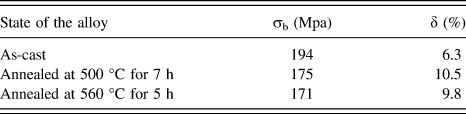
Table III shows the mechanical properties of eutectic Al–Si at different states. The tensile strength of Al–12.6Si is slightly weakened as shown in Table III, but the alloy becomes increasingly elongated after annealing. After the Al–12.6Si is annealed at 500 °C for seven hours, the alloy’s tensile strength decreases by 9.8%; however, its elongation rate increases by 67%. After Al–12.6Si is annealed at 560 °C for five hours the tensile strength of the alloy decreases by 11.9%, but its elongation rate increases by 55.6%. The elongation and tensile strength of Al–12.6Si decrease simultaneously with an increase in the annealing temperature. The results reflect the microstructure of Al–12.6Si, which has been annealed at different temperatures and with optimal annealing times. The average size of the Si particles within the Al–12.6Si alloy annealed at 560 °C for five hours is a few larger than that at 500 °C for seven hours. Since this is the case, the roundness of the Si particles, the tensile strength, and the elongation of the former are all slightly less than those of the latter.
Mechanical properties of Al–12.6Si at different states of matter.

IV. CONCLUSION
(1) When Al–12.6Si is annealed at 500 and 560 °C, the flake-like Si phase might transform into rod-like or granular phases. The optimal annealing time for Al–12.6Si at 500 °C and 560 °C is seven and five hours, respectively.
(2) As the annealing temperature is increased, the average Si particles size of the eutectic Al–Si alloy increases, and the roundness of the Si particles in the alloy decreases slightly.
(3) After annealing, the tensile strength of the eutectic Al–Si alloy decreases, but the elongation of the alloy apparently increases. With the decrease of annealing temperature, the tensile strength and elongation of the eutectic Al–Si alloy simultaneously increase.
ACKNOWLEDGMENTS
The authors gratefully acknowledge the financial support from National Natural Science Foundation of China (No. 51571039) and the Jiangsu 2016 ordinary university graduate research and innovation project (KYLX16_0633).