Introduction
Brown–Vialetto–Van-Laere syndrome is a rare disorder characterised by sensorineural deafness and cranial nerve deficits involving the motor components of cranial nerves VII to XII. Less commonly, cranial nerves III to VI, upper motor neurons and spinal motor nerves are involved. There is normal early development and intelligence, with problems usually presenting only after the first decade, often with bilateral sensorineural deafness.Reference Gallai, Hockaday, Hughes, Lane, Oppenheimer and Rushworth1 Because of the pontobulbar palsy, patients may require multidisciplinary support including percutaneous gastrostomy or tracheostomy.
We present two adult siblings with Brown–Vialetto–Van-Laere syndrome, who are the first reported cases of this syndrome to undergo cochlear implantation.
Case reports
A male patient with Brown–Vialetto–Van-Laere syndrome was referred to the Northern Ireland Regional Cochlear Implant Centre at the age of 38 years. His sister also had the same syndrome, but his elder brother and parents were unaffected.
The patient's progressive hearing loss had commenced at approximately nine years of age. Telephone usage became a problem from the age of 10 years, and he began wearing a hearing aid at 14 years.
He had developed good speech intelligibility and excellent lip-reading skills at the time he presented for assessment, although bilateral high-powered hearing aids provided only limited benefit.
At this time, an extended Romberg test revealed the patient to be unsteady and leaning towards the right even with eyes open. Bilateral cold water caloric tests failed to produce nystagmus or dizziness. The patient commonly experienced daytime, narcoleptic-like episodes of deep sleep. He had also developed optic atrophy, mild dysphagia and muscle weakness involving the neck, hands and respiratory muscles, together with kyphoscoliosis.
The male patient's sister presented at 43 years of age, following her brother's cochlear implantation. She had suffered hearing problems from 14 and a half years of age and used hearing aids, but only intermittently due to background noise amplification. Her hearing had worsened from the age of 35 years, with even less benefit from aids. She was diagnosed with a milder form of Brown–Vialetto–Van-Laere syndrome, and also suffered from visual problems, neck pain and weakness, and hand weakness.
Both patients had bilateral profound sensorineural deafness and bilateral patent cochleae noted on high-resolution temporal bone computed tomography scanning.
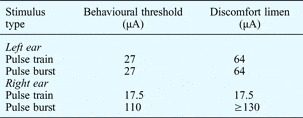
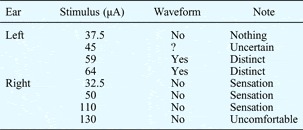
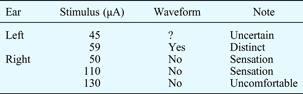
As the male patient presented first, extensive testing was performed only on him. He had bilaterally absent transient evoked otoacoustic emissions. Prior to implantation, no late cortical response recordings could be elicited at maximum auditory input, so measurement of electrically evoked middle latency responses and late cortical responses was attempted via a transtympanic stimulating needle electrode. Promontory stimulation in the left ear established a behavioural threshold of 27 µA and a discomfort level/limen of 64 µA at 200 Hz (pulse train and pulse burst). In the right ear, a threshold was established at 17.5 µA, with a discomfort level/limen also of 17.5 µA at 200 Hz (pulse train), and much higher thresholds using a pulse burst (Table I). In the left ear, reproducible middle latency response waveforms (Table II) and late cortical response waveforms (Table III) were elicited using 59 µA pulse bursts. However, there was slight habituation, with an amplitude reduction of approximately 50 per cent during the test session. In the right ear, we were unable to record a satisfactory middle latency response or late cortical response (Tables II and III).
Male patient's behavioural thresholds and discomfort limens

Male patient's electrically evoked middle latency responses

Male patient's electrically evoked late cortical responses
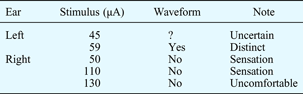
Auditory evoked potential testing suggested better preservation of auditory pathways leading from the male patient's left ear, and he felt his right ear to be the better responder to a hearing aid; therefore, the decision was made to implant his left ear.
The patient underwent full insertion of a Nucleus 24 Contour device (Cochlear Corporation, Sydney, Australia) at the age of 41 years. On extubation, the patient suffered a prolonged apnoeic episode and required reintubation and transfer to the intensive care unit for 24 hours. He made a satisfactory recovery, and was discharged three days post-operatively.
The female patient felt that her right ear responded better to a hearing aid. As her outlook was uncertain following her brother's poor outcome, her left ear was implanted at the age of 45 years. She too underwent full insertion of a Nucleus Freedom with Contour Advance Electrode device (Cochlear Corporation, Sydney, Australia). In both cases, neural response telemetry (NRT) recordings obtained in the operating theatre were poor, despite subsequent post-operative X-rays confirming satisfactory positioning of electrodes.
The male patient's cochlear implant was activated one month after surgery; however, no comfortable stimulation within normal advanced combination encoders (ACE) map limits was achieved. Extra-cochlear stimulation in monopolar 1 and monopolar 1 + 2 modes caused uncomfortable non-auditory sensations. Finally, an intra-cochlear bipolar (BP + 3) mode was utilised, using the Speak strategy with wide pulse widths and an Esprit 3G processor. However, every day the patient noted a deterioration in his hearing ability as the day progressed, in keeping with neural fatigue.
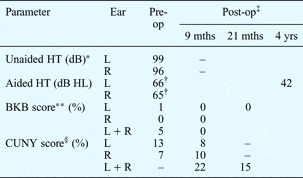
The male patient's implant-aided thresholds had improved to 42 dB HL year 4, compared with pre-operative hearing-aided levels of 66 dB (Table IV). However, his monaural, implant-aided Bamford–Kowal–Bench test sentence scores (left ear; auditory only in quiet) were zero at both nine and 21 months post-operatively, showing no improvement from the pre-operative score of 1 per cent (Table IV). His monaural, implant-aided City University of New York (CUNY) sentence test score (left ear; auditory plus lip-reading) was 8 per cent at nine months, marginally worse than the pre-operative score of 13 per cent (Table IV). At the time of writing, the male patient continued to wear his contralateral hearing aid along with his cochlear implant, and was still dependent on lip-reading skills for communication.
Male patient's pre- and post-operative audiological assessment results

*Five frequencies (0.5–4 kHz). †Hearing aid; ‡cochlear implant. **Aided and in quiet. §Aided. Pre-op = pre-operative; post-op = post-operative; mths = months; yrs = years; HT = hearing threshold; L = left; R = right; BKB = Bamford–Kowal–Bench sentence; CUNY = City University of New York
The female patient had Bamford–Kowal–Bench scores of 25 per cent in quiet and 3 per cent in noise at six months post-operatively, an improvement from a pre-operative score of zero.
Post-operative auditory evoked potential assessment in the male patient included assessment for acoustically elicited mismatch negativity responses and P50 sensory gating recordings, in addition to middle latency response and ‘standard’ late cortical response recordings. A weak late cortical response at maximal auditory free field input was detected, but no middle latency response or P50 gating phenomenon. A small delayed mismatch negativity response was also evident, but only to low frequency deviants.
Discussion
Approximately 50 per cent of Brown–Vialetto–Van-Laere syndrome patients have an affected relative, usually a sibling (as in our patients), together with normal hearing parents, suggesting an autosomal recessive genetic disease as the cause.Reference Gallai, Hockaday, Hughes, Lane, Oppenheimer and Rushworth1–Reference Megarbane, Desguerres, Rizkallah, Delague, Nabbout and Barois5 Although deafness can vary from mild to profound, it usually results in severe to profound hearing loss thresholds.Reference Gallai, Hockaday, Hughes, Lane, Oppenheimer and Rushworth1, Reference Francis, Ponsford, Wiles, Thomas and Duchen6, Reference Aydin, Ozcelikel, Senbil and Gurer7 In reported cases with less severe hearing loss thresholds, there were accompanying severe developmental and behavioural changes, suggesting possible additional central nervous system pathological changes.Reference Dipti, Childs, Livingston, Aggarwal, Miller and Williams8 At autopsy, neuropathological changes have been found in the auditory pathways up to and including the brainstem, including neuronal degeneration of cochlear nuclei and astrocytic gliosis of the inferior colliculi.Reference Gallai, Hockaday, Hughes, Lane, Oppenheimer and Rushworth1, Reference Francis, Ponsford, Wiles, Thomas and Duchen6 Pathological changes higher in the auditory pathways have not previously been described, nor the use of auditory evoked potential assessment.
In our male patient, although promontory stimulation data indicated lower thresholds in the right ear, there was a less useful dynamic range. There was also an unusual right ear threshold dependence upon the style of stimulus delivery (i.e. pulse train versus pulse burst), indicating less peripheral functionality on the right (despite the patient considering this his better hearing ear). There was evidence from auditory evoked potential testing that these retrocochlear deficits probably extended higher in the auditory pathway. Pre-operative middle latency responses and late cortical responses were absent on the right but present on the left (albeit with slight habituation). On the basis that this was evidence of sufficient peripheral functionality, the left side was chosen for implantation. However, in post-operative auditory evoked potential assessments only a weak late cortical response and small delayed mismatch negativity response feature could be detected, suggestive of poor central auditory function. The patient's post-operative auditory evoked potential data were consistent with his very poor post-implantation Bamford–Kowal–Bench and city university of New York scores (Table IV), implant strategy programming difficulties, and self-reported deterioration in hearing ability as the day progressed (due to neural fatigue and/or adaptation). This phenomenon of post-implantation neural fatigue has also been described in two patients with superficial siderosis of the central nervous system.Reference Wood, Bird, Giles and Baber9
Our female patient had a milder form of the syndrome, with marginally better results, perhaps due to reduced auditory pathway degeneration.
• Brown–Vialetto–Van-Laere syndrome is a rare disorder usually characterised by lower cranial nerve deficits, including sensorineural deafness
• Cochlear implantation results in such patients have not previously been reported
• Two such patients underwent cochlear implantation, with poor post-implantation outcomes; in the more extensively investigated patient, this outcome correlated with poor electrically evoked auditory potentials
• These data suggest that, in Brown–Vialetto–Van-Laere syndrome patients, retrocochlear and probable central auditory pathway degeneration limit the benefit possible from cochlear implantation
Regarding other neurological systems, our male patient's unsteadiness and leaning on extended Romberg testing, and his absence of caloric test responses, suggested deficits in vestibular function. The patient also experienced narcoleptic-like episodes of daytime deep sleep, suggesting involvement of the reticular activating system. Aside from sensorineural deafness, other reported cranial neuropathies in Brown–Vialetto–Van-Laere syndrome patients include visual problems, ptosis, facial weakness, stridor, dysphagia and tongue fasciculation. Spinal motor nerve deficits can result in muscle wasting, skeletal contractures and scoliosis (as in our male patient). The clinical course may be irregularly progressive, with patients alive 20–30 years after the onset of initial symptoms, or quickly fatal.Reference Megarbane, Desguerres, Rizkallah, Delague, Nabbout and Barois5, Reference Sztajzel, Kohler, Reichart, Djientcheu, Chofflon and Magistris10, Reference Voudris, Skardoutsou and Vagiakou11 Fifty per cent of Brown–Vialetto–Van-Laere syndrome patients reported before the year 2000 have survived more than 10 years after the onset of their first symptom.Reference Sathasivam, O'Sullivan, Nicolson, Tilley and Shaw12
Respiratory failure is the most common cause of death. Our male patient required prolonged post-operative intubation to recover from his general anaesthetic. A recent paper has reported anaesthetic issues affecting Brown–Vialetto–Van-Laere syndrome patients, specifically regarding early weaning from intermittent positive pressure ventilation to non-invasive positive pressure ventilation.Reference Fell13
The integrity and residual function of the entire auditory neural pathway, from the outer hair cells to the auditory cortex, is important for effective central auditory processing.Reference Kraus, McGee and Koch14–Reference Fayad, Linthicum, Otto, Galey and House18 The current report illustrates the significant retrocochlear and probable central auditory deficits present in Brown–Vialetto–Van-Laere syndrome patients, resulting in poor cochlear implantation outcomes.
Acknowledgements
We thank Mrs C M McAnallen and Miss I Brannigan, of the Northern Ireland Regional Cochlear Implant Centre at the Belfast City Hospital, for their assistance in data collection.