Introduction
Plants exhibit behavioural patterns that are classically thought of as only possible in animals in possession of a central nervous system (Karban Reference Karban2008). Behaviour is usually defined as a living organism’s response to stimuli (Karban Reference Karban2008; Levitis et al. Reference Levitis, Lidicker and Freund2009). Because of their vastly different biology, the behaviour of plants has often been seen as simpler than that of animals, when it is accepted as true behaviour at all (Karban Reference Karban2008). An increasing number of studies, however, have challenged the assumption that plant behaviour is simpler (Amador-Vargas et al. Reference Amador-Vargas, Dominguez, León, Maldonado, Murillo and Vides2014; Baldwin & Schmelz Reference Baldwin and Schmelz1996; Gagliano et al. Reference Gagliano, Renton, Depczynski and Mancuso2014; Iwasaki & Paszkowski Reference Iwasaki and Paszkowski2014; Reimer-Michalski & Conrath Reference Reimer-Michalski and Conrath2016; Reed-Guy et al. Reference Reed-Guy, Gehris, Shi and Blumstein2017; Simon et al. Reference Simon, Hodson and Roitberg2016; Thellier et al. Reference Thellier, Desbiez, Champagnat and Kergosien1982; Ton et al. Reference Ton, D’alessandro, Jourdie, Jakab, Karlen, Held, Mauch-Mani and Turlings2007). One reason plant behaviour that has previously been considered simple in comparison to that of animals is that it is often slower, but there are plant species that can exhibit rapid responses (Karban Reference Karban2008). One such organism is Mimosa pudica L., a terrestrial Neotropical weedy legume that can move its leaflets to a closed position in a matter of seconds when stimulated (Chaudhary et al. Reference Chaudhary, Bala, Thakur, Kamboj and Dumra2018; Martone et al. Reference Martone, Boller, Burgert, Dumais, Edwards, Mach, Rowe, Rueggeberg, Seidel and Speck2010), presumably as an adaptation to avoid herbivory (Chaudhary et al. Reference Chaudhary, Bala, Thakur, Kamboj and Dumra2018; Eisner Reference Eisner1981). According to this hypothesis, if a caterpillar or other insect herbivore touches a leaflet as it crawls on the leaf to chew it, the leaf would move quickly and strongly enough to make the caterpillar fall off.
The rapid response exhibited by M. pudica makes it ideal to study complex ‘animal-like’ behaviours, such as habituation and memory (Amador-Vargas et al. Reference Amador-Vargas, Dominguez, León, Maldonado, Murillo and Vides2014; Gagliano et al. Reference Gagliano, Renton, Depczynski and Mancuso2014; Reed-Guy et al. Reference Reed-Guy, Gehris, Shi and Blumstein2017; Simon et al. Reference Simon, Hodson and Roitberg2016). Because the closing of the leaflets requires energy input (Hoddinott Reference Hoddinott1977), and closed leaves cannot photosynthesize effectively (Fleurat-Lessard et al. Reference Fleurat-Lessard, Bouché-Pillon, Leloup and Bonnemain1997), the benefit of this activity must be balanced against its energy costs (Amador-Vargas et al. Reference Amador-Vargas, Dominguez, León, Maldonado, Murillo and Vides2014). The plant should not spend energy unnecessarily by responding to every tactile stimulus. It would be advantageous for the plant to habituate to non-harmful stimuli, such as water drops or debris carried by the wind. Habituation occurs when a reaction to a stimulus decreases, not due to fatigue (Rankin et al. Reference Rankin, Abrams, Barry, Bhatnagar, Clayton, Colombo, Coppola, Geyer, Glanzman, Marsland and McSweeney2009). It would also be advantageous for the plant to remember the stimulus for a long period of time, to keep habituation to that stimulus high. M. pudica shows evidence of both habituation and long-term memory. In the case of habituation, when a repeated non-harmful stimulus is applied in controlled lab settings, M. pudica plants reduce the degree of leaflet closing (Gagliano et al. Reference Gagliano, Renton, Depczynski and Mancuso2014). When a different stimulus is applied immediately after, the plant fully closes its leaflets again, demonstrating that reduced closing is not due to fatigue and is in fact habituation (Gagliano et al. Reference Gagliano, Renton, Depczynski and Mancuso2014). Under controlled laboratory conditions, M. pudica plants that had already showed habituation continued to have a reduced reaction to a non-harmful stimulus 28 days after the last time the stimulus was applied (Gagliano et al. Reference Gagliano, Renton, Depczynski and Mancuso2014), indicating long-term memory. The short-term habituation found in the lab in M. pudica has been confirmed in the field once, using a rice grain dropped on the leaves as non-harmful stimuli similar in magnitude to something like a water droplet, but different from many common environmental stimuli (Amador-Vargas et al. Reference Amador-Vargas, Dominguez, León, Maldonado, Murillo and Vides2014). No study has confirmed the kind of long-term memory demonstrated by Gagliano et al. (Reference Gagliano, Renton, Depczynski and Mancuso2014) in the field, where wild plant’s exposure to these common stimuli could disrupt memory function.
In addition to knowing whether the plants adapt to non-harmful stimuli, it is important to assess the sensitivity of the recognition involved in habituation behaviour. As mentioned above, it would be advantageous for the plant to habituate to non-harmful tactile stimuli, but the habituation experiments conducted so far used stimuli that are stronger/heavier than many tactile stimuli experienced under field conditions. The lab experiment by Gagliano et al. (Reference Gagliano, Renton, Depczynski and Mancuso2014) elicited leaf movement by shaking or dropping the plants’ pots, a stimulation that is not comparable to natural tactile stimuli. The field study on M. pudica by Amador-Vargas et al. (Reference Amador-Vargas, Dominguez, León, Maldonado, Murillo and Vides2014) used rice grains as tactile stimuli. An average rice grain is about 20–40 milligrams (Song et al. Reference Song, Huang, Shi, Zhu and Lin2007). It is important to measure the reaction of M. pudica to a lighter stimulus because many organisms the plant might encounter can well be below 20 milligrams. For instance, an ant can be just 10 milligrams (Ness et al. Reference Ness, Bronstein, Andersen and Holland2004), an aphid 1–2 milligrams (Dixon & Kindlmann Reference Dixon and Kindlmann1999), and other organisms may be lighter and require more sensitivity from the plant to recognized. In addition, starting to elucidate the sensitivity threshold in this plant may help us understand more of its species interactions, such as whether herbivore insects can overcome the potential defensive behaviour of leaf closing. For instance, larvae of the butterfly Eurema lisa feed on this plant, and leaf closure may help to discourage egg laying (Abrahamson and Marshall Reference Abrahamson and Marshall2009). The plant can react to the butterfly tactile stimulus (Dethier Reference Dethier1940) but it is unknown whether it can react to the tactile stimulus imposed by the weight of the egg itself. If the plant registers these eggs as non-harmful and ceases to react as strongly to them, this would allow the butterfly to lay successful larvae more easily in the future and overcome the plant’s defence. Butterfly eggs are very light, usually between 0.30 and 0.55 milligrams (Fischer et al. Reference Fischer, Zwaan and Brakefield2002; Svärd & Wiklund Reference Svärd and Wiklund1988). We used tiny Styrofoam balls less than 0.5 milligrams to test for habituation in field M. pudica to weights close to the mass of a butterfly egg. In general, if the plant can react to this weight, it would show a potential to habituate to any object heavier than 0.5 milligrams.
When considering the significance that the presence of these behaviours would have on a wild population, one of the first questions is whether they appear to be beneficial for survival and/or reproduction. Habituation in M. pudica is likely beneficial (Amador-Vargas et al. Reference Amador-Vargas, Dominguez, León, Maldonado, Murillo and Vides2014). However, if rapid leaflet movement is indeed a response to damage caused by an herbivore (Chaudhary et al. Reference Chaudhary, Bala, Thakur, Kamboj and Dumra2018; Eisner Reference Eisner1981), such as chewing by a caterpillar, M. pudica should not habituate to those harmful stimuli. This prediction from the herbivory avoidance hypothesis remains untested. Habituation to a harmful stimulus would most likely reduce the fitness of the plant by leaving it vulnerable to future herbivory. Previous experimentation in M. pudica grown in a greenhouse has shown that a single damaging stimulus can affect future plant reaction to different stimuli (Cahill et al.Reference Cahill, Bao, Maloney and Kolenosky2012), but to our knowledge no experiment has evaluated how the plant reacts directly to harmful stimuli and how this may change over repeated exposure. To evaluate whether M. pudica is able to distinguish between harmful and non-harmful stimuli and retain only the benefits of habituation, it should be determined whether similar habituation-like behavioural changes are seen when the plant is exposed to a repeated harmful stimulus that simulate the damage caused by an herbivore. Here we test this prediction for the first time, to our knowledge. Specifically, we mimicked herbivory by snipping the leaves with a pair of scissors and evaluated whether the plants habituated to this stimulus. This kind of mechanical damage has been helpful in analysing deterrence for damage, even if it is not a perfect mimic of an herbivore attack that may have previously been experienced (Hjältén Reference Hjältén, Weisser and Siemann2008).
In addition to testing reaction to a lighter stimulus and the key prediction that M. pudica should not habituate to harmful stimuli, we also evaluated whether signs of memory in this species occurs under field conditions. Previous tests of long-term memory were conducted only under controlled laboratory conditions and on plants that were not stimulated at all in the interim time of 28 days (Gagliano et al. Reference Gagliano, Renton, Depczynski and Mancuso2014), a condition unlikely to arise in a natural setting. In nature, Mimosa pudica will frequently react to common tactile stimuli such as wind and rain, in addition to damage caused by insects or vertebrates, a condition which may affect the presence or length of memory that they possess (Azmi et al. Reference Azmi, Singh and Akhtar2011; Dean & Smith Reference Dean and Smith1978; Eisner Reference Eisner1981). Hence, memory in the field may not last for weeks as it happens under controlled conditions. We exposed wild plants to a non-harmful stimulus repeatedly until they show habituation and tested them again later to determine whether the response remains. The non-harmful stimulus was a dropped grain of rice, the stimulus used in Amador-Vargas et al. (Reference Amador-Vargas, Dominguez, León, Maldonado, Murillo and Vides2014) for their field study of habituation in M. pudica.
Before conducting the experiments mentioned above, we confirmed that the plants at our study site habituated to dropped rice grains as in the field study by Amador-Vargas et al. (Reference Amador-Vargas, Dominguez, León, Maldonado, Murillo and Vides2014). All experiments in this study were conducted with wild plants under field conditions. First, we tested whether the plants decrease their response to repeated dropped rice grains, as a form of repeated non-harmful stimulus (Experiment 1. Repeated Non-harmful Stimulus). We then conducted an experiment with a harmful stimulus (leaf snipping) that followed the non-harmful stimuli (rice grain dropping) to rule out the possibility of fatigue (Experiment 2. Repeated Non-harmful Stimulus +Harmful stimulus). After confirming that plants in our study population show the same pattern of habituation to non-harmful stimuli found by Amador-Vargas et al. (Reference Amador-Vargas, Dominguez, León, Maldonado, Murillo and Vides2014), we tested their habituation to a much lighter non-harmful stimulus in the experiment with light Styrofoam balls (Experiment 3 Repeated Non-harmful Light Weight Stimulus) and to a harmful stimulus experiment in which we mimicked herbivory by snipping the leaflets with scissors (Experiment 4. Repeated Harmful Stimulus). Finally, we looked at the non-harmful habituation across time scales not yet considered in wild M. pudica to evaluate if previous experience of a stimulus would be reflected by a change in behaviour, which would imply that long-term memory allowed the stimulus to be registered as familiar rather than novel (Experiment 5. Memory).
Study site
Field experiments were conducted in Monteverde, Costa Rica (10°19'N, 84°49'W) between 10 April and 2 May 2019. The rainy season in Monteverde typically starts in May (Clark et al. Reference Clark, Lawton, Butler, Wheelwright and Nadkarni2000), so the study was conducted during a transitional period from the dry to rainy season in the area. Wind speed ranged from 0.8 to 9.0 km/h during the study period, rainfall ranged from 0 to 18.5 mm, and hourly temperature ranged from 18.4 to 20.7ºC. The days in which we conducted the experiments were not significantly different in rainfall or wind speed compared to other days in the study period (Mann–Whitney U test, P-value > 0.3 in both cases) but were slightly cooler (19.3 vs 20.2ºC average temperature; Mann–Whitney U test, P-value = 0.02).
Methods
Selecting plants and leaflets
Experiments were performed on eighty-eight wild M. pudica plants that were chosen and tested based on the following protocols. Plants were measured from two locations, and because these are wild plants, they were exposed to the environment before the experiment began. Both locations were in cleared lots adjacent to main roads. Each experiment included data from the plants at both locations to reduce the possibility of confounding location differences. For each test, as many plants as possible were tested in the time available for field experiments. The number of plants tested in each experiment varied due to differences in the time required for each experiment. Previous studies have found that light affects the responses of M. pudica (Jensen et al. Reference Jensen, Dill and Cahill2011; Simon et al. Reference Simon, Hodson and Roitberg2016), so we only used plants that were completely exposed to sunlight during the entire day. Plants were already on location, so we could not be certain of each plant’s age, but we used similarly aged leaves on each individual plant. The leaves of different ages may show slightly different responses (Amador-Vargas et al Reference Amador-Vargas, Dominguez, León, Maldonado, Murillo and Vides2014), so we followed Amador-Vargas et al (Reference Amador-Vargas, Dominguez, León, Maldonado, Murillo and Vides2014) and only tested the second fully formed leaf across plants; one of the terminal pinnas within each leaf was chosen to be tested. Each stimulus was focused on the end of the pinna, affecting the terminal leaflets. All leaves were tagged to avoid double testing.
Variables measured
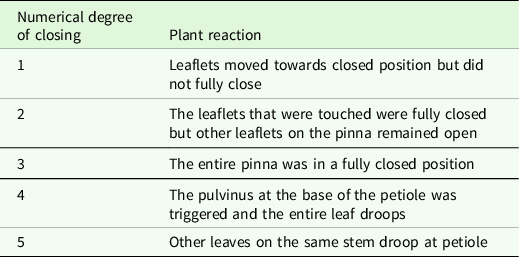
All measurements were taken between 7:30 am and 10:30 am, before the sun of mid-day became intense enough to cause leaves to close. Two variables were measured to establish the degree of reaction to each stimulus. First, how completely the leaf closed in response to the stimulus (Table 1). This was a qualitative measurement of the ‘degree of closing’ that was quantified in five categories by the data collector. Our categories were more detailed than the scale used in Amador-Vargas et al. (Reference Amador-Vargas, Dominguez, León, Maldonado, Murillo and Vides2014) to better reflect the wide variation in extent of movement that we observed at our study site. Second, the time to completely reopen the leaflets from the closed position (opening time) was recorded. This was determined by measuring the time in seconds from the moment the leaflet finished moving towards closing to the moment when the leaflet appeared to be fully open as compared to the leaflets and pinnas surrounding them.
Description of the classifications of degree of closing for Mimosa pudica following a tactile disturbance

Experiments
Repeated non-harmful stimulus
This experiment, henceforth referred to as Non-Harmful experiment, was a modified version of the experiment performed by Amador-Vargas et al. (Reference Amador-Vargas, Dominguez, León, Maldonado, Murillo and Vides2014). Specifically, a grain of rice was dropped from 3 cm above the chosen leaflet (see above), disturbing it as it fell past. The degree of closing and opening time was measured as described above. Another grain was dropped as soon as the leaflet was deemed fully open. This procedure was repeated four more times for a total of six grains dropped on each plant. Seventeen plants were tested on this ‘Non-Harmful’ experiment.
Repeated non-harmful stimulus + harmful stimulus
This experiment is a repetition of the previous one with a difference: the series of six rice drops was followed by a single harmful stimulus that involved cutting the very tip of the leaflet with scissors. The cut was focused on one of the terminal leaflets and by cutting across would remove the tips of this one and up to two adjacent leaflets. Only the degree of closing was measured in this experiment. Hereafter, we referred to this experiment as the Non-Harmful/Harmful. Seventeen plants were included in this experiment.
Repeated non-harmful light weight stimulus
To test the plants reaction to lighter stimuli (henceforth referred to as Light Weight experiment), styrofoam balls of about 0.2 mg were used to simulate as stimulus. The ball was placed on the top of the leaflet, and the degree of closing and opening time was measured as described above. Another ball was placed next to the last once the leaflet was deemed fully open. In total, six balls were placed on each plant. Twenty-six plants were tested in this experiment.
Repeated harmful stimulus
To test the effect of a repeated harmful stimulus that mimicked herbivory such as chewing on the leaf (henceforth referred to as Harmful experiment), the leaflet was cut with scissors in a similar manner to the final harmful stimulus in Non-harmful/Harmful experiment. Each time, a few millimetres of the same leaflet was removed. Simulated herbivory is an appropriate method for investigating physiological processes and defence responses in plants (Hjältén Reference Hjältén, Weisser and Siemann2008; Waterman et al. Reference Waterman, Cazzonelli, Hartley and Johnson2019). This was repeated four times, and each time, both degree of closing and opening time were measured. Eleven plants were tested in this experiment.
Memory of repeated non-harmful stimulus
For testing memory, the methods for the Non-Harmful experiment were repeated, but the stimulus was applied nine times rather than six. This was done with the assumption that a slightly higher initial exposure might increase the chance of the stimulus being committed to memory. Nine stimuli were the most that could be consistently completed on all plants in a day before the heat of mid-day affected opening times. Both degree of closing and opening time were measured for each stimulus. The Non-Harmful test was repeated on the same leaflet with six stimuli 15 days later (referred to as Follow-Up). Seventeen plants were measured for memory. As an indication of memory, we expected the plants to show reduced reaction to the non-harmful stimulus on the follow-up experiment compared to the initial experiment conducted 15 days earlier (Gagliano et al. Reference Gagliano, Renton, Depczynski and Mancuso2014). Specifically, we expected the plants in the follow-up experiment to either not respond to the repeated stimulus or to respond with a very low degree of closing and with very short opening times compared to the initial experiment. Rainfall, wind speed, and average hourly temperate were not significantly different between the days’ memory was tested and the rest of the days in the study period (Mann–Whitney U test, P-value > 0.2 in all cases).
Statistical analysis
The dataset for each experiment consisted of the replicates collected for that experiment with one exception. For the analysis of the Non-Harmful responses, data from the Non-Harmful experiment were combined with the data from the Non-Harmful/Harmful experiment (before the harmful stimuli was applied) because both datasets were equivalent. The combined dataset included thirty-four plants, seventeen from each experiment.
The datasets for each experiment were analysed using linear mixed models (LMMs). All models included plant identity as random effect, to account for the fact that multiple samples were repeatedly collected from the same plant leaf over time (non-independent repeated measurements). Fixed effects correspond to stimulus (the sequential replicate of each stimulus, a number from 1 to 6 in most cases) and dataset in the case of memory (initial, follow-up). Opening time was modelled with hazard rate models using the R package ‘coxme’. Degree of opening, which was recorded as an ordered category, was modelled as such using the R package ‘ordinal’. P-values of fixed effects correspond to analyses of deviance in the case of hazard rate models, or likelihood ratio tests (LRT) in the case of ordinal models, and were approximated using the chi-square distribution. Planned independent contrasts were conducted with the R package ‘emmeans’ between the first replicate and the other replicates of the stimulus. In the Non-harmful experiment, the last (seventh) replicate was also compared against the previous six. Means and standard errors across all plants for each replicated stimulus are presented for each experiment for illustrative purposes even though the LMMs compare treatments within plants and generalize the result across plants. All analyses were conducted in R 4.0.0 (R core Team 2020).
Results
Non-harmful
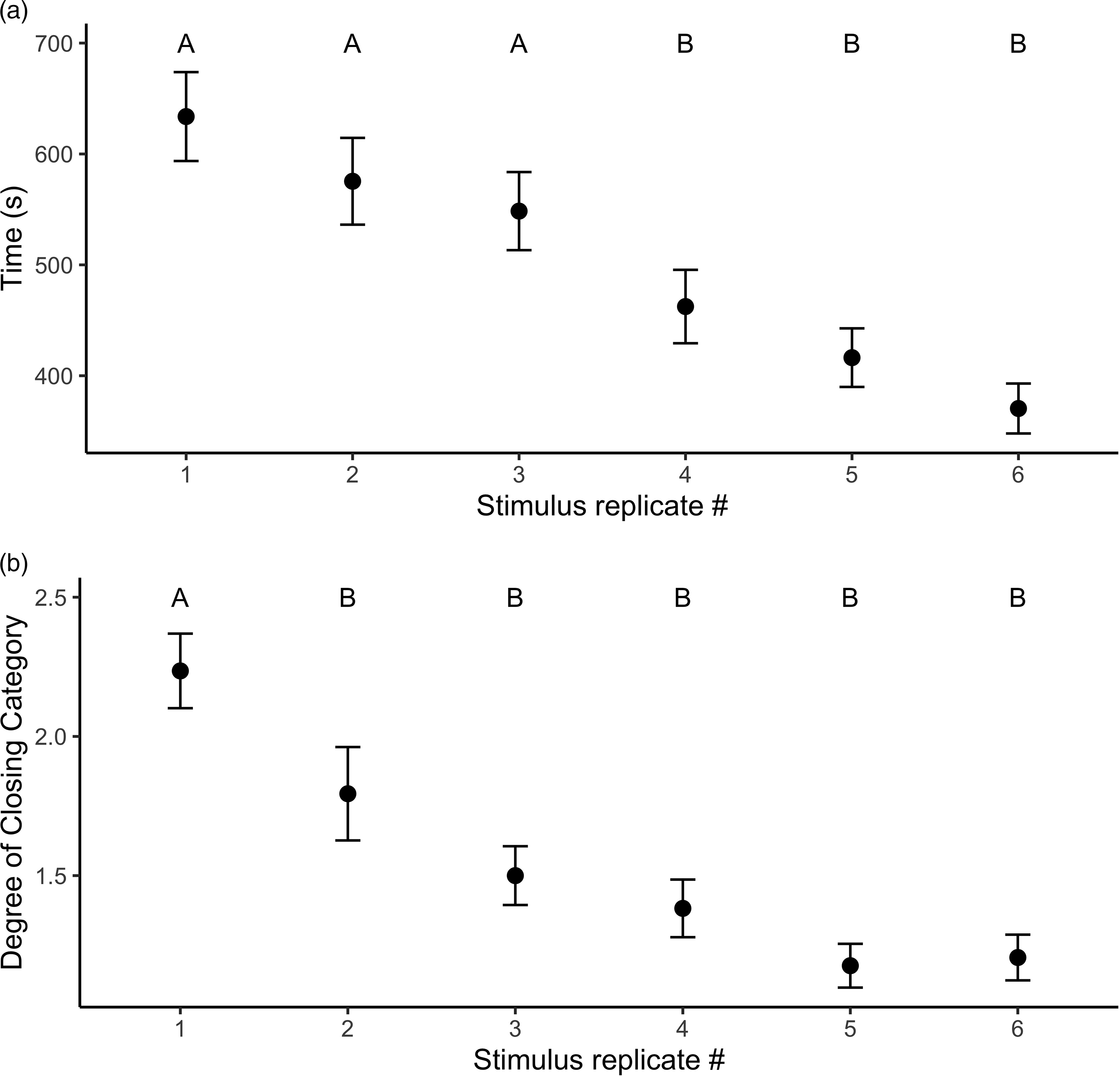
The combined Non-Harmful dataset (N = 34 plants) showed habituation through decreasing opening time across the six times the stimulus was applied (LMM: X 2 = 82.36, df = 5, P < 0.0001). Significant decline occurred by the fourth stimulus (Figure 1a). The degree of closing also decreased across repeated application of the stimulus (LMM: LRT = 57.43, df = 5, P < 0.0001). Significant declines in degree of closing were seen by the second stimulus (Figure 1b). Analysis with only 17 plants produced essentially the same results (not shown).
Reduction in (a) opening time and (b) degree of closing for Mimosa pudica leaflets after a non-harmful stimulus (rice grain dropped on leaflet) was repeated 6 times on 34 plants. Degree of closing was measured using an ordered scale from 1 (leaflets on focal leaf partially closed with the stimulus) to 5 (focal and surrounding leaves fully closed and dropped) (Table 1). Means that do not share letters were significantly different from each other (P < 0.05) based on planned independent contrasts between the first and other replicates. Means are presented ± one standard error.

Non-harmful/harmful
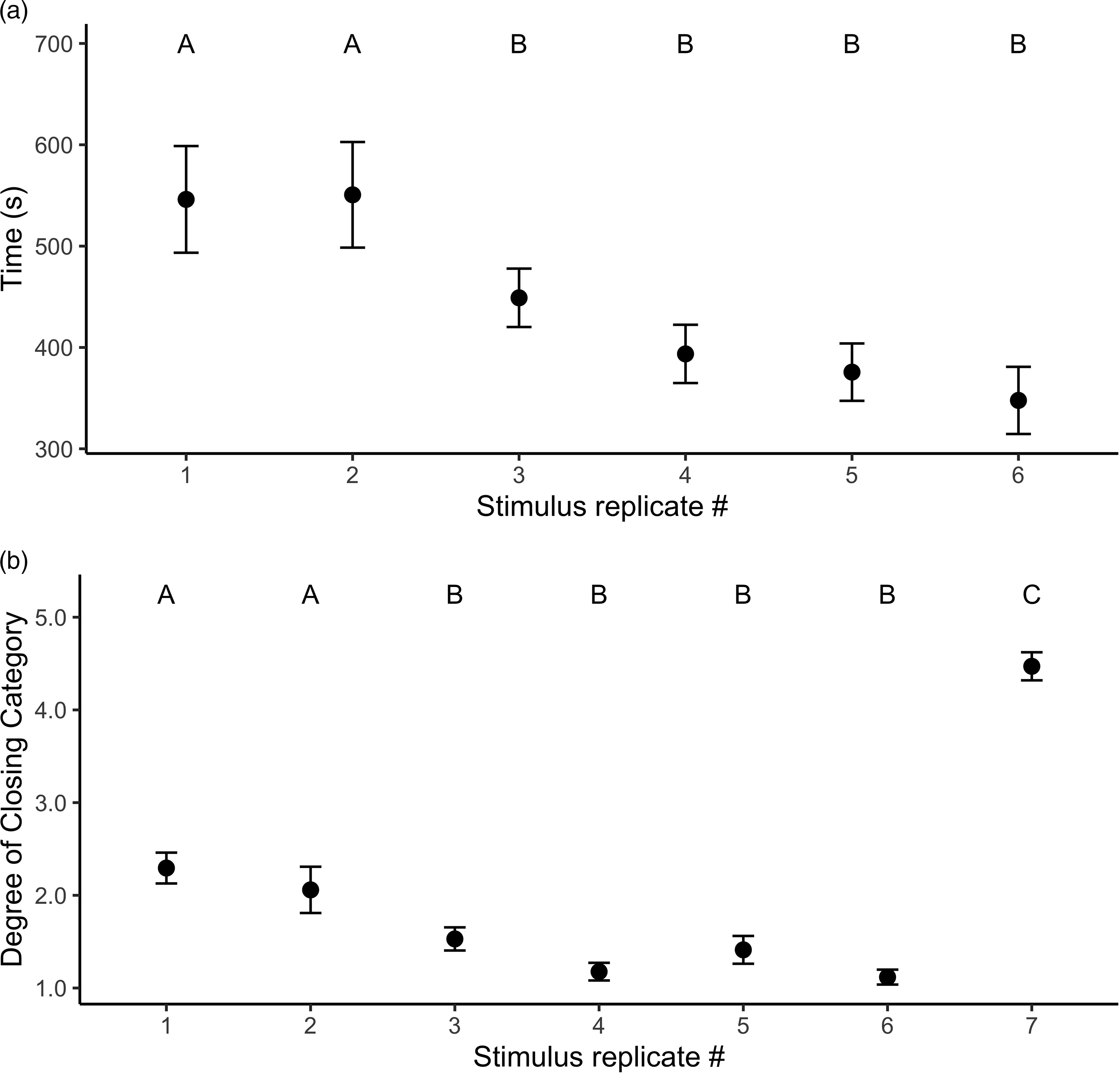
As in the previous experiment, the Non-Harmful/Harmful experiment (N = 17 plants) had a reduction in opening time across stimuli (LMM: X 2 = 58.06, df = 5, P < 0.0001) and degree of closing (LRT = 119.14, df = 6, P < 0.0001). The pattern of reduction was similar to the one described above for the non-harmful experiment, with a significant decline in time and degree of closing by the third stimulus (Figure 2a, b). The final harmful stimulus (#7) elicited a significantly higher degree of closing than any of the previous six replicates of the non-harmful stimulus (Figure 2b).
Reduction in (a) opening time and (b) degree of closing for Mimosa pudica leaflets after a non-harmful stimulus (rice grain dropped on leaflet) was repeated 6 times on 17 plants. A harmful stimulus (leaflet cut) followed the sixth non-harmful one for degree of closing. Degree of closing was measured using an ordered scale from 1 (leaflets on focal leaf partially closed with the stimulus) to 5 (focal and surrounding leaves fully closed and dropped) (Table 1). Means that do not share letters were significantly different from each other (P < 0.05) based on planned independent contrasts between the first and other replicates, and between the last and other replicates. Means are presented ± one standard error.

Light weight
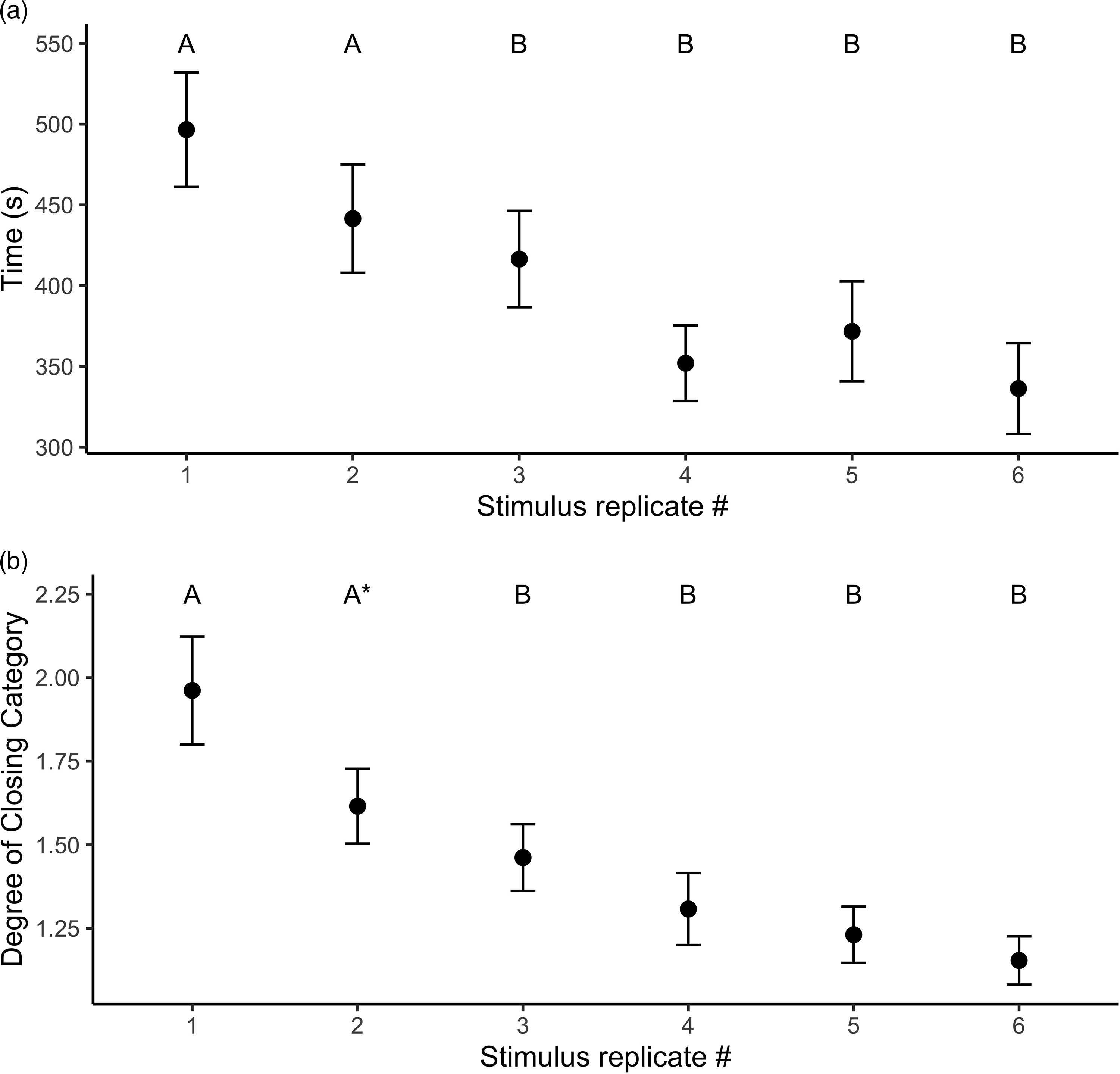
The Light Weight dataset (N = 26) responses showed comparable declines to the non-harmful experiment conducted with much heavier rice grains (Figure 3). Opening time decreased (LMM: X 2 = 53.62, df = 5, P < 0.0001) by the third stimulus, and there was a reduction in degree of closing (LRT = 31.60, df = 5, P < 0.0001), which also became significant after the third stimulus.
Reduction in (a) opening time and (b) degree of closing for Mimosa pudica leaflets after a light non-harmful stimulus (Styrofoam ball, 0.5 mg) was repeated 6 times on 26 plants. Degree of closing was measured using an ordered scale from 1 (leaflets on focal leaf partially closed with the stimulus) to 5 (focal and surrounding leaves fully closed and dropped) (Table 1). Means that do not share letters were significantly different from each other (P < 0.05) based on based on planned independent contrasts between the first and other replicates. * indicates 0.05 < P < 0.10. Means are presented ± one standard error.

Harmful
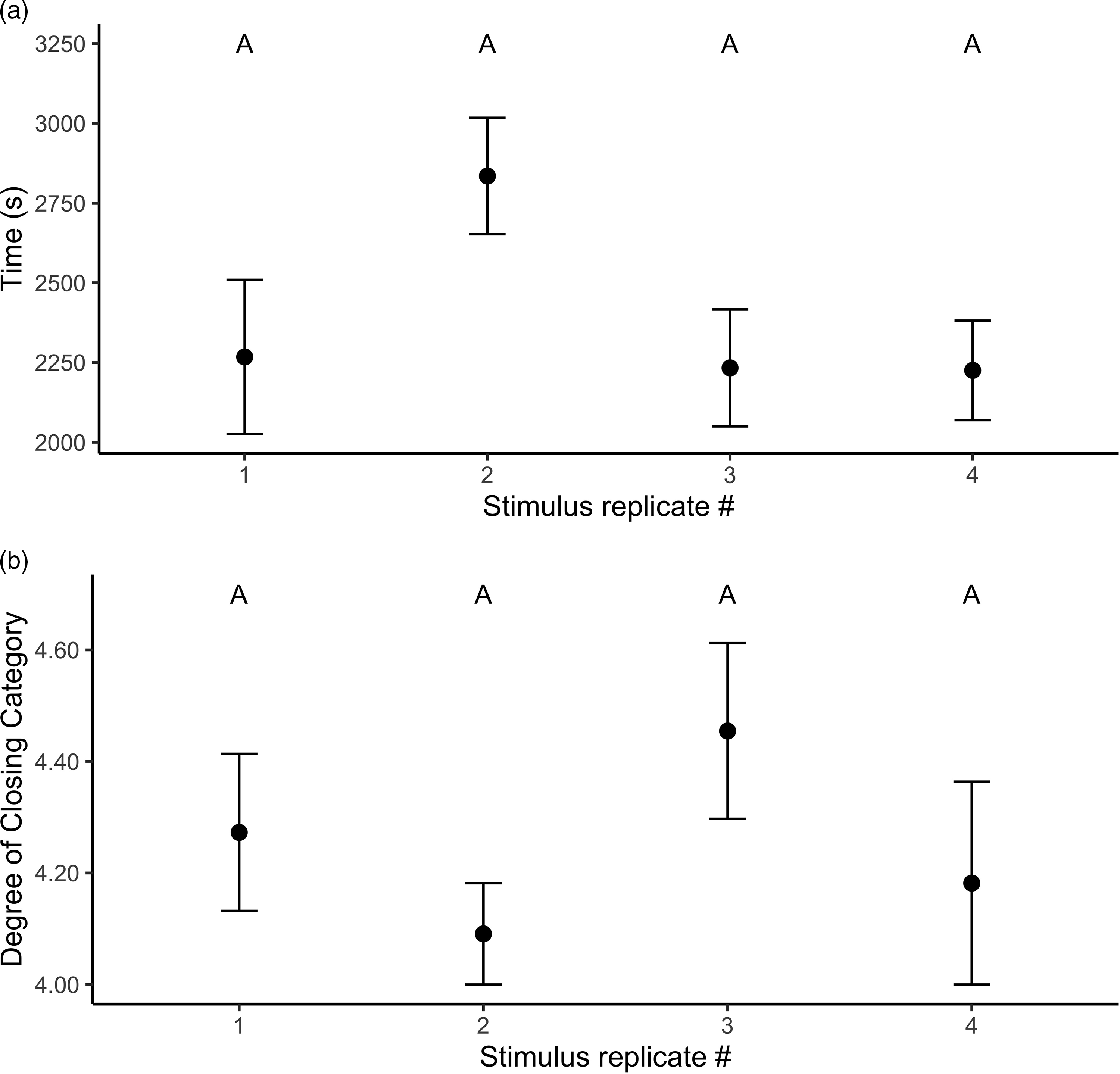
The Harmful experiment (N = 11 plants) did not show a significant difference in opening time (LMM: X 2 = 4.35, df = 3, P = 0.23) or in degree of closing (LMM: LRT = 6.41, df = 3, P = 0.09) between stimuli (Figure 4a and 4b respectively).
Reduction in (a) opening time and (b) degree of closing for Mimosa pudica leaflets after a harmful stimulus leaflet cut was repeated 4 times on 11 plants. Degree of closing was measured using an ordered scale from 1 (leaflets on focal leaf partially closed with the stimulus) to 5 (focal and surrounding leaves fully closed and dropped) (Table 1). Means that do not share letters were significantly different from each other (P < 0.05) based on planned independent contrasts between the first and other replicates. Means are presented ± one standard error.

The opening times from the Harmful dataset (Figure 4a) were higher in comparison with the opening times from the Non-harmful dataset shown in Figure 1a (LMM dataset effect: X 2 = 216.42, df = 1, P < 0.0001). Degree of closing values was also higher in the Harmful dataset (Figure 4b) in comparison with the Non-harmful dataset shown in Figure 2b (LMM dataset effect: LRT = 88.91, df = 1, P < 0.0001).
Memory
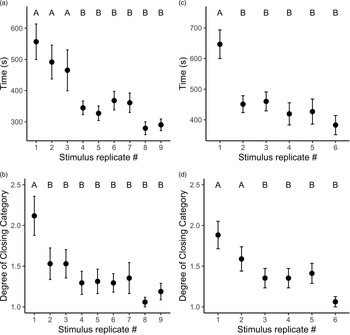
Plants tested for memory (N = 17) showed decline in both opening times (LMM: X 2 = 63.95, df = 8, P < 0.0001) and degree of closing (LRT = 24.84, df = 8, P = 0.002) across the first nine stimuli. As with the Non-Harmful experiment, reduction in opening time occurred by the fourth stimulus (Figure 5a) and by the second stimulus in the case of degree of closing (Figure 5b). In the follow-up experiment conducted 15 days later on the same plants, the overall change in opening time actually happened sooner compared to the first nine stimuli. Specifically, the significant reduction in opening time (LMM: X 2 = 22.44, df = 5, P = 0.0004) occurred already by the second stimuli (Figure 5c), not by the fourth one as in the first nine stimuli (Figure 5a). The degree of closing in the follow-up showed a significant pattern of decrease between stimuli (LRT = 23.03, df = 5, P = 0.0003), but in this case the decrease did not occur sooner than 15 days earlier. It occurred by the third stimulus (Figure 5b) compared to the second stimulus 15 days earlier (Figure 5b). It is worth noticing that the levels of opening time and degree of closing between the initial (Figure 5a, b) and the follow-up experiment (Figure 5c, d) were similar in magnitude.
Reduction in (a) opening time and (b) degree of closing for Mimosa pudica leaflets after a non-harmful stimulus (rice grain dropped on leaflet) was repeated 9 times on 17 plants. Degree of closing was measured using an ordered scale from 1 (leaflets on focal leaf partially closed with the stimulus) to 5 (focal and surrounding leaves fully closed and dropped) (Table 1). The experiment was repeated on the same plants 15 days later on the same plants with 6 repetitions of the stimulus for both (c) opening time and (d) degree of closing, to test for memory. Means that do not share letters were significantly different from each (P < 0.05) other based on planned independent contrasts between the first and other replicates. * indicates 0.05 < P < 0.10. Means are presented ± one standard error.

Additional observations
While observing M. pudica in this study, it was common to see some ants and other insects crawling over the plants and eliciting no reaction. Additionally, the weather did appear to have an effect on them. They closed their leaves in response to high light during mid-day, and when a strong wind blew by, but did not seem to respond to mist or very light rain.
Discussion
Our study produced three major novel results in addition to confirming previous findings. First, M. pudica develops habituation to tactile non-harmful stimuli as light as 0.5 milligrams, an order of magnitude lighter than previously known. Second, this plant seems capable of retaining habituation to non-harmful stimuli for at least two weeks under field conditions. Third, M. pudica does not habituate to harmful stimuli that simulate a chewing herbivore.
Habituation to non-harmful stimuli was evident through the declines in reaction seen in both the degree of closing and the opening time. The decrease could be seen usually by the third to fourth stimulus for opening time and the second to third for degree of closing, slightly faster than was detected by Amador-Vargas et al. (Reference Amador-Vargas, Dominguez, León, Maldonado, Murillo and Vides2014). It is also clear that this is true habituation because the increased reaction to a different stimulus in Non-Harmful/Harmful experiment rules out exhaustion or fatigue (Rankin et al. Reference Rankin, Abrams, Barry, Bhatnagar, Clayton, Colombo, Coppola, Geyer, Glanzman, Marsland and McSweeney2009). This confirmed the findings of Amador-Vargas et al. (Reference Amador-Vargas, Dominguez, León, Maldonado, Murillo and Vides2014) and Gagliano et al. (Reference Gagliano, Renton, Depczynski and Mancuso2014) that M. pudica can habituate to non-harmful stimuli. As mentioned in the introduction, the standard non-harmful stimulus we used can be an order of magnitude heavier than many of the organisms M. pudica might encounter (Dixon & Kindlmann Reference Dixon and Kindlmann1999; Fischer et al. Reference Fischer, Zwaan and Brakefield2002; Ness et al. Reference Ness, Bronstein, Andersen and Holland2004; Song et al. Reference Song, Huang, Shi, Zhu and Lin2007; Svärd & Wiklund Reference Svärd and Wiklund1988). The fact that M. pudica can also habituate to our 0.5 milligram light weight stimuli suggests this plant has the capacity to feel lighter and more subtle stimuli than previously known. Hence, they can habituate to relevant ecological light tactile stimuli that are commonly experienced in the field and harmless, thereby better maximizing their energy use. In addition, the observation while experimenting that insects such as ants appeared to crawl over the leaves without eliciting a response further suggests that habituation could have ecological importance to M. pudica’s interactions with other organisms and its environment. Important to note is that the Styrofoam balls we used resemble in size and weight the eggs of small butterflies(Fischer et al. Reference Fischer, Zwaan and Brakefield2002; García-Barros Reference García-Barros2000; Svärd & Wiklund Reference Svärd and Wiklund1988), something that is not necessarily harmless. Habituation to stimuli of this size and weight indicate that the plant may not recognize butterfly eggs as a threat, even though they can clearly detect this type of object because they habituate to them. The caterpillars of the butterfly Eurema lisa are herbivores of M. pudica, so it would be advantageous not to habituate to eggs laid on the leaflets, because leaf movement can decrease the number of eggs found on the plant (Abrahamson & Marshall Reference Abrahamson and Marshall2009), but given the evidence, it seems likely that habituation in this plant evolved to not waste energy when common environmental tactile stimuli, as light as 0.5 milligrams in mass, trigger leaf movement but do not immediately cause harm. Further research may be able to clarify whether other attributes of the stimuli besides weight, such as the texture, volume, temperature (Kaiser & Grams Reference Kaiser and Grams2006), or even less tactile stimuli such as the presence of chemicals, static charge (Edwards Reference Edwards1962; (Jones & Wilson Reference Jones and Wilson1982), or sound (Appel & Cocroft Reference Appel and Cocroft2014; (Khait et al. Reference Khait, Obolski, Yovel and Hadany2019), might allow the plant to distinguish between harmful and harmless stimuli of similar weights.
The plants showed evidence of changed behaviour in the field which suggests some form of memory. This is because they reacted differently to a follow-up implementation of stimuli than to the original exposure. We did not see the overall reduction in reaction that was seen the Gagliano et al. (Reference Gagliano, Renton, Depczynski and Mancuso2014); however, the plants did habituate more quickly to the stimuli in the follow-up. The plants responded with degrees of closing and opening times of roughly comparable in magnitude to the initial experiment, but habituation occurred sooner to the stimuli in the follow-up experiment. Specifically, it took less repetitions to find a significant reduction in opening time in the follow-up experiment compared to the initial experiment conducted 15 days earlier. Despite the lack of an overall reduced reaction, the more rapid rehabituation in the case of opening time still suggests an influence of the prior experience and therefore memory for at least 15 days. The lack of rapid rehabituation in the case of degree of closing may indicate that it is more difficult to memorize this variable than the time the leaf remains closed. Our interpretation that M. pudica can remember at least part of past habituation experiences should be taken with caution, because this study of memory did not have a control group of plants that had not experienced previous stimulation. Because of this, it is possible that changes in environment or age of the plants could be a factor in their changed behaviour. However, because Gagliano et al. (Reference Gagliano, Renton, Depczynski and Mancuso2014) have already shown this kind of memory in the lab, it seems likely that plant memory is a reasonable explanation for the behaviour, and further studies with a control group could confirm this. In the previous lab study (Gagliano et al. Reference Gagliano, Renton, Depczynski and Mancuso2014), memory was shown under conditions where plants were not stimulated at all in the interim time of 28 days. Our study suggests that some form of memory is also retained in wild plants that are exposed to a variety of tactile non-harmful stimuli such as wind and rain, and natural harmful stimuli such as herbivory, that may have also produced habituation and memory responses in the plants. By indicating memory in the wild, this study suggests that whatever the memory storage mechanism is for M. pudica, it can distinguish and remember multiple stimuli at a time. A possible next step in the research of memory in this plant could establish how many stimuli the plant can remember simultaneously and for how long, to get a better sense of the memory capacity of M. pudica.
M. pudica did not, however, show the same steady decline in opening time or degree of closing to a stimulus when the repeated stimulus is harmful. This shows that the plant is able to distinguish between these two types of stimuli and suggests that M. pudica is capable of showing habituation only when the stimulus is not directly relevant to herbivore damage. Opening times showed a non-significant increase on the second stimulus but returned to the levels shown on the first stimulus after that. One possible explanation for the peak in opening times at the second stimulus may be that the plant was initially increasing its reaction because the stimuli was harmful. In other words, the plant enhanced its defence in response to an attack by a herbivory, a form of short-term memory. After a certain amount of damage, the leaf decreased its response. This could be the result of physical damage hindering the ability of the plants to respond further or causing the plant to decrease investment in the damaged leaf. Additional research on the cellular changes caused by damage and how they interact with the chemical and electrical mechanisms of movements and memory in M. pudica (Braam Reference Braam2005; Volkov et al. Reference Volkov, Foster, Ashby, Walker, Johnson and Markin2010, Volkov et al. Reference Volkov, Baker, Foster, Clemmons, Jovanov and Markin2011; Volkov et al. Reference Volkov, Reedus, Mitchell, Tuckett, Volkova, Markin and Chua2014) might be able to improve understanding of these behavioural responses to harmful stimuli.
The capacity of wild M. pudica to distinguish between harmful and non-harmful stimuli and adjust their behaviour (habituation or lack thereof) over time in response is consistent with the hypothesis that rapid leaf movement in this plant is a response to herbivory. We showed that this species does not habituate to the kind of damage that a chewing herbivore can make, so our results indirectly support the hypothesis but cannot be taken as a definite test. Our results, however, should encourage future studies aimed at testing the hypothesis directly. Additionally, this suggests that the habituation that M. pudica is capable of is likely beneficial to its survival in the wild, at least in its native Neotropical range.
Conclusion
We have shown here that tropical plants in the field can distinguish and potentially memorize different stimuli and habituate to relevant ones only. These results indicate that plants are capable of more complex behaviours than what previous studies with M. pudica have revealed. Studying these behaviour in other plant species that respond rapidly to tactile stimuli, such as carnivorous plants (Poppinga et al. Reference Poppinga, Masselter and Speck2013), or finding ways to measure rapid but less visible responses (Muday & Brown-Harding Reference Muday and Brown-Harding2018), may help us determine whether the abilities shown by M. pudica, which are equivalent to cognitive abilities in animals, also occur in other plant species.
Acknowledgments
Thanks to Sabrina Amador-Vargas for comments on an earlier version of this manuscript. Alan Masters for help with the butterfly component, and Karla Barboza, Moncho Calderon and Adam Stein for logistic support. This study is a result of a CIEE Study Abroad Program in Tropical Ecology and Conservation in Monteverde, Costa Rica. Permission to conduct research in the area during 2019 was granted under permits 169-2018-ACAT and 087-2019-ACAT.
Financial support
This research received no specific grant from any funding agency, commercial or not-for-profit sectors
Conflict of interest
None.