Introduction
Levamisole (Lms) is a synthetic thiazole, originally used as an anti-helminthic drug (Lionel et al., Reference Lionel, Mirando, Nanayakkara and Soysa1969; Scherb, Reference Scherb1969). Also, scientists have shown its use as an immunomodulatory agent with beneficial or harmful outcomes, depending on the dose regimen, the timing of the treatment and the immune status of the patient (Brunner and Muscoplat, Reference Brunner and Muscoplat1980). Lms has been assayed as adjuvant therapy for infectious diseases (e.g. cutaneous leishmaniases and malaria), in vitro and in vivo, as well as in clinical trials, again with opposite effects related to the posology and the immune status of the host. The applicability of immunomodulatory agents for infectious diseases may represent relevant approach to overcome mechanisms of parasite drug resistance, as well as to avoid the subversion of host's immune response, that weakens the fight against these threats (Butler, Reference Butler1982; Rezai et al., Reference Rezai, Behbehani, Gettner and Ardehali1988; Maude et al., Reference Maude, Silamut, Plewes, Charunwatthana, Ho, Abul Faiz, Rahman, Hossain, Hassan, Bin Yunus, Hoque, Islam, Ghose, Hanson, Schlatter, Lacey, Eastaugh, Tarning, Lee, White, Chotivanich, Day and Dondorp2014; Köksal et al., Reference Köksal, Yanik, Bilgin, Yılmaz and Hokelek2016).
Chagas disease (CD) is a neglected infectious disease caused by the protozoa Trypanosoma cruzi and the patients urge for alternative treatments (Coura, Reference Coura2009; Scarim et al., Reference Scarim, Jornada, Chelucci, de Almeida, Dos Santos and Chung2018). Infected people may or not present a mildly symptomatic flu-like acute phase and progress to a frequently silent and long chronic phase that can remain indeterminate for life or cause cardiac and/or digestive irreversible damages (Prata, Reference Prata2001). The only aetiologic drugs available on the market are benznidazole (Bz) and nifurtimox, both related to severe side-effects, low efficacy on chronic phase and naturally resistant strains (Filardi and Brener, Reference Filardi and Brener1987; Rassi et al., Reference Rassi, Rassi and Marin-Neto2010). Recent efforts have demonstrated the potential use of repurposing strategies for different parasitic diseases including CD. Fungicidal drugs acting as CYP 51 inhibitors (E1224 and posaconazole) reached clinical trials on chronic chagasic patients but unfortunately presented therapeutic failure (Morillo et al., Reference Morillo, Waskin, Sosa-Estani, Del Carmen Bangher, Cuneo, Milesi, Mallagray, Apt, Beloscar, Gascon, Molina, Echeverria, Colombo, Perez-Molina, Wyss, Meeks, Bonilla, Gao, Wei, McCarthy and Yusuf2017; Torrico et al., Reference Torrico, Gascon, Ortiz, Alonso-Vega, Pinazo, Schijman, Almeida, Alves, Strub-Wourgaft and Ribeiro2018).
Then, search continues and among the approaches, we highlight drug repositioning and combo therapies as relevant strategies to help scientists providing faster and cheaper solutions. In this effort, we investigated the efficacy of Lms alone and in co-administration with Bz for the treatment of experimental acute CD in a murine model, assessing the antiparasitic activity and immunomodulatory potential of the combo in comparison with the standard treatment.
Materials and methods
Drugs
Bz was purchased from Laboratório Farmacêutico do Estado de Pernambuco (Brazil) and Lms from Janssen Pharmaceutica (Belgium). Bz was diluted in distilled water with 3% Tween 80 (Sigma-Aldrich, United States), and Lms only in distilled and sterile water. All drugs were prepared in extemporaneous solutions. Each treated animal received no more than 100 µL of a solution, either intraperitoneally (i.p.) or per oral (p.o.).
Animals
Female (18–23 g) and male (11–13 g) Swiss Webster mice obtained from the Instituto de Ciência e Tecnologia em Biomodelos (ICTB/Fiocruz) (Rio de Janeiro, Rio de Janeiro, Brazil) were housed in cages in a conventional room at 20–24 °C under a 12 h/12 h light/dark cycle, with sterilized water and chow ad libitum. Groups were formed with maximum of five animals. All procedures were carried out according to the guidelines of Fiocruz Committee of Ethics for the Use of Animals (CEUA L38/17).
Mouse acute toxicity
Female mice (n = 2 per assay, two assays) received i.p. or p.o. staggering doses of Lms, every 2 h, up to 100 mg kg−1 of body weight (mpk). Toxic and sub-toxic symptoms were ascertained to determine the no-observed-adverse-effect level according to the guidelines of the Organization for Economic Cooperation and Development (OECD). After 48 h of drug administration, the mice were euthanized for blood collection through cardiac puncture and haematological analyses were provided by the ICTB/Fiocruz, being the whole procedure performed as described elsewhere (Simões-Silva et al., Reference Simões-Silva, De Araújo, Oliveira, Demarque, Peres, D'Almeida-Melo, Batista, Da Silva, Cardoso-Santos, Da Silva, Batista, Bahia and Soeiro2017).
Mice infection
Male mice (n = 5 per assay, three assays) were infected i.p. with 104 blood trypomastigotes of T. cruzi Y strain. The treated mice and the control group (infected not-treated) were composed only of animals with positive parasitaemia at day 5 post infection (dpi). Assays also included a control group of not-infected not-treated animals.
Efficacy studies
Infected mice were treated (i.p. and p.o.) with different daily doses of Lms from 5 to 9 dpi. The groups received 10 − 0.5 mg kg−1 of body weight (mpk) at the same time every day. Bz treatment (p.o.) at 10 and 100 mpk was given in parallel. Additionally, the co-administration (p.o.) using different doses of Lms (10 − 0.5 mpk) and 10 mpk of Bz were also evaluated. Infected not-treated groups, as well as the not-infected not-treated group received distilled water under the same treatment protocol. Finally, there were also some groups that received one single dose of the respective Lms scheme 24 h before the inoculum with T. cruzi, and then following the above described 5-day therapy protocol.
Parasitaemia, mortality rates and endpoint
Daily parasitaemia was individually assessed by fresh blood sampling (5 µL) since 5 dpi until the 30th day post treatment (dpt) as reported (Brener, Reference Brener1962). Mortality was daily checked until 40 dpi, and death rate was expressed as percentage of cumulative mortality (% CM) (Simões-Silva et al., Reference Simões-Silva, De Araújo, Oliveira, Demarque, Peres, D'Almeida-Melo, Batista, Da Silva, Cardoso-Santos, Da Silva, Batista, Bahia and Soeiro2017). On the 30 dpt, surviving animals were euthanized for blood and heart collection.
Cytokine analyses
Interleukin (IL)-10, IL-17A, tumour necrosis factor (TNF), interferon (IFN)-γ, IL-6, IL-4 and IL-2 were evaluated in plasma samples by flow cytometry using a BD™ Cytometric Bead Array (CBA) Mouse Th1/Th2/Th17 Cytokine Kit (BD Biosciences, United States), according to the manufacturer's instructions. Samples were acquired in a BD FACSCalibur™ flow cytometer and data analyses were performed using CBA analysis FCAP Array™ software (BD Biosciences, United States).
Quantitative polymerase chain reaction (qPCR) analyses
500 µL of blood were diluted 1:2 in a volume of guanidine solution (6 m guanidine-HCl, 0.2 m EDTA) and heated for 90 s in boiling water. Guanidine-EDTA blood (GEB) samples were processed with the QIAamp DNA minikit (Qiagen, Germany) as previously described (Moreira et al., Reference Moreira, Ramírez, Velázquez, Melo, Lima-Ferreira, Guhl, Sosa-Estani, Marin-Neto, Morillo and Britto2013). Multiplex real-time qPCR assays targeting the T. cruzi satellite nuclear DNA and the exogenous internal amplification control (plasmid pZErO-2 containing an insert from the Arabidopsis thaliana aquaporin gene, 40 amplification cycles) were performed as previously described (Duffy et al., Reference Duffy, Cura, Ramirez, Abate, Cayo, Parrado, Bello, Velazquez, Muñoz-Calderon, Juiz, Basile, Garcia, Riarte, Nasser, Ocampo, Yadon, Torrico, de Noya, Ribeiro and Schijman2013). The standard curves for absolute quantification were constructed with 1/10 serial dilutions of total DNA obtained from a negative GEB sample spiked with 105 parasite (Y strain) equivalents/mL of blood.
Statistical analysis
The statistical analysis was performed individually for each assay using analysis of variance (ANOVA), two-way ANOVA with Bonferroni post-test and two tailed t-test.
Results
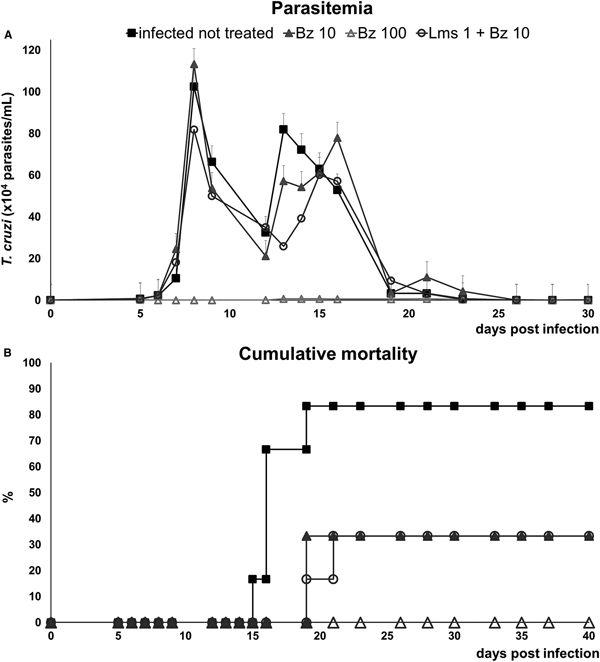
To determine Bz and Lms doses to be used in the co-administration assays, T. cruzi-infected mice were treated for 5 days and the results showed that Bz 100 mpk suppressed completely parasitaemia, while Bz 10 mpk promoted 10% of increase on the 8 dpi, corresponding to the peak of parasitaemia, in relation to the infected not-treated group (Fig. 1A). In addition, Bz 10 was not as efficient as Bz 100 in protecting against death: while the standard treatment kept all animals alive until the established endpoint, the suboptimal dose presented ⩾ 30% of mortality (Fig. 1B). At the same time, ~83% of the infected not-treated mice died down to the 40 dpi (Fig. 1B).
Blood parasitaemia (A) and cumulative mortality (B) of male Swiss Webster mice infected with T. cruzi (Y strain) not-treated, treated with optimal (Bz 100 mpk) and suboptimal (Bz 10 mpk) doses of Bz or co-administration of Lms and Bz (Lms 1 mpk + Bz 10 mpk) for 5 days during the acute phase of the experimental CD.

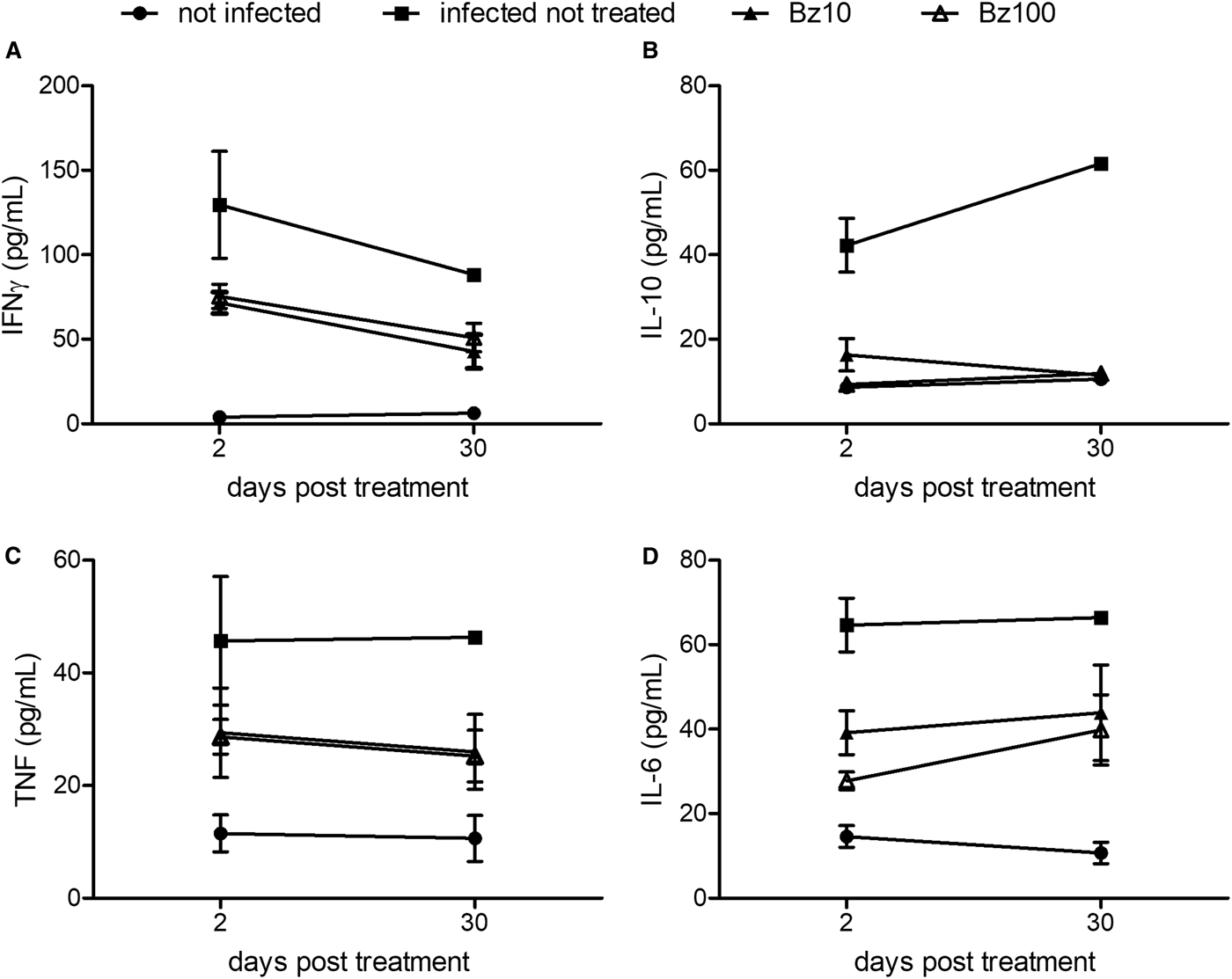
In this model of T. cruzi acute infection, statistically significant increased plasma levels of IFN-γ, TNF, IL-6 and IL-10 were found, in contrast to healthy animals, mainly with a striking enhancement of IFN-γ at the 6 dpi, thereby denoting the induction of a highly inflammatory environment (Fig. 2). Both Bz doses showed a reduction of these cytokine levels, presenting a quite similar response (Fig. 2). IL-17A, IL-4 and IL-2 could not be detected in infected nor healthy animal samples, subjected or not to treatment.
Cytokine expression levels in blood of male Swiss Webster mice infected with T. cruzi (Y strain) on the 2nd and 30th day post treatment (corresponding to 6th and 40th day post infection, respectively) with optimal (Bz 100 mpk) and suboptimal (Bz 10 mpk) doses of Bz, in comparison with not-treated and uninfected/not-treated mice. The levels of IFN-γ (A), IL-10 (B), TNF (C) and IL-6 (D) were determined by flow cytometry.

The potential repositioning of Lms for CD was explored, starting by the evaluation of the toxicological aspects of the treatment. Although for p.o. up to 100 mpk, no side-effect was found, the i.p. administration of high doses (⩾50 mpk) induced sudden death in both healthy (one out of two) and T. cruzi-infected mice (five out of five animals) (data not shown). In Lms-treated but non-infected mice, no alterations in haematological tests were found in comparison with untreated animals. The gross pathology demonstrated haemorrhagic aspects in the lung and altered liver configuration (pale organ), that may be suggestive of vasculitis or disseminated intravascular coagulation (data not shown).
After the toxicology analysis, the antiparasitic capacity of Lms was assessed in an acute mice infection model. All doses of Lms (either by i.p. or p.o.) exacerbated the parasitaemia in relation to the infected not-treated control group, providing low animal survival rates (data not shown).
Next, the co-administration (p.o. for 5 consecutive days at the same hour, starting at the parasitaemia onset) of the suboptimal dose of Bz (10 mpk) with different Lms concentrations resulted in decreased parasitaemia levels, reaching at the use of Lms 1 + Bz 10 around 28% of reduction (mean of the results of two assays, range of suppression 20–36%) (Fig. 1A and data not shown), in contrast to the respective Bz 10 alone that did not decrease parasitaemia (Fig. 1A). Besides, this combo was also effective at shortening mortality rate in comparison with the infected not-treated group, protecting 70% of the animals, just like Bz 10 (Fig. 1B).
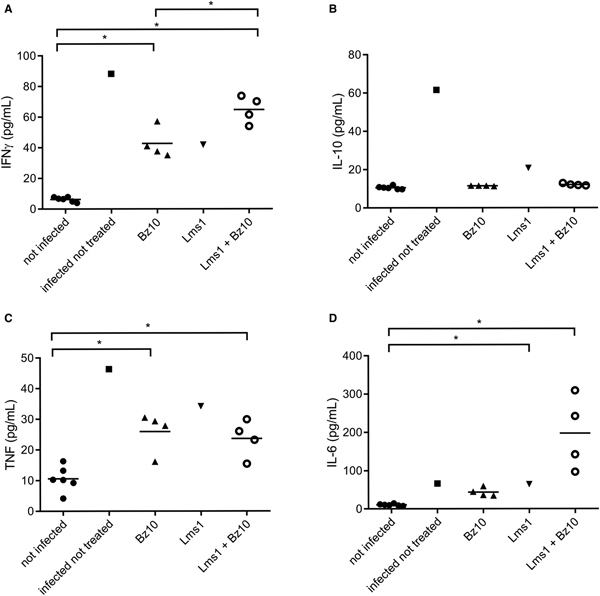
At the endpoint (40 dpi/30 dpt), the aforementioned cytokines were dosed in the blood of the surviving animals (Fig. 3). While comparing in the surviving animals, the levels of IFN-γ in Bz 10 and Lms 1 alone were lower than the combo Lms 1 + Bz 10 (Fig. 3A), and also remarkable increases in IL-6 levels, even higher than the infected not-treated group (Fig. 3D).
Cytokine expression in blood of male Swiss Webster mice infected with T. cruzi (Y strain) on the 30th day post treatment (corresponding to 40 dpi) with suboptimal dose of Bz (10 mpk), Lms (1 mpk) and co-administration (Lms 1 mpk + Bz 10 mpk), in comparison with not-treated and uninfected/not-treated mice. The levels of IFN (A), IL-10 (B), TNF (C) and IL-6 (D) were determined by flow cytometry. Statistically significant differences (*, ** and ***) were P < 0.05.

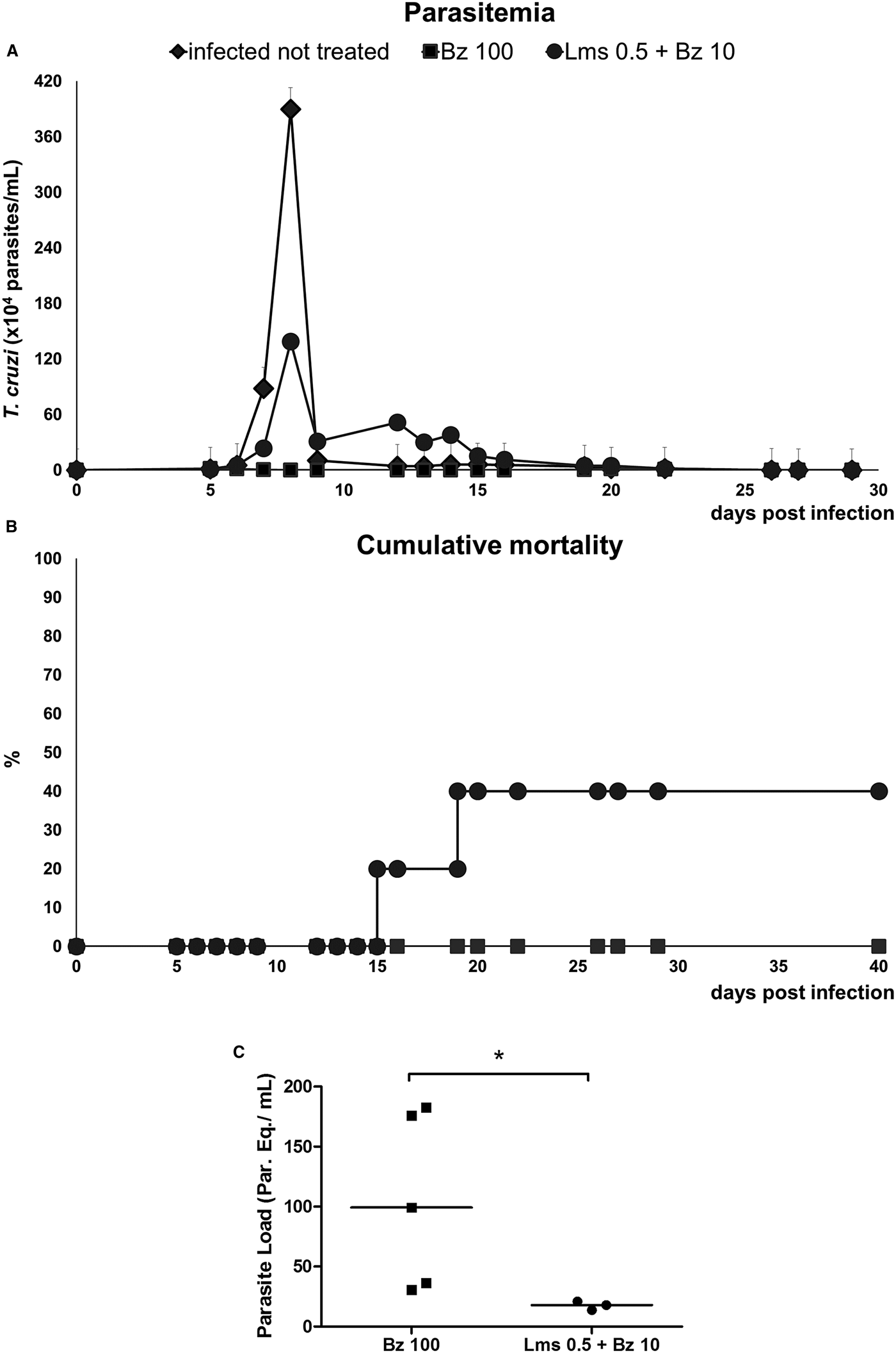
Subsequently, to further explore the effect of Lms + Bz combo but using lower doses of this thiazole, Lms 0.5 + Bz 10 was assayed and found to promote a decrease around 60% of parasitaemia peak in comparison with the infected not-treated group and gave a mild protection (60% animal survival) against mortality up to 30 dpi. In parallel, Bz 100 mpk (its optimal dose) completely suppressed parasitaemia during the 5 days of treatment and promoted 100% animal survival until 30 dpi (Fig. 4A and B). Regarding the blood analysis by qPCR, this technique demonstrated that in the surviving mice, Lms 0.5 + Bz 10 was more effective (around 5.5-fold; P = 0,036) at reducing the parasite load in blood than Bz given at its optimal dose (100 mpk) (Fig. 4C).
Blood parasitaemia analysis by light microscopy (A), mortality rates (B) and blood parasite load quantified by qPCR obtained on the 30th day post treatment (C) of Swiss Webster mice experimentally infected with T. cruzi (Y strain) treated with Bz 100 mpk and Lms 0.5 mpk co-administered with Bz 10 mpk for 5 days during the acute phase of the experimental CD.

Discussion
To our knowledge, Lms started as anthelmintic drug in the early 1960s, and has been tested as an immunotropic agent since 1970s (Amery and Bruynseels, Reference Amery and Bruynseels1992). It has been clinically assayed, for instance, as adjuvant therapy in the treatment of colon rectal cancer, being later on encouraged for the practical use due to its positive outcome (Mutch and Hutson, Reference Mutch and Hutson1991). Also, it demonstrated beneficial effects against protozoa in patients with chronic cutaneous leishmaniasis (Butler, Reference Butler1982), as well as in experimental visceral leishmaniasis either used in monotherapy or combination (Rezai et al., Reference Rezai, Behbehani, Gettner and Ardehali1988; Rifaat et al., Reference Rifaat, Mohammad and Jawdat1989). In mice experimentally infected with Toxoplasma gondii, Lms co-administered with the combo sulphadiazine plus pyrimethamine showed an immunopotentiator effect, promoting life span of the treated mice in comparison with non-treated or treated with combo without Lms (Köksal et al., Reference Köksal, Yanik, Bilgin, Yılmaz and Hokelek2016).
The urge needs of alternative treatments against CD directed us to revisit these results. Using updated techniques and validated models of T. cruzi-mice acute infection, hence to assess the potential antiparasitic and immunomodulatory activities of Lms with different therapeutic protocols and contemplate the possibility of repositioning alone or in co-administration.
Thus, to validate the protocols, a standard treatment with Bz in optimal and suboptimal doses was characterized concerning parasitaemia and inflammatory profile and compared with not-infected and infected not-treated control groups on the same parameters. Bz 100 showed, as usual, efficient antiparasitic activity, not observed with Bz 10, as demonstrated previously by our group (Simões-Silva et al., Reference Simões-Silva, De Araújo, Oliveira, Demarque, Peres, D'Almeida-Melo, Batista, Da Silva, Cardoso-Santos, Da Silva, Batista, Bahia and Soeiro2017). The parasitaemia suppression obtained with Bz 100 could be related to a regulated inflammatory profile in relation to the highly pro-inflammatory environment existent in infected not-treated animals, once the levels of parasite in the organism causing damage, during the acute phase, is strikingly reduced. Curiously, Bz 10 displays equivalent inflammatory regulation, that is not correlated with parasitaemia reduction, as in the case of Bz 100 treatment. This observation dissociates the reduction of parasite load from the activation of pro- and anti-inflammatory cytokines, corroborating previous findings that the effectiveness of Bz treatment on acute T. cruzi infection is built upon the trypanocidal effect and the cooperation with the host's immune system (Ferraz et al., Reference Ferraz, Gazzinelli, Alves, Urbina and Romanha2007).
Lms has been reported to act as an antiparasitic and immunomodulatory agent. The distinct mode of action is obtained with different doses that range from 7.5 to 1.8 mpk (Risvanli and Aydin, Reference Risvanli and Aydin2003). However, some aspects are very important to achieve one outcome, naming appropriate timing of the treatment, careful dosing and the immune status of the host. The use of Lms must always be primarily indispensably evaluated in healthy models or individuals, speaking respectively of pre-clinical and clinical trials, aiming to avoid disadvantageous scenarios (Brunner and Muscoplat, Reference Brunner and Muscoplat1980). Similar side-effects as we observed have been reported for people who used Lms-adulterated cocaine in United States (Fredericks et al., Reference Fredericks, Yon, Alex, Morton, Messer, Bokhari and Poulakidas2017). Deleterious effect of Lms was formerly described on experimental African trypanosomiasis in different mice strains, increasing mortality in more susceptible animals (Libeau and Pinder, Reference Libeau and Pinder1981). Renoux (Reference Renoux1980) addressed general issues of the immunopharmacology of Lms, stating that since it can act as an immunostimulant or immunosuppressive agent, diverse outcomes could be expected according to one's methodologies (meaning experimental assays, timing of drug administration, amount of drug exposure and model of disease), and these are mostly not reproducible among groups, or even in the same laboratory.
Former studies on T. cruzi experimental infection (Y strain, Swiss Webster mice) showed that a 10-day prophylactic treatment with Lms reduced parasitaemia to less than 50% of the levels observed in infected not-treated mice, decreasing also death rate to 10%, while a therapeutic subcutaneous alternate administration for the first 10 days after infection did not interfere with parasitaemia levels comparing with infected not-treated, presenting similar mortality (Abath et al., Reference Abath, Coutinho, Montenegro, Gomes and Carvalho1988). In our studies, the administration of a single dose of Lms previously to the infection, then followed by 5-day treatment did not provide reduction in the parasitaemia levels. In all the groups, there was parasitaemia exacerbation, and the pre-infection single dose of Lms did not cause any influence in the result, when comparing with the groups without pre-treatment (data not shown).
Lms tested in monotherapy using therapeutic protocols (starting at the 5 dpi, that corresponds to the parasitaemia onset in this experimental models) demonstrated that the drug was not able to reduce parasitaemia with any of the doses administered (10, 5 and 1 mpk, neither i.p. nor p.o.) that comprised the range described in the literature from antiparasitic to immunomodulatory action (Risvanli and Aydin, Reference Risvanli and Aydin2003). In fact, the treatment increased parasitaemia (13–146%) in comparison with the infected not-treated control group (data not shown). Parasitaemia increase was also described for mice infected with T. (nanomonas) congolense treated with Lms (Libeau and Pinder, Reference Libeau and Pinder1981).
Additionally, co-administration protocols were also performed, using the suboptimal dose of Bz (10 mpk) and different doses of Lms. Among the combos assayed, Lms 1 + Bz 10 decreased around 30% of parasitaemia in relation to the infected not-treated control group. This combo was even more effective than the respective monotherapies Lms 1 and Bz 10. Cytokine analysis showed that Lms 1 and Bz 10 similarly reduced the levels of the studied mediators (IFN-γ, IL-6, TNF and IL-10), presenting lower levels than the infected not-treated group. The combo Lms 1 + Bz 10 induced a highly inflammatory profile associated with significantly increased levels of IFN-γ and IL-6 in comparison with all other studied groups. Mice strain that are susceptible or resistant to T. cruzi show elevated production of IFN-γ during acute infection (Nabors and Tarleton, Reference Nabors and Tarleton1991; Morato et al., Reference Morato, Colley and Powell1998), and it was also observed here. The combined treatment increased IFN-γ production in comparison with the monotherapies that may suggest an immune response interaction between Lms and Bz at the above-defined doses. However, the bulk of the results show that the combo does not represent a promising anti-parasitic and immunomodulatory alternative for future therapeutic approaches for CD as it does not fully protect against mice mortality and only partially decreases the parasite load measured by light microscopy and qPCR.
Regarding IL-6 expression, it is elevated in parasitized tissues and in the circulation of experimental animals, as well as in humans (Truyens et al., Reference Truyens, Angelo-Barrios, Torrico, Van Damme, Heremans and Carlier1994; Chandrasekar et al., Reference Chandrasekar, Melby, Troyer and Freeman1996). IL-6 plays an important role in mediating resistance against the parasite in a murine model, showing that it can influence also the antigen specific T-cell differentiation, and might be even correlated with the kinetics of IFN-γ expression (Gao and Pereira, Reference Gao and Pereira2002). IL-6 does not reduce parasite levels, and its transitory higher expression during early infection may prolong animal survival (Truyens et al., Reference Truyens, Angelo-Barrios, Torrico, Van Damme, Heremans and Carlier1994).
Parasitaemia suppression (60% animal survival) was also achieved using combo Lms 0.5 + Bz 10, even though a mild protection against mortality was obtained. Also, the surviving animals from this combo displayed lower blood parasite load measured by qPCR than Bz at the optimal dose (100 mg kg−1 day−1) that completely suppressed the parasitaemia peak (by light microscopy readout) and fully protected against mortality. The lower qPCR levels in the mice group treated with the combo in comparison with the standard Bz 100 may be related to modulation of the mice immune response leading to the clearance of residual parasite nests. This result might indicate that the lower the dose of Lms, the better the combo antiparasitic effect is, but this hypothesis needs to be further verified by additional future studies using molecular analysis as well as cytokine measurements.
Our results show the importance of conducting pre-clinical trials with drug candidates for repositioning and in combination, once they can be beneficial or harmful to the host and, in a wider scale, to the patient. Careful attention must be paid to drug interactions that could have surprising outcomes in face of an altered immune status of the host. Fundamentally, we must consider that individuals infected with T. cruzi mostly are diagnosed in a later chronic phase, when they are older adults who require other medications for comorbidities related or not to CD, and treatment must be mindfully addressed to avoid unwanted consequences.
Author ORCIDs
Maria de Nazaré Correia Soeiro, 0000-0003-0078-6106
Acknowledgements
We would like to thank MSc. Julianna Siciliano, MSc. Ludmila Fiuza, Ivana Melo and Patrícia Bernardino for technical support. We also thank the Rede de Plataformas Fiocruz (PDTIS-Fiocruz) for the facilities on the real-time PCR RPT09A platform and RPT11G.
Financial support
The funding was provided by Coordenação de Aperfeiçoamento de Pessoal de Nível Superior (CAPES), Conselho Nacional de Desenvolvimento Científico e Tecnológico (CNPQ), Fundação Carlos Chagas Filho de Amparo à Pesquisa do Rio de Janeiro (FAPERJ), PAEF and Instituto Oswaldo Cruz (IOC/Fiocruz). MNCS, OCM and CB are CNPq fellows and Cientista do Nosso Estado CNE FAPERJ.
Conflict of interest
None.