1. Introduction
During the nineteenth and twentieth centuries, western European agriculture changed profoundly. After the Second World War in particular, agricultural modernisation processes accelerated and intensified in both pace and scale. The 1960s may be regarded as a turning point. At a time when the European Community became a major player in agriculture through the Common Agricultural Policy, the economic and social importance of agriculture altered. The continuing intensification, business expansion, mechanisation and specialisation of agriculture resulted in a massive productivity increase. Rural youths and women were pushed out of agriculture into the booming industrial and service sectors. The active farming population decreased and aged rapidly. The rise in transportation possibilities opened up rural areas to several non-agricultural functions, such as housing, industrial activities, road building and recreation.Footnote 1 Besides the physical exploitation of rural land, the commodification of the rural landscape, culture and lifestyle became increasingly prevalent. As a result, the European countryside developed some strong urban traits. This blurring of urban and rural space was combined with the assertion of new discourses. New lifestyles, morals and standards were interchanged and the original, agricultural inhabitants had to tolerate new rural neighbours.Footnote 2 This transformation of post war rural society has only recently begun to be studied in depth. During the past century, countryside history was almost completely synonymous with agricultural history. Rural history was essentially ‘agricultural history writ large’, as Jeremy Burchardt strikingly characterised English rural historiography, and the same was true of Belgium.Footnote 3 Since the 1980s and 1990s a new rural history, boasting a broader thematic scope, has become prevalent.Footnote 4
The ‘Agrarian Transition’ of the western European countryside, from an agrarian society into a post-industrial and multifunctional rural realm, can be linked to a more general social transformation.Footnote 5 The turbulent ‘golden sixties’ heralded a changing world in which debates and trends, such as secularisation, democratisation and globalisation, intensified in pace and scale, helped by the emergence of the mass media. A dynamic and contesting youth culture appeared and new social movements sprang up all over the Western world.Footnote 6 In the last few decades a considerable amount of literature has been published on new social movements,Footnote 7 and recently, there has been a growing interest in the emergence of rural movements in response to rapid changes in the post war countryside.Footnote 8 Geographer Michael Woods, for instance, claims that the declining economic significance of agriculture and other resource industries, the effects of mass migration both from and to the countryside, neo-liberal state reforms and changing public attitudes towards the environment and animal welfare, have all given rise to new grassroots movements primarily defined by the centrality of the meaning and regulation of rurality itself. Woods has identified these rural movements as new social movements in contrast to older, hierarchically structured and more established social movements such as the agricultural unions. He connects the origins of the rural movements to a shift from ‘rural politics’ towards a ‘politics of the rural’.Footnote 9
However, little attention has been paid to the reaction of old social movements to this changing rural world. In Germany, social scientists Heinze and Voelzkow have studied the responses of the German Farmers’ Association to structural changes.Footnote 10 The Norwegian sociologist, Gundelach, has used a social movement perspective in his research into the umbrella organisation for Danish farmers’ organisations.Footnote 11 At the end of the 1980s, an international sociological research group R-Europa (Réseau Européen de Recherche sur les Organisations Professionelles Agricoles) was founded to analyse post war agricultural developments and their political and organisational outcomes.Footnote 12 But like most historical studies on agricultural organisations, R-Europa tends to focus on political or agricultural economic contexts rather than on society in general. In this paper, I will concentrate on the Flemish rural situation. Flanders, the northern, Dutch speaking part of Belgium, is a very small, densely populated and fairly industrialised area. The region consists of a multitude of towns and chains of rural settlements, connected through a well established transport network. Discussing rurality or the countryside in Flanders is quite paradoxical due to its lack of large agglomerations and its strong urbanisation, making it an interesting case study for agricultural organisations dealing with rural change in Europe.Footnote 13 During the 1960s and 1970s several new social movements emerged in Flanders, such as the student protest movement, the feminist movement and the nature conservation movement, Bond Beter Leefmilieu.Footnote 14
I will therefore focus on the case of the Boerenbond (Farmers’ Union) as the oldest farmers’ organisation of Belgium, which, quite early on in its development, acquired an almost monopolistic status in the representation of Flemish farmers.Footnote 15 In 1971 the Boerenbond transformed itself, by demerging, into a highly specialised farmer's association and a broader ‘Rural Movement’ in which non-farming inhabitants of the countryside were expected to play an equally important role. Using a variety of oral and archival sources, this paper analyses the transformation of the Boerenbond during the 1960s and 1970s by focusing on the initial objectives of the Rural Movement leadership, the often international sources of inspiration and the strategies it used to achieve its goals. Firstly, in order to understand the characteristics of the Boerenbond during the post war period, a brief outline of the organisation's history will be presented. Secondly, the increasing focus on socio-cultural education in the Boerenbond from the late 1950s onwards will serve to illustrate the changing organisational strategy and thinking. Finally, after discussing the various phases of the organisation's restructuring, the activity of the Rural Movement in the 1970s will be analysed.
2. The Boerenbond up until the 1950s: an influential power block with far reaching branches
In the last quarter of the nineteenth century, the rural elites of several western European countries founded agrarian organisations in an effort to respond to a profound agrarian crisis within Western Europe. Like many of these newly founded agricultural organisations, the Boerenbond was set up along confessional and political dividing lines and carried a clear corporatist tendency.Footnote 16 More specifically, the Boerenbond was founded in 1890 by Catholic politicians and came to the support of the predominantly Catholic peasant class who were suffering from the crisis. With the introduction of universal male suffrage pending, they wanted to ‘protect’ farmers against socialist influences. The founders of the Boerenbond were inspired by German corporatism and developed their farmers’ guilds using the medieval guilds and the Rheinische Bauernverein as models.Footnote 17
These newly established unions frequently provided economic and social support for their members.Footnote 18 The Boerenbond, in particular, was set up as an umbrella structure over a network of parochial farmers’ guilds and was tightly affiliated with the Catholic church. It was conceived as a ‘total’ organisation, aiming ‘to protect not only the professional but also the social, moral, religious and political interests of its members and their families to form a powerful Christian farming class’.Footnote 19 Consequently, from the nineteenth century, the Boerenbond developed social law sections and economic divisions covering an insurance company (ABB), a financial institution (CKL) and a cooperative for buying and selling cattle feed, fertilisers, etc (AVV). At the beginning of the twentieth century, the Boerenbond enlarged its influence and founded branches for farmers’ women (Boerinnenbond) in 1911 and for youth (Boerenjeugdbond) in 1929 for boys and 1931 for girls. Membership increased at a high pace, thus enabling the Boerenbond to play its part in the development of the economic, social and cultural life in the countryside.Footnote 20 Although there are marked similarities between these European agricultural organisations, a simultaneous emergence does not necessarily imply a similar rhythm of growth and development. Comparative studies illustrate the impact of different economic, social, political and religious contexts on the development of agricultural associations in different countries.Footnote 21
Developing its wide ranging guild system enabled the Boerenbond to strengthen the existing structures of rural Flanders and to fit the corporate idea into the small village communities structured around the church and local notables, thereby gaining ground in almost every parish in Flanders. While noticeable differences existed between the regions, it is the centralised and unitary structure that really makes the Boerenbond unique. Almost every activity of the farmers’ organisation existed in the neighbouring countries but, unlike in Flanders, these were organised separately or in other combinations. In the United Kingdom, similar women's and youth organisations existed, such as the Women's Institute and Young Farmers’ Clubs, but affiliation with the National Farmers’ Union was not as close as between the Boerenbond and its women's and youth branches.Footnote 22 Like the cooperatives of the Boerenbond, Dutch cooperatives were attached to agricultural organisations. Yet, after the Second World War, these Dutch cooperatives were separated from their agricultural partners.Footnote 23 In the Boerenbond all branches and activities came together in just one central authority, with a formal top down hierarchical structure and a self proclaimed sense of unity.
Other farmers’ unions in Flanders, like Boerenfront, founded in 1937, or ABS (Algemeen Boerensyndicaat) from 1962, were smaller than the Boerenbond and had a less developed economic and social support system for their members. In Wallonia, the fairly industrialised and more secularised French speaking southern part of Belgium, two big farmers’ organisations played a key role: the religiously neutral and Boerenbond opposed UPA (Fédérations des Unions Professionelles Agricoles), established in 1919 and from 1929 the Catholic AAB (Alliance Agricole Belge), which had strong links with the Boerenbond.Footnote 24 Thus, by 1945, the Boerenbond had become an influential power block with ideologically robust branches stretching out into the political, economic, financial, and social spheres. It is interesting to see how the Boerenbond remodelled itself in order to keep its power hold on the rapidly changing Flemish countryside after the Second World War.
3. Farmers are human beings too: towards a socio-cultural education in the Boerenbond
Until the 1960s, almost all Boerenbond activities were situated in economic and political spheres, such as the material assistance of farmers, the promotion of their interests and their professional education. In the women's and youth branches of the Boerenbond, however, the situation was quite different. Founded in 1911 as an organisation for professional farm women, the Boerinnenbond offered technical assistance training on farming issues. Before long, members could also engage in all sorts of social and family educational activities, including cooking, nursing, and needlework classes. With such a recipe for success, it is not surprising that several non-farming women became members. The changing of the journal's name from The Farmer's Wife (De Boerin) to At the Fireside (Bij de Haard) in 1949, clearly illustrates this evolving attitude. In the late sixties the organisation started calling itself ‘Catholic Rural Women’ and in 1971 it officially adopted the name Katholiek Vormingswerk voor Landelijke Vrouwen or Catholic Socio-economic Education for Rural Women.Footnote 25
The same evolution is noticeable in the Boerenbond branch for the farming youth. After the Second World War, farming sons and daughters found it difficult to find work on the parental farm and had to look for jobs elsewhere. As a result, the members’ profile of the organisation altered. In 1965 the new name ‘Catholic Rural Youth’ (Katholieke Landelijke Jeugd) replaced the old Farmers’ Youth Organisation (Boerenjeugdbond) to better reflect the contemporary situation. The youth branch had a long tradition of socio-cultural education including sports, singing, oratory, acting, dancing and other courses. According to several Boerenbond leaders, farming women and rural youths, particularly girls, were more sensitive to social and cultural aspects of life, whereas men were simply preoccupied with farm keeping.Footnote 26 Just as in the Netherlands, this historical assignment of tasks, with culture and religion for women and youths and professional and economic tasks for men, was taken for granted as a natural form of generational and gender segmentation.Footnote 27
Despite its strong economic focus, the Boerenbond took an increasing interest in culture and society in the years before the organisation's restructuring in 1971. Thanks to some new leaders and partly imbued with the spirit of the age, a wind of change was blowing through the Boerenbond. In the early 1960s the Boerenbond saw its Board of Directors change. Until then, the upper ranks had largely consisted of leaders from the pre war generation. One of them was the chairman, Gilbert Mullie (1876–1962), who, according to several contemporaries, kept on chairing meetings despite being blind and over eighty years old. In 1961 Maurice Van Hemelrijck (1901–1964) succeeded Mullie as chairman of the Boerenbond. Even though his chairmanship lasted only three years, he succeeded in reorganising several departments and several other leaders stressed that ‘he was a man with innovative opinions’ and that ‘he was very progressive, unlike Mullie or Monsignor Cruysberghs’.Footnote 28 The recruitment of sociologically skilled employees, instead of exclusively agricultural engineers and lawyers, provided new and fresh insight. One person, although not sociologically skilled, stands out in particular. Hein Nackaerts was an inspector of the Boerenbond who visited and checked the local guilds for compliance. He was the first to notice the gap between the male professional branch and the more culturally minded female and youth divisions and to take that problem seriously. Nackaerts personified culture in the Boerenbond, both within the organisation and towards the outside world.Footnote 29
In 1957 Nackaerts received the approval from then vice-chairman Van Hemelrijck to start up a separate Culture Department. The goal of this one man department was to pay more attention to culture in the Boerenbond organisation. Around the same time, and integrated into Flemish cultural emancipation, a culture department was established in similar organisations such as the NCMV, the organisation for trades people in Belgium.Footnote 30 In the beginning, the Culture Department moved very cautiously, yet Nackaerts succeeded in establishing a cooperation agreement with another Catholic organisation (the Flemish culturally-minded Davidsfonds), a cultural page in ‘the Farmer’ (De Boer), the weekly magazine of the Boerenbond, and he also organised cultural lectures in the local guilds for which the organisation received government subsidies. Following the founding of several committees in the fast-growing Boerenbond, a specialised counselling body (Staf voor Godsdienst en Cultuur) was established in 1964 to give advice to the central leadership on culture and religion. In 1965 the Culture Department acquired a corporate personality as a non profit organisation, so it could go on receiving government subsidies.Footnote 31 From that moment, a more clearly defined vision on culture was established in the Boerenbond.
The content for this Culture Department and the inspiration for a vision around culture came partly from abroad. Nackaerts and several sociologically trained employees of the Boerenbond were inspired by the ideas of the Wageningen school for agricultural sociology.Footnote 32 The basic assumption was that farmers were to be considered as more than farm managers; they were human beings too. As in the Belgian tradition of Christian Personalism, the whole human being was taken into account. The starting point for thinking on culture was the existence of a cultural conflict due to incompatible lifestyles. The rapidly evolving Flemish rural society after the Second World War stood out against the rather static image of the farmer. According to the Boerenbond farmers were considered to be traditional and culturally deprived people as a result of living an isolated existence in their villages and farms. Because of the opening up of villages through the development of modern communications and transport facilities and the arrival of new inhabitants of the countryside, farmers were being exposed to new people with new ideas. The lifestyle of the farmer was poorly adapted to this culture shock, and therefore more integration was needed. The top of the Boerenbond regarded the organisation as the ideal actor to promote ‘the mobilization of the farmer in contemporary modern society’.Footnote 33
Culture was not seen as elite culture with a capital C. Instead, a broad approach was presented: culture is everything that is more than nature. As a result, socio-cultural education in the Boerenbond was seen as a ‘savoir-vivre’ (levenskunst), everything which makes the farmer and his family more human. According to Nackaerts, culture could not be viewed in isolation from life; it is not a separate box. Indeed, culture is engrafted onto work, family life, recreation etc. In the second half of the 1960s, this vision evolved into a broader approach to socio-cultural education and a more concrete methodology, including manuals for the committees of the local guilds with practical tips on, for example, the looks of the farmer, the farmhouse, etc.Footnote 34 Although the integration of farmers into modern society was the primary purpose of this cultural approach, the link with the agricultural past was also important. The idea was to enable farmers to adapt to modernity by falling back on historical traditions. This cultural approach and the accompanying methods were rather paternalistic, which caused some Boerenbond employees to warn of excessive paternalism. Farmers were considered as rather passive creatures, unable to adapt on their own. The view of culture remained explicitly class bound and fitted in perfectly with the corporatist Boerenbond. The whole view was mirrored in the central organisation. The impact of these ideas was limited because, in reality, the material means and manpower to fulfil these objectives were lacking. Nackaerts wrote many letters to the Boerenbond leadership, complaining about the lack of means and the poor degree of appreciation and participation. He felt that he was a ‘missionary’ or ‘a voice (crying out) in the wilderness’. He did not feel that he was taken seriously in the Boerenbond. Nackaerts was sometimes considered a ‘special man’, which distanced him from the rest of the organisation.Footnote 35 It seemed to suggest that he was almost the only culturally minded person working in a culturally indifferent environment.
Nackaerts was not directly involved in the debate over the reorganisation of the Boerenbond, yet his overall ideas about culture and education had an indirect but undeniable influence on the discussions that preceded the reorganisation in 1971. Many patterns of thought that laid the base for founding the Rural Movement can be traced back to the first thoughts about culture and the integration of farmers into modern society described above. In one way, the Culture Department can be seen as a foreshadowing of the future Rural Movement. One might think that the increasing cultural sensitivity served as the starting point for the restructuring in 1971, but this is not the case.
4. Agriculture before everything: the reorganisation, 1966–1970
Surprisingly, the reorganisation did not initially aim to create a Rural Movement with socio-cultural education for all rural inhabitants. On the contrary, the debate centred, essentially, around the need to modernise and strengthen the Boerenbond as a professional organisation. The leadership of the Boerenbond were persuaded of this need for several reasons.
4.1. To preserve a threatened power and unity
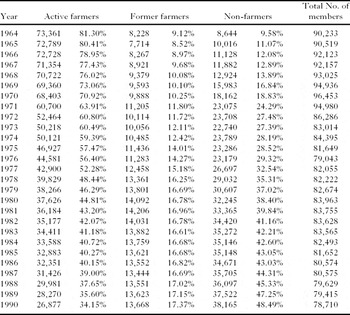
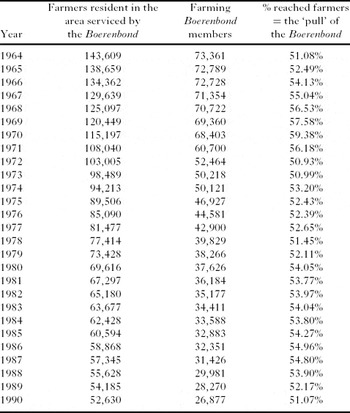
Between 1964 and 1971, the number of male farmers in the sphere of action of the Boerenbond decreased from 143,609 to 108,040. This is a decline of almost twenty-five per cent in a few years.Footnote 36 However, in spite of this declining farming population, the Boerenbond's membership figures stood firm and even rose from 90,233 in 1964 to 94,980 in 1971 (Table 1). Expressed as a percentage of the total farmers reached, this means that the ‘pull’ of the Boerenbond increased from fifty-one per cent in 1964 to almost sixty per cent in 1970 (Table 2). But the proportion of farming and non-farming members also changed dramatically in that period. In 1964 less than ten per cent of the farmers’ guilds members were non-farmers. In just a few years this situation changed completely and, in 1971, almost one quarter of the Boerenbond members were non-farmers. Finding a clear explanation for this shift is not simple. The new focus on culture may have attracted non-agricultural members. More plausible, however, is an economic explanation focusing on the bank and insurance divisions (CKL and ABB) of the Boerenbond, which were extending their services outside the farming community. Becoming a member of the Boerenbond meant a big discount on loans or assurances for non-agricultural clients.
Membership figures of the Boerenbond, sorted into groups according to profession

The ‘pull of the Boerenbond ’
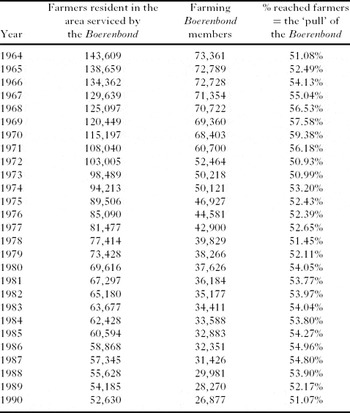
Although the shrinking agricultural population does not seem to have had a direct effect on the membership figures, the Boerenbond obviously felt that its future social position was under threat. Fewer farmers would mean fewer members, less earnings and diminished political power. Together with the breakdown of farmers’ traditional standards and values in a fast changing countryside, its well established power structure came under increasing pressure in the 1960s. The local farmers’ guilds were declining rapidly because their services were no longer adapted to the changing member profiles. Modern farmers no longer felt at home in the ‘old fashioned’ parochial farmers’ guilds, which had been originally modelled on the old mixed family farms. They felt a need for more specialised agricultural education and lobbying and thus found the Boerenbond service unsatisfactory. In several sectors, parallel movements arose in which highly specialised farmers, such as market gardeners, could gather outside Boerenbond structures, to get informed by highly educated experts. The remaining farmers were specialising at a high rate. Specialised farming created professional gaps between different farming sectors: a pig breeder was distinct from a horticulturist or a dairy farmer. In short, the long cultivated sense of unity was seriously threatened.Footnote 37
The powerful position of the Boerenbond in Flanders was also threatened by the arrival of a new farmers’ organisation. Flemish farmers, discontented with the relative support of the Boerenbond for the Common Agricultural Policy, founded ABS, or Algemeen Boerensyndicaat, in 1962. This organisation particularly focused on demonstrations and trade union initiatives. ABS attracted mainly dissatisfied Boerenbond members and quickly became a potentially important competitor, although not in absolute membership figures.Footnote 38 The leading Belgian farmers’ organisation seemed to collapse slowly after that.
4.2. A monistic or dualistic future Boerenbond?
Clearly aware of these threats to its power and unity, the Boerenbond began to reflect on its future. The farming organisation wanted to counter this fast changing farming landscape and prevent their farmers’ guilds from eroding any further. Constant Boon (1911–1997) succeeded van Hemelrijck as chairman and, together with his first secretary Jan Hinnekens, he took the lead in reshaping the Boerenbond.Footnote 39 The first step in a restructuring process which began in 1966 and lasted until the mid 1970s included a consultation in which all departments, divisions and branches of the Boerenbond could reflect on possible structural adjustments. The round was held in three phases from September 1966 until November 1967. Subsequently, the discussion was brought down to two options: Boerenbond was to have either a monistic or a dualistic structure in future. In the monistic structure the old mixed farmers’ guilds would be replaced by specialised guilds, for pig farmers, market gardeners, etc. In the dualistic option, all local farmers and gardeners would stay in their mixed guilds, which would be flanked by specialised sections responsible for technical and economic education, information and lobby work.Footnote 40
Some employees of the Boerenbond chose the monistic option, which favoured modern farmers, whereas others preferred the dualistic option because they believed that the Flemish farming sector was not yet specialised enough.Footnote 41 The women's and youth branches opted entirely for the dualistic option because it leant most towards their own developments and future perspectives. The monistic option, they felt, threatened to make collaboration impossible between the Boerenbond’s central powers and the local women's or youth divisions. The economic divisions of the Boerenbond voted for the dualistic option, as they had already extended their services to the whole rural, and even urban, population.Footnote 42
In June 1969, Maurice Beddegenoots, director of the Organisatiediensten (‘Organisational Services’) and the first sociologist to be recruited in the Boerenbond, made a blueprint of the future Boerenbond. He suggested: ‘The Boerenbond should not squeeze itself into the tight corset of a purely professional organization. On the contrary, we should opt for a double finality: to remain the major professional organisation for a minority group of farmers and to become the representative organisation of the rural population.’Footnote 43 This vote, for the dualistic option, was the prime condition for the creation of the Rural Movement. In 1969 the discussions broadened noticeably. Hinnekens and his colleagues started to reflect on the position of the Boerenbond in society at large. Hinnekens drew his inspiration from several foreign authors, such as the French sociologist, philosopher and political scientist Raymond Aron, the American economist John Kenneth Galbraith and Cees Stapel from the Dutch Volkshogescholen or adult education centres. He had conversations with the Dutch Catholic farmers’ organisation, KNBTB, and he relied on different articles about foreign farmers’ unions for his restructuring plans. Yet the Belgian situation was too specific to rely completely on foreign examples.Footnote 44
Hinnekens’ reasoning corresponded mostly to the image of society developed by the Culture Department a few years earlier. He believed that, although society had changed profoundly, the basic inspiration of the Boerenbond should remain the same: ‘Putting the farmer's fate in the farmer's own hands’. In the contemporary circumstances, however, the realisation of this goal depended on new means. Hinnekens argued that the static society had, since the end of the nineteenth century, developed into an expanding, global and dynamic society. To integrate the farmer into this new open society, he proposed social and cultural education for the male rural population, following the educational work of the youth and women's divisions of the Boerenbond. This meant that the Boerenbond needed to extend its sphere of activity. According to Hinnekens, the socio-economic task remained the priority but the Boerenbond also had to perform a broader social task by providing more general education.Footnote 45 In the second half of 1969 and the first half of 1970, different reorganisation plans were proposed, discussed and adapted. Yet, the most important and thorough discussions were held in the spring of 1970 and dealt with the structure of the specialised professional organs in the future Boerenbond.Footnote 46
4.3. The Rural Movement in the periphery of the new Boerenbond?
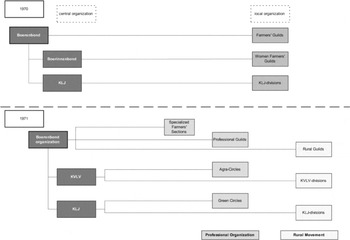
In the autumn of 1970 the board of directors of the Boerenbond presented a revised Charter, which was quickly approved by the Bondsraad (the Boerenbond's ‘parliament’). From that moment, the Boerenbond was split into a highly specialised farmers’ league consisting of male farm guilds, agricultural circles for farming women and farming youth; and a parallel, broader Rural Movement with parochial Rural Guilds and divisions of the KVLV (Catholic Socio-economic education for Rural Women) and the KLJ (Catholic Rural Youth) whose aim was to ‘conduce to the construction of society and to promote the religious, moral, spiritual and physical development of rural families.’Footnote 47 (Figure 1)
Structural changes of the Boerenbond.

In the spirit of the age, a growing demand for more democracy and participation clearly affected the reorganisation process. One of the first documents concerning the reorganisation stated that ‘the self-awareness of farmers [would] increase’ and that ‘farmers [were] longing for more participation’. Hinnekens and Boon obviously realised that they had to give a voice to their farming members, to prevent them from leaving the organisation. It was likewise suggested that they should exploit instead of thwarting the growing tendency of the guilds towards independence, flying in the face of the central organisation. The decentralising of the debate, with the broad consultation in the beginning, exposed a remarkable mental shift away from the Boerenbond’s former centralist and oligarchic traits. Still, members themselves remained firmly in the background, as employees and central organisation leaders directed the reorganisation process. The leadership feared that Boerenbond members would start to question the guilds’ structure openly. They emphasised that the consultation round was only meant to collect information.Footnote 48
Unsurprisingly, the final new structure only partly gave in to the democratic tendency. The professional organisation had a bottom up structure with indirect delegation up to the upper ranks. The local farmers’ guilds were represented in district, provincial and national decision-making bodies, thus showing some respect for grass-roots sentiment. The Rural Movement, in contrast, remained controlled from above and was ruled in a purely top down manner. At the provincial and national levels, the movement had some representatives on advisory committees, but without real democratic rights.Footnote 49 The Boerenbond was not willing to establish a true double democratic structure and the integration of the rural population by socio-cultural education still showed some paternalistic tendencies. In this respect, it is symptomatic that Nackaerts and the Culture Department were not involved at all in the discussions concerning the reorganisation. He warned in vain against the ‘segregation policy’ of the Boerenbond. Splitting the organisation into professional farmers’ guilds and Rural Guilds was dangerous, in his eyes, because of the risk of isolating the two groups. Farmers would lose their interest in things outside the profession, whereas rural members would not care or bother about farmers’ problems.Footnote 50
In other words, the reorganisation was born out of a clearly felt need for change. Some foreign writers and examples supplied theoretical inspiration, but practical adjustments to old structures were essentially a technical and institutional matter. To stay in touch with modernising farmers, the Boerenbond chose to form specialised guilds across parochial borders, big enough to remain viable. The question remained of what to do with the old guilds. The consensus grew to offer more than just purely material services and to maintain and elaborate on the general socio-cultural work. In doing so, the Boerenbond sought to tackle the criticism that it directed excessive attention towards the material side of farmers’ lives. The Boerenbond hung on to its carefully built power structure in the villages in the Flemish countryside. Spurred on by the economic departments and inspired by the departments for women and youths, institutional changes were made.
Notwithstanding the Boerenbond's increasing attention to the socio-cultural education of farmers, the entire debate was primarily concerned with modernising and strengthening the Boerenbond as a professional organisation. In a way, we can identify the Rural Movement as a peripheral phenomenon of the modernised professional Boerenbond.Footnote 51
5. Filling an empty box: the activity of the Rural Guilds, 1971–1980
5.1. New structures
When new structures arose during the early 1970s, the prevalence of the professional agricultural organisation over the Rural Movement was striking. The big farmers’ demonstration against the Common Agricultural Policy in Brussels on 23rd March 1971 played a key role in the implementation process. Pressured by these circumstances, Beddegenoots declared that ‘the restructuring cannot stay an academic discussion anymore. [. . .] We have to go forward now, but remain vigilant’.Footnote 52 In the winter of 1971 to 1972, professional farmers’ guilds were established across parochial boundaries, alongside specific sections according to specialisation. For example, a dairy farmer would become a member of the professional guild of his municipality, not his parish, and of the dairy section of his region. He also automatically remained a member of his old parochial guild, now called a ‘Rural Guild’. Indeed, the ‘old’ parochial guilds were merely renamed ‘Rural Guilds’, without any deep reflection on their role. By slowly and silently intensifying their rural oriented activities, these guilds would then gradually evolve to become part of a real, broader, rural movement.Footnote 53
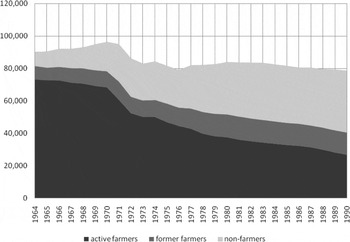
The relatively slow progress illustrates the caution with which the reorganisation was viewed. The Boerenbond presented its new corporate structure as a mere practical adjustment, rather than a spectacular change in course. It emphasised the gradual character of the reorganisation, likening it to existing trends within the KLJ and KVLV.Footnote 54 Nevertheless, the new structure required a mentality shift on different levels, which was not always easy to obtain. The concern about massive membership loss due to the shrinking of the agricultural population was one of the main motivations to reorganise the Boerenbond. Before 1970 there was no significant membership decline whereas, after the reorganisation, membership figures plummeted. The professional farmers in particular pulled out. Between 1970 and 1973 the Boerenbond lost more than 18,000 farming members. In addition, the total of non-agricultural members grew steadily from 18,162 to 22,740 (Table 1 and Figure 2). A special campaign for membership recruitment was therefore launched. The goal of ‘Objective 5000’ was to stop the annual member loss and attract 5,000 new members, only half of them professional farmers. Competition between guilds was stimulated through contests and prizes for the most successful membership drives. At first, these efforts generated a positive effect. By 1974, over a thousand new members - three quarters of them non-farmers - joined the guilds. But in 1975 and 1976, the Rural Guilds lost over 5,000 members, mostly professional farmers, in line with the fast declining farm population.Footnote 55
Membership figures of the Boerenbond, sorted into groups according to profession.

Fully and accurately explaining the logic behind the changes in membership is a daunting task. The economically and socially turbulent years of the early 1970s seem to have caused a decline in farmers’ membership figures. This reduced membership level also seems to suggest a malaise within the newly created Rural Movement. From the outset, the reactions recorded by the travelling staff of the Boerenbond were not universally positive. Even Maurice Beddegenoots admits that he initially had doubts about the future of the Rural Guilds.Footnote 56 Despite the extensive consultation in the reorganisation years, many farmers decried the lack of joint decision making and the top down approach to the restructuring.Footnote 57
In the mid seventies, many members and employees of the Boerenbond shared the view that the Rural Guilds had got off to a bad start. Farmers’ guilds were too abruptly renamed ‘Rural Guilds’, without giving sufficient reasons. Reflection on the content of the new Rural Movement had barely taken place. The Rural Movement was, from the outset, essentially an empty box. In a recent interview, Beddegenoots described his task in the early 1970s as literally ‘giving content’ to the Rural Guilds. The guilds themselves were often reluctant or even defiant about the shift, with reports of explicit opposition to the inclusion of non-farmers in committees or even the guild as such. In the most agricultural areas of Flanders, in particular, many continued to call themselves ‘farming guilds’. Nevertheless, there were some well functioning Rural Guilds with flourishing socio-cultural activities, but provincial representatives argued that these were isolated and not organically bound together into a movement for and from the rural environment. In many guilds the active members were still mostly farmers. New people were not attracted because solid grassroots work was lacking, mainly due to the malfunctioning of the committees in the local guilds.Footnote 58
5.2. Identity reflection
This vicious circle was broken by both a change in approach and an ideological deepening of the Rural Guilds. Firstly, more attention was paid to the ongoing training and supervision of the existing committees of the Rural Guilds and to the recruitment of new committee members. This required a major mentality shift for the still heavily agrarian and technically skilled corps of consultants.Footnote 59 Secondly, a consensus was reached about an intensified political engagement of the Rural Movement. A clear call for action was uttered: ‘We have been claiming for almost two years now that the Rural Movement is there to take care of the specific problems of the rural environment, now it is time that we address these specific problems. We cannot keep on talking about problems, we must tackle them’. In this respect, the Rural Guilds adopted the practice of ‘theme years’, highlighting one aspect of village life, as in, for instance, ‘A school for each village’ in 1974 to 1975.Footnote 60
Thirdly, the adoption of the Decree on ‘socio-cultural education for adults in a group context’ of 4th July 1975 provided additional government subsidies for those Rural Guilds which organised at least six socio-cultural activities a year. Although this meant a lot of paperwork, these D-guilds, as they were known, underwent a revival, with activities varying from film projections, family lectures, village festivities, folkloristic days, Masses on farms, excursions and open farmhouses to sports events, cooking classes and very popular gardening courses. The decree provided for a fully funded staff and thereafter several consultants were solely responsible for the socio-cultural activities. By fulfilling some administrative obligations attached to this Decree, such as adopting a distinct membership card, a more distinct profile for the Rural Movement was promoted in relation to the Boerenbond as a whole. Furthermore, the Boerenbond made every effort to fit the institutional adjustments, as proposed in this new Decree, into existing Boerenbond structures in order to safeguard the unity between all Boerenbond branches.Footnote 61
Finally, the Rural Guilds started to reflect on the character of the countryside. This contemplation went hand in hand with people musing on the position of the Boerenbond itself within that changing countryside. The main expression of this new identity consciousness was the ‘Fundamental Vision of the Rural Guilds’, a new set of maxims published in 1975. The aim of this declaration of intent was to justify the existence of the movement by defining a distinct rural identity. For ‘without a clearly formulated image in respect of the members, employees and the outside world, the movement cannot achieve the dynamism and depth that it needs to reach its objectives.’Footnote 62 The Fundamental Vision (Grondvisie) was, in essence, a detailed version of the very vague objectives written down in the Charter of the Rural Movement of 1970.
In the Fundamental Vision, an analysis of the rural status quaestionis was given, followed by a clear formulation of purposes and strategies. The Rural Guilds adopted a definition of the countryside as a separate spatial category with some typical characteristics and functions. These were agriculture, in the first place, but also green areas, recreation, tourism and rural dwellings. Typical problems were also identified, such as too fragmented public facilities and limited municipal services. Considering the obvious influence of the sociologically skilled employees in the Boerenbond, it is not surprising that this definition subscribed entirely to the sociological trends of that time.Footnote 63 The sociologists believed that, in a world of growing material wealth, a corresponding level of well being was not attained. Rapid changes accentuated the need for socio-cultural education, especially in the countryside. More than ever the typical characteristics of rural people, such as their presumed bond with nature, religious character and respect for family life, were held to be threatened as suburbanisation swallowed up much of the countryside. Thus, the main objective was to promote rural well being by preserving and promoting the specific rural values and to get rid of welfare deficiencies due to inadequate public and social structures in the countryside.Footnote 64 Within the work method, a ‘socio-cultural education for adults in a group context’ is put first, explicitly referring to the Decree. Finally, the ‘Year of the Village’ in 1978 may be regarded as an extrapolation of the ongoing process of identity formation and the new practical approach focusing on specific problems. The ‘Year of the Village’ was a government campaign, conceived and planned by the Boerenbond's public relations services and subsequently monopolised by the Rural Guilds. Several central leaders and inspectors readily admitted that the Year of the Village gave the sluggish Rural Guilds much needed momentum and provided the Rural Movement with an opportunity to gain ground within local communities.Footnote 65
5.3. The Rural Movement: a unique ‘movement’?
Characterising itself as an ‘organised, Christian and socio-emancipational movement’, the Rural Movement tried to confirm its identity, both as an idealistic group in a turbulent society and as part of the old established power structure of the Boerenbond. The Rural Movement thus tried to recycle some popular campaign themes and to integrate these into their own organisation. Relying on its Catholic origins, it offered a plausible alternative for popular existentialist and Marxist world views.Footnote 66 It presented itself as a valuable alternative for people in search of a better world. The Rural Movement addressed the ‘many people’ who ‘without joining the active and sometimes extreme protest groups, [correctly diagnosed] that the economic boom of our society causes many unwanted phenomena and social problems’. Movements ‘on the fringes of society’, like the hippie movement or nature conservationists, were searching for ways of life that only a less or differently urbanised society could offer. It claimed that these ways of life still existed in rural societies, albeit in latent and less conscious forms. The Rural Movement proposed rural society as a unique opportunity for a better society on a human scale.Footnote 67
An apparently similar ‘rural consciousness’ arose and ‘village action’ gained popularity in several European countries. In the late 1970s, rural village action groups or movements were founded in many countries. In 1975, the Dutch Association of Small Towns and Villages was founded in the Netherlands to protect village interests and promote their viability. In 1976, the first Village Action Groups were created in Scandinavia. In the Belgian region of Wallonia, a predecessor of the Fondation Rurale de Wallonie was founded in the mid seventies. And, in 1980, the ‘Rural Voice’ arose in England. These local grassroots action groups were established to address issues of rural decline, agricultural change, migration, centralisation and European Union accession.Footnote 68 In contrast to the Rural Movement, they all had non-agricultural origins and were conceived in a bottom up fashion. Inviting all rural inhabitants to join non-professional ‘Rural Guilds’, the Boerenbond effectively pre-empted the founding of village action committees, which were potentially more critical of modern agriculture. In the 1980s, the Boerenbond could not prevent a wave of hostile public reaction to modern farming. Nevertheless, by attracting non-farming members, it could extend its membership capacity in favour of modern agriculture, thereby enabling itself to be of great weight in countering the criticism of environmental movements against modern agriculture.
Moreover, by studying the membership figures, the dualistic option seemed well chosen. Firstly, compared to other professional agricultural organisations in Western Europe, the decline in membership of the Boerenbond was less pronounced. Between 1964 and 1990, the Boerenbond lost only thirteen per cent of its members while, for example, the Danish farmers’ unions (for smaller and bigger farmers) shrunk by sixty per centFootnote 69 and the national Catholic, liberal and protestant farmers’ unions in the Netherlands saw their memberships decline by twenty-five to thirty per cent.Footnote 70 In Britain, the National Farmers Union lost over half of its members between 1953 and 1990.Footnote 71 Thanks to a growing membership of non-agricultural members, the Boerenbond succeeded in overcoming the membership's low-point of the mid seventies. The percentage of non-farming members increased from ten per cent in 1964, to thirty per cent in the mid-seventies and then to almost fifty per cent in 1990 (Table 1). This percentage varied considerably between more agricultural and urbanised Flemish regions. Many of these non-farming members had remarkably close family bonds or economic affiliations with the agricultural sector. Secondly, the Boerenbond also succeeded in attracting modern farmers and thus stayed the most representative farmers’ union in Flanders. After a difficult start, with a plunging membership in the early 1970s, the percentage of reached farmers, or the ‘pull’ of the Boerenbond, surpassed the level of 1964 in 1980. Until 1990 this ‘attraction’ level fluctuated between fifty-two and fifty-five per cent (Table 2).
6. Conclusion
The division of the Boerenbond organisation into a specialised agricultural organisation and a broader Rural Movement countered both the rapid shrinking of the farm population and the strong specialising of modern farmers. It succeeded in diminishing the effects of the general decline in the number of farmers by attracting non-farmers. In doing so, the Boerenbond maintained and, little by little, even extended its support in the countryside. It managed to institutionalise its image of the ‘rural’. Even without numerous farmers, the Boerenbond still had a sufficient number of members which, in line with the original aim of the restructuring, helped to safeguard its political, economic and social position in the Flemish multipurpose countryside.
By setting up a new structure for a Rural Movement that included the ‘more culturally minded’ women and youth, the Boerenbond halted the ongoing erosion of its unity. Until the late 1990s, the reorganisation of 1971 endorsed the affiliation between all branches, divisions and departments through intertwined, structural, personal and administrative bonds.Footnote 72 In this way, the Boerenbond was able to keep hold of its expanding and increasingly professional economic departments much longer than, for instance, the Dutch agricultural organisations. Margreet van Der Burg argued that the situation in the Netherlands originated from a division between agricultural modernisation, which was regarded as appropriate for men, and rural development, a stereotypical concern for women and youth. The once felt complementarities between these two eventually resulted in an awkward division: farmers were no longer interested in broader, socio-cultural, rural developments while women and youth alienated themselves from agricultural, economic or political issues.Footnote 73
A farmers’ union opening up to non-farming members in a society with emerging new social movements seems progressive at first glance. But, the objectives and motives of the Boerenbond leaders were not that revolutionary. The overall prevalence of agriculture in all stages of discussions and implementation is striking. The choice of socio-cultural education for the rural male population was subordinate to the modernising of the farmers’ organisation. The Rural Movement was not democratic and did not have fluid boundaries or bottom up structures. On the other hand, it originated from a similar sensitivity to contemporary needs. In essence, the Boerenbond restructured itself in 1971, opening up a potential member market without losing too many of its conservative supporters.
Although the transformation of the Boerenbond largely determined the organisation's future, the reorganisation was, in some respects, less drastic than it initially appeared. The Boerenbond already had some experience with socio-cultural education. The women's and youth branches served as an inspiration and the economic departments of the Boerenbond provided convincing economic motives. Besides, the time lapse between the first thoughts about possible restructuring and the last structural and substantive changes was almost ten years. It was a while before the empty box of the Rural Movement was filled with content and activities, for it is easier to change the blueprints of organisational charts than to change people's behaviour. Leaders or representatives of an organisation might say, and perhaps also believe, that things have changed, while old routines may persist within the organisation.Footnote 74
Nevertheless, the Boerenbond succeeded in effectively transforming itself, distinguishing itself from foreign initiatives. Simultaneous village action movements elsewhere in Europe were, in contrast to the Rural Movement in Belgium, grassroots organisations without agricultural purpose.Footnote 75 Similar professional farmers’ unions in Western Europe had to cope with significantly bigger membership losses. Thus, the history of this old, corporatist and Catholic farmers’ league of the nineteenth century, incorporating a Rural Movement with new socio-cultural goals, suggests that this is a unique case in north-western Europe.
Tables and illustrationsFootnote 76
Acknowledgements
I am grateful to Dr. Jeremy Burchardt and my colleagues at the Leuven Ruralia Group for their expert advice and comments on the early drafts of this paper.