Between January 1 and June 30, 2017, adenovirus DNA was detected in bronchoalveolar lavage (BAL) specimens collected from 3 of 314 patients. On July 8, 2017, a patient (ie, the index patient) was admitted to the surgical intensive care unit (SICU) with adenovirus pneumonia. Between July 14 and July 26, multiplex PCR testing of BAL specimens from 7 other patients in the SICU identified adenovirus DNA. An outbreak investigation was undertaken.
Methods
Medical charts, clinical microbiology databases, bronchoscopy procedure logs, bronchoscope reprocessing logs, bronchoscope cleaning, and high-level disinfection (HLD) practices were reviewed. Case patients were those, other than the index patient, whose BAL yielded adenovirus by (qualitative) multiplex polymerase chain reaction (PCR, Verigene Respiratory Pathogens Flex test, Luminex, Austin TX) in July 2017. Healthcare workers assigned to the SICU or bronchoscopy were assessed for signs and symptoms of adenovirus infection (ie, fever, myalgias, cough, and conjunctivitis). Nasopharyngeal swabs and sterile saline specimens drawn through bronchoscopes were submitted for multiplex PCR testing, and bronchoscope specimens were also placed in culture for virus.
Results
Epidemic curve
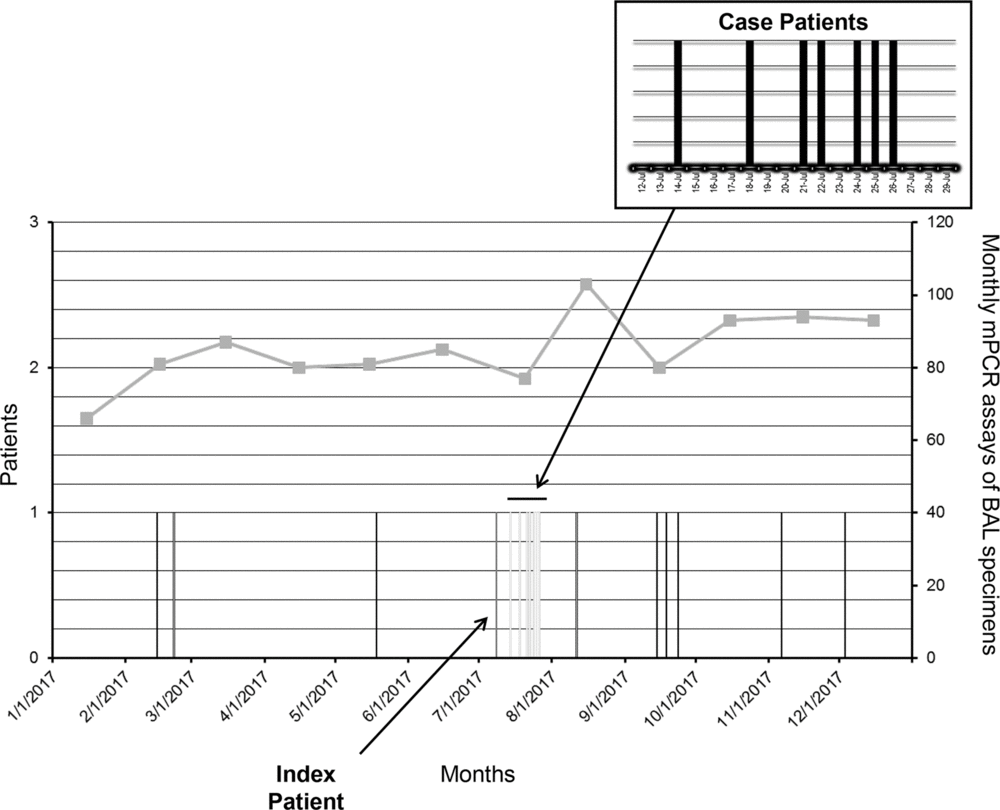
Figure 1 provides the dates of the first identification of adenovirus by PCR of BAL, by patient, from January through July 2017 at our institution. A notable increase in the number of new patients with BAL specimens yielding adenovirus by PCR is evident in July.
Epidemic curve and BAL specimens tested monthly for adenovirus DNA, 2017.

Index patient
The index patient was a previously healthy adult transferred to the SICU from another medical facility on July 8, 2017, with subacute fever, diffuse morbilliform rash, lymphadenopathy, arthralgias, and acute hypoxic respiratory failure. Multiplex PCR testing of a July 8, 2017, BAL specimen detected adenovirus DNA. A quantitative laboratory-developed adenovirus PCR of a BAL specimen collected 5 days later identified >200,000 copies/mL. Evidence of other infection or disease was not identified. The patient was placed on droplet and contact precautions on July 8.
Case patients
All case patients were in the SICU when adenovirus DNA was detected in their BAL. Case patients 1 through 5 underwent bronchoscopy for evaluation of postoperative shock, hospital-acquired purulent tracheobronchitis, ischemic necrosis of airways after lung transplant, or hospital-acquired pneumonia. Case patients 6 and 7 underwent bronchoscopy for evaluation of community-acquired pneumonia.
Bronchoscope, index and case patients, and healthcare worker evaluations
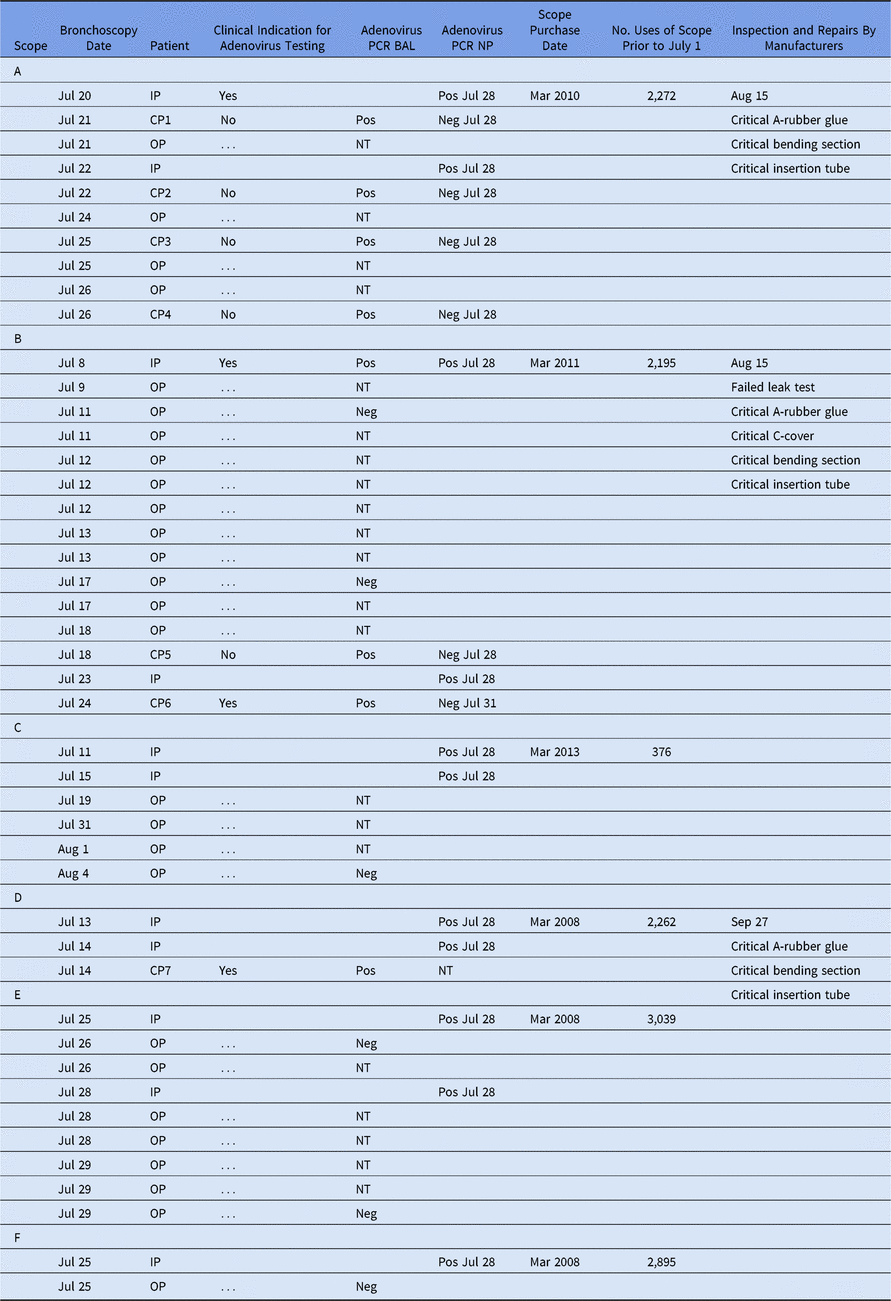
On July 28, following cleaning and HLD, specimens of sterile saline were drawn through the suction channels of 3 bronchoscopes that had returned BAL specimens containing adenovirus DNA (Table 1, scopes A, B, and D). Multiplex PCR testing of the saline specimen collected from 1 bronchoscope (scope A) identified adenovirus DNA, but viral culture did not yield growth. Nasopharyngeal swab specimens were collected from all patients in the SICU and from all case patients who were still hospitalized (6 of 7 case patients, 18 patients in all). The only nasopharyngeal swab specimen that yielded adenovirus DNA by PCR was the specimen collected from the index patient. No healthcare workers assigned to the SICU or bronchoscopy were found to have current or recent signs or symptoms of adenovirus infection.
Results of Clinical Testing and Outbreak Interventions by Patient and Bronchoscope in 2017

Note. BAL, bronchoalveolar lavage; CP, case patient; IP, index patient; Neg, negative; NP, nasopharyngeal swab; NT, not tested; OP, other patient; PCR, polymerase chain reaction; Pos, positive.
Interventions
All case patients were initially placed on droplet and contact precautions. In the absence of corroborating clinical or laboratory (nasopharyngeal swab PCR) evidence of adenovirus infection, these precautions were withdrawn on August 4, 2017. Reviews of bronchoscope cleaning and HLD practices were performed and no deficiencies were identified: (1) precleaning completed with saline rinse of channels and gauze wipe of scope exteriors in procedure areas followed by leak testing; (2) cleaning of all internal and external surfaces with a fresh sink of measured concentration of surfactant based agent approved by scope manufacturer; (3) high-level disinfection using 0.55% ortho-phthaladehyde in scope compatible automated endoscope reprocessor, completion of all cycles checked before scope removed; and (4) scope storage in a ventilated cabinet with date of reprocessing attached. Reprocessing was performed by 1 of 7 licensed respiratory therapists who had successfully completed competency-assessed reprocessing training.
From July 28 to July 30, 2017, bronchoscopes A, B, and D underwent ethylene oxide (EtO) sterilization after cleaning and HLD and were then sent to the manufacturer for inspection and repair. Saline specimens drawn through the suction channels of these bronchoscopes after EtO sterilization and before return to the manufacturer did not yield adenovirus DNA by PCR. Prior to manufacturer inspection, there was no visible damage and the bronchoscopes passed leak testing. At the manufacturer, 1 scope failed leak testing, and internal damage in all 3 scopes was identified and repaired. Age and cumulative use of bronchoscopes were not associated with detection of adenovirus DNA in BAL specimens of case patients. Results are summarized in Table 1. In addition to the SICU, bronchoscopes were used in a separate suite of the hospital building for care of other inpatients and outpatients.
Postoutbreak
The frequency of recovery of adenovirus DNA in BAL specimens decreased, and the index patient did not undergo bronchoscopy after July 2017 (Fig. 1).
Discussion
A sharp increase in adenovirus DNA detection in BAL specimens in July 2017 was associated with adenovirus detection in patients with conditions for which adenovirus infection would not be anticipated and without corroborating clinical or nasopharyngeal molecular evidence of adenovirus infection. The frequency of adenovirus DNA detection in BAL specimens fell after EtO sterilization of selected bronchoscopes, inspection and repair of bronchoscopes by the manufacturer, and cessation of bronchoscopic evaluation of an index patient with adenovirus pneumonia. The July 2017 outbreak was attributed to pseudoinfections resulting from nonviable adenovirus DNA remaining on bronchoscopes after cleaning and HLD. To our knowledge, this is the first report of an adenovirus pseudo-outbreak associated with bronchoscopy or other medical care. Reference Archibald and Jarvis1–Reference Weber and Rutala5
Although managed successfully as an outbreak of pseudoinfections, the certainty of pseudoinfections is challenged by 3 considerations. First, some infections of case patients may have been subclinical, and in turn, related to true transmissions from the index patient. Second, adenovirus DNA is not always detected by PCR of nasopharyngeal specimens when it has been identified by PCR of lower respiratory specimens of patients with adenovirus infection. Reference Azadeh, Sakata, Brighton, Vikram and Grys6,Reference Wurzel, Marchant and Clark7 Third, in the absence of culture, speciation, and additional serologic or molecular typing, the adenovirus DNA identified in the BAL specimens could not be confirmed to be derived from the infection of the index patient. Nonetheless, the epidemiologic, clinical, and laboratory evidence for pseudoinfection of case patients 1–4 by persistence of nonviable adenovirus DNA on bronchoscope A, as summarized in Table 1, is compelling. Viral culture of the saline specimen collected from that bronchoscope did not yield adenovirus; however, inactivation of adenovirus infectivity by disinfectants, despite preservation of viral genome, has been known to occur. Reference Sauerbrei, Sehr, Eichhorn, Reimer and Wutzler8
The likely source of the adenovirus DNA identified in the BAL of case patient 5 was not established. Possible sources include in-hospital transmission from the index patient or an unrecognized adenovirus infection in the patient for whom bronchoscope B was used before being used to collect the BAL from case patient 5.
Ultimately, it could not be determined whether the outbreak of adenovirus pseudoinfection was caused by internal damage of 1 or more bronchoscopes or whether the infection was resolved by EtO sterilization of bronchoscopes, manufacturer repair of internal bronchoscope defects, or cessation of bronchoscopy of the index patient. Lack of identification of adenovirus DNA in a saline specimen drawn through bronchoscope A after EtO sterilization suggests that the use of EtO was helpful.
Acknowledgments
Mayo Clinic does not endorse specific products or services included in this article.
Financial support
No financial support was provided relevant to this article.
Conflicts of interest
All authors report no conflicts of interest relevant to this article.