




No CrossRef data available.
Organizing Power: The Prospects for an American Labor Movement
Published online by Cambridge University Press: 09 January 2004
Abstract
A comparative perspective on labor unions reveals that the best of all worlds for the workers is coordinated bargaining at thenational level and significant rank-and-file engagement at the local level. But the achievement of national and coordinated bargaining is an unrealistic goal in the foreseeable future in the United States. What American labor can do, however, is to become once again a social movement. In order for organized labor to play its critical role as a countervailing power within the American political system, there must be intensified organizing, internal democratization, increased electoral and lobbying clout, and social-movement unions willing to mobilize with others and, if necessary, on the streets.This paper was originally prepared for presentation at Theme Panel 7, “Politics of Labor,” at the 2002 meeting of the American Political Science Association (APSA) in Boston. The commentators at APSA—Glenn Adler, Ron Blackwell, Sakhela Buhlungu, and Linda Kaboolian —gave me generous and insightful feedback. So did Frances Fox Piven, Robby Stern, Victoria Murillo, Katrina Pflaumer, George Lovell, Jennifer Hochschild, Bernhard Ebbinghaus, Wolfgang Streeck, Fritz Scharpf, Bruce Ackerman, and four anonymous reviewers. I particularly want to thank my two most trusty critical readers: John Ahlquist, my research assistant, and David Olson, my long-term colleague and collaborator. I did not always take their advice but always appreciated it.Previous books include Of Rule and Revenue; Consent, Dissent, and Patriotism; and the co-authored Analytic Narratives
Information
- Type
- ARTICLES
- Information
- Copyright
- 2003 by the American Political Science Association
In the staged version of Nickel and Dimed,1
Intiman Theater, Seattle, 2 August 2002.
My claim is that labor unions are important to American democracy and to the achievement of local, national, and global justice in the twenty-first century, but they are inhibited in these aims by major institutional, organizational, and ideological obstacles. I hope to demonstrate that there are means—some more effective or likely than others—for overcoming these obstacles and making labor organizations a more powerful force for democracy and social justice. Most necessitate the transformation of the dominant business-union paradigm, in which unions fight only to improve their own material conditions, into a paradigm more closely approximating social-movement unionism, in which unions fight for better conditions for all.
The American labor movement is being revitalized. Unions, once bulwarks of white, male dominance, have had to make room for people of color, women, and new immigrants. They have expanded to accommodate not just the craft and industrial sectors, but also the service sector, high- and low-skilled, private and public. Long dormant, the debate about union democracy is surfacing again. The deadening effect of federal structures on local actions is giving rise to a revival of central labor councils and regional mobilization. Successful organizing drives and strikes are becoming more commonplace. The American labor movement is becoming an active partner in a range of social-movement coalitions and reclaiming its role in mobilizing voters on behalf of candidates and public policies. While there are many historical sources for these changes, my emphasis is on the contemporary period, inaugurated with the 1995 election of John Sweeney as president of the American Federation of Labor–Congress of Industrial Organizations (AFL-CIO), and his New Voices slate.
Nonetheless, these are grounds for skepticism about unions and reasons for pessimism about the future of the American labor movement. In the United States and many other advanced industrial democracies, organized labor lacks the political and economic power it once possessed. The era of Big Business, Big Government, and Big Labor has given way to Giant Corporations, Reduced Government, and Weak Labor. Racism, sexism, and xenophobia are still evident within some unions, and there is recurring corruption. Labor organizations continue to be perceived—and sometimes act—as special-interest groups, advocating protectionism at the expense of other citizens and of workers internationally.
Even so, organized labor is arguably the most effective popular vehicle for achieving a democratic and equitable society. This is particularly important now, with the increasing gap between the poor and the rich in the United States and with the apparent atrophy in the democratic character of American executive, legislative, and bureaucratic institutions. International corporations seem to be beyond the laws and control of the national state, corporate boards, or stockholders; political parties can neither mobilize voters nor hold accountable the candidates they elect; there is a well-documented decline in voluntary associations that promote civic engagement; fears of terrorism generate tensions between civil liberties and security.
The size of the polity, the complexity of the issues, the relative passivity of so many of the voters, and the overwhelming clout and money of corporate interests make a system of countervailing powers as necessary as it has ever been but also more difficult to create and sustain. There are very few potential candidates to represent the interests of workers and employees, the bulk of the population. The AFL-CIO is a major contender. Organized labor still claims more than 16.3 million union members, a significant voting bloc when they and their families turn out and pull the same lever. While some of its policies deserve criticism, the AFLCIO remains the primary agent fighting for human dignity and rights at the workplace and the major voice for the concerns of working people, be they middle-class, poor, or unemployed.
In what follows, I explore what has been and could be done to increase the power and influence of the U.S. labor movement, make it an effective advocate of universal social justice, and enable it to help American governing institutions become more democratic and accountable. I come to the problem as a partisan but outside observer whose views may be highly influenced by the experiences of the West, or “Left,” Coast.2
After a recent interview, New York Times reporter Steve Greenhouse noted my relative optimism, which sharply contrasts with the perspective of his more pessimistic East Coast informants. We discussed how that might be an effect of the fact that the old East Coast unions are still lagging behind the innovative and increasingly revitalizing West Coast labor movement.
These challenges are threefold: institutional, organizational, and ideological. Both the legal framework within which unions must operate and the set of rules and procedures that has evolved in relationship to union governance have important consequences for the behavior of union leadership, union rank and file, unrepresented workers, employers, and government. The legislative and regulatory framework circumscribes the tactical repertoire of the labor movement. Legal reform will enable unions to become more effective as a countervailing power, but such change is difficult, particularly given Republican dominance of Congress and the presidency.
The institutions internal to the union movement are also an issue. The tendency to rely on a federal structure within the large internationals reduces local democracy, spontaneous actions, and large-scale, disruptive mobilization. Inter-union rivalry, rather than coordination among unions, still dominates. Union constitutions often circumscribe rank-and-file participation in major union decisions and inhibit spontaneous or disruptive actions. Yet there is evidence of institutional shifts toward democratization, decentralization, and increased inter-union cooperation. How this helps the American labor movement, which lacks the coordinated and centralized national bargaining of some of its seemingly more effective counterparts, will be a major focus of the following discussion.
The decline in union density also represents a significant constraint on labor power. The strength of labor lies in its numbers; the smaller its membership, the less effective its economic power, electoral and lobbying clout, and capacity to mobilize on behalf of social-justice issues. The New Voices leadership recognizes the essentiality of organizing; it and many AFL-CIO affiliates have dedicated significant resources to achieving greater density. Although labor law, sectoral change, and demographic change make the task extremely daunting, there have been some major recent successes. Organizing new union members is not enough, however. Also critical to the resurgence of a labor movement committed to democracy and social justice is its ability to weld alliances with community-based organizations, global-justice activists, environmentalists, and others with similar goals, both in the United States and abroad. This is partially an organizing problem. It is also an issue of willingness to mobilize and, possibly, to use disruptive as well as electoral power. But such mobilization can occur only if the unions represent a progressive ideology upheld by the rank and file as well as by the union leaders.
American labor faces three very different kinds of ideological challenges. The first is the variant of pro-business and neoliberal philosophy that defines unions as inhibitors of free trade and thus a detriment to economic advancement. This perspective reinforces political opposition to labor reform and fosters anti-union action by employers. The second is the left-wing (or globaljustice) ideology that defines labor unions as part of the problem rather than part of the solution. This makes alliances more difficult to achieve and sustain. Finally, there are the values held by labor union members themselves.
Organizational needs within the context of U.S. labor's institutional arrangements tend to encourage business unionism, in which the responsibility of leaders is to improve the workers’ material conditions (hours, wages, working environment, benefits, and other immediate economic interests), provide services to their dues-paying members, and use the political process only to protect their members' jobs and economic well-being. Member responsibility is to pay dues, and to strike when strikes are authorized. Such unions tend to be hierarchic and oligarchic. Socialmovement unions, on the other hand, aim to serve the economic interests of their members while also encouraging membership engagement in larger issues of democratization (within the union and within the larger polity), social justice, and economic equality. Their leaders fight for improvements in the material conditions of their members but also have an agenda that transcends the economic interests of the rank and file they represent. Members pay dues and strike but are also expected to mobilize on behalf of causes beyond their own. These unions tend to be democratic and participatory.
Business unionism may enhance the political and economic power of organized labor as a special interest, but there is serious question about the extent to which it can reconcile the short-term and economistic demands of workers with longer-term concerns for generalized social and economic justice. Unions are by nature protectionist in regard to workers' rights and jobs. This is the sine qua non of unions, bolstered by the incentives inherent in union structures. Much of union behavior derives from the necessity to provide selective benefits in order to ensure membership loyalty3
and from leadership's obligation to deliver decent contracts in order to win reelection. Most workers join unions to improve their wages and working conditions. Although many have social objectives as well, these are not always and everywhere foremost. The effect is that unions fight hard—as they should—for their members' job security, wages, and social protections. Sometimes this is at the expense of others, domestically and internationally, but sometimes it results in a win for everyone.Business unionism is the dominant paradigm in the United States. However, the kind of labor politics advocated here requires social-movement unions. While still in the minority in the United States, social-movement unions are emerging again, and more of the traditional business unions recognize the importance of concerning themselves with issues additional to those that directly serve their members.
To foreshadow the argument: A comparative perspective on labor unions reveals that the best of all worlds for the workers— and, as it turns out, for the economy—is coordinated bargaining at the national level and significant rank-and-file engagement at the local level. But the achievement of national and coordinated bargaining is an unrealistic goal in the foreseeable future in the United States. What American labor can do, however, is to become once again a social movement. In order for organized labor to play its critical role as a countervailing power within the American political system, there must be intensified organizing, internal democratization, increased electoral and lobbying clout, and social-movement unions willing to mobilize with others and, if necessary, on the streets.
Discursus: Does Political Science Help?
The president of the American Political Science Association (APSA), Theda Skocpol, and her predecessor Robert Putnam, both have strong commitments to the rights and welfare of working people and have initiated research programs on social capital, civic involvement, and voluntary associations.4
Yet neither treats the labor movement as an important subject for investigation, let alone a vital source of progressive policies and change.5Similarly, another recent president, Sidney Verba, discusses American unions only in terms of their relative weakness as agents of politicization. See Verba et al. 1995, 384–8, 520–1.
See, e.g., McAdam, Tarrow, and Tilly 2001; Keck and Sikkink 1998. This is particularly interesting given how closely identified Charles Tilly is with the study of labor actions (Shorter and Tilly 1974; Tilly 1978 and 1984). Sidney Tarrow's recent work does address unions (Tarrow 2002).
Unions' political influence, their internal governance, and the labor movement as a social movement have always engaged a segment of the scholarly community, however. There was a flowering of work in the 1940s, 1950s, and 1960s, including important research by several presidents of the political science and sociology associations.7
Notable works include Dunlop 1948 and 1949; Goldthorpe 1968a and 1968b; Goldthorpe et al. 1969; Greenstone 1969; Lipset 1963; Lipset, Trow, and Coleman 1956; Ulman 1955.
Among these are Przeworski and Wallerstein 1982; Lange 1984; Garrett and Lange 1986; Shefter 1986; Rothstein 1990 and 1992; Wallerstein 1989; Wallerstein, Golden, and Lange 1997.
See, for example, Gaventa 1980; Katznelson 1981; Bowman 1989; Crouch 1993; Golden 1990 and 1992; Goldfield 1987 and 1997; Hattam 1993; Johnston 1994; McCann 1994; Franzosi 1995; Pontusson 1991; Streeck 1992; Swenson 1989; Thelen 1991; Seidman 1994; Stepan-Norris and Zeitlin 1995; Milkman 1997; Western 1997; Garrett 1998; Iversen 1999; Robertson 2000; Dark 2001.
To name just a few: Bronfenbrenner et al. 1998; Locke, Kochan, and Piore 1995; Milkman 2000; Ness and Eimer 2001.
Geoghegan 1992; Jacoby 1998; Moody 1997; Century Foundation 1999 are some of the most cited.
There are so many works by labor historians that it would be daunting to cite them all. It is notable, however, that some of the major figures were responsible for initiating the Teach-Ins on the Future Labor in 1996 and after, and for the founding of SAWSJ (Scholars, Artists, and Writers for Social Justice). Several of their recent books address the practices of and policies toward unions. See, especially, Fraser and Freeman 1997; Lichtenstein 2002.
Most economists, even labor economists, treat unions as marginal or irrelevant to their concerns. Among the exceptions are Lars Calmfors, Barry Bluestone, Richard Freeman, David Gordon, Henry Farber, Michael Reich, and David Soskice.
Two very recent books are Silver 2003; Swank 2002.
See, for example, Cohen and Rogers 1995; Freeman and Rogers 1999; Luria and Rogers 1999; Piven 1992; Piven and Cloward 1977 and 2000; Rogers and Streeck 1995.
This extensive literature is informative about the constraints on American labor unions as a force for democratization and social justice, but it also reveals some of the new potential in the contemporary American labor movement. Cross-national and historical comparisons offer perspective on the effect of national institutional arrangements. The most recent literature reveals potential models for dynamic and innovative organizing and political campaigns.
American Unions in Comparative Perspective
The reasons for shifts in the political, economic, and, indeed, social importance of unions are complex and multifaceted. Many of the most significant variables are outside the control of unions and those they represent. My primary concern is with the variables that unions do control. However, first it is worth cataloguing the situation of the American labor movement and putting it in comparative and historical context.
United States
The American Labor movement is a paradox of power. In absolute terms, we are the strongest labor movement in the world. We are the largest labor movement among developed countries, and we are certainly the wealthiest. Our workplace organization is as strong as any country's. Relative to employers, political parties, and governments, however, we are the weakest labor movement in the industrialized world. Our challenge is to harness the advantages of our absolute size, wealth, and organization to rebuild our strength with employers and governments to restore justice to our workplaces and our society.17
— Ron Blackwell, director of corporate affairs, AFL-CIO
In 1954 more than one-third of wage and salary workers belonged to unions.18
Farber and Western 2001, 462; Century Foundation 1999, 26.
Bureau of Labor Statistics 2002a. Table 3.

By 2001 there were 16.3 million union members, down from a peak of 20.2 million in 1978.21
Dark 2001, 16.
Other indicators of decline are plentiful. There were once labor pages in the daily newspapers and reporters dedicated to the labor beat; the first is long gone and the second almost nonexistent. David Greenstone23
famously argued that by the late 1960s, the AFL-CIO had become a powerful campaign organization for the Democratic Party at the state and local level. This remains true in a few cities and states, but most union-based lobbying, pressure politics, and get-out-the-vote campaigns were weak or moribund at both the national and local level by the mid-1990s. There is, however, an ongoing debate about the nature of the current relationship between the Democratic Party and the major union organizations, especially the AFL-CIO and the internationals.24Taylor Dark (2001, 10 and passim) claims, “In the unsettled politics at the end of the twentieth century, unions are still included in the American political system on roughly the same terms that they were fifty years ago.” However, most other analysts note the declining political strength of the AFL-CIO since the 1950s and 1960s.
In 1995 the AFL-CIO elected as its leaders the New Voice slate, composed of President Sweeney, of the Service Employees International Union (SEIU); Secretary-Treasurer Richard Trumka, of the United Mine Workers of America (UMW); and the first woman titled officer, Executive Vice President Linda Chavez-Thompson, of the American Federation of State, County, and Municipal Employees (AFSCME). They ran on a reform platform, summarized in the title of Sweeney's 1996 book America Needs a Raise: Fighting for Economic Security and Social Justice. 25
Their stated goals are to improve the lives of America's workforce—employed and unemployed—by raising their wages, to improve their working conditions, and to ensure the provision of a social floor through government-provided unemployment, health, and other benefits. Their repertoire of tactics includes large-scale organizing efforts, strengthened bargaining power, coalitions with community-based organizations (CBOs), enhanced political capacity in elections and pressure politics, and greater rank-and-file activism and involvement. They are demanding that government once again recognize a wide array of social obligations to all of its citizens, not just the wealthy few. This has meant reorganization of resources and energies. There are new AFL-CIO departments, new programs, and a multitude of new organizers. High-level staff is recruited from among those with extensive labor or social-movement experience at the grass roots, and many have New Left bona fides.Under the guidance of the New Voices leadership, organized labor is counterattacking entrenched employer hostility to workers' rights and trying to transform government into an ally in this effort. Yet success is still elusive. The AFL-CIO has stemmed the decline in union density, but it has not raised the percentage of workers in unions. It was a presence in the 2000 and 2002 national elections, but its influence is not sufficient to give it the political weight it seeks and needs.
Other advanced industrialized countries
Most advanced industrial democracies have decreased in union density since 1950.26
Western 1997; Ebbinghaus and Visser 1999; Golden, Wallerstein, and Lange 1999; Wallerstein and Western 2000.
Wallerstein and Western 2000, 358, Table 1. Data on New Zealand is not available.
There are in fact multiple dimensions of political and economic power, as the French case makes clear.28
For particular country accounts, see Ebbinghaus and Visser, eds. 2000; Martin and Ross 1999; Richards 2001; Piven 1992.
Calmfors et al. 2001, 79. Also, see Visser 2000, 107.
Calmfors et al. 2001, 79–80. Also, see Traxler, Blaschke, and Kittel 2001, 107.
Bernhard Ebbinghaus and Jelle Visser argue for analyzing labor movements according to their national institutional configurations, for it is these that “structure the alternatives for strategic choice given the ongoing changes and new challenges.”31
Ebbinghaus and Visser 1999, 155 and passim.
Additional confirmation for this finding is in Western 1997; Iversen 1999; Wallerstein and Western 2000; Iversen, Pontusson, and Soskice, eds. 2000; Calmfors et al. 2001.
Calmfors et al. 2001, 113, 121; Traxler, Blaschke, and Kittel 2001, 225.
There is also considerable confirmation for Bo Rothstein's argument that advanced industrial democracies with unemployment insurance run by unions (the Ghent system) are likely to engender a more powerful labor movement.34
Rothstein 1990 and 1992. For confirming evidence, see Western 1997; Ebbinghaus and Visser 1999; Wallerstein and Western 2000; Traxler, Blaschke, and Kittel 2001, 225.
Another important set of institutions includes arrangements providing significant union access to the workplace or other forms of workplace representation.36
Ebbinghaus and Visser 1999, 143–4, 150–5. Also, see Calmfors et al. 2001, 45–6.
Calmfors et al. 2001, 32, report on these surveys.
See Calmfors et al. 2001, 81–2, for a general discussion. See Visser 2000, 246–8, on the comites d’enterprises , the works councils in France; council members run on union slates even if they are not union members themselves. See Streeck 1984 for the seminal discussion of works councils.
Where unions have significant economic and political power, as they do throughout much of continental Europe, the claims Richard Freeman and James Medoff made for what American unions do for workers are even more evidently true.40
Calmfors et al. 2001, 61–70, makes this claim, based on Freeman and Medoff 1984. On the relationship between coordinated bargaining and pay equity, see Wallerstein 1999.
The explanations for the variation in union density and strength are multiple and complex,41
Ebbinghaus and Visser 1999; Wallerstein and Western 2000; Calmfors et al. 2001; Traxler, Blaschke, and Kittel 2001; and Streeck 2002 offer useful interpretations of some possible causes of union decline.
Newly industrializing countries
Research on the recent past of the advanced industrial democracies indicates the importance of institutional factors in accounting for variations in national labor movements. Research on the early history of those movements and, more recently, on the labor movements in newly industrializing countries is informative about the role of labor as a social movement. Whether unions emerge in response to employers' preferences, autonomous state action, or labor mobilization remains a subject of scholarly debate, but their establishment is, at least in part, a reflection of labor militance.42
Korpi 1978, among others.
See, e.g., Bergquist 1996; Collier 1999; Collier and Collier 1991; Perry 1993; Seidman 1994; Silver 2003.
See, e.g., Bates 1981; Goldberg 1986; Goldberg 2003; Murillo 2001.
There are at least two elements in the success of such movements. The first is that many have a local base at the shop floor and in the community; such unions have a foundation for building membership and creating the kinds of social pressure and selective incentives that in turn facilitate effective collective action. The second is institutional, having to do with both electoral and legislative arrangements. European and Latin American governments and parties tend to be structured in ways that make them more open to labor constituencies and more able to offer organized labor favorable policies and treatment in return for support than the more fragmented and decentralized American governance system normally can.45
Victoria Murillo made this point to me in an email, 12 September 2002.
A comparative perspective affirms the importance of institutions in accounting for the relative weakness of American labor while indicating how essential mobilization, locally and nationally, is for increasing union power. Absent a strong set of labor market institutions and without—at this conjuncture—the political clout to establish them, the best strategy is mobilization through socialmovement unions.
The Historical Context
American employers have opposed trade unions with vehemence unequaled in other OECD [Organisation for Economic Co- Operation and Development] nations.46
Robertson 2000, 23. Also see Jacoby 1991 and Tomlins 1985.
— David Brian Robertson, Capital, Labor, and State
What strongly distinguishes U.S. labor history from that of other advanced industrial democracies is the quality of employer hostility towards unions, the ideology and political strategies of a crucial set of leaders at a critical historical moment, and, most important, the government and legal framework. There may be a chicken-and-egg problem here. To some extent, the attitudes and behavior of employers and unions explain government institutions, but the state philosophy and rules governing labor relations also influence the strategies of the two groups toward each other and toward government. Government institutions, throughout most of U.S. history, have tended to empower bosses and weaken workers.
Employer hostility
Throughout the United States, employer hostility has traditionally been fierce, and union avoidance remains common. Research on organizing campaigns47
finds that the use of management consultants, delaying tactics, illegal firings, and harassment of union activists is relatively prevalent and has negative effects on union representation elections. More impressionistic evidence gleaned from newspaper stories and labor Web sites offers numerous examples of such tactics by management in workplaces as diverse as Wal-Mart,48 the Massachusetts Society for the Prevention of Cruelty to Children (MSPCC),49 and apple packing houses in Washington State.50Employers in the South and the Southwest have been and continue to be particularly anti-union. The Sunbelt was an original locus of the now common shifts of jobs from powerful, higher paid workers to lower paid, more tractable ones. Despite the heroic organizational efforts of the CIO's Operation Dixie in 1946,51
the southern states remain among those with the lowest union density; in 2001 only 5 percent of the employed in Virginia belonged to unions, and only 3.7 percent did in North Carolina.52 Only at the turn of this century did the textile factory, memorialized in the film Norma Rae, finally win union representation and collective bargaining rights. The southern and southwestern states are also most likely to have right-to-work laws: legislation prohibiting mandatory payment (in dues or representation fees) by employees to unions that have negotiated contracts on their behalf.U.S. employers are hardly alone in attempting to block unions; the history of advanced industrial countries and the current experiences of the newly industrializing are chockablock with examples of employer recalcitrance. Repression at the workplace, harassment and firing of union organizers and strikers, and reliance on courts and police are not unique to America. However, U.S. government institutions and laws do seem to encourage and empower anti-union actions by employers.53
Robertson 2000 makes a strong and well-documented argument to this effect that is largely consistent with others who have considered this question. Also, see Sexton 1991. In addition, Orren 1995 makes the related but quite distinct claim that labor disputes have influenced the development of American constitutional law. Stone (1981, 1999, and 2001) tracks the various forms of anti-union activity that reside in the legal structure.
The state, the law, and the NLRB
The philosophy of the U.S. state is grounded in individualism, not collectivism. Individual liberties and voice, not collective or corporatist rights, form the basis for influence and power. Government leadership, with a few noteworthy exceptions, has supported a version of federalism that privileges localisms, including slavery and the institutionalized racism that followed. The national state did not perceive its role as providing a social floor for its citizens. There was a brief moment in U.S. history when government introduced corporatist or, at least, tripartite power sharing arrangements with labor and business. In the 1930s, the Great Depression—with its manifest labor unrest— raised real questions about the future of capitalism and most definitely about the self-regulating capacities of the market. Then World War II created the need for new forms of industrial cooperation and incentives. The labor movement had not yet reached its apex of union density, but it may well have been in its most powerful political moment. It had the potential to cripple the economy and affect the outcome of elections. President Franklin Delano Roosevelt recognized his reliance on the votes of workers and the unemployed, and so did numerous mayors, governors, and legislators at all levels of government.
One initial response was the passage of a major new national law in 1935. The Wagner Act, the popular name for the National Labor Relations Act (NLRA), recognizes the rights of workers to organize and creates a regulatory framework for union representation elections, collective bargaining, and strikes managed by the National Labor Relations Board (NLRB). Employers claimed NLRB favoritism toward labor; and by the end of World War II, both employers and government were increasingly antagonistic to unions, especially militant or radical unions. The result was, first, a change in the appointments and character of the NLRB, and then the more draconian and anti-union refinements embodied in the Taft-Hartley Act of 1947.54
The history of the NLRB—its relationship to political pressures as well as to shifts and splits in the AFL and CIO—is well documented and debated. See esp. Gross 1974 and 1981 and Tomlins 1985.
Moe 1985 and Flanagan 1989 offer interesting statistical evidence. Gould 2000 provides a compelling first-person account from the perspective of a former chair of the NLRB.
What is important for my argument is the nature of the regulatory and legal structure this legislation created rather than the details of the provisions or motivations behind their enactment. The rules made representation and contract negotiation revolve around bargaining units rather than whole firms or occupations or industries. The centralized and coordinated bargaining of many European states did not exist; in the United States, bargaining is generally decentralized, localized, and only occasionally and partially coordinated. The rules also eviscerated the strike weapon. Legal strikes could only take place during contract negotiations— and then only under certain conditions. Taft-Hartley outlawed secondary boycotts and sympathy strikes, further reducing the efficacy of work stoppages.
The industry-wide agreements that characterize Australian and most European bargaining were not available to U.S. unions except in the rare case where sufficient bargaining and strike power could impose coordination through a national contract on the employers. Under the leadership of Harry Bridges, the longshore workers won coast-wise56
This is not a typographical error but rather the terminology adopted by the International Longshore and Warehouse Union in the 1930s.
Lichtenstein 2002, 128.
The institutions of labor law and its administration ensured that full-fledged corporatist relationships could not emerge in the United States—even if there had been serious advocacy for them. The United States experienced no sustained tripartite governance of industry with labor at the table beside government and business. Industrial democracy, as meaningful worker voice in workplace and production decisions, was a demand and a dream of the unions that organized so effectively in the 1930s. In the United States, the collective-bargaining system means that workers can influence firm decisions only to the extent they have the power to enforce democratic inclusion through strike threats.
The absence of an American labor party combines with presidentialism and the nature of the American party system to further inhibit union power. Organized labor has never been and cannot be a partner in a governing coalition. At best it was—and is—a strong interest group within the Democratic Party. It lobbies and pressures, but it does not rule. This may be a result of the opposition of government to such efforts, particularly in the nineteenth century, but it also reflects the attitudes and ideology of a long stream of AFL and CIO leadership.59
See, e.g., Greenstone 1969; Hattam 1992 and 1993; Voss 1993.
With the rise of the CIO, there was a significant change in attitude toward the government's role in labor. There were union leaders and rank-and-file workers agitating for universal benefits and protections, and they did succeed in winning minimum wage, fair labor standards, Social Security, and unemployment insurance. However, the more conservative forces within the labor movement and without ultimately defeated even the mildest social-democratic platforms. A rights-based approach evolved in which workers received individual rather than collective rights; this may have further undermined corporatist demands.60
There is an interesting literature on this question. See, e.g., Forbath 1991 and Lovell 2003. Also see Stone 1992.
Bowles and Gintis 1982; Bowles, Gordon, and Weisskopf 1984; Lichtenstein 2002.
Union governance
The governance of American unions reflects the institutions of American government and the laws regulating labor activity. Both the AFL-CIO and its member internationals are structured federally and vertically; the major power lies with the international unions that form the federation, particularly the largest among them. It is they who pay membership fees to the AFL-CIO; it is their locals that organize, collect dues, and engage in collective bargaining and strikes.
The basis of representation and action in the AFL-CIO is not geographic, even though the other major building blocks in the AFL-CIO are state federations, whose primary tasks are legislative and electoral, and to some extent involve public relations and coordination. In the nineteenth century, central labor councils (CLCs) formed to coordinate political, social, and economic action by the working class within an urban area.62
I draw here largely from Eimer 2001 and Gordon 1999.
Once social-movement organizations, American business unions tend to fit the Michels stereotype of bureaucratized, hierarchical, and oligarchical organizations.63
Michels [1919] 1962; also, see Piven and Cloward 1977.
There are also far too many horror stories of corruption and thuggery. In 1969 UMW reformer Jock Yablonski and his family were murdered after his successful run for the presidency of the union. Tony Boyle, the president he challenged, was convicted of conspiracy in the crime in 1972 as well as for embezzlement from the union. Headlines regularly remind the public of the excesses of the Teamsters, East Coast longshore union, building trade unions, and even chapters of AFSCME and of AFL-CIO President Sweeney's own union, the SEIU. Such stories and other recurring scandals feed general public cynicism toward unions. They also raise questions about the benefits of unions in the minds of potential and actual members.
What Do Workers Want?
American unions confront many of the same economic pressures that unions in other countries face. The internationalization of capital and labor markets, the movement of jobs to locations with low-wage and nonunionized workers, and the consequent race to the bottom is worldwide. Manufacturing is moving from the early to the late industrializers, and the service economy is becoming increasingly predominant in Europe and the Antipodes as well as North America. Globalization, measured by a variety of means, is omnipresent but with large variations in its effects on policies, politics, and union density.64
There is, of course, a large debate about the effects of global economic changes on unions as well as on the role of unions as mediating those effects. See, e.g., Franzese 2002; Garrett 1998; Iversen 1999; Swank 2002.
Unions can exist only if workers want to join them, and unions can be a force for social equity only if the membership is progressive. There are issues about both of these motivations on the part of contemporary workers and employees. There is an even deeper question about how and when workers are likely to support policies and programs for larger issues of social justice.
Do workers want unions?
Richard Freeman and Joel Rogers65
Freeman and Rogers 1999.
Hart Associates 2002, 5–6.
Workers may want unions, but there is nonetheless a decline in the commitment to unions. Memory is short. Those who built and benefited from the unions are no longer the active membership. The “lords of the docks” who work the ports today never had the experience of being the “wharf rats” that prior generations did. If even the ILWU67
Nelson 1988, Kimeldorf 1988, and Wellman 1995 provide useful histories of this union. David Olson and I (with the help of John Ahlquist, Heather Larson, Randy Eng, Adam Goodwin, and Elizabeth Zamora) are currently documenting the extent of participation and democracy over the life of the ILWU.
Are workers progressive?
Karl Marx and Friedrich Engels believed that the proletariat constituted the potential revolutionaries who would bring down capitalism and erect a new world order dedicated to peace, prosperity, and the equality of all. Undoubtedly, workers' organizations have been at the forefront of some important movements for democracy and social change. Recent experiences in South Africa, Brazil, and Korea are illustrative, and labor unions have been essential to the achievement of wide-ranging social-insurance programs and protections, as well as being “the folks who brought you the weekend.” However, few would claim anymore that the workers of the advanced industrial countries are the vanguard of a new world order.
A long tradition in political sociology dating from Robert Michels68
insists that workers are passive, preferring to be led. Seymour Martin Lipset69 goes further, claiming that workers have tendencies toward authoritarianism, extremism, racism, and xenophobia. Others concur that some workers have these tendencies, but insist that these attitudes are contextual and malleable. V.I. Lenin70 believes in the power of leadership to transform the working class. His solution is an ideologically committed intelligentsia that designs organizations and campaigns to overcome the natural economism or short-term material interests of the membership. Adam Przeworski71Przeworski 1985.
Lichtenstein 2002, 275.
Does this claim depend on workers having “nothing to lose but their chains”? Obviously not. Nor does it depend on workers having something but not much to lose. Although the famous “affluent worker” studies suggest that better-off workers have weak loyalty or even linkage to unions,73
Goldthorpe 1968a and 1968b.
It appears that workers' ideological commitments and preference for union style is not a given. There is a literature suggesting that American unions with communist leadership were more likely to be both democratic and socially committed.74
Lichtenstein 2002; Stepan-Norris and Zeitlin 1995.
Levi (forthcoming).
How Can Unions Change?
The mission of the AFL-CIO is to improve the lives of working families—to bring economic justice to the workplace and social justice to our nation. To accomplish this mission we will build and change the American labor movement.
This is the first part of the mission statement of the AFL-CIO, available at www.aflcio.org/about/mission.htm. Here is what follows:
We will build a broad movement of American workers by organizing workers into unions. We will recruit and train the next generation of organizers, mass the resources needed to organize and create the strategies to win organizing campaigns and union contracts. We will create a broad understanding of the need to organize among our members, our leadership and among unorganized workers. We will lead the labor movement in these efforts.
We will build a strong political voice for workers in our nation. We will fight for an agenda for working families at all levels of government. We will empower state federations. We will build a broad progressive coalition that speaks out for social and economic justice. We will create a political force within the labor movement that will empower workers and speak forcefully on the public issues that affect our lives.
We will change our unions to provide a new voice to workers in a changing economy. We will speak for working people in the global economy, in the industries in which we are employed, in the firms where we work, and on the job everyday. We will transform the role of the union from an organization that focuses on a member's contract to one that gives workers a say in all the decisions that affect our working lives—from capital investments, to the quality of our products and services, to how we organize our work.
We will change our labor movement by creating a new voice for workers in our communities. We will make the voices of working families heard across our nation and in our neighborhoods. We will create vibrant community labor councils that reach out to workers at the local level. We will strengthen the ties of labor to our allies. We will speak out in effective and creative ways on behalf of all working Americans.
What can and should American unions do in order to promote the vision of government and social justice the AFL-CIO claims to serve? Reform of labor law in order to remove restrictions on union recognition and strikes and to increase coordinated bargaining would almost certainly enhance union strength, but such reforms are unlikely in the current political environment. Labor organizations can, however, reform their internal institutions of union governance structures; they can commit even more resources to organizing; and they can become socialmovement unions. There are limits to all these strategies, but they are limits worth facing and overcoming to the extent possible.
The tendency toward business unionism is not, in fact, an iron law.77
Sakhela Buhlungu eloquently pointed this out in his comments at the 2000 meeting of APSA in Boston.
Internal reform
The New Voices leadership did not just burst on the scene. It emerged from forces of change already building within the union movement.
Reform groups now exist in a number of internationals. Perhaps the best known is Teamsters for a Democratic Union (TDU), but there are others. Since the 1970s, national constituency groups have formed within the AFL-CIO in order to give the silenced a voice.79
The Coalition of Black Trade Unionists, the Coalition of Labor Union Women, and, of more recent origin, the Asian Pacific American Labor Alliance, the Labor Council for Latin American Advancement, and Pride at Work.
The New Voices regime has shaken up the bureaucracy in the national and some of the AFL-CIO's state offices. The reorganization of departments and programs reflects an effort to speak to the concerns of rank-and-file union members, activists, and constituencies. For example, the Common Sense Economics program engages numerous members and allies in guided learning about how the economy works, who benefits, and who loses. The Corporate Affairs Department has been active in aiding unions in their efforts to interact with employers over capital stewardship and corporate governance and also in developing strategies to achieve workplace democracy and deal with technological change.
Partially in response to the pressure and campaigns by activists within and without, the AFL-CIO is redefining its program through actions. Involvement in the campaigns for global justice, the living wage, and the anti-sweatshop movement reveal, as no words can, a commitment to social justice not only for American workers but for American and world citizens more generally. This is not to deny the very real tensions within the labor movement about what its stance should be on protectionism and free trade, on jobs that go overseas and the workers who take them, on environmental questions, and so forth.80
Rose 2000 recounts such tensions—and, sometimes, their resolution—in the labor, peace, and environmental movements.
A renaissance is occurring at the regional and urban levels too. Under the leadership of several reform-minded and militant executive secretaries in San Diego, Los Angeles, Seattle, Milwaukee, and other cities, central labor councils are becoming more active.81
One consequence of the renewed emphasis on geographically based organizing is the AFL-CIO's Union Cities program, initiated in 1997.Some locals are also transforming themselves. After a detailed analysis of the 14 locals of SEIU, Hotel Employees and Restaurant Employees (HERE), and United Food and Commercial Workers (UFCW) in northern California, Voss and Sherman posit three factors as essential to revitalization of union locals: political crisis within the local, activists with experiences in other unions and social movements, and pressure from the international.82
Voss and Sherman 2000, 325–38.
The following review of American unions' efforts to recruit and retain members and to more effectively use and increase their political and economic clout can only suggest the importance of these factors. Further research is necessary to confirm them and to lay out the conditions under which various strategies are more likely to succeed or to fail.
Organizing: The tactical repertoire
The labor movement needs to increase union density or, at least, to slow its decline if it is to survive and enhance its economic and political power. This requires a national commitment to organizing more workers, openness to involving workers from outside the crafts and industrial core, and a revised and innovative repertoire of organizing tactics. It also involves developing public support and allies from outside the labor movement. The global-justice movement and other new social movements are creating further opportunities for mobilization and coalitions.
The AFL-CIO “new leadership” committed 30 percent of its budget to organizing and asked all its affiliated unions to do the same.83
Unfortunately, there is no hard evidence available yet about the number of unions that have actually made the pledge, to what extent, and with what effect. The evidence remains partial.
Moreover, given the changes in the occupational structure and given the enormity of the task before them, it is not clear that the AFL-CIO unions even possess the resources to mount an effective organizing drive. Henry S. Farber and Bruce Western argue that the decline in density in private-sector unions in the United States is largely owing to the increase in employment in the nonunion sector and the decrease in employment in the union sector.84
To improve density, even to sustain it, thus requires a massive organizing effort, as Figure 2 indicates. It would mean a resource commitment “three times that observed even at the peak of the 1940s growth spurt.”85Farber and Western 2001, 475; also, see 478–9.
Farber and Western 2001, 479–80.

There are nonmonetary obstacles as well. Given the growth of the low-wage service sector and changes in the demography of the labor force, many of the organizing drives target occupations largely composed of people of color, immigrants, and women. Many union locals have traditionally drawn their membership from a particular gender or racial group and are not well prepared to represent another. This sends a negative signal about the openness of unions to diversity, which the AFL-CIO is attempting to counter by recruiting organizers and union staff more representative of the population they wish to recruit. Stories of organizers and workers87
reveal both how much the labor movement has changed and how far it still has to go to be credible among a truly diverse population.There is, nonetheless, some very effective organizing taking place. The public sector had a huge spurt in density in the 1960s and 1970s, largely owing to the passage of legislation that legalized collective bargaining and, in some cases, strikes. Union density in the public sector is, as of 2001, approximately 37 percent, but it has largely held steady since 1983. Unionization is particularly high in local government, especially among the protective services, although it is also high among teachers.88
Recently, new groups within the public sector have begun to organize, however. So have groups with a public-sector connection. Graduate-student teaching and research assistants are winning bargaining rights in states across the country. In Los Angeles 75,000 home care workers voted to affiliate with the SEIU in February 1999. This was the largest election ever won by the AFL-CIO, and its impact was political as well as economic. The SEIU was so effective in part because it defined government as the employer and then used its political clout in an electoral environment that reduced resistance to its campaign. Subsequent gubernatorial proposals to improve the wages and benefits of home care workers appear to have been a direct consequence of the union victory.Public-sector and private-sector unionization rates, measured by both density and coverage, indicate the increasing divergence between the public and private sectors, as Figure 3 illustrates. They also reveal a greater gap between coverage and membership in the private sector, indicating a greater degree of free riding.

Sherman and Voss89
identify major tactics in the private sector, some quite innovative and others reinventions of old tactics, that unions currently use in organizing. The first is intensive worker organizing with an emphasis on direct worker contact through house visits and involvement in workers' committees. In these contacts, the campaign uses a rhetoric of dignity and fairness as well as economic benefits. The second is the corporate campaign, involving research on the target firm and appeals to stockholders, board members, and lenders. The third tactic in the new repertoire is strategic targeting, the selection of a business based on its strategic centrality to an industry rather than immediate worker complaints. Fourth, organizers are seeking to avoid the cumbersome NLRB election process and gain voluntary recognition from employers with simple demonstrations of majority support by the workers. This is the basic repertoire, but organizers are also finding new ways to build coalitions with community groups whose constituents are possible union members and most definitely potential supporters and allies in efforts to win better working conditions and to achieve social justice.Using the repertoire. Both the SEIU's Justice for Janitors campaign90
and HERE's wall-to-wall organizing of the employees of the Las Vegas casinos and hotels illustrate the effective use of this tactical repertoire. Organizers went where people live as well as where they work. Workers mobilized and demonstrated, they shamed bosses and political officials, they got newspaper coverage, and they won.Two interesting recent campaigns illustrate the range in the new tactical repertoire. The Society of Professional Engineering Employees in Aerospace (SPEEA) originally organized in 1944 and became the collective-bargaining agent with Boeing in 1946. SPEEA was primarily a professional association composed of the most highly educated, highest paid, and highest status employees at Boeing; chief executives of the company regularly moved up the ladder from their midst. SPEEA was used to the periodic layoffs in the industry and prepared to deal with them. However, when the culture of Boeing changed after its merger with McDonnell Douglass, SPEEA also changed its style. It affiliated with the International Federation of Professional and Technical Engineers, becoming IFPTE Local 2001, AFL-CIO, in 1999, and in the following year ran its historic strike. These were not people used to being on picket lines, honking their horns when they saw union marches or pickets, or otherwise identifying with unions. They learned fast with the help and support of regional unions, Jobs with Justice and the King County Labor Council. They won the strike and inspired 5,200 Boeing engineers in Kansas City to vote for representation by SPEEA in 2000. They are currently organizing in St. Louis.
In the 1990s, the “permatemps” of Microsoft and other hightech companies began to object to their second-class and insecure status as contract workers. Microsoft classified them as employees of temporary staffing firms, thus denying them health benefits, vestment in the company, advancement opportunities, and even invitations to the company picnic. Yet they did the same work as the permanent employees and had not necessarily chosen to be “permatemps.” In 1998 they officially formed the Washington Alliance of Technology, or WashTech, and affiliated with the Communications Workers of America (CWA), AFL-CIO. Their primary tactic is legal; in 1998 they began to win major settlements in a suit initiated against Microsoft in 1992. They appeal to members and allies through open debates, investigative reports on the industry, and media coverage. The strike is not—at the moment—in their repertoire.
Building alliances.91
I provide a more extended discussion of the issues around union coalition building in Levi 2001. Also see Levi and Olson 2000.
Success often requires community support, but distrust tends to characterize the relationship between unions and their potential allies from community-based organizations. A history of racial discrimination, anti-immigration policy, and downright xenophobia provides part of the explanation for the distrust that ethnic and minority groups feel toward unions. The urbanrenewal programs of the 1960s and, more recently, stadium building, transportation programs, and downtown redevelopment confirm that unions and CBOs often possess competing interests in issues of economic and community development. These public projects create jobs, but often at the expense of the current residents, who find themselves denied membership and apprenticeships in the unions whose members are razing their homes and neighborhoods. The distrust becomes mutual when protests and lobbying put at risk projects for which unions have won hard-fought battles to secure jobs for their members and to ensure employer neutrality during organization and representation campaigns. Lack of confidence in the competence and commitment of potential coalition partners fuels further distrust. Unions fear that community groups lack the numbers and discipline necessary to mobilize people for the picket line, hearing, or ballot box. Community groups perceive unions as using them when in need of allies and failing to follow through on promises.
Union survival is the major motivation for union efforts to win community allies. Ira Katznelson92
finds that the split between the political and economic lives of workers in the United States often undermines political militancy while making ethnic identification trump class in politics. Coalitions may transform that relationship, reinforcing cross-racial class identity among lowwage workers in African American, Latino, immigrant, and other ethnic communities, possibly leading them to be sympathetic to unionization.93Perhaps the most effective way to overcome distrust is by a credible commitment—that is, procedures, rules, and institutional arrangements that ensure automatic sanctions against the trusted if the trust is violated. Credible commitments by unions require going further than rhetorical recognition of the poor as part of the working class or even campaigns for policies supposed to aid the working poor and unemployed, be they union members or not. Credible commitments require unions to grant to CBOs valuable monetary, human, and reputational resources.94
In the language of Williamson 1993, the unions make their resources “hostage” to the CBOs as a sign of their willingness to follow through on promises.
This is not, however, an easy commitment for unions to make. Their pockets, while fuller than those of most CBOs, are not infinitely deep. The source of union funds is member dues, which might better serve the interests of the rank and file if dedicated to direct organizing or lobbying.
Provision of services
Several of the new organizing drives provide services in addition to the promise of improved wages and working conditions. For example, in the late 1990s the Bay Area SEIU 616 turned to the Labor Project for Working Families to provide a service center for the African American, Mexican, Central American, and Filipino women who worked as home care workers.95
The partnership between the SEIU and the Labor Project facilitated access to funding, produced a real team effort—and a real team—among the union and community organizers, and offered the kinds of services and networks that the workers needed to maintain their commitment to the union.UNITE has created Garment Workers Justice Centers (GWJCs) in New York City, Miami, Los Angeles, and San Francisco for minority and immigrant sweatshop workers. The long-term goal is to use a neighborhood base to unionize workers in a dispersed and highly competitive industry. The GWJCs are open to nonmembers as well as members of UNITE; they offer skills training, language education, and education about their rights in the country and at the workplace. In a survey of individuals coming to the GWJC in New York's fashion district, Immanual Ness found that the centers do engender support for unionization and collective action.96
Ness 1998, 95–100.
Building a network
Jobs with Justice (JwJ) coalitions, created in 1987, bring together union, community, and religious activists, and other socialmovement groups, on behalf of issues that affect the rights and welfare of workers and their families. JwJ is closely tied to organized labor but also stands apart from it.
JwJ has supporters sign cards pledging them to attend at least five actions a year on behalf of someone else's fight, and then it follows up with leaflets, mailers, e-mail lists, and phone banks. The Workers' Rights Boards (WRBs) are committees of prominent citizens drawn from the community, legislature, and religious and educational institutions; they hold public hearings on violations of the rights of local workers, organized and unorganized. As of 2001, there were WRBs in 20 cities and JwJ chapters in 29 states and the District of Columbia. There were 63 workplace campaigns, up from 41 in 2000.97
See www.jwj.org.
By mobilizing support for civil rights and community actions as well as for strikes and other labor actions, JwJ builds a network of activists who begin to recognize the overlap in the interests of unions and those of CBOs. By focusing on problems that are of importance to poor and minority peoples, whether or not they are members of unions, JwJ overcomes distrust of unions as narrowly self-interested.
Mobilizing union resources to enhance union power
Organizing new workers while retaining old ones increases union density and power. This is but an initial step, however. To be an effective countervailing power within American democracy, labor organizations must use members and their resources to further enhance not only their own material well-being but also democracy and social justice. Strikes, of course, are the primary weapon by which American unions traditionally have gained recognition and boosted their economic position. Under NLRA/Taft-Hartley restrictions and with a hostile governmental and employment environment, American labor organizations can no longer rely only on the strike even for these important but limited purposes. Despite their significant weaknesses, unions nonetheless possess considerable collective resources: as investors, as consumers, as members of a social movement, and as political actors.
Union pension funds are currently worth more than $7 trillion, but there are also other forms of deferred workers' savings. Investments in housing and long-term economic redevelopment plans that benefit poor people as well as higher paid union members can represent a credible commitment to CBOs. Strategic use of funds can also influence the political economy of regional economic development. Workers' money can have an important impact on revitalizing depressed communities by providing venture capital for firms that would be unable to continue or start up.98
The best discussion of these strategies is in Fung et al. 2001.
These funds, it must be remembered, are pension funds, and their primary use is—and must remain—as social insurance to the workers. The mobilization of the workers' consumer dollars, votes, and protest does not carry this restriction.
Boycotts and consumer campaigns. For much of the twentieth century, unions used their purchasing power to “buy American.” Union labels conveyed to the consumer that a good was “made in the U.S.A.” Dana Frank99
Frank 1994 and 1999.
The potential efficacy of boycotts on behalf of organizing drives is another matter. Most famous is the UFW's ongoing grape boycott, which is at best a limited success story. A less wellknown but major victory for the UFW came after an eight-year campaign to win representation and bargaining rights for the Ste. Michelle vineyard workers. The UFW encouraged consumers and restaurants to boycott wines produced by American Tobacco, the vineyard's owner, until it agreed to recognize the union and grant it bargaining rights. In 1995 the first contract for agricultural workers in Washington State was signed. This signaled the first major UFW victory for many years. On the other hand, the simultaneous strawberry boycott in California was ineffective.
Another recent example of an effective boycott was the one against Jessica McClintock in San Francisco from 1992 to 1996.100
Needleman 1998, 74–7; Louie 2001, 226–8.
Mobilizing workers in social movements
The degree to which labor organizations become involved in domestic and global-justice campaigns is one indicator of the extent to which they are becoming social-movement unions. There remains considerable variation among unions, and the reasons for this demand further exploration. Yet there is evidence of activism on behalf of those for whom a coalition with major American unions is a real boost to the campaign. Unions bring resources to the table in terms of money, reliable participants in marches and other actions, votes, and, often, political savvy and clout. In return, the unions may win political allies during their strikes and political actions, attract potential recruits, and gain renewed experience in action outside the workplace and routine politics.
The following examples illustrate the kinds of social-movement activity in which unions have played a role. Many involve issues of working conditions, wage equity, or international trade agreements that affect jobs and labor standards. These are questions close to the normal concerns of union members even when the campaigns are being fought on behalf of other workers. However, there are also instances of engagement around environmental, human rights, international policy, and other matters that represent a broadening of the vision of what unions should fight for.101
See, e.g., Rose 2000.
Living-wage campaigns. Approximately 80 cities and counties around the country have passed living-wage ordinances that require service contractors in projects using public money to provide a wage adequate to support the workers and possibly their families. The result is a wage usually above the federally mandated minimum. The original living-wage campaigns originated with CBOs such as the Industrial Areas Foundation (IAF) or the Association of Community Organizations for Reform Now (ACORN) but unions or central labor councils have initiated others.102
From the labor movement's point of view, the living-wage campaigns are most likely to be successful and sustained when linked with organizing drives, so even failures in passing legislation can represent labor movement gains. In Houston the ordinance lost citywide but won in low-wage neighborhoods. Moreover, the joint campaign with SEIU Local 100 helped the union succeed in its efforts to organize Head Start workers. In New Orleans, the community-labor coalition targeted hotel workers, which then became the focus of an organizing drive by HERE. In Oakland, where the ordinance passed, the effect was to frighten the Port Authority, which then commenced conversations about how to get covered.103
These examples are drawn from a presentation by Steve Kess, executive director of ACORN, at the Metro Unionism Conference, University of Washington, 13 June 1998.
Despite these and other successes, there are also tensions inherent in coalition building. Many unions do not see enough for them in the living-wage campaigns to justify serious or longterm involvement unless the campaigns are directly tied to organizing drives. Unions are also wary about what CBOs, church groups, and others can bring to the table. When the IAF or ACORN is involved from the outset, unions have assurances that they will have allies able to plan and mobilize as full partners. When no such groups exist, the unions become more wary. Finally, there are real differences of opinion among labor activists about the value of coalition politics. Unions have limited resources and must consider trade-offs. Should energy and resources be put into mobilizing for living-wage campaigns or put straight into workplace organizing? When a first contract is under negotiation, should low-wage workers hold out for the higher living wage or settle for salaries lower than those mandated by a living-wage ordinance but still representative of a victory for that local?
Transnational solidarity. Some American unionists have engaged in solidarity with workers from other parts of the world. There is a history of international confederations and of organized support on behalf of another country's labor actions. In the past few decades, there has been an emphasis on worker-to-worker interactions and on cross-border organizing.
One of the earliest international-solidarity movements developed among unions representing port workers and seafarers. The International Transport Workers' Federation (ITF), founded in 1886, now represents about five million workers from 604 transport trade unions in 137 countries.104
See www.itf.org.uk.
The ITF is one of 10 global-union federations affiliated with the International Confederation of Free Trade Unions (ICFTU). Lane Kirkland, the president of the AFL-CIO from 1979 to 1994, convinced the federation to re-affiliate with the ICFTU in 1981. His motivations were those of a cold-war warrior, and he established a variety of internationally oriented bodies to serve that end. The New Voices leadership transformed these soon after its election. The ICFTU itself evolved to become a forum of workers worldwide. Its Seattle meeting in the days before the World Trade Organization (WTO) Ministerial provided a forum for debate about appropriate policies toward workers in countries to which American and European jobs were migrating.
There are multiple examples of the creation of worker-toworker ties and American union support of counterpart actions overseas.105
Frank 1999, 244–7.
These new coalitions and organizing efforts are full of the tensions that plague such endeavors. All will be hard to sustain, and most will fail. However, as the history of the labor movement demonstrates, persistent and recurring attempts can pay off.
Anti-sweatshop campaigns. Campaigns to eliminate sweatshops in the United States often originate among community groups, but the campaigns against sweatshops internationally usually begin among students. By joining a coalition originating with others, unions demonstrate their solidarity with a larger social movement and their willingness to act in ways not always immediately beneficial to them.
The student-inspired campaigns are aimed at using the purchasing power of the universities and students against companies that provision the sports teams and supply goods with the university's logo. The student actions are initially directed at issues of social and economic justice for workers of developing countries, but as students learn more about corporate and university practices, many become involved in support of living-wage and organizing campaigns on their campuses. The student occupation of the administration building at Johns Hopkins University in February 2000 was intended to raise the wages of university laundry workers. In April 2000 students at Wesleyan University occupied a building and won improvements in wages and benefits for the school's janitors; that same month, there was a similar occupation at the University at Albany, State University of New York, in protest of university complicity with international sweatshops and with a unionbusting food vendor.107
Global-justice campaigns. In Seattle during the week of the WTO Ministerial meetings, November 29–December 3, 1999, the AFL-CIO and its member internationals mobilized money and 30,000+ people for the march and rally on November 30.108
The discussion of the WTO protests and organized labor's role in them draws on the WTO History project (www.wtohistory.org) and on related research, such as Levi and Murphy 2002 and Levi and Olson 2000.
The AFL-CIO was a major presence during the WTO meetings, but there were splits and arguments about tactics and goals. Some believed that the AFL-CIO had not gone nearly far enough in its opposition to the WTO and other international NGOs. Some were determined to be more militant and join the civil disobedience in the downtown core. Some wanted to abolish the WTO, and others aspired to make it work for them and the national unions in developing countries.
Union involvement in the WTO protests, the AFL-CIO leadership of campaigns against the North American Free Trade Agreement (NAFTA), and even fast-track authority could be interpreted—and are interpreted by some—as protectionist and rear-guard stances. By demanding enforceable labor standards and a veto over provisions of NAFTA and other executive trade policies, unions are safeguarding their interests by raising the price of workers overseas. However, some of the unions and some of their members are in fact actively engaged in the enterprise of protecting workers' rights and dignity in the United States and worldwide. Their aim is social justice for all, not just the very legitimate and comprehensible goal of protecting their own jobs.
Increasing political power
Let me conclude my litany of what unions can do by considering their power to mobilize and deliver votes, to act as a pressure group, and to change laws and policies—all in the interest of improving the democratic accountability and responsiveness of American governing and policy-making institutions.
Electoral politics. The New Voices leadership is putting renewed emphasis on mobilizing voters and influencing the outcome of elections through votes, ad campaigns, and contributions. There is some evidence that unions affect electoral turnout. For example, Benjamin Radcliff finds that “each percentage point of the workforce organized elevates turnout by.40 percent… [and] every percentage point decline costs just under half a percentage point of turnout.”109
Radcliff 2001, 408.
There are still questions about how much difference union electoral mobilization made in recent presidential and congressional elections; unfortunately, there seem to be no systematic studies of effectiveness other than those provided by the AFLCIO. In several state-based electoral campaigns, however, the results speak for themselves. Exemplary is the union-led defeat of the California proposition that would have restricted the use of union dues in electoral campaigns.
Not surprisingly, disagreement exists within the AFL-CIO about which candidates to support, and among scholars about the effectiveness of various strategies.110
Dark 2001 addresses the different kinds of circumstances that make electoral and pressure strategies more effective and offers detailed case materials to support his hypotheses about when bargaining power is higher or lower. There is also a literature on party reform that suggests old labor strategies will not work. For example, Nelson Polsby 1983, chapter 4, notes the declining influence of interest groups and political intermediaries who rely on face-to-face mobilization relative to those who use the media.
Union members are far from a homogenous group. Some are pro-choice and some are right-to-life. Some support gun laws, and some are violently opposed to any restrictions on the right to bear arms. Some are racist or sexist, and some are not. To create a more effective voting bloc requires effective mobilization around key issues. It also may require voter education to enable voters to understand that their interests might actually lie with a different candidate or policy than they initially believed. For example, Rick Bender, the president of the Washington State Labor Council, described to one of my classes the process of trying to explain to white, male union members why they should support affirmative action or at least not oppose it. This involved focus groups followed up by revised understanding and framing of the issues.
The AFL-CIO rank and file demonstrated the fallacy of the assumption of only one viable option when so many chose to vote for Ronald Reagan. Some internationals, most famously the Teamsters, are as likely to back the Republican for president as they are the Democrat. There are also those who advocate the formation of a labor party or the use of fusion politics. So far, the AFL-CIO and most of its affiliates have retained their commitment to work within a two-party system and in more or less traditional, if modified, ways. Social scientists, however, have paid relatively little attention to the actual leverage of the recent labor vote and how well the current electoral strategy will work. These questions deserve serious scholarly investigation.
Pressure politics and lobbying. The traditional political-pressure tactic of unions has been lobbying against legislation they perceive as harmful and in favor of legislation they view as positive for the rights of workers. They attempt to maintain access to— and good working relations with—public officials throughout the federal hierarchy in order to influence decisions about responses to strikes and other actions and to encourage sympathetic interventions with employers during representation drives, contract negotiations, and other conflicts. More recently, the unions have joined with other social-justice groups to push for changes in governmental policies and laws.
The AFL-CIO and its state federations have long been an important presence in the halls and back rooms of the country's legislatures. Their well-trained lobbyists screen proposed legislation for its impact on workers and push for legislation that expands workers' rights and benefits. They maintain legislative hot lines, information bulletins, and other forms of outreach to mobilize union activists and allies to call, e-mail, and fax elected representatives. The AFL-CIO is the big gun among the progressive lobbyists; getting the AFL-CIO behind an issue is counted as a major success by the fair-trade and environmentalist organizations and other such groups.111
Jessica Roach, former staff member of Public Citizen, conversation, 26 August 2002.
Linkages with government have produced some important policy initiatives in recent years. With a coalition of unions, CBOs, NGOs, and other social-justice groups, the living-wage and anti-sweatshop movements have had some successes. Livingwage campaigns ultimately require the passage of an ordinance, and this means that the campaigns must succeed in getting allies among local public officials who will formulate the legislation, hold hearings on it, and vote on it. The anti-sweatshop campaign works at the national level. Organized labor was critical in prompting the Clinton White House to institute an industry code of conduct and in initiating and monitoring the Apparel Industry Partnership (AIP) in 1996.112
From the AIP evolved the Fair Labor Association (FLA), an organization whose mission is to enforce an industrywide code of conduct and independent monitoring of companies throughout the world. Its members include apparel and footwear companies, human-rights NGOs, religious groups, and universities. Student groups and unions started in the FLA but later formed the alternative Workers Rights Consortium (WRC) in the belief that the FLA is industry-dominated and thus incapable of real and independent monitoring. More than 100 universities and colleges now belong to the WRC, often in response to campus pressure, but many hold dual memberships in the FLA and WRC.
As secretary of labor, Robert Reich set up the Commission on the Future of Worker-Management Relations under the chairmanship of John Dunlop. Proposals for new forms of workermanagement cooperation in the public sector, alternatives to privatization, and other ideas gathered wide-ranging support and even some limited adoption.113
Even so, the primary aims of designing and then achieving agreement on a new labormanagement relations system and employee participation schemes were dashed.114Lichtenstein 2002, 244–5.
Role of protest and disruption. Elections and lobbying are the stuff of normal politics. But many of the major and breakthrough gains seem to be achieved during periods of extraordinary politics and dynamic contention.115
Formal organizations, such as unions, play an important role in protecting and extending those gains, however, and the tactical use of protest and disruption may actually aid their purposes rather than hurt them, as they seem to have been relearning in recent years. Demonstrations and protests as well as strikes and actions outside the NLRA framework can, if properly managed, alert a wider public to the issues. They can also help create pressure on officials, eager to show voters that they can manage conflict. Seattle, for instance, lost both a mayor and a police chief in the aftermath of the WTO protests. Other cities have passed living-wage ordinances or created government pressure on union-avoiding employers in order to quell labor protest.My emphasis on the democratization of unions and their decentralization in the sense of permitting local militance, creativity, and coalitions to flourish reflects a partial recognition of the important insights captured by Frances Fox Piven and Richard Cloward in Poor People's Movements. 116
Their argument transforms that of Michels. While recognizing the oligarchical, hierarchical, and routinizing effects of the formalization of worker power into unions, they also provide strong support for the claim that workers achieve their greatest gains in those extraordinary moments when mass protest occurs. Workers win significant political, legal, and economic concessions in those periods because their disruptions destabilize normal electoral politics, and politicians then seek means to calm their anger and regulate their behavior. Union leadership, often believing it can win additional concessions and reinforce those already won, will cooperate, exchanging a disciplined union membership for organizational recognition and benefits. Even so, the credible threat of disruption, on the streets as well as through strikes, is an important weapon in the labor repertoire, especially when there is such governmental and employer hostility to unions and to labor rights.The problem with this framing is that it underestimates what unions accomplish in ordinary political periods.117
Piven and Cloward 2000 recognize this and develop their argument further.
Meeting the Challenge
When the union's inspiration through the workers' blood shall run, there can be no power greater anywhere beneath the sun.
—Ralph Chaplin, “Solidarity Forever,” 1915
Ralph Chaplin wrote these words at a time when labor was exercising its muscle through strikes and mobilization in order to win the right to organize and to bargain collectively. Today these words seem outdated. The archaic language is quaint, and the very idea of worker solidarity suggests a bygone era of socialmovement politics. Yet the potential revival of a labor movement is exactly what I have been tracking and advocating.
This is an important historical moment for unions, rivaling the eras marking the formation of craft unions in the mid-nineteenth century and the development of industrial unions in the 1930s. The growth of the service economy, the heightened mobility of corporations and jobs, and the new skills and human capital demanded of workers interact with political transformations in the role and obligations of government. Each of these earlier periods of labor mobilization required innovative organizing and political strategies. Some of today's union leadership is experimenting and developing new repertoires, just as their predecessors did. There is a fresh vitality in American unions, but neither present energy nor past success at transforming the American labor movement ensures future victory. No one knows this better than do the union activists themselves.
I have argued that unions are essential to a vigorous American democracy. As political scientists have well documented, the establishment of government institutions that ensure access to the vote and to other forms of voice is only a first step. Also important is the existence of organizations that offer collective influence to those who lack individual clout in important political and economic domains. However, wide acceptance for this view of democracy is getting farther away, not closer. To obtain it entails two things. First is articulation of a democratic project that moves people to action. The AFL-CIO and the labor movement could play a role here. They have done so occasionally in the past in the United States, and labor movements still do so in other countries. As this paper has documented, there is movement in this direction but hardly enough. The second requirement is a popular political movement to demand governmental and policy change to reduce the effects of the extraordinary inequities in income and service provision. The unions, if they mobilize as a social movement, would be a key player here, too.
To become a powerful and countervailing voice for social justice and enhanced democracy, the labor movement has to grow in numbers and in political and economic muscle. The legal framework inhibits such growth; and the necessary institutional changes are difficult, if not impossible to achieve, without a more receptive governmental and business elite. The only thing that would make the elite more willing to reform the institutions regulating labor unions and labor markets is a palpable increase in the power of labor. The AFL-CIO and its affiliates know how important increased organizing and electoral mobilization is. What we, as social scientists, have confirmed is how much these two reinforce each other. Without members, there are fewer votes and lower turnout. Without votes and turnout, there is a decreased likelihood of reforming the laws that inhibit recruitment and retention.
Given their relative weakness in density and in normal politics, American unions are developing new organizing strategies, new confrontational and political tactics, new models of bargaining, and new coalitions. They must if they are to survive as serious advocates for workers' rights and needs. Equally important is the realization that unions must once again become part of a major social movement in which organized labor plays a crucial role while acting as a reciprocal participant in a larger network of social activists. This means that unions, even business unions, must take on more of the characteristics of social-movement unions. More and more are. An increasing number of unions— although still too few—are democratizing internally, engaging in issues of economic and political justice for others as well as themselves, and increasingly willing to mobilize in actions that bring home to the halls of power their anger, their frustration, and their demands for a more democratic and just society.
References
Baccaro Lucio2001 “Aggregative” and deliberative decisionmaking procedures in trade unions: A comparison of two southern Italian factories Politics and Society 29 2243-71Google Scholar
Bates Robert H.1981 Markets and States in Tropical Africa: the Political Basis of Agricultural PoliciesBerkeleyUniversity of California Press
Bergquist Charles1996 Labor and the Course of American Democracy: U.S. History in Latin American PerspectiveNew YorkVerso
Blackwell Ron2002 Personal communication to Margaret Levi. 29 August, in Washington, D.C.
Bowles SamuelHerbert Gintis1982 The crisis of liberal democratic capitalism: The case of the United States Politics and Society 11 151 93Google Scholar
Bowles SamuelDavid GordonThomas Weisskopf1984 Beyond the Waste Land: A Democratic Alternative to Economic DeclineNew YorkDoubleday, Anchor Press
Bowman John R.1989 Capitalist Collective Action: Competition, Cooperation, and Conflict in the Coal IndustryCambridge, EnglandCambridge University Press
Bronfenbrenner KateSheldon FriedmanRichard W. HurdRudolph A. OswaldRonald L Seeber1998 Organizing to Win: New Research on Union StrategiesIthaca, N.Y.ILR Press, Cornell University Press
Bronfenbrenner KateJuravich Tom1998 It takes more than house calls: Organizing to win with a comprehensive union-building strategy. InOrganizing to Win: New Research on Union StrategiesKate BronfenbrennerSheldon FriedmanRichard W. HurdRonald L. SeeberRudolph A. OswaldIthaca, N.Y.ILR Press, Cornell University Press
Bureau of Labor Statistics 2002a Current population survey. Table 3. Union affiliation of employed wage and salary workers by occupation and industry. Washington, D.C.: U.S. Department of Labor. Available at www.bls.gov/news.release/union2.t03.htm. Accessed 4 December 2002.
Bureau of Labor Statistics2002b Current population survey, news release. Union members in 2001. Washington, D.C.: U.S. Department of Labor. Available at ftp://146.142.4.23/pub/news.release/union2.txt. Accessed 4 December 2002.
Bureau of Labor Statistics2002c News release Table 1 Work stoppages involving 1,000 workers or more, 1947–2001Washington, D.C.U.S. Department of LaborAvailable at www.bls.gov/news.release/wkstp.t01.htm. Accessed 4 December 2002.
Calmfors LarsJohn Driffill1988 Bargaining structure, corporatism and macroeconomic performance Economic Policy 3 13 61Google Scholar
Calmfors LarsAlison BoothMichael BurdaDaniele ChecchiRobin NaylorJelle Visser2001 Part 1: The future of collective bargaining in Europe. InThe Role of Unions in the Twenty-First Century: A Report to the Fondazione Rodolfo DebenedettiTito BoeriAgar BruiaviniLars CalmforsOxfordOxford University Press1 134
Century Foundation, Task Force on the Future of Unions1999 What's next for organized laborNew YorkThe Century Foundation
Cohen JoshuaJoel Rogers1995 Associations and DemocracyNew YorkVerso
Collier Ruth Berins1999 Paths toward Democracy: The Working Class and Elites in Western Europe and South AmericaNew YorkCambridge University Press
Collier Ruth BerinsDavid Collier1991 Shaping the Political Arena: Critical Junctures, the Labor Movement, and Regime Dynamics in Latin AmericaPrincetonPrinceton University Press
Crouch Colin1993 Industrial Relations and European State TraditionsOxfordClarendon Press
Dark Taylor2001 The Unions and the Democrats: An Enduring AllianceIthacaCornell University Press
Dunlop John T.1948 The development of labor organization: A theoretical framework. InInsights into Labor IssuesRichard LesterJoseph ShisterNew YorkMacmillan 163–93
Dunlop John T.1949 Collective Bargaining: Principles and CasesChicagoIrwin
Ebbinghaus BernhardJelle Visser1999 When institutions matter: Union growth and decline in western Europe, 1950–1995 European Sociological Review 15 21 24Google Scholar
Ebbinghaus BernhardJelle Visser2000 Trade Unions in Western Europe since 1945New YorkGrove/Palgrave
Edwards RichardDavid GordonMichael Reich1982 Segmented Work, Divided Workers: The Historical Transformation of Labor in the United StatesNew YorkCambridge University Press
Eimer Stuart2001 The history of labor councils in the labor movement: From the AFL to New VoiceCentral Labor Councils and the Revival of American Unionism: Organizing for Social Justice in Our CommunitiesImmanual NessStuart Eimer ArmonkN.Y.: M.E. Sharpe 53 76
Farber Henry S.Western Bruce2001 Accounting for the decline of unions in the private sector 1973–1998 Journal of Labor Research 22 3459-85Google Scholar
Fine Janice2000 Community unionism in Baltimore and Stamford: Beyond the politics of particularism Working USA 4 359 85Google Scholar
Flanagan Robert J.1989 Compliance and enforcement decisions under the National Labor Relations Act Journal of Labor Economics 7 3257-80Google Scholar
Fletcher Bill Jr.Richard W Hurd2000 Is organizing enough? Race, gender, and union culture New Labor Forum 6 58 69Google Scholar
Forbath William E.1991 Law and the Shaping of the American Labor MovementCambridgeHarvard University Press
Forman Michael1998 Nationalism and the International Labor Movement: The Idea of the Nation in Socialist and Nationalist TheoryUniversity ParkPennsylvania State University
Frank Dana1994 Purchasing Power: Consumer Organizing, Gender, and the Seattle Labor MovementNew YorkCambridge University Press
Frank Dana1999 Buy American: The Untold Story of Economic NationalismBostonBeacon Press
Franzese Robert J Jr.2002 Macroeconomic Policies of Developed DemocraciesNew YorkCambridge University Press
Franzosi Roberto1995 The Puzzle of Strikes: Class and State Strategies in Postwar ItalyNew YorkCambridge University Press
Fraser SteveJoshua B Freeman1997 Audacious DemocracyBostonHoughton Mifflin
Freeman Richard B.Medoff James L.1984 What Do Unions Do?New YorkBasic Books
Freeman Richard B.Rogers Joel1999 What Workers Want.IthacaN.Y.ILR Press, Cornell University Press and New York: Russell Sage Foundation Press
Frundt Henry2000 Models of cross-border organizing in maquila industries Critical Sociology 26 1/236 55Google Scholar
Fung ArchonTessa HebbJoel Rogers2001 Working Capital: The Power of Labor's PensionsIthacaCornell University Press
Garrett Geoffrey1998 Partisan Politics in the Global EconomyNew YorkCambridge University Press
Garrett GeoffreyPeter Lange1986 Performance in a hostile world: Economic growth in capitalist democracies, 1974–1982 World Politics 38 4517-45Google Scholar
Gaventa John1980 Power and Powerlessness: Quiescence and Rebellion in an Appalachian ValleyUrbanaUniversity of Illinois Press.
Geoghegan Thomas1992 Which Side Are You On? Trying to Be for Labor When It's Flat on Its BackNew YorkA Plume Book
Goldberg Ellis J.1986 Tinker, Tailor, and Textile Worker: Class and Politics in Egypt, 1930–1952BerkeleyUniversity of California Press
Goldberg Ellis J.2003 Not the Gift of Nature OnlyState CollegePennsylvania State University Press
Golden Miriam1990 A Rational Choice Analysis of Union Militancy with Application to the Cases of British Coal and FiatIthacaCornell University Press
Golden Miriam1992 The politics of job loss American Journal of Political Science 36 2408-30Google Scholar
Golden MiriamMichael WallersteinPeter Lange1999 Trade union organization and industrial relations in the postwar era in twelve countries. In Continuity and Change in Contemporary CapitalismH. KitscheltP. LangeG. MarksJ. D. StephensNew YorkCambridge University Press194 230
Goldfield Michael1987 The Decline of Organized Labor in the United StatesChicagoUniversity of Chicago Press
Goldfield Michael1997 The Color of Politics: Race and the Mainsprings of American PoliticsNew YorkNew PressDistributed by W.W. Norton
Goldthorpe John H.1968a The Affluent Worker: Industrial Attitudes and BehaviourLondonCambridge University Press
Goldthorpe John H.1968b The Affluent Worker: Political Attitudes and BehaviourLondonCambridge University Press
Goldthorpe John H.David LockwoodFrank BechhoferJennifer Platt1969 The Affluent Worker in the Class Structure, 4 volsLondonCambridge University Press
Gordon Colin1999 The lost city of solidarity: Metropolitan unionism in historical perspective Politics and Society 27 4561 85Google Scholar
Gould William B. IV2000 Labored Relations: Law, Politics, and the NLRB: A Memoir. CambridgeMass.MIT Press
Greenstone J David1969 Labor in American PoliticsNew YorkVintage Books
Gross James A.1974 The Making of the National Labor Relations Board: A Study in Economics, Politics, and the Law, 1933–1937 Volume 1AlbanyState University of New York Press
Gross James A.1981 The Reshaping of the National Labor Relations Board: National Labor Policy in Transition, 1937–1947 Volume 2AlbanyState University of New York Press
Hart Research Associates 2002 Labor Day 2002: Americans’ views on the economy, corporate behavior and union representationWashington, D.C.AFL-CIO
Hattam Victoria1992 Institutions and political change: Working-class formation in England and the United States, 1820–1896. In Structuring Politics: Historical Institutionalism in Comparative AnalysisSven SteinmoKathleen ThelenFrank LongstrethNew YorkCambridge University Press155-87
Hattam Victoria1993 Labor Visions and State Power: The Origins of Business Unionism in the United StatesPrincetonPrinceton University Press
Honey Michael K.1993 Southern Labor and Black Civil Rights: Organizing Black Memphis WorkersUrbanaUniversity of Illinois Press
Iversen Torben1999 Contested Economic Institutions: The Politics of Macroeconomic and Wage Bargaining in Advanced DemocraciesNew YorkCambridge University Press
Iversen TorbenJonas PontussonDavid Soskice2000 Unions, Employers, and Central Banks: Macroeconomic Coordination and Institutional Change in Social Market EconomiesNew YorkCambridge University Press
Jacoby Daniel1998 Laboring for Freedom: A New Look at the History of Latin America. ArmonkN.Y.M.E. Sharpe
Jacoby Sanford1991 American exceptionalism revisited: The importance of management. InMasters to Managers: Historical and Comparative Perspectives on American EmployersS. JacobyNew YorkColumbia University Press173 200
Johnston Paul1994 Success While Others Fail: Social Movement Unionism and the Public WorkplaceIthaca, N.Y.ILR Press, Cornell University Press
Katzanek Jack2002 Wal-Mart accused of illegal actions in Lake Elsinore, CaliforniaKnight Ridder Tribune Business News1
Katznelson Ira1981 City Trenches: Urban Politics and the Patterning of Class in the United StatesNew YorkPantheon Books
Keck Margaret EKathryn Sikkink1998 Activists beyond Borders: Advocacy Networks in International PoliticsIthacaCornell University Press
Kimeldorf Howard1988 Reds or Rackets? The Making of Radical and Conservative Unions on the WaterfrontBerkeleyUniversity of California Press
Korpi Walter1978 The Working Class in Welfare Capitalism: Work, Unions, and Politics in SwedenLondonRoutledge, Kegan, and Paul
Kusnet David1998 The “America needs a raise” campaign: The new labor movement and the politics of living standards. InNot Your Father's Union Movement: Inside the AFL-CIOJ. A. MortLondonVerso167–78
Lange Peter1984 Unions, workers and wage regulation in advanced industrial democracies: The rational bases of consent. InOrder and Conflict in Contemporary CapitalismJ. H. GoldthorpeLondonOxford University Press99 123
Lawler J. J.1984 The influence of management consultants on the outcome of union certification elections Industrial and Labor Relations Review 38 138 51Google Scholar
Lenin V. I.1963 What Is to Be Done? Trans. S V Utechin and P UtechinOxfordClarendon Press
Levi Margaret2001 Capitalizing on labor's capital. In Social Capital and Poor CommunitiesSusan SaegertJ. Phillip ThompsonMark R. WarrenNew YorkRussell Sage Foundation246-66
Levi Margaret2002 Institutionalizing preferences in organizations: Corrupt versus social unions. Paper read at Preferences in Time conference, 7–8 April, Russell Sage Foundation, New York
Levi MargaretGillian Murphy2002 Coalitions of contention: The case of the WTO protests in Seattle.Paper read at International Sociological Association meetings in Brisbane, Australia.
Levi MargaretDavid J. Olson.2000 The battles in Seattle Politics and Society 28 3217-37Google Scholar
Levi MargaretDavid J. OlsonErich Steinman 2003 Living wage campaigns and laws. InThe Encyclopedia of American Social MovementsImmanual Ness. New York: M.E. Sharpe. Forthcoming.
Lichtenstein Nelson.2002 State of the Union: A Century of American Labor. Princeton: Princeton University Press.
Lipset Seymour Martin.1963 Political Man: The Social Bases of Politics.Garden City, N.Y.Anchor Books, Doubleday
Lipset Seymour MartinMartin TrowJames Coleman.1956 Union Democracy: The Internal Politics of the International Typographical UnionGarden City, N.Y.Anchor Books, Doubleday
Locke RichardThomas KochanMichael Piore1995 Employment Relations in a Changing World EconomyCambridgeMIT Press
Louie MiriamChing Yoon2001 Sweatshop Warriors: Immigrant Women Workers Take on the Global FactoryCambridgeSouth End Press
Lovell George.2003 Legislative Deferrals: Statutory Ambiguity, Judicial Power, and American DemocracyNew YorkCambridge University Press
Luria Daniel DJoel Rogers1999 Metro Futures:Economic Solutions for Cities and Their Suburbs.Boston:Beacon Press.
Martin AndrewRoss George1999 The Brave New World of European Labor: European Trade Unions at the Millennium.New York:Berghahn Books.
McAdam DougSidney TarrowCharles Tilly2001 Dynamics of ContentionNew YorkCambridge University Press.
McCann Michael W.1994 Rights at Work: Pay Equity Reform and the Politics of Legal Mobilization.ChicagoUniversity of Chicago Pressg
McNamara Eileen2001 Agency puts workers last. Boston Globe,14 November, B1.
Michels Robert1919 Political Parties: A Sociological Study of the Oligarchical Tendencies of Modern DemocracyNew YorkThe Free Press
Milkman Ruth.1997 Farewell to the Factory: Auto Workers in the Late Twentieth Century.BerkeleyUniversity of California Press
Milkman Ruth.2000 Organizing Immigrants: The Challenge for Unions in Contemporary California.Ithaca, N.Y.ILR Press, Cornell University Press
Milkman RuthLuis Escola RobadanKent Wong2000 Voices from the Front LinesLos AngelesCenter for Labor Education and Research, University of California at Los Angeles.
Moe Terry1985 Control and feedback in economic regulation: The case of the NLRB American Political Science Review 79 41,094-116Google Scholar
Moody Kim.1997 Workers in a Lean World: Unions in the International EconomyNew YorkVerso
Murillo Maria Victoria2001 Labor Unions, Partisan Coalitions and Market Competition in Latin America: Trade Unions and Market ReformsNew YorkCambridge University Press.
Needleman Ruth1998 Building relationships for the longhaul: Unions and community-based groups working together to organize low-wage workersOrganizing to Win: New Research on Union StrategiesKate BronfenbrennerSheldon FriedmanRichard W. HurdRonald L. SeeberRudolph A. OswaldIthaca, N.Y.ILR Press, Cornell University Press.
Nelson Bruce1988 Workers on the Waterfront: Seamen, Longshoremen, and Unionism in the 1930sUrbanaUniversity of Illinois Press
Ness Immanual1998 Organizing immigrant communities: UNITE's workers center strategy. InOrganizing to Win: New Research on Union StrategiesKate BronfenbrennerSheldon FriedmanRichard W. HurdRonald L. SeeberyRudolph A. OswaldIthaca, N.Y.ILR Press, Cornell University Press
Ness ImmanualStuart Eimer2001 Central Labor Councils and the Revival of American Unionism: Organizing for Justice in Our Communities.Armonk, N.Y.M.E. Sharpe.
Olson Mancur1965 The Logic of Collective Action: Public Goods and a Theory of Groups.CambridgeHarvard University Press.
Orren Karen1995 The primacy of labor in American constitutional development American Political Science Review 89 2377-88Google Scholar
Perry Elizabeth J.1993 Shanghai on Strike: The Politics of Chinese Labor.StanfordStanford University Press.
Piven Frances Fox1992 Labor Parties in Postindustrial Societies.New YorkOxford University Press
Piven Frances FoxRichard Cloward1977 Poor People's Movements: Why They Succeed, How They Fail.New YorkVintage Books
Piven Frances FoxRichard Cloward2000 Power repertoires and globalization Politics and Society 28 3413-30Google Scholar
Polsby Nelson W.1983 Consequences of Party Reform.OxfordOxford University Press
Pontusson Jonas1991 The Limits of Social Democracy: Investment Politics in SwedenIthacaCornell University Press
Przeworski Adam1985 Capitalism and Social DemocracyNew YorkCambridge University Press
Przeworski AdamMichael Wallerstein1982 The structure of class conflict in democratic capitalist societies American Political Science Review 76 2215-38Google Scholar
Putnam Robert D.2000 Bowling Alone: The Collapse and Revival of American Community.New YorkSimon and Schuster
Radcliff Benjamin2001 Organized labor and electoral participation in American national elections Journal of Labor Research 22 2405-14Google Scholar
Richards Andrew2001 The crisis of union representationCan Class Still Unite? The Differentiated Work Force, Class Solidarity, and Trade UnionsGuy Van GyesHans de WittePatrick PastureBurlingtonAshgate13-36
Robertson David Brian2000 Capital, Labor, and State: The Battle for American Labor Markets from the Civil War to the New Deal.Lanham, Md.Rowman and Littlefield
Rogers JoelWolfgang Streeck1995 Works Councils: Consultation, Representation, and Cooperation in Industrial RelationsR. B. FreemanNBER Comparative Labor Market Series ChicagoUniversity of Chicago Press
Rose Fred2000 Coalitions across the Class Divide: Lessons from the Labor, Peace, and Environmental MovementsIthacaCornell University Press
Rothstein Bo1990 Marxism, institutional analysis and working-class power: The Swedish case Politics and Society 18 3317-45Google Scholar
Rothstein Bo1992 Labor market institutions and working-class strength. InStructuring Politics: Historical Institutionalism in Comparative PerspectiveS. SteinmoK. ThelenF. LongstrethNew YorkCambridge University Press33 56
Seidman Gay W.1994 Manufacturing Militance: Workers’ Movements in Brazil and South Africa, 1970–1985.BerkeleyUniversity of California Press.
Sexton Patricia Cayo1991 The War on Labor and the Left:Understanding America's Unique Conservatism. Volume 325Boulder and OxfordWestview Press
Shefter Martin1986 Trade unions and political machines. InWorking-Class Formation: Nineteenth-Century Patterns in Western Europe and the United StatesIra KatznelsonA. ZolbergPrincetonPrinceton University Press
Sherman RachelKim Voss2001 “Organize or die”: Labor's new tactics and immigrant workers. InOrganizing Immigrants: The Challenge for Unions in Contemporary CaliforniaRuth MilkmanIthaca, N.Y.ILR Press, Cornell University Press
Shorter EdwardCharles Tilly1974 Strikes in France, 1830–1968.New YorkCambridge University Press.
Silver Beverly J.2003 Labor Movements of the World in the Twentieth Century.New YorkCambridge University Press.
Skocpol ThedaMarshall GanzZiad Munson2000 A nation of organizers: The institutional origins of civic voluntarism in the United States American Political Science Review 94 3527-46Google Scholar
Soskice David1990 Wage determination: The changing role of institutions in advanced industrialized countries Oxford Review of Economic Policy 6 41 23Google Scholar
Stepan-Norris JudithMaurice Zeitlin1995 Union democracy, radical leadership, and the hegemony of capital American Sociological Review 60 6829-50Google Scholar
Stone Katherine V.W.1981 The post-war paradigm in American labor law Yale Law Review 90 71,509-80Google Scholar
Stone Katherine V.W.1992 The legacy of industrial pluralism: The tension between individual employment rights and the New Deal collective bargaining system University of Chicago Law Review 59 2575 644Google Scholar
Stone Katherine V.W.1999 Rustic justice: Community and coercion under the Federal Arbitration Act North Carolina Law Review 77 3931 1,036Google Scholar
Stone Katherine V.W.2001 The new psychological contract: Implications of the changing workplace for labor and employment law UCLA Law Review 48 3519 661Google Scholar
Streeck Wolfgang1984 Co-determination: After four decadesInternational Yearbook of Organisational DemocracyB. WilpertA. SorgeLondonWiley391 422
Streeck Wolfgang1992 Social Institutions and Economic Performance: Studies of Industrial Relations in Advanced Capitalist EconomiesNewbury Park, Calif.Sage Publications
Streeck Wolfgang2002 Labor unionsInternational Encyclopedia of the Social and Behavioral SciencesN. J. SmelserP. B. BaltesOxfordElsevier Science8,214-20
Summers Timothy P.John H. BettonThomas A. Decotiis1986 Voting for and against unions: A decision model The Academy of Management Review 11 3643-55Google Scholar
Swank Duane H.2002 Global Capital, Political Institutions, and Policy Change in Developed Welfare States.New YorkCambridge University Press
Sweeney John J.1996 America Needs a Raise: Fighting for Economic Security and Social Justice.BostonHoughton Mifflin
Swenson Peter1989 Fair Shares: Unions, Pay, and Politics in Sweden and GermanyIthacaCornell University Press
Tarrow Sidney2002 The new transnational contention: Organizations, coalitions, mechanisms. Paper read at annual meeting of American Political Science Association, in Boston, 26 August–1 September.
Thelen Kathleen1991 Union of Parts: Labor Politics in Postwar GermanyIthacaCornell University Press
Tilly Charles1978 From Mobilization to RevolutionReading, M.A.:Addison-Wesley.
Tilly Charles1984 Social movements and national politicsStatemaking and Social Movements: Essays in History and TheoryCharles BrightSusan HardingAnn Arbor:University of Michigan297 317
Tomlins Christopher1985 The State and the Unions: Labor Relations, Law and the Organized Labor Movement in America, 1880–1960.New YorkCambridge University Press
Traxler FranzSabine BlaschkeKittel Bernhard2001 National Labour Relations in Internationalized Markets: A Comparative Study of Institutions, Change, and Performance.OxfordOxford University Press
Ulman Lloyd1955 The Rise of the National Trade Union: The Development and Significance of its Structure, Governing Institutions, and Economic PolicyCambridgeHarvard University Press
U.S. Secretary of Labor, Task Force on Excellence in State and Local Government through Labor-Management Cooperation 1996 Working Together for Public Service.Washington, D.C.:U.S. Department of Labor.
Verba SidneyKay Lehman SchlozmanHenry E. Brady1995 Voice and Equality: Civic Voluntarism in American Politics.Cambridge:Harvard University Press.
Visser Jelle2000 FranceIn Trade Unions in Western Europe since 1945Bernhard EbbinghausJelle VisserNew YorkGrove's Dictionaries.
Voss Kim.1993 The Making of American Exceptionalism: The Knights of Labor and Class Formation in the Nineteenth Century.Ithaca:Cornell University Press.
Voss KimRachel Sherman2000 Breaking the iron law of oligarchy: Union revitalization in the American labor movement American Journal of Sociology 106 2303-49Google Scholar
Waldinger RogerChris EricksonRuth MilkmanDaniel J. B. MitchellAbel ValenzuelaKent WongMaurice Zeitlin1998 Helots no more: A case study of the Justice for Janitors campaign in Los AngelesIn Organizing to Win: New Research on Union StrategiesKate BronfenbrennerSheldon FriedmanRichard W. HurdRonald L. SeeberRudolph A. OswaldIthaca, N.Y.ILR Press, Cornell University Press.
Wallerstein Michael1989 Union organization in advanced industrial democracies American Political Science Review 83 2481 501Google Scholar
Wallerstein Michael1999 Wage-setting institutions and pay inequality in advanced industrial societies American Journal of Political Science 43 3649-80Google Scholar
Wallerstein MichaelMiriam GoldenPeter Lange1997 Unions, employer associations, and wage-setting institutions in northern and central Europe, 1950–1992 Industrial and Labor Relations Review 50 3379 401Google Scholar
Wallerstein MichaelBruce Western2000 Unions in decline? What has changed and why Annual Review of Political Science 3 355-77Google Scholar
Wellman David T.1995 The Union Makes Us Strong: Radical Unionism on the San Francisco Waterfront.New York:Cambridge University Press.
Western Bruce1997 Between Class and Market: Postwar Unionization in Capitalist Democracies.Princeton:Princeton University Press.
Williams Heather L.1999 Mobile capital and transborder labor rights mobilization Politics and Society 27 1139-66Google Scholar
Williamson Oliver E.Richard Craswell1993 Calculativeness, trust, and economic organization Journal of Law and Economics 36 1453 500Google Scholar
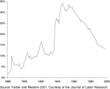
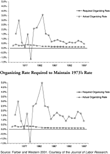
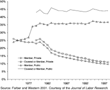
 You have
Access
- 52
- Cited by