Introduction
The oriental fruit moth, Grapholitha molesta (Busck) (Lepidoptera: Tortricidae), is a common fruit pest that is widely distributed throughout fruit growing areas of the world (Cardé and Minks Reference Cardé and Minks1995) and, in particular, has become an increasingly serious problem in China (Lu et al. Reference Lu, Huang and Wang2010). Grapholitha molesta attacks almost all orchard fruits and is a major pest of stone fruit (Rothschild and Vickers Reference Rothschild and Vickers1991), pears (Il’ichev et al. Reference Il’ichev, Williams and Milner2004), peaches (Cardé and Minks Reference Cardé and Minks1995), and apples (Kovanci et al. Reference Kovanci, Schal, Walgenbach and Kennedy2005; Myers et al. Reference Myers, Hull and Krawczyk2006). Mated female G. molesta moths lay eggs on host foliage or fruit. Feeding by first generation larvae causes damage to the growth of sprouting shoots in the spring and early summer and the larvae of summer generations subsequently destroy fruit by internal feeding (Rothschild and Vickers Reference Rothschild and Vickers1991). Populations increase as the season progresses so early peach varieties are generally less heavily damaged than late varieties. However, even low population densities of G. molesta can cause economic damage and result in substantial crop losses of up to 50% (Rothschild and Vickers Reference Rothschild and Vickers1991; Kanga et al. Reference Kanga, Pree, van Lier and Walker2003).
Commercial peach production relies on the use of broad-spectrum insecticides to control G. molesta populations (Kanga et al. Reference Kanga, Pree, van Lier and Walker2003; Riga et al. Reference Riga, Lacey, Guerra and Headrick2006). Although the prolonged use of insecticides for controlling G. molesta is effective, undesirable side effects include impacts on nontarget organisms, environment pollution, and an increased potential for the development of insecticide resistance (Kanga et al. Reference Kanga, Pree, van Lier and Walker2003). As an alternative to such pesticides, control methods based on insect sex pheromones including mating disruption (Weakley et al. Reference Weakley, Kirsch and Rice1987) and mass trapping (Giblin-Davis et al. Reference Giblin-Davis, Weissling, Oehlschlager and Gonzalez1994; Cardé and Minks Reference Cardé and Minks1997; Smit et al. Reference Smit, Downham, Laboke, Hall and Odongo2001; Alpizar et al. Reference Alpizar, Fallas, Oehlschlager, Gonzalez, Chinchilla and Bulgarelli2002) have great potential for pest management (Cardé and Minks Reference Cardé and Minks1997; Phillips Reference Phillips1997; Agelopoulos et al. Reference Agelopoulos, Birkett, Hick, Hooper, Pickett and Pow1999; Suckling Reference Suckling2000). Capture of male moths in sex pheromone-baited traps has been the principal measure used to trigger and time the use of insecticide sprays (Riedl et al. Reference Riedl, Croft and Howitt1976) and monitor sex pheromone-treated orchards (Gut and Brunner Reference Gut and Brunner1996).
The effectiveness of pheromone-baited traps in capturing insects is influenced by many factors including the distance of insects to traps (Schlyter Reference Schlyter1992; Byers Reference Byers1999; Laboke et al. Reference Laboke, Ogenga-Latigo, Smit, Downham, Odongo and Hall2000), weather (e.g., rainfall, wind speed, temperature) (Jansson et al. Reference Jansson, Heath and Coffelt1989; Laboke et al. Reference Laboke, Ogenga-Latigo, Smit, Downham, Odongo and Hall2000; Sappington and Spurgeon Reference Sappington and Spurgeon2000), and trap type (Murad Reference Murad2001) among other variables. Trap height, trap location, and inter-trap distance (i.e., spacing) strongly influence catch numbers (Riedl et al. Reference Riedl, Hoying, Barnett and DeTar1979; McNally and Barnes Reference McNally and Barnes1981). The mating activity of most male and female moths in the upper canopy generally causes the efficiency of male capture to vary with canopy height (Rothschild and Minks Reference Rothschild and Minks1977; Sarzynski and Liburd Reference Sarzynski and Liburd2004; Kovanci et al. Reference Kovanci, Schal, Walgenbach and Kennedy2006). Traps that are placed close to each other so that their radii of attraction overlap may cause interference thereby reducing the number of male moths caught per trap (Bacca et al. Reference Bacca, Lima, Picanço, Guedes and Viana2006). Practical factors important for the effective use of such traps for G. molesta in peach orchards remain unknown. Examination of factors that influence trap efficacy such as trap height, trap location, and inter-trap distance is required for the successful implementation of pheromone-based traps for this insect pest.
We investigated the effects of trap height, trap location, and inter-trap distance on the efficiency of G. molesta capture in pheromone-baited traps in a peach orchard.
Materials and methods
Experimental setup
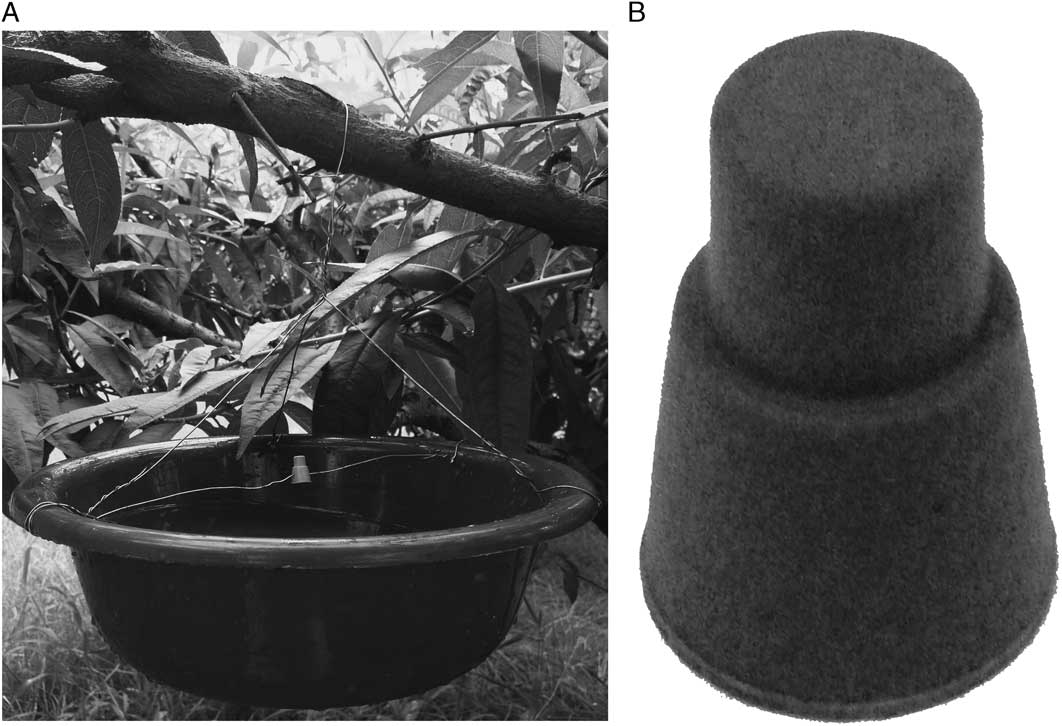
The study was conducted at a farm in the town of Beiwang in Taigu county (37°18′N, 112°29′E, 824 m), Shanxi Province, China, from April through August in 2010 and 2011 during the four main peak periods of G. molesta adult moth emergence and flight in this region (R.S.H., personal observation). The experiments were carried out in one conventional peach orchard (15 ha) planted with Amygdalus persica Linnaeus (Rosaceae), cultivar Dajiubao. The peach trees were six years old, about 2.5 m in height and were spaced 2.5 m apart within rows and 5.0 m apart between rows. A Water-tray trap (Zhao et al. Reference Zhao, Rong, Li, Zhang, Kong and Hu2013; Fig. 1A) baited with a single G. molesta pheromone lure loaded with 200 μg of a 9:1:1 blend of (Z)-8-dodecenyl acetate, (E)-8-dodecenyl acetate, and (Z)-8-dodecanol from bell-shaped green rubber septa (Fig. 1B) over one month (≈4 weeks) period exhibited a relatively constant release rate of <1.2 μg/day (Kovanci et al. Reference Kovanci, Schal, Walgenbach and Kennedy2006) (Beijing Pherobio Technology Co., Beijing, China) was used to capture male G. molesta moths. Monitoring traps were used at the beginning of four periods of male G. molesta moth flight in peach orchards (R.S.H., personal observation); when the total number of male moths per trap were more than 200 for a seven-day period (Z.G.Z., personal observation), the experiments would be conducted for 10–15 days afterwards.
Water-tray trap designs tested in Taigu County, Shanxi Province, China. Each trap consisted of a plastic basin, 20 cm in diameter×10 cm in height. A single pheromone lure was fixed with iron wire and the larger end was down. The plastic trays filled with 8–9 cm water. A small amount of detergent powder was added to the water to reduce surface tension and prevent moths from escaping. (A) Water-tray trap; (B) Pheromone lure.

The effect of trap height on the capture of male moths was investigated from April through August of 2010. Traps were placed at seven different heights above the ground: 3.0, 2.5, 2.0, 1.5, 1.0, 0.5, 0.1 m. Traps were suspended from the branches except for those at 0.1 m, which were placed directly on the ground. Higher traps were positioned within the tree canopy. Treatments were arranged in a randomised complete block design with four replicates per treatment at each peak period of G. molesta moth flight for a total of 112 traps. Traps were spaced at 30 m intervals within rows and at 30 m intervals between rows. The minimum distance between four separate areas (block) corresponding to four peak trapping periods was 50 m.
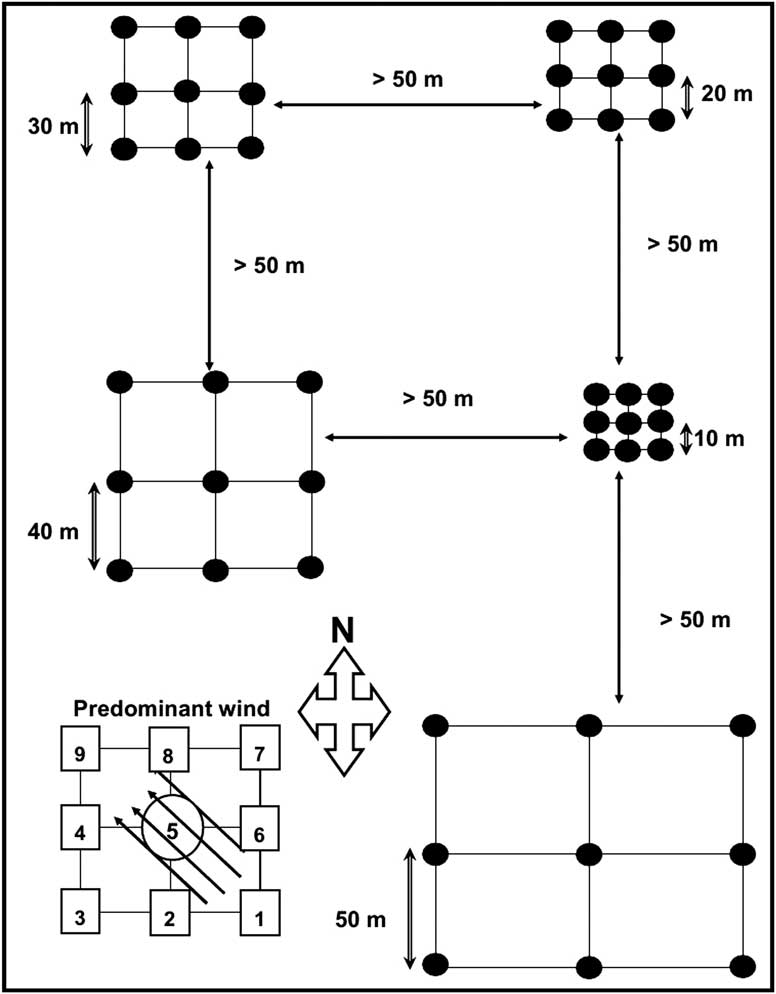
The effects of trap location and inter-trap distance on the capture of male moths were investigated between April and August 2011. Traps were deployed in arrays of nine traps in a 3×3 grid pattern with 10, 20, 30, 40, or 50 m spacing between traps (Fig. 2). The minimum distance between neighbouring spacings was 50 m. The positions of the different inter-trap spacing trap grids within the orchard were re-randomised between peak periods of G. molesta flight. This experiment used 180 traps in total. All traps were positioned in the lower part of the canopy about 1.5 m above the ground (medium height). The prevailing winds were from the southeast (local meteorological data for the past 10 years).
Schematic representation of locations of the Grapholitha molesta pheromone-baited traps showing arrays of 10, 20, 30, 40, and 50 m distance between traps and the positions relative to the cardinal directions and prevailing wind. Arabic numerals in panels indicate the serial numbers of trap positions. ●=Grapholitha molesta sex pheromone-baited trap.

Male G. molesta moths were counted from traps every morning (07:00–10:00) during four peak flight periods. After doing the above work, these moths and others (i.e., flies, leaves, or petal) in the traps were removed, and water was added to the requirements. Traps and lures were replaced every one peak flight period.
Statistical analysis
Data of trap heights were subjected to univariate analysis to examine the interaction effect between treatment and block (peak trapping period) throughout the monitoring period. If there is no significant interaction between treatment and block, it would be respectively tested for the effect of block (peak trapping period) on the pooled data with four measures of catch per height for the entire season and the effect of trap height on the mean catch per trap separately for each of four trapping periods. Normality of residuals was tested for all data sets of trap heights with the Shapiro–Wilk test. If the null hypothesis that data were normally distributed was rejected, count data were transformed with a square-root transformation to stabilise variances (Snedecor and Cochran Reference Snedecor and Cochran1967). If the transformed data were normally distributed (Shapiro–Wilk test), analysis of variance (ANOVA) was used, and means with significantly differences were separated using Tukey’s studentised range test. Otherwise, data were analysed with a Kruskal–Wallis parametric ANOVA of mean ranks. As far as each of trap spacings, the data for the summed catch for 10 days with four measures for the entire season per trap according to trap location were analysed using χ2 test (P=0.05). The number of males captured per square metre for each inter-trap distance was estimated by the ratio of the total number of males captured in nine traps to the total area within the trap array for each inter-trap distance (Bacca et al.
Reference Bacca, Lima, Picanço, Guedes and Viana2006). The relationship between the number of male G. molesta captured per m2 (y) and inter-trap distances (x) was described using the nonlinear regression function
 $y={\rm a}x^{{\rm b}} $
where a and b were constants obtained as fitted parameters (Bacca et al.
Reference Bacca, Lima, Picanço, Guedes and Viana2006). All analyses were done with SPSS for Windows Version 16.0 software (SPSS Inc., Chicago, Illinois, United States of America).
Results
Effect of trap height
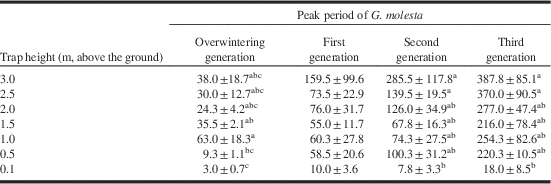
The interaction effect between treatment and block (peak trapping period) was not significant (F=1.4, df=18, P=0.18). For the total catch per trap for seven heights during four generations of G. molesta, catch was significantly different among four blocks (peak trapping period) (H=39.3, df=3, P<0.05). Also, the effect of trap height on the mean number of catches per trap differed between the overwintering generation and the subsequent 1–3 generations of G. molesta. For the overwintering generation, traps placed 1.0 m above the ground captured significantly more moths than traps placed 0.1 or 0.5 m above the ground (F=4.5, df=6, 21, P<0.05) (Table 1). Otherwise, traps at 3.0 m above the ground captured the most moths with significant treatment effects observed for the second (F=4.0, df=6, 21, P<0.05) and third generation (F=3.4, df=6, 21, P<0.05) but not the first generation (H=0.4, df=2, P=0.8) (Table 1).
Mean values (±SE) of total numbers of male Grapholitha molesta moths captured per trap placed at different heights above the ground during four periods of peak moth flight, from 19 April to 17 August 2010, in a peach orchard located in Taigu County, Shanxi Province, China.

Note: Means within columns followed by the same superscript letter are not significantly different, P=0.05, Tukey’s test.
Effect of trap location
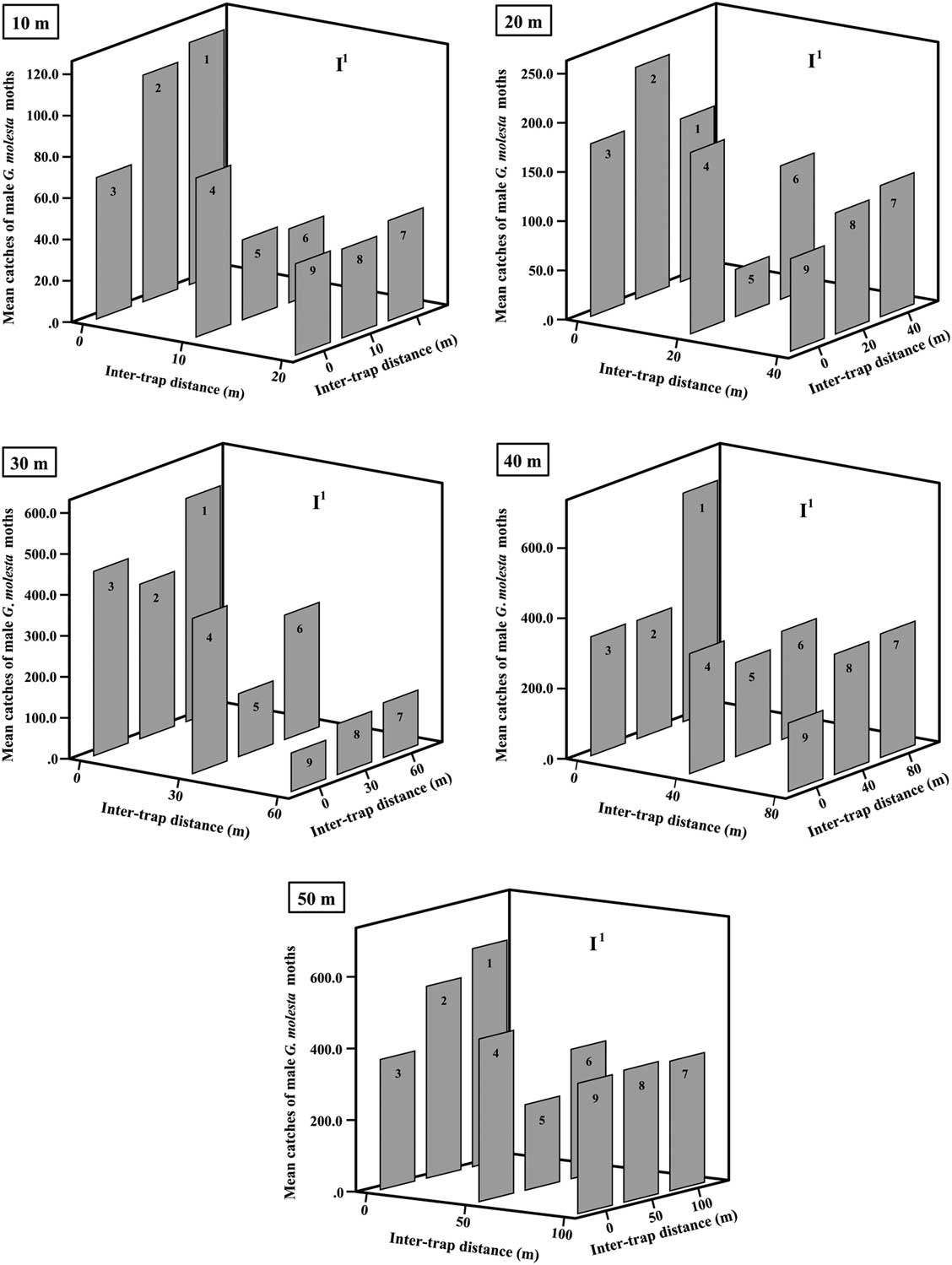
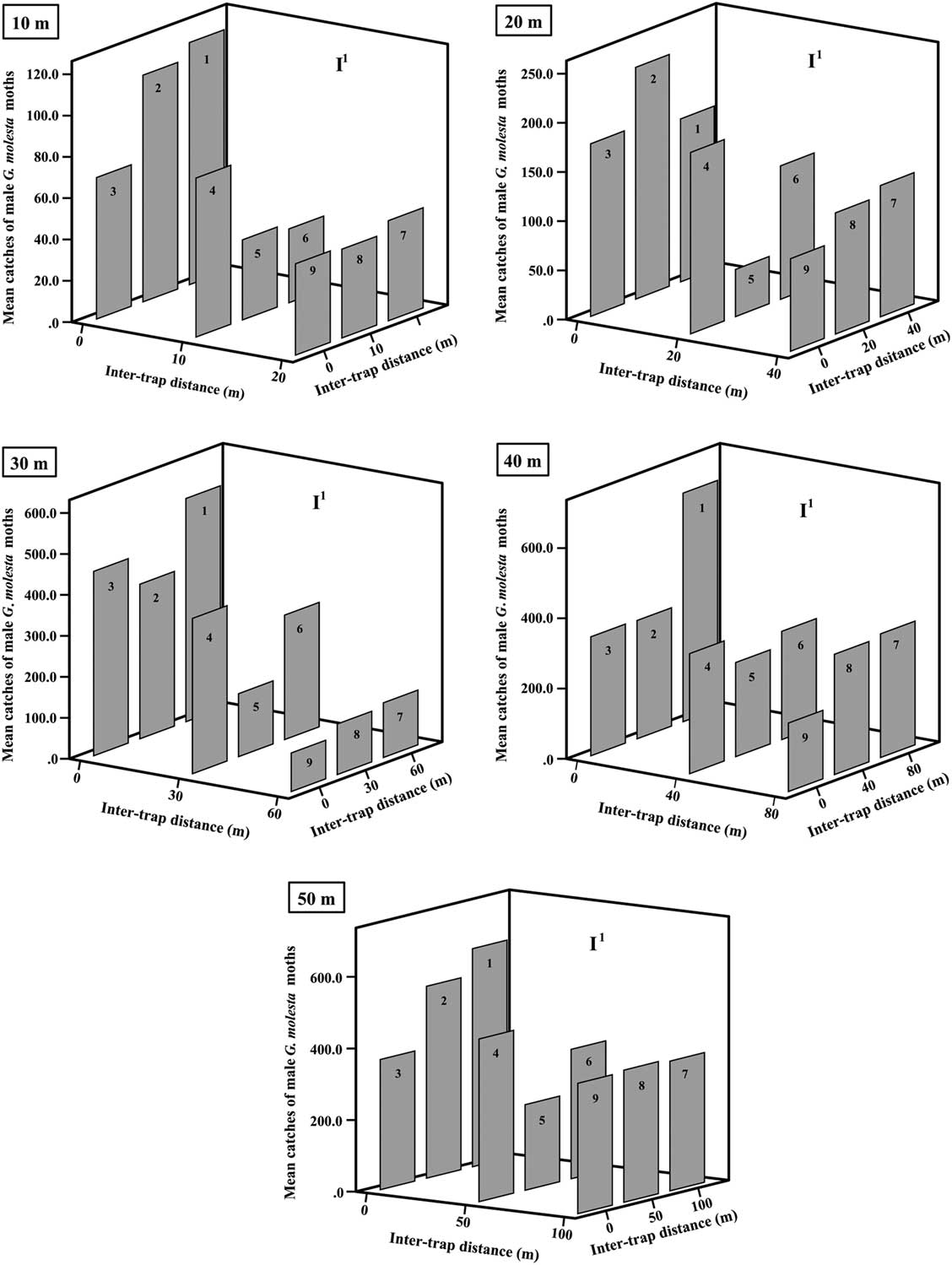
The difference was significant comparing the summed catch for 10 days of male G. molesta moths captured per trap during four periods of peak moth flight with trap location (10 m: χ²=74.9, df=31, P<0.05; 20 m: χ²=60.3, df=34, P<0.05; 30 m: χ²=51.2, df=33, P<0.05; 40 m: χ²=68.2, df=33, P<0.05; 50 m: χ²=55.7, df=34, P<0.05), and the mean number of total catches per trap during the entire flight season tended to be greater in traps located along the upwind edge of grids than in the central trap or along the down edge (Fig. 3).
Effect of trap location within 3×3 grids with different inter-trap distances (shown in the upper left of each graph) on mean numbers (±SE) of total catches for 10 days of male Grapholitha molesta moths captured per trap during four periods of peak moth flight, from 16 April to 20 August 2011, in a peach orchard located in Taigu County, Shanxi Province, China. Arabic numerals in bars of each graph correspond to trap position within the grid as illustrated in Figure 2.
Effect of distance between traps
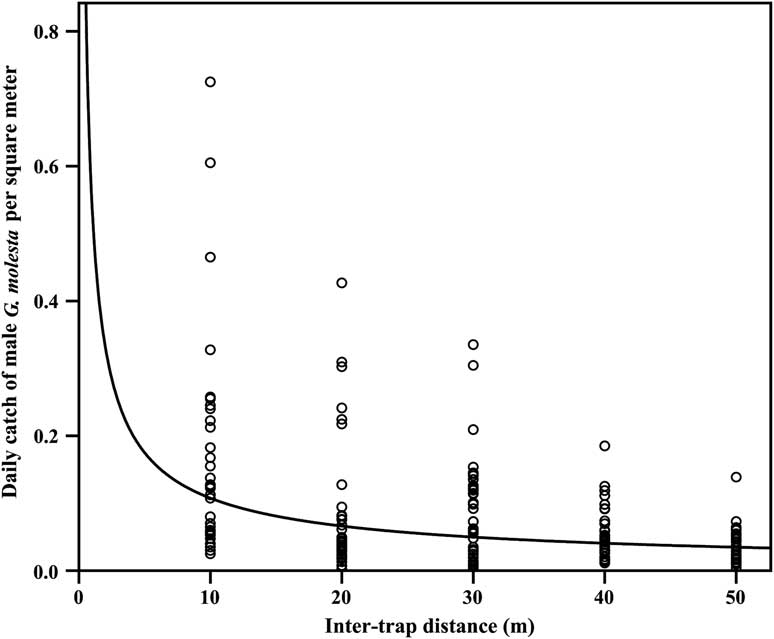
The data from 10-day trapping was used to establish the capture by distance relationship (
 $y=0.542x^{{{\!\minus\!}0.702}} $
, R
2=0.161, F=34.1, df=4, 178, P<0.0001; Fig. 4). The capture density (males captured per m2) depended on the distance between traps: the greater the distance, the lower the capture density (Fig. 4). At inter-trap distances of 30 m or more, capture density stabilised and traps did not compete with each other (Fig. 4).
Relationship between the daily catch of male Grapholitha molesta moths per m2 and the distance among traps (
 $y=0.542x^{{{\!\minus\!}0.702}} $
, R
2=0.161, F=34.1, df=4, 178, P<0.0001; n=1440).
Discussion
We examined the effects of trap placement on the capture of G. molesta in pheromone-baited traps. Host plant architecture and wind direction are key environmental factors influencing the dispersion of pheromone and the capture of G. molesta in pheromone-baited traps, whereas height, location, and spacing of traps are key nonenvironmental factors. We found that catches of male G. molesta moths were generally greater in traps placed 2.5–3.0 m above the ground than in traps placed near the ground and there were no statistical differences in catches at different heights from 1.0–3.0 m for any generation. The reduced catches in traps placed near the ground may be associated with inadequate dispersal of pheromone near the ground, e.g., as reported for almond moth, Cadra cautella (Walker) (Lepidoptera: Pyralidae) by Ahmad (Reference Ahmad1987). Our results supported those of Kovanci et al. (Reference Kovanci, Schal, Walgenbach and Kennedy2006), who found that captures of male G. molesta moths in apple orchards were consistently higher in pheromone traps placed in the upper canopy. However, Rothschild and Minks (Reference Rothschild and Minks1977) found that G. molesta catches in peach orchards (peach trees 3–4 m high) were greater in traps placed at 2 m than in traps at either 4 or 1 m above the ground. The traps in their study were baited with (Z)-8-dodecenyl acetate only whereas we used the three-component blend of (Z)-8-dodecenyl acetate, (E)-8-dodecenyl acetate, and (Z)-8-dodecanol. The different results may also have been due to differences in the heights of peach cultivars, attractive sources (i.e., component blend, ratio, and dose) or other factors (i.e., planting patterns). Thus, the ideal height for traps to capture insects varies with the canopy height of various plant hosts.
We found higher catches of male G. molesta moths in the upwind and outside traps than in the central traps regardless of inter-trap distances. Knight (Reference Knight2007) found that capture of male Cydia pomonella (Linnaeus) (Lepidoptera: Tortricidae) moths was significantly reduced at all other locations inside versus outside of pheromone-plots including traps placed on the downwind edges of such plots. Our results may be due to the influence of wind direction on the performance of the traps (Riedl et al. Reference Riedl, Howell, McNally and Westigard1986). In general, pheromone plumes from traps deployed upwind appeared to prevent or reduce moth captures in traps deployed downwind (Wall and Perry Reference Wall and Perry1982). In our study, winds were mainly from the southeast in the spring and summer and the greatest number of male moths was captured in traps placed along the upwind (on the south and east sides) of all plots.
We also found that interference between traps occurred when inter-trap distances were < 30 m. That capture density stabilised and traps did not compete with each other at inter-trap distances of 30 m or greater thereby suggesting that 30 m should be the minimum inter-trap distance for monitoring G. molesta similar to what was shown for traps for a sawfly, Neodiprion sertifer (Geoffroy) (Hymenoptera: Diprionidae) (Wedding et al. Reference Wedding, Anderbrant and Jönsson1995), pear moth, Cydia nigrica (Fabricius) (Lepidoptera: Tortricidae) (Wall and Perry Reference Wall and Perry1982), and coffee leaf miner, Leucoptera coffeella (Guérin-Méneville) (Lepidoptera: Lyonetiidae) (Bacca et al. Reference Bacca, Lima, Picanço, Guedes and Viana2006). Hence, the optimal trap spacing is likely to vary for different species.
Our results suggest that capture of male G. molesta moth in pheromone-baited traps in peach orchards in Shanxi Province, China, would be increased by placing traps in the upper canopy and using an inter-trap spacing of at least 30 m. However, each of our experiments were conducted in a single peach orchard and year so replication at additional sites and years would be necessary to determine how general these relationships are.
Acknowledgements
The authors thank our undergraduate student assistants, J.G. Li, G.C. Huang, J.S. Guo, and H. Meng (Shanxi Agricultural University), for their assistance in collecting field data. We are grateful to the town of Beiwang for allowing us to conduct experiments in their peach orchards. We thank Dr. Y.L. Fan and H. Xiao for reviewing and correcting the English of earlier versions of this manuscript. This study was funded by the Public Welfare Project from the Ministry of Agriculture of China (grant number 201103024), the Top-notch Talents Project from Shanxi Agricultural University of China (SXAUBJRC 201201) and the Undergraduate Innovation Project of Shanxi Province of China (2010, 2011).