Introduction
Pre-harvest sprouting is one of the main constraints for grain sorghum [Sorghum bicolor (L.) Moench] production under Argentinean cropping conditions. Grain maturation usually takes place during late summer or early autumn when damp or rainy conditions prevail and, hence, susceptible genotypes are prone to sprouting. Variability exists for this trait; among white, tannin-less sorghums, some are characterized as sprouting susceptible and others as sprouting resistant. On the basis of previous work, it was concluded that sprouting resistance was related to the maintenance of a sufficient dormancy level until later stages of seed development and maturation (Steinbach et al., Reference Steinbach, Benech-Arnold, Kristof, Sánchez and Marcucci Poltri1995).
The plant hormone abscisic acid (ABA) has long been recognized to play a central role both in the imposition and the maintenance of dormancy in seeds of many species. ABA-deficient or -insensitive mutants of Arabidopsis and maize germinate precociously (Robichaud et al., Reference Robichaud, Wong and Sussex1980; Karssen et al., Reference Karssen, Brinkhorst-Van der Swan, Breekland and Koornneef1983), and application of the ABA-synthesis inhibitor, fluridone, reduces dormancy in developing seeds of some species (Fong et al., Reference Fong, Smith and Koehler1983; Xu et al., Reference Xu, Coulter and Bewley1990). In sorghum, the participation of ABA in the imposition of dormancy is indicated by the inhibition of ABA synthesis with fluridone, which accelerates the termination of dormancy when applied at early developmental stages (Steinbach et al., Reference Steinbach, Benech-Arnold and Sánchez1997). Despite some differences between varieties in ABA content of embryos excised from caryopses at various stages of development, it was clear that embryos from the more dormant variety IS 9530 did not have a consistently higher ABA content than embryos from the less dormant variety Redland B2 (Steinbach et al., Reference Steinbach, Benech-Arnold, Kristof, Sánchez and Marcucci Poltri1995). However, suppression of germination of Redland B2 embryos required ABA concentrations tenfold higher than those required for inhibiting germination of IS 9530 embryos (Steinbach et al., Reference Steinbach, Benech-Arnold, Kristof, Sánchez and Marcucci Poltri1995). This difference in embryonic ABA sensitivity should be an important feature both for the imposition and the expression of the different patterns of dormancy release displayed by developing grains of these two varieties. The nature of such a contrasting level of embryo sensitivity to ABA, however, has not been explored so far.
A plausible explanation for the low sensitivity to ABA displayed by Redland B2 embryos is a disruption in ABA signalling during seed development and maturation. Much progress has been made in recent years in dissecting ABA signalling, although mainly in model organisms (Finkelstein et al., Reference Finkelstein, Gampala and Rock2002). Different secondary messengers have been identified that catalyse certain steps of the ABA signal transduction pathway, as well as the genes that encode them (for a review, see Gubler et al., Reference Gubler, Millar and Jacobsen2005). These secondary messengers include kinases, phospholipases, phosphatases and G proteins, and mutations in the genes that encode them lead to changes in ABA responsiveness (Finkelstein et al., Reference Finkelstein, Gampala and Rock2002). Thus, a low level of any of these messengers, or allelic differences in their functionality between lines, could underlie the low ABA sensitivity exhibited by Redland B2 embryos. The transcription factor ABI3 was among the first identified proteins involved in ABA signalling; Arabidopsis abi3 mutants display an ABA-insensitive phenotype (Giraudat et al., Reference Giraudat, Hauge, Valon, Smalle, Parcy and Goodman1992). An ABI3 homologue, VP1, may be involved in the pre-harvest sprouting behaviour of wheat (McKibbin et al., Reference McKibbin, Wilkinson, Bailey, Flintham, Andrew, Lazzeri, Gale, Lenton and Holdsworth2002). However, in previous reports, we have shown that VP1 expression was not correlated with sorghum dormancy throughout the seed developmental period (Carrari et al., Reference Carrari, Pérez-Flores, Lijavetzky, Enciso, Sánchez, Benech-Arnold and Iusem2001), nor did VP1 map within any of the dormancy QTLs (quantitative trait loci) described for the cross Redland B2 × IS 9530 (Carrari et al., Reference Carrari, Benech-Arnold, Osuna-Fernández, Hopp, Sánchez, Iusem and Lijavetzky2003). These results almost rule out the possibility that the ABA signalling pathway is disrupted at the level of VP1 in Redland B2, but do not exclude disruptions in signalling by other messengers. ABA receptors have been identified recently (Razem et al., Reference Razem, El-Kereamy, Abrams and Hill2006; Shen et al., Reference Shen, Wang, Wu, Du, Cao, Shang, Wang, Peng, Yu, Zhu, Fan, Xu and Zhang2006). Thus, a disruption in ABA signalling could also be ascribed to an insufficient number or/and abnormal functionality of these receptors. An alternative explanation for an apparently low embryonic ABA sensitivity was given by Visser et al. (Reference Visser, Vissers, Cagirgan, Kijne and Wang1996), working with a barley mutant that displayed low dormancy. They found a higher ABA degradation/conjugation rate in the apoplast of the mutant embryos compared with wild-type embryos.
In this paper, we analyse the nature of the different ABA sensitivities exhibited by Redland B2 and IS 9530 embryos. We explored two different possibilities: (1) a different functionality of the ABA signalling pathway, and (2) a different rate of ABA degradation/conjugation in the apoplast of embryos from these genotypes. To assess the first possibility, we used an ABA-responsive gene (Rab17) as a reporter of changes in endogenous ABA content, artificially induced in embryos from both genotypes, by means of fluridone application immediately after anthesis and embryo incubation in the presence of ABA. Maize RAB17 protein is a highly phosphorylated, late embryogenesis abundant protein that may play a specific role in growth inhibition of embryonic tissues, probably during germination and during the induction or maintenance of seed dormancy (Riera et al., Reference Riera, Figueras, Lopez, Goday and Pages2004). Thus, we predicted that a defect in ABA signalling should be seen as a level of expression of Rab17 that is independent of endogenous ABA level.
Materials and methods
Plant material and treatments
Two varieties of sorghum (Sorghum bicolor [L.] Moench) exhibiting contrasting behaviour to pre-harvest sprouting were used in this study: Redland B2 (susceptible) and IS 9530 (resistant). Both varieties were sown in an experimental field of the Facultad de Agronomía (Universidad de Buenos Aires, Argentina) (34°25′S, 58°25′W) on 6 November 2002 in three randomized blocks. Plant density was 8 plants m− 2. Control of weeds, insects and diseases was carried out following the schedule used under production conditions. The crop was irrigated when necessary to avoid water stress. Each plant was labelled with its flowering date when pollen had been released by florets from the upper two-thirds of the panicle. To minimize variation, only spikelets from the middle third of the panicle were used for the experiments.
Some panicles of both lines were sprayed at early stages of development [3, 5, 8 and 11 d after pollination, (DAP)] with the ABA synthesis inhibitor fluridone (Sonar, Elanco Products, Indianapolis, Indiana, USA) at a concentration of 125 mg l− 1.
Germination tests
Caryopses from control and fluridone-treated panicles of both varieties were harvested at various stages of development (15, 20, 25, 30, 35, 40 and 47 DAP). Thirty caryopses were incubated in Petri dishes on two layers of filter paper containing 6 ml of distilled water at 25 °C. Germination was recorded daily for 12 d, and a germination index (GI) was calculated as described by Steinbach et al. (1997). The GI gave maximum weight to caryopses that germinated first and less weight to those that germinated later.
Embryonic sensitivity to ABA
At different stages of development (15, 20, 25, 30, 35, 40 and 47 DAP), embryos from control caryopses from both varieties were dissected and incubated in Petri dishes (20 embryos per dish) on two layers of filter paper containing 5 ml of distilled water or different ABA concentrations (0.5, 5 and 50 μM) at 25 °C. Germination (embryo growth) was recorded daily for 12 d and the germination index, as described above, was calculated.
Changes in endogenous ABA content and in the incubation medium of embryos incubated in distilled water
To test for the possibility of a differential rate of ABA degradation/conjugation in the embryo apoplast of both varieties, the following experiment was carried out. At two different stages of development (28 and 42 DAP), 20 embryos from control caryopses from both varieties were incubated for different periods (0, 2, 4, 6, 8, 12, 16, 24, 48 and 76 h) in wells containing 600 μl of distilled water at 25 °C, in triplicate. At the end of each incubation period, embryos were immediately frozen in liquid N2 until ABA analysis. The incubation media of these embryos was stored in the same way. Since no physical barriers exist in the communication between the embryo apoplast and the medium, it can be assumed that a continuum exists between these two regions. Therefore, this allows for the estimation of the ABA concentration in the embryo apoplast by measurements of ABA in the incubation medium.
To test for the activity of enzymes involved in the ABA degradation/conjugation in the embryo apoplast, 28 DAP embryos from fluridone-treated caryopses from both varieties (to ensure similar endogenous ABA content in embryos from both varieties) were incubated in 600 μl of distilled water for 4 h at 25 °C. At the end of the incubation period, the embryos were immediately frozen in liquid N2. The incubation medium (500 μl) was treated in either of two ways: (1) after boiling for 5 min, ABA (10 μl of a solution of 3 mM ABA) was added, after which the mixture was incubated for 15 h at 25 °C; or (2) ABA (10 μl of a solution of 3 mM ABA) was added to the samples, and the mixture was incubated for 15 h at 25 °C. Samples were immediately frozen in liquid N2 until assayed for ABA content.
ABA quantification
ABA content was determined in embryos and in incubation media by a radioimmunoassay (RIA) that uses the monoclonal antibody AFRC MAC 252 (Quarrie et al., Reference Quarrie, Whitford, Appleford, Wang, Cook, Henson and Loveys1988), as described previously in Steinbach et al. (Reference Steinbach, Benech-Arnold, Kristof, Sánchez and Marcucci Poltri1995). Briefly, the embryos were lyophilized for 3 d, weighed and powdered. Distilled water was added to the powder in a 20 : 1 ratio [distilled water : embryo dry weight (DW)]. ABA was extracted overnight in a cold room at 4 °C. The resultant suspension was centrifuged, and the supernatant used for ABA quantification: 50 μl of each sample was taken to determine its ABA content (each sample was analysed in duplicate).
Modifications of ABA levels in embryos
With the aim of lowering (1) or increasing (2) endogenous ABA content of the embryos, the following treatments were carried out. (1) Some panicles of both varieties were sprayed with the ABA-synthesis inhibitor fluridone (Fong et al., Reference Fong, Smith and Koehler1983), as described above (Steinbach et al., Reference Steinbach, Benech-Arnold and Sánchez1997). At different stages of development (19, 31, 40, 45 and 50 DAP), control and fluridone-treated caryopses from both lines were harvested. Their embryos were dissected and immediately frozen in liquid N2 for later RNA extraction. (2) At 35 DAP embryos from control caryopses from both varieties were dissected from caryopses and incubated in Petri dishes on two layers of filter paper containing 5 ml of either distilled water or 50 μM ABA solution for different periods (0, 0.5, 2, 4, 6, 8 and 16 h). At the end of each incubation period, the embryos were frozen in liquid N2 for later RNA extraction.
RNA extraction and quantification of Rab17 gene expression
Total RNA extraction was performed with Trizol (Gibco-BRL; Invitrogen, Carlsbad, California, USA), according to the manufacturer's instructions. After size fractionation on a 1% agarose MOPS-formaldehyde gel, the RNA was blotted to a nylon membrane filter (Hybond, Amersham, Piscataway, New Jersey, USA) by capillary action in 20 × saline sodium citrate (SSC; Sambrook and Russell, Reference Sambrook and Russell2001). For probe labelling, the entire Rab17 cDNA (kindly provided by Dr Monserrat Pagés, CSIC, Barcelona, Spain) was used as template for random primer extension (Prime-A-Gene kit, Promega, Madison, Wisconsin, USA) with 32P-labelled deoxycytosine triphosphate ([32P]dCTP). Actin (see Fig. 6) and ribosomal RNA (see Fig. 7) gene probes were used as controls for RNA loading. Hybridization was carried out at 42 °C for 16 h in a solution containing 5 × SSC, 1 × Denhardt's solution, 1.25% SDS, 50% formamide, 100 μg ml− 1 denatured salmon sperm DNA and 5 μg ml− 1 yeast tRNA. Filters were washed once for 20 min at 42 °C in 2 × SSC, 0.1% SDS; once for 20 min at 42 °C in 0.5 × SSC, 0.1% SDS and finally for 20 min at 65 °C in 0.1 × SSC, 0.1% SDS. After washing, the filters were exposed to X-ray film (Xomat, Kodak, Rochester, New York, USA) for 2–4 d. Autoradiographs were scanned with a UMAX scanner, and band intensity was quantified with NHI image software.
Results
The pattern of dormancy release during grain development
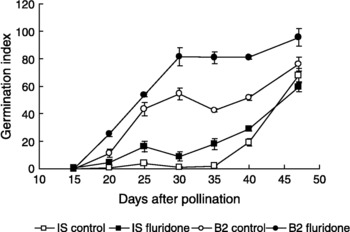
Incubation at 25 °C of caryopses harvested at different stages of development confirmed the known difference in the pattern of dormancy release that exists between immature Redland B2 (high PHS susceptibility, low dormancy level) and IS 9530 (low PHS susceptibility, high dormancy level) caryopses (Fig. 1). Redland B2 grains began to germinate from early stages of development (i.e. 20 DAP), while IS 9530 grains showed a germination index (GI) close to zero until physiological maturity (i.e. 35 DAP). Fluridone application to panicles promoted an advancement of dormancy release in caryopses from both varieties, exhibited by higher GIs at almost all stages of grain development (Fig. 1), suggesting that a reduction in ABA content was achieved. Control grains from both varieties reached a similar GI (close to 70) at 47 DAP.
Germination indices (GI) of sorghum caryopses harvested from control and fluridone-treated (125 mg l− 1) panicles of Redland B2 (B2; low dormancy) and IS 9530 (IS; high dormancy) at different days after pollination and incubated in distilled water at 25 °C. Vertical bars are mean SE when larger than the symbol.

Embryonic ABA sensitivity
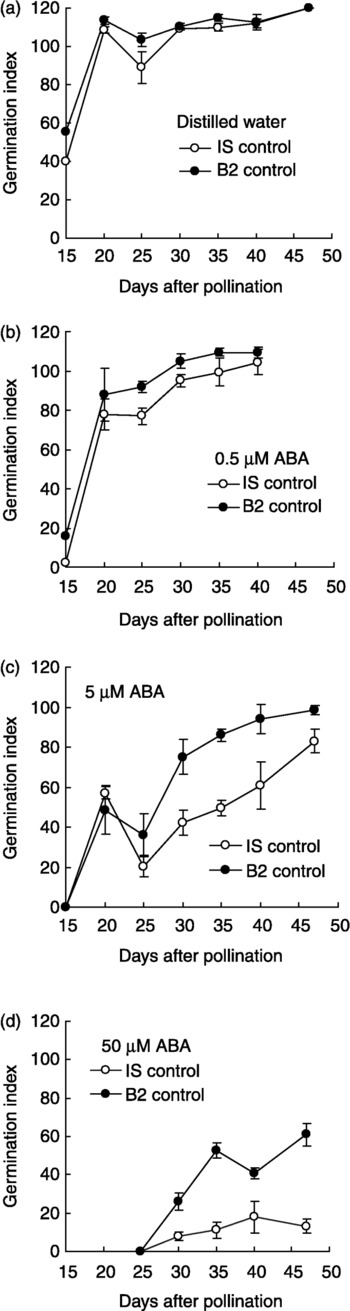
Control embryos from both varieties isolated at different developmental stages showed a similar and constant GI (close to 110) when incubated in distilled water (Fig. 2a). However, when these embryos were incubated under increasing ABA concentrations (Fig. 2b–d), differences in GI were found between varieties. These differences were particularly evident when embryos were incubated in 50 μM ABA (Fig. 2d); germination of IS 9530 embryos was almost completely inhibited by this ABA concentration throughout the whole developmental period, while Redland B2 embryos were able to overcome much of the ABA inhibitory effect from 30 DAP onwards. Moreover, GI values from Redland B2 embryos incubated with 50 μM ABA resembled those obtained with IS 9530 embryos incubated at 5 μM ABA (Fig. 2c, d), demonstrating that IS 9530 embryos are about ten times more sensitive to ABA than Redland B2.
Germination indices (GI) of isolated sorghum embryos from control caryopses of Redland B2 (●) and IS 9530 (○) harvested at different days after pollination (DAP) and incubated in (a) distilled water or the following abscisic acid (ABA) solutions: (b) 0.5 μM ABA, (c) 5 μM ABA, (d) 50 μM ABA. Vertical bars are mean SE when larger than the symbol.

Changes in endogenous ABA content and in the incubation medium of embryos incubated in distilled water
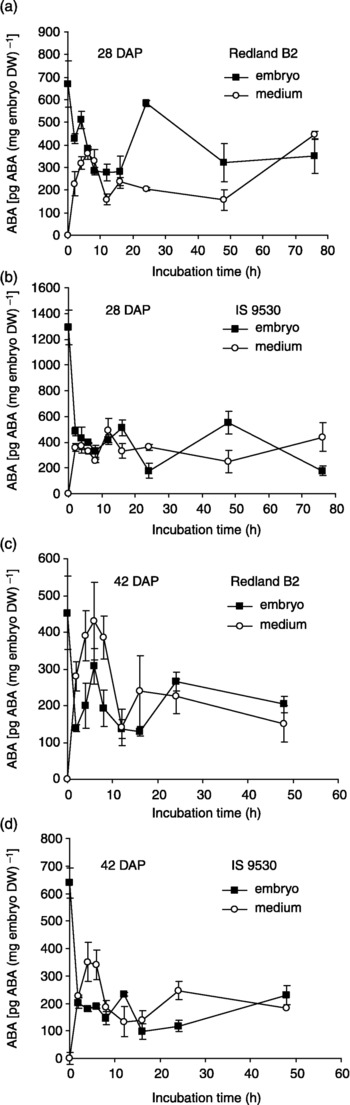
To explore the possibility that this contrasting ABA embryonic sensitivity was a consequence of a different rate of ABA degradation/conjugation in the apoplast of the embryo, ABA contents were measured in 28 and 42 DAP embryos incubated for various periods of time. In parallel, as a measure of the apoplastic ABA, the content of this hormone was measured in the incubation medium after each incubation time had elapsed. The patterns of ABA content relative to embryo weight [pg ABA (mg embryo DW)− 1] did not show significant differences between embryos of both varieties at either developmental stage (28 and 42 DAP) (Fig. 3a–d). Initial ABA content found in 28 DAP IS 9530 embryos was higher than that recorded in Redland B2. Soon after initiation of incubation, ABA decreased at a similar rate in embryos from both varieties and subsequently remained constant around 300–600 pg ABA (mg embryo DW)− 1 until the end of the experiment (Fig. 3a, b). A very similar result was obtained with 42 DAP embryos (Fig. 3c, d).
Relative abscisic acid (ABA) content [pg ABA (mg embryo dry weight)− 1] in embryos (■) and incubation media (○) from (a, c) Redland B2 and (b, d) IS 9530 isolated sorghum embryos incubated in distilled water for various periods. Embryos were isolated from caryopses at (a, b) 28 d or (c, d) 42 d after pollination (DAP). Vertical bars are mean SE when larger than the symbol.

In both varieties and for both developmental stages, the ABA concentration decreased in embryos throughout the incubation period, concomitant with increased ABA in the incubation medium during the first 6 h of incubation (Fig. 3a–d). The release pattern of ABA into the incubation media was not significantly different, either between varieties or developmental stages (28 and 42 DAP) (Fig. 3a–d). In the case of 42 DAP embryos, ABA concentration in the media increased during the first hours of incubation until a maximum value at around 6 h [430 pg ABA (mg embryo DW)− 1 in Redland B2 line; 340 pg ABA (mg embryo DW)− 1in IS 9530]. Subsequently, ABA in the media of both lines decreased to a value close to 135 pg ABA (mg embryo DW)− 1at 12 h of incubation, and then fluctuated between 130 and 250 pg ABA (mg embryo DW)− 1 until the end of the experiment (Fig. 3c, d). ABA concentration in media from 28 DAP embryos of both lines followed a similar pattern (Fig. 3a, b). ABA values in embryos and incubation media reached equilibrium around 6 h of incubation in both varieties and at both developmental stages (Fig. 3a–d).
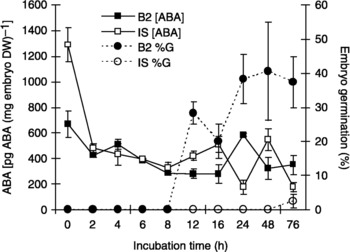
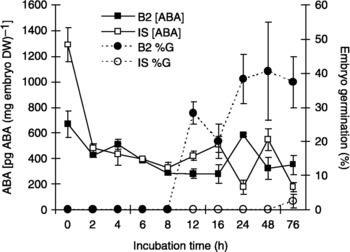
The results suggested that ABA concentrations present in the embryo apoplast throughout the incubation period, which results from the balance between rates of ABA synthesis and ABA degradation/conjugation, did not differ between sorghum varieties, even though germination of 28 DAP embryos incubated in wells with distilled water exhibited important differences between lines (Fig. 4). During the first 48 h of incubation, the germination percentage of IS 9530 embryos was zero. In contrast, Redland B2 embryos began to germinate at 12 h of incubation, reaching 38% germination after 24 h of incubation. This occurred despite the fact that similar endogenous ABA levels were detected in embryos of both varieties throughout the incubation period and in their respective incubation media.
Sorghum embryo relative abscisic acid (ABA) content [pg ABA (mg embryo DW)− 1] (solid lines, squares) and germination percentage (%G; dashed lines, circles) during incubation in distilled water. Redland B2 (B2; closed symbols) and IS 9530 (IS; open symbols) embryos were isolated from caryopses at 28 d after pollination (DAP). Vertical bars are mean SE when larger than the symbol.
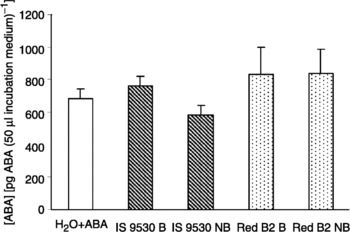
To test for the activity of an enzyme that may be involved in ABA degradation/conjugation after ABA diffusion into the apoplast, we added 10 μl of 3 mM ABA solution to the incubation media, and inactivated half of the samples by boiling for 5 min. To obtain samples of embryos with comparable ABA content between both sorghum varieties, embryos derived from fluridone-treated panicles were used for this experiment. When the ABA concentration was determined in incubation media 15 h after adding ABA, no significant differences were found between boiled and unboiled samples (Fig. 5). Therefore, these results do not provide evidence of enzyme activity that participates in ABA degradation/conjugation after its diffusion into the apoplast.
Stability of abscisic acid (ABA) [pg ABA (50 μl of medium)− 1] in the media following removal of sorghum embryos. IS 9530 and Redland B2 (Red B2) embryos were isolated from caryopses, harvested 28 d after pollination (DAP) from fluridone-treated panicles. After incubation of embryos in the media for 4 h at 25 °C, the embryos were removed. Subsequently, different thermal treatments were applied to the media [not boiled (NB) or boiled (5 min at 100 °C) (B)], and then ABA (10 μl of a solution of 3 mM ABA) was added to all samples. ABA measurements were performed after incubation of the media for 15 h at 25 °C. H2O + ABA, control for the ABA quantity added. Vertical bars are mean SE.

Functionality of the ABA signal transduction pathway
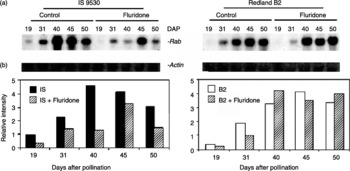
The possibility that a disruption in the ABA signalling pathway could account for the low sensitivity to ABA displayed by Redland B2 embryos was explored by expression analysis of an ABA-responsive gene in relation to changes induced in embryo ABA content. Rab17 gene expression in embryos isolated from control caryopses harvested at different developmental stages increased between 19 and 40 DAP in both varieties (Fig. 6a, b). Lowering ABA content by application of fluridone resulted in a marked reduction of Rab17 expression in IS 9530 embryos at all developmental stages (Fig. 6). For example, at 40 DAP, Rab17 expression in IS 9530 embryos from fluridone-treated panicles was a third of that recorded in IS 9530 control embryos (Fig. 6b). In contrast, Rab17 expression in Redland B2 embryos (Fig. 6b) did not reflect changes in ABA endogenous content induced by fluridone treatment (Steinbach et al., Reference Steinbach, Benech-Arnold and Sánchez1997).
Rab17 gene expression in embryos from sorghum [IS 9530 (IS; high dormancy); Redland B2 (B2; low dormancy)] harvested at 19, 31, 40, 45 and 50 d after pollination (DAP), from control and fluridone-treated panicles. (a) Northern blot analysis with a Rab17 maize cDNA probe. (b) Rab17 mRNA abundance relative to actin mRNA.

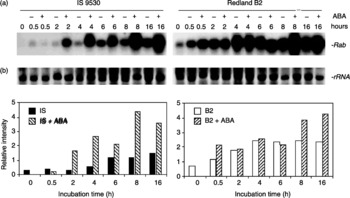
When 35 DAP IS 9530 isolated embryos were incubated in 50 μM ABA, Rab17 expression became immediately (i.e. 2 h after incubation) two- to threefold higher than that recorded in embryos incubated in distilled water, and this difference was maintained until the end of the experiment (Fig. 7a, b). In contrast, in the Redland B2 line, incubation in the presence of ABA did not induce changes in Rab17 expression in relation to that detected in embryos incubated in distilled water until ≥ 8 h of incubation in ABA (Fig. 7a, b).
Rab17 gene expression in sorghum embryos [IS 9530 (IS; high dormancy); Redland B2 (B2; low dormancy)] isolated from caryopses at 35 d after pollination (DAP). The embryos were incubated for 0–16 h in distilled water or 50 μM ABA. (a) Northern blot analysis with a Rab17 maize cDNA probe. (b) Rab17 mRNA abundance relative to an rRNA probe.

Discussion
Pre-harvest sprouting resistance in sorghum is related to the maintenance of a sufficient level of dormancy in the developing grains until late stages of maturation (Steinbach et al., Reference Steinbach, Benech-Arnold, Kristof, Sánchez and Marcucci Poltri1995). This is the case in variety IS 9530, in which caryopses are released from dormancy well after physiological maturity. In contrast, the sprouting-susceptible variety, Redland B2, produces caryopses that are released from dormancy prematurely. An important feature behind this pattern of behaviour is the different response to ABA shown by developing embryos of these two varieties: IS 9530 embryos are ten times more sensitive to ABA than Redland B2. In this work, we explored two possible mechanisms to account for the differing ABA sensitivities displayed by embryos of these sorghum varieties: (1) ABA degradation/conjugation rate in the apoplast of embryos differs between varieties, and (2) a differential functionality of the ABA signal transduction pathway exists between varieties.
In contrast to results presented by Visser et al. (Reference Visser, Vissers, Cagirgan, Kijne and Wang1996) with barley embryos, ABA degradation/conjugation rate in the apoplast of embryos did not differ between varieties, and the amounts of ABA, either in the embryos or in the incubation media, were very similar (Fig. 3). Clearly, some degradation/conjugation occurred in our system, since total ABA at the end of the experiments (ABA in the embryo plus ABA in the incubation medium) was lower than that measured in embryos prior to incubation. This degradation/conjugation must have taken place during the first minutes of embryo incubation, before ABA was released to the apoplast, and at a rate that was similar in embryos of both varieties. ABA-8’-hydroxylase is the first enzyme committed to ABA metabolism (Krochko et al., Reference Krochko, Abrams, Loewen, Abrams and Cutler1998; Kushiro et al., Reference Kushiro, Okamoto, Nakabayashi, Yamagishi, Kitamura, Asami, Hirai, Koshiba, Kamiya and Nambara2004). Since our results also showed that no temperature-sensitive enzyme involved in ABA metabolism appeared to have been released into the apoplast (Fig. 5), it could be speculated that, if this enzyme is indeed involved, the activity of ABA-8′-hydroxylase is restricted to the symplast. Overall, our results do not allow us to conclude that the low sensitivity to ABA shown by Redland B2 embryos is due to a faster rate of ABA degradation/conjugation in the apoplast.
Alternatively, a disruption in the ABA signalling pathway appears as a plausible explanation for the low ABA responsiveness displayed by Redland B2 embryos. This disruption is indicated by the fact that Rab17 (an ABA-responsive gene) expression in Redland B2 embryos remained relatively unchanged, despite changes in endogenous ABA content (Figs 6 and 7). When the endogenous ABA content in embryos was reduced by early application of fluridone to the panicles, the expression level of Rab17 remained unchanged, as compared to that measured in Redland B2 control embryos of the same age (Fig. 6). Since we did not measure ABA in embryos derived from fluridone-treated panicles, it could be argued that fluridone did not inhibit ABA synthesis in these embryos. This latter possibility is unlikely since dormancy was lower in Redland B2 caryopses from fluridone-treated panicles than in control (untreated) ones (Fig. 1), a situation known to be the result of reduced ABA synthesis (Steinbach et al., Reference Steinbach, Benech-Arnold and Sánchez1997). Alternatively, increasing ABA content through embryo incubation in the presence of 50 μM ABA did not modify Rab17 expression levels with respect to that observed in Redland B2 embryos incubated in water (Fig. 7). An undisrupted ABA signalling functionality would have been observed as a modification in Rab17 gene expression in response to induced ABA changes in embryos (i.e. the gene should have been up- or down-regulated as ABA levels were increased or reduced, respectively). This was observed in IS 9530 embryos, where Rab17 expression was down-regulated in embryos derived from fluridone-treated panicles, and up-regulated in embryos incubated in the presence of ABA. Comparing absolute levels of Rab17 expression between varieties would not be of much value, since it is known that expression of this ABA-responsive gene is not only regulated by ABA, but also by the genetic background of each variety.
In spite of this apparent alteration in ABA signalling, Redland B2 embryos cannot be regarded as ABA insensitive. Physiological ABA concentrations (i.e. 50 μM or even less, depending on the developmental stage) can inhibit Redland B2 embryo germination, albeit to a lesser extent than in IS 9530 (Fig. 2). This suggests that Redland B2 embryos can sense different concentrations of ABA, and this may be achieved through mechanisms that are not associated with Rab17 gene expression. Assuming that embryos from both varieties exhibit a similar functioning of other ABA signalling pathways, disruption in the pathway associated with Rab17 expression in Redland B2 would lead to a lower ABA signal intensity (at least in relation to the germination process) in this variety compared to that of IS 9530, with similar amounts of ABA in the embryos.
When comparing Redland B2 and IS 9530 embryos, it can be speculated that the apparent differences in response to ABA are due to differences in the functionality of the ABA signal transduction pathway. The transcription factor VP1, an ABI3 homologue, has been implicated in the sprouting behaviour of wheat (McKibbin et al., Reference McKibbin, Wilkinson, Bailey, Flintham, Andrew, Lazzeri, Gale, Lenton and Holdsworth2002). In previous work, we found that VP1 expression was not correlated with dormancy throughout the seed development period in sorghum (Carrari et al., Reference Carrari, Pérez-Flores, Lijavetzky, Enciso, Sánchez, Benech-Arnold and Iusem2001), nor did VP1 map within any of the dormancy QTLs described for the cross Redland B2 × IS 9530 (Carrari et al., Reference Carrari, Benech-Arnold, Osuna-Fernández, Hopp, Sánchez, Iusem and Lijavetzky2003). These results exclude the possibility that the ABA signalling pathway is disrupted at the level of VP1 in Redland B2; however, disruptions of other messengers could be present. A lower synthesis and/or a differential functioning of other secondary messengers, such as kinases, phospholipases, phosphatases and G proteins, which regulate steps of the ABA signalling pathway associated with Rab17 gene expression, could account for the disruption found in Redland B2 sorghum, and therefore the lower ABA sensitivity exhibited by embryos of this variety.
Another possibility for explaining this disruption in ABA signalling may be related to ABA receptors. In this context, receptor concentration is known to modify sensitivity of cells to a specific signal (Trewavas, Reference Trewavas, Buchanan, Gruissem and Jones2000). During development, tissues can adjust or desensitize in response to environmental conditions through changes in receptor concentration. ABA receptors have been identified recently (Razem et al., Reference Razem, El-Kereamy, Abrams and Hill2006; Shen et al., Reference Shen, Wang, Wu, Du, Cao, Shang, Wang, Peng, Yu, Zhu, Fan, Xu and Zhang2006). The lack of a sufficient number of ABA receptors and/or their abnormal functioning could underlie the Rab17 expression disruption in Redland B2 sorghum.
The results of our work suggest that the lower ABA sensitivity exhibited by the embryos of the sprouting-susceptible sorghum variety Redland B2 may have its origin in ABA signalling disruption. Our current research efforts are focused towards the identification of the components of the ABA signalling pathway that are involved in this disruption. This should contribute to a better understanding of the physiological and molecular mechanisms that control pre-harvest sprouting susceptibility in sorghum and other cereals.
Acknowledgements
This work was supported financially by two grants from the National Agency for Science promotion (ANPCyT), PICT 1999 No. 08-06 609 and PICT 2003 No. 08-14 402, and by a grant from the University of Buenos Aires (UBA) (G603).