



No CrossRef data available.
Article contents
THE MEAN-MEDIAN-MODE INEQUALITY: COUNTEREXAMPLES
Published online by Cambridge University Press: 31 March 2005
Abstract
Let x be a random variable whose first three moments exist. If the density of x is unimodal and positively skewed, then counterexamples are provided which show that the inequality mode ≤ median ≤ mean does not necessarily hold.I thank Andrey Vasnev for help with the graphs and Jan Magnus for various helpful discussions. I also thank Martin Bland, Paolo Paruolo, Peter Phillips, Michael Rockinger, and a referee for their comments. ESRC grant R000239538 is gratefully acknowledged.
Information
- Type
- NOTES AND PROBLEMS
- Information
- Copyright
- © 2005 Cambridge University Press
1. MOTIVATION
Let x be a continuous random variable with distribution Fx(u) := Pr(x ≤ u) and density fx(u) := dFx(u)/du. Assume that the first three moments of x exist and let μ := E(x) denote the mean, m the median, and M the mode. If the density of x is unimodal with E((x − μ)3) > 0 (positive skewness), then there appears to be widespread belief that the inequality M ≤ m ≤ μ holds. (If E((x − μ)3) < 0 then the inequality is reversed.)
In fact, this is incorrect. Although no counterexamples have been given, various authors have attempted to find conditions under which the inequality does hold, hence also acknowledging the possibility of its violation. Thus, van Zwet (1979), following earlier papers by Groeneveld and Meeden (1977) and Runnenburg (1978), argues that, because

a sufficient condition for m ≤ μ is that

henceforth called “van Zwet's condition.” Van Zwet then shows that his condition also implies that M ≤ m, thus establishing the inequality. Notice that van Zwet is not discussing skewness (but see Section 3). He is only interested in finding the class of densities for which the median is located between the mode and the mean.
Van Zwet's condition is a very strong one: that the inequality holds at every point u of the integrand for it to hold for the integral too. However, it is simple and appealing, and most of the well-known asymmetric distributions (gamma, beta) satisfy his condition. Two later papers discuss the relationship between van Zwet's condition and stochastic ordering (Dharmadhikari and Joag-Dev, 1983) and a discrete analogue (Abdous and Theodorescu, 1998).
In spite of all these papers, several questions remain. First, many distributions other than the standard textbook ones (e.g., mixtures) have now become popular in areas of applied statistics, such as empirical finance (e.g., see Abadir and Rockinger, 2003). Will these also satisfy van Zwet's condition? If they do not satisfy this sufficient (but not necessary) condition, will the mean-median-mode inequality still be satisfied? Using a simple mixture of two densities, Section 2 derives three counterexamples to the inequality. The first of these is also used to illustrate that m ≤ μ may hold in spite of van Zwet's condition being violated. In Section 3, the features of the simple illustrative counterexamples are discussed, and it is shown how these examples can be extended and the conclusions unchanged.
2. COUNTEREXAMPLES
One counterexample is provided for each of the three inequalities implied by M ≤ m ≤ μ. In each case, it will be assumed that the distribution is positively skewed in the sense that E((x − μ)3) > 0.
(a) M > m. Consider the density

an equally weighted mixture of two densities, with means of opposite signs. It is easy to see that μ = 0 and

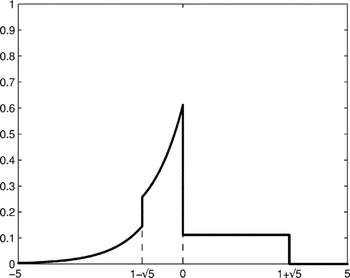
hence no skewness, but that the density is not symmetric around μ = 0; see Figure 1. The mode M is also zero, but the median is m ≈ −¼, because

Allocating slightly less probability to the lower end of the density, one can substantially increase the mean and skewness but not alter the median by as much. The mode is unchanged. As a result, a counterexample arises where the median is less than the mode, in spite of the positive skew. For example, replacing eu by 2e2u in (1) gives

. Notice that this is an example where μ > m, even though van Zwet's condition

is violated for some u, e.g., any u ∈ (−0.19, 0.19).

M = 0, m ≈ −0.25, μ = 0, skewness = 0 in (1).
(b) m > μ. Next, consider the density

where ε > 0 and small. The components have means of opposite sign, giving μ = 0. Also, M = 0. The median is smaller than either, because Pr(x < 0) > ½, but the skewness is negative because of the long lower tail of the exponential function:

which is negative for

. The mirror image of the density, namely,

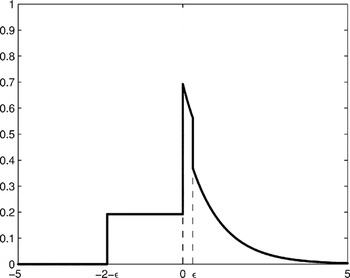
has E((x − μ)3) > 0, but μ = M < m, in violation of the second alleged inequality. This is illustrated in Figure 2 for ε = 0.3.

M = 0, m ≈ 0.09, μ = 0, skewness > 0 in (2).
(c) M > μ. Finally, one can make μ < M by shifting the uniform component of the last density (2) slightly to the left (away from the origin).
3. EXTENSIONS
First, one may query the role played by the flat portion of the density. One possible reason for this query is as follows. Kendall and Stuart's (1977, p. 40) definition of a mode M is such that fx(M) > fx(u) at “neighbouring values below and above” M. Other authors may use the less common definition of the mode as the value of u that maximizes the density subject to fx(u) > 0. In this case, one would regard the flat part of fx(u) > 0 as giving rise to a continuum of modes, and the distribution would not be regarded unimodal. (Without the positivity requirement, points where the density is zero would also have qualified as modes; e.g., any

in Figure 1.) Nevertheless, the counterexamples would still go through after a slight alteration. For example, in density (1) of (a), one can add an arbitrarily small linear slope to the uniform at its middle point (u = 1), and

for a small ε > 0 (which must also not exceed

for the density to be nonnegative). For

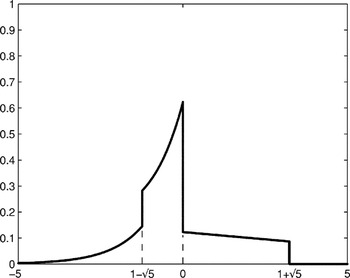
, which is within the assumed domain, the mode is still zero. This density is illustrated in Figure 3 for ε = 0.1. In general, μ = −5ε/6 and

which is positive for

. This is because the mean μ is quite negatively sensitive to the ε-change that has been introduced, whereas E((x − μ)3) goes the other way. By Pr(x < 0) > ½, the median is negative, hence less than the mode, in spite of the positive skew. Notice that this provides a new counterexample for (c), because μ < M also.

M = 0, m ≈ −0.29, μ ≈ −0.08, skewness > 0 in (3).
Second, the discontinuities in the densities can also be questioned. Again, giving a slight inclination to the vertical lines in the previous graphs shows that the conclusions still hold. In fact, nonlinear splines can be used in the same way to provide counterexamples where the density is differentiable a number of times.
Third, there are various other measures of skewness, which are less commonly used. They include Karl Pearson's first and second measures, respectively,

The latter lies in the interval [−3,3]. If one of these two measures of skewness is adopted then, in the mean-median-mode inequality, one of the three relations is a tautology but the others may still not hold, as shown in the counterexamples. Notice that, with these alternative definitions of skewness, van Zwet's condition then implies that the inequality holds and also that the distribution is skewed in a particular direction.
References
REFERENCES
Abadir, K.M. &
M. Rockinger
(2003)
Density functionals, with an option-pricing application.
Econometric Theory
19,
778–811.Google Scholar
Abdous, B. &
R. Theodorescu
(1998)
Mean, median, mode IV.
Statistica Neerlandica
52,
356–359.Google Scholar
Dharmadhikari, S.W. &
K. Joag-Dev
(1983)
Mean, median, mode III.
Statistica Neerlandica
37,
165–168.Google Scholar
Groeneveld, R.A. &
G. Meeden
(1977)
The mode, median, and mean inequality.
American Statistician
31,
120–121.Google Scholar
Kendall, M. &
A. Stuart
(1977)
The Advanced Theory of Statistics,
vol. 1,
4th ed.
Charles Griffin & Co.
M = 0, m ≈ −0.25, μ = 0, skewness = 0 in (1).
M = 0, m ≈ 0.09, μ = 0, skewness > 0 in (2).
M = 0, m ≈ −0.29, μ ≈ −0.08, skewness > 0 in (3).
 You have
Access
- 25
- Cited by