Introduction
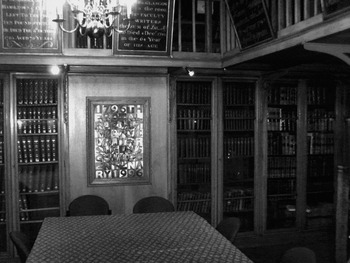
The Royal Faculty of Procurators in Glasgow is one of the oldest legal societies in the UK. Its date of incorporation, while not entirely certain, is definitely “long prior to 1668” (Muirhead Reference Muirhead1948) and by Royal Charter in 1796. The formation of a library for members was first proposed in 1736 and it was finally established in 1817. Members paid a subscription to erect the Faculty Halls whose primary function was to house the library. This magnificent building, built in the style of a Venetian palazzo, was completed in 1857.
Library collection and services
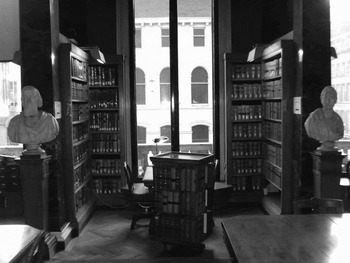
The library collection now covers all areas of Scots law (we currently take every Scots law text and multiple copies of popular texts), as well as significant holdings of English and European law. The library also houses comprehensive holdings of statutory materials, including local legislation, and an extensive collection of case report series (Scottish, English and European case report series as well as selected series from other jurisdictions) and journals. This has been augmented by a range of electronic resources. The library, in addition to having a wealth of legal materials, also has significant collections of historical, biographical, antiquarian and general literature and has been the recipient of a number of bequests over the years. The most significant of these was the Hill Collection, a collection relating chiefly to Glasgow history and comprising maps, charters, illustrations and over 1,600 books. Since 1952 there has also been a small branch library at the Sheriff Court, which contains a collection of works used in court practice and is intended for the use of members appearing before the sheriffs there.
With this weight of history, is the library an anachronism in the modern age of increasing electronic provision of legal information? The answer is emphatically no. The library continues to be financed directly by money raised from the payment of annual subscriptions by members who value it as the jewel in the crown of the Royal Faculty and for the access it gains for them to an extensive collection of legal works, far beyond the means of all but the largest firms. Even in the case of firms with significant libraries of their own, the Royal Faculty library provides a back-up (when books inevitably disappear or online services fail) and an augmentation of their own resources, as well as access to historical material, such as older case reports. While an increasing number of members have access to online sources of legal information, they still require and benefit from library staff who can mediate requests for information and carry out research. The library, therefore, remains very relevant to members' needs, which is illustrated by the expanding number of firms with corporate membership, the steadily increasing number of issues over the last decade, and the dramatic increase in requests for document delivery.
Document delivery service
The document delivery service has become increasingly popular with members largely because of the emphasis on customer care, the quick turnaround time and the good value for money. Another reason for the increase in requests, and the issue of books, is a change in working practices – with fee earners less able to justify taking time to go to the library in person (Westwood Reference Westwood2004, pp. 97–104). Trainees are also not routinely sent to the library to carry out research – as was the case in the past. There is, therefore, less awareness of what the library has to offer and consequently less impetus for them to visit the library, and so it is vitally important to promote the library and the services which it provides. To this end induction for all members (but in particular for trainees) has been heavily promoted and we have also set up a Trainee and Newly Qualified Society to facilitate education seminars, social interaction and networking for those new to the legal profession but also, crucially, to promote the services of the Royal Faculty, and especially the library, to the next generation of lawyers. We are also keen, depending on demand, to develop a bulletin or alerter service for members as this would definitely serve to highlight to members what the library can provide.
Small Library

Refurbishment programme
The Royal Faculty library has been described as “… a veritable oasis in the city centre, with exquisite surroundings and a peaceful atmosphere making even the most harassed lawyer feel focussed and relaxed.” (Benstock Reference Benstock2008). Members continue to cherish the study areas available, which are away from the demands and distractions of their offices. To ensure that this remains the case, a programme of refurbishment has been put in place to upgrade the fabric of the building in general and the comfort of the library in particular.
Main Library

Membership
Membership is open to all practising and retired solicitors, law firms and advocates. One of the challenges constantly facing the library is catering for the needs of a diverse membership - small practices requiring general texts, while larger firms often look to the Royal Faculty for more esoteric works. Coupled with this is the fact that the membership covers the full range of legal specialisms, and so the library is required to hold material on as broad a range of legal topics as possible. Furthermore, while the nature of a local law society means that there is a definite bias towards hard copy over electronic holdings, in recent years we have been looking to improve the coverage of electronic resources, as increasingly the membership comes to expect and require this and more information is made available on electronic platforms. This often necessitates the duplication of resources in different formats. All of these factors, together with the steady rise in the cost of subscription materials and legal texts faced by all legal libraries, combine to present a challenge to the Royal Faculty library in ensuring that the collection is both as broad as possible, as well as covering key areas of law in sufficient depth within the constraints of a finite budget.
Stairwell

Study bay in Main Library

Conclusion
What of the future? Whilst there are other benefits of membership, such as belonging to a collegiate body which has taken a lead in encouraging debate on the issues affecting the legal profession and representing the needs of members, the services of an auditor for executry and court feeing work and discounted access to the Royal Faculty's CPD education programme, by far the most important benefit remains access to the library. In times of financial constraint it can often be seen as a soft option to unsubscribe from library services to save money. On the other hand, the economic downturn also presents an opportunity to the Royal Faculty, as it makes more sense than ever for lawyers to take a collective approach to the purchasing of legal textbooks and resources. Indications are that this is a message which law firms and individual members are responding to. One thing is certain – the Royal Faculty and its library remain vigorous and will continue to serve its members and the legal community in Glasgow and Scotland.
Biography
John McKenzie began his career in Glasgow City Council Legal Library before becoming Faculty Librarian at the Royal Faculty of Procurators in Glasgow over six years ago.
Royal Faculty of Procurators in Glasgow
12 Nelson Mandela Place
Glasgow G2 1BT