INTRODUCTION
Human-induced alterations of the environment are influencing species interactions across the world (Palumbi, Reference Palumbi2001). The impact that the alterations have on host–parasite interactions depends on how they affect host encounter rate and the ability of the parasite to successfully infect the host, i.e. compatibility (Combes, Reference Combes2001). Current evidence suggests that various human activities are having profound effects on host–parasite interactions, with further consequences for population dynamics of both hosts and parasites (Lafferty and Kuris, Reference Lafferty, Kuris, Thomas, Guégan and Renaud2005; Budria and Candolin, Reference Budria and Candolin2014).
Anthropogenic eutrophication of aquatic ecosystems is an insidious, global problem that promotes primary production and alters both abiotic and biotic components of ecosystems (Smith and Schindler, Reference Smith and Schindler2009). It changes a range of factors that can influence host–parasite encounter rate and compatibility, such as host abundance and condition, visibility and predation risk, concentration of algal toxins and degree of hypoxia. These factors differ in their influence on host–parasite interactions, which makes it difficult to predict the ultimate effect of eutrophication on host–parasite systems. For example, increased primary production improves the condition of the intermediate snail host of the trematode Ribeiroia ondatrae, which increases the release of the parasite from the snails (Johnson et al. Reference Johnson, Chase, Dosch, Hartson, Gross, Larson, Sutherland and Carpenter2007). However, eutrophication also causes toxic algal blooms and hypoxia, which have the opposite effect on host condition and the release of trematode parasites (Johnson and Carpenter, Reference Johnson, Carpenter, Ostfeld, Keesing and Eviner2008). Moreover, the influence that improved host condition has on the dynamics of parasite populations can differ among systems. It can improve either resistance or tolerance of hosts to parasites, depending on the particular properties of the host–parasite system (McKenzie and Townsend, Reference McKenzie and Townsend2007; Johnson and Carpenter, Reference Johnson, Carpenter, Ostfeld, Keesing and Eviner2008; Johnson et al. Reference Johnson, Townsend, Cleveland, Glibert, Howarth, McKenzie, Rejmankova and Ward2010).
An ecosystem that has undergone drastic changes during the last decades because of an excessive discharge of nutrients by humans is the Baltic Sea. Along the coast of Finland, variations in the local input of nutrients and in water currents have resulted in spatial gradients in the degree of eutrophication (Raateoja et al. Reference Raateoja, Seppälä, Kuosa and Myrberg2005). However, little is known about the influence that these have on host–parasite interactions (but see Zander, Reference Zander2002). A common species in the area is the threespine stickleback Gasterosteus aculeatus. It spends the winter in deeper water and migrates in spring to coastal waters to spawn. These spawning areas differ in the degree of eutrophication (Tuomainen et al. Reference Tuomainen, Sylvin and Candolin2011). Stickleback are the second intermediate host of the parasitic cestode Schistocephalus solidus. They transfer the parasite to the definitive hosts – piscivorous birds – particularly to terns, Sterna hirundo and Sterna paradisaea, which breed in the area from early May to end of July. The parasite matures in the bird, and the eggs pass out with the feces and hatch in the water into free-swimming first-stage larvae (coracidia). These are in turn ingested by cyclopoid copepods, the first intermediate host of the parasite. Stickleback acquire the parasite when ingesting parasitized cyclopoid copepods. The plerocercoids grow inside the body cavity of the stickleback and can eventually exceed the mass of the fish (Arme and Owen, Reference Arme and Owen1967). Thus, the parasite imposes a heavy energy drain on the stickleback, which impairs their growth and reproduction and induces behavioural alterations that increase their exposure to piscivorous birds (Walkey and Meakins, Reference Walkey and Meakins1970; Bagamian et al. Reference Bagamian, Heins and Baker2004; Heins and Baker, Reference Heins and Baker2008).
We investigated if the level of eutrophication along the coast of Finland correlates with the prevalence of S. solidus infections in threespine stickleback populations. To further evaluate if such correlations could be mediated by effects of eutrophication on the condition and reproductive investment of stickleback, we recorded the condition and reproductive state of the stickleback and related these to differences between habitats in the prevalence of the parasite. We caught threespine stickleback from four parallel pairs of undisturbed clear water and eutrophied turbid water habitats along the coast of Finland, both at the start of the breeding season, when the fish arrived from deeper water to coastal spawning areas, and later during the breeding season when the height of the breeding season had passed. Stickleback experience relatively constant conditions during the winter in deeper water, but highly variable conditions in coastal spawning areas. In particular, eutrophied spawning areas have a higher primary production and food availability than clear water habitats, and a lower abundance of the final host of the parasite, piscivorous birds, because of the lower foraging success of birds in turbid water (Cézilly, Reference Cézilly1992). The density of the first intermediate host, cyclopoid copepods, on the other hand, is higher in eutrophied habitats (Scheinin and Mattila, Reference Scheinin and Mattila2010, Scheinin personal communication), which makes it difficult to predict the ultimate effect of eutrophication on the host–parasite system. In the Baltic Sea, stickleback typically spend the two first summers in shoals in shallow water, and usually reproduce in their third summer when 2+, after which they die (Borg, Reference Borg1982; Borg and van Veen, Reference Borg and van Veen1982; Candolin, Reference Candolin2000).
METHODS
We collected adult threespine stickleback from four areas along the coast of Finland in 2011 (Table 1). The areas differ in degree of eutrophication with the area in the Gulf of Bothnia (Raumo) being less eutrophied than the three areas in the Gulf of Finland (Nagu, Tvärminne, and Kotka). The most severely eutrophied area is the most eastern area in the Gulf of Finland, Kotka. The areas differ also in salinity and in species composition, which precludes direct comparisons among them. We therefore selected a relatively undisturbed, clear water habitat (C) and a eutrophied habitat (E), separated by 5–10 km, within each area. The habitats are classified to be in good vs poor ecological state based on long-term observations of several environmental factors (Table 1, Vuori et al. Reference Vuori, Mitikka and Vuoristo2009).
Chlorophyll-a concentration and Secchi depth (mean ± s.d.) in the clear water (C) and eutrophied (E) habitats in the four areas. The data are compiled from environmental reports (Häkkinen Reference Häkkinen2009; Turkki Reference Turkki2010, Reference Turkki2011) and the web portal of the Finnish Environmental Administration (http://wwwp2.ymparisto.fi/script/oiva.asp)

The stickleback were collected during three periods: when the breeding season started in mid-May, after the height of the breeding season had been passed in mid-June and at the end of the breeding season in early July. Temperature, which can influence physiological processes and immune activity (Karvonen et al. Reference Karvonen, Kristjánsson, Skúlason, Lanki, Rellstab and Jokela2013; Dittmar et al. Reference Dittmar, Janssen, Kuske, Kurtz and Scharsack2014), did not significantly differ between the habitats during sampling (temperature measured at 1 m depth, mean ± s.e., at the clear water and eutrophied sites, respectively: Raumo: 14·64 °C ± 2·01 and 14·02 °C ± 1·72, Nagu: 15·44 °C ± 5·41 and 14·92 °C ± 4·59, Tvärminne: 15·53 °C ± 4·90 and 15·94 °C ± 3·52, Kotka: 16·18 °C ± 4·43 and 19·40 °C ± 2·90). The fish were collected using a hand-trawl with mesh size 7 mm, which excludes juveniles. The stickleback were sacrificed through decapitation, and brought to the laboratory within 1 day, in an ice box, and frozen for later examination.
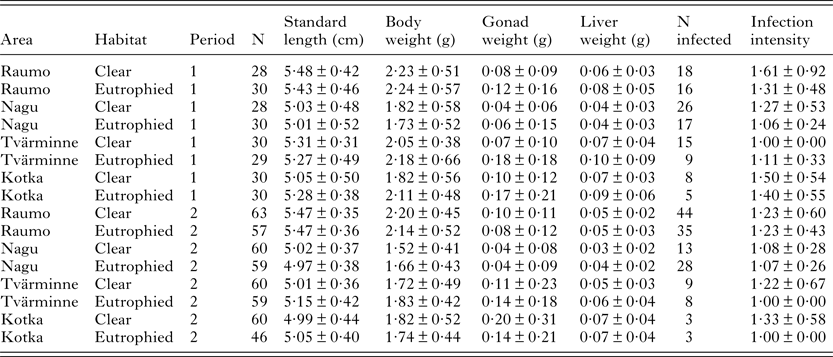
About 30 randomly chosen stickleback were inspected for each site and time period. For the last period, less than 30 fish were caught from some sites, because of high mortality and migration out of the spawning sites at the end of the breeding season. We measured standard length (SL, to 0·1 mm) and wet weight (WW, to 0·001 g) of the stickleback, and noted whether males had blue eyes and red throats. From the body cavity, we removed the liver, the gonads and plerocercoids of S. solidus, dried them on absorbent paper and weighed them (to 0·001 g). We calculated net body mass by extracting the mass of the gonads and S. solidus plerocercoids from the body mass. We calculated the following measures for each individual stickleback: (1) the parasite index (PI), which is the mass of all S. solidus plerocercoids in the body cavity divided by the net body mass of the stickleback (Arme and Owen, Reference Arme and Owen1967), (2) the residual condition index (RCI), which is the residual from a regression of log net body mass on log standard length, using all inspected fish (Jakob et al. Reference Jakob, Marshall and Uetz1996), (3) the hepatosomatic index (HSI), which is liver mass divided by net body mass, which indicates energy reserves (Chellappa et al. Reference Chellappa, Huntingford, Strang and Thomson1995) and (4) the gonadosomatic index (GSI), which is gonad mass divided by net body mass. Female gonad mass varies depending on whether the gonads are measured before or after spawning, but this variation should be the same across populations. Standard length, wet weight, gonad weight and liver weight of stickleback inspected at each site at each period are given in the Appendix (Table A1).
We analysed the influence of eutrophication and time of the season on parasite prevalence using mixed models with area as random factor and habitat (eutrophied or not) and time as fixed factors, with habitat nested within area. Because no significant differences were found between the two latter sampling times, and the sample size was low for the last sampling time, samples from the two latter samplings were pooled, resulting in two time periods: period 1 at the start of the breeding season, and period 2 after the height of the breeding season had passed. Analyses were conducted using IBM SPSS Statistics 20.
RESULTS
At the start of the breeding season, the proportion of stickleback infected with S. solidus was lower in eutrophied habitats than in clear water habitats (generalized linear mixed model (GLMM) with binomial error distribution: F 1,238 = 8·31, P = 0·004, Fig. 1a). The intensity of infections (number of parasites per infected stickleback) did not differ between habitats (GLMM with negative binomial error distribution, including only infected fish: F 1,112 = 0·41, P = 0·52, see Table A1). The proportion of single infections was 72 ± 11% (mean ± s.e.) in clear water and 78 ± 8% in eutrophied waters. When the height of the breeding season had passed, the prevalence of the parasite decreased markedly in three of the four habitats with clear water, while the reduction was less pronounced in eutrophied waters (GLMM with binomial error distribution: habitat*period: F 1,703 = 9·40, P = 0·002, Fig. 1a). The intensity of the infections did not change over time (GLMM with negative binomial error distribution, including only infected fish: F 1,254 = 0·49, P = 0·48), independent of habitat (habitat*period: F 1,253 = 0·06, P = 0·81).
Infection by S. solidus in clear and eutrophied waters in the four areas at the start of the breeding season, P1, and after the height of the breeding season had been passed, P2. (a) Percentage of stickleback infected, with numbers above bars indicating the number of stickleback inspected, and (b) the relative weight of the parasite(s) per infected stickleback, P1.

The relative mass of S. Solidus in the body cavity (PI) did not differ between habitats at the start of the breeding season (linear mixed model (LMM), including only infected stickleback: F 1,2·7 = 1·69, P = 0·29, Fig. 1b). PI decreased over the season in clear water but not in eutrophied water (habitat*period: F 1,247 = 4·40, P = 0·037), with the reservation that the pattern was not evident in all areas (Fig. 1b). Most S. solidus plerocercoids were large enough to be mature and infective (competent), as 303 out of 312 plerocercoids weighed more than 50 mg (see Tierney and Crompton, Reference Tierney and Crompton1992). The body size of the stickleback did not differ between habitats at the start of the season (including all stickleback, SL: F 1,3·1 = 0·22, P = 0·67, WW: F 1,3·01 = 1·10, P = 0·37), but decreased over the season, independent of habitat (including all stickleback, SL: F 1,691 = 7·38, P = 0·007, WW: F 1,693 = 23·59, P < 0·001). The reduction correlated with a change in sex ratio (sex ratio inserted as a covariate in LMM: F 1,33 = 11·69, P = 0·002), from female biased in period 1 (males to females: 0·92 ± 0·10, mean ± s.e.) to male biased in period 2 (1·87 ± 0·37) as males were smaller than females.
Females were infected more often than males in clear water but not in eutrophied water (GLMM with binomial error distribution, sex inserted into the model: habitat*sex: F 1,699 = 4·27, P = 0·039), and the difference between the sexes was more pronounced later in the season when the proportion of infected females in proportion to infected males had slightly increased in turbid water (period*sex: F 1,699 = 6·29, P = 0·012, Fig. 2). Because females are larger than males, the same pattern is found when sex is replaced by body length (SL): large individuals were more often infected in clear water than in eutrophied water (habitat*SL: F 1,692 = 3·64, P = 0·057), and the difference between infected and uninfected stickleback in size increased over the season (period*SL: F 1,692 = 18·69, P = 0·001). Thus, particularly small infected males were disappearing from the populations, and particularly from clear water habitats, while larger uninfected females were disappearing from the total population. The model with body length scored lower Akaike information criterion (AIC) value than the model with sex (AICStandard length = 741·21, AICSex = 768·75), which indicates that body size rather than sex determined the probability of infection. The relative weight of S. solidus in the body cavity (PI) did not differ between the sexes, independent of habitat and time (F 1,246 = 0·12, P = 0·73).
Proportion of males and females infected by S. Solidus in clear (C) and eutrophied (E) waters, at the start of the breeding season, period 1, and after the height of the breeding season had been passed, period 2. Data are mean ± s.e. and based on the mean value for each area, N = 4. Number above bars give the total number of males and females inspected for the four areas.

Infected fish were in poorer condition than uninfected fish, with the difference being more pronounced in eutrophied waters, particularly at the end of the season (LMM: habitat*period*infection: F 1,650 = 4·35, P = 0·037, Fig. 3a). Infected fish also had lower energy reserves (the hepatosomatic index HSI), with the difference being smaller later in the season when the energy reserves of uninfected fish had decreased (period*infection: F 1,673 = 5·09, P = 0·024, Fig. 3b). The higher the relative weight of S. solidus (PI), the poorer the condition of the stickleback (b = −1·15 (s.e. = 0·16), F 1,240 = 48·62, P < 0·001) and the lower the hepatosomatic index (b = −3·83 (s.e. = 0·78), F 1,240 = 24·09, P < 0·001), independent of habitat and time. Uninfected stickleback were in better condition in eutrophied than in clear water habitats at the start of the season, but not later in the season when their condition had deteriorated (habitat*period: F 1,433 = 8·79, P = 0·003, Fig. 3a). The haematosomatic index of uninfected stickleback did not differ between habitats F 1,3·81 = 2·72, P = 0·18), but was lower later in the season, (F 1,440 = 17·00, P < 0·001, Fig. 3b).
The condition of uninfected and infected stickleback in clear (C) and eutrophied (E) waters at the start of the breeding season, period 1, and after the height of the breeding season had been passed, period 2. Condition is measured as (a) residual body condition and (b) hepatosomatic index. Data are mean ± s.e. and based on mean value for each habitat, N = 4.

Infected females had lower gonadosomatic index (GSI) than uninfected females, but the difference was less pronounced later in the season in clear water habitats, because of the large variation among females in GSI in clear water (LMM: habitat*period*infected: F 1,287 = 5·40, P = 0·021, Fig. 4). The GSI of females decreased with increasing relative weight (PI) of S. solidus (b = −0·10 (s.e. = 0·04), F 1,137 = 7·72, P = 0·006). The gonadosomatic index of uninfected females increased over the season, but less so in eutrophied habitats (habitat*period: F 1,153 = 10·13, P = 0·002, Fig. 4).
The gonadosomatic index of uninfected and infected individuals in clear and eutrophied waters at the start of the breeding season, period 1, and after the height of the breeding season had passed, period 2. Data are mean ± s.e. and based on the mean value for each habitat, N = 4.

Infected males were less often in breeding condition, judged by their eye colour, independent of habitat and time of the season (GLMM with binomial error distribution: F 1,395 = 12·94, P < 0·001). They were also less often nuptially coloured, with the difference being more pronounced later in the season (period*infection: F 1,394 = 5·12, P = 0·024, Fig. 5). The relative weight of S. solidus (PI) did not influence the probability of blue eyes (F 1,106 = 1·27, P = 0·26) or red throats (F 1,106 = 1·19, P = 0·28). Eutrophication had no influence on the proportion of uninfected males in reproductive condition (blue eyes: F 1,4·7 = 0·19, P = 0·68, red throat: F 1,259 = 2·24, P = 0·14), but more males were in reproductive condition later in the season (blue eyes: F 1,260= 150·13, P < 0·001, red throat: F 1,258 = 82·67, P < 0·001, Fig. 5).
The percentage of uninfected and infected males with red throat in clear and eutrophied waters at the start of the breeding season, period 1, and after the height of the breeding season had been passed, period 2. Data are mean ± s.e. and based on mean value for each habitat, N = 4.

DISCUSSION
Fewer stickleback were infected with S. solidus at the start of the breeding season in eutrophied waters, but while prevalence decreased markedly in undisturbed clear waters across time, high infection levels were maintained in eutrophied waters. This suggests that eutrophication could relax selection against parasitized individuals.
The lower prevalence of S. solidus in eutrophied habitats at the start of the season is most likely a consequence of a lower transmission rate of the parasite. The density of piscivorous birds, which are the final host in the life cycle of the parasite, are less common in areas where water visibility is poor and foraging hampered (Candolin, personel observation) (Cézilly, Reference Cézilly1992). This should reduce the prevalence of the parasite also in the first host, cyclopoid copepods, which transmit the parasite to stickleback. Infection had probably taken place in the same habitat where the stickleback were caught by us, during previous summers, as 0+ or 1+juveniles, as stickleback are infected only in the summer when adult cyclopoid copepods occur (Scheinin and Mattila, Reference Scheinin and Mattila2010), and as they often return to the same area to spawn where they had hatched (Lind and Grahn, Reference Lind and Grahn2011). In support of this, the infections had taken place several months before the stickleback were caught by us, as indicated by the large size of the plerocercoids (Tierney and Crompton, Reference Tierney and Crompton1992).
Alternative, not mutually exclusive, explanations for the lower parasite prevalence in eutrophied habitats at the start of the season is that stickleback in eutrophied habitats have better resistance against parasites, or that they suffer from lower tolerance of infections and experience higher mortality outside the breeding season. Stickleback in eutrophied habitats were in better condition than stickleback in clear water habitats at the start of the breeding season, which supports the possibility of higher resistance, but decreases the possibility of higher winter mortality. Another possibility is that parasitized stickleback avoided eutrophied spawning habitats. However, this is contradicted by an earlier findings that habitats with a high density of macroalgae, which is typical for eutrophied habitats, attract infected stickleback (Heuschele and Candolin, Reference Heuschele and Candolin2010). It is also refuted by a smaller decline in the prevalence of infected stickleback over the season in eutrophied than in clear water habitats.
The much smaller decline in the prevalence of the parasite across the season in eutrophied habitats could be caused by a lower mortality of infected stickleback or, alternatively, by less dispersal out of from eutrophied habitats. A lower mortality is supported by the unchanged relative mass of the parasite in eutrophied habitat, which contrasts with the decrease in clear water habitats. Heavily infected stickleback may survive despite the burden of the parasite in eutrophied habitats, because of higher food levels or lower predation risk. Higher primary production probably increases food availability, which could ensure survival despite the energy drain induced by the parasite (Arme and Owen, Reference Arme and Owen1967; Walkey and Meakins, Reference Walkey and Meakins1970). This is supported by the higher proportion of small infected individuals – who should be most sensitive to poor food conditions – in eutrophied than in clear water habitats. These small infected individuals are probably less able to sustain the costs imposed by the parasite, as they disappeared from the populations to a higher degree than larger infected individuals. In agreement with earlier studies, infected stickleback were in poorer condition than uninfected individuals, and the relative size of the parasite correlated negatively with the condition of the fish (e.g. Bagamian et al. Reference Bagamian, Heins and Baker2004). Schistocephalus solidus infections are known to cause premature death (e.g. Pascoe and Mattey, Reference Pascoe and Mattey1977; Barber and Ruxton, Reference Barber and Ruxton1998) and mass mortality in natural stickleback populations (e.g. Threlfall, Reference Threlfall1968; Pennycuick, Reference Pennycuick1971; Heins et al. Reference Heins, Baker and Green2011).
A lower predation risk in eutrophied habitats could have similarly promoted the survival of infected fish. Infected fish swim closer to the surface, where they are prone to predation by birds (Tierney et al. Reference Tierney, Huntingford and Crompton1993, Reference Tierney, Huntingford and Crompton1996). Because piscivorous birds are less common in eutrophied areas, and have a lower foraging success (Candolin, personel observation) (Cézilly, Reference Cézilly1992), the behaviour may impose lower risk in eutrophied habitats. Moreover, it is possible that predation pressure from piscivorous fishes is also lower in eutrophied, turbid water (Carreon-Martinez et al. Reference Carreon-Martinez, Wellband, Johnson, Ludsin and Heath2014), particularly from the common fish predators in the areas, perch and pike, as these use vision to catch prey (Radke and Gaupisch, Reference Radke and Gaupisch2005; Ranåker et al. Reference Ranåker, Jönsson, Nilsson and Brönmark2012).
An alternative explanation for the difference between habitats in parasite prevalence across the season is that infected stickleback invested less in reproduction in eutrophied environments and therefore better sustained the burden of the parasite. However, there was no significant difference between habitats in the GSI of infected females, or in the proportion of infected males in breeding condition. Infection did reduce egg production and the probability of males entering, or maintaining, reproductive condition, but the effect did not depend on eutrophication. The probability that infected males enter breeding condition is probably more sensitive to other environmental conditions, such as the degree of competition from other males (Candolin and Voigt, Reference Candolin and Voigt2001).
The possibility that fewer infected individuals dispersed out of eutrophied habitats is plausible as infected fish are less likely to survive until the next breeding opportunity, and therefore should invest heavily in current reproduction. Because primary production and, hence, food availability is higher in eutrophied waters, infected individuals with high energy demands could be more likely to stay in eutrophied habitats, as has been found in earlier studies (Heuschele and Candolin, Reference Heuschele and Candolin2010). Moreover, mating success is more random in eutrophied habitats where visibility is low, which should be advantageous for infected individuals that have a low mating probability in clear water (Engström-Öst and Candolin, Reference Engström-Öst and Candolin2007; Candolin and Vlieger, Reference Candolin and Vlieger2013; Candolin et al. Reference Candolin, Nieminen and Nyman2014).
The lower disappearance of infected stickleback from breeding populations in eutrophied environments, combined with a higher probability of reproduction, suggests that individuals with a low resistance to parasites, who could be of low genetic quality, could contribute more to the breeding pool in eutrophied habitats. Eutrophication could then favour the evolution of less parasite resistant populations. This could have further consequences for the viability of the species that are directly or indirectly linked to the host–parasite system. However, how changes in the resistance of stickleback to the parasite influence population dynamics and evolutionary processes of linked species is unknown but would deserve further investigations. In general, more information is needed on how alterations in host–parasite interactions, because of human-induced rapid environmental changes, influence the dynamics and evolution of species linked to the host–parasite system.
To summarize, our results show that eutrophied environments harbour fewer infected stickleback at the start of the breeding season, but that infected individuals are not removed from the breeding pool to the same degree as in undisturbed clear water habitats. There are several possible, non-mutual explanations for this, and the most likely explanation is that lower predation risk and higher food availability allow infected stickleback to survive and breed in eutrophied environments. This could in turn favour the evolution of less parasite resistant populations, with possible consequences for the dynamics and evolution of the interacting parties of the host–parasite system.
ACKNOWLEDGEMENTS
The authors thank Jérémy Huyghe, Sophie Renard and Aurora Paloheimo for assistance, and two reviewers for valuable comments.
FINANCIAL SUPPORT
This study was funded by the Maj and Tor Nessling Foundation (to U.C. and A.B).
APPENDIX
Number of stickleback inspected, their standard length, body wet weight, gonad wet weight, liver wet weight, number of stickleback infected and their infection intensity (number of parasites per infected stickleback). Values are mean ± s.d. for each site and each period.