


1 PRELIMINARIES
First, I need to explain what I mean by hedonism. The formulation of the basic form of hedonism that I shall discuss here is:Footnote 1
(HP1) Only tokens of pleasure or pain bear final value or disvalue.
(HP2) All tokens of pleasure bear final value.
(HP3) All tokens of pain bear final disvalue.
Following Korsgaard and others, I use ‘final value’ rather than ‘intrinsic value’ to refer to something's being good ‘for its own sake’ or ‘as an end’.Footnote 2 This is partly because of the ambiguity of the term ‘intrinsic value’ but also in keeping with Mill's discussion. This is because, at least in Utilitarianism, Mill talked mostly of things being ‘desirable as an end’, ‘valuable’, or as an ‘ultimate end’, rather than their being ‘intrinsically valuable’.Footnote 3 Furthermore, some of the few times Mill does talk of ‘intrinsic good’ he appears to use the term as a contrast to things being a means to a good, an idea better expressed by ‘good as an end’ or ‘finally valuable’ than by ‘intrinsically valuable’.Footnote 4
This formulation of hedonism makes clear that it is a theory of what is finally good and is silent on questions of rightness. Failing to recognize this can lead to mistakes about the sorts of claims that hedonism is committed to. One such error would be to reason from the fact that the outcome in which K performs ϕ contains more value than any alternative possible outcome, to the conclusion that it would be right for K to ϕ.
Such reasoning is wrong as it assumes that the deontic status of acts derives solely from the value properties of states of affairs. Whilst some normative theories – such as act-consequentialism – do hold this, it is false that hedonism entails anything about rightness. Adopting hedonism as a theory of the good does not commit one to any view about the nature of rightness and its relatedness, or non-relatedness, to goodness.
We can combine hedonism with both deontological and teleological normative theories. A familiar example of the latter is hedonistic act-utilitarianism, which combines the hedonist theory of good with the fundamental tenets of utilitarianism. Hedonistic act-utilitarianism would hold that all agents have the same basic requirement – to generate as much net pleasure as possible. Conversely, we could combine hedonism with a deontological moral theory such as Nozick's side-constraint theory.Footnote 5 Whilst this would be an unusual combination, it would not be an incoherent one. It would hold that pleasure is finally good, but that the value of resultant states of affairs does not provide reasons for action. For example, to ϕ is permissible not because it will produce a valuable state of affairs, but for some other reason – such as its respecting the natural rights of agents.
There are two other issues I will mention briefly. First, we can distinguish between hedonism as a theory of well-being, and hedonism as a theory of value. Hedonism as a theory of well-being has a narrower scope as it holds that pleasure and pain are the only factors which determine ‘what makes someone's life go best’.Footnote 6 A hedonist theory of value has a wider scope as it holds that pleasure and pain are the only things which determine the value of outcomes as a whole. This article is about hedonism as a theory of value.
The second issue to set aside is the ‘paradox of hedonism’. The paradox, as described by Sidgwick amongst others, is that agents who strive directly for their own pleasure tend to generate it less successfully than those who strive for other goals.Footnote 7 Whilst neither alleging nor denying the existence of the paradox, I want to make clear that, even if the paradox is real, it does not undermine the claim that hedonism is a true account of what is good as an end. This can be seen by differentiating between hedonism as an account of value, and as a conscious guide to action. Whilst it may be true that those attempting to generate pleasure are less likely to generate pleasure by deliberately striving for it, this does not undermine the claim that what is good as an end, aside from the issue of how it is most successfully generated, is pleasure. The paradox might point out a surprising feature of attempts to generate what is valuable but this does not damage hedonism as an account of what is good as an end.
2 QUALITATIVE HEDONISM
Worries about the inability of hedonism to value pleasures on non-quantitative grounds, namely grounds other than their intensity and duration, are long-standing. Hedonists are often perceived to face a dilemma. The first horn of the dilemma is that if hedonists refuse to recognize qualitative differences in pleasures and retain a purely quantitative form of hedonism then they are committed to counter-intuitive implications. The second horn is that a qualitative form of hedonism would be a contradiction and would actually involve the abandonment of hedonism and adoption of value pluralism. My aim here is to show that qualitative hedonism is not contradictory, and thus that hedonism may be able to avoid the second horn of the dilemma.
The most plausible interpretation of Mill is that he holds a form of qualitative hedonism in which certain pleasures are more valuable than others, even when the quantities are equal.Footnote 8 Mill claims that:
It is quite compatible with the principle of utility to recognize the fact that some kinds of pleasure are more desirable and more valuable than others. It would be absurd that, while in estimating all other things quality is considered as well as quantity, the estimation of pleasures should be supposed to depend on quantity alone.Footnote 9
For example, qualitative hedonism might hold that an instance of pleasure from reading Plato, with a duration of 20 and an intensity of 10, is more valuable than an instance of pleasure from skimming stones, despite its also having a duration of 20 and an intensity of 10. So, the qualitative hedonist sees the value of pleasure as being determined by three variables: duration, intensity and quality.
The first argument against qualitative hedonism is from Moore who claims that qualitative hedonism is inconsistent. One route to Moore's conclusion is to simply assert that hedonism must take a purely quantitative form, by specifying that pleasures can vary only according to their quantity, and thus that the value of pleasure can only be a function of intensity and duration. Moore makes this point by asking ‘Can one pleasure be pleasanter than another, except in the sense that it gives more pleasure?’Footnote 10
As discussed by Crisp and others, Moore's claim arguably begs the question against qualitative hedonism by assuming that hedonism can only take a quantitative form.Footnote 11 Whilst it is true that Mill's qualitative hedonism is inconsistent with formulations of hedonism that require it to take a purely quantitative form, it is dialectically uninteresting to resolve the inconsistency by adjudging qualitative hedonism as incoherent on that ground alone, without providing an independent ground for rejecting the notion of qualitative variation in pleasures.
A more interesting argument for the inconsistency of qualitative hedonism is one made by Bradley as follows:
Higher then, . . . has no meaning at all, unless we go to something outside pleasure, for we may not go to quantity of pleasure. But, if we go outside pleasure, not only have we given up the greatest amount theory, but we have thrown over Hedonism altogether.Footnote 12
Moore seems to make the same point by saying:
I have pointed out that, if you say, as Mill does, that quality of pleasure is to be taken into account, then you are no longer holding that pleasure alone is good as an end, since you imply that something else, something which is not present in all pleasures, is also good as an end.Footnote 13
The claim is that by introducing quality as a determinant of the value of pleasure, qualitative hedonism abandons value monism and allows something other than pleasure to be good as an end.
This claim is false because there can be monistic forms of qualitative hedonism. Returning to the example of reading Plato versus skimming stones, qualitative hedonism need not ascribe additional final value to the reading of Plato, as compared with skimming stones. Rather, it ascribes additional value to the pleasure of reading as opposed to the pleasure of skimming stones. The Bradley–Moore claim would be correct if a qualitative hedonist held that there is final value in reading Plato without enjoyment. Yet, it is clear that a qualitative hedonist need not make such a claim. We can formulate a consistent version of qualitative hedonism as follows:
(1) Tokens of pleasure are all, and the only, bearers of final value.
(2) Tokens of pain are all, and the only, bearers of final disvalue.
(3) The final value of a token of pleasure is a function of its intensity, duration and quality where:
(a) A more intense pleasure has greater final value, ceteris paribus, than a less intense pleasure.
(b) A longer-length pleasure has greater final value, ceteris paribus, than a shorter-length pleasure.
(c) A higher-quality pleasure has greater final value, ceteris paribus, than a lower-quality pleasure.
It is clear that qualitative hedonism is monistic in that it allows pleasure and pain alone to be bearers of final value and disvalue. The Bradley–Moore claim – that qualitative hedonism must ascribe value to something other than pleasure – seems to presuppose that qualitative hedonism holds something like the following:
(1) Tokens of pleasure are all, and the only, bearers of final value.
(2) Tokens of pain are all, and the only, bearers of final disvalue.
(4) Activities vary in their final value, according to their quality.
(4) contradicts (1) and (2) by allowing things other than pleasure and pain (activities) to be bearers of final value. But, if the qualitative hedonist actually holds (1), (2) and (3) then he is clearly not abandoning the monistic element of hedonism. He simply holds that the final value of an instance of pleasure is determined by three factors: intensity, duration and quality.
If we look again at the quotation from Mill we are reminded that his claim is that different kinds of pleasure are of different value. Thus, Mill's qualitative hedonism is not committed, pace Bradley and Moore, to claiming that A's reading Plato without pleasure is more valuable than B's skimming stones without pleasure. Rather, qualitative hedonism would say that the fact that neither agent experiences pleasure means that there is no final value in either situation, so the issue of qualitative superiority cannot arise.
At the heart of the argument against qualitative hedonism is the idea that it allows other values, such as knowledge, to creep into the list of bearers of final value, thus making it pluralistic. As I have shown, this is mistaken. Qualitative hedonism is not inconsistent. Although it is consistent, it is much less clear that qualitative hedonism is plausible, and it is to this issue that I will now move.
In fairness to Bradley and Moore, it may be that their objection to qualitative hedonism was a reasonable worry about the introduction of quality as a determinant of the value of pleasure being unmotivated and that they conflate this with the question of whether qualitative hedonism is monistic.Footnote 14 The difficulty for the proponent of qualitative hedonism is to specify exactly how the quality of a pleasure affects its value. I have shown that qualitative hedonism is neither inconsistent nor pluralistic, but this does not provide grounds for thinking that qualitative variation of pleasures is well motivated. As Feldman points out, it is inadequate to take as a motivation for qualitative hedonism the fact that it supports the intuitively ‘right’ answer when it comes to comparing the values of reading Plato and skimming stones.Footnote 15 The qualitative hedonist needs to give a good justification for the claim that quality can affect the value of a token of pleasure and how it can do so without itself being valuable.
A qualitative hedonist could simply stipulate that quality ‘just does’ contribute to the value of pleasure, in the same way that an increase in the intensity or duration of a pleasure increases its final value.Footnote 16 Yet the obvious response is to say that there is strong intuitive support for the claim that the value of pleasure is increased when it is more intense or of longer duration, so it is not difficult to see why such quantitative factors affect the final value of an instance of pleasure. By contrast, the notion of quality remains somewhat mysterious. It does not seem that what Mill would regard as higher pleasures feel superior to lower pleasures. Nor is it clear how the pleasure an agent gets from reading poetry is better than an equal-sized pleasure from playing skittles, other things being equal.
I have shown why the common objection to qualitative hedonism – that it is pluralistic – is mistaken. Qualitative hedonists can be monists about value. Yet, as I have briefly explained, such forms of qualitative hedonism require a lot to motivate them, as quality does not seem on ‘all fours’ with intensity and duration as being a determinant of the value of a pleasure. But this is not to say that it cannot be done.
3 MALICIOUS PLEASURES
Another standard objection to hedonism is the objection from malicious pleasures. This objection attacks (HP2) from my formulation of hedonism above by claiming that some pleasures either hold zero final value or final disvalue (hereafter ‘value’/‘disvalue’ unless otherwise specified).
Of course, hedonism is committed to ascribing equal final value to malicious pleasure, all things being equal, as to equal sized non-malicious pleasures. Rather than attempting to avoid this conclusion, my aim in this section is to explain how it might be less counterintuitive to assign final value to malicious pleasures by showing how our intuitions can go awry on the issue. I believe that some of our judgements about malicious pleasures are illegitimately affected by considerations of: the wrongness of acts, the disvalue of people's being capable of experiencing malicious pleasure, and the gratuitous badness of outcomes.
When considering the objection from malicious pleasures against hedonism we should focus on the salient issue: malicious pleasure. Compare the following cases:
(1) X plays football with Y for pleasure, generating net amount of pleasure P.
(2) X tortures Y for pleasure, generating net amount of pleasure greater than P.
Someone might claim that hedonism cannot give a reason for thinking that X should do (1) rather than (2), because of the greater amount of pleasure in (2). Yet, as explained earlier, hedonism makes no deontic claims. So, whilst hedonism cannot say that (1) is more valuable than (2), because of the greater pleasure in the latter, this does not commit it to saying that the act performed in (2) is right. Only if one assumes a perfect relationship between evaluative properties of states of affairs and deontic properties of acts does one get such a result, and hedonism does not entail this, or any other, relationship.
This point is important because pairs of cases such as (1) and (2) are likely to give illegitimate support for the objection from malicious pleasures by introducing considerations of the wrongness of acts, and of the pain of the person who is the object of the malicious pleasure. Thus, if we want to examine the objection from malicious pleasures we should compare pairs of cases in which the act is the same and the only salient difference is the presence of malicious pleasure, as in the following:
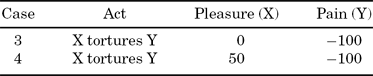
By making this comparison we focus on the salient issue – whether X's experiencing pleasure from the act makes outcome (4) better. Distracting issues are filtered out because the act X performs is the same in both cases, as is the pain experienced by Y.
This helps perhaps to make it less counter-intuitive to ascribe final value to the pleasure of torture because it prevents us from, illegitimately, comparing the ascription of final value to pleasures stemming from malicious acts with the ascription of final value to a pleasure stemming from non-malicious acts.
However, even in a comparatively pure case such as this, there are likely to be other distracting issues that affect our intuitions. The first of these is that despite the pain of Y being stipulated as equal in the two cases, it is probable that in a situation in which X tortures Y, Y's being aware that X is enjoying the act is likely to increase the pain experienced by Y. We should, therefore, also stipulate that the pleasure experienced by X is indiscernible, and keep in mind that Y's pain is a constant.
Another important consideration is that, when we are thinking about examples of malicious pleasures, the agent's character is likely to affect our intuitions. So, for example, it is plausible that there is substantial disvalue in X's having a personality which can derive pleasure from torturing other sentient beings. A hedonist will agree that there is likely to be instrumental disvalue in X's being disposed to derive pleasure from torture – for this disposition is likely to lead to disvalue by generating pain for other agents.Footnote 17 And, as Smart points out, when a character trait will nearly always be instrumentally bad it is difficult to avoid moving from ascribing instrumental disvalue to the character trait, to ascribing final disvalue to it, to ascribing final disvalue to the pleasure that goes with that character trait.Footnote 18
In addition to the wrongness of the act, and the instrumental disvalue of malicious persons, there seems to be another distracting influence on our intuitions. This is the fact that examples of malicious pleasures tend to involve cases in which an unnecessary pain is brought about – such as Y's being tortured. We can neutralize the influence of this fact, and perhaps make malicious pleasures less counterintuitive, by considering an example in which an agent takes malicious pleasure in inflicting a pain that is non-gratuitous.
For example, let us compare two cases in both of which a dentist performs a painful tooth extraction on a patient to prevent future toothache:
Sadistic dentist: The dentist (indiscernibly) experiences pleasure from the unavoidable pain the patient experiences from the procedure.
Ordinary dentist: The dentist (indiscernibly) experiences neither pain nor pleasure from the unavoidable pain the patient experiences from the procedure.
The amount of pain experienced by the patient is equal in each case. Let us also stipulate that the sadistic dentist enjoys the pain the patient experiences, but he performs the procedure as painlessly as possible, so his experiencing malicious pleasure does not cause him to inflict unnecessary pain. It seems clear that this is malicious pleasure, as the sadistic dentist experiences pleasure in the pain of another, but it does not seem so obviously incorrect to ascribe final value to this pleasure.
Perhaps very few examples of malicious pleasure will be like this. The point remains that it does not seem counterintuitive to ascribe final value to the pleasure of the sadistic dentist. This suggests that some of our intuitions against the final value of malicious pleasure stem from distracting, and illegitimate, considerations.
Some will remain unconvinced by this. They will think that the outcome where the ordinary dentist performs the procedure is a better one, despite its lacking pleasure. My claim is not that we can make malicious pleasures entirely intuitively acceptable. Rather I claim that reflecting on the dentist case, especially in comparison with the torture case discussed earlier, makes it less obviously counterintuitive to ascribe final value to malicious pleasure. If this is so, it helps to establish the point that some of our intuitive reluctance to recognize the final value of malicious pleasure stems from illegitimate considerations. This is significant even if we reject hedonism. For even if hedonism is misguided in granting value to all malicious pleasures, the correct conclusion to draw is not that malicious pleasures never have value. At least in the case of the sadistic dentist as I described it, there is some final value in his taking pleasure in the other's pain.
In summary, I have explained three different ways for the hedonist to try to make it less counterintuitive to claim that malicious pleasures hold final value. The first of these was to argue that the malicious pleasure is valuable, but that this does not affect the deontic status of the act. Ascribing value to a malicious pleasure does not require hedonism to say that the act should be performed. The second tack was to argue that our intuitions about such cases are unreliable because of a tendency to allow evaluation of the agent to affect our attitude towards malicious pleasures. Third, I argued that there are cases in which it does seem plausible to ascribe final value to malicious pleasures, such as when we compare the sadistic dentist with the ordinary dentist.
In the first part of this article I argued that qualitative hedonism is coherent, and can be consistently monistic about value. I did not argue that qualitative hedonism is well motivated. My more modest aim was to undermine the long-standing allegation that qualitative hedonism is incoherent or pluralistic. In the second part of this article I provided a case for ascribing final value to at least some tokens of malicious pleasure. If some malicious pleasures, such as the pleasure of the sadistic dentist, do hold final value then this perhaps marks the first step towards a defence of the hedonist from the objection from malicious pleasure. Even if such a defence is not forthcoming, we have still seen that there are malicious pleasures that are plausible candidates for holding final value.Footnote 19


