Introduction
Trust is essential for the stability and economic prosperity of democratic welfare states (Fukuyama, Reference Fukuyama1995; Zak and Knack, Reference Zak and Knack2001; Uslaner, Reference Uslaner2002; Halpern, Reference Halpern2005). This paper asks what role national identity plays in generating – or on the contrary undermining – social and political trust. It thereby tests the first part of the ‘national identity argument’: the claim that national identity is a crucial source of trust in large-scale liberal democracies (Miller and Ali, Reference Miller and Ali2014; Lenard and Miller, Reference Lenard, Miller and Uslaner2018).Footnote 1 The underlying idea is that nationality offers a common in-group identity that strengthens cohesion among citizens who are otherwise divided, some would say increasingly so, along political, cultural, ethnic, or even sexual lines. In the long run, liberal nationalists argue national identity thus becomes crucial for upholding the economic solidarity embodied by the welfare state (cf. Tamir, 1993, Reference Tamir2019; Miller, Reference Miller1995: 140; Kymlicka, Reference Kymlicka2015). This is why ‘liberal nationalism’ (Tamir, Reference Tamir2019) and ‘inclusive patriotism’ (Mounk, Reference Mounk2018) have recently been revived in debates on how to counteract growing populism and eroding trust in liberal democracy and its institutions on both sides of the Atlantic.
The problem is that the benign link between national identity and trust that forms the basis of the national identity argument is far from a settled fact. Liberal nationalists often rely on the well-established association in social psychology between group identification and in-group trust (Foddy et al., Reference Foddy, Platow and Yamagishi2009; Platow et al., Reference Platow, Foddy, Yamagishi, Lim and Chow2012). However, only one experiment has shown that this applies to national identities specifically: in Malawi, Robinson (Reference Robinson2016) found that making the overarching national identity salient heightened trust in co-nationals, including those from rivalling ethnic groups. Indeed, if we look at observational studies, the research front is divided between those who, using North American data, find that the link between national identity and trust is positive (Theiss-Morse, Reference Theiss-Morse2009; Johnston et al., 2010, Reference Johnston, Wright, Soroka, Citrin, Banting and Kymlicka2017), and those who, using cross-national data sets or case studies from Europe, on the contrary conclude that it is negative (Berg and Hjerm, Reference Berg and Hjerm2010; Reeskens and Wright, Reference Reeskens and Wright2013; Breidahl et al., Reference Breidahl, Holtug and Kongshøj2018; Kongshøj, Reference Kongshøj2019).
By taking a more comprehensive approach to the question of how national identity and trust are related, we advance the current research frontier in four ways. First, in the next two sections, we distinguish between the four most important dimensions of national identity and then use social identity theory to develop new hypotheses for how each is likely to affect trust. Secondly, we do so for both social and political trust, the latter of which has received less attention in relation to the national identity argument. Thirdly, in the empirical part of the paper, we test our hypotheses by studying the association of each subdimension to trust while holding constant the others, which has not been done previously. Fourthly, we do so with survey data from the US as well as the Netherlands, thus expanding current knowledge of national identity and trust to a highly relevant yet neglected European case, where we expect national chauvinism to behave differently than in the more studied US context.
A multi-dimensional approach to national identity and trust
This paper seeks to bridge two literatures that have often looked at national identity through different frameworks. On the one hand, there is the scholarship that seeks to test and develop the national identity argument, rooted in the political theory of liberal nationalism (for overviews, see Miller and Ali, Reference Miller and Ali2014; Lenard and Miller, Reference Lenard, Miller and Uslaner2018), often operating under the assumption that such a relationship must be undergirded by shared values (Breidahl et al., Reference Breidahl, Holtug and Kongshøj2018). On the other hand, there is the psychological research tradition of viewing national identity as a specific case of the wider phenomenon of social identities, and their tendencies to invoke in-group bias and cooperation, quite independently, as we will see in the next section, of shared values (cf. Li and Brewer, Reference Li and Brewer2004; Huddy and Khatib, Reference Huddy and Khatib2007; Levendusky, Reference Levendusky2018).
While we side with the latter literature in focusing on shared identity rather than values, we propose a fourfold typology for national identity that speaks to both these literatures. Our first dimension is national attachment, the extent to which a person feels emotionally close to her nation and co-nationals, and the degree to which this group identity resonates with her sense of self. While this dimension does not contain any evaluation of the social identity at hand, the second dimension, national pride, does capture a specifically positive form of identification with the nation (if it did not contain an element of identification it would not be pride, but awe or esteem).Footnote 2 Our third dimension, national chauvinism, captures a comparative evaluation: the specific idea that one’s national in-group is superior to others. Our fourth dimension, the normative conception of national identity, finally, refers to the specific content with which the national identity is filled out. This dimension has traditionally been conceptualized as ranging between an ethnic understanding of the national identity as based on blood and soil, and a civic view stressing citizenship and law-abidingness. The ethnic-civic typology, however, has come under increasing fire, for example for neglecting the third, cultural, conception of nationhood defended by liberal nationalists (cf. Gustavsson, Reference Gustavsson2019a; see Shulman, Reference Shulman2002, for an overview).
This multidimensional take on national identity helps overcome what Miller and Ali (Reference Miller and Ali2014) diagnosed as a major problem in the literature on the national identity argument: the failure to separate between indicators of, for example, national attachment and national pride, respectively. Indeed, since Miller and Ali wrote their overview, this problem has been aggravated. The most recent studies to investigate the effects of national identity on social trust, which find largely negative effects, have focused on our last dimension: different normative conceptions of the national identity (Reeskens and Wright, Reference Reeskens and Wright2013; Breidahl et al., Reference Breidahl, Holtug and Kongshøj2018; Kongshøj, Reference Kongshøj2019). At the same time, they have not accounted for the strength of national attachment or pride. It is therefore difficult to synthesize their negative results with the largely positive ones from earlier studies, which by contrast measured national attachment or pride, but in turn neglected people’s normative conceptions of their national identity (Theiss-Morse, Reference Theiss-Morse2009; Johnston et al., 2010, Reference Johnston, Wright, Soroka, Citrin, Banting and Kymlicka2017; Robinson, Reference Robinson2016).
More fundamentally, behind this concern lies a theoretical problem that has yet to be spelled out. Despite claiming that ‘national identities are complex phenomena, and their effects may depend on which aspects are highlighted’ (Lenard and Miller, Reference Lenard, Miller and Uslaner2018: section III), the literature continues to speak of testing the national identity argument in the singular. Yet if we take the multidimensional nature of national identity seriously, it makes more sense to break down the national identity argument into several different expectations, one for each dimension of national identity. Moreover, if these expectations run in opposite directions, it is crucial to theorize and assess how different dimensions of national identity affect trust while controlling for the effect of the others. In previous research, by contrast, even those who recognize that different dimensions of national identity ‘must be in play’ in the national identity argument have nevertheless gone on to look only at how they relate to trust separately from one another (Johnston et al., Reference Johnston, Wright, Soroka, Citrin, Banting and Kymlicka2017: 156).
Turning now to the multidimensional nature of trust, recent studies of the national identity argument have taken important steps forward by distinguishing between generalized trust, for example, the type of trust that people extend to all unknown others, and particularized trust, such as ethnic in- or out-group trust (Breidahl et al., Reference Breidahl, Holtug and Kongshøj2018; Kongshøj, Reference Kongshøj2019). We suggest advancing this discussion further by asking how national identity affects political trust, sometimes also referred to as ‘vertical trust’ or ‘institutional confidence’. Political trust is no less important than social trust for democratic and welfare state institutions to function well (Hetherington, Reference Hetherington2005; Rothstein et al., Reference Rothstein, Samanni and Teorell2012). This is also the type of trust to have declined the most over recent years, especially among populist voters (Dustmann et al., Reference Dustmann, Eichengreen, Otten, Sapir, Tabellini and Zoega2017; Hooghe and Dassonneville, Reference Hooghe and Dassonneville2018). Yet political trust has not received as much attention as social trust in previous research on the national identity argument. This is all the more surprising considering that one of the few studies that has looked at how national identity affects political trust on the individual level found that, in Canada, this positive effect was twice as great as the effect on social trust (Johnston et al., Reference Johnston, Banting, Kymlicka and Soroka2010: 361).
Mechanisms and hypotheses
An overwhelming number of studies in social psychology have shown that social identities tend to form with remarkable ease, and at the same time serve as powerful motivators of trust and cooperation with other in-group members (cf. Tajfel and Turner, Reference Tajfel, Turner, Austin and Worchel1979; Turner and Giles, Reference Turner and Giles1981). Both experimental and non-experimental studies have found that group identification raises trust in other group members (Foddy et al., Reference Foddy, Platow and Yamagishi2009; Platow et al., Reference Platow, Foddy, Yamagishi, Lim and Chow2012), and that strong group identifiers display more trusting behavior than do those with a weaker sense of group identity (Tyler, Reference Tyler and Cook2001; Voci, Reference Voci2006). It does not seem wildly unrealistic, then, to expect certain aspects of a social identity like the national one to heighten trust in a similar way.
In the following, trust is conceptualized as a form of positive bias, which need not be deliberate, toward those who share the trustor’s social identity. This ties us to Hardin’s (Reference Hardin2002) concept of trust as a matter of estimating trustworthiness, as opposed to Uslaner’s (Reference Uslaner2002) concept of trust as a disposition or norm (Nannestad, Reference Nannestad2008). Also, note that by ‘more trust’ we mean higher levels rather than an expanded radius of trust (Delhey et al., Reference Delhey, Newton and Welzel2011). The latter is certainly an important question as well, but one that we will leave aside here, since it has to do with how the boundaries of the social identity can be redrawn to begin with, as opposed to how the strength of that identity affects attitudes to those who are already within its boundaries, which is our focus in the following.
Why, then, would identifying more with a shared social identity raise one’s level of trust? The first mechanism draws on perceived similarity (Miller, Reference Miller1995; Lenard and Miller, Reference Lenard, Miller and Uslaner2018). In the case of people who we do not know and with whom we have no direct interactions, any sign of similarity with ourselves – whether accurate or not – cues us to think their behavior is likely to be the same as our own, thus making us feel like the risk that they will betray our trust is less likely than if we did not belong to a common in-group (Messick and Kramer, Reference Messick, Kramer and Cook2001: 100). Note that even a superficial identity marker such as preferring Klee over Kandinsky is apparently able to spark this effect, despite the rather small likelihood that such an art preference would indeed be a reliable source for behavioral predictions.
The second path between social identity and trust goes through the need for a positive group identity. Social identity theory posits not just that we search for a feeling of belonging to a group, but also that we want that group to reflect positively on ourselves (Tajfel and Turner, Reference Tajfel, Turner, Austin and Worchel1979; Brown, Reference Brown2000). Since changing groups is often emotionally and socially costly, we tend to solve this need by convincing ourselves that our group is already the best. In other words, there is a strong tendency to evaluate the other members of our in-group favorably, for example in terms of trustworthiness (Kramer and Brewer, Reference Kramer and Brewer1984; Brewer and Kramer, Reference Brewer and Kramer1985; Tanis and Postmes, Reference Tanis and Postmes2005).
The implication of the above is that feeling attached to one’s nation and co-nationals is likely to make me deem them to be more trust-worthy, both because it lowers the risks I perceive in trusting them (independently of how accurate this perception really is), and because it makes me more likely to think of them as good and honest people. Both our two mechanisms, then, support the following expectation:
H1. National attachment has a positive relationship to social trust.
While H1 is in line with what has been suggested by Miller and Ali (Reference Miller and Ali2014: 18), in contrast to them we also suggest there is reason to expect a similar relationship from national pride. National pride is after all a specifically positive type of connection to the nation, and thus to the identity we share with our co-nationals. This means that it is likely to get at the ‘sympathetic attachments among compatriots’ that the national identity argument, Miller and Ali (Reference Miller and Ali2014) note, is ultimately about (emphasis added). We also know from the trust literature that we tend to trust not only those whom we perceive as similar to ourselves, but also those ‘for whom we have positive regard’ (Messick and Kramer, Reference Messick, Kramer and Cook2001: 100), and it does not seem unreasonable to assume that people who are proud of their nationality would also have more positive regard for their co-nationals. Previous multidimensional studies of national identity, moreover, have found that national pride is positively related to other aspects of social capital than trust, such as political participation and attentiveness (Huddy and Khatib, Reference Huddy and Khatib2007). We therefore also posit the following:
H2. National pride has a positive relationship to social trust.
National chauvinism, by contrast, does not really imply any sense of connectedness that in turn would give rise to either perceived similarity or positive in-group bias. Instead, national chauvinism captures a sense of comparative superiority toward and disdain for other nations. Contrary to what is sometimes assumed, such negative out-group bias has been shown to be unrelated to positive in-group bias (Brewer, Reference Brewer1999). We also know that national chauvinism tends to be negatively correlated with political participation (Huddy and Khatib, Reference Huddy and Khatib2007), but positively linked to anti-egalitarianism (Peña and Sidanius, Reference Peña and Sidanius2002), and anti-immigrant sentiment (Jeong, Reference Jeong2013; Huddy and del Ponte Reference Huddy, del Ponte, Gustavsson and Miller2019). A recent study suggests this might partly be because people who score high on national chauvinism also score significantly higher on social dominance orientation (SDO); for example, they are more cynical and tend to favor the right of the stronger to dominate the weaker in society. People who report high levels of national pride, by contrast, are less – not more – likely to espouse such a dominance-oriented worldview (Osborne et al., Reference Osborne, Milojev and Sibley2017). National chauvinism thus captures a harsh outlook on social relations, a sense of a ‘dog-eat-dog world’, where trust is likely to be regarded as naïve. We thus expect the following:
H3. National chauvinism has a negative relationship to social trust.
Turning now to political trust, it is worth noting that historical accounts of welfare state formation often give national identity a pivotal role in bringing people to support and have confidence in their political institutions (Ferrera, Reference Ferrera2005). The idea that a national ‘we-feeling’ (Offe, Reference Offe2000: 5) is a precondition for political trust and ultimately for any stable state authority also finds wide support in the system-building tradition (cf. Bartolini, Reference Bartolini2007), and Easton’s (Reference Easton1965) system support theory. For individual level links to political trust, more specifically, we can look to the literature on tax compliance, which shows that the strength of a person’s national identification predicts her perceived legitimacy of the national tax system (Wenzel, Reference Wenzel2007: 43; also see Wenzel and Jobling, Reference Wenzel and Jobling2006). Presumably the reason that people who identify strongly with their nation also consider their tax authorities more legitimate has to do with the latter symbolizing their national identity (Tyler, Reference Tyler and Cook2001). An Austrian experimental study, moreover, showed that being primed with national achievements also increased people’s trust in public institutions (Gangl et al., Reference Gangl, Torgler and Kirchler2016). National attachment and national pride – which national achievements probably spark – thus both seem likely to raise our political trust:
H4. National attachment has a positive relationship to political trust.
H5. National pride has a positive relationship to political trust.
National chauvinism is more complicated. Huddy and del Ponte (Reference Huddy, del Ponte, Gustavsson and Miller2019) have recently argued that the political implications of this dimension differ across contexts. This is reflected in their finding that the negative relationship between national chauvinism and support for globalization and immigration is considerably stronger in Western (e.g., Britain, Germany, and Sweden) than in Central or Eastern Europe (e.g., Hungary, Latvia, and Slovakia). This, they speculate, could be due to differing political rhetoric and elite behavior. The literature on policy issue distance, moreover, tells us that holding other opinions than the elites brings along a greater tendency to distrust the political institutions and their representatives (cf. Miller, Reference Miller1974). Given that national chauvinism involves the belief that one’s country and co-nationals are superior to others, we thus expect the link between national chauvinism and political trust to be affected by one narrative in particular, which is propagated by many right wing populists in Europe today. This is the story according to which the national political institutions are run by ‘rootless cosmopolitans’ who suffer from cultural self-hatred. On this view, these ‘anti-nationalist elites’ are shaming the country by their eagerness to apologize rather than stand up for its (often colonial) past, and undermining its superiority by welcoming foreign influences and cross-national collaboration (Lacroix and Nicolaidis Reference Lacroix and Nicolaidis2010). In contexts where this type of discourse is likely to affect public opinion, we thus expect a negative relationship between national chauvinism and political trust:
H6. In contexts where the ‘anti-nationalist elites narrative’ is politically salient, national chauvinism has a negative relationship to political trust.
What, finally, should we expect from our last dimension of national identity, for example, the normative conception people have of its content? Several studies have concluded that this dimension affects both social trust (Reeskens and Wright, Reference Reeskens and Wright2013; Breidahl et al., Reference Breidahl, Holtug and Kongshøj2018) and political trust (Berg and Hjerm, Reference Berg and Hjerm2010; McLaren, Reference McLaren2017; Kongshøj, Reference Kongshøj2019). The over-all pattern they suggest is that ethnic conceptions of national identity undermine trust, while civic conceptions are sometimes able to strengthen it. In our view, however, these patterns are more likely to be about restrictions vs. expansions of the radius of trust than about raising the levels of trust in other group members, which is what we are concerned with here. From the perspective of social identity theory, there is little reason to assume that the motivational power of any identity to heighten the level of trust would depend on its content, rather than its strength and salience. My conception of the content of the identity we have in common says nothing about the extent to which I also identify with it and with those who share it, and yet this is what should matter for my level of trust in them (Theiss-Morse, Reference Theiss-Morse2009: 44). This is why, in the original experiments of the ‘minimal group paradigm’, merely having a similar preference for Klee over Kandinsky, or vice-versa, turned out to be quite enough to trigger positive bias toward other group members, as long as that group identity was salient (cf. Tajfel and Turner, Reference Tajfel, Turner, Austin and Worchel1979; Turner and Giles, Reference Turner and Giles1981). It is also difficult to see how merely having a certain normative conception of the nation could set in motion, or undermine, either of the two mechanisms we have suggested as leading to an increased level of trust: perceiving those who share one’s social identity as more similar to oneself and thus less risky to trust, or wanting to evaluate them positively and therefore deeming them to be more trustworthy.Footnote 3 In the following, we will thus refrain from formulating and testing hypotheses about this fourth, normative, dimension of national identity, but we encourage future studies focused on the radius rather than level of trust to also consider this dimension.
We do, however, recognize the need to assess the risk that national attachment or national pride might only boost trust at the price of also fuelling out-group exclusion. If, for example, national identity only bolstered trust under the condition that its content was ethnic, this would make it rather useless for liberal nationalists, since such an identity would be too static and non-inclusive to be compatible with liberalism (Gustavsson, Reference Gustavsson2019a). The same would be true if the same dimensions of national identity that led to trust also led to out-group distrust, specifically. These fears from the perspective of liberal nationalism are captured in the following quote:
Where people identify more strongly with their nation, they tend to be more trusting of others, but strong identifiers are also more likely to hold an ethnic conception of the nation. This means that their trust is particularised, that is, that they are less willing to trust those who do not ‘belong’, whether new immigrants or settled minorities (Lenard and Miller, Reference Lenard, Miller and Uslaner2018).
The benefit of our multidimensional approach is that we can disentangle the three implicit empirical expectations in this quote: (1) that people with a strong national identity will be more trusting in general; (2) that the same people will also most likely have an ethnic conception of the nation; and (3) that this ethnic conception of the national identity will make them less trusting of out-groups such as new immigrants. Since our hypotheses all relate to how the strength of the first three dimensions of national identity affects trust, our focus in the following analyses will lie with the first of these claims. As we will explain in the next section, however, we will also try to say something about the latter two claims.
Data, methods, and our two countries
Our data options are narrowed down by our commitment to examining the individual-level relationship between several dimensions of national identity as well as of trust. We found two sources of data that enabled such tests. The first is the Longitudinal Internet Studies for the Social Sciences (LISS) from the Netherlands, with response rates that are typically as high as 80% and thus on par with those of data collected by face-to-face interviews (Revilla and Saris, Reference Revilla and Saris2013). Here, we merged several online surveys conducted between 2012 and 2013 on a random sample of the Dutch population.Footnote 4 The second is the General Social Survey (GSS, 2014) from the US, which is collected mostly through face-to-face interviews following a full probability sampling.
On average, Americans score considerably higher than the Dutch on all three dimensions of national identity strength. For example, while the Dutch who report that they ‘agree entirely’ that they are proud to be Dutch amount to 18%, the equivalent number in the US is 70%. By studying both countries, we thus test our hypotheses both in a case where national identity is generally very strong and in one where it is weaker. Examining both countries is important because of the divide in previous research between those who find generally negative links between national identity and trust in Europe, and those who find largely positive links between the two in North America (see the introduction). Moreover, the Netherlands constitutes somewhat of a tough test for our hypotheses about national attachment and pride, since in a country with such a turbulent public debate on national identity one might fear that even these dimensions could be polarizing rather than cohesive. Over the past few decades, the Netherlands has namely gone from beacon of multiculturalism to a leader on civic integration. A common complaint from (but not limited to) the right-wing populist party (PVV) is that by allowing too much immigration and not placing sufficient demands on immigrants to adopt Dutch norms, the political establishment has failed to protect Dutch culture (Scheffer, Reference Scheffer2011; Sniderman and Hagendoorn, Reference Sniderman and Hagendoorn2007), or even that they are suffering from ‘oikophobia’, a fear of their own national culture (Kešić and Duyvendak Reference Kešić and Duyvendak2019; Lacroix and Nicolaidis Reference Lacroix and Nicolaidis2010). These circumstances at the same time also make it the type of context where we would expect national chauvinism to be linked to political distrust (H6).
In the US, by contrast, the ‘anti-nationalist elites’ narrative has arguably been less pervasive than in former colonial powers such as the Netherlands – at least until the presidential elections in 2016. This is why ‘it is not immediately clear as to whether concern about immigration (…) would translate into reduced political trust’ in this context (McLaren Reference McLaren2012: 204). Indeed, American national chauvinism has at times even given rise to the ‘rally around the flag’ effect, by which public opinion supports the political leaders in times of crisis. Again, however, rhetoric matters, as this only happened when the political leaders invoked an explicitly nationalist narrative in response to an external threat (Feinstein Reference Feinstein2016). For these reasons, we do not expect national chauvinism in our US data from 2014 to induce more distrust in the political institutions.
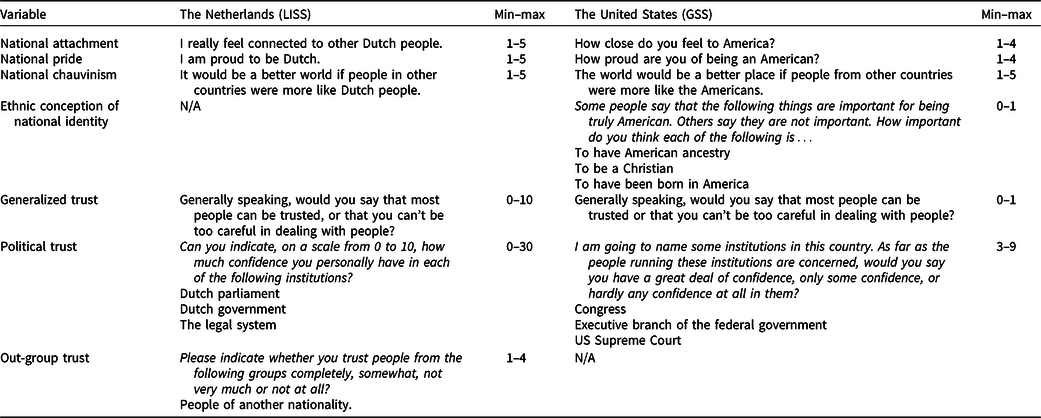
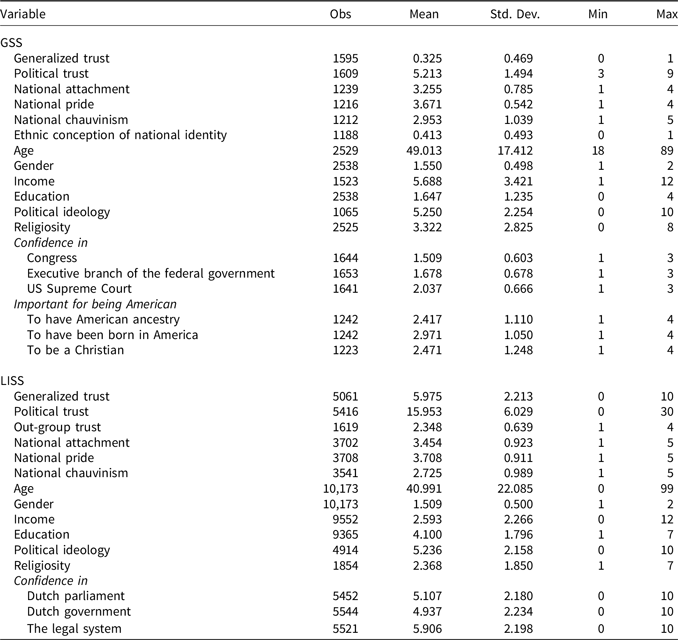
Table 1 shows our measures of the independent and dependent variables in the Netherlands and the US, respectively.
National identity and trust variables in LISS and GSS

Since the GSS only contained one adequate measure each for our first three national identity dimensions – all of which deal with the strength of a national identity – we opted for single-item measures in the LISS as well. In choosing our indicators, we sought to follow Huddy and Khatib (Reference Huddy and Khatib2007) as closely as possible. Although our LISS measure of national attachment asks about connectedness to co-nationals and our GSS measure about closeness to the country, both nevertheless capture the sense of sharing a social identity, and the proximity of this identity to one’s sense of self, that is one of the most likely sources of trust according to social identity theory. The national pride items are rather straightforward, since they ask directly about taking pride in one’s national identity. They have also been used previously, for example, by Shayo (Reference Shayo2009). The national chauvinism question was in turn chosen to capture a sense of national superiority. We deliberately avoided the question that asks the respondent if his country, as opposed to people, is better than most others. The reason for this is that a person could agree with this statement without being a national chauvinist, simply because he might take as his reference point the institutions, say, of less developed and economically wealthy countries. In line with previous research (Huddy & Khatib, Reference Huddy and Khatib2007; Jeong, Reference Jeong2013; Huddy and del Ponte, Reference Huddy, del Ponte, Gustavsson and Miller2019), we will treat these three variables as continuous. To make sure our results are robust, however, we have also tested by treating them as categorical (models available on request). In the following, we will note whenever these results differ from the ones we report.
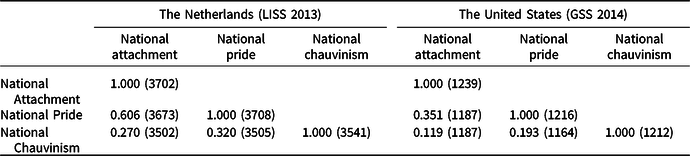
As has been shown in greater detail by Huddy and Khatib (Reference Huddy and Khatib2007) and Gustavsson (Reference Gustavsson, Gustavsson and Miller2019b), these measures capture dimensions of national identity that are not only theoretically but also empirically separate from one another. In Table 2, we can also see that, especially in the US, their intercorrelations are far from as high as we would assume if we were to think of them as different measures of one and the same underlying concept.Footnote 5
Correlations between different dimensions of national identity

Notes: All correlations significant at P < 0.001. Pearson’s correlation. Observations in parentheses.
If we instead turn to the ethnic conception of the national identity, there is less agreement in the literature on the optimal measures and coding (cf. Wright et al., Reference Wright, Citrin and Wand2012). In line with, for example Johnston et al. (Reference Johnston, Wright, Soroka, Citrin, Banting and Kymlicka2017), we use the three most unambiguously ethnic ‘to-be-questions’, which ask if a person needs to have American ancestry, be born in the US and be a Christian in order to be truly American. We dichotomized our measure so that in order to count as having an ethnic conception of the national identity, a person had to claim that all of these three ethnic markers were ‘fairly’ or ‘very’ important for being an American (Cronbach’s alpha: 0.786). We believe this measure is appropriate for assessing the risk that what is really doing the trust boosting work is an exclusionary understanding of national identity that is normatively problematic for liberals to endorse.
Unfortunately, there is no measure of an ethnic conception of the national identity in LISS. In our Dutch sample, therefore, we assess the risk that any positive link between national identity and general trust comes at the expense of exclusionary attitudes by looking at the effects of our different dimensions of national identity on out-group trust, which we operationalize as trust for people of another nationality.
Following previous research, we will focus on one of the most important aspects of social trust: generalized trust in unknown others, which is here measured by the classic question of whether most people can be trusted or not. This question has long been the standard measure of generalized trust in surveys, and although it has been criticized for capturing trust in people one knows rather than strangers in some countries, this does not seem to be a concern in either the Netherlands or the US, where the question does indeed capture trust in unknown others to a similar extent (Delhey et al., Reference Delhey, Newton and Welzel2011). Note that in the LISS data set, this variable runs from 0 to 10, and thus we treat it as continuous and employ ordinary least square (OLS) regressions. In the GSS, however, the variable is dichotomous, and we will hence use logistic regression. To ease interpretation, we will not only report the logit regression coefficient (log odds) but also provide a graphical presentation of the predicted probabilities in a margins plot.
Political trust has in previous research included many different setups of trust in the government, parliament, legal system, political parties, politicians, police, military, and more (see e.g., Berg and Hjerm, Reference Berg and Hjerm2010; Newton and Zmerli, Reference Newton and Zmerli2011; McLaren, Reference McLaren2017). We focus on the ‘core institutions of the state’ (Norris, Reference Norris2011: 29) by creating an additive index of trust in the parliament, government, and legal system (Cronbach’s alpha is 0.897 in LISS and 0.650 in GSS).
In both the US and the Netherlands, we control for age, gender, income, education, and political ideology – measured by self-positioning on a left-right scale in the Netherlands, and on a liberal-conservative scale in the US – all of which are typically found to affect trust (Alesina and La Ferrara, Reference Alesina and La Ferrara2002). We also include religiosity, measured by the attendance rates of religious services, which we know to correlate with general trust (Reeskens and Wright, Reference Reeskens and Wright2013: 13), and which might also correlate with some of our dimensions of national identity. See descriptives in the appendix for more information on these variables. All respondents who are included in the study are over 18 years of age.
Results
National identity and social trust
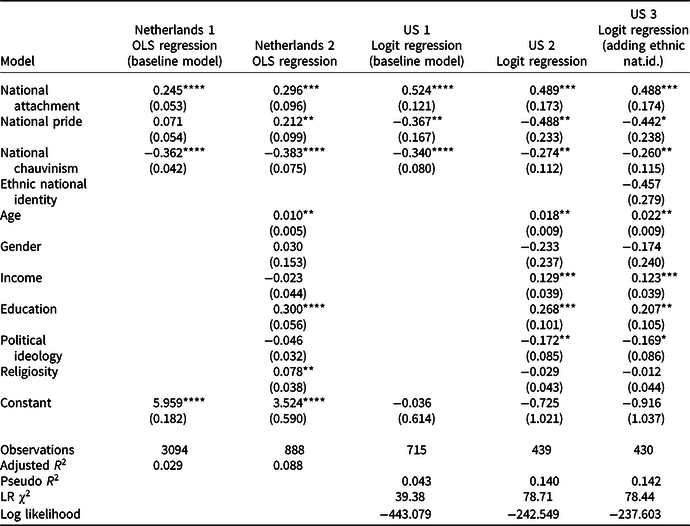
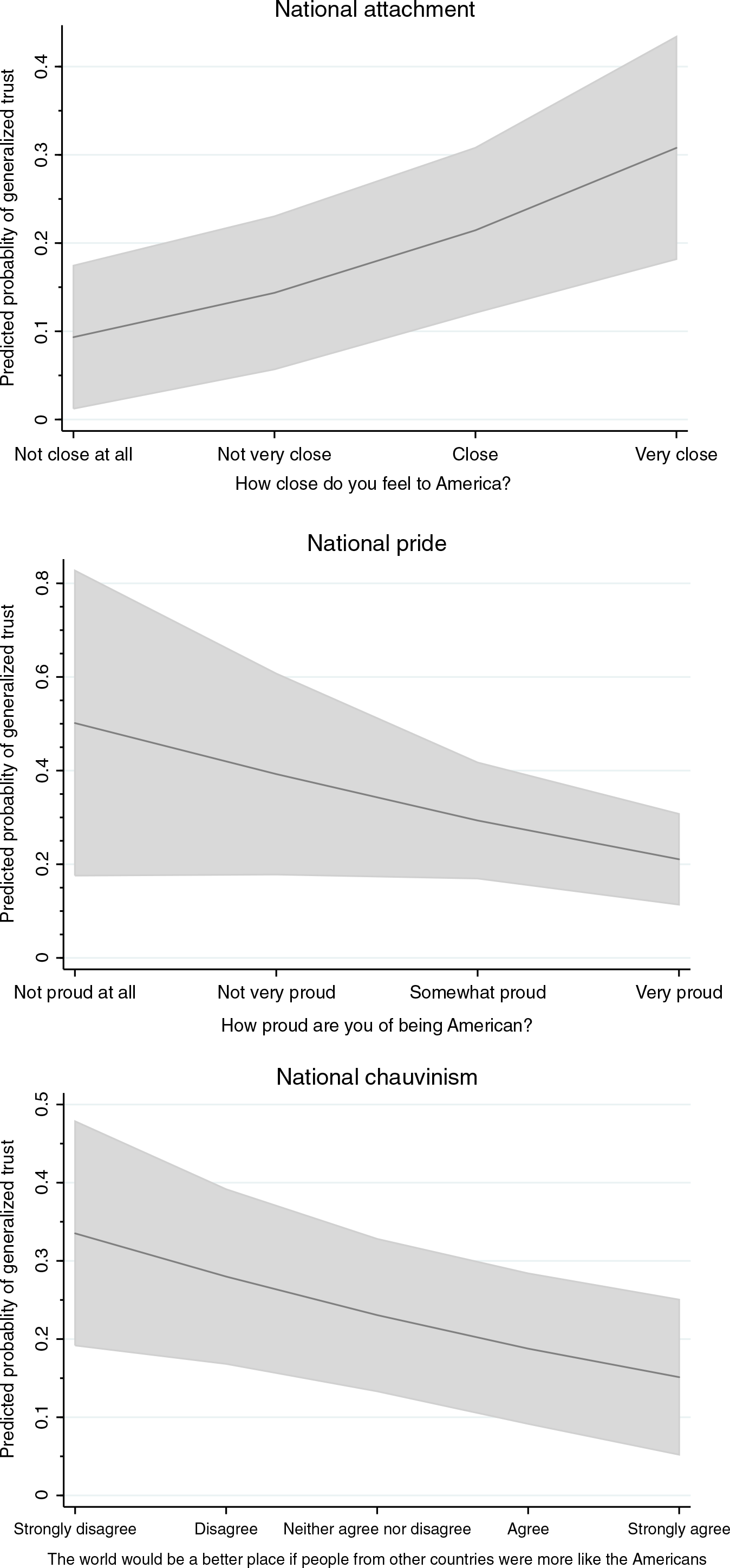
Table 3 shows the results from gauging the relationships between national identity and generalized trust in the LISS data (OLS regressions) and the GSS (logistic regressions). Our findings lend clear support to H1: national attachment is positively related to social trust. Throughout the models, the coefficient for national attachment is positive, statistically significant at the 99% level or higher, and of considerable magnitude. In the Netherlands (model 2) someone with the highest score on national attachment is predicted to be 25% more trusting than someone with the lowest score, all else equal. In the US (model 3), a person who feels ‘not close at all’ to America has a predicted probability to trust other people in general of only 9%. However, for a person who instead feels ‘very close’ to America, but is similar to the former in all other relevant respects, this probability rises to 31% (see Figure 1).Footnote 6
The relationship between national identity and generalized trust in the Netherlands (LISS, 2013) and the United States (GSS, 2014)

Notes: ****P < 0.001, ***P < 0.01, **P < 0.05, *P < 0.1. Unstandardized regression coefficients are displayed. Standard errors in parentheses.
Marginal effects of three different dimensions of national identity on generalized trust in the United States (GSS, 2014).

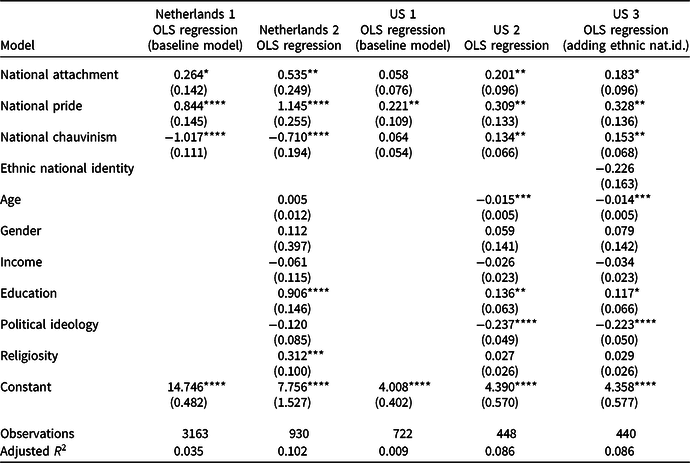
Our results are more mixed with regard to H2, according to which national pride should have a similarly positive relationship to social trust. In the LISS data, we see that the coefficient for national pride is indeed positive and significant once we include controls, but only at the 95% level. In the US, however, it is negative and only statistically significant at the 90% level once we control for ethnic national identity (US 3). Indeed, when we treat national pride as categorical instead of continuous, none of the response options are significant in relation to the reference level ‘very proud’. Could this have to do with the fact that the ‘general national pride’ item we use in the US tends to capture sympathetic attachments to abstract values embodied by the nation, such as ‘freedom’ (Meitinger, Reference Meitinger2018), rather than to compatriots? To assess this, we also ran alternative models with a substantial measure of national pride, specifying five institutional aspects that people might take pride in (these are available on request). However, the positive relationship between national pride and social trust in the Dutch data turned out to be even stronger in these models, while the equivalent relationship in the US data failed to reach statistical significance. This suggests there are indeed national differences in the effects of pride, which we will return to in our concluding discussion.
Both our Dutch and US data yield unambiguous support, by contrast, to our third expectation: that national chauvinism is negatively related to social trust (H3). In the Netherlands, someone with the maximum score on national chauvinism is predicted to be 25% less trusting than someone with the minimum score (Netherlands 2). In other words, national chauvinism diminishes generalized trust about as much as national attachment heightens it. Although weaker, this link is substantially significant in the US as well. The national chauvinism graph in Figure 1 tells us that an average American (in all the respects we control for) who strongly disagrees that the world would be a better place if people from other countries were more like Americans has a 34% predicted probability of being trusting. For each unit increase in national chauvinism this number declines, to 28, 23, 19, and a final low of 15%, respectively.
National identity and political trust
We have assumed that national attachment and national pride are positively (H4 and H5) and national chauvinism negatively (H6) related to political trust depending on the political context. In Table 4, we find support for H4 in the Netherlands: national attachment does indeed correlate positively with political trust, and the relationship is significant at the 95% level once all controls are included. In the US, however, once we include a control for ethnic national identity (US 3), the significance of this link falls down to the 90% level. Indeed, when we treat national attachment as categorical, we find that none of the response options have an effect that is statistically different from that of the reference category ‘very close’. The magnitudes in the Netherlands are also more modest than for social trust, although not negligible; there is a 16% predicted increase in political trust for a person who goes from the lowest to the highest level of national attachment, all else equal. In sum, our results regarding H4 are mixed: in the Netherlands, but not in the US, there does indeed seem to be a positive link from national attachment to political trust, although not as strong as the one we found for social trust.
The relationship between national identity and political trust in the Netherlands (LISS, 2013) and the United States (GSS, 2014)

Notes: ****P < 0.001, ***P < 0.01, **P < 0.05, *P < 0.1. Unstandardized regression coefficients are displayed. Standard errors in parentheses.
Turning to national pride and H5, we find more compelling evidence in favor of our predictions. In the Netherlands, there is a remarkably strong positive relationship between national pride and political trust, at the 99.9% level of significance. Based on our second model in the Netherlands, if we were to compare a person with the lowest score on national pride to another with the highest score, all else equal, their predicted increase in political trust would be no less than 40%. A similarly positive, although somewhat less robust (95% level significance), relationship is found in the US case (model 3), where the equivalent increase would be about 23%. In sum, H5 receives support in both countries.
The negative link between national chauvinism and political trust in the LISS gives tentative support to H6, the expectation that there is a negative relationship between national chauvinism and political trust in contexts where the ‘anti-nationalist elites’ narrative has taken hold (H6). This relationship is both robust and substantial: if the same Dutch respondent were to go from scoring the lowest on national chauvinism to the highest, all else equal, his or her political trust would decrease by as much as 18%, based on the Netherlands 2 model. In the GSS data, by contrast, our analyses reveal not only that the negative link from national chauvinism to political trust fails to materialize, but that in the US it even goes in the opposite direction. Unexpectedly, changing from the lowest to the highest score on national chauvinism yields a 12% predicted increase in political trust in the US (model 3), which resonates with Feinstein’s (Reference Feinstein2016) finding that American national chauvinism has at certain historical time points led to a rally around the flag effect.Footnote 7
In-group cohesion at the cost of out-group exclusion?
Finally, do we have reason to worry that these relationships between national identity and trust are mainly driven by ethnic identifiers, or that while national identity boosts some forms of trust it also diminishes out-group trust specifically, as suggested by Lenard and Miller (Reference Lenard, Miller and Uslaner2018)? We think not.
The last columns in both Tables 3 and 4 show that our three most robust results – the positive relationship between national attachment and general trust (H1), the negative one between national chauvinism and general trust (H3), and the positive one between national pride and political trust (H5) – remain virtually unaffected by controlling for ethnic conceptions of national identity. Once we include ethnic national identity in our US models, there are only two changes worth noting: that the unexpected negative link we found between national pride and general trust becomes slightly weaker, and that the positive link between national attachment and political trust loses some, but not all, of its statistical significance.
The graphs in Figure 2, moreover, show that although those who hold ethnic conceptions of their national identity are overrepresented among those who score the highest on national pride, as many as 60% of Americans who do not hold such a conception similarly express the highest level of national pride. Among those who report the strongest sense of national attachment, the difference between ethnic identifiers and those who hold other conceptions of the national identity is only a few percentage points. To say that ‘strong identifiers are also more likely to hold an ethnic conception of the nation’ (Lenard and Miller, Reference Lenard, Miller and Uslaner2018) is thus both an over-simplification and an exaggeration, if by strong identification we mean feeling close to one’s country.
National identity in the United States (GSS, 2014).

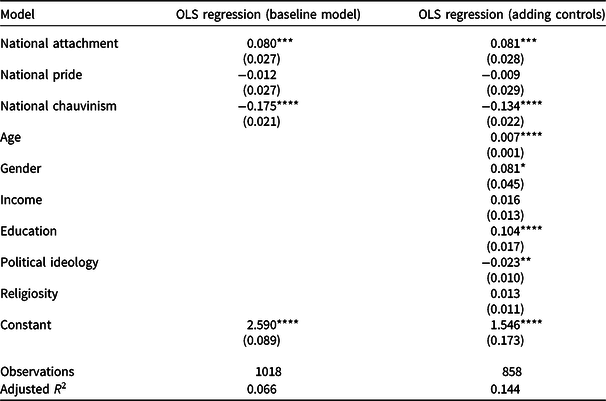
In the Netherlands we, instead, regressed out-group trust on national identity. The results, as can be seen from Table 5, are reassuring. Not only does national attachment fail to dampen out-group trust; in fact, it seems to have a weak yet significantly positive correlation with it, in line with recent findings by Huddy & del Ponte (Reference Huddy, del Ponte, Gustavsson and Miller2019). National pride, in turn, has no significant link to this type of trust in either direction, while national chauvinism, as is to be expected, is strongly and negatively related to out-group trust.Footnote 8
The relationship between national identity and out-group trust in the Netherlands (LISS, 2013)

Notes: ****P < 0.001, ***P < 0.01, **P < 0.05, *P < 0.1. Ordinary least square (OLS) regressions. Unstandardized regression coefficients are displayed. Standard errors in parentheses.
Discussion
This paper set out to nuance the first part of the ‘national identity argument’: the claim that national identity leads to trust. Our overarching theory has been that national identity is both a blessing and a curse for trust, depending on which dimensions of either concept we have in mind. Throughout the paper, we have assumed that the direction of this relationship runs from national identity to trust. Admittedly, our cross-sectional data do not allow us to make causal claims or even to exclude the possibility of reversed causality. However, the idea that political trust, for example, would affect a person’s territorial attachment, rather than the other way around, has previously not been found very convincing (cf. Easton, Reference Easton1965). In line with social identity theory, moreover, we have suggested there are psychological reasons to assume that a sense of group identity such as the national one is likely to have a causal impact on trust.
Our main conclusion is that national attachment is the dimension liberal nationalists should set their hopes on when seeking to promote trust by strengthening the national identity. We have elaborated the mechanisms that should drive this relationship, and we have been able to empirically show, for the first time, that national attachment does indeed have a strong positive relationship to trust, especially of the social kind, even when the other dimensions of national identity are held constant. We find little evidence, moreover, to support the worry that this comes at the cost of excluding out-groups (cf. Lenard and Miller, Reference Lenard, Miller and Uslaner2018). This link is neither dependent on having an ethnic conception of the nation nor is there a negative relationship between those dimensions of national identity that boost general trust, on the one hand, and out-group trust, on the other.
National pride, moreover, is not the villain it is often made out to be (cf. Miller and Ali, Reference Miller and Ali2014). We have argued that social identity theory leads us to expect national pride to have a positive, not negative, effect on both political and social trust. Both our Dutch and US data fall in line with the first of these expectations: scoring high on national pride is remarkably strongly and robustly related to higher levels of political trust. This goes against the previous work of Schildkraut (Reference Schildkraut, Schwartz, Luyckx and Vignoles2011), who found no such link in the US, but who in contrast to us did not control for national chauvinism. Our results resonate more with findings from Ghana (Godefroidt et al., Reference Godefroidt, Langer and Meuleman2017) and Austria (Gangl et al., Reference Gangl, Torgler and Kirchler2016). As Yael Tamir (Reference Tamir2019) has recently suggested but not empirically verified, national pride could thus indeed be an interesting candidate for counteracting the worrying trend of declining trust in political institutions and elites, which seems to be driving voters into the arms of populist movements and protest parties (Dustmann et al., Reference Dustmann, Eichengreen, Otten, Sapir, Tabellini and Zoega2017; Hooghe and Dassonneville, Reference Hooghe and Dassonneville2018) – on the condition, of course, that this pride qualifies as an ‘inclusive patriotism’ (Mounk, Reference Mounk2018), pertaining to conceptions of the national identity that are cultural or civic rather than ethnic in their content.
When it comes to social trust, however, the consequences of national pride turn out to be more ambiguous. While in the Netherlands we do find the positive link we expected, in the US we do not, and there is even some, although weak, evidence of the inverse, negative, relationship. This could have something to do with the fact that in high-status countries by international comparison, such as the US, national pride is known to be correlated to social dominance orientation – while in most other contexts only national chauvinism is (Osborne et al., Reference Osborne, Milojev and Sibley2017). Perhaps the reason that people who express high national pride do not also trust their co-nationals more in the US is thus that they also tend to see the world as a competitive jungle, which is closely related to distrust and cynicism regarding people’s motives (Duckitt et al., Reference Duckitt, Wagner, du Plessis and Birum2002)? Unfortunately, we did not have measures in our data sets for assessing this possibility, but we encourage future studies to consider these questions further.
The darker side of national identity, we conclude, is national chauvinism. Not only does this dimension of national identity have a negative association with out-group trust, as our Dutch results reveal; in both countries, national chauvinism also clearly diminishes generalized trust to about the same extent that national attachment enhances it. A crucial challenge for anyone trying to socially engineer higher levels of national attachment for the sake of cohesion is thus to avoid heightening the level of national chauvinism. This task should not be impossible, however; as Table 2 showed, these two dimensions of national identity only correlate modestly in the Netherlands (0.27), and even more weakly in the US (0.12). Finally, not even national chauvinism turns out to be entirely negative. While in the Netherlands it does reduce political trust, in the US it actually increases it. Whether this still holds true in the US in 2016 and beyond, when a narrative of ‘anti-nationalist elites’ may have become more popular than in 2014, is a question we leave for future research to explore.
Acknowledgments
We would like to thank Per Adman, Karl Loxbo, and Ralph Sundberg for their helpful advice on earlier drafts of this paper. We are also sincerely grateful for the comments we received from three anonymous reviewers, and from the participants at three events where drafts of this paper were presented: the ‘National Identity – Problem or Cure for an Angry Age?’ workshop, Uppsala University, 3–5 February, 2020; the twentieth anniversary conference of the Centre for the Study of Ethnicity and Citizenship, University of Bristol, 8–10 November, 2019; and the research seminar at the Department of Sociology, Umeå University, 22 November, 2019.
Appendix
Descriptives

Note: Gender: 1 = man, 2 = woman.