Introduction
The genus Aspicilia (lichen-forming Ascomycota: Megasporaceae) displays a considerable range of morphological variation. Within the genus the bulk of the species are crustose, with a saxicolous habitat. Only a small number of species are characterized by their terricolous habitat and fruticose, subfruticose, or even amorphous thalli, and they are usually regarded as vagrant lichens. Terricolous vagrant species are also considered to be candidates of the biblical manna, and are therefore commonly called ‘manna lichens’ [e.g., Aspicilia esculenta (Pall.) Flagey, A. fruticulosa (Eversm.) Flagey and A. vagans Oxner; see Sohrabi & Ahti Reference Sohrabi and Ahti2010].
The manna lichens are characterized by three-dimensional, fruticose, subfruticose or spherical forms with or without vagrant (free) thalli, thickened medullary layer, usually with pseudocyphellae, fewer than 8 spores per ascus, very low secondary metabolite diversity, and occurrence in arid and semiarid regions of the temperate zone of the Northern Hemisphere or primarily in the Holarctic ecozone (sensu Takhtajan Reference Takhtajan1986).
Szatala (Reference Szatala1957) and Follmann & Crespo (Reference Follmann and Crespo1974) placed most of the terricolous vagrant species under the genus Sphaerothallia Nees. Based on ascus anatomy, Hafellner (Reference Hafellner1991) claimed that species in the genus Sphaerothallia are closely related to other members of the genus Aspicilia. Major changes in generic delimitations and the descriptions of old genera are to be expected, but at present the acceptance of Sphaerothallia is not being proposed. The present study is part of a series of studies focused on species delimitation in the vagrant Aspicilia complex, but it also aims to disclose species groups that may eventually merit generic status.
Vagrant Aspicilia species in Central Asia have been discussed by numerous authors and a comprehensive list of publications were summarized in Sohrabi & Ahti (Reference Sohrabi and Ahti2010). Additions to that list are Abbas et al. (Reference Abbas, Wu and Jiang1996), Dzhuraeva (Reference Dzhuraeva1978), Litterski (Reference Litterski2000, Reference Litterski2002, Reference Litterski2006) and Kudratov & Mayrhofer (Reference Kudratov and Mayrhofer2002).
Recently the vagrant Aspicilia complex has undergone a major reorganization ofthe species, currently including 12 species accepted in Sohrabi & Ahti (Reference Sohrabi and Ahti2010). In the framework of a major revision of vagrant/manna species of the genus Aspicilia by the first author, the complicated morphological variation among the A. fruticulosa complex was investigated. Although some of the specimens in the complex resemble typical A. fruticulosa, detailed studies showed that the branching pattern in one of the specimens differed somewhat from the species A. fruticulosa (including its Eurasian and American variants) and A. hispida Mereschk. in the complex. Initially, we thought that the specimen was a result of specific environmental conditions, but a closer morphological study revealed that it differed not only in the branching pattern, but also in producing possibly pycnidioid structures. Molecular analyses were initiated to clarify the genetic relationships between the aberrant specimen and putative close relatives, which provided support for a new taxon described and discussed below.
Material and Methods
Assessment of morphological characters
Material from the following herbaria was studied: GFW, H, LE and SPR. The specimens were examined by standard techniques using stereoscopic and compound microscopes. For anatomical observations a few branches of thalli were cut using a razor blade and additional sections 10–16 µm thick were cut using a freezing microtome (Model Leica CM 3050S). Sections were mounted in lactophenol Cotton blue and subsequently photographed with a Leica DM 2500 compact light microscope equipped with a digital camera, Leica DFC490. Additional observations of anatomical features were made with a Leica Dialux 20 compound microscope. Measurements of anatomical details were carried out on material mounted in water. Thallus mass size and branch thickness were measured using a digital vernier caliper (Cocraft 40-6925). Thin-layer chromatography (TLC) was applied following Orange et al. (Reference Orange, James and White2001) using the solvent systems A, B and C. High performance liquid chromatography (HPLC) was performed following Søchting (Reference Søchting1997).
Photographs of the new species as well as its online distribution map in Kyrgyzstan, based on this study, are presented at the Myco-Lich website (www.myco-lich.com) created by Sohrabi (Reference Sohrabi and Sohrabi2010).
Taxon sampling for DNA analyses
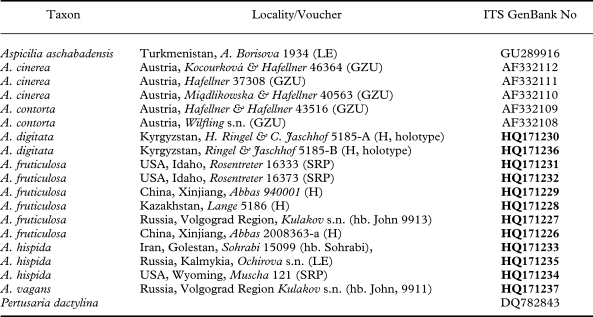
Eighteen specimens representing seven species of Aspicilia were used in this study. Three new sequences from the gene region ITS1-5.8S-ITS2 (rDNA) were obtained from A. fruticulosa and A. hispida, the obvious close relatives of our suspected new species. In addition, a number of representatives from other principal morphological groups within the large genus Aspicilia were selected from GenBank. Details of the material, locality information, collector's name, and deposition of the voucher specimens are listed in Table 1. It should be noted that two sequences of the new species were generated from the two separate thalli of the holotype and recorded as A and B in the Table. Sequences produced by Aras et al. (Reference Aras, Cansaran, Türk, Kandemir and Candan2007; GenBank nos. DQ411556–DQ411563, DQ411567–DQ411568, DQ411570–DQ411571), however, turned out to be incompatible with the ITS sequences of other Aspicilia studies, such as those by Ivanova & Hafellner (Reference Ivanova and Hafellner2002) and Nordin et al. (Reference Owe-Larsson, Nordin, Tibell, Nash, Gries and Bungartz2007), and were omitted from this study. Pertusaria dactylina (Ach.) Nyl. was used as an outgroup. The outgroup selection was based on the previous study by Miądlikowska et al. (Reference Miądlikowska, Kauff, Hofstetter, Fraker, Grube, Hafellner, Reeb, Hodkinson, Kukwa and Lücking2006).
Voucher and GenBank accession numbers of sequences from Aspicilia species included in this study

PCR amplification
The ITS regions including the 5.8S gene of the nuclear rDNA were amplified using direct PCR as described by Arup (Reference Arup2006). The amplification was performed using the primers ITS1F (Gardes & Bruns Reference Gardes and Bruns1993) and ITS4 (White et al. Reference White, Bruns, Taylor, Innis, Gelfand, Sninsky and White1990). The PCR settings used followed the manufacturer's recommendations. Initial denaturation for 1 min 25 s at 94°C followed by 35 cycles of 35 s at 95°C, 55 s at 55°C, 45 s at 72°C with a 4 s increase per cycle, terminated with a final elongation at 72°C for 10 min. PCR products were purified using NucleoFast96 PCR (Macherey-Nagel). Both complementary strands were sequenced. Sequencing was performed by Macrogen Inc. (www.macrogen.com).
Sequence alignment and phylogenetic analyses
The sequences were aligned using the Muscle v4. programme with default settings running on the Web Server located at the CSC – IT Center for Science, Finland (Edgar Reference Edgar2004) and optimized manually in the programme PhyDe® (http://www.phyde.de/).
Parsimony analyses were conducted using the programme PAUP* 4.0b10 (Swofford Reference Swofford2002). In the analysis process we applied a heuristic search using 1000 random addition replicates and the TBR branch swapping algorithm, with branches collapsed if the maximum branch length was zero and the MULTREES option in effect. Gaps were treated as missing data and all characters equally weighted. Bootstrap support values were estimated using 1000 bootstrap replicates, each with 100 random addition sequence replicates. For the Bayesian analyses, the best-fit model of nucleotide evolution was estimated using MrModeltest v. 2.2 (Nylander Reference Nylander2004) with the Akaike Information Criterion (Posada & Buckley Reference Posada and Buckley2004). The Bayesian phylogenetic inference was conducted in MrBayes v. 3.0B4 (Ronquist & Huelsenbeck Reference Ronquist and Huelsenbeck2003). Two independent runs, each with four Metropolis-Coupled Markov Chain Monte Carlo (MC3) chains and a temperature of 0·2 were initiated and run for one million generations, with tree and parameter sampling every 100 generations. Burn-in was set to discard 25% of samples. For this study MrModeltest suggested GTR+G as the best-fit model of nucleotide evolution. A stationary phase was reached well before the burn-in threshold imposed, as revealed by the plot of the MrBayes cold chain likelihood values against the generation number.
Results
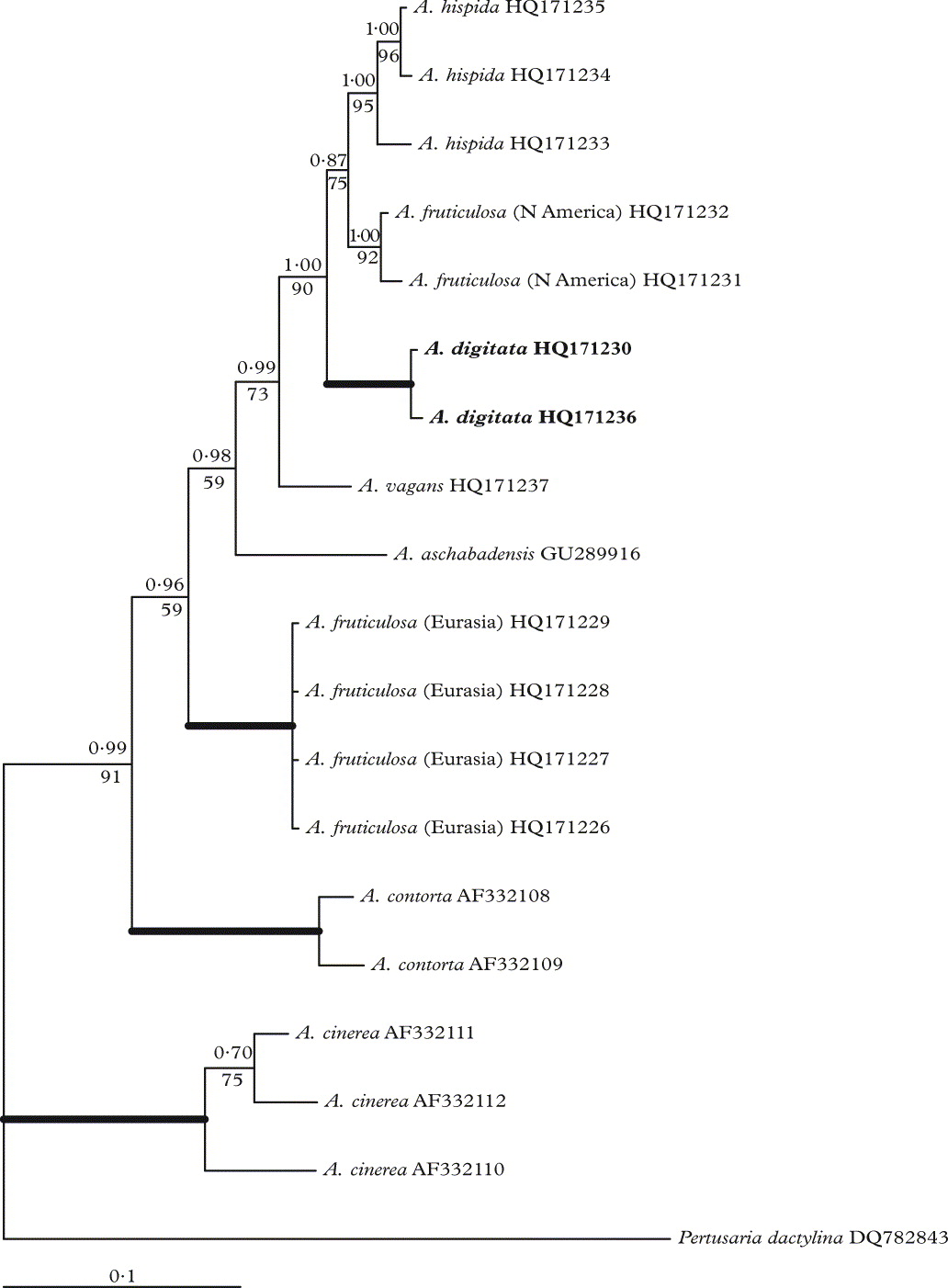
According to the results achieved from both analyses conducted with the maximum parsimony program PAUP* 4.0b10 (Swofford Reference Swofford2002) and Bayesian phylogenetic inference with MrBayes v. 3.0B4 (Ronquist & Huelsenbeck Reference Ronquist and Huelsenbeck2003), we obtained congruent topology in the phylogenetic tree (Fig. 1). In the parsimony analyses we obtained a strict consensus tree which was characterized by the following information: length of tree = 224, number of MPTs = 6, consistency index (CI) = 0·7143, homoplasy index (HI) = 0·2857 and retention index (RI) = 0·8251. In the Bayesian analyses we obtained (>50%) majority-rule consensus trees.
Phylogenetic relationships of Aspicilia digitata and other close vagrant Aspicilia species occurring in Eurasia and N America. Phylogram inferred from Bayesian analysis of ITS dataset. Bayesian posterior probabilities (PPs) are shown above the branches and bootstrap values ≥ 50 under maximum parsimony (MPB) are shown below the lines adjacent to the branches. Branches with PPs equal to 1·00 and MP bootstrap support values equal to 100% are indicated in bold. The tree is rooted with Pertusaria dactylina.

Based on both molecular analyses and morphological studies Aspicilia digitata should be regarded as a separate species. Aspicilia digitata is the sister taxon to A. hispida and A. fruticulosa (American variant) in the trees, and evidently the monophyly of A. digitata is clear and well-supported. Aspicilia fruticulosa (Eurasian variant), is superficially similar to our new species but in both analyses it was quite distinct from A. digitata. As A. fruticulosa is morphologically very variable and rather widely distributed in the Eurasian steppes and lowlands, we obtained two more ITS sequences to test whether its variability is shown.
The analysis of the ITS sequences presented here is part of an ongoing study on the infrageneric systematics of vagrant Aspicilia and is therefore preliminary. However, the taxonomic status of the American variant of A. fruticulosa can be inferred from the data already available (M. Sohrabi et al., unpublished data). It is recognized as a distinct taxon and will be described elsewhere.
The Species
Aspicilia digitata Sohrabi & Litterski sp. nov
Thallus liber, subfruticosus, flavovirens, olivaceus, olivaceofuscus vel cinereus. Similis Aspiciliae fruticulosae sed differt lobis magis irregularibus, simplicioribus, centro non condensatis, apice punctis nigrescentibus. Etiam differt sequentiis molecularibus ITS. Materiae chemicae secundariae desunt.
Typus: Kyrgyzstan, Jangy-Jer Range (“Dshangy-Dsher”), Jal-Jyr River (“Dshal-dshir-Fluss”), mouth of Archaly River (“Artschaly-Mündung”), on soil (“epigäisch”), 41°18′15″N, 76° 44′36″E, 2900 m, 6 July 2007, H. Ringel & C. Jaschhof 5185 (H—holotypus; GFW—isotypus).
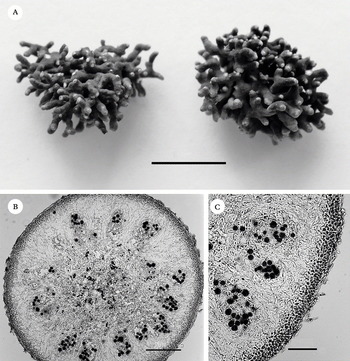
(Fig. 2A–C)
Aspicilia digitata, holotype. A, thallus with abundant branches; B, section of branch with cortex and medullary layers and clustered algal cells; C, section of branch showing detail of two cortical layers (outer part paraplectenchymatous tissue, inner part prosoplectenchymatous tissue) and medullary layer with prosoplectenchymatous type of tissue surrounded by algal cells. Scales: A = 1 cm; B = 50 µm; C = 20 µm.

Thallus fruticose, free, forming tiny shrubby lumps or clumps, 0·5–1 cm tall and 0·5–1 (–1·5) cm wide, tufts usually spherical, rounded, irregular or more or less globose, occasionally elongated, often much branched, branchlets finger-shaped, intricate, irregular, rarely dichotomous in uppermost parts, short to somewhat elongate, main branches radiating from the thin central axial part. Usually branches widening up to (0·35–)0·45–1(–1·2) mm diam., rather fragile, surface dark green to greyish green, sometimes whitish grey to green or pale olive-green to pale green; pseudocyphellae on tips of branches, ± white, rarely along the branches. Upper cortex 25–35 µm thick, outer part paraplectenchymatous, ± brown, c. 3–6 cells thick, cells (4–)5–7(–8) µm diam.; inner part prosoplectenchymatous (40–)50–100(–110), c. 2–4 times as thick as the outer layer; cortex covered with a thin epinecral, amorphous layer 1–5(–10) µm thick. Photobiont chlorococcoid, cells ± spherical, 5–15 µm diam., clustered in small groups, each group up to 60–120 × 40–90 µm broad.
Apothecia not seen. Black spots usually located on tips of branchlets, supposedly being primordia of pycnidia but no conidia were found. The pycnidioid structures are surrounded with a white rim of pseudocyphellae.
Chemistry. All spot-tests (K, C, KC, P, I) on the thallus were negative. TLC & HPLC: no traces of secondary chemical compounds were detected.
Etymology. The specific epithet reflects the similarity of the external morphology of the new species to coralloid radiation of interwoven, finger-like branchlets.
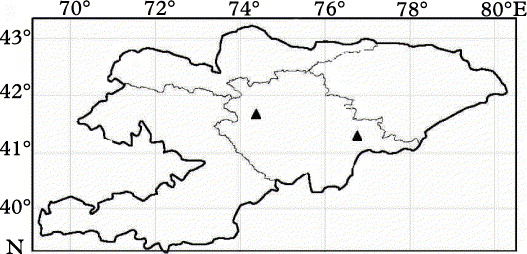
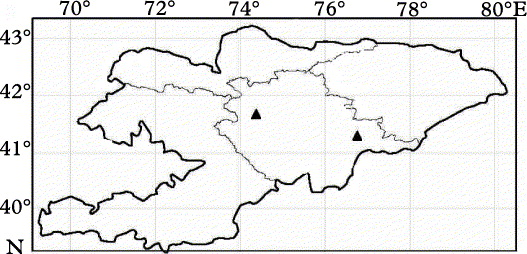
Distribution and ecology. Aspicilia digitata is hitherto known only from two localities in the Central Tian-Shan mountain range in Kyrgyzstan (Fig. 3). It is a terricolous vagrant species growing among pebbles and gravel of rivers, especially in the subalpine belt (2900–3100 m). Its occurrence on a river terrace is remarkable, since other vagrant Aspicilia species generally occur on plateaux with steppe vegetation.
Known distribution of Aspicilia digitata in Kyrgyzstan.
Remarks. Aspicilia digitata is most similar to the Eurasian variant of A. fruticulosa. Both species are ground-dwelling and probably reproduce mainly asexually by fragmentation of thallus branches. In general, the thalli in A. fruticulosa are rather large [up to 1–2(–3) cm wide] with the central part of the thallus condensed and branches evidently radiating from the central part giving the impression of being dichotomous. Most of the branchlets arise at acute angles, are short and usually have a tiny depressed hollow with a rim of white pseudocyphellae on the tips. In A. digitata the central part of the thallus is more irregular with the interior branches being more or less loose, finger-shaped, somewhat narrower, slightly elongate, more or less irregularly to dichotomously branched at mostly wider angles and branchlets bearing black spots at the tips (Fig. 2). Aspicilia digitata is apparently restricted to high altitudes and river banks, whereas the Eurasian variant of A. fruticulosa is more widespread.
Aspicilia digitata can also be somewhat similar to A. hispida, another terricolous species with a caespitose growth form and Cladonia-like branches. Apart from being intimately attached to soil, it differs by having long narrower cylindrical branchlets with tapering black tips. The two species also have different distributions, as A. digitata is possibly restricted to the Tian-Shan Mountains, while A. hispida has a wide distribution, having been reported from Central Asia by Andreeva (Reference Andreeva1987), Iran by Sohrabi et al. (Reference Sohrabi and Sohrabi2010), Europe by Hafellner et al. (Reference Hafellner, Nimis and Tretiach2004), and North America by Owe-Larsson et al. (Reference Owe-Larsson, Nordin, Tibell, Nash, Gries and Bungartz2007).
Aspicilia digitata may also be superficially similar in habit to what is here provisionally called the American variant of A. fruticulosa, but they are easily distinguished by different morphological characters, particularly in their branching patterns. Aspicilia digitata has thalli smaller than those of A. fruticulosa and the branches are more intricately finger-shaped, somewhat narrower, slightly elongate, and the central radiating part is not thickened. In general, the thalli of American A. fruticulosa are larger and the branches are more irregular, generally broader and the central radiating part is noticeably thicker. Although both A. digitata and the American A. fruticulosa bear similar black spots at tips of the branches, our molecular study supports their recognition as two distinct species (Fig. 1).
Additional specimen examined. Kyrgyzstan: Central Tian-Shan, northern side of Moldo-Too ridge, in the valley of the river Ming-Kush, 3100 m, 6 vii 1970, L. I. Bredkina s.n. (LE).
Discussion
The new species Aspicilia digitata is readily accommodated within the circumscription of the manna lichens as discussed in Sohrabi & Ahti (Reference Sohrabi and Ahti2010). The gross morphology of the thallus in A. digitata resembles that of A. fruticulosa. Their systematic relationships have been clarified by means of molecular data (Fig. 1).
The distribution patterns of vagrant ‘manna’ Aspicilia species in Central Asia show that they are widely distributed from the lowlands of the Astrakhan Region (0–150 m) in the north-east of the Caspian Sea, Russia, through Kazakhstan to the highest point (over 4000 m) of the Tian-Shan mountain range in Kyrgyzstan. In the course of nomenclatural clarification of manna lichens by Sohrabi & Ahti (Reference Sohrabi and Ahti2010) it was found that the type specimens of manna lichens mainly derive from restricted areas. For instance, the type specimens of the species Aspicilia esculenta, A. vagans (syn.: A. affinis (Eversm.) Mereschk.) and A. hispida were reported from the lowland steppes of the Astrakhan Region and the “Kirgisischen Steppen” (in Kazakhstan!) by Pallas (Reference Pallas1776), Eversmann (Reference Eversmann1831) and Mereschkowsky (Reference Mereschkowsky1911), respectively. We assume that the large part of Central Eurasia with an extensive range of steppe vegetation with an arid to semiarid climate is most likely the centre for distribution of vagrant Aspicilia lichens, and it is understandable that they are well-distributed throughout the large phytogeographical Irano-Turanian region (sensu Takhtajan Reference Takhtajan1986). Of the twelve manna lichens, the three narrow endemic species, Aspicilia alpicola Elenkin, A. cerebroides Mereschk., and A. fruticulosofoliacea (Elenkin) Sohrabi, are known only from high altitudes (above 2500 m a.s.l.) in the Tian-Shan Mountains in Kyrgyzstan. Aspicilia digitata might thus be another example of an endemic vagrant lichen in that region.
We wish to thank B. Owe-Larsson and A. Nordin (both from Uppsala) for valuable discussions on taxonomy of Aspicilia species. We thank Masoomeh Ghobad-Nejhad & Neil Bell (both from Helsinki) for help with the Bayesian analysis. Our thanks also go to H. Ringel and C. Jaschhof for collecting vagrant Aspicilia species in Kyrgyzstan. The Iranian Ministry of Science and Technology financially supported the first author's studies at the University of Helsinki. The Synthesys office (European Union-funded Integrated Infrastructure Initiative grant) supported the first author's travel (DK-TAF-4656) to Copenhagen. Ulrik Søchting is acknowledged for his kind help during DNA extraction for this study. Special thanks go to Pirkko Harju (Helsinki), who helped us to make microtome sections on some lichens.