Introduction
The past few decades have witnessed an increasing interest in environmental safety and food quality, and this has driven a major expansion in the organic farming sectorReference Yiridoe, Bonti-Ankomah and Martin1. In contrast to conventional production systems, those followed in the organic sector are popularly perceived as being environmentally sustainable and consumer friendly, since they specifically avoid the use of either synthetic fertilizers or organic pesticidesReference Heaton2–Reference Magkos, Arvaniti and Zampelas4. The relative healthiness of organic produce, however, remains controversialReference Woese, Lange, Boess and Bögl5, Reference Dangour, Dodhia, Hayter, Allen, Lock and Uauy6. Nevertheless, organic production systems have been established all over the world and have expanded considerably in Italy during the 1990s, consolidating its position as the leading European producer of organic foodReference Willer and Kilcher7. Potato is one of the crops to be successfully grown organically both in ItalyReference Fiorillo, Rouphael, Cardarelli, Saccardo, Colla and Cirica8, Reference Maggio, Carillo, Bulmetti, Fuggi, Barbieri and De Pascale9 and elsewhereReference Warman and Havard10–Reference Mourão, Brito, Coutinho, Neuhoff, Halberg, Alföldi, Lockeretz, Thommen, Rasmussen, Hermansen, Vaarst, Lueck, Caporali, Jensen, Migliorini and Willer12.
Potato cultivation in the Mediterranean Basin occupies about 1 Mha and produces 27 Mt of tubers13, mostly cropped in the period from March to June to exploit the ‘early crop potato’ marketReference Mauromicale, Ierna, Bianco, La Malfa and Tudisca14. In southern Italy (Sicily, Campania and Apulia), potato production contributes significantly to the agricultural economy. ‘Early’ crop potato production conventionally requires major inputs of inorganic fertilizer and pesticideReference Mauromicale, Ierna, Bianco, La Malfa and Tudisca14, which can result in undesirable residues in both the tubersReference Bacchi, De Nadai Fernandes, Tsai and Santos11 and the soilReference Navarro Pedreño, Moral, Gómez and Mataixm15. As a result, organic systems of ‘early’ crop potato production are on the rise. Despite the price premium available for organic potato tubers (over 200–250 per ton more than conventional ones), there has been to date little effort to breed cultivars specifically for the organic production of ‘early’ crop potatoes. Parisi et al.Reference Parisi, Govoni, Mainolfi, Baschieri and Ranalli16 have suggested that such cultivars need to show a reliably high yield in a low-input production system, be efficient with respect to nutrient uptake, be able to provide early ground cover rapidly, show a good level of resistance/tolerance to the common biotic and abiotic stresses and a high suitability to low temperatures of storage.
Yield levels are typically lower in organic systems than in conventional high-input onesReference Maggio, Carillo, Bulmetti, Fuggi, Barbieri and De Pascale9, Reference Mourão, Brito, Coutinho, Neuhoff, Halberg, Alföldi, Lockeretz, Thommen, Rasmussen, Hermansen, Vaarst, Lueck, Caporali, Jensen, Migliorini and Willer12, although a few examples have been reported showing that performance has not been compromised by the absence of high inputsReference Fiorillo, Rouphael, Cardarelli, Saccardo, Colla and Cirica8, Reference Warman and Havard10. Aspects of the chemical composition of main crop tubers have been shown to depend on the cultivation system. Some authorsReference Bourn and Prescott3, Reference Moschella, Camin, Miselli, Parisi, Versini, Ranalli and Bagnaresi17 have reported that tuber dry matter content is higher in organically grown potatoes than in conventionally grown ones, but Pither and HallReference Pither and Hall18 claimed that the opposite was true. Contradictory data have also been published with respect to both vitamin CReference Wacholder and Nehring10, Reference Wacholder and Nehring19, Reference Asami, Hong, Barret and Mitchell20 and total protein contentReference Woese, Lange, Boess and Bögl5, Reference Maggio, Carillo, Bulmetti, Fuggi, Barbieri and De Pascale9, Reference Moschella, Camin, Miselli, Parisi, Versini, Ranalli and Bagnaresi17. A recent review by LaironReference Lairon21 concluded that the nitrate content of organically grown foodstuffs (including potato) is in general lower than in conventionally grown produce. Since potatoes belong to the category of vegetables with low nitrate content, these results might help to reduce the total intake of nitrate, mainly in the countries where potatoes are highly consumed. This is important, since nitrates are thought to act as precursors for carcinogenic nitrosamines in the human gut, and for the nitrites associated with methaemoglobinaemia in infants and the elderlyReference Santamaria22. The tuber composition of organically grown ‘early’ crop potatoes, which has not been analyzed in any detail to date, may be greatly influenced by the particular environmental conditions associated with ‘early’ crop potato production, which substantially modify the morphology and phenology of the cropReference Mauromicale, Ierna, Bianco, La Malfa and Tudisca14. These tubers are essentially immature, and so differ qualitatively from main crop onesReference Lombardo, Mauromicale, Tedone, Marzi, Palchetti, Manzelli, Chiru, Olteanu, Aldea and Bădărău23. As a result, little of the literature describing the characteristics of main crop potatoes can be used to make inferences regarding ‘early’ crop tubers. Here, we set out to generate a body of information regarding the behavior of the organically grown ‘early’ potato crop. We have compared the performance, on a single farm, of a cultivar much used by organic farmers with that of two Italian pre-releases. Our aim was to identify the influence of the cultivation system on the crop phenology and growth, yield and the chemical composition of the tubers.
Materials and methods
Site, climate and soil
The trials were conducted over two seasons (2007 and 2008) at a commercial farm located on the coastal plain of Siracusa (37°01′N, 15°12′E, 30 m above sea level), which is an area typical for ‘early’ crop potato cultivation in southern Italy. The local climate consists of mild winters and hot, rainless summers. The soil type is a calcixerollic xerochrepts24, with pH 7.7 and a soil composition of 48% sand (2–0.02 mm), 18% silt (0.02–0.002 mm), 34% clay (<0.002 mm), 6% limestone, 1.8% organic matter, 0.2% total nitrogen, 0.0028% available P2O5 and 0.018% exchangeable K2O. A layer, 0.25 m thick (from −0.05 to −0.30 m), where about 90% of active roots were located, was considered for the soil analysis. In the 2 years of the trials, we used two adjoining fields in the same area to guarantee pedoclimatic conditions as uniform as possible for both types of cultivation systems. The plots used for organic cultivation converted fully to organic farming 10 years ago by following a period of lemon production with a crop rotation involving potato, zucchini and wheat. The conventional plots (involving the same crop rotation) were separated from the organic ones by rows of trees, resulting in a total distance of 50 m.
Plant material, experimental design and management practices
In each cultivation system (conventional and organic), a randomized block design with three replications repeated over 2 years was used. Each block included three cultivars (Ditta, MN 1404 O5 and MN 2-1577 S1) with a plot size of 42 × 45 m, each containing 101 plants. Ditta is an Austrian cultivar used for organic production in several European countries and is a popular choice for Sicilian organic producers. Its firm, deep yellow colored flesh is important for the export market. The two Italian pre-release clones MN 1404 O5 and MN 2-1577 S1 are currently being assessed by the Italian National List of Varieties; their provisional cultivar names are Gilda and Unidea, respectively.
In both cultivation systems and seasons, disease-free non-pre-sprouted ‘seed’ tubers, from a single seed lot, were manually planted on January 23, 2007 and January 30, 2008 at 5.33 plants m−2. The conventional cultivation system (CONV) was managed according to local farming practices. Prior to planting, the soil was disinfected with 23 and 4 kg ha−1 of fipronil and pencicuron, respectively, to control wireworms (Elateridae) and stem canker (Rhizoctonia solani Kuhn). A pre-emergent treatment with flufenacet and metribuzin (0.8 and 0.5 kg ha−1) was included to control weeds, and cymoxanil (11 kg ha−1) was applied to control late blight [Phytophthora infestans (Mont.) de Bary], both prophylactically and curatively. Insect infestation (aphids and the Colorado potato beetle) was prevented by spraying with deltamethrin at a dose of 0.5 kg ha−1. The crop management of the organic cultivation system (ORG) followed current EU regulations (Regulation CE 834/2007, 889/2008, 967/2008, 1235/2008 and 1254/2008). No herbicide treatment was given, since the crop was kept free of weeds through hand-hoeing when necessary. Late blight was controlled by applying copper hydroxide and a pitchy extract from propolis (bee glue), which, in both seasons, were applied weekly after plant emergence and throughout the plant development [from 60 to 100 days after planting (DAP)] at a dose of 5 and 3 kg ha−1, respectively.
The same fertilizer regime was applied in CONV and ORG, namely a pre-sowing application of 50 kg ha−1 N, 100 kg ha−1 P2O5 and 120 kg ha−1 K2O in the form of either NPK synthetic fertilizer (CONV) or a mixture of feathers and torrefied bone and meat meal (ORG). A further 83 kg ha−1 N was supplied at the tuber induction stage in the form of ammonium nitrate (CONV) or a mixture of dried manure and hydrolyzed pelt (ORG). Drip irrigation was initiated once the accumulated daily evaporation rate had reached 40 mm, and the total water supplied was 128 and 198 mm in 2007 and 2008, respectively. Five irrigation treatments were performed during each season.
Crop phenology, growth, disease and yield
Emergence date was expressed as the number of DAP when a visible shoot had emerged from 80% of the ‘seed’ tubers, while crop maturity date (in DAP) was defined as when 80% of the plants either showed signs of haulm desiccation or when the tuber periderm could not be removed by hand rubbing. No attempt was made to manually defoliate plants infected with late blight, in order to allow for a proper evaluation of plant susceptibility during the 12th, 14th and 15th weeks after planting, using the Malcolmson scaleReference Cruickshank, Stewart and Wastie25. The latter measures the intensity of foliar blight caused by P. infestans by assessing the overall amount of necrotic tissue per plant on a scale from 1 (highly susceptible) to 9 (highly resistant) (Fig. 1). The number and fresh weight (FW) of shoots were determined at 90 DAP, in both seasons, aimed at providing additional information on crop growth. For the determination of total yield, tubers were harvested manually when about 70% of haulms were fully desiccated, and the number and weight of marketable and unmarketable tubers per plant were determined. Tubers which were greened, misshapen or displayed pathological damage were classed as unmarketable, as well as those with weight lower than 20 g. This allowed the calculation of the number of marketable tubers per hectare, mean tuber weight, total yield and yield losses (expressed as percentage of unmarketable yield of the total yield).
Late blight susceptibility of the three studied potato cultivars under organic cultivation system in (A) 2007 and (B) 2008. Scoring is based on the Malcolmson scaleReference Cruickshank, Stewart and Wastie25, where 1 represents highly susceptible and 9 highly resistant.

Determination of tuber chemical composition
Tuber chemical composition was analyzed from a representative sample of at least 20 marketable tubers (Φ 35–70 mm), of uniform size and disease-free, per replicate. The tubers were washed, dried with tissue paper, weighed, diced and blended in a domestic food processor at 0 °C (Kenwood Multipro, Milan, Italy). Finally, an amount of the resulting slurry was freeze-dried (Christ freeze drier, Osterode am Harz, Germany) and stored at −20 °C until analysis of total protein content, another sample was used fresh for vitamin C content determination and the remaining portion was oven-dried at 65 °C, until a constant weight was reached, in order to determine the dry matter content. Then, the dried material was ground and passed through a 1-mm sieve, and used for the determination of nitrate content.
Vitamin C was quantified using the 2,6-dichlorophenolindophenol (DCPIP) dye method26. An amount (100 g) of slurry was mixed with 50 ml of 8% (v/v) acetic acid and 50 ml of 3% (w/v) metaphosphoric acid, vigorously shaken and filtered. Then, an aliquot (10 ml) of the filtrate was titrated with DCPIP until the development of a rose–pink color. The vitamin C content was expressed as mg kg−1 of FW.
Total protein content was determined according to BradfordReference Bradford27 assay. Briefly, 20 mg of powdered freeze-dried material was suspended in 5 ml with NaOH (0.5 N), as described by Snyder and DesboroughReference Snyder and Desborough28, vortexed and centrifuged (3000 g, 10 min) at 25 °C. Then, an aliquot of extract (0.3 ml) was transferred into plastic cuvettes and 2.8 ml Bradford reagent were added. The solution was thoroughly mixed by inversion, and after being held for 10 min at room temperature, the absorbance was measured at 595 nm using a Shimadzu 1601 UV–Visible spectrometer (Shimadzu Corp., Tokyo, Japan). The total protein content was determined on the basis of a standard calibration curve generated with known amounts of bovine serum albumin (BSA) standard. The results were converted on FW basis, considering the dry matter content, and expressed as g kg−1.
Nitrate content was determined using an ion-selective electrode methodReference Wilhelm, Arnold and Schepers29. A 5 g sample of powdered dried material was homogenized in 100 ml 0.04 M (NH4)2SO4 for 30 min on a magnetic stirrer. The ionic strength of the solution was directly measured with a pH meter equipped with an ion selective electrode (Jenway, Essex, England). The results were converted on FW basis, considering the dry matter content, and expressed as mg kg−1.
All reagents were purchased from Sigma-Aldrich (Milan, Italy), and solutions were prepared in double-distilled water. All analyses were performed in triplicate.
Statistical analysis
Bartlett's test was used to test for homoscedasticity, following which the data were subjected to a two-way analysis of variance (ANOVA), considering the cultivation system and cultivar as fixed factors and the growing season and blocks as random factorsReference Gomez and Gomez30. Means were separated by Tukey's HSD test, when the F-test was significant. Percent values were transformed to arcsin √x (Bliss transformation) prior to analysis and then subjected to ANOVA; untransformed data were reported and discussed.
Weather conditions
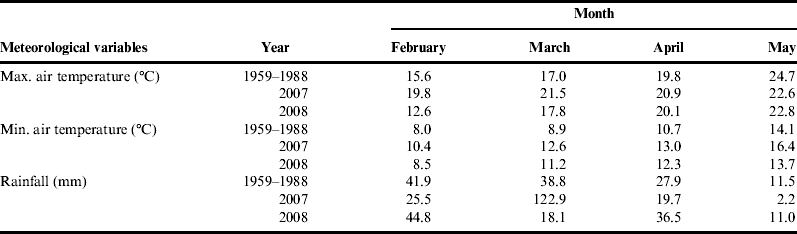
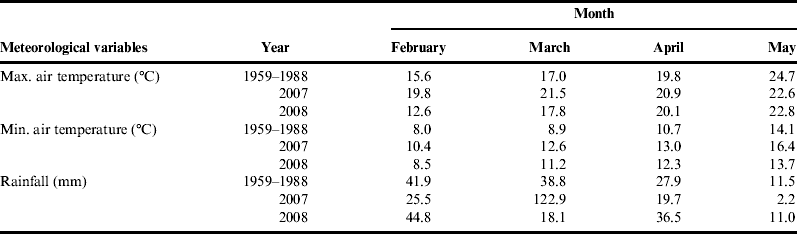
Rainfall during the 2007 growing season was above average (170 mm versus a 30-year mean of 120 mm), as were the mean maximum (21.2 versus 19.3 °C) and minimum (13.1 versus 10.4 °C) temperatures in the period from February to May. The 2008 growing season was more typical as compared to the long-term climate, experiencing about 60 mm less rain than in 2007, and a lower than average mean temperature during the growing period (Table 1).
Local mean maximum and minimum temperatures and rainfall over the period 1959–1988, and in 2007 and 2008.
Results and discussion
Crop phenology and growth
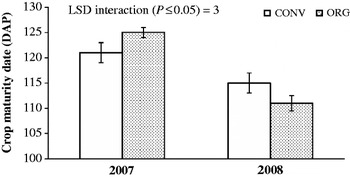
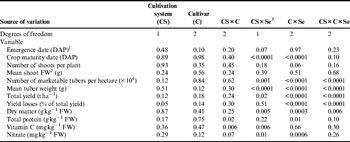
Unlike the emergence date the crop maturity date was significantly affected by cultivation system, but its effects were season dependent (Table 2). Passing from 2007 to 2008, crop maturity date was markedly delayed, especially under ORG (14 days) (Fig. 2). In contrast, no uniform trend was observed between cultivation systems within a growing season (Fig. 2). It is difficult to ascertain which possible mechanism was involved, since no literature data are available about the relationship between the ‘early’ potato crop phenology and kind of cultivation system.
Crop maturity date of ‘early’ potato crop as affected by the interaction between cultivation system and season. Vertical bars represent the standard error. CONV, conventional cultivation system; ORG, organic cultivation system; DAP, days after planting.

P-values, resulting from ANOVA, for all the studied variables.

1 DAP, days after planting.
2 FW, fresh weight.
3 Se, season.
No significant effect on crop growth, as measured by number and FW of shoots per plant, was shown in relation to cultivation system (Table 2). This, probably, implies that nutrient availability under ORG does not represent a limit for the regular crop growth.
Tuber yield and its components
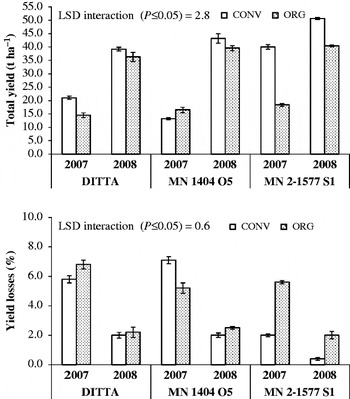
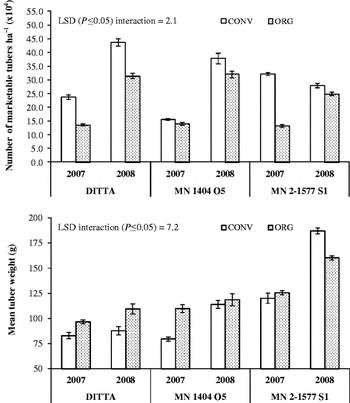
The effect of the cultivation system on the total yield was both cultivar- and season-dependent (Fig. 3). In both seasons, apart from MN 1404 O5 in 2007, the total yield was significantly lower under ORG (Fig. 3). However, the relative loss in total yield under ORG was comparable to that experienced both in main crop potatoReference Maggio, Carillo, Bulmetti, Fuggi, Barbieri and De Pascale9 and in other cropsReference Herencia, Ruiz, Melero, Garcia Galavis and Maqueda31. Yield reduction suffered under low-input systems may be ascribed to a limitation in the amount of available soil nitrogenReference Clark, Horwath, Shennan, Scow, Lantni and Ferris32 and to a less complete and slower control of diseasesReference Fiorillo, Rouphael, Cardarelli, Saccardo, Colla and Cirica8. In the latter view, under ORG all the studied cultivars produced a greater total yield in 2008 than in 2007, mostly thanks to their lower late blight susceptibility recorded in the second season (Fig. 1). The latter was, however, characterized by less severe late blight attacks (data not shown). In particular, the yield of ORG-grown Ditta was 150% higher in 2008 than in 2007 (Fig. 3). The reduced disease pressure experienced in 2008 also resulted in a lower yield differential between ORG and CONV, narrowing from 7% (Ditta) to 20% (MN 2-1577S1) (Fig. 3). It is well known that the yield reduction due to premature destruction of foliage and diseased tubers depends on timing and severity of late blight infectionReference Hospers-Brands, Ghorbani, Bremer, Bain, Litterick, Halder, Leifert and Wilcockson33. Olanya et al.Reference Olanya, Starra, Honeycutt, Griffin and Lambert34 noted that the level of damage by P. infestans is directly related to the environmental conditions prevailing over the growing season of the crop. P. infestans infection and spread are facilitated by prolonged periods of leaf wetness and high humidityReference Harrison, Haverkort and MacKerron35, as it was in 2007. The latter was characterized by higher mean temperatures and total rainfall (especially at the end of March) that created the optimal conditions for the following development of late blight infection. In Figure 3, the yield losses, expressed as the percentage of unmarketable yield of the total yield, are also shown. The effect of cultivation system on this variable was both cultivar- and season-dependent (Table 2). In 2007, passing from CONV to ORG, yield losses increased in Ditta and MN 2-1577 S1, whereas they decreased in MN 1404 O5 (Fig. 3). In contrast, in 2008 higher yield losses under ORG were only noted in MN 2-1577 S1 (Fig. 3). Just as for total yield, the number of marketable tubers per hectare and mean tuber weight were significantly affected by ‘cultivation system × cultivar × season’ interaction (Table 2). In particular, the number of marketable tubers per hectare of ORG-grown Ditta and MN 1404 O5 was, on average, 130% higher in 2008 than in 2007 (Fig. 4). This trend toward a better productive performance of the ‘early’ potato crop in 2008 was also shown for the mean tuber weight, except for CONV-grown Ditta tubers (Fig. 4). In particular, passing from 2007 to 2008, the mean tuber weight of MN 2-1577 S1 rose from 126 to 160 g under ORG and from 120 to 187 g under CONV (Fig. 4). As suggested by WarmanReference Warman36, variation in weather has a greater influence on productivity than the kind of fertilizer adopted. The lower rainfall and mean temperature experienced in 2008 (Table 1) limited the damage caused by late blight infection, and this was probably largely responsible for the better performance of the crop in that year.
Total yield and yield losses of ‘early’ potato crop as affected by the three-way interaction between cultivation system, cultivar and season. Vertical bars represent the standard error. CONV, conventional cultivation system; ORG, organic cultivation system.

Yield components of ‘early’ potato crop as affected by the three-way interaction between cultivation system, cultivar and season. Vertical bars represent the standard error. CONV, conventional cultivation system; ORG, organic cultivation system.

Chemical composition of the tuber
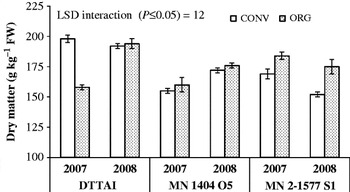
Tuber chemical composition is thought to be more strongly influenced by the choice of cultivar and location than by the cultivation systemReference Moschella, Camin, Miselli, Parisi, Versini, Ranalli and Bagnaresi17. In our study, the cultivation system significantly affected the chemical variables under study, with the extent of the effect being season and/or cultivar dependent (Table 2). In particular, there were significant differences between ORG and CONV with respect to the dry matter content accumulated by cultivars and between seasons (Fig. 5). In this sense, in both seasons MN 2-1577 S1 was more efficient in ORG than in CONV, a trait that is important in the context of cooking qualityReference Van Marle, Van der Vuurst, Wilkinson and Yuksel37. In contrast, the dry matter content of MN 1404 O5 was unaffected by the cultivation system in both seasons (Fig. 5). This implies that combination of cultivar and cultivation system may lead to a product with fairly distinct nutritional traits.
Dry matter content of ‘early’ potato tubers as affected by the three-way interaction between cultivation system, cultivar and season. Vertical bars represent the standard error. CONV, conventional cultivation system; ORG, organic cultivation system.

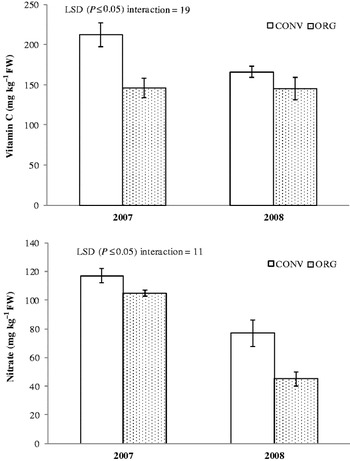
Cultivar, growing environment, harvesting technique and post-harvest storage conditions are all important for the determination of tuber vitamin C contentReference Finlay, Dale, Griffiths and Drummond38. Here, this parameter was significantly affected by the cultivation system, but its effect was both cultivar- and season-dependent (Table 2). In 2007, the vitamin C content in the CONV-grown tubers was 45% higher than in the ORG-grown ones, whereas no differences were shown in 2008 (Fig. 6). This result does not agree with previous findingsReference Pither and Hall18, Reference Asami, Hong, Barret and Mitchell20. However, a similar response to cultivation system has been observed for carrotReference Bender, Ess, Matt, Moor, Tõnutare and Luik39 and tomatoReference Montagu and Goh40. Although plants do not require light to synthesize vitamin C, the amount of light available has an indirect impact on its synthesis through its influence on the photosynthetic production of sugarReference Lee and Kader41. According to Toor et al.Reference Toor, Savage and Heeb42, the higher amount of the soil nitrogen available to the plant (which is more abundant under CONV than under ORG) may have promoted leaf growth, and thus enhanced the photosynthetic rate and hence the production of the sugars needed for vitamin C synthesis. We suggest that this explains the better performance under CONV than under ORG of MN 2-1577 S1 and Ditta, but note that the vitamin C content of MN 1404 O5 did not significantly differ between CONV and ORG (Fig. 7). The carbohydrate pool is not the sole regulator of vitamin C synthesisReference Conklin43, and other factors therefore probably underlie the extensive genetic variation for vitamin C content observed both here (that of the two MN clones was, on average, significantly higher than that of Ditta) and by Leo et al.Reference Leo, Leone, Longo, Lombardi, Raimo and Zacheo44.
Vitamin C and nitrate content of ‘early’ potato tubers as affected by ‘cultivation system × season’ interaction between cultivation system, cultivar and season. Vertical bars represent the standard error. CONV, conventional cultivation system; ORG, organic cultivation system; FW, fresh weight.

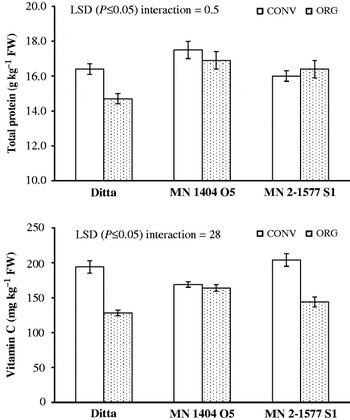
Total protein and vitamin C content of ‘early’ potato tubers as affected by ‘cultivation system × cultivar’ interaction. Vertical bars represent the standard error. CONV, conventional cultivation system; ORG, organic cultivation system; FW, fresh weight.

The effect of cultivation system on the total protein and the nitrate content of the tuber was cultivar- and season-dependent, respectively (Table 2). As in main potato cropsReference Bourn and Prescott3, Reference Woese, Lange, Boess and Bögl5, CONV-grown tubers tended to accumulate more nitrogenous substances than ORG-grown ones, due to the higher availability of soil nitrogen under CONV. However, MN 2-1577 S1 had a relatively stable total protein content between the two cultivation systems (Fig. 7). Although the total protein content of ORG-grown tubers was significantly lower than that in CONV-grown ones, it is believed, on the basis of peptide composition, that protein quality (in terms of its nutritional value) is superior in ORG-grown produceReference Rembiałkowska45. This is an important observation, since in the developing countries the potato, likewise wheat, rice and maize, represents the major source of proteinsReference Rosegrant46. In addition, in both seasons the ORG-grown tubers tended to accumulate less nitrate amount compared to the CONV-grown ones (Fig. 6). It is known as organic fertilizers with slowly or moderately available nitrogen (especially composts) compared with chemical ones lead to lower nitrate accumulations in vegetablesReference Lairon21. No sample from both cultivation systems exceeded, however, the nitrate limit of 200 mg kg−1 FW proposed by some European countries (e.g., Germany), which is an important benefit in the context of human healthReference Santamaria22. Finally, the nitrate concentration of CONV- and ORG-grown tubers fell by 34 and 57%, respectively, from 2007 to 2008 (Fig. 6). The differences in nitrate accumulation reflected the contrasting weather conditions between the two seasons (Table 1), which is known to affect the nitrate assimilation rate in plant tissuesReference Santamaria, Elia and Gonnella47.
Conclusion
Our results demonstrated that ‘early’ potato crops can be successfully grown under an organic production system. In fact, the latter was able to generate an acceptable decrease of the level of total yield in comparison with the conventional cultivation system, except when heavily attacked by late blight. However, the response of the ‘early’ crop potato to organic farming depended upon cultivar choice and seasonal conditions. In this view, the Italian breeding clones MN 1404 O5 and MN 2-1577 S1 may be a valuable alternative to the popular cultivar Ditta for ‘early’ potato production under organic cultivation systems. In particular, they deserve specific consideration due to their higher yield potential than Ditta under organic farming, as reported especially in the second season. Given the worldwide importance of late blight to potato production, and the detrimental impact of fungicides on the environment, the low susceptibility of the two MN-clones to late blight attacks, at least until the 14th week, deserves specific consideration for the next potato improvement programs. In addition, regardless of season, the ORG-grown tubers of the MN-clones achieved higher total protein and vitamin C content than those of Ditta. Overall, ORG-grown tubers accumulated significantly less nitrate than CONV-grown ones, a finding that has potentially important consequences where potato forms a major component of the diet (e.g., in Scandinavia and Central Europe).
The results here obtained are important considering that a number of EU-based breeding companies have recently released cultivars (e.g., Bionica, Lady Balfour, Raja, Sarpo Mira, Stirling and Toluca) targeted at the organic farming sector, but their yield potential for ‘early’ crop potato production is uncertain. However, the positive characteristics of the MN clones have to be confirmed further in the context of ORG-grown ‘early’ crop potato. The development of an integrated management system for organically produced ‘early’ crop potato requires the breeding of cultivars specifically adapted to low-fertilizer and zero-pesticide systems. At the same time, these cultivars also require a high level of genetic resistance to disease and an acceptable nutritional value. When these cultivars become available, their crop management will have to include the right mix of agronomy, soil fertility and disease (especially late blight) control. These considerations underline the necessity that any enhancement of the yield and quality of organic crops will need a far-reaching optimization of production systems.
Acknowledgements
This research was carried out in the frame of the ‘Costituzione di varietà di patata adatte alle produzioni biologiche (VAPABIO)’ project funded by MiPAAF. We thank the Azienda Agricola Fratelli Giardina for hosting the experiments, and for their generous help in conducting the trials.