INTRODUCTION
The importance of the Strait of Messina (central Mediterranean Sea) for the collection of rare and unusual fish species for taxonomic studies has been highlighted since the 19th Century, when the marine biologist August David Krohn defined the area as ‘the zoologists’ paradise'. In fact, the area is well-known for upwelling phenomena, due to tidal currents, that characterize the hydrodynamic regime and are responsible for the strandings of uncommon mesopelagic and deep-sea fauna (Mazzarelli, Reference Mazzarelli1909; Genovese et al., Reference Genovese, Berdar and Guglielmo1971; Berdar et al., Reference Berdar, Cavaliere, Cavallaro, Giuffrè and Potoschi1983). For this reason, the Strait of Messina is considered an important site by several marine biologists and other scientists.
In this paper the finding of a stranded specimen of Eretmophorus kleinenbergi Giglioli, Reference Giglioli1889 (Moridae) is reported. This species is very rarely reported, and data on its biology and ecology are not available in the literature. In fact the last record of E. kleinenbergi in the central Mediterranean Sea dates from 1917 (Mazzarelli, Reference Mazzarelli1917). This new record, after 93 years, can add new information on the presence of this rare morid in the Mediterranean and on the taxonomic features related to the fresh coloration of the body and the otolith morphology.
MATERIALS AND METHODS
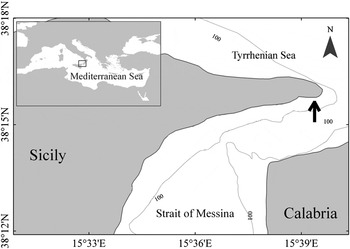
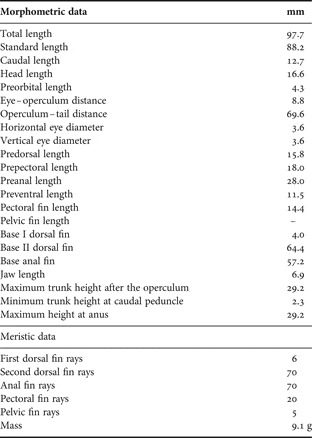
On 16 April 2010 a specimen of E. kleinenbergi 97.7 mm total length (TL) was found stranded on the shore (38°15.81′N 15°39.90′E) on the Sicilian coast of the Strait of Messina (Figure 1). Digital photographs were taken and its identification was made according to Giglioli (Reference Giglioli1889), Mazzarelli (Reference Mazzarelli1917) and Tortonese (Reference Tortonese1970). Morphometric data to the nearest 0.1 mm, mass to the nearest 0.1 g and meristic characteristics were recorded (Table 1). Sagittal otoliths were removed, cleaned, photographed and stored dry. Their description follows the terminology of Tuset et al. (Reference Tuset, Lombarte and Assis2008). The specimen was preserved in formalin and is deposited in the ichthyological personal collection of G. Ammendolia.
Stranding location of the specimen of Eretmophorus kleinenbergi in the Strait of Messina.

Morphometric and meristic data of a specimen of Eretmophorus kleinenbergi stranded on the shore of the Strait of Messina.

RESULTS
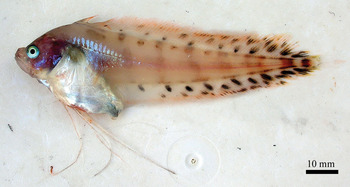
Eretmophorus kleinenbergi has peculiar ventral fins that are composed of 5 long pellucid rays, three of which (2nd, 3rd and 4th) are greatly elongated and bear a lanceolate paddle-like blade at the terminal part (Figure 2). Unfortunately, only few blades are present on the ventral fins of our specimen—because of the fragility of these structures the others are damaged or missing. The body is compressed and tapered towards the caudal peduncle, and the snout is prominent and rounded, without a barbel. The mouth slopes down to 45° and shows a pinkish colour inside. Small conical teeth are present on the jaws. The rounded eye shows a pale-yellow silvery iris. The post-orbital, pre-opercular and opercular zones have a violet-pinkish shade, with two blue-silvery spots. The abdomen is silvery pearl-grey and ends with a darker anal papilla. The body is white pinkish, with transverse brown bands, darker towards the caudal fin (Figure 2). The second dorsal and the anal fins have the same number of rays (70) and have black-brown blotches and dark margins.
The individual of Eretmophorus kleinenbergi (total length = 97.7 mm) found stranded on shore within the Strait of Messina on 16 April 2010.

The macroscopic analysis of gonads did not allow the sex of this specimen to be determined, since these sexual organs were immature and very slender.
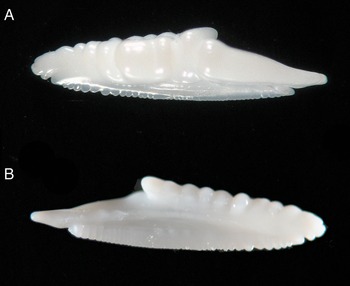
The sagittae have a sagitiform shape (Figure 3), with a median caudal sulcus acusticus. The sulcus can be defined as heterosulcoid, as ostium and cauda are clearly differentiated and dissimilar in shape. In fact, the ostium appears elliptic while the cauda has a tubular shape. The anterior region of sagitta is characterized by a lanceolated and pointed rostrum; the posterior one is prolonged and narrow, with a pointed or round postrostrum and a very short postantirostrum. The otolith has a crenate ventral margin and a lobed dorsal one.
Right sagittal otolith of Eretmophorus kleinenbergi: (A) convex side; (B) concave side.

DISCUSSION
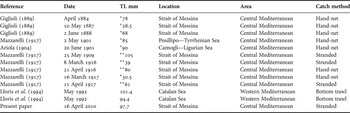
The first description of E. kleinenbergi was given by Giglioli (Reference Giglioli1889), who examined three specimens from the Strait of Messina (see Table 2 for all Mediterranean records). This species was considered to be an endemic Mediterranean species until 1991, when a specimen was caught in the Atlantic Ocean (Howes, Reference Howes1991). However, most records come from the central Mediterranean Sea (Strait of Messina, Ligurian Sea and Tyrrhenian Sea) and they date mostly from 1889 to 1917. All individuals were caught near the surface by hand-nets or were found stranded on the shore. More recently, two specimens were collected in the Catalan Sea by bottom trawl at depths ranging from 930 m to 1151 m (Lloris et al., Reference Lloris, Stefanescu and Rucabado1994). The findings of Lloris et al. (Reference Lloris, Stefanescu and Rucabado1994) extend the geographical distribution of this species to the western Mediterranean and have improved the knowledge about its vertical distribution. In fact E. kleinenbergi was considered an epipelagic organism for a long time (Cohen, Reference Cohen, Whitehead, Bauchot, Hureau, Nielsen and Tortonese1986) even though Mazzarelli (Reference Mazzarelli1917) had hypothesized that this species may live in a mesopelagic environment.
Eretmophorus kleinenbergi records in the Mediterranean Sea. The total length (TL) values marked with * and ** are specimens preserved in alcohol or formalin respectively.

The taxonomy of this species has been discussed for a long time. Initially, E. kleinenbergi was regarded as a juvenile specimen of Rhyncogadus hepaticus (Lo Bianco, Reference Lo Bianco1903) or Lepidion lepidion (D'Ancona, Reference D'Ancona1933). Although these suppositions were not supported (Lo Bianco, Reference Lo Bianco1911; Tortonese, Reference Tortonese1970), some authors (Mazzarelli, Reference Mazzarelli1917; Tortonese, Reference Tortonese1970; Cohen, Reference Cohen, Whitehead, Bauchot, Hureau, Nielsen and Tortonese1986) agree that the individuals of E. kleinenbergi examined up to now could be juvenile stages of the above mentioned gadiforms, due to the ventral appendages that are often characteristic of a pre-metamorphic status. The specimens caught by Lloris et al. (Reference Lloris, Stefanescu and Rucabado1994) lacked these appendages, but these might be lost during the trawling, as they are fragile and easily torn off (as observed on the specimen studied in the present paper). Additionally, the possibility that E. kleinenbergi is a neotenic species (Cohen, Reference Cohen, Whitehead, Bauchot, Hureau, Nielsen and Tortonese1986) is also a plausible hypothesis.
Remarks on the body coloration of this species are deemed important. To date descriptions of E. kleinenbergi have stated that the body is predominantly yellow (Giglioli, 1989; Mazzarelli, Reference Mazzarelli1917; D'Ancona, Reference D'Ancona1933), although all reported specimens were already preserved in alcohol or formalin when studied, and so their colour was thus changed. In our fresh specimen (Figure 2) the body is pinkish-white.