From the New Order (1967–98) through the ensuing period of post-authoritarian Reformasi and formal democratization in Indonesia, forest resources have been extracted and traded for the benefit of a small number of private actors with the state acting as facilitator. When President Suharto fell in 1998, Indonesians and especially NGOs and activists hoped that democratization would alleviate the corruption of the New Order and lead to a reconfiguration of forest rights, including the rights of indigenous people. However, the political economy of resources—and the interrelated issue of land rights—in post-authoritarian, democratic Indonesia is more complex and variegated.
Forests, as this paper seeks to show, are a vital lens into the relationship between political economy, law, and the formation of the Indonesian state. In Weber's classic definition, states are entities that successfully claim a monopoly of the legitimate use of force within a given territory, but this claim is almost always codified into law (Cribb Reference Cribb, Aspinall and van Klinken2011). Colonial law, as Daniel Lev (Reference Lev1985, 57) observed, “was intended primarily to make exploitation efficient.” Although founded in violence, the New Order also “sought to rest its legitimacy upon constitutional and legal processes” (Langenberg 1990, 132, cited in McCarthy Reference McCarthy2000, 93). The Suharto government built its “extractive regime” (Gellert Reference Gellert2010) on the material foundations of extraction of natural resources from fisheries to forests to minerals, and this regime's legitimacy was founded in law (backed by violence). The regime used the Constitution of 1945 as the basis for forestry and other laws to lay state claim to exclusive authority over all the lands and seas in the archipelago.
In the waning years of the New Order, a wide range of actors questioned the legitimacy of the regime, and one key area of questioning was the accumulation of wealth, mainly from the so-called outer islands, for the benefit of a small coterie of elites or oligarchs in Jakarta (Robison and Hadiz Reference Robison and Hadiz2004; Winters Reference Winters2011). Amid the lingering effects of the anti-Suharto slogan of fighting KKN (corruption, collusion, and nepotism), “clean government” advocates and academic scholars have continued to address the illegality of the Indonesian state and the ubiquity and “entrenched” character of corruption (Aspinall and van Klinken Reference Aspinall, Van Klinken, Aspinall and van Klinken2011; Lindsey Reference Lindsey, Lloyd and Smith2001; Robison Reference Robison1986). Furthermore, as Bedner (Reference Bedner2010, 49) reports, “billions of dollars” have been spent on projects aiming to establish “rule of law” as part of “good governance.”
Thus, one of the most important contemporary conflicts in Indonesia appears to reside at the legal level. Legal systems rely on authority more than power (Lev Reference Lev and Lindsey2007, 236), so the key question at the legal level is who has the authority to decide what happens in different forested and nonforested areas. The authority to decide is particularly important to the vast expansion of oil palm in the last decade, in the wake of over three decades of logging in Indonesia. After a significant expansion in the first decade of the twenty-first century, as of 2010 Indonesia had established 7.82 million hectares of oil palm and almost half of the world's crude palm oil production (Colchester et al. Reference Colchester, Jiwan, Andiko, Sirait, Firdaus, Surambo and Pane2006; Obidzinski et al. Reference Obidzinski, Andriani, Komarudin and Andrianto2012).
The question of authority can be addressed in multiple ways. First, authority is addressed as a legal question. Issues of property and ownership are paramount, as are the jurisdiction and regulation by the state. Indonesia is a state that claims the vast majority of the land in its Constitution (see Barber Reference Barber1989; see also Colchester et al. Reference Colchester, Jiwan, Andiko, Sirait, Firdaus, Surambo and Pane2006; Contreras-Hermosilla and Fay Reference Contreras-Hermosilla and Fay2005; Epistema et al. 2011; Fay and Sirait Reference Fay, Sirait, Colfer and Resosudarmo2002). Second, there is the question of jurisdictional struggles between the center and the regions in a period of approximately fifteen years of decentralization and regional autonomy. Third, there is the political question of who actually accesses and uses the land, how, and for how long, as well as the related question of who is excluded from access (Hall, Hirsch, and Li Reference Hall, Hirsch and Li2011; Ribot and Peluso Reference Ribot and Peluso2003).
Fourth and most importantly, there is the political economy and class question of who benefits from different uses of the “forested” areas of Indonesia, especially the sequential and overlapping cycles of commodification of resources (Gellert Reference Gellert2010). Much of the research on beneficiaries has focused on local and indigenous rights to forests and forest resources (Contreras-Hermosilla and Fay Reference Contreras-Hermosilla and Fay2005; Harwell and Lynch Reference Harwell and Lynch2002) while paying less attention to conflicts between different state and private actors. Studies of decentralization have indicated the importance of the struggles between levels of governance (Colfer et al. Reference Colfer, Capistrano, Dahal and Moeliono2008), and we contribute further to that effort. As Epistema et al. (2011, 1) observe, “Uncertainty and conflict over forest land delays the achievement of effective and just forest management in Indonesia.” However, as these advocates of tenure reform note, the conflicts not only affect local and indigenous communities but also involve business and government.
Different academic disciplines have approached these questions in various ways. Legal studies scholars, at least in Indonesia, tend to focus on normative aspects and to reject the intersection of legal with nonlegal aspects. For the promoters of this viewpoint, law is free from nonlegal factors. Legal changes can cause social changes but not vice versa. In other words, law quite simply is a tool of social engineering. This normative perspective, based in the classic thinking of Roscoe Pound, has been rejected by a small group of scholars and activists in Indonesia who follow American critical legal studies (e.g., Suhendar and Kasim Reference Suhendar and Kasim1996; Unger Reference Unger1996) in considering the politics and social acceptance of law as more important and causally prior to the establishment of “rule of law.”
On the other hand, political economists are more attuned to social relations of rule, but much political economy literature ignores or underemphasizes laws and regulations. In some neo-Marxist perspectives, for example, law is viewed as part of the superstructure that is merely a reflection of the mode of production. Mainstream political scientists have largely not addressed such issues directly but focused instead on the establishment of rule of law as part of the literature on so-called transitions to democracy. Pluralist analyses consider Indonesia to be a “case of incomplete transition from high authoritarianism to democracy” (Dick Reference Dick and Lindsey2007, 43; see also Liddle Reference Liddle2013; Pepinsky Reference Pepinsky2013). In this view, there is a presumed sequence from democratization to establishment of rule of law as part of a general “linear progression from authoritarianism to a predatory form of democracy and then to a liberal form,” as Hadiz and Robison (Reference Hadiz and Robison2013, 39) observe. However, structural political economists (Hadiz and Robison Reference Hadiz and Robison2013; Winters Reference Winters2013) identify how the central question is not to what extent rule of law has been established but by whom and for whom. In other words, there are political questions about the rule of law. The question of whether Indonesia “has transitioned” to democracy is dropped in favor of a perspective that asks about configurations of social and political power. As Hadiz and Robison (Reference Hadiz and Robison2013, 36) word it, the central goal of analysis is “to explain how those interests that had established political ascendancy within the previous Indonesian regime have been able to reorganize their power and preserve salient features of the old social and political order within the shell of the new democratic and market society.”
While highlighting this reorganization of power is vital, consideration of the law itself, including the extent to which and with what effect rule of law is sought, is important in Indonesia and elsewhere. We thus add to the structural political economy perspective by examining the role of law in establishing the configurations of power in Indonesia. In this way, we contribute to a political economic analysis of power by paying attention to the variability of local contexts, as “critical pluralists” (Pepinsky Reference Pepinsky2013) would have us do as well. In fact, in accord with Pepinsky, power dynamics in Indonesia can be “illustrated in the context of natural resource extraction in the era of decentralization” (97).
Since the 1990s, grasping the normative perspective, the World Bank has “embraced rule of law building” (Tamanaha Reference Tamanaha2011, 235) applied as a “technocratic project” (Peerenboom Reference Peerenboom2009, 112; see also Carroll Reference Carroll2010; Ohnesorge Reference Ohnesorge and Woo2007) that does not transgress the Bank's professed international legal commitment of international institutions to respect nation-state sovereignty. Ocko and Gilmartin's (Reference Ocko and Gilmartin2009a) cultural comparative approach to rule of law recognizes the importance of analyzing legal institutions and practices within a historical approach that is attuned to past and contemporary social change. However, they reject the “dominant tendency in legal studies” to be “instrumentalist” in one's approach to law and justice (56). In disagreement with Ocko and Gilmartin (Reference Ocko and Gilmartin2009b, 130) and the Bank, we are focused on the “myriad ways that the operation and meaning of the law were negotiated.”
By focusing on the legal aspects of forestry, this paper also addresses questions of state capacity, like those raised by Strauss (Reference Strauss2009) in her study of forest conservation in China. Strauss sheds light on the Chinese state's expansion of capacity down to the local level, but does so with a focus on conservation framed as public good. In our case, the Indonesian state continues to be concerned with species control, and therefore we examine how local officials legally contest central authorities—regardless of any real capacity to govern the activities in the forested areas of Indonesia.
In the end, however, we argue that the quest for “rule of law” is a technocratic dream that remains quixotic if the deeper social inequality and cleavages in Indonesian society are not addressed. With broad decentralization policies adopted after Suharto's fall, Indonesia's political system has opened up to competition over the legitimate authority of the nation-state. This competition has real material consequences, especially in resource-rich parts of the archipelago. Although rule of law is undoubtedly complex, with multiple definitions and “thin” and “thick” versions (Bedner Reference Bedner2010; Carrothers Reference Carrothers2003; Peerenboom Reference Peerenboom2009), we argue that there is a misuse of rule of law, loosely defined, by its promoters who tout its role in democracy, development, and combating authoritarianism without acknowledging the risks of certainty. In advocating for a thick, democratic rule of law, O'Donnell (Reference O'Donnell2004, 43) urges us to recall that “[c]ontrary to technocratic and positivistic views, we should never forget that the law, in its content and application, is largely (like the state of which it is a part) a dynamic condensation of power relations.” In our view, rule of law is even potentially undesirable if the law is not beneficial or is systematically detrimental to weaker or minority groups within the country, and if it serves to legitimize the systemic exploitation of nature and society.Footnote 1
This article combines legal and political economy perspectives to examine the continued importance of power and accumulation strategies in natural resource commodification in Indonesia's forested areas. We focus on ways in which the Ministry of Forestry, the key power broker during the New Order, is finding its authority under pressure.Footnote 2 This pressure is especially strong as the biologically and ecologically forested areas continue to diminish in Indonesia. In recent years, the government of then president Susilo Bambang Yudhoyono made commitments to reduce deforestation and alleviate climate change. Notably, Indonesia signed a $1 billion deal with Norway to avert deforestation via REDD+ (Reducing Emissions from Deforestation and Forest Degradation) and in 2013 renewed the two-year moratorium on new permits. The government proudly announced that the official deforestation rate had been reduced from 1.17 million hectares per year in 2000–2006 to 0.48 million hectares per year in 2009–2010 (UNDP Indonesia 2013). However, in addition to disagreements about the moratorium map, environmentalists from Greenpeace Indonesia have questioned the legitimacy of the deforestation statistics because the Ministry of Forestry has not made the methodology publicly available. Greenpeace asserts that the decline in deforestation for the recent period may only refer to the formal or legal release of forest areas (pelepasan kawasan hutan). As a Greenpeace campaigner explained, “From the figures [provided], we (Greenpeace) can only speculate that the rate of deforestation that is claimed as net deforestation means that what is calculated as deforestation is the release (pelepasan) of forest area (kawasan hutan) to non-forest land (kawasan non hutan)” (Globe Journal 2013).Footnote 3 The process and structure of changes in these designations from kawasan hutan to kawasan non hutan is the focus of this paper.
Such disagreements over official, national-level data are commonplace in Indonesia and throughout the developing world. Many analysts have blamed states for such slippages and related corruption for degrading environments in the name of development. Others question this view, for example by showing that there is a broader “will to improve” that is not monopolized by states and their projects (Li Reference Li2007). As Hall, Hirsch, and Li (Reference Hall, Hirsch and Li2011) develop this argument further, various actors, groups, agencies, and collectivities ranging from huge transnational corporations to small prawn pond fisher-farmers engage in efforts to “improve.” As they do so, they almost invariably seek to “exclude” others. This leveling of the analytical field to include such a wide range of actors, unfortunately, pays more attention to exclusion than to power. We argue that the expansion of state power needs to be unpacked to analyze such political questions as power for whom and power for what. Seen in this light, the competition among different agencies (forestry, mining, agriculture, etc.) and between central and regional authorities is a struggle over implementation between different factions of capitalist interests. Importantly, Peluso and Vandergeest (Reference Peluso and Vandergeest2001) introduce us to the historical establishment of “political forests” and examine the changes over time in how the state asserts and (re)establishes its power to shape capitalist extraction, production, and trade. In our analysis, we combine this Foucauldian insight on the penetration by the state and its production of categories of land, forest, species, and peoples with the insights into power and class relations of structural political economy. The spread of the political forest, including the “rules of the game” as codified in law, is thereby understood as not only an extension of the state but also re-enforcement of the power of dominant politico-bureaucrats and the business class.
Much of the recent literature of relevance to such issues has been framed around questions of governance (e.g., Broekhoven, Savenije, and von Scheliha Reference Broekhoven, Savenije and Von Scheliha2012; Bullinger and Haug Reference Bullinger and Haug2012; Colfer et al. Reference Colfer, Capistrano, Dahal and Moeliono2008; Gellert Reference Gellert, Hout and Robison2009; Li Reference Li2007). The focus of these governance studies, however, is more on local community use of forests than on conflicts between different state jurisdictions, let alone states and large corporate land users. In a typical example, an analyst of local and community forestry rights observes, “In many tropical countries, governments have set aside large areas of their national territory as state forest …, with little regard for rural populations living in these areas …, so that local land use frequently violates the national legal framework” (Kusters et al. Reference Kusters, de Foresta, Ekadinata and van Noordwijk2007, 428, citations omitted). For them, the dilemma is that de facto “local land use frequently violates the national legal framework” (428). The path forward for many governance studies, therefore, is “good governance.” Yet in the quest for resolution, such governance studies sometimes overlook questions of power (Colfer et al. Reference Colfer, Capistrano, Dahal and Moeliono2008; Hout and Robison Reference Hout and Robison2009). As Broekhoven, Savenije, and von Scheliha (Reference Broekhoven, Savenije and Von Scheliha2012, x) observe, “understanding and dealing with power and powerful groups is important in order for forest governance reform processes to be successful, because these reform processes often change power relations. This key aspect of forest governance reform typically remains implicit.” Moreover, even those scholars who do address power rarely address conflicts between states and corporations.
Combining insights from legal studies with a historical and comparative political economy perspective to address the expansion of oil palm plantations and conflicts among state actors has several potential strengths. We believe it allows us to pay careful attention to the importance of the law in all its specificity while at the same time not accepting law as the creator of social change. In addition, we argue that this combination can recognize the ways that laws and regulations are (mis)used by powerful actors for their benefit. Such actors, including state institutions, may use the law to provide ideological cover for their actions and the creations of political structures that favor the powerful.
This paper proceeds in four parts. In the next section, we briefly introduce the concept of “political forests” and its relevance to understanding conflicting claims in Indonesia. This section also situates the discussion of political forests in the literature on rule of law and its history in Indonesia. In the longer middle section of the paper, we examine two cases of legal changes as a reflection of social and political struggle. Both cases relate to oil palm, and we focus on Kalimantan (Indonesian Borneo), especially Central Kalimantan Province, because that is where the REDD+ pilot project was initiated in 2011 and because of data availability. The first case focuses on the negotiated resolution of overlapping permits from the central government and regional governments, particularly for oil palm plantations in the kawasan hutan of Indonesia. The second case examines the maneuvers of the Ministry of Forestry to assert its authority over oil palm plantation activity while maintaining lands as kawasan hutan. In the final section of the paper, we consider the continued lack of legal certainty and argue that the quest for certainty and rule of law is quixotic because it ignores the realities of political economy, including social conflict, beneath the veneer of law.
“Political Forests” and Ministry of Forestry Claims
The Ministry of Forestry stands at the nexus of private, corporate power and interest in capital accumulation, on the one hand, and state declarations of forest control, on the other. Theories of the capitalist state and globalization, relying on the enduring insights of Marx (e.g., Harvey Reference Harvey2003; Jessop Reference Jessop1990; Robinson Reference Robinson2004), point to the role of the state in facilitating capital accumulation. Scholars who focus on natural resource commodities have noted the power of capitalists to access and control resources and the role of resource extraction and transportation infrastructure in creating “generative sectors” that spur hegemonic power (Bunker and Ciccantell Reference Bunker and Ciccantell2005; see also Bunker Reference Bunker, Socolow, Andrews and Berkhout1994; Gaventa Reference Gaventa1980). In the political economy of Indonesia, Robison and Hadiz (Reference Robison and Hadiz2004; see also Hadiz Reference Hadiz2010; Hadiz and Robison Reference Hadiz and Robison2013; Winters Reference Winters2011, Reference Winters2013) have done the most thorough work highlighting the controlling power of a small oligarchy. Power has not been shared with a wide range of civil society actors so much as “reorganized” within the new, formally democratic system, and the aim of those in power continues to be predatory accumulation of wealth.
Given the contemporary importance of state institutions, it is useful to deploy the concept of “political forests” developed by Peluso and Vandergeest (Reference Peluso and Vandergeest2001, 762), with its roots in Weberian and Foucauldian analysis, to explain a “discourse of state property” in which there are “lands states declare as forests.” The Indonesian state has long claimed authority over all the land and seas of Indonesia for the public good. This claim is enshrined in the national Constitution and its oft-quoted Article 33 (Paragraph 3), which states that the “the land, the waters, and the natural resources within shall be under the powers of the State and shall be used to the greatest benefit of the people.”Footnote 4 Article 33 was used during the New Order period of President Soeharto as the basis for the Forestry Law of 1967 and a whole series of regulations that constrained and impinged on the rights of local and indigenous people.
At the national level, 130 million hectares or 68 percent of Indonesia's 192 million hectares of land area is claimed as kawasan hutan (Department of Forestry 2012). The forest area is further subdivided by the Ministry of Forestry into production forest (32.6 million hectares), limited production forest (24.5 million hectares), conservation forest (26.8 million hectares), protected areas (28.9 million hectares), and conversion forest (17.9 million hectares). The remaining 61.3 million hectares or almost one-third of the national land area falls under the jurisdiction of the National Land Agency (BPN 2010, 12). From the Ministry of Forestry perspective, these lands are designated as kawasan non hutan. As a result, in other words, two governmental agencies, the National Land Agency (Badan Pertanahan Nasional or BPN) and the Ministry of Forestry together claim 100 percent of Indonesian lands, and the two-thirds under Ministry of Forestry jurisdiction is claimed as what Peluso and Vandergeest (Reference Peluso and Vandergeest2001) call “political forest.” In fact, one can think of all of Indonesia as being defined in relation to whether or not there is a political forest. It is not surprising in these circumstances that the Ministry of Forestry has been known as a very powerful, opaque, and “wet” or corrupt ministry. In practice, however, there are many competing claims on the lands—forested or not—from multiple levels of government, different institutions, and also local and indigenous communities.Footnote 5
For Peluso and Vandergeest (Reference Peluso and Vandergeest2001), political forests are a critical component of the development of colonial states. They write that “‘forest land’ became that land that was either demarcated by the state for permanent reservation or that land that was claimed by the state” (801). Working from a Foucauldian perspective, they trace the genealogies of political forests to the late colonial period in Indonesia, Malaysia, and Thailand. In this period, foresters “naturalized” the category of forest and politically designated it as state land. The prerequisite for the establishment of political forests was “disciplining people's actions” (764).
Although this disciplining continues, it also laid the groundwork for “the roles of states in managing and imagining nature” through processes of territorial and resource or “species” control (Peluso and Vandergeest Reference Peluso and Vandergeest2001, 764, 780ff). Peluso and Vandergeest observed the contestation between the Department of the Interior and the precursor to the Ministry of Forestry, the Forest Service, as political forests expanded from the late nineteenth century through the 1930s. As we demonstrate below, these roles have come into tension again in the post-Suharto period with Ministry of Forestry contesting the release of forest areas “back” to the BPN. In terms of our argument, it is important to recall that the political forest was supported by law, but law, as Lev (Reference Lev1985) noted, has been used to support extraction. The struggles between central and regional elites are struggles over who will reap the benefits of disciplined people and forests and rationalized exploitation of commodities in a global, export-oriented, resource-extractive economy.
Several points about the broader importance of this paper's focus on forests and rule of law, which to some may appear narrow, are worth emphasizing. Most crucially, forests and especially political forests are reflections of the assertion of state power. Indonesia is one of many countries in which the state lays claim not just to Weberian state power within a given territory but to a wider array of authority relations. As a result, to understand forests and the social, political, and economic relations attendant to them, including law, is to understand Indonesia more broadly.
Except for ten years of parliamentary rule just after independence, both the Old Order of Sukarno and the New Order of Suharto used the 1945 Constitution to reject Western notions of democracy and rule of law by establishing an integralist state idea (in Dutch, integralistische staatsidee) (Lindsey Reference Lindsey and Peerenboom2004, 290). Compared to Sukarno, however, the New Order was more like the colonial state in its “efficiency, economic drive, effective political control and even its superficial claim to rule by law” (Lev Reference Lev1985, 73).
Indonesians are fond of saying that they live in a negara hukum, which is loosely translated and, especially since 1998, understood popularly as “rule of law.” In this regard, negara hukum “is the term most often used to describe what the New Order never was” (Lev Reference Lev and Lindsey2007, 249). However, negara hukum is more properly translated as “law state” from the German Rechtsstaat (Lindsey Reference Lindsey and Peerenboom2004, 293). In this “law state” or integralist state, rule of law is “thin” and more like “rule by law” or rule by rulers (Lindsey Reference Lindsey and Lindsey2007, 8–9) without more democratic notions of separation of powers or limits on discretionary powers of the state. The roots of this thin notion were laid by the country's chief author of the 1945 Constitution, Soepomo, who in effect argued that “the state, being the [spirit of the] people, cannot be wrong.… [A]ll state acts are inherently legitimate and legally correct.” The further consequence is that “individuals acting against the state, manifest as the government, are therefore acting against society – the rakyat” (Lindsey Reference Lindsey and Peerenboom2004, 292). It is in this spirit that the New Order favored extraction and promulgated forestry regulations that limited local and indigenous access to the forest (Fried Reference Fried1995; Gellert Reference Gellert2010).
Since 1999, when the Indonesian legislature passed amendments to the Indonesian Constitution, the possibility has emerged of a thicker (Anglo-American) sense of rule of law with recognition of civil rights and equality of all citizens, even powerful oligarchs, before the law (Indrayana Reference Indrayana2008; Lindsey Reference Lindsey and Peerenboom2004, Reference Lindsey and Lindsey2007; Tahyar Reference Tahyar2012). From a political economy perspective, there may be real change “generated as capitalism outgrows its predatory roots and where capital begins to see its interests in more predictable and transparent regulation and in rule of law” (Hadiz and Robison Reference Hadiz and Robison2013, 55–56). However, as law and society scholars have found in their examination of U.S. racial relations and civil rights, initial enthusiasm has given way to a more cautious stance about the potential use of law in promoting progressive change (Calavita Reference Calavita2010). Galanter (Reference Galanter1974) classically demonstrated how law's professed neutrality (e.g., in equality before the law and due process) does not result in fair or equal outcomes, for example when some corporate players have more experience and resources to engage in litigation. The “most fundamental limit on law as an instrument of radical change” is that laws “‘get bent in the direction of their society.’ … [C]apitalist law looks, smells, and acts capitalist” (Macaulay, Friedman, and Stookey 1995, 7, cited in Calavita Reference Calavita2010, 144–45).Footnote 6 As we show in the case studies below, the most important challenges to central authority are not coming from “below” but from regional elites, raising questions about which ruler's wishes are embodied in rule by rulers or rule by law.
Two Attempts to Maintain (Reestablish) Central Authority
The political economy of law and its application to the so-called (legally designated) “forest area” or kawasan hutan of Indonesia is best understood by beginning with two critical cases in recent years. These cases reveal the dilemma of central authorities who are attempting to maintain and, in some cases, reestablish authority in a system that is no longer centralized and authoritarian. In the first case, five regional leaders in Central Kalimantan challenged the constitutionality of the 1999 Forestry Law. Their legal challenge, only possible after the October 2003 establishment of the Constitutional Court (Mahkamah Konstitusi), gained a partial, negotiated victory for the regional leaders but ultimately resulted in legal inaction coupled with political and economic negotiation. Despite some recognition of abuse of power by the Ministry of Forestry, a continued lack of clarity of the law is enabling the regional leaders to continue to serve the interests of private capital via the allocation of permits.Footnote 7
In the second case, Indonesia's expansion of oil palm plantations has occurred on lands that used to be kawasan hutan. The political risk for the Ministry of Forestry is the loss of authority over these lands as they are converted from forest area to agricultural area.Footnote 8 Circumventing this legal process of conversion from kawasan hutan to “area of other uses” (areal penggunaan lain), the Ministry of Forestry has attempted to maintain its jurisdictional authority over the lands by expanding its regulatory authority to include oil palm. The attempt is also complicated by debates over what actually constitutes a “forest” commodity (Dijk and Savenije Reference Dijk and Savenije2010).
These two cases are then used to support our argument that a combined legal and political economy perspective is more powerful than either one in isolation. They demonstrate, in other words, the difference between a top-down, formal, and legalistic perspective that Scott (Reference Scott1998) has called “seeing like a state” and a more nuanced and multifaceted perspective on the constellation of social and political forces shaping the construction of the state and its effectiveness. At the same time, the two cases also indicate the weakness of a perspective that merely emphasizes rule of law, as some professional-class NGOs have done, because that opens the door for free-riders or regional misuse of the issues that they have long raised, such as the infringement of the central government on local rights (with local rights not specified as people's rights). Similar questions are being raised in Indonesia about a 2013 Constitutional Court decision that allows for indigenous (adat) forest rights. The political economy questions raised above are of utmost importance.
Case 1: “Synchronizing” Forest Authority in the Face of Overlapping Permits and Competing Claims
If one has—or claims—jurisdictional authority over forested area, one can also apply regulatory authority, such as permits for plantation activity. But, how can one determine if an area is legally “forest” in Indonesia? As noted above, the important point is that the state claimed sole authority over the lands for the benefit of the nation. The jurisdictional authority claimed by the Ministry of Forestry was used throughout the New Order (1967–98) as the basis for allocation of logging and plantation permits. As logging depleted the forest, the government encouraged the establishment of fast-growing tree plantations, and the Ministry of Forestry used its authority to allocate forest area for these plantations. This development sometimes required reallocation of forest area from production and other categories to conversion forest status. Although the relationship to natural forest cover was tenuous, logged-over areas that were degraded often met the standards for conversion.
During the subsequent reform era, the centralized authority of the Ministry of Forestry, especially the authority over kawasan hutan, has been questioned by regional competing authorities. Two specific factors were important to this challenge. On the one hand, the fall of Soeharto was precipitated by criticism of the centralization of power during his thirty-two years of rule. The momentum for decentralized power was supported by the 1999 and subsequent laws on regional autonomy, with the result that the Ministry of Forestry no longer has regional offices (kanwil). Significant tension arose between the center and the regional authorities over the uses of the lands (see Gellert Reference Gellert, Nevins and Peluso2008). On the other hand, the expansion of oil palm raised an institutional threat to the Ministry of Forestry's power because oil palm plantation permits fall under the legal jurisdiction of the Department of Agriculture. The lands for oil palm plantations and other agricultural uses in Indonesia are based in legal rights (hak), not permits (izin), and such legal rights are only overseen by the BPN. Of course, as we will see in the second case, who has the power depends on the parsing of the technical difference between a “tree” crop and an “agricultural” crop (see Dijk and Savenije Reference Dijk and Savenije2010).
While the real conflict is between different levels of governmental authority, the questioning surfaced as a conflict over permits. In 2011, five regional leaders (bupati) from Central Kalimantan Province and one businessman (in his individual capacity as a citizen) brought a legal case to the Constitutional Court of Indonesia (Case 45/PUU-IX/2011). The basis of the case was questioning the 1999 Forestry Law's inclusion of the right of the central Ministry of Forestry authority to “designate” forest area for different uses. Article 15 of the 1999 Forestry Law delineates the process for legal gazettement (pengukuhan) of forest area in the following technical sequence: first, forest area designation (penunjukan); second, forest area boundary demarcation (penetapan batas); third, forest area mapping (pemetaan); and fourth, forest area establishment (penetapan). In fact, very little of Indonesia's forest has been gazetted beyond mere designation, the first step in the sequence (see Contreras-Hermosilla and Fay Reference Contreras-Hermosilla and Fay2005; Fay and Sirait Reference Fay, Sirait, Colfer and Resosudarmo2002). The lack of real technical implementation of the “political forest” has not prevented those in authority from using their power to issue permits for a variety of economic activity. During the New Order, the authority to do so was clearly backed up by force, but since 1998, the authority has been questioned by various actors, from regional political elites to advocates of adat rights.
The Constitutional Court case reveals this contestation between central and regional elites. The legal aspects of the case were analyzed fully by Arizona, Mary, and Negara (Reference Arizona, Mary and Negara2012). In their annotation, Arizona et al. note that the central concern of the case was Article 1(3) of the 1999 Forestry Law, which stated, “Forest area means a certain area which is designated and or stipulated by government to be retained as permanent forest” (BKPM 1999, emphasis added).Footnote 9 The five regional leaders and one businessman who brought the case were raising the question of whether a regional leader was legally within his authority to give permits (ijin) for areas that were simply designated as permanent areas. In reality, many permits had already been allocated by this time, especially for oil palm, at the regional level. If the 1999 Forestry Law were not amended, these permits would be illegal and the regional leaders could be brought to trial as criminals.
Therefore, they brought the suit on a number of bases to support the political (and legal) authority of regional leaders. First, despite decentralization and regional autonomy policies, there was no legal assurance of their position of authority in giving permits or renewals for plantations, mining, as well as housing or other permanent rights. In other words, any permit for use of land outside of a forest area (kawasan non hutan), which they argued should be in their regional authority, was potentially unauthorized and thus illegal. Second, regional autonomy was constrained if all such permits and activities were considered as occurring in kawasan hutan until the completion of the full sequence of gazettement to establishment of forest and nonforest areas. Third, regional, sub-regional, and local-level planning could not proceed because these areas were not yet completely established as forest areas. Fourth, they could be indicted for criminal behavior for intruding on forest areas, including via the allocation of permits. Fifth, even the land and building ownership rights of the people of the regions of Central Kalimantan could be taken by the national state.
The state (i.e., national) attorney general at the time recommended that there be an out-of-court settlement that his office might facilitate between the Ministry of Forestry and the regional governments. He based this recommendation on the argument that the palm oil industry had already made significant contributions to the nation via strengthening of human resources.Footnote 10 His opinion did not take into account, however, the interest of local people in rights to land or other aspects of social justice, despite the reasonable assumption that the attorney general should serve the public interest.
In the end, the Constitutional Court decided in favor of the six plaintiffs. Article 1(3) of the Forestry Law was deemed unconstitutional and was changed as follows: “Forest area shall be a certain area which is designated and or stipulated by the Government to be preserved as a permanent forest” (Constitutional Court 2011). However, the Constitutional Court decision was very narrow and did not affect other articles in the forestry law, with the result that at most its decision would apply to future permits. The Minister of Forestry did not cede his authority easily. In fact, he did not respond to the lack of boundary demarcation and mapping identified by the Constitutional Court and which Fay and Sirait (Reference Fay, Sirait, Colfer and Resosudarmo2002) had pointed out was lacking a decade before. Instead, he simply sent a circular letter (surat edaran) regarding the decision to the governors and regional leaders, which informed them that all the Ministry's decisions were still (claimed as) valid and legal (Ministry of Forestry 2012a). No further action would be taken.
The deeper root of the problem of conflicting authorities over permits lay in the exhaustion of natural forest areas for logging and the economic opportunity available from expansion of various commodities that result in forest conversion—pulp plantations, oil palm plantations, and coal mines. To address this problem, as well as collusion in the forest-related industries, President Susilo Bambang Yudhoyono appointed a Special Commission for Combatting Legal Mafia in February 2011, amazingly using the word “mafia” as part of the official name of the commission.Footnote 11 The result of the commission's investigations in Central Kalimantan Province showed that, of the 352 palm oil companies with permits for development of an area totaling 4.6 million hectares, fewer than 20 percent had been “released” by the Ministry of Forestry. Legally, such release of forest areas should have occurred via permits for the release of forest area (izin pelepasan kawasan hutan) from ministerial authority (Diansyah, Fariz, and Yuntho Reference Diansyah, Fariz and Yuntho2012, 24).
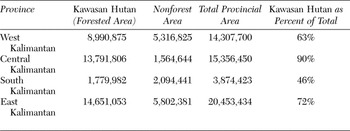
In the reform era, the Ministry of Forestry attempted to create a unified plan for forest usage between the central authority and the provinces. The Synchronization (Paduserasi) of Forest Land Use by Consensus and Provincial Spatial Plan began in 2002 to bring national land use planning maps into harmony with provincial ones. Most provinces were willing to accept the national level's lead in this exercise. However, three resource-rich provinces, Central Kalimantan, Riau, and Riau Islands (Kepulauan Riau), openly rejected the Ministry of Forestry's initiative, leading to more extensive negotiations between central and regional authority.Footnote 12 When one looks at the division of forest area and nonforest area by province, the reason becomes clear (see table 1). Compared to the national average, which is roughly two-thirds forest area and one-third nonforest area, Central Kalimantan only contained 10 percent designated as nonforest area. Even the governor's office in the provincial capital of Palangkaraya was on land designated as forest area.
Pre-2011 kawasan hutan in Kalimantan provinces (in hectares).

Source: Department of Forestry (2012).
By comparing data across the four provinces of Kalimantan, one can understand the institutional and historical genesis of the problem. The history of the establishment of political forest designations resulted in a much higher percentage of Central Kalimantan's lands being designated as forest area. The cause may have been the lower degree of colonial penetration of Central Kalimantan. As table 1 shows, about 90 percent of Central Kalimantan's area was claimed by the state as kawasan hutan. A significant portion of these lands were in various stages of becoming plantation lands under the BPN and no longer kawasan hutan, from getting location permits to governor's recommendation letters to in process for plantation use rights.
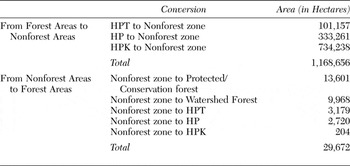
After private negotiations, a compromise was reached between the Ministry of Forestry and the Province of Central Kalimantan. On May 31, 2011, Minister of Forestry Zulfikli Hasan signed Decision Number 292 (SK 292/2011). This short decision letter specified major changes in the categories and jurisdiction of land area (see table 2). Most importantly, the compromise allowed an additional 1,168,655 hectares of the kawasan hutan to be recategorized as kawasan non hutan, which presumably resolved some of the tension around conversion to oil palm plantations both de facto and with regional permits. (It also changed 29,672 hectares of nonforested areas into kawasan hutan.)
Changes in Central Kalimantan kawasan hutan and kawasan non hutan designations, 2011.

Source: Ministry of Forestry (2011).
Notes: HPT = limited production forest; HP = production forest; HPK = conversion forest.
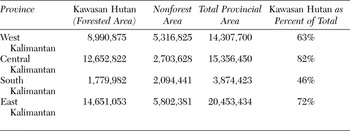
Maintaining their authority via secrecy, neither the Ministry of Forestry nor the provincial government in Central Kalimantan released a list of companies and permits to the public until October 4, 2013, when the Ministry posted a list that appears to legalize 136 companies in the province ex post facto.Footnote 13 What is clear is that a significant political resolution had been reached between a forest-rich province and the central authority in the Ministry of Forestry. Regional allocation of over 1 million hectares of forest for oil palm, mining, and other activities became part of the new legal reality. Perhaps promoters of the rule of law would interpret this change as evidence of legal clarity in support of rule of law. At the same time, as table 3 shows, the resulting redistribution of land categories in Central Kalimantan only decreased the provincial kawasan hutan to 82 percent, which is still by far the highest percentage of the four provinces on Borneo. In other words, this redistribution was only one political step in the redefinition of the political forest and the relative power and authority of the Ministry of Forestry and the regional power brokers. Importantly, however, the conflict was resolved and both parties continue to operate under (the fiction of) rule of law.
Post-2011 kawasan hutan in Kalimantan provinces (in hectares).

Source: Department of Forestry (2012).
Case 2: Attempting to Legalize Oil Palm Permits in Kawasan Hutan
In a political economy dominated by oligarchic power, whose bases continue to be heavily focused on extractive and agricultural commodities, maintaining wealth relies on maintaining power and authority. Due to the pressure to facilitate the expansion of the booming palm oil sector (see Casson Reference Casson1999; Colchester et al. Reference Colchester, Jiwan, Andiko, Sirait, Firdaus, Surambo and Pane2006), the Ministry of Forestry faced a second, arguably more significant, legal and political choice than the regional contestation of the first case: either let the forest area be released from the Ministry's authority or somehow change the legal regulations to include Ministry of Forestry authority over agricultural activities in “their” forest. In the end, the Ministry chose the latter path of “improving” the regulation of forest area to allow agricultural plantation use of forest area. By doing so, it revealed its material interest in maintaining jurisdictional authority—and related access to economic rents—over the maximum area of political forest in the country.
The proper legal path to allow expansion of palm oil in Indonesia, if Indonesia were truly operating under rule of law, would have been to release the land from forest control to local governments. The 1999 Forestry Law (no. 41) only specified a series of permits that could be given by the Ministry, notably forest product use permits (izin usaha pemanfaatan hasil hutan kayu) for logging, which replaced the previous forest concessions (hak pengusahaan hutan).Footnote 14 By omission, it did not delineate a process for release of forest area for tree plantations. The only partially relevant components of the law are Article 18, which specifies that the government must keep a minimum of 30 percent of the area forested,Footnote 15 and Article 19, which states that changes in forest use (e.g., to nonforest) are determined by the government based on “integrated research” and will be arranged in further regulations (Peraturan Pemerintah or PP).
As is the common practice in Indonesian law, the forestry law was specified further in a series of “implementing regulations” from the government of Indonesia (executive branch) and from the Ministry of Forestry. The first few such regulations—PP 24 in 2002, PP 6 in 2007, and PP 3 in 2008—did not specify anything about the establishment of oil palm (or other) plantations inside state forests. Only in 2010 were the first implementing regulations that began to address the fantastic growth in oil palm plantations released: PP 10 from the executive branch and Forestry Regulation (Permenhut) 33.Footnote 16 Article 19 of PP 10 specified that changes to nonforest areas could be done via either conversion forest being released by the Ministry of Forestry or a complex process of exchanging (tukar menukar) parcels of forest in different categories and then new conversion forest areas being released. Two years later, PP 60 of 2012 amended PP 10 and (in Article 51A) required permit holders to request release of forest area from the Minister of Forestry within six months.
Forestry Regulation 33 delineated the process by which forest area could be converted into plantations. It specified that oil palm plantations must be developed in nonforest areas (di luar kawasan hutan negara). Article 3 listed twenty-two specific uses of forest area that must be done in nonforest areas and, therefore, required a process of release from the authority of the Ministry of Forestry. These uses ranged from housing to schools to airports, but clearly the most relevant was Article 3(s), Perkebunan (Plantations). Article 4 specified further that plantations were limited to 100,000 hectares, except in Papua and West Papua provinces, where a limit of 200,000 hectares was set. The release process importantly required a recommendation letter from the governor or bupati/walikota (regional head/mayor) based on technical considerations to be provided by the head of the regional (provincial or kabupaten) level forestry agency (dinas). In other words, permitting would continue to rely on dual authority in the capital and the provinces.
Nonetheless, the political and economic implications of Forestry Regulation 33 were dire for the functional staff of the Ministry of Forestry. To be sure, there would be an opportunity to obtain informal benefits related to corruption in the release (pelepasan) of forest areas, but pelepasan could only happen once. After that, where would the Ministry of Forestry be? If forest area was released, all that the Ministry could gain was the cost of forest area boundary demarcation and taxes and fees related to clearing the forest, but since IMF-led structural adjustment, the Reforestation Tax was paid directly to the Ministry of Finance. More important than the fees or even potential for further corruption was that, in the worst-case scenario, the Ministry of Forestry would be left managing the environmental sustainability of the required 30 percent of forest-covered area in each province while all of the available conversion forest would have been released from kawasan hutan for other uses.
Some staff in the Ministry clearly had begun to recognize the looming threat to their authority over the political forest that had been established over a century earlier. Director General of Production Hadi Daryanto told the press in February 2010 that the Ministry was planning to promulgate a new regulation allowing oil palm in the kawasan hutan. His statement, less than a month after the release of PP 10, is very revealing: “By this regulation, it is hoped that investment in palm oil will not sacrifice the forest area [kawasan hutan] but sustain it” (Antara News 2010, emphasis added). The crux of the problem for the Ministry of Forestry would be the release or “sacrifice” of politically designated “forest area” from its authority, no matter what the ecology of the lands inside this designation. Nonetheless, the Minister of Forestry signed Forestry Regulation 33 five months later on July 29, 2010.Footnote 17 The pressure on the Minister after the signing must have been immense. A year later, the Minister decided to take regulatory action to avoid the loss of kawasan hutan from the Ministry's jurisdiction. Permenhut 62 was released on August 25, 2011.Footnote 18 This regulation absorbed Daryanto's message; it allowed oil palm plantations inside the kawasan hutan and attempted to legalize the political economic reality that many bupati had already given permits to oil palm operations within the kawasan hutan.
To support the Ministry of Forestry's continued authority, Article 1(5) of this new regulation (re)defined forest plantations as including a variety of wood trees in combination with annual wood crops and “other species as determined by the Minister.”Footnote 19 Furthermore, Article 2 specifically included rubber, coconut, and palm oil as tree crops whose wood could be used as raw material for industry,Footnote 20 while Article 7 defined these trees as producing wood crops by legally establishing new terms: rubber wood (kayu karet), coconut wood (kayu kelapa), and oil palm wood (kayu sawit). This regulation was a reversal of historical practices of species control in the political forest that had first deemed all woody tree crops to be “forest species” under the jurisdiction of forest departments but, with the spread of plantations of “important” tree plantation crops such as rubber and coffee, then reclassified them as “agricultural” (Peluso and Vandergeest Reference Peluso and Vandergeest2001, 786).
After a thorough review of the various international scientific definitions, Dijk and Savenije (Reference Dijk and Savenije2010, 16) conclude that most existing definitions consider oil palm to be an agricultural crop:
Although oil palm plantations resemble tree plantations in terms of their physiognomy (height and crown cover), they are otherwise primarily an agricultural crop, specifically in terms of their time cycle, nature and intensity of management. Oil palm plantations are regularly fertilized, harvesting is frequent and weeds are controlled. We conclude that oil palm plantations should not be classified as continuously forested areas.
For Dijk and Savenije, the often cited UN Food and Agriculture Organization's definition of forests based on forest cover is insufficient, but the question of whether or not to convert forests into oil palm plantations is a political and economic one that, they acknowledge, can be justified under some circumstances. In other words, politics trumps taxonomy.
Thus, we are returned to the politics of the situation. The most important part of the regulation was Article 8, which ex post facto “legalized” the change of agricultural plantation permits from regional leaders (governors, bupati, or walikota) into tree plantation permits. This article reads as follows:
Regarding plantation developments that have already obtained permits (izin) from the governor or bupati/walikota based on Law No. 22/1999, Regulation 25/2000 and which are in production forest areas, these plantation permits can be diverted/altered into industrial tree plantations of a variety of genus.
The procedure specified to divert or alter the permit was simply a letter to the Minister of Forestry. At this point, a change that from the Foucauldian perspective is one of state penetration of nature via the governance and disciplining of people and species is quite baldly a move to preserve the authority and material benefits to a particular branch of central government.
The sudden release of Permenhut 62 led to a predictably strong response from nongovernmental organizations. The umbrella environmental organization Friends of the Earth Indonesia (WALHI) released an open letter (WALHI 2011) to the Minister of Forestry on September 21 criticizing the new regulation as whitewashing the law and protecting forest crimes (kejahatan kehutanan). WALHI's letter pointed out that as of 2010 there were almost 20,000 villages with claims on lands in various parts of the kawasan hutan, including production forests, protected forests, and conservation areas. In addition, based on Sawit Watch data, WALHI added that there are over 9 million hectares of oil palm and 26 million hectares more of planned expansion, and that all of these are operating without following proper legal procedures to release (pelepasan) the land from the jurisdiction of the Ministry of Forestry. In Central Kalimantan Province alone, as discussed in the first case, 3.7 million hectares of land were developed without going through the pelepasan procedure (WALHI 2011).
A mere five days after the WALHI letter, the Minister of Forestry revoked Permenhut 62 by releasing Permenhut 64.Footnote 21 His decision was brief and merely noted that Permenhut 62 was not consistent with a number of existing laws and regulations. Exactly what was inconsistent was not explained. The Minister unusually admitted to the press a level of professional incompetence, noting that the regulation really was not ready when he signed it (Kontan Online 2011). Not surprisingly, the palm oil association was unhappy with the reversal because it had begun “to see [its] interests in more predictable and transparent regulation and in rule of law” (Hadiz and Robison Reference Hadiz and Robison2013, 55–56). The Secretary General of Gapki, Joko Supriyono, stated that the reversal showed that the Minister, rather than the regulation, was not ready: “[W]ith this revoking the government has shown itself not to be serious. [The government is] not pro poor and pro jobs” (Natalia 2011).
Given Indonesian political leaders' historical insensitivity to pressures from NGOs, it seems highly unlikely that this reversal was only due to their pressure. It makes more sense to speculate that the timing of the Ministry of Forestry's attempted legal whitewash was quite poor given that then president Susilo Bambang Yudhoyono was concerned with satisfying a more international audience. He had signed the $1 billion agreement with Norway in 2010 and on May 19, 2011, he signed the instruction for the two-year moratorium on new forestry concessions. Even inside the Ministry of Forestry, criticisms were being raised. Director General Darori publicly complained (VetoNews 2010) about the 1.58 trillion rupiah in losses to the state—that is, the Ministry of Forestry—from 282 plantation permits and 629 mining permits in Central Kalimantan, as well as 16 trillion rupiah in foregone reforestation fund receipts due to the loss of logging areas.Footnote 22 Although the moratorium, renewed in 2013 amid heated discussion, applied only to future permits, the legalization of millions of hectares of oil palm permits from regional governments may not have been the right political message for the time.
Conclusion: The Quixotic Search for “Legal Certainty”
We have highlighted the struggles between central and regional state actors as they strive to include and codify legal certainty to bring about their own, idiosyncratic versions of the universal ideal of rule of law. Importantly, the Ministry of Forestry has aimed to reassert its legitimate authority over vast areas of the country as kawasan hutan. Clearly this is more than a question of the existence of laws and acceptance of rule of law. As actors compete for control of forest area and species, there is no lack of laws in Indonesia.Footnote 23 Whatever their form, therefore, our conclusion is that the quest for legal certainty is a quixotic one that does not recognize the political and economic forces that shape the formation of law. Most distressingly for those who favor equity and social justice, the idea of rule of law, as Lev (Reference Lev1985) discovered, continues to be used to make exploitation more efficient as the scope and uses of the “political forest” first established in the colonial era are extended into the twenty-first century.
We have argued that it is vital to pay close attention to the minutiae of legal changes in local contexts to expose the vast structural inequalities that lie behind historical variations in the achievement of legal certainty. To address the questions of by whom and for whom rule of law is established, we have reviewed the detailed and sometimes backroom negotiations over forestry law and its implementation in Indonesia through a focus on Central Kalimantan Province. Given the legacy of integralist state claims to the forest, codified in the Indonesian Constitution, which has only been amended in the last decade to uncertain effect, attending to authority over kawasan hutan is not an environmental side-issue. Rather, studying the sociopolitics of the forest is vital to understanding the broader political economy of Indonesia today and the reorganization of power between central and regional politico-bureaucrats and business elites.
In an observation that is uncanny for the Indonesian cases discussed here, Benton (Reference Benton2009, 118, quoting Kahn 2003) notes that “all political sides tend ‘to frame their actions in terms of law's rule.’” If, instead, we begin with a focus on conflict before tracing the production of discourses around “rule of law,” then we are better positioned to understand ongoing contestation over law and its uses in Indonesia. The “political forest” was created not within a cultural milieu of consensus around state sovereignty over the people or the forests (as culturalist approaches would have it) but rather within the colonial period of conquest and rule. As the relations of rule have evolved in the postcolonial period, through authoritarian and more recent postauthoritarian decades, different national and subnational actors have joined the competition for declaring their authority over “forested areas.”
Yet, the quest for rule of law continues to entice those actors who believe in and are pursuing a “rational” solution to the deforestation and the crisis of corruption in Indonesia. Recent efforts include the REDD+ Task Force (Satgas REDD+) created in 2010 and the signing of a Memorandum of Understanding on “Forest Area Gazettement Acceleration in Indonesia” (Percepatan Pengukuhan Kawasan Hutan Indonesia) with the Anti-Corruption Commission and twelve departments and institutions, including the Ministry of Forestry (Andreanto Reference Andreanto2013). We do not completely reject the importance of these efforts to create legal certainty regarding the forest area because they can show the line between criminal and noncriminal behavior.
However, given that the activities of poor and indigenous people living in and around the forest areas are much more often criminalized than activities of companies in Indonesia, the situation is rather different from China, where Strauss (Reference Strauss2009, 1176) still finds central government concern with training professional forestry cadres who will take into account the “interests of the whole.”Footnote 24 In fact, although the state can—and frequently does—refer to the 1945 Constitution in claiming that it is managing the forest for the good of the nation, the powerful actors contesting forest uses in Indonesia thus far are more often private capital and state actors than villagers or village organizations.
Who exactly wants “rule of law”? Although most social scientists assume a universal desire for rule of law, this seemingly benign question is fraught with complex social and political relations. These relations have serious implications for the ecology of forests in a nation-state whose economy continues to rely on extraction and propagation of commodities from and in the forest. As the political forest is extended, it is not just state power itself that expands. Arguably more important than rule of law to powerful political and economic actors is the maintenance of their authority and the reorganization of their power to extract. Contestation over overlapping permits and reassertion of oil palm plantations as “forests” illuminate not only the continued efforts of the central Ministry of Forestry to maintain authority over “its” forests into the future but also the regional politico-bureaucrats' recognition of this legal terrain of struggle. We have demonstrated the various ways that the (fictions of) rule of law and, within it, legal certainty are sought and used to wage the struggle.
Many scholars stress the problem of entrenched corruption in “young” or insufficiently consolidated democracies, a problem that applies not only to Indonesia but to other parts of Southeast Asia and the rest of the Global South. However, we join others who examine the persistence of oligarchy and its inventive reorganization as not only endemic to poor and underdeveloped countries but also a more widespread phenomenon of global capitalism. Thus, the surprise is not that structures of power and accumulation persist but that powerful state and private actors continue to seek to codify their practices in law. This codification is implicitly and explicitly expected by many advocates of legal reform to provide clarity and rights, potentially even portending substantive aspects of rights and justice. In the loose universalist idea supported by the World Bank, rule of law has been embraced by authoritarian regimes, although that may stretch the definition of rule of law (Bedner Reference Bedner2010, 53).Footnote 25 The Bank's view of rule of law is simply “a legal order consisting of predictable, enforceable and efficient rules required for a market economy to flourish” (Santos Reference Santos, Trubeck and Santos2006, 253). In this emphasis on market economy and economic development, clarity of law or transparency is frequently touted as the best way to achieve rule of law. Broader approaches are possible but obscured analytically (Tamanaha Reference Tamanaha2011). They are also blocked in practice by those who benefit from the inequalities maintained by law in all its flexibility. Clarity of law is not only difficult to achieve, it may be undesirable to powerful actors (see Ho Reference Ho2001). More importantly, although rule of law sounds attractive to prodemocracy actors in a postauthoritarian situation, the law is insufficient, as critical legal scholars have demonstrated, and, in fact, mostly trails changes in social—and environmental—relations.
A political economy of law perspective thus leads us to make several concluding points. First and foremost, the legitimacy of state claims to the forest is not taken as a given but is questioned in that it is historically produced. It also is not neutral but clearly serves the interests of certain actors—in the colonial period, predominantly the European colonial powers; in the authoritarian period, the developmentalist state; in the democratic neo-liberal period, the state at multiple levels in conjunction with the private sector. Second, this perspective demonstrates the “difficult position” in which the Ministry of Forestry finds itself as the forest is degraded. As logging and other activities have degraded and deforested Indonesia, the Ministry of Forestry has less legitimacy in its claim to oversee the forest. It was one thing to create a “political forest” in an unknown and uncharted territory. It is quite another to maintain the political forest as the forest is disappearing. No doubt this dilemma is what has led to the effort to redefine what is and is not a forest tree crop. Thus, third, a political economy of law perspective highlights the efforts of the Ministry of Forestry to salvage its claim to legitimate control of the kawasan hutan. Such efforts are expressed in law but represent the Ministry's competition with regional leaders' desires to control the kawasan for their own benefit.
Moreover, the creation of legal certainty, paradoxically, may defer the pursuit of social justice. Legal certainty may be used to expand formal market relations and further the commodification of the forest, even if joined willingly by some smallholders. Formal democratization and formal legal certainty hide the underlying social, political, and ecological conflicts. An emphasis on “rule of law” and “legal certainty,” while important to anti-corruption efforts, is ineffective in addressing social conflicts. In reality, millions of people are still without legal certainty in the kawasan hutan. Truly addressing the extent and depth of conflicts would require a reconfiguration of natural resources and agrarian assets in Indonesia.
Acknowledgments
The authors gratefully acknowledge travel support from the Association for Asian Studies (AAS) Late Developing Countries Travel Grant Program, as well as the Department of Sociology at the University of Tennessee (UT). An earlier version of this paper was presented at the 2013 Annual Meeting of the AAS and in the colloquium series of the UT Department of Sociology. We appreciate the feedback and reactions from our fellow panelists Tim Forsyth, Takeshi Ito, and Pam McElwee, as well as audience members and colleagues at both venues. Michelle Brown and Adriaan Bedner read the full manuscript and provided very helpful suggestions. We are responsible for all remaining errors.