Introduction
A consequence of the war between Finland and the Union of Soviet Socialist Republics (USSR) in 1939–1945 was that more than 70,000 Finnish children were evacuated from Finland to Sweden (Kavén, Reference Kavén2004). From a lifetime perspective, evidence is lacking in the literature about parenting and psychopathology in these evacuees. Important influences of childhood attachment based on non-appropriate parental rearing behavior have been described by theorists from different angles. Kuwert et al. (Reference Kuwert, Spitzer, Träder, Freyberger and Ermann2007) reported post-traumatic stress symptoms and current working psychopathology sixty years after World War II. More than 65 years after the end of World War II, few studies have inquired into lifetime post-traumatic stress disorder (PTSD) among individuals who were separated from their parents in early childhood (Andersson, Reference Andersson2010). According to Bowlby the concept of defensive exclusion in memory might be a core mechanism in the development of psychopathology. The theory originally proposed by Bowlby (Reference Bowlby1969; Reference Bowlby1973; Reference Bowlby1980) postulates that the growing child develops relatively stable internal working models (IWM) of self and others in relationships with its principal caregivers. The IWMs will later determine what kind of information is attended to, as well as how information is interpreted and recorded. Attachment as an organizing principle with central topics like childhood abuse, neglect and loss of self-regulation (van der Kolk and Fisler, Reference van der Kolk and Fisler1994) explain important adversities in interpersonal relationships throughout a person's lifespan. Research has shown that dysfunctional parenting strategies linked to childhood experiences of emotional disturbances have far-reaching effects on personality development during the rest of a person's life (Bowlby, Reference Bowlby1969; Ainsworth et al., Reference Ainsworth, Blehar, Waters and Wall1978). From this point of view, it is reasonable to assume that Finnish evacuees removed from their parents in early childhood have experienced serious emotional disturbances based on the strange situation of parental separation, frightening childhood experiences and other adversities under serious stress.
In response to these claims, it seems relevant to assess whether a test group of Finnish evacuees show significantly higher parental deprivation in combination with higher scores on the Post Traumatic Stress Disorder Checklist (PCL-C) compared to a control group of individuals who, as children, remained living in Finland during World War II.
The following hypotheses were tested in the present case-control study:
(i) subjects with high scores on measures of EMBU (Swedish acronym for “Own Memories of Parental Rearing”) relating to parental rejection would also score high on measures of the DSM-IV PTSD Checklist (PCL-C);
(ii) findings would be consistent across all measures of DSM-IV Checklist (PCL-C) Total diagnosis: Intrusion, Avoidance and Hyperarousal, independent of the kind of relationship taken into account;
(iii) Finnish evacuees would show higher significant correlations between memories of parental rejection in childhood and measures of DSM-IV Checklist (PCL-C) Total Diagnosis, Intrusion, Avoidance and Hyperarousal compared with corresponding results for control subjects;
(iv) the Odds Ratio would indicate a significant higher risk factor among exposed subjects (Finnish evacuees) compared to non-exposed subjects (control group);
(v) the results of the study would support Bowlby's construct of the Attachment Theory due to the development of individual vulnerability among exposed subjects (test group) compared to non-exposed subjects (control group).
Methods
Participants
A convenience (non-random) sample of 152 subjects was collected on an anonymous, voluntary basis. Finnish adult evacuees (n = 98) living in northern, central and southern Sweden in 2008, as well as Finnish non-evacuees (n = 54) living in Finland in 2008, were invited to participate. They were recruited with the help of the chairman and leader of the local Finnish War Child Association. Understanding Swedish was a prerequisite for inclusion in the study. In addition, it was required that none of the subjects had previously participated in a study about child evacuees. Five (four female and one male) participants were excluded from the investigation because of incompleteness of data. No medical records were available for subjects included in the study. The study design was approved by the ethics committee at Karolinska Institutet, Solna, Sweden.
Measures
Following the Diagnostic and Statistical Manual of Mental Disorders (American Psychiatric Association, 2000), the PTSD Checklist (PCL, civilian: PCL-C; military: PCL-M; specific: PCL-S) was developed by American scientists (Weathers et al., Reference Weathers, Litz, Herman, Huska and Keane1993) for assessment of Post Traumatic Stress Disorder (PTSD) among Vietnam veterans. Psychometric properties of the PTSD checklist (PCL) were investigated and recommended for use in samples with high prevalence of current PTSD (Blanchard et al., Reference Blanchard, Jones-Alexander, Buckley and Forneris1996). The civilian Swedish version of the Post Traumatic Stress Disorder Checklist (PCL-C) used in this study (Andersson, Reference Andersson2010) is a self-report measure of 17 DSM-IV symptoms of PTSD and depicts Criterion B (Intrusion), Criterion C (Avoidance) and Criterion D (Hyperarousal). The reliability coefficients for the instrument are highly satisfactory (Cronbach's α = 0.90) with the dimensionality of standards obtained for Intrusion, Avoidance and Hyperarousal being satisfactory, and sample power analyses support the results by sample size.
The EMBU, the Swedish acronym for “Own memories of parental rearing”, is a retrospective self-report questionnaire (Perris et al., Reference Perris, Jacobsson, Lindström, von Knorring and Perris1980). The scale consists of 81 questions with two additional questions concerning strictness and consistency in parental rearing behavior. The EMBU items are based on a Likert scale with all items given separately for mother and father. Factor analyses yielded three first-order factors: (i) Rejection, (ii) Emotional warmth, and (iii) Overprotection (Arrindell et al., Reference Arrindell, Perris, Arrindell and Eisemann1994). The factor Rejection includes 26 items and reflects physical punishment, lack of respect for the child's opinions, attitudes in combination with disrespectful criticism of the child's inadequacies, and problems in front of others. Emotional warmth (18 items) represents emotional warmth and fundamental dimensions of the parent's ability to identify children's emotional needs, ability and openness to provide help by soothing, and respect for children's reciprocity-seeking behaviors, including transparency for intellectual stimulation. Overprotection (16 items) reflects high levels of intrusive behaviors, high standards of achievement, and imposition of strict rules and demands for unconditional obedience. The EMBU can be used with options for formats of a midparent factor scale (composite scores of the father + composite scores of the mother), as well as with 14 subscales if needed. The scale discriminates between healthy subjects and patients suffering from depression, anxiety, anorexia/bulimia and schizophrenic disorders, as well as heroin addiction and transsexual disorders. Stability and validity independent of mood and symptom changes for EMBU were assessed (Gerlsma, Reference Gerlsma, Perris, Arrindell and Eisemann1994; Arrindell and Perris, Reference Arrindell and Perris2000) and findings corroborated the accuracy of the instrument. Another study (Arrindell et al., Reference Arrindell, Gerlsma, Vandereycken, Hageman and Daeseleire1998) tested the convergent validity of the EMBU, and dimensions underlying the scale were, as expected, related to each other. The EMBU has been shown to correlate highly with clinician-administrated measures. The scale shows highly satisfactory α coefficients (Cronbach's α = 0.90) in this study.
Statistical analysis
The data analysis was computed using the Statistical Package for Social Sciences (SPSS, version 11.0). Mean, SD, t-test 2-tailed, χ2 tests, Alpha Power and Cronbach's α coefficients were compiled, and Cohen's d with effect size r were also assessed. Correlations were calculated as Pearson's coefficients. The formula for odds ratio (OR) of exposure on Post Traumatic Stress Disorder Checklist (PCL-C) Total Diagnosis category was calculated by a/c:b/d.
Results
The relevant results obtained in the two series are summarized in Tables 1, 2 and 3. Initially, a χ2 test was conducted for Finnish evacuees and Finnish non-evacuees with the background factors of gender, education, language and marital status. There was no significant relationship between the groups with respect to background factors [gender = χ2 value 0.74, df 1, and Asym.Sig. (2-sided) 0.38; education = χ2 value 3.2, df 2, Asym.Sig. (2-sided) 0.19; language = χ2 value 2.7, df 1, Asym.Sig. (2-sided) 0.09; marital status = χ2 value 8.4, df 5, Asym.Sig. (2-sided) 0.13].
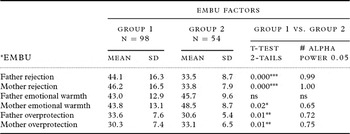
Descriptive statistics (Mean, SD for Group 1 and Group 2) and t-test respective to alpha power for Group 1 versus Group 2 in scores of EMBU factors

*Note: Coding/answer alternatives for EMBU are; `No, never´ (1); `Yes, but seldom´ (2); `Yes, often´(3); `Yes, most of the time (4). Group 1 n=98 Finnish refugees; Group 2 n=54 Finnish children living in Finland during 1939–1945. #Alpha power = 0.05, 2-tailed, to test the nil hypothesis for variances (t-test) by samples. Sign: * = P < 0.05; ** = P < 0.01; ***P < = 0.000; ns = not significant.
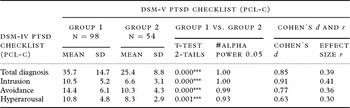
Descriptive statistics (Mean, SD for Group 1 and Group 2) and t-test with respect to α for Group 1 versus Group 2 in scores of DSM-IV Post Traumatic Stress Disorder Checklist (PCL-C) Total diagnosis, Intrusion, Avoidance and Hyperarousal with calculated value of Cohen's d and the effect size r using the means and standard deviations of the two groups (n = 98 and n = 54)

Items range from “Not at all” (1) to “Extremely” (5) for DSM-IV Post Traumatic Stress Disorder Checklist (PCL-C) in Group 1 n = 98 Finnish refugees; Group 2 n = 54 Finnish children living in Finland during 1939–1945. #Alpha Power = 0.05, 2-tailed, to test the nil hypothesis for variances (t-test) by samples.
Sign: ***P < = 0.000.
Correlation coefficients (Pearson, two-tailed) between Post Traumatic Stress Disorder Checklist (PCL-C) Total diagnosis, Intrusion, Avoidance, Hyperarousal and EMBU Father rejection and EMBU Mother rejection for Group 1 Finnish refugees (n = 98) and Group 2 Finnish non-refugees (n = 54) living in Finland, 1939–1945

ns = not significant; * = P < 0.05; ** = P < 0.01; *** = P < 0.001. Group 1 Finnish refugees n = 98; Group 2 Finnish non-refugees n = 54 living in Finland during the war 1939–1945. Note: Items range from “Not at all” (1) to “Extremely” (5) in the Post Traumatic Stress Disorder Checklist (PLC-C) while items in EMBU range from “No, never” (1) to “Yes, most of the time” (4).
The dyadic issue of parental rearing was examined (Table 1) by using the EMBU scale factors of Father Rejection, Mother Rejection, Father Emotional Warmth, Mother Emotional Warmth, Father Overprotection and Mother Overprotection. Finnish evacuees experienced higher levels of parental rejection in childhood in combination with lower emotional warmth in parental rearing, as well as more parental overprotection compared to control subjects. Consequently, the results indicate a possible link between early experiences of relational trauma and individual vulnerability among Finnish evacuees, while the quality of attachment between parental figure and child with Emotional Warmth in parental rearing is normal among non-evacuees.
Compared to non-evacuees, Finnish refugees exhibit a significantly higher level of PTSD on the PTSD Checklist (PCL-C) Total diagnosis, Intrusion, Avoidance and Hyperarousal as an outcome effect of parental rejection in early childhood (Table 3). Consequently, one goal of the study was to test the null hypothesis that the two population means are equal. The criterion for significance (α) has been set at 0.05. The test is two-tailed, which means that an effect in either direction will be interpreted. With sample sizes of 98 and 54 for the two groups, the present study had power of 99.7% to yield a statistically significant result on the PTSD Checklist (PCL-C) Total diagnosis. This computation assumes that the mean difference is 10.3 (corresponding to a mean of 35.7 versus 25.4) and the common intragroup standard deviation is 12.9 (based on SD estimates of 14.7 and 8.8). This effect was selected as the smallest that would be important to detect, in the sense that any smaller effect would not be of clinical or substantive significance. It is also assumed that this effect size is reasonable, in the sense that an effect of this magnitude would be anticipated in this field of research. A second goal of the study was to estimate the mean difference between the two populations. On average, a study of this design would enable reporting of the mean difference with a precision (95.0% confidence level) of +/− 4.32 points. For example, an observed difference of 10.3 would be reported with a 95.0% confidence interval of 5.98–14.62. The precision estimated here is the median. Precision will vary as a function of the observed standard deviation (as well as sample size) and will be narrower or wider than this estimate in any single study. The computational option is variance-estimated (t-test).
Stipulated Post Traumatic Stress Disorder Checklist (PCL-C) scoring is (i) < 44 for a civilian population; (ii) 45–50 for a military population; and (iii) >51 for a population experiencing rape. The following distribution of scoring categories was identified among Finnish evacuees [n = 98] versus Finnish non-evacuees [n = 54]: (i) 63.3% vs. 98.1%; (ii) 16.3% vs. 0%; (iii) 20.4% vs. 1.9%.
Correlation coefficients (Pearson, two-tailed) were calculated between the EMBU factors Father rejection and Mother rejection and the DSM-IV Post Traumatic Stress Disorder Checklist (PCL-C) in order to reveal significant correlations for the test group subjects and non-significant correlations for control subjects (Total diagnosis n = 98 Father 0.41***, Mother 0.35*** vs. n = 54 Father ns, Mother ns; Intrusion n = 98 Father 0.31***, Mother 0.24** vs. n = 54 Father ns, Mother ns; Avoidance n = 98 Father 0.47***, Mother 0.47*** vs. n = 54 Father ns, Mother ns; Hyperarousal n = 98 Father 0.28**, Mother 0.24** vs. n = 54 Father ns, Mother ns).
The odds ratio of exposure to DSM-IV Checklist (PCL-C) Total diagnosis was also calculated and revealed a 10.6 higher relative risk for Finnish evacuees (test group subjects) for this specific disease compared to Finnish non-evacuees without this disease (control subjects).
Discussion
The study evaluates the evidence and draws conclusions about long-term PTSD outcomes associated with parental separation and trauma which can occur within the caregiving system. The aim of the study was to investigate the long-term effect of trauma exposure among test group subjects of Finnish adult evacuees and compare the outcome effect with a control group of Finnish non-evacuees. The results of the study confirm the following hypotheses (i) subjects with high scores on measures of EMBU parental rejection would also score high on measures of DSM-IV PTSD Checklist (PCL-C); (ii) findings would be consistent across all measures of DSM-IV Checklist (PCL-C) Total diagnosis, Intrusion, Avoidance, Hyperarousal, independent of the kind of relationship taken into account; (iii) Finnish refugees would show higher significant correlations between memories of parental rejection in childhood and measures of DSM-IV Checklist (PCL-C) Total diagnosis, Intrusion, Avoidance and Hyperarousal compared with corresponding results for control subjects; (vi) the Odds Ratio would indicate a significant higher risk factor among exposed subjects (test group) compared to non-exposed subjects (control group); (v) consequently, results would support Bowlby's construct of Attachment Theory due to the development of an individual vulnerability among exposed subjects (test group) compared to non-exposed subjects (control group).
The present investigation is based on two retrospective self-report questionnaires: (i) the EMBU, reflecting experiences of parental rearing, the relevance of which has been highlighted in other studies (Gerlsma, Reference Gerlsma, Perris, Arrindell and Eisemann1994; Arrindell, et al., Reference Arrindell and Perris2000), and (ii) the Post Traumatic Stress Disorder Checklist (PCL-C), a relevant measure in settings of high rates of current PTSD (Weathers, et al., Reference Weathers, Litz, Herman, Huska and Keane1993; Blanchard, et al., Reference Blanchard, Jones-Alexander, Buckley and Forneris1996; Andersson, Reference Andersson2010). The introduction to this paper gives an account of the feasibility of, and consensus about, parental rearing on the development of emotional disorders. Perceptions of dysfunctional rearing with respect to the EMBU factors of Father Rejection and Mother Rejection contributed mostly to identifying power among Finnish evacuees. As was the case with other investigations on war children (Lagnebro, Reference Lagnebro1994; Kuwert, et al., Reference Kuwert, Spitzer, Träder, Freyberger and Ermann2007; Pesonen, et al., Reference Pesonen, Raikkonen, Heinonen, Kanantie, Forsen and Erikson2007) and Vietnam veterans (Schlenger et al., Reference Schlenger1992), the prevalence of a high level of Post Traumatic Stress Disorder among Finnish evacuees is supported by evidence in the present study.
There are three major findings in this study, 65 years after the end of the Second World War II. First, there is significant support for Bowlby's theory of parental deprivation – including experiences of rejection on the EMBU scale – suggesting a link between childhood parental separation and termination of the internalized attachment hierarchy of origin. According to Bowlby, evidence for deactivation of attachment behavior, i.e. detachment, might lead to a path of different types of psychopathology. However, note that Bowlby's classification of affectionless psychopaths is not appropriate in this context, because 89% of test group subjects had lived in close relationships with their attachment figure for more than 10 years. The corresponding level among control subjects was 90%. Second, we show mental holocaust trauma of Finnish evacuees due to separation of parental origin. Third, the Post Traumatic Stress Disorder Diagnosis Total on the PCL-C version was identified for 36.7% of test group subjects indicating affect dysregulation and disorders of the self (Schore, Reference Schore2003).
Analysis of results
Results extrapolated for the entire population of Finnish evacuees in the light of the alpha power outcome of the study (0.99) offer the following scenario. From a total population (N = 70,000) of Finnish children who came to Sweden during World War II, there would be 1,141 evacuees (1.63%) who would meet the same PTSD scoring levels as American soldiers from the Vietnam war. When the corresponding calculation is made for the population experiencing rape, 1,428 evacuees (2.04%) would meet the stipulated scoring level of PTSD. Taken together, the incident rate of 2,569 children of Finnish evacuees (N = 70,000) would exhibit a significant level of stipulated Post Traumatic Stress Disorder Checklist (PCL-C) scoring, corresponding to a military population of Vietnam veterans score of 45–50 while those in the cohort experiencing rape would score >51 compared to non-evacuees.
There is a satisfactorily high alpha power outcome among test group subjects due to lack of caring in parental rearing on the factors Father Rejection 0.99 and Mother Rejection 1.00, indicating high levels of emotional abuse, insult, insinuation and criticism that engender low self-esteem in children and inability to judge a situation realistically. At the same time, the late group experienced deprivation, i.e. loss of emotional warmth and caring. There were significant differences on the symptom of C3 Inability to recall important aspects of the trauma (MD 2.5, SD 1.4 versus MD 1.6, SD 1.1; t-test [2-sided] 0.000***; with alpha power 0.05 calculation, 2-tailed, reaching 0.98), and with identified value of Cohen's d = 0.71 and effect-size r = 0.34 for test group and control subjects in the positive predicted direction. Owing to displacement, evacuated Finnish children had lost their primary attachment figure and been subject to the effects of privation in dysfunctional family backgrounds in Sweden. They had no survival strategy other than living with their own fear of rejection. The trauma of war children in the World War II led to permanent consequences in adult life.
Childhood as a symbolic inner representation was, by forced displacement with loss of parental figures of origin and a detachment process with lack of parental emotional warmth rearing (Bowlby, Reference Bowlby1980), replaced by a mental holocaust scenario due to (1) generational collapse, (2) generational linking, (3) perforation and (4) space creation (Kaplan, 2003; Kaplan and Modell, Reference Kaplan and Modell2008). These mechanisms became a violation of the self in Finnish evacuees (Schore, Reference Schore2003) and are very similar to the mechanisms identified in Jewish children who came to Sweden from Nazi concentration camps. For example, generational collapse reflects experiences of forced displacement in the evacuation to Sweden, with loss of parental figures of origin, loss of spoken language, and loss of family history. Generational linking can be understood as an idiosyncratic inner dialogue between self and ego to change cognitive distortions, i.e. a process of resilience based on Kaplan's concepts of perforation of self and space creation. In interpreting the item “Do you have a sense of a foreshortened future?” one has to remind oneself that not children, but evacuees around 70 years old, are answering the question. Evidence corroborates perforation as a destruction of sense of age among Finnish evacuees, but not for non-evacuees living in Finland during the war in 1939–1945 (MD 1.8, SD 1.1 versus MD 1.4, SD 0.8; t-test [2-sided] 0.03*; with alpha power 0.05 calculation, 2-tailed, reaching 0.65). The answer to the question reflects a childhood of young selves who experienced the trauma, but who today are not able to differentiate age as retired adults recalling the memory of trauma. On the other hand, a self among adult non-evacuees seems able to differentiate between childhood self and adult self, while quite the reverse is true for Finnish evacuees who as adults remember their current working self as a child.
The construct of space creation or strategies for survival – in line with Kaplan's frame of reference above – is a process of resilience at the boundary between consciousness of trauma events and consciousness about what happened in the past. Space creation has the function of a metaphoric window between feeling, memory and knowing. However, the evidence supports a mental effort based on past memories for re-categorizing within space creation, i.e. strategies of survival on the Post Traumatic Stress Disorder Checklist (PCL-C) Diagnosis Avoidance, with identified significant differences between test group and control subjects (MD 14.4, SD 6.1 versus MD 10.3, SD 4.3; t-test [2-sided] 0.000*** with alpha power 0.05 calculation, 2-tailed, reaching 0.99). A successful idiosyncratic work of the self within the Avoidance diagnosis seems to have had the function of a survival strategy in combination with a parallel process for space creation among evacuees. Children's experiences of a childhood with emotional warmth in parenting are of crucial importance for their future psychological development. Cross-fertilization between the conceptualization of Kaplan's theory about extreme traumatization and affect regulation – used as analysis tools – and Bowlby's theory of deprivation has identified a detachment process in Finnish evacuees that promotes defensive exclusion. In its earlier developmental phase, defensive exclusion is supported by evidence for experiences of parental figures that have not responded to children's attachment behavior when it is strongly aroused, and therefore were terminated. At the same time, it is also possible to identify an adaptive process in adults by which the deactivation of attachment behavior is released by space creation with fewer pathological internal working models of processing.
Gilman emphasizes the need to overcome threats to causal inference (Gilman, Reference Gilman2007) in the framework of life course epidemiology and developmental psychopathology. The assessment of causality between exposure and disease are supported by the strength of the association for Finnish evacuees (OR 10.6). An important condition in this connection is the fact that the sequence of the events of parental separation of origin has preceded the effect of disease. Additionally, evidence makes clear statements on the development of concentration difficulties (OR 14.0) and hyperarousal (OR 7.8) among evacuees over their life-time. The association is also consistent with what is generally known about the occurrence of PTSD: its history, psychopathology and findings do not conflict with Attachment Theory due to its functioning as a comprehensive theoretical frame of reference. Parental separation seems to be a traumatic stressor as shown by the sound evidence of this study.
The results of the present report should be interpreted in the context of several limitations. The findings partly rest on retrospective reports of perceived caring of parental figures that might raise questions about low reliability and bias in current data. Gerlsma (Reference Gerlsma, Perris, Arrindell and Eisemann1994) demonstrated results with respect to memories of perceived parental rearing behavior to be quite stable and unbiased. The question of small sample sizes in general concern convenience (non-random) samples and are judged to be non-representative for an entire population. Nevertheless, current convenience working samples are considered significant comparable to a natural disaster during World War II. In the present type of a case-control design, potential confounders are expected to be randomly distributed in the samples under investigation. A case-control study methodology helps overcome this issue.
Owing to a 10.6 odds ratio on the Post Traumatic Stress Disorder Checklist Total Diagnostic category (PCL-C), the research design could confirm an association between exposure and PTSD, i.e. that exposed Finnish evacuees are at higher risk of PTSD than Finnish children living in Finland during the 1939–1945 war. Convincing evidence supported by sufficient power of variances in different sample populations under investigation point to the representativeness of possible variables. Experiences of a disrupted and stolen childhood among Finnish evacuees suggest a link between selves extremely traumatized by detachment and a clinical diagnosis on the Post Traumatic Stress Disorder Checklist Total (PCL-C). Findings that include detection of an unexpected hidden health trauma among Finnish war children have been met by a conspiracy of silence at all levels of society since World War II. Victims/survivors were left alone and voiceless with fragmented memories of traumata (dissociative amnesia) in a society that has not assumed responsibility for the outcome effects of childhood cruelties and atrocities. It is a terrible indictment of twenty-first-century priorities to simply wait for these refugees to disappear from history. Providing knowledge is of critical importance because space creation signifies and facilitates a health process. Applying professional mental health treatment to child refugees who suffer from Post Traumatic Stress Disorder or other psychological problems should be a clinical priority all over the world.
Conflict of interest
None.
Acknowledgments
I thank the Finnish war children who participated in the study. Sincere thanks also go to the chairman and leader of the local Finnish War Child Association on both sides of the Baltic Sea. I acknowledge Kaj Björkqvist, Professor of Developmental Psychology Åbo Akademy University, Campus Vasa, Finland and David Titelman, Associate Professor, National Center for Suicide Research and Prevention of Mental Ill-Health (NASP), Department of Public Health Sciences, Karolinska Institutet, Stockholm, Sweden for their interest in John Bowlby's attachment theory.