INTRODUCTION
Trypanosoma brucei brucei infection in the dog is highly pathogenic (Sayer et al. 1979; Kaggwa et al. 1984) and constitutes a major health threat for dogs in South-eastern Nigeria (Omamegbe et al. 1984; Anene and Omamegbe, 1987). Diminazene aceturate is the first-line trypanocide used for their treatment (Anika et al. 1987) but the effectiveness of therapy has been largely unsatisfactory due to relapses suffered by a percentage of the animals, which then became even less responsive to diminazene treatment (Kaggwa et al. 1988; Chukwu et al. 1990). The efficacy of diminazene treatment has further diminished over the last few years (Anene et al. 1999) reflecting increased diminazene treatment failure in other domestic animals in Nigeria (Kalu, 1995a; Anene et al. 2001). This underlines the need for an effective alternative chemotherapy against canine trypanosomosis. However, the usual veterinary alternative, isometamidium, has similarly failed in dogs (Kaggwa et al. 1988; Ezeokonkwo et al., unpublished observations) and strains resistant to both diminazene and isometamidium have been isolated from Nigerian cattle (Kalu, 1995b).
Pentamidine is a human trypanocide developed in the 1930s. It is remarkably effective in patients with early-stage T. b. gambiense infection (Pepin and Milord, 1994). Whereas resistance to diminazene aceturate in animals is a rapidly growing problem (Kalu, 1995a; Anene et al. 2001), resistance to pentamidine has been slow to develop in man (Fairlamb et al. 1992; Bacchi, 1993; Bray et al. 2003). Thus, treatment with pentamidine of early-stage African sleeping sickness is not currently endangered by resistance (Kaminsky and Mäser, 2000). This has been attributed to the fact that T. b. brucei accumulates pentamidine through at least 3 different transporters (De Koning, 2001a), whereas diminazene uptake may depend solely on the P2 aminopurine transporter (Matovu et al. 2003; De Koning et al. 2004). This implies that the loss of one non-essential transport activity through a single mutation is sufficient to cause diminazene-resistant trypanosomes that are not cross-resistant to pentamidine (Matovu et al. 2003).
As part of the growing effort to find a better treatment of canine trypanosomosis, and to understand the basis of the current treatment failures, we have thus investigated the comparative trypanocidal efficacy of pentamidine isethionate and diminazene aceturate on a stock of T. brucei isolated from a clinically infected dog, using a rodent model.
MATERIALS AND METHODS
Experimental animals
Thirty-six female albino rats weighing 140–200 g bred within the Faculty of Veterinary Medicine, University of Nigeria, Nsukka were used. They were kept in clean cages in a fly-proof house and were fed and watered ad libitum.
Drugs
Diminazene aceturate (Berenil, Hoechst Roussel Vet limited Cookstown, Tallaght, Dublin) and pentamidine isethionate (Aventis; generous gift from WHO) were dissolved in distilled water just before use. Diminazene aceturate was administered at a dose of 7 mg/kg intraperitoneally as a single dose and pentamidine isethionate at 4 mg/kg intramuscularly daily for 7 days, after appropriate dilution in distilled water to achieve the desired dosages. Diminazene aceturate (99·6%) and antipyrine (phenazone, >99·0%) used in the HPLC determinations were gifts from Intervet, Germany, and the Medicines Testing Laboratories, UK, respectively.
Trypanosome infections
The Trypanosoma brucei stock used, designated UNN001, was isolated from a clinically infected dog that had relapsed following treatment with 2 doses of 7·0 mg/kg diminazene aceturate administered at 2-week intervals. The trypanosomes were maintained in donor rats prior to use. The trypanosome species was identified morphologically using a Giemsa-stained thin film preparation (Soulsby, 1982). The rats were inoculated intraperitoneally, each with 5×10⁵ trypanosomes. The number of parasites was assessed by the method of Herbert and Lumsden (1976).
Experimental design
The rats were randomly divided into 6 groups (groups I–VI) of 6 rats each. Group 1 served as uninfected control while groups II–VI were infected with trypanosomes. Group II acted as the untreated control, Groups III and IV were treated with a single i.p. dose of 7 mg/kg diminazene aceturate on days 7 and 10, respectively, post-infection (p.i.). Groups V and VI were treated with pentamidine isethionate, starting also on days 7 and 10 p.i., respectively, with 4 mg/kg for 7 consecutive days intramuscularly. These doses would certainly be curative against drug-sensitive T. b. brucei. Reported ED50 values for diminazene and pentamidine, using single i.p. administrations in mice are typically 0·22–0·30 mg/kg for diminazene aceturate and 0·22–0·91 mg/kg for pentamidine (e.g. Fairlamb et al. 1992; Berger et al. 1995; De Koning et al. 2000). The lack of response to 7 mg/kg diminazene is widely accepted as an indication of diminazene resistance (Mbwambo et al. 1988; Peregrine, 1991; Anene et al. 1999). The diminazene dose recommended by the manufacturers is 3·5 mg/kg.
The rats were monitored for development of parasitaemia by examination of tail blood smears daily until parasitaemia was established. They were also closely observed throughout the study period for clinical signs and mortality. Packed cell volume (PCV), body weight and parasitaemia were determined on the day of infection and subsequently every seventh day until day 70 p.i. for use in the assessment of the drug's therapeutic efficacy.
PCR amplification of T. b. brucei markers
Blood from infected rats was spotted on to FTA Gene Cards (Whatman) either before or after centrifugation in a haematocrit centrifuge to enrich for trypanosomes, in order to preserve DNA samples for analysis. For PCR analysis, a 1·2 mm disk was cut out from the card using a Harris micro-punch and washed 3 times with 200 μl of FTA purification buffer (Whatman) and twice with TE buffer according to the manufacturer's instructions. PCR conditions using the air-dried filter disk were 4 min at 94 °C followed by 30 cycles at 94 °C (30 s), 50 °C (30 s) and 72 °C (60 s) followed by 7 min at 72 °C. The reaction volume was 25 μl, in 4·5 mM Tris HCl (pH 8·8), 1·1 mM (NH4)2SO4, 0·45 mM MgCl2, 13 μg/ml BSA, 0·44 μM EDTA and 0·1 mM each of dATP, dCTP, dGTP and dTTP. Specific primers for the identification of T. brucei group trypanosomes (TBR; based on satellite sequences identified by Masiga et al. (1992)) and T. b. gambiense specific (TgsGP; Radwanska et al. 2002) were as follows: TBR-F-5′ TGC GCA GTT AAC GCT ATT ATA CA-3′; TBR-R-5′AAA GAA CAG CGT TGC AAA CTT-3′; TgsGP-F-5′GCT GCT GTG TTC GGA GAG C-3′; TgsGP-R-5′GCC ATC GTG CTT GCC GCT C-3′ and Taq DNA polymerase (Promega) was used.
HPLC analysis of diminazene quality
Samples of commercially available diminazene preparations were analysed for the content of diminazene and antipyrine by reversed phase HPLC using the method of Atsriku et al. (2002). Chromatographic separations were performed at ambient temperature on a Lichrospher® 60 RP-select B column (125×4 mm i.d.), 5 μm particle size. The mobile phase (acetonitrile-methanol-ammonium formate buffer (20 mM, pH 4·0) (10[ratio ]10[ratio ]80 v/v/v)) was delivered at a flow rate of 0·7 ml/min. Analytes were monitored at 254 nm and the data acquired and analysed using Chromquest® Version 2.51 (1999) software.
Statistical analysis
The results of the study were statistically analysed using SPSS 9.0 software package by the application of Analysis of Variance (ANOVA) and Duncan's multiple range tests.
RESULTS
Clinical treatment of trypanosome-infected dogs
Trypanosome-infected dogs presented at the University of Nigeria Veterinary Teaching Hospital (UNVTH) are usually treated with 2 doses of 7·0 mg/kg diminazene aceturate with a 2-week interval. In one instance, 8 out of 12 (67%) cases of trypanosomosis in Alsatians so treated relapsed and died within 1–6 weeks of the initial treatment or developed central nervous system derangement and died 1–7 days after treatment. On account of this, isometamidium chloride was used for treatment in another 6 trypanosome-infected Alsatian dogs. This therapy was also characterized by high rates of relapses (4 out of 6 or 67%).
Assessment of diminazene quality
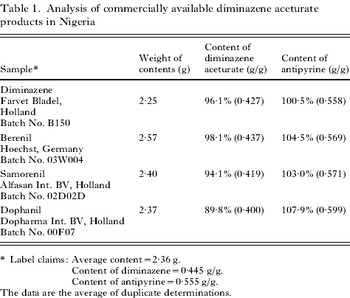
To test whether the high failure rate with diminazene aceturate was attributable to sub-standard quality of the commercial preparations available, samples were analysed by HPLC, using the method of Atsriku et al. (2002). The excipient antipyrine was present to at least 100% of stated content in all 4 preparations analysed. However, 2 of the preparations analysed contained less than 95% and less than 90% of the stated active ingredient, respectively (Table 1). In spite of this failure to comply with accepted labelling standards, however, treatment failure could not be attributed to deficiencies in quantity of drug administered.

Experimental treatment of rats infected with dog-isolated T. b. brucei
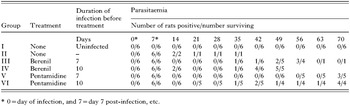
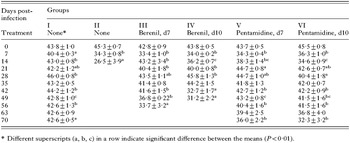
Following infection, trypanosomes were detectable in the blood of rats 4–5 days p.i. The untreated control rats died due to infection within 11–16 days p.i. except 1 rat that survived for 35 days p.i. (Table 2). For the berenil-treated rats (groups III and IV), trypanosomes disappeared from the rats' blood within 48 and 120 h, respectively. For the pentamidine-treated rats (groups V and VI), pentamidine isethionate gave complete clearance of parasites from the blood of the infected rats within 72 or 96 h of the start of treatment. There were relapse parasitaemias in both groups III and IV by days 35 p.i. (days 28 and 25 respectively, after treatment) (Table 2). The relapse rate reached 33·3% and 100%, respectively, for groups III and IV by day 49 p.i. and that of group III increased to 83% by day 70 p.i. when the experiment ended. For the pentamidine-treated rats, only group VI relapsed by day 35 p.i. (day 25 after treatment). By day 70 p.i. both groups V and VI recorded relapse rates of 50% and 100%, respectively. Three mortalities occurred in the pentamidine-treated rats and were not associated with recrudescence of parasitaemia. One of the deaths was recorded in group V by day 56 p.i. while the other 2 occurred in group VI on days 21 and 49 p.i., respectively. Before death, symptoms exhibited were neurological signs i.e. loss of balance and torticollis. The infection caused a significant fall in PCV by day 7 p.i. (Table 3). This fall in PCV was sustained in all infected groups up to day 14 p.i. except groups III and V treated 7 days p.i. By day 21 p.i., the PCV of all infected and treated groups was restored to normal. The relapse infection recorded in groups III and IV caused a further fall in PCV by days 49 and 42 respectively. The fall in PCV was also noted for groups V and VI by day 70 p.i.


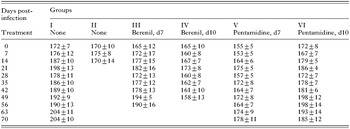
Generally, the infected and treated groups recorded progressive weight gains similar to the untreated control (group 1) whereas weight loss (most evident in groups IV) characterized infections and relapses (Table 4).
Table 4. Weight (kg) (mean±S.D.) of Trypanosoma brucei-infected rats treated with berenil or pentamidine (The weight of individual rats was measured every week post-infection until all the animals in the group were dead (blank boxes) or until the end of the experiment at day 70 p.i.)

Confirmation of subspecies
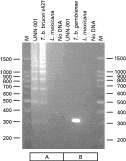
The demonstration of diminazene/pentamidine cross-resistances in a clinical sample is exceedingly rare and it is of obvious importance to verify the exact trypanosome species in UNN-001, initially classified as T. b. brucei on the basis of microscopical observations. To the authors' knowledge, there have been no well-documented clinical cases of pentamidine resistance (as opposed to treatment failure) in T. b. gambiense or T. b. rhodesiense, with resistance confirmed in isolated trypanosomes. Given the geographical origin of the isolate under study in the present study the species would be T. b. gambiense, if human infective. We therefore extracted DNA, preserved on Whatman FTA Gene Cards, of these trypanosomes and submitted them to a series of PCR reactions with primer sets specific for T. b. brucei satellite repeats (TBR; Masiga et al. 1992) and the T. b. gambiense-specific glycoprotein TgsGP (Radwanska et al. 2002). Genomic DNA preparations of T. b. brucei strain 427 and T. b. gambiense strain Eliane served as positive controls and similar preparations of Leishmania mexicana genomic DNA and reactions without added DNA served as negative controls. The Eliane strain was isolated from a human patient in Ivory Coast in 1952 and confirmed as T. b. gambiense subspecies by Tait et al. (1984) on the basis of enzyme typing. The specificity of the primer sets was confirmed, with gDNA isolated from s427 being negative with the TgsGP primers and TBR primers unable to amplify from Eliane DNA (not shown).
Fig. 1A, shows the PCR products using the TBR primers. The UNN-001 isolate gave an identical banding pattern as genomic DNA isolated from T. b. brucei s427, whereas the controls with L. mexicana and without DNA were negative. Using the TgsGP primers, only the Eliane strain was positive, with a slightly larger than 300 bp fragment, as reported by Radwanska et al. (2002), whereas UNN-001 and controls were negative (Fig. 1B). UNN-001 isolates from 3 different rats gave identical results.

Fig. 1. PCR amplification of genomic DNA isolated from blood of infected rats. Primers used were TBR (lanes A) or TgsGP (lanes B) and conditions as described in the Materials and Methods section. Markers (M) are indicated with sizes in bp.
DISCUSSION
In many parts of Africa, the successful treatment of animal trypanosomosis is increasingly threatened by drug resistance (Anene et al. 2001; Geerts et al. 2001; Matovu et al. 2001). However, in some cases the reports of treatment failure are anecdotal and it is unclear whether all incidences of failure reflect real resistance based on adaptations by the parasite. A firm conclusion requires the isolation of the parasite and assessment of drug sensitivity under laboratory conditions.
Amid a general trend of diminazene treatment failures in livestock in Nigeria, success rates for canine trypanosomosis treatment in Nsukka, Nigeria, have fallen sharply in the last few years, due to apparent resistance to the first-line treatment with diminazene aceturate. In the current study we investigated (1) whether the treatment failures reflect true drug resistance, (2) whether the human diamidine drug pentamidine isethionate could be an alternative treatment for diminazene-refractory domestic animals and (3) the (sub)species of the drug-resistant trypanosomes.
As discussed by Geerts et al. (2001) treatment failure may result from causes other than drug resistance, including under-dosing, poor drug quality and rapid re-infection with short-acting therapeutic agents such as diminazene aceturate. To exclude the possibilities of under-dosing and poor drug quality, samples of commonly used diminazene preparations were analysed. Even though 2 out of 4 preparations contained less active substance than indicated on the product label, it was concluded that under-dosing and drug quality were not the cause of diminazene aceturate treatment failures observed at the University of Nigeria, Nsukka Veterinary Teaching Hospital (UNVTH).
Isolation of trypanosomes from a dog relapsed after diminazene treatment and treatment of this strain in infected rats confirmed that the strain was indeed resistant to a standard diminazene aceturate dose of 7 mg/kg. Relapse rates were 100% when treatment was initiated after 10 days, and even in the 7 days p.i. group 83% of the rats relapsed. Since treatment of trypanosome-infected dogs with other veterinary trypanocides had been unsuccessful in UNVTH, we wanted to test whether pentamidine would be able to cure the experimental infection in rats. There has been considerable debate in the literature about cross-resistance between aromatic diamidines (Barrett and Fairlamb, 1999; De Koning, 2001b; Bray et al. 2003; Matovu et al. 2003). It has been demonstrated that whereas diminazene aceturate is accumulated by T. b. brucei almost exclusively through the TbAT1 aminopurine transporter (Matovu et al. 2003; De Koning et al. 2004), pentamidine resistance would require the loss of multiple transporter activities (De Koning, 2001a; Bray et al. 2003; Matovu et al. 2003), making cross-resistance with diminazene possible but not necessary, and it has been postulated that T. b. brucei refractory to berenil may be successfully eliminated by pentamidine (Bacchi, 1993). However, the strain used in the current study does appear to be cross-resistant to pentamidine, in that the standard treatment protocol used for humans produced only slightly improved results compared to diminazene. A theoretical alternative explanation might be that the UNN-001 strain reaches extravascular compartments such as the central nervous system much more quickly than is usual, before the commencement of treatment on day 7. This would shield a proportion of the parasite population from treatment with diamidines.
Most critical in the chemotherapy of T. brucei infections is the late-stage disease (Kaggwa et al. 1984; Anene et al. 1989; Chukwu et al. 1990). In this study, treatment could not be delayed until 14 days p.i. (Jennings et al. 1979) because an acute disease ensued, necessitating early chemotherapeutic intervention. Neither treatment at 7 nor 10 days p.i. with either the standard dose of berenil or pentamidine was effective as relapse infections were recorded for both trypanocides. Scope for increased dosing to enhance cure rates may exist for berenil (rats can tolerate up to 40 mg/kg) (Kalu, 1995a), but pentamidine appears to be toxic at the dose used. This is in view of the mortalities recorded in the pentamidine-treated rats, which were not associated with trypanosome infections. This study also provides evidence to support previous reports that the earlier the treatment, the higher the cure rates (Jennings et al. 1977). While the strain used in this study was identified as T. b. brucei and therefore not human infective, a recent report described T. brucei isolates from cattle in Nigeria that were resistant to isometamidium, diminazene aceturate and human serum (Kalu, 1995b). Resistance to pentamidine was not investigated in this study. Further investigations of the levels of drug resistance and zoonotic potential of animal trypanosome stocks are urgently required.
We thank Dr Jean Jannin of the World Health Organization (WHO) for donating the pentamidine isethionate used for this study through the WHO's agreement with Aventis.