1 Introduction
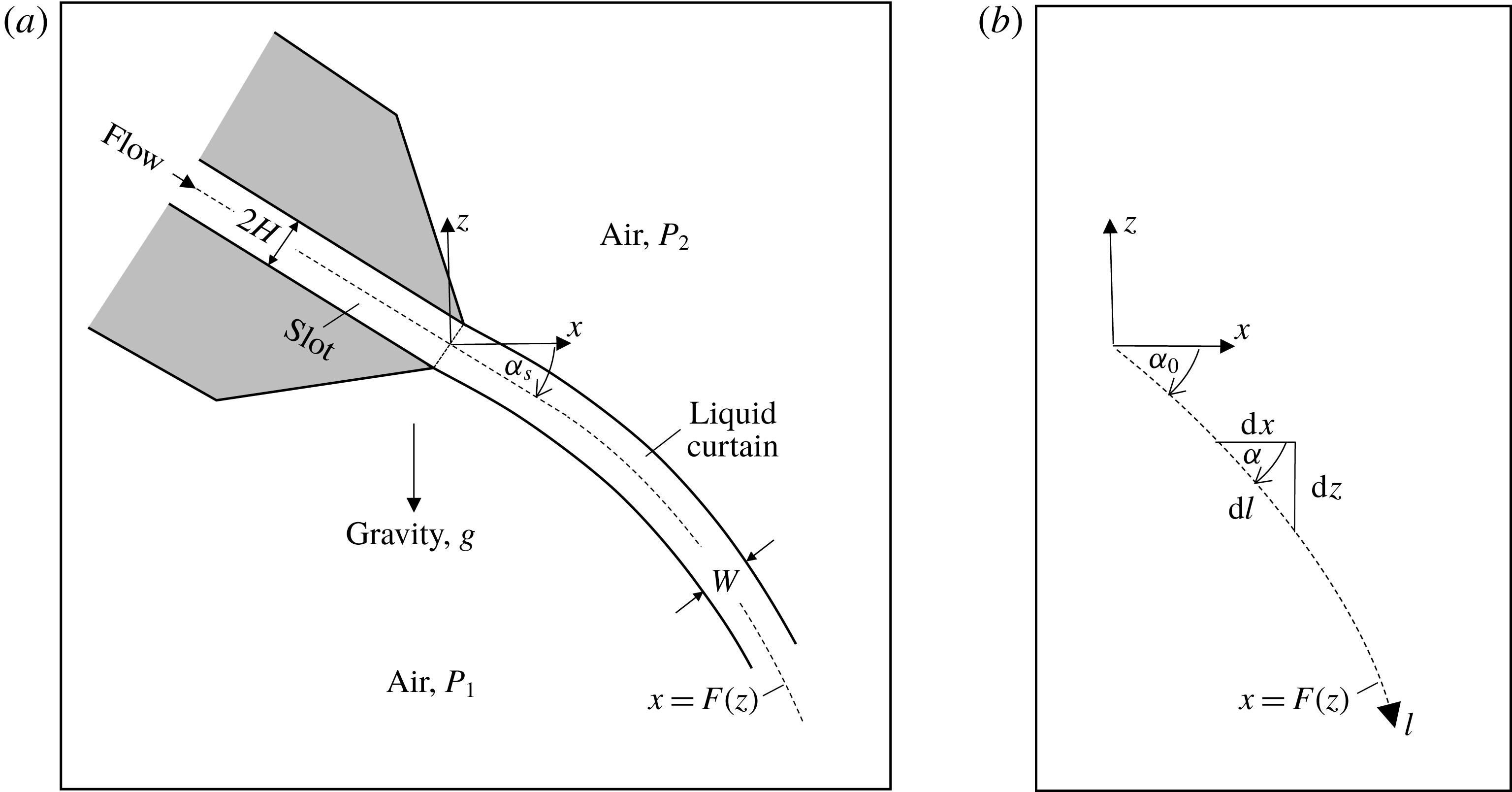
Planar liquid sheets are essential to industrial curtain coating processes (Weinstein & Ruschak Reference Weinstein and Ruschak2004). In such processes, a curtain typically emanates from a coating die, which in simplest form is a vertical slot with a rectangular cross-section that is wide and thin. Curtains thin further in the direction of flow as gravity accelerates fluid elements. Because curtains are thin, and more specifically because the characteristic lengths are much greater than the curtain thickness, the equations governing the liquid flow may be simplified significantly. Recently, Benilov (Reference Benilov2019) used asymptotic methods to derive equations that describe the flow of a widthwise-invariant curtain and analysed configurations in which the die slot is not vertical. Figure 1(a) is a sketch of Benilov’s configuration using his coordinate system notation. Benilov’s time-dependent solutions are valid for large deflections, and he provides high-viscosity equations in arclength coordinates valid under steady-state conditions. Interestingly, his high-viscosity equations do not depend on viscosity in the relevant limits; surface tension and inertia determine the curtain trajectories. A key dimensionless parameter for characterizing such flows is the slot Weber number,
 $\mathit{We}_{0}=\unicode[STIX]{x1D70C}qu_{0}/2\unicode[STIX]{x1D70E}$
, where
 $\unicode[STIX]{x1D70E}$
is the surface tension,
 $\unicode[STIX]{x1D70C}$
is the liquid density,
 $u_{0}$
is the average speed at the slot, and
 $q$
is the volumetric flow rate per width in the curtain. For configurations in which a fluid emanates from a downward-facing slot that is inclined to the vertical and
 $\mathit{We}_{0}<1$
, Benilov predicts curtain shapes that bend upwards against gravity. Such shapes are also predicted in the much earlier inviscid analysis of liquid curtains by Keller & Weitz (Reference Keller and Weitz1957) for
 $\mathit{We}_{0}<1$
conditions.
Definition sketch of the curtain geometry. (a) Coordinate system and key geometric variables, showing a slot whose centreline is inclined with angle
 $\unicode[STIX]{x1D6FC}_{s}$
, where as drawn,
 $\unicode[STIX]{x1D6FC}_{s}<0$
. It is assumed that there is no flow or curtain thickness variations in the
 $y$
direction, which is oriented into the figure. In the figure,
 $W$
is the local thickness of the curtain measured perpendicular to the centreline,
 $2H$
is the height of the slot, and
 $x=F(z)$
is the parameterization of the curtain centreline. The ambient pressures on each side of the curtain,
 $P_{1}$
and
 $P_{2}$
, are constants. (b) Relationship between the curtain centreline parameterization,
 $x=F(z)$
, the arclength coordinate,
 $l$
, and surface angle,
 $\unicode[STIX]{x1D6FC}$
. The angle of the curtain centreline at the slot is denoted as
 $\unicode[STIX]{x1D6FC}_{0}$
, where as drawn,
 $\unicode[STIX]{x1D6FC}_{0}<0$
,
 $\text{d}x>0$
and
 $\text{d}z<0$
. The coordinate system is chosen to be consistent with that of Benilov (Reference Benilov2019).

In previous work, Finnicum, Weinstein & Ruschak (Reference Finnicum, Weinstein and Ruschak1993) examined the effect of a constant pressure drop on a liquid curtain thinning under the influence of gravity and emanating downwards from a downward-facing vertical slot. This configuration corresponds to the case in which the slot inclination angle,
 $\unicode[STIX]{x1D6FC}_{s}$
, is
 $-\unicode[STIX]{x03C0}/2$
, as shown in figure 1(a). Finnicum et al. (Reference Finnicum, Weinstein and Ruschak1993) assume that the curtain flow is inviscid, which is supported by the experiments of Brown (Reference Brown1961) and Clarke et al. (Reference Clarke, Weinstein, Moon and Simister1997). This assumption is also supported by an examination of G. I. Taylor’s equation (the equation is found in the appendix of Brown (Reference Brown1961)) in Weinstein et al. (Reference Weinstein, Clarke, Moon and Simister1997). Like Benilov, Finnicum et al. (Reference Finnicum, Weinstein and Ruschak1993) derive equations in arclength coordinates that account for large deflections; Finnicum et al. (Reference Finnicum, Weinstein and Ruschak1993) then convert these equations into a single equation in Cartesian coordinates that governs the response of the curtain centreline (
 $x=F(z)$
in figure 1) to a steady difference in pressure applied to the faces of the curtain (i.e.
 $P_{1}\neq P_{2}$
in figure 1). Finnicum et al. (Reference Finnicum, Weinstein and Ruschak1993) validate their theoretical predictions with experiments for both supercritical (
 $\mathit{We}_{0}>1$
) and subcritical (
 $\mathit{We}_{0}<1$
) cases. They find that when the curtain leaves the vertical slot as a supercritical flow, the angle that the curtain centreline makes with the horizontal,
 $\unicode[STIX]{x1D6FC}_{0}$
in figure 1(b), is the same as the angle that the slot centreline makes with the horizontal,
 $\unicode[STIX]{x1D6FC}_{s}$
in figure 1(a). However, when fluid leaves the slot as a subcritical flow, the curtain centreline angle,
 $\unicode[STIX]{x1D6FC}_{0}$
in figure 1(b), does not equal that of the slot,
 $\unicode[STIX]{x1D6FC}_{s}$
. A key feature of the curtain equation is that it is singular where the local Weber number,
 $\mathit{We}=\unicode[STIX]{x1D70C}qu/2\unicode[STIX]{x1D70E}$
, expressed in terms of the free-fall speed,
 $u=(u_{0}^{2}-2gz)^{1/2}$
, equals 1. The specific angle taken by the curtain centreline at the slot,
 $\unicode[STIX]{x1D6FC}_{0}$
, is determined such that the singularity in the curtain is removed. The result is a continuously differentiable curtain shape that traverses the singularity.
Weinstein et al. (Reference Weinstein, Clarke, Moon and Simister1997) derive time-dependent equations for a thinning liquid curtain that emanates from a vertical slot and is subjected to an ambient pressure drop; these equations are derived for small deflections of the curtain centreline from vertical. The equation governing the centreline location is a second-order hyperbolic partial differential equation (PDE), and thus its structure may be deduced by examining the two characteristics that specify the velocity of wave propagation in the curtain. In Weinstein et al. (Reference Weinstein, Clarke, Moon and Simister1997, § IV), the location of boundary conditions in the above-described problem of Finnicum et al. (Reference Finnicum, Weinstein and Ruschak1993) are justified based on the direction of propagation associated with these characteristics. Although the configuration of Finnicum et al. (Reference Finnicum, Weinstein and Ruschak1993) is steady, it must arise through a transient behaviour that follows these characteristics. Weinstein et al. (Reference Weinstein, Clarke, Moon and Simister1997) argue that the location of boundary conditions, even in the steady problem, must thus be consistent with the characteristics of the transient. In the supercritical regime (that is, the case in which
 $\mathit{We}_{0}>1$
), both characteristics specify downward propagation of waves in the curtain from the location
 $z=0$
(figure 1
a); thus, two boundary conditions must be applied in accordance with hyperbolic theory (John Reference John1982). However, in the subcritical regime (that is, the case in which the slot Weber number
 $\mathit{We}_{0}<1$
), only one characteristic specifies downward propagation of waves from the location
 $z=0$
. Thus, only one boundary condition may be applied at that location: namely that the curtain centreline coincides with that of the slot. At the downstream location in the curtain where the local Weber number satisfies
 $\mathit{We}=1$
, one characteristic specifies downward propagating waves, but another is identically zero. Below the
 $\mathit{We}=1$
location in the curtain, both characteristics specify the downstream propagation of waves. Note that the singularity location at
 $\mathit{We}=1$
found in the steady problem of Finnicum et al. (Reference Finnicum, Weinstein and Ruschak1993) is precisely the location in the transient problem where the speed of one of the characteristics switches sign; this delineates the location above which waves may propagate upwards. In this case, a constraint may be applied such that the curtain remains finite at this location. This boundary condition placement and singularity elimination is utilized in the recent analysis of time-dependent liquid curtains (Girfoglio et al.
Reference Girfoglio, De Rosa, Coppola and de Luca2017). A similar structure is found in many thin film problems having subcritical to supercritical transitions in the literature. This is discussed extensively by Weinstein & Ruschak (Reference Weinstein and Ruschak1999), who further examine such transitions in detail through their analysis of rapid dip coating of a thin liquid film onto a substrate withdrawn from a liquid pool.
In what follows, we first demonstrate in § 2 that the high-viscosity system proposed by Benilov (Reference Benilov2019) is identical to that of the inviscid equation of Finnicum et al. (Reference Finnicum, Weinstein and Ruschak1993) for cases where the ambient gas dynamics are neglected and there is no pressure drop across the curtain. In § 3, we examine this equation closely, and propose that one of the two boundary conditions utilized by Benilov at the slot exit is disallowed when fluid exits the slot such that
 $\mathit{We}_{0}<1$
, based on the underlying propagation direction of waves in the curtain (as described above). Consequently, curtain shapes that bend upwards against gravity predicted by Benilov are not physically correct. In § 3, the correct solution is provided. We provide some closing comments on our analysis in § 4.
2 Cartesian representation of the governing equations
The starting point for our analysis is equations (4.2)–(4.6) of Benilov (Reference Benilov2019), which govern the shape of the curtain, and are written here in dimensional form (see figure 1 for definition sketch):
 $$\begin{eqnarray}\displaystyle \frac{\text{d}(uW)}{\text{d}l} & = & \displaystyle 0\end{eqnarray}$$
 $$\begin{eqnarray}\displaystyle u\frac{\text{d}u}{\text{d}l} & = & \displaystyle -g\sin \unicode[STIX]{x1D6FC}\end{eqnarray}$$
 $$\begin{eqnarray}\displaystyle \left(2\unicode[STIX]{x1D70E}-\unicode[STIX]{x1D70C}Wu^{2}\right)\frac{\text{d}\unicode[STIX]{x1D6FC}}{\text{d}l} & = & \displaystyle \unicode[STIX]{x1D70C}gW\cos \unicode[STIX]{x1D6FC}\end{eqnarray}$$
 $$\begin{eqnarray}\displaystyle \frac{\text{d}x}{\text{d}l} & = & \displaystyle \cos \unicode[STIX]{x1D6FC}\end{eqnarray}$$
 $$\begin{eqnarray}\displaystyle \frac{\text{d}z}{\text{d}l} & = & \displaystyle \sin \unicode[STIX]{x1D6FC}.\end{eqnarray}$$
 $u$
is the local speed in the curtain,
 $W$
is the curtain thickness,
 $l$
is the arclength coordinate,
 $\unicode[STIX]{x1D6FC}$
is the angle that the curtain centreline makes with the horizontal,
 $x$
and
 $z$
are the horizontal and vertical coordinates,
 $g$
is the gravitational acceleration,
 $\unicode[STIX]{x1D70E}$
is the constant surface tension of the air–liquid interfaces, and
 $\unicode[STIX]{x1D70C}$
is the density of the liquid. In the derivation of (2.1), the slender curtain approximation is applied, in that the characteristic length of the curtain (in the
 $l$
direction) is assumed to be much larger than
 $W$
. Our goal is to obtain a single equation that governs the curtain centreline
 $x=F(z)$
. We consider appropriate boundary conditions for the resulting equation in § 3 below.
Equation (2.1a
) expresses the fact that mass is conserved and thus the volumetric flow rate per unit width,
 $q$
, is constant. It can be integrated to yield
 $$\begin{eqnarray}uW=q=u_{0}2H.\end{eqnarray}$$
Here,
 $u_{0}$
is the liquid speed and
 $W=2H$
is the thickness of the curtain at
 $x=0$
, assumed to be the same as that of the slot (figure 1). The system (2.1) is strictly valid in a region displaced downstream from the slot, as the loss in viscous traction from the slot leads to a flow rearrangement near the slot that violates the slender curtain assumption. The net effect of the flow rearrangement is a curtain thickness that is different from that of the slot, and this gives rise to an adjusted value of
 $u_{0}$
(Weinstein et al.
Reference Weinstein, Clarke, Moon and Simister1997) appropriate for (2.1). As this assumption does not change the conclusions drawn in this paper, for definiteness we have neglected this effect in (2.2a
).
Dividing (2.1b
) by (2.1e
) to eliminate the arclength coordinate, integrating in
 $z$
, and denoting that the speed of the curtain at
 $z=0$
is
 $u_{0}$
, the result is
 $$\begin{eqnarray}u=({u_{0}}^{2}-2gz)^{1/2}.\end{eqnarray}$$
Multiplying (2.1b
) by
 $\unicode[STIX]{x1D70C}$
and
 $W$
and noting that (2.2a
) applies, we obtain
 $$\begin{eqnarray}\unicode[STIX]{x1D70C}gW=-\frac{1}{\sin \unicode[STIX]{x1D6FC}}\frac{\text{d}(\unicode[STIX]{x1D70C}qu)}{\text{d}l}.\end{eqnarray}$$
Substituting (2.3a ) into (2.1c ) and using (2.2a ) yields
 $$\begin{eqnarray}\left(2\unicode[STIX]{x1D70E}-\unicode[STIX]{x1D70C}qu\right)\frac{\text{d}\unicode[STIX]{x1D6FC}}{\text{d}l}=-\frac{\text{d}(\unicode[STIX]{x1D70C}qu)}{\text{d}l}\cot \unicode[STIX]{x1D6FC}.\end{eqnarray}$$
The following relationships hold based on the geometry in figure 1(b):
 $$\begin{eqnarray}\displaystyle \cot \unicode[STIX]{x1D6FC} & = & \displaystyle \frac{\text{d}F}{\text{d}z},\end{eqnarray}$$
 $$\begin{eqnarray}\displaystyle \frac{\text{d}\unicode[STIX]{x1D6FC}}{\text{d}l} & = & \displaystyle \frac{\displaystyle -\frac{\text{d}^{2}F}{\text{d}z^{2}}}{\displaystyle \left[1+\left(\frac{\text{d}F}{\text{d}z}\right)^{2}\right]^{3/2}},\end{eqnarray}$$
 $$\begin{eqnarray}\displaystyle \frac{\text{d}}{\text{d}l} & = & \displaystyle \sin \unicode[STIX]{x1D6FC}\frac{\text{d}}{\text{d}z},\end{eqnarray}$$
 $$\begin{eqnarray}\displaystyle \sin \unicode[STIX]{x1D6FC} & = & \displaystyle \frac{1}{\displaystyle \left[1+\left(\frac{\text{d}F}{\text{d}z}\right)^{2}\right]}.\end{eqnarray}$$
Equations (2.3c–f ) are substituted into (2.3b ) to yield
 $$\begin{eqnarray}\left(2\unicode[STIX]{x1D70E}-\unicode[STIX]{x1D70C}qu\right)\frac{\displaystyle \frac{\text{d}^{2}F}{\text{d}z^{2}}}{\displaystyle \left[1+\left(\frac{\text{d}F}{\text{d}z}\right)^{2}\right]^{3/2}}=\frac{\text{d}(\unicode[STIX]{x1D70C}qu)}{\text{d}z}\frac{\displaystyle \frac{\text{d}F}{\text{d}z}}{\displaystyle \left[1+\left(\frac{\text{d}F}{\text{d}z}\right)^{2}\right]}.\end{eqnarray}$$
Equation (2.3g ) can be rewritten as
 $$\begin{eqnarray}\frac{\text{d}}{\text{d}z}\left(\left(\unicode[STIX]{x1D70C}qu-2\unicode[STIX]{x1D70E}\right)\frac{\displaystyle \frac{\text{d}F}{\text{d}z}}{\displaystyle \left[1+\left(\frac{\text{d}F}{\text{d}z}\right)^{2}\right]^{1/2}}\right)=0.\end{eqnarray}$$
Equation (2.3h
) is identical to Finnicum et al. (Reference Finnicum, Weinstein and Ruschak1993, equation (7)) (once adjustments to the notation and coordinate system are made) for the case where the pressures on both faces of the curtain are the same (i.e.
 $P_{1}=P_{2}$
in figure 1). Finally, we integrate (2.3h
) to obtain
 $$\begin{eqnarray}\frac{\displaystyle \frac{\text{d}F}{\text{d}z}}{\displaystyle \left[1+\left(\frac{\text{d}F}{\text{d}z}\right)^{2}\right]^{1/2}}=\frac{C}{\left(\unicode[STIX]{x1D70C}qu-2\unicode[STIX]{x1D70E}\right)},\quad u=({u_{0}}^{2}-2gz)^{1/2},\end{eqnarray}$$
where
 $C$
is an integration constant. Equation (2.4) governs the shape of the curtain centreline,
 $x=F(z)$
, and the local thickness of the curtain about the centreline is given by (2.2).
3 Curtain solutions
We focus here on the configuration of the die examined by Benilov (Reference Benilov2019), where the die centreline is angled as shown in figure 1(a), for which
 $\unicode[STIX]{x1D6FC}_{s}<0$
(note that
 $\unicode[STIX]{x1D6FC}$
is negative in the orientation shown in figure 1
b). In this configuration, the distance downwards from the slot is given as
 $-z$
, and in accordance with (2.4), the curtain speed increases in the
 $-z$
direction monotonically. If the curtain exits the slot such that
 $\unicode[STIX]{x1D70C}qu_{0}>2\unicode[STIX]{x1D70E}$
(i.e.
 $\mathit{We}_{0}>1$
), the denominator of the right-hand side of (2.4) is always positive. This corresponds to a supercritical configuration, and in accordance with the discussion of prior literature in § 1, two boundary conditions are applied at the slot exit precisely as stated by Benilov (Reference Benilov2019):
 $$\begin{eqnarray}\displaystyle F & = & \displaystyle 0,\quad \text{at}~z=0,\end{eqnarray}$$
 $$\begin{eqnarray}\displaystyle \frac{\text{d}F}{\text{d}z} & = & \displaystyle \cot \unicode[STIX]{x1D6FC}_{s},\quad \text{at}~z=0.\end{eqnarray}$$
 $\unicode[STIX]{x1D6FC}_{0}$
in figure 1(b), is identical to that at the slot,
 $\unicode[STIX]{x1D6FC}_{s}$
, and the trajectory of the curtain centreline is well posed. Upon application of (3.1b
), the constant
 $C$
is given for the slot centreline orientation in figure 1(a) as
 $$\begin{eqnarray}C=-\left(\unicode[STIX]{x1D70C}qu_{0}-2\unicode[STIX]{x1D70E}\right)\cos \unicode[STIX]{x1D6FC}_{s},\end{eqnarray}$$
(note that the constant
 $C$
can be written generally for any configuration as
 $C=\text{sign}(\sin \unicode[STIX]{x1D6FC}_{s})(\unicode[STIX]{x1D70C}qu_{0}-2\unicode[STIX]{x1D70E})\cos \unicode[STIX]{x1D6FC}_{s}$
). With this constant defined, equation (2.4) can be integrated and the curtain shape is fully defined once the constraint (3.1a
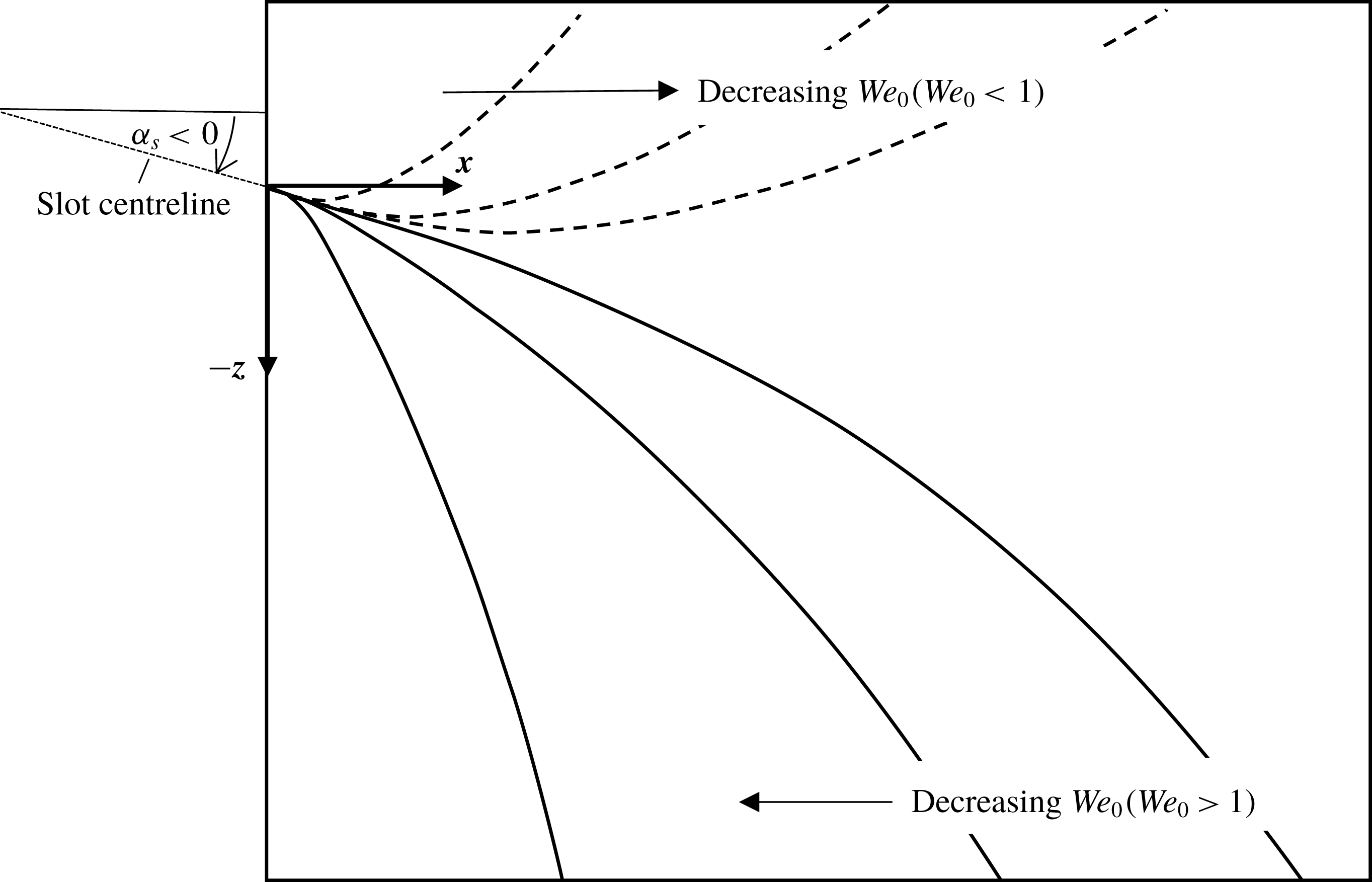
) is applied. This leads to curtain shapes that curve downwards, as predicted in Benilov (Reference Benilov2019); these are shown schematically in figure 2. For cases where the curtain exits the slot with a subcritical flow, characterized by
 $\unicode[STIX]{x1D70C}qu_{0}<2\unicode[STIX]{x1D70E}$
(i.e.
 $\mathit{We}_{0}<1$
), the denominator on the right-hand side of (2.4) has a singularity at the location where
 $\unicode[STIX]{x1D70C}qu=2\unicode[STIX]{x1D70E}$
, as the curtain will accelerate as it moves downwards with increasing
 $-z$
. When Benilov (Reference Benilov2019) considers this case, equation (3.1b
) is applied at the slot as for the supercritical case, utilizing the constant (3.2). The mathematical solution obtained leads to an upward-curving curtain, as shown in figure 2. This finite solution necessarily adjusts to avoid the singularity entirely.
Schematic of curtain centreline solutions of Benilov (Reference Benilov2019),
 $x=F(z)$
, showing the trend in curtain shapes as the slot Weber number,
 $\mathit{We}_{0}$
, is varied. For
 $\mathit{We}_{0}>1$
, curtain centrelines curve downwards (solid curves), and their centrelines move towards the
 $z$
axis. As
 $\mathit{We}_{0}$
is decreased further such that
 $\mathit{We}_{0}<1$
, curtains curve upwards (dashed curves) with the indicated trend. For all shapes shown, the angle
 $\unicode[STIX]{x1D6FC}_{s}$
is imposed at the slot (located at
 $x=z=0$
).

We propose here, in keeping with the prior literature cited in § 1, that the direction of wave propagation does not allow the specification of (3.1b
), and only the boundary condition (3.1a
) may be applied at the slot exit. This leaves the constant,
 $C$
, in (2.4) undetermined at this stage. Finnicum et al. (Reference Finnicum, Weinstein and Ruschak1993) shows that when a fluid exits a slot in a subcritical manner and is exposed to a pressure drop across it, the curtain centreline angle at the slot is different from that of the slot centreline (i.e.
 $\unicode[STIX]{x1D6FC}_{0}\neq \unicode[STIX]{x1D6FC}_{s}$
in figure 1). The angle taken at the slot by the curtain is precisely that necessary to eliminate the singularity in the curtain. Furthermore, the equation of Finnicum et al. (Reference Finnicum, Weinstein and Ruschak1993) has been verified experimentally in both subcritical and supercritical cases when a pressure drop is applied. From symmetry, curtains emanating from a vertical slot with no pressure drop will have a vertical centreline, and that steady solution is admitted by (2.4) with
 $C=0$
. Under such conditions, note that the distinction between subcritical and supercritical flows does not affect the centreline solution.
The above discussion supports the contention that when the slot centreline is angled as shown in figure 1(a) and a curtain exits the die such that
 $\mathit{We}_{0}<1$
, the curtain adopts a path such that the singularity at the location where
 $\unicode[STIX]{x1D70C}qu=2\unicode[STIX]{x1D70E}$
in (2.4) is eliminated. This requires that
 $C=0$
in (2.4) for all subcritical cases. Thus, regardless of the angle of inclination of the slot
 $\unicode[STIX]{x1D6FC}_{s}$
in figure 1(a), the angle that the curtain centreline takes at the slot exit is
 $\unicode[STIX]{x1D6FC}_{0}=-\unicode[STIX]{x03C0}/2$
in figure 1(b). This result is consistent with the structure of the second-order hyperbolic time-dependent equation derived by Weinstein et al. (Reference Weinstein, Clarke, Moon and Simister1997) that governs small deflections of the curtain centreline. Here, we rewrite this equation to reflect the coordinate system in figure 1(a) and with no applied pressure (i.e.
 $P_{1}=P_{2}$
in figure 1
a) as
 $$\begin{eqnarray}\frac{\unicode[STIX]{x2202}^{2}F}{\unicode[STIX]{x2202}t^{2}}-2u\frac{\unicode[STIX]{x2202}^{2}F}{\unicode[STIX]{x2202}z\unicode[STIX]{x2202}t}+u\frac{\unicode[STIX]{x2202}}{\unicode[STIX]{x2202}z}\left(\left[u-\frac{2\unicode[STIX]{x1D70E}}{\unicode[STIX]{x1D70C}q}\right]\frac{\unicode[STIX]{x2202}F}{\unicode[STIX]{x2202}z}\right)=0.\end{eqnarray}$$
In (3.3),
 $u$
is the free-fall velocity given by (2.2b
). The characteristics of this equation satisfy
 $$\begin{eqnarray}\frac{\text{d}z}{\text{d}t}=-u\left(1\pm \frac{1}{\mathit{We}^{1/2}}\right),\quad \mathit{We}=\frac{\unicode[STIX]{x1D70C}qu}{2\unicode[STIX]{x1D70E}},\end{eqnarray}$$
where
 $\mathit{We}$
is the local Weber number, as defined previously. Noting that the
 $-z$
direction is downwards in figures 1 and 2, equation (3.4) indicates that when fluid exits the slot such that
 $\mathit{We}_{0}>1$
, two waves associated with the characteristics move downwards from the slot from
 $z=0$
. However, when the curtain exits the slot such that
 $\mathit{We}_{0}<1$
, equation (3.4) shows that only one wave propagates downstream from the slot, until reaching the location where fluid has accelerated in the curtain such that
 $\mathit{We}=1$
. In the subcritical problem of Benilov (Reference Benilov2019), this hyperbolic structure dictates that only one boundary condition be applied at the slot (i.e. equation (3.1a
)), as there is only one characteristic associated with wave propagation away from the boundary at
 $z=0$
downwards in the curtain. It is natural to apply a second condition at the singularity in the curtain because of the upstream influence of the characteristic associated with that location. This condition sets the constant
 $C$
in the steady equation to be zero, which assures that the curtain falls vertically. Thus, returning to figure 2, the upward-bending curtains (those with dashed lines in the figure) are in fact disallowed, and for any situation where
 $\mathit{We}_{0}<1$
, the curtain centreline is vertical (i.e. coincident with the
 $x=0$
axis in the figure). Physically, what this means is that as the curtain flow is reduced such that
 $\mathit{We}_{0}\rightarrow 1$
from above, the angle of the curtain moves closer to the
 $z$
axis, such that
 $\unicode[STIX]{x1D6FC}_{0}=-\unicode[STIX]{x03C0}/2$
, at
 $\mathit{We}_{0}=1$
. For additional details that support the above conclusions and provide the full mathematical structure surrounding the characteristics of the governing PDE, see Weinstein et al. (Reference Weinstein, Clarke, Moon and Simister1997, § IV).
Although we have argued that upward-curving sheets are not possible in a freely falling curtain, they are theoretically possible if
 $\unicode[STIX]{x1D70C}qu/2\unicode[STIX]{x1D70E}<1$
everywhere in a sheet, provided the downstream portion of the sheet is supported in some way. In a fully subcritical sheet, the two characteristics indicate wave propagation away from each boundary into the curtain – the first from the slot in the downstream direction and the second at the end of the curtain in the upstream direction. Thus, one could place a location boundary condition at each end of such a sheet and thereby hold it in place. Note that Finnicum et al. (Reference Finnicum, Weinstein and Ruschak1993) did report the formation of a fully subcritical falling liquid curtain emanating from a downward-facing vertical slot in their experiments. In those experiments, a curtain could be created by slowly lowering the flow rate in an existing curtain that started in the supercritical regime; such subcritical curtains were sensitive to disturbances and disintegration. In the case of a fully subcritical upward-curving sheet, a careful experimental technique would be needed, as it is not possible to manipulate the location of the bottom of the curtain if it is supercritical. The curtain would need to be fully formed in a subcritical regime and likely would be difficult to maintain.
4 Summary and closing comments
We show that the parametric equations derived in the high-viscosity limit by Benilov (Reference Benilov2019) are identical to those derived by Finnicum et al. (Reference Finnicum, Weinstein and Ruschak1993). Although Benilov predicts upward-curving subcritical curtains in situations where the slot is non-vertical, an alternative solution is that a subcritical curtain falls vertically regardless of slot orientation. The proposed solution is consistent with prior experimental and theoretical literature. This solution is also consistent with the second-order hyperbolic equation of Weinstein et al. (Reference Weinstein, Clarke, Moon and Simister1997) that governs nearly-vertical curtains, where the number of boundary conditions that may be applied must be consistent with the number of characteristics associated with wave propagation away from any boundary. The upward-bending subcritical flow solutions of Benilov (Reference Benilov2019) are a consequence of the slot angle being imposed on the centreline of the curtain at the slot; this constraint is inconsistent with the hyperbolic structure of the curtain flow. Finally, we note that entrance effects in the vicinity of the slot exit have not been considered in this paper. If a fluid appreciably wets the lip of the die, the location of the curtain centreline may be altered from that of the slot exit, and destabilization may occur for curtains that are subcritical at the slot exit. For low-viscosity curtains emanating under conditions of laminar flow, as examined by Finnicum et al. (Reference Finnicum, Weinstein and Ruschak1993) experimentally, entrance effects are not significant in the application of (2.4), as evidenced by the agreement of experiment and theory.