


INTRODUCTION
Thin-walled pottery (ThW) was, along with terra sigillata, the iconic tableware of the Roman Empire. It was first made in northern and central Italy in the early second century BCE in the form of small drinking vessels with rough, unslipped surfaces and simple barbotine decoration. Some scholars interpret its appearance as a continuation of the production of the Iron Age (mid eighth to fifth centuries BCE) pottery imitating metal situlae from north Italy (Marabini Moevs Reference Marabini Moevs1973, 35–45; Mayet Reference Mayet1975, 17; Walker, Hayes and Roberts Reference Walker, Hayes, Roberts, Swaddling, Walker and Roberts1995, 337; Slane Reference Slane and Herbert1997, 349; Kögler Reference Kögler2011, 337; Stone Reference Stone2014, 291). In a recent study, however, Leone (Reference Leone2021, 14–15) rejects this assumption and seeks inspiration for ThW ware production in Etruscan black gloss pottery. Regardless of the origin of its model, the manufacture of ThW ware in the Republican period was also influenced by the Hellenistic ceramic tradition, which is reflected in the shape of some drinking cups, for example, skyphoi (cf. Marabini Moevs Reference Marabini Moevs1973, 37; Stone Reference Stone2014, 291). Italian ThW pottery was produced and distributed throughout the Mediterranean from the mid second century BCE until the end of the second century CE or beyond. From the late first century BCE, it was also produced in regional centres across the Roman Empire (Hayes Reference Hayes2008, 95; Stone Reference Stone2014, 291). Apart from numerous production places in Italy (Gervasini Reference Gervasini and Gandolfi2005, 300–4; Tassinari Reference Tassinari and Gandolfi2019, 100–15; Leone Reference Leone2021, 8–10) and Sicily (Stone Reference Stone2014, 291; Tassinari Reference Tassinari and Gandolfi2019, 115–17, Leone Reference Leone2021, 10), it was also made to the west and north of Italy, namely in Sardinia, the Iberian Peninsula, Gaul, Noricum and Britain (Mayet Reference Mayet1975; Walker, Hayes and Roberts Reference Walker, Hayes, Roberts, Swaddling, Walker and Roberts1995; Hayes Reference Hayes1997, 67; Gervasini Reference Gervasini and Gandolfi2005, 305–6; Krajšek, Bekljanov Zidanšek and Žerjal Reference Krajšek, Bekljanov Zidanšek, Žerjal, Dolenz and Strobbel2019; Tassinari Reference Tassinari and Gandolfi2019, 118–25; Leone Reference Leone2021, 10–12). Some workshops located to the east also introduced this pottery category to their repertoire. These include production centres in Pannonia (Tassinari Reference Tassinari and Gandolfi2019, 124), mainland Greece (Lund Reference Lund, Sørensen and Jacobsen2006, 205; Hayes Reference Hayes1973, 466; Slane and Jones Reference Slane and Jones1980, 171; Slane Reference Slane1986, 291, 312; 1990, 89–93; Lolos Reference Lolos2016; Reference Lolos2019; Reference Lolos2020; Reference Lolos and Blizos2022; Tzavella Reference Tzavella and Lolos2021, 249–51, fig. 5.128), Asia Minor (Japp Reference Japp1999; Kögler Reference Kögler2011; Struber-Ilhan Reference Struber-Ilhan, Reinholdt and Wohlmayr2012), Egypt (Élaigne Reference Élaigne2000, 19; Reference Élaigne2014, 20) and the Levant (Slane Reference Slane and Herbert1997, 349).
In recent years, the production of ThW pottery has also been suggested for Cyprus. This is based on the discovery of a waste deposit excavated at Fabrika Hill in Nea Paphos (Fig. 1).Footnote 1 In addition, excavations in the city’s agora yielded a certain number of ThW vessel fragments characterised by different fabrics and decoration, suggesting that this category of pottery was also imported to Nea Paphos from various production centres. The pottery from both sites in Nea Paphos was subjected to macroscopic and laboratory analyses to characterise it in terms of macroscopic appearance, typology, technology and composition. The goal of this study was to define the local production and identify the origin of the presumed imports in order to understand the place of Nea Paphos in the context of Early Roman production, distribution and consumption of ThW pottery.
Satellite image of the archaeological site of Kato Paphos showing the location of the agora and Fabrika Hill (based on Google Earth).

DEFINITION OF THIN-WALLED WARE POTTERY
ThW vessels are distinctive for the thinness of their walls and include mostly small-sized drinking vessels, but they were made of various fabrics and decorated using various techniques depending on where they were produced. Therefore, different criteria are used in order to define this pottery category (Leone Reference Leone2021, 5). In this study, the classification was based on the thickness of the vessel walls, the shape and the fabric. As most of the studied fragments were undecorated, another potential criterion, namely decoration, which sometimes takes forms specific for the ThW pottery, was rejected (Leone Reference Leone2021, 219–25). The thickness of the walls is usually between 0.10 and 0.25 cm (compare Slane Reference Slane and Herbert1997, 349). However, this category also includes vessels with thicker (up to 0.50 cm; see also Mayet Reference Mayet1975, 3; Struber-Ilhan Reference Struber-Ilhan, Reinholdt and Wohlmayr2012, 175; Japp Reference Japp2015, 154) and thinner (0.05 cm, the so-called eggshell ware; Mayet Reference Mayet1975, 3; Hayes Reference Hayes2008, 96) walls. ThW pottery is characterised by a specific repertoire of forms, mostly representing small vessels intended for drinking, that is, drinking cups, beakers, and mugs.Footnote 2 Exceptionally, recent studies have revealed some rare examples of other, larger forms such as pouring vessels and even lids (Leone Reference Leone2021). The other criterion for classification is fabric, which is usually red/reddish brown and looks like a finer version of cooking ware (or brittle ware). However, there are exceptions to this rule; in some cases, ThW drinking cups are made of very fine buff fabric. Because of this variability, a vessel or a sherd has been assigned to this category if it has at least two of the three characteristics described above.
MATERIAL
The analysed material includes two ceramic assemblages recovered at different excavation sites in Nea Paphos (Fig. 1). The first one, unearthed in the area known as Fabrika Hill (Fig. 2), was excavated in 2011 in one of the rooms (Space 1) of the Early Roman building, excavated on the north slope of the hill (Balandier Reference Balandier and Balandier2016).
Aerial view of the Early Roman building and the photogrammetry of the wall showing the location of Space 1 (©MafaP).

This deposit includes more than 2500 sherds of ThW vessels characterised by the same appearance of fabric and dating to the first half of the first century CE (Élaigne Reference Élaigne2014, 22–4). Its importance has at least two dimensions: as a chronological indicator and as a potential reference group of local pottery. The deposit was found as a part of a filling layer of the Hellenistic quarry preceding the construction of the building, and it is interpreted as a terminus post quem for the first habitation phase in this area (Balandier Reference Balandier and Balandier2016, 130). Its value for the ceramic study is related to the homogeneous appearance and chronology of the assemblage and the presence of numerous fragments of misfired vessels, suggesting its local origin. The results of macroscopic, typological and quantitative analysis of pottery from this deposit have already been published (Élaigne Reference Élaigne2014). However, in order to provide a detailed mineralogical and elemental characterisation of this pottery, 15 fragments were selected for additional laboratory analysis.
The second assemblage was selected from the ceramic material excavated on the Paphos agora between 2011 and 2018. Most of the ThW sherds were recovered in the eastern portico (Trench II; see Fig. 3), where a set of Late Hellenistic and Early Roman rooms interpreted as small shops and/or workshops were unearthed (Miszk Reference Miszk2020, 153). In general, ThW material was found in layers of diverse character, including both fills of the rooms and surface layers of varying chronology. Its presence in more chronologically coherent contexts demonstrates that the material occurs in Early Roman layers, mainly dating to the Augustan period and the first century CE. Only isolated fragments dating to the first century BCE were recorded on the agora as imports from Campania.
Aerial photo showing the area of Trench II excavated by the Paphos Agora Project (photo Ł. Bąk).

A total of 138 diagnostic ThW fragments were documented, representing less than 3 per cent of tableware assemblage at the site. They have diverse characteristics in terms of forms and fabrics (see below). Due to their context of finding, they are considered as a representation of the ThW vessels used in the city.
METHODS AND RESEARCH PROCESS
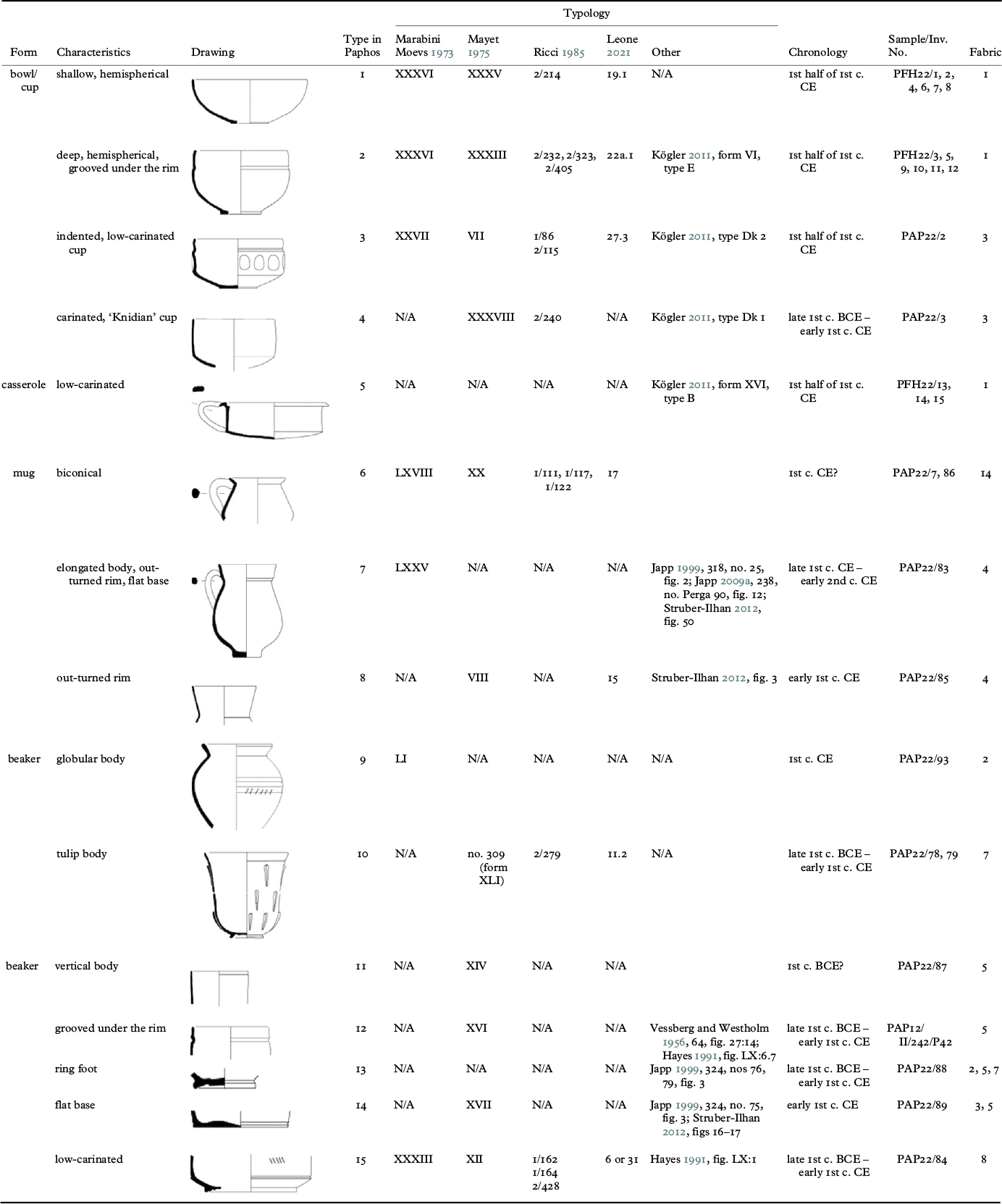
The macroscopic investigation of the ThW vessels focused on their types and fabric appearance. The typological examination was based on the main published classifications of ThW pottery from Italy (Marabini Moevs Reference Marabini Moevs1973; Leone Reference Leone2021), the Iberian Peninsula (Mayet Reference Mayet1975), Asia Minor (Japp Reference Japp1999; Kögler Reference Kögler2011; Struber-Ilhan Reference Struber-Ilhan, Reinholdt and Wohlmayr2012) and elsewhere (Ricci Reference Ricci and Bandinelli1985). In many cases, assigning a vessel to a specific type was impossible due to its fragmentary state of preservation. In such instances, only a general indication of shape (such as a bowl or beaker) was recorded when feasible. To avoid overinterpretation, the typological analysis focuses on larger vessel fragments, whose preservation allowed for clear type determination and which were subjected to laboratory analysis. These fragments form the foundation of the current typology (Table A1: see Appendix), which may be expanded in future research to include additional vessel types and more comprehensive quantitative data. The fabrics were examined using the naked eye and a magnifying lens (x10) in order to divide the ThW vessels into preliminary macroscopic groups (MG) potentially associated with various production centres. The appearance of vessels’ fresh breaks and surfaces was examined following Orton and Hughes’ (Reference Orton and Hughes2013) description system, with some modifications (Marzec, Kajzer and Nocoń Reference Marzec, Kajzer and Nocoń2020; Kajzer et al. Reference Kajzer, Marzec, Kiriatzi and Müller2021, 295). This characterisation includes the following features: frequency and size of inclusions and voids, hardness, the feel of the surface, the texture of the fresh break, and colour determined by the Munsell Soil Color Charts (2009). The macroscopic analysis carried out on both assemblages resulted in the definition of 10 MGs and a few outliers. However, the pottery fragments subjected to laboratory analysis represent only five MGs because a significant number of sherds was preserved insufficiently to meet sampling requirements.
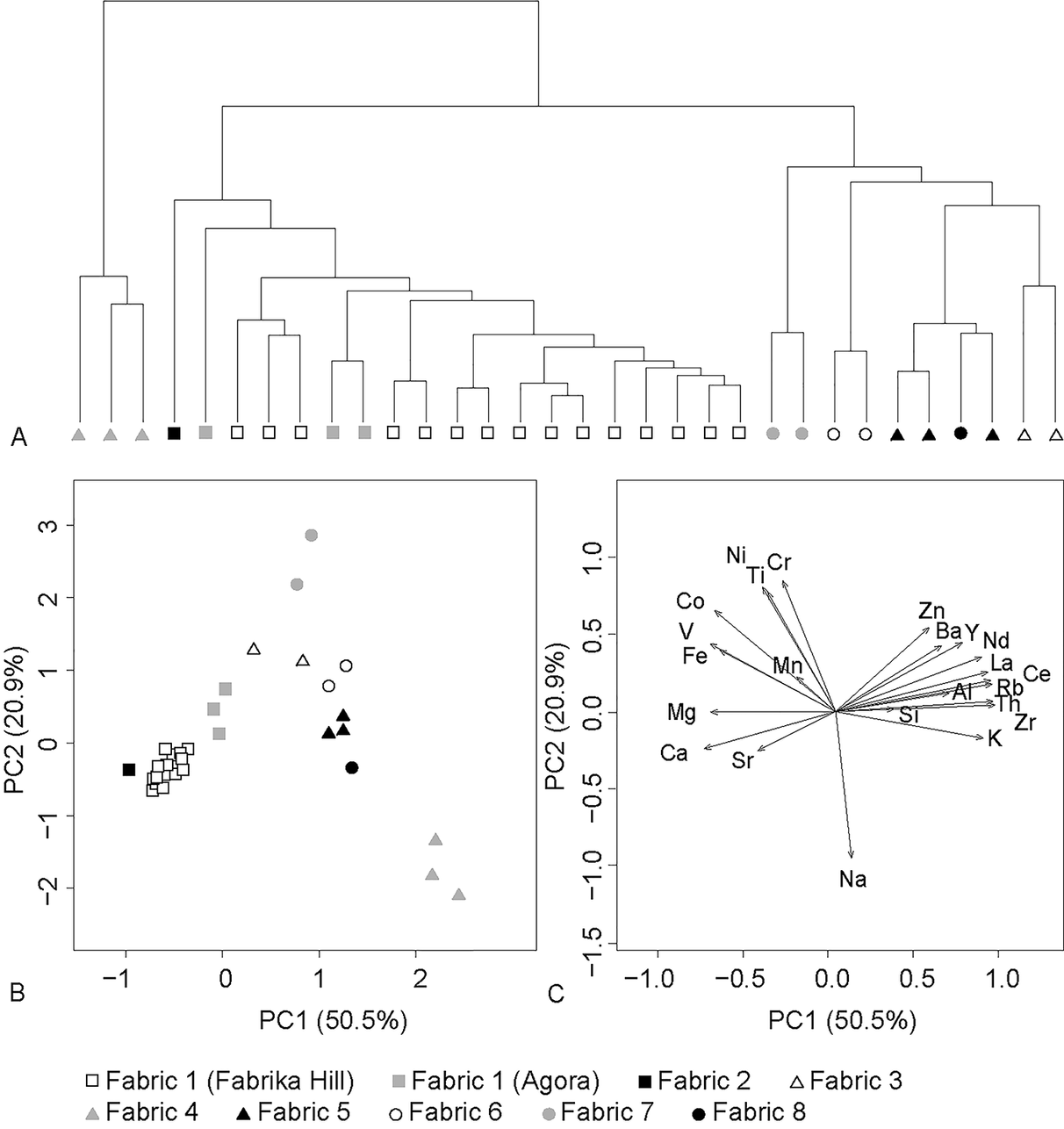
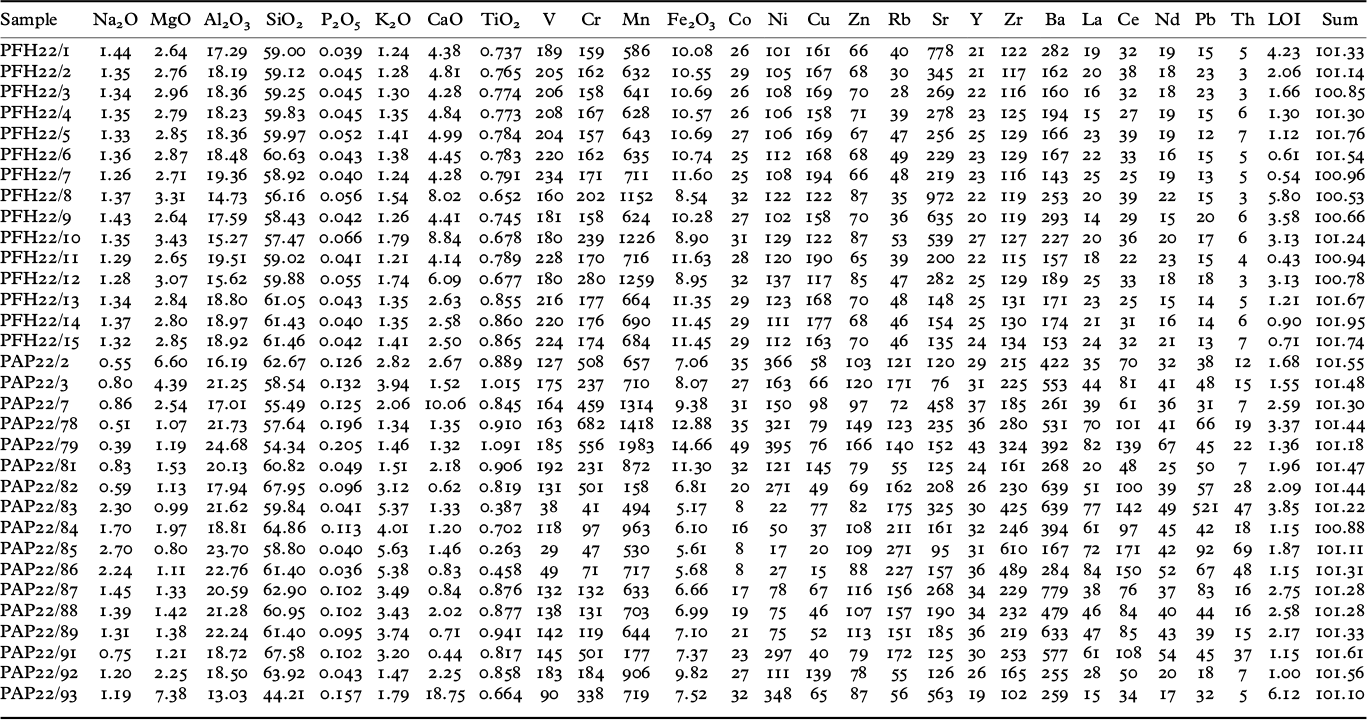
Based on the results of macroscopic analysis, 32 samples representing visual variability and similarity of the vessels from both assemblages were selected for laboratory analyses. All samples were analysed using wavelength dispersive X-ray fluorescence (WD-XRF) and thin section petrography to determine their elemental and mineralogical composition. The WD-XRF spectrometer with an Rh excitation source (BRUKER S-TIGER), using a custom calibration based on certified reference materials, determined 26 major, minor and trace elements: Na, Mg, Al, Si, P, K, Ca, Ti, V, Cr, Mn, Fe, Co, Ni, Cu, Zn, Rb, Sr, Y, Zr, Ba, La, Ce, Nd, Pb and Th (Georgakopoulou et al. Reference Georgakopoulou, Hein, Müller and Kiriatzi2017). The data were processed statistically using the R software to assess the variability of the dataset. The calculation of the variation matrix for 26 elements showed a high value of the total variation (vt = 7.34). The elements with the highest variability are Ca, Th, Cu and Pb. Despite this, the first two elements were kept in the dataset (Table A2) because Ca reflects the differences in the calcareous composition of clay paste, and Th might be important as a provenance indicator. Cu and Pb were removed from further statistical examination (Georgakopoulou et al. Reference Georgakopoulou, Hein, Müller and Kiriatzi2017). An additional element excluded from the dataset was P, due to potential contamination during use and deposition (Freestone, Meeks and Middleton Reference Freestone, Meeks and Middleton1985; Buxeda i Garrigós, Mommsen and Tsolakidou Reference Buxeda i Garrigós, Mommsen and Tsolakidou2002). After removing Pb, Cu and P, the value of the total variation is still high (vt = 6.03) and indicates a heterogeneous nature of the assemblage (Buxeda i Garrigós Reference Buxeda i Garrigós1999; Buxeda i Garrigós and Kilikoglou Reference Buxeda i Garrigós, Kilikoglou and Van Zelst2003). The elemental dataset, including 23 elements, was grouped through cluster analysis (using squared Euclidean distances as a metric and the average linkage method as a linkage criterion) and principal component analysis (PCA) using log-transformed element concentrations.
All samples were also subjected to thin section petrography in order to group them according to their geological origin and provide information on their provenance. The petrographic analysis applied for fine and semi-fine pottery allows an understanding of the variability observed in elemental composition within certain MGs, facilitating associations between macroscopic and chemical groups. The thin sections were examined with a Zeiss Axioscope polarising microscope at magnifications ranging between x25 and x500. For the petrographic fabric description, the adjusted system proposed by Whitbread (Reference Whitbread1995) was adopted.
Once all analyses were completed, their results were integrated, and final fabrics were established. Due to some discrepancies between the preliminary macroscopic and the final groupings, the MGs were discarded, and the agora assemblage of the ThW was re-examined macroscopically in order to assign non-sampled vessels to the final fabrics.
RESULTS
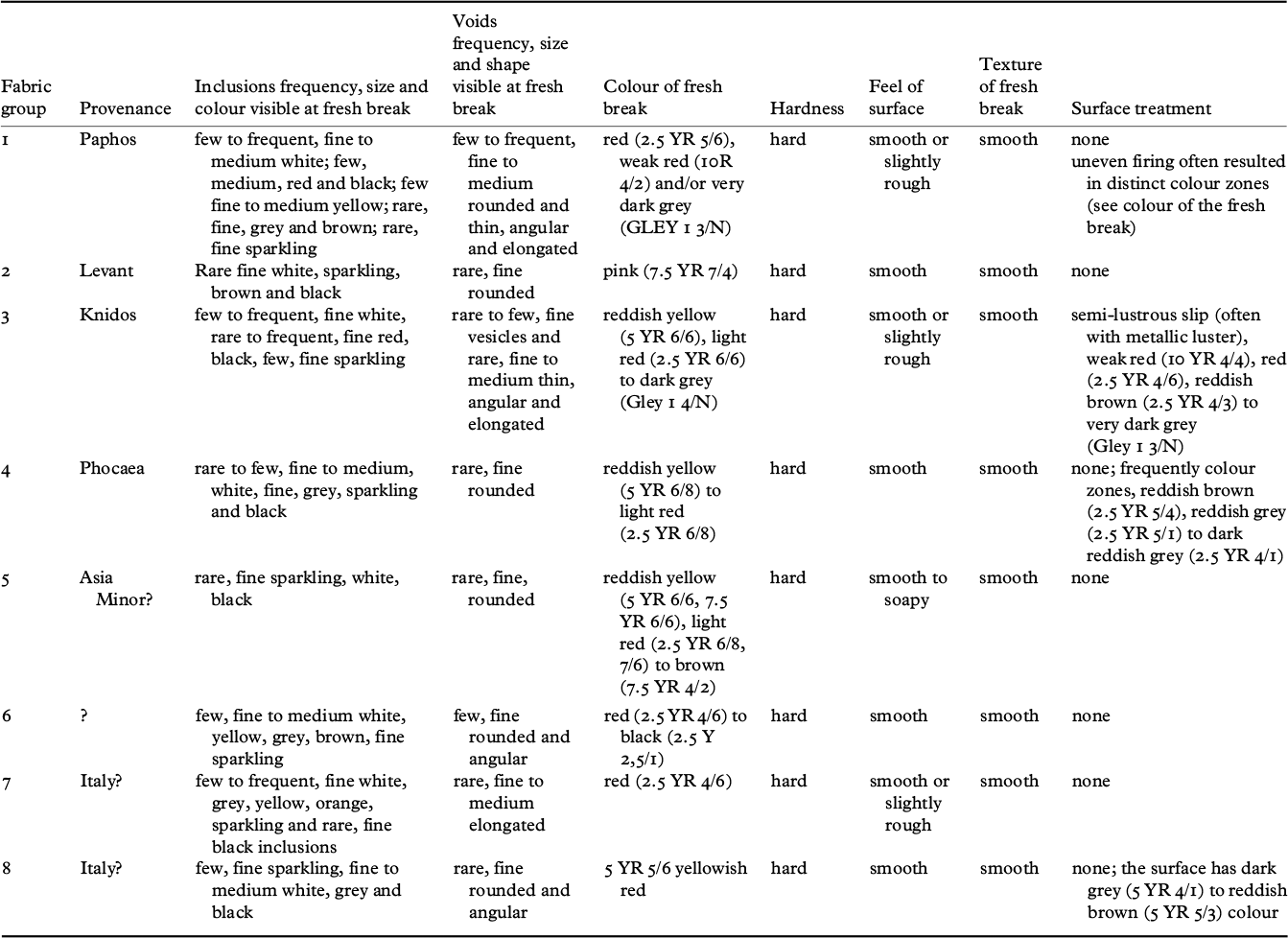
The integration of all analyses resulted in the definition of eight fabrics (Table A3; Fig. 4) characterised by different elemental and mineralogical compositions. This section presents the typological, visual and compositional characterisation of the fabrics, as well as information on their provenance.
Results of statistical analyses of the log transformed WD-XRF data, excluding Pb, Cu and P for the 32 samples analysed. a) Results of hierarchical clustering: dendrogram. b) Results of principal component analysis: plot of factor 1 v. factor 2. c) Loadings for variables included in the principal component analysis. Both the dendrogram (a) and the plot (b) show the association of samples to the fabrics.

Fabric 1
Fabric 1 includes all vessels from the deposit in Fabrika Hill, which is more than 2500 sherds, corresponding to a minimum number of 109 vessels classified into three types (Élaigne Reference Élaigne2014, 22, table 1). Additionally, this fabric includes 19 fragments recovered at the agora. The vessels assigned to this fabric are represented by two types of hemispherical bowls/cups, casseroles and one-handled mugs with a carination below the handle (Table A1, types 1–2, 5–6; Fig. 5). The latter was found only at the agora. There are also some fragments whose shapes cannot be assigned to any form due to their small size. Based on findings from Fabrika Hill and published records, the hemispherical cups and casseroles date to the first half of the first century CE (Élaigne Reference Élaigne2014, 24). The contexts of the sherds from the agora support their Early Roman chronology.
Photographs, drawings, fresh break and thin section photomicrographs (XPL) of Fabric 1.

The macroscopic appearance of the fabric is characterised by the presence of white, red, black and yellow inclusions. The colour of the fresh break is red, weak red or dark grey. The fabric shows high variability in terms of the frequency of inclusions and voids as well as the colour. Frequently, distinct colour zones, with diffuse to sharp boundaries, are present across the fired cores (Table A3:1; Fig. 5). The colour of the surface may be uniform or bi-colour, often very dark grey in the upper part and red in the lower part of the vessel. The latter is probably a result of kiln stacking. The fabric is hard, the feel of the surface is smooth or slightly rough, and the texture of the fresh break is smooth.
A total of 18 samples (15 from Fabrika Hill and three from the agora) assigned to this fabric were subjected to laboratory analysis. In terms of elemental composition, Fabric 1 is characterised by high Fe2O3, low Rb and medium to high Cr and Ni content. It shows the variability of CaO and a few other elements (Tables 1 and A2), even within the samples from the Fabrika Hill deposit. Differences between the samples were also observed in the thin sections; however, they are only related to size, frequency and distribution of inclusions. In terms of mineralogical composition, all samples assigned to this fabric are very similar to each other. The fabric has common to frequent fine to semi-fine and angular to rounded inclusions. It is characterised by the presence of ophiolitic rock fragments (fine to coarse-grained basic igneous rocks and their constituents), as well as epidote group minerals, serpentinite, quartz, micrite, microfossils, chert, mudstone and sandstone (for detailed description see Table A4). The matrices of the samples are reddish yellow, brown, reddish brown and black in PPL and XPL (x50). They are optically active to inactive (Fig. 5).
Mean elemental composition (oxides are expressed in wt% and elements in ppm) and relative standard deviation (rsd) of ThW ware Fabric 1 and the reference groups.

Despite some differences, all samples assigned to Fabric 1 can be associated with local production. This interpretation is based not only on the context of the finds and compatibility of the sample mineralogy with the geology of western Cyprus but also on their compositional similarity to cooking ware pottery analysed recently and considered as local to the site (Table 1; Marzec et al. Reference Marzec, Nocoń, Miziołek, Müller and Kiriatzi2024, Fabric Group 2).
Fabric 2
Two fragments of globular mugs dated to the first century CE (Table A1, type 9; Fig. 6a) were assigned to Fabric 2. Their shape is analogous to globular mugs from Cosa in Italy (Marabini Moevs Reference Marabini Moevs1973, 154–5), but they have different macroscopic fabric. The vessels found in Nea Paphos are characterised by very fine, hard and pink fabric as well as smooth and plain slip-free surfaces (see Table A3:2). One sample subjected to laboratory analysis has high MgO and CaO content and low SiO2 and Rb concentration (Table 2). In the thin section (Table A4), the fabric shows rare, very fine subangular to rounded inclusions composed of quartz, mica, brown opaque inclusions, serpentinite, microfossils, feldspar, amphibole, and chert. The matrix is mottled olive and reddish-brown in both PPL and XPL (x50) and inactive (Fig. 6a).
Photographs, drawings, fresh break and thin section photomicrographs (XPL) of a) Fabric 2, b) Fabric 3 and c) Fabric 4.

Elemental composition (oxides are expressed in wt% and elements in ppm) of ThW ware Fabric 2 and mean elemental composition and relative standard deviation (rsd) of the reference groups.

The macroscopic appearance and the elemental and mineralogical composition of Fabric 2 are compatible with Eastern Sigillata A (ESA) (Table 2), whose origin is tentatively pinpointed to the area of northern Levant, somewhere between Antioch and Tarsus.Footnote 3 However, no parallel shapes of ThW pottery interpreted as local have been reported from the assumed production area.
Fabric 3
A total of 14 fragments were assigned to Fabric 3. They represent two, well-preserved types of drinking vessels: a cup with thumb impressions (or an indented cup) and a carinated cup also known as the ‘Knidian cup’ (Table A1, types 3–4; Fig. 6b). The fabric also includes body fragments of beakers with dotted barbotine decoration (Kajzer and Marzec Reference Kajzer and Marzec2020, 255), a handle and small body sherds which cannot be assigned to any form. The vessel’s fresh breaks are reddish yellow to dark grey, and the surface is covered by a semi-lustrous red, reddish brown to very dark grey slip. The fabric is hard and has a smooth or slightly rough surface (Table A3:3). All fragments were registered at the agora in the Late Hellenistic and Early Roman layers, and they date between the first century BCE and the middle of the first century CE. Based on typology and macroscopic appearance, Knidian origin can be suggested for this fabric (Doksanalti Reference Doksanalti2000, 75–7; Kögler Reference Kögler, Briese and Vaag2005; Reference Kögler2011, 343–4, 352–5).
Two samples analysed using WD-XRF have generally low CaO content and relatively high MgO, Cr and Ni concentrations. However, PAP22/2 has higher MgO, SiO2, Cr and Ni contents than PAP22/3. Despite these differences, both fit the reference patterns from Knidos, including ThW pottery, published by Schneider (Tables 3 and A2; Schneider Reference Schneider2000, 533, table 3). He noted that the Knidian reference group is characterised by high variation, and it should probably be subdivided since CaO, MgO, Cr, and Ni show high relative standard deviations. Petrographic examination also supports the proposed origin (Table A4; Whitbread Reference Whitbread1995, 69–78). The samples have common (PAP22/3) to frequent (PAP22/2) semi-fine angular to rounded inclusions composed of monocrystalline and polycrystalline quartz, fragments of phyllite, mica, textural concentration features (TCFs), serpentinite, micrite, opaques, feldspar, sandstone, and chert. It seems that the differences in elemental composition are related to the frequency of inclusions. PAP22/2 has generally more inclusions, particularly more quartz and serpentinite, than PAP22/3. The matrices of the samples are yellowish brown, brown to reddish brown, and grey in PPL (x25), and strong brown, reddish brown to dark grey in XPL (x25), and optically moderately active (Fig. 6b).
Elemental composition (oxides are expressed in wt% and elements in ppm) of two samples classified as ThW ware Fabric 3 and mean elemental composition and relative standard deviation (rsd) of the reference group.

Fabric 4
Fabric 4 contains 27 fragments of vessels showing typological and chronological variability. The so-called Aegean mug (Hayes Reference Hayes2008, 102; Table A1, type 7; Fig. 6c) is a common and very distinctive form representing this fabric. The other documented examples seem to be variants of the Aegean mug, but they are too fragmented to understand their complete shapes (Table A1, type 8; Fig. 6c). In addition, the fabric includes various fragments of straight rims, cut bases and body walls with simple incised decoration from undefined vessel shapes (Fig. 7).
Photographs showing body sherds of Fabric 4 with incised decoration.

Their presence indicates a more diversified repertoire of forms spanning between the early first century and the second century CE. The characteristic feature of the vessel freak break is an orange core. The surface is usually greyish, sometimes with reddish brown to dark reddish grey zones. Moreover, the sherds are characterised by hard fabric, the smooth feel of the surface and rare to few inclusions visible in the fresh break (Table A3:4; Fig. 6c). Based on macroscopic examination, Fabric 4 was identified as an import from Phocaea (Japp Reference Japp1999, 318; Reference Japp2009a, 238; Hayes Reference Hayes2000, 285; Reference Hayes2008, 102). To check this assumption, three samples were subjected to laboratory analysis. All samples are characterised by high K2O, Rb, Zr and Th concentrations as well as very low CaO, V, Cr and Ni content (Tables 4 and A2). In thin sections, the fabric shows few (PAP22/85) to common fine angular to subrounded inclusions composed of quartz, feldspar, trachyte, opaques, mica, serpentinite, TCFs and rare volcanic glass (Table A4). The matrices of the samples are yellowish brown in PPL (x25), reddish yellow to reddish brown in XPL (x25), and optically active to moderately active (Fig. 6c). The elemental and mineralogical composition of Fabric 4 fits well with reference groups of cooking pottery produced in the area of Phocaea (Table 4; Mayet and Picon Reference Mayet and Picon1986; Schneider Reference Schneider2000, 533, table 3; Schneider and Japp Reference Schneider and Japp2009; Amicone et al. Reference Amicone, Müller, Heinze, Schneider, Neumann, Fenn and Kiriatzi2022).
Mean elemental composition (oxides are expressed in wt% and elements in ppm) and relative standard deviation (rsd) of ThW ware Fabric 4 and the reference groups.

Fabric 5
Fabric 5 includes 31 fragments of beakers (Table A1, types 12–14; Fig. 8a) found in layers dating to the late first century BCE and early first century CE. Their macroscopic fabric is orange, hard and with a soapy feel of the surface, and it contains rare inclusions (Table A3:5; Fig. 8a). Three samples selected for laboratory analysis are characterised by low CaO, Cr and Ni (but higher than in Fabric 4) concentrations. They have common, fine, angular to subrounded inclusions composed of quartz, fragments of metamorphic rocks (including phyllite), serpentinite, mica (biotite and white mica), opaques, feldspar, TCFs (streaks, clay lumps), microsparite and rare pumice (Table A4). The sample matrices are yellowish brown in PPL (x25), yellow, reddish yellow to reddish brown in XPL (x25), and optically active (Fig. 8a).
Photographs, drawings, fresh break and thin section photomicrographs (XPL) of a) Fabric 5, b) Fabric 6, c) Fabric 7 and d) Fabric 8.

Cylindrical beakers analogous to the one illustrated in Table A1, type 14, were registered in Pergamon (Japp Reference Japp1999, fig. 3) and Ephesos (Struber-Ilhan Reference Struber-Ilhan, Reinholdt and Wohlmayr2012, figs 16–17). The vessels found in Ephesos are also similar in terms of the macroscopic appearance of the fresh breaks, and it has to be stressed that they were interpreted at the site as imports. Furthermore, the elemental composition of Fabric 5 is similar to Hellenistic tableware vessels found in Pergamon, Elaea and Atarneus analysed with WD-XRF by Schneider and Japp (Reference Schneider and Japp2009, 298, Gruppe 6). They noted that their ‘Gruppe 6’ is clearly separate from their other groups associated with Pergamon and Çandarlı productions because it has lower MgO and Ni concentrations. However, due to the lack of suitable comparative data, they could not pinpoint the origin of this group in any production centre. Interestingly, Gruppe 6 includes one sample classified as ‘ESC’, that is Eastern Sigillata C, which is generally associated with the products of workshops located in Pergamon and/or Çandarlı area (Bes Reference Bes2015, 17–19). These results suggest more complex production pattern in this region. Nevertheless, based on current data, the eastern Aegean origin should be considered as a potential source of Fabric 5.
Fabric 6
Fabric 6 is represented by three small fragments of ThW drinking vessels (Fig. 8b). Due to their poor state of preservation, the identification of their types and origin is difficult. They might be fragments of mugs analogous to those assigned to Fabric 1 (Table A1, type 6) and Fabric 2 (Table A1, type 7) or beakers. Their macroscopic fabric is red to black, hard with the smooth feel of the surface (Table A3:6). Based on the stratigraphic data, all three fragments date to Augustan times.
Two fragments were analysed using WD-XRF and thin section petrography. They are characterised by high SiO2, Cr, Ni, elevated Th concentrations as well as very low CaO and low MgO and Mn content. In thin sections, the fabric shows common, fine angular to rounded inclusions. They contain fragments of schist, quartz, feldspar, opaques, mica (biotite and white mica), some chert and sporadically serpentinite, brown spinel and tourmaline (Table A4). The matrix is brown, dark reddish brown to dark grey in PPL (x25), reddish yellow, reddish brown to dark grey in XPL (x25), and optically active to inactive (Fig. 8b). Due to the lack of comparative material, the provenance of these samples is unknown.
Fabric 7
A total of 29 fragments found in layers dating back to the Augustan times were assigned to Fabric 7. Their macroscopic fabric is characterised by a red colour, smooth or slightly rough surface and smooth fresh break. It is hard and contains few to frequent inclusions (Table A3:7). Two non-joining fragments from the same vessel belong to a tulip shape beaker (Table A1, type 10; Fig. 8c), which is rare (Leone Reference Leone2021, 116–17). The other registered fragments seem to represent different types of beakers. However, due to their fragmentary state of preservation, it is impossible to define their specific types. Possibly, they represent shapes comparable to those registered on other Cypriot sites, such as the House of Dionysos (Hayes Reference Hayes1991, 60, fig. XXII:3–4), chamber tombs in Agios Ermogenis in Kourion (McFadden Reference McFadden1946, 480–2, pl. XLII), and Panaya Ematousa (Lund Reference Lund, Sørensen and Jacobsen2006, 204–5, fig. 110). They date between the mid first century BCE and the early first century CE (McFadden Reference McFadden1946, 480; Lund Reference Lund, Sørensen and Jacobsen2006, 205), which is compatible with the chronology of those from the Paphos agora. Similar vessels are also known from Tarsus (Jones Reference Jones and Goldman1950, 189–90), Knidos (Kögler and Mandel Reference Kögler, Mandel, Poblome, Talloen, Brulet and Waelkens2004) and Athens (Hayes Reference Hayes2008, 97). Based on forms, decoration and basic fabric characteristics, it is possible that all of these vessels share the same origin, which, according to Hayes, was somewhere in Italy (Hayes Reference Hayes1991, 59; Kögler and Mandel Reference Kögler, Mandel, Poblome, Talloen, Brulet and Waelkens2004; Lund Reference Lund, Sørensen and Jacobsen2006, 205). In order to investigate the source of this fabric, two samples were subjected to laboratory analyses. They have high Cr, Ni and Fe2O3 concentrations and low CaO and K2O content. The fabric has common semi-fine angular to rounded inclusions. It is dominated by quartz and chert inclusions, accompanied by metamorphic rock fragments composed of quartz and mica, and opaques. It also includes TCFs (clay lumps) and rare grains of serpentinite, amphibole and spinel group minerals as well as microfossils (Table A4). The matrix is dark brown in PPL (x25), reddish brown in XPL (x25) and optically moderately active (Fig. 8c).
At this stage of research, Fabric 7 could not be assigned to any reference material. Many possible production areas could be proposed based on the fabric mineralogy, which includes sedimentary, metamorphic and ophiolitic components.
Fabric 8
Fabric 8 includes a single sample coming from the lower part of a vessel tentatively identified as a relatively large beaker with straight, vertical walls (Table A1, type 15; Fig. 8d). In Cyprus, the similar shape of low-carinated beaker was documented in the House of Dionysos (Hayes Reference Hayes1991, 177, fig. LX:1). It is dated to the Augustan phase on both sites. The macroscopic characteristics resemble Fabric 4 in terms of the appearance of the surface, which is dark grey to reddish brown. The core is slightly brighter and has a yellowish red colour. The frequency of inclusions is similar to Fabric 4, although there are slight differences in terms of their size (Table A3:8). The sample is characterised by low CaO, Cr and Ni concentrations and high K2O and Rb content. It has frequent semi-fine very angular to subangular inclusions. It is dominated by volcanic glass in the form of fine needles as well as C and Y-shaped fragments. It also consists of mica (biotite and white mica), quartz, sanidine feldspars, opaques, fragments of fine-grained igneous rocks (composed of feldspar and biotite?) and metamorphic rocks (aggregates of quartz with undulose extinction), TCFs, sandstone, and serpentinite (Table A4). The sample matrix is yellowish red to brown in PPL (x25), reddish yellow to reddish brown in XPL (x25) and optically active (Fig. 8d).
The provenance of this fabric is unknown due to the lack of a comparative reference material. The common presence of pyroclastic inclusions observed in the thin section indicates several sources, including, but not limited to, Campania and Sardinia, and also the eastern Aegean (Cherchi et al. Reference Cherchi, Marcello, Marini, Murru, Pretti and Salvadori1982; IGME 1983; Bonardi, D’Argenio and Perrone Reference Bonardi, D’Argenio and Perrone1988; Şenel Reference Şenel2002).
CONSUMPTION AND PRODUCTION OF THIN-WALLED WARE IN THE EASTERN MEDITERRANEAN
The earliest presence of ThW ware in the Eastern Mediterranean correlates with the Roman expansion in the second century BCE and, thus, with the increased movement of people and various goods from Italy. As suggested for other categories of Italian pottery (Morel Reference Morel1986; Berlin Reference Berlin1993), the early distribution of ThW vessels can be linked with personal use rather than trade.
The establishment of a duty-free port on Delos in 166 BCE brought Italian imports to the island. ThW vessels have been found in various contexts on Delos, including public, for example, a tavern (Chatzidakis Reference Chatzidakis and Kypraiou1997, 304, pl. 226), domestic, for example, the House of Masks (Peignard-Giros Reference Peignard-Giros2000, 216, fig. 17) and the House of Comedians (Bruneau Reference Bruneau, Bruneau, Vatin and Becerra De Meneses1970, 257, pl. 47), and sacred, for example, Sarapiea (Brun-Kyriakidis and Marzec Reference Brun-Kyriakidis and Marzec2020), mostly in layers dating to the late second and early first centuries BCE. The relatively frequent use of ThW vessels and other pottery categories from Italy on Delos seems to be related to a large number of Italians, such as merchants, living on and visiting the island (Morel Reference Morel1986; Peignard-Giros Reference Peignard-Giros2000, 216–21; Kögler Reference Kögler2014). Italian ThW pottery has also been found in other Eastern Mediterranean cities with more or less numerous Roman populations, such as Ephesos (Struber-Ilhan Reference Struber-Ilhan, Reinholdt and Wohlmayr2012), Athens (Rotroff Reference Rotroff1997, 221), Stobi (Anderson-Stojanović Reference Anderson-Stojanović1992, 36–7), Tel Anafa (Slane Reference Slane and Herbert1997, 350), Alexandria (Élaigne Reference Élaigne2012, 287) and Nea Paphos (Hayes Reference Hayes1991, 59–60; Marzec and Kajzer Reference Marzec and Kajzer2020, 234). However, based on the published records, the occurrence of this pottery is rare. There are also sites, such as Knidos, where the Late Hellenistic Italian ThW ware has not been recovered despite the presence of Romans (Kögler Reference Kögler2014).
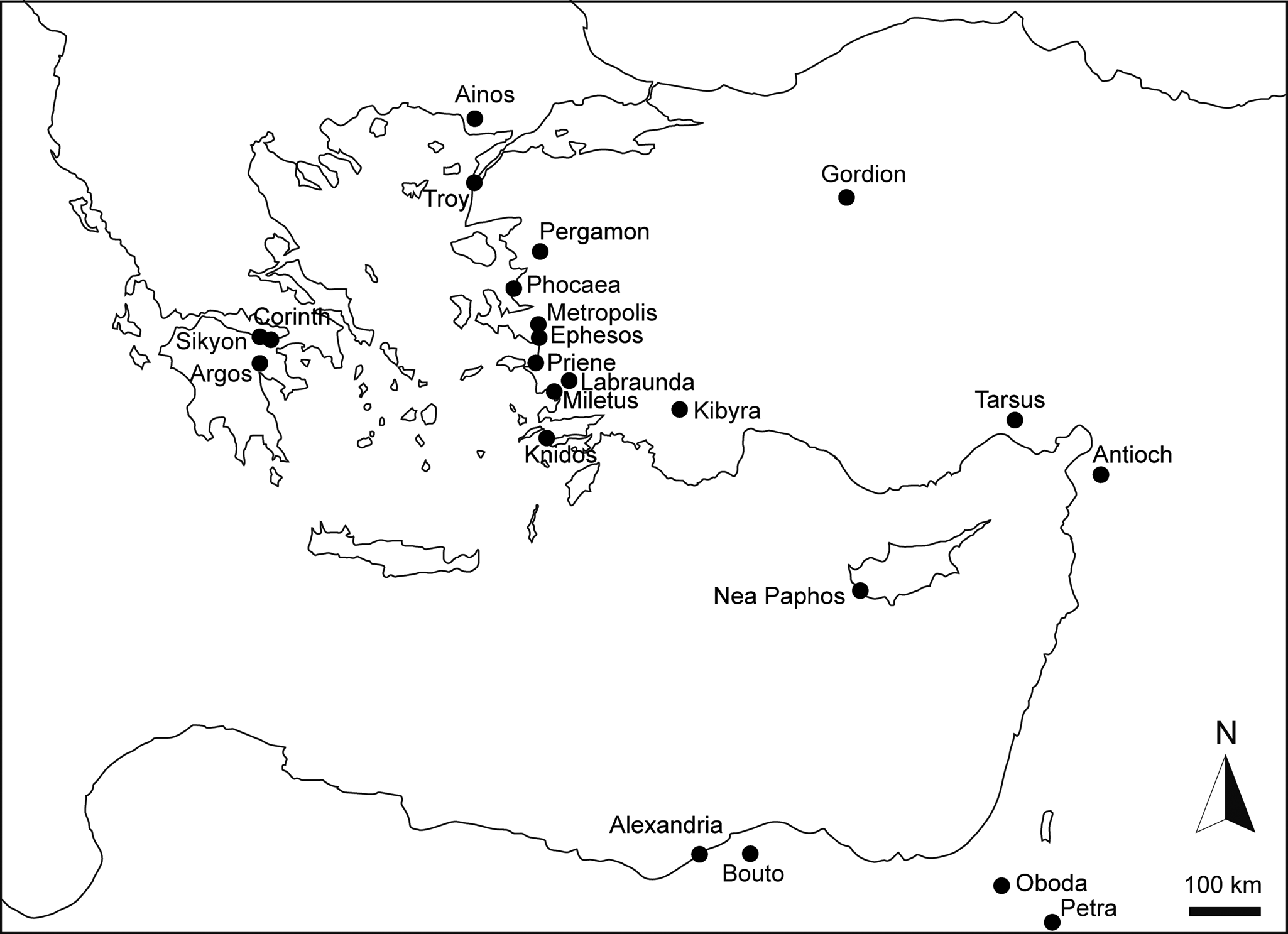
In the Early Roman period, ThW pottery gained popularity in the Eastern Mediterranean (Élaigne Reference Élaigne2000, 21; Reference Élaigne2014, 19; Kögler and Mandel Reference Kögler, Mandel, Poblome, Talloen, Brulet and Waelkens2004; Fenn Reference Fenn2008; Kögler Reference Kögler2011). It became prominent in Athens (Hayes Reference Hayes2008, 96) after the middle of the first century BCE. In the north-east Peloponnese, the importance of the ThW ware is reflected not only in the presence of Italian vessels but also in the regional production and consumption of forms derived from it (Hayes Reference Hayes1973, 470; Slane and Jones Reference Slane and Jones1980, 171; Slane Reference Slane1986, 291, 312; Reference Slane1990, 89–93; Élaigne Reference Élaigne2000, 19; Abadie-Reynal Reference Abadie-Reynal2007, 146–7, 257; Lolos Reference Lolos2016; Reference Lolos2019; Reference Lolos2020; Reference Lolos and Blizos2022; Tzavella Reference Tzavella and Lolos2021, 249–51, fig. 5.128). Also, workshops in Asia Minor, such as Pergamon (Japp Reference Japp1999, 319, nos 32−3, fig. 2; Reference Japp2003, 246) and Ephesos (Struber-Ilhan Reference Struber-Ilhan, Reinholdt and Wohlmayr2012, 175; Kögler Reference Kögler2011, 337), adopted the idea of ThW vessels and began to produce them independently as early as the first century BCE. Interestingly, this new trend in pottery production can also be observed in places where the presence of Italian ThW ware was not significant in scale. In Knidos, local derivatives were made at the latest in the Augustan period (Kögler and Mandel Reference Kögler, Mandel, Poblome, Talloen, Brulet and Waelkens2004; Kögler Reference Kögler, Briese and Vaag2005), possibly under the influence of workshops producing ThW pottery that already existed in Asia Minor. The provincial production increased in the first century CE, which is suggested by the adaptation of this technological style by the other ceramic production centres in Asia Minor, for example, Phocaea and Troy or Ainos (Hayes Reference Hayes1995, 190; Tekkök Reference Tekkök2003, 240). There is also evidence of Early Roman production in Miletus (Pülz Reference Pülz1985; Reference Pülz1986; Şahin Reference Şahin2018),Footnote 4 Labraunda (Streinu Reference Streinu2020), Metropolis (Struber-Ilhan Reference Struber-Ilhan, Reinholdt and Wohlmayr2012, 176), Priene (Fenn Reference Fenn2016), Kibyra (Japp Reference Japp2009b) and Gordion (after Tekkök Reference Tekkök2003, 240). Apart from Asia Minor, ThW pottery was possibly made locally in Egypt in Alexandria (Élaigne Reference Élaigne2014, 20) and Bouto (Élaigne Reference Élaigne2000, 19), as well as in the Levant. The Levantine production includes a potential manufacturing centre in Tarsus (barbotine ware; Jones Reference Jones and Goldman1950, 188–9; Hayes Reference Hayes2008, 96) and in the Nabatean region, i.e. Oboda or Petra (Negev Reference Negev1986, 62–9, 81–4; Slane Reference Slane and Herbert1997, 349). Nabatean ThW includes the forms comparable to the ones discussed in the paper. However, the production of these vessels, including the so-called Nabatean egg-shell pots, is much more diversified in terms of forms and decoration (rouletted, incised or painted). Based on the results of the current research, Nea Paphos (Fabric 1) and the workshop(s) somewhere between Antioch and Tarsus (Fabric 2) can be added to the list of eastern ThW production areas (see Fig. 9).
Map of the Eastern Mediterranean showing the attested and presumed ThW ware production sites discussed in this paper (based on d-maps.com).

CONSUMPTION AND PRODUCTION OF THIN-WALLED WARE IN NEA PAPHOS AND CYPRUS
In Nea Paphos, ThW ware was used from the first century BCE, but such early vessels are very rare, and all identified fragments were likely imported from Campania (Hayes Reference Hayes1991, 59; Papuci-Władyka Reference Papuci-Władyka1995, 199, no. 356). Additionally, two beakers dated to the Late Hellenistic period of probable Italian origin were recorded on Yeronisos island (Lund Reference Lund2015, 188; Młynarczyk Reference Młynarczykforthcoming), located around 18 km north of Nea Paphos. In the House of Dionysos, Italian ThW ware occurs in contexts dating until the early first century BCE (Hayes Reference Hayes1991, 59). According to Hayes, the later imports also include products from Etruria and north-central Italy, as well as the Po Valley and the Iberian Peninsula (Hayes Reference Hayes1991, 59; Lund Reference Lund2015, 188). He also observed that the first and second century CE thin-walled wares from the site are ‘eastern, not Italian’.
The ceramic material from the agora excavations also includes Campanian ThW ware imports of the first century BCE (Marzec and Kajzer Reference Marzec and Kajzer2020, 234). However, apart from them, the presence of other Italian imports cannot be confirmed (see Fabrics 7 and 8). Most of the imported fabrics originate from the Aegean (Knidos, Phocaea and possibly other unidentified centres, e.g. Fabric 5). They appeared already in the first century BCE and were imported at least until the end of the second century CE. There is some evidence for later use of ThW mugs developed in the second and third centuries CE at the House of Aion in Nea Paphos (Meyza Reference Meyza2008, 519, fig. 5; Lichocka and Meyza Reference Lichocka and Meyza2001, 166, fig. 8:1–2). Apart from the agora, imports from this region were also identified macroscopically in the other areas of Nea Paphos and Cyprus. Knidian ThW knobbed beakers, bowls, carinated cups, indented cups, and mugs were found in Nea Paphos in Saranda Kolones (Hayes Reference Hayes2003, 460, 462, 464, 470, nos 55, 69, 70, 89–90, 113) and the House of Dionysos (Hayes Reference Hayes1991, 59, 61, 190, figs XXII, LXVI), as well as in Kourion among unpublished material from the Acropolis,Footnote 5 and Kition (Marquié Reference Marquié, Eiring and Lund2002, 255, fig. 8:6). In the latter, a ThW mug of Knidian origin was found in the layer dated to the late first/early second century CE. Also, Phocaean ThW ware imports were identified in the House of Dionysos (Hayes Reference Hayes1991, 80) and possibly the Kourion Acropolis. Moreover, a cylindrical beaker in a shape analogous to the one assigned to Fabric 5 (Table A1, type 12) was found in one of the tombs in Marion (Vessberg and Westholm Reference Vessberg and Westholm1956, 64, fig. 27:14). Another example is known from the House of Dionysos (Hayes Reference Hayes1991, 174–5, fig. XXII:5).
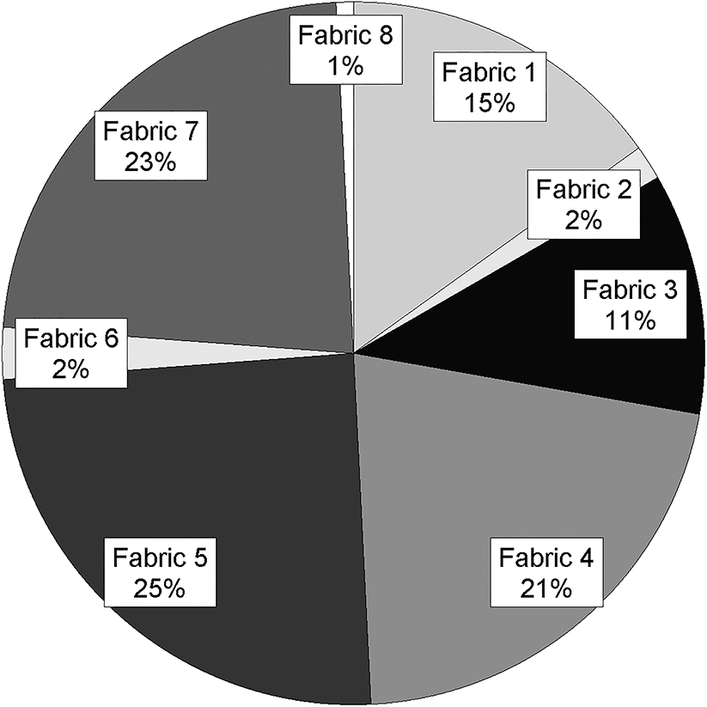
The excavations in Nea Paphos also yielded evidence of the local production of ThW ware pottery. It refers to the ceramic material from the dump in Fabrika Hill interpreted as production wasters and several examples from the agora. The results of laboratory analyses show that these vessels are characterised by mineralogical and elemental composition compatible with the local cooking wares, thus confirming their local origin. The local production of ThW vessels dates to the first half of the first century CE. However, apart from the minimum number of 109 vessels from Fabrika Hill, the local fabric is represented only by 18 fragments from the agora. In comparison to imported Fabrics 4, 5 and 7 (Fig. 10), this is a low number, suggesting that locally made ThW pottery was used less frequently than imported variants. It might suggest that the deposit from Fabrika Hill had some special meaning or was discarded nearby the manufacture place.
Percentage of the defined ThW fabrics found at the agora in Nea Paphos.

There is no other secure evidence of locally made ThW pottery being used in other areas of Nea Paphos and Cyprus. Hemispherical cups assigned to the same type as local ones (Table A1, type 2; Fig. 1) were documented in Nea Paphos in the House of Dionysos (Hayes Reference Hayes1991, 183, fig. LXII:35),Footnote 6 Kourion, in chamber tombs in Agios Ermogenis (McFadden Reference McFadden1946, 482, nos 80–1, pl. XLII), and Amathus, in the Sanctuary of Aphrodite (Burkhalter Reference Burkhalter1987, 394–5, no. 224). Because ThW hemispherical cups were commonly produced across the Mediterranean and the published record provides only brief descriptions of macroscopic fabric, at this stage of research, it has been impossible to assign these vessels to our Fabric 1.
ROMAN INNOVATION V. LOCAL TRADITION
The eastern workshops, including Nea Paphos, produced vessels of the same shape as those known from Italy but also modified them and created new forms of ThW ware. For example, cups with thumb impressions or indented cups, produced in almost unchanged form known from Italy, were made in Knidos. Another universal form was the hemispherical cup produced in various western and eastern centres in the Mediterranean (Japp Reference Japp1999, fig. 4; Faga Reference Faga2010, fig. 2; Élaigne Reference Élaigne2014, figs 3, 6; Grifa et al. Reference Grifa, De Bonis, Guarino, Petrone, Germinario, Mercurio, Soricelli, Langella and Morra2015, fig. 2dej; Grigoropoulos Reference Grigoropoulos2021, 265–6; Leone Reference Leone2021, 140, 149–50), including Nea Paphos (Fabric 1; Table A1, types 1–2). The modification of Italian forms is clearly visible in the collarino type mugs, which were first introduced in Italy and western provinces (Leone Reference Leone2021, 129). In the Eastern Mediterranean, their production was identified on the Thracian coast, potentially near Ainos and Troy (Hayes Reference Hayes1995; Reference Hayes, Briese and Vaag2005, 21; Reference Hayes2008, 102–3, figs 50–1; Tekkök Reference Tekkök2003, 240; Lund Reference Lund2015, 196; Grigoropoulos Reference Grigoropoulos2021, 271–3) or the Phocaean region (Japp Reference Japp1999; Tekkök Reference Tekkök2003; Hayes Reference Hayes, Briese and Vaag2005, 21). These mugs date from the mid first until the third century CE or even later. Beyond the area of manufacture, they were recorded in Knidos (Kögler and Mandel Reference Kögler, Mandel, Poblome, Talloen, Brulet and Waelkens2004) and Nea Paphos (see above, Fabric 4). Generally, the eastern versions have more bulging bodies with the largest diameter lower (in the middle or in the lower third of the entire vessel height) than those made in the west. The eastern workshops also introduced new forms to the ThW vessels. For example, the production of ThW carinated cups (‘Knidian cups’) in Knidos followed the local tradition (Kögler Reference Kögler, Briese and Vaag2005; Reference Kögler2011, 343–5). The exact form occurred in the repertoire of Knidian fine wares as early as the Hellenistic period. The Hellenistic Knidian fine wares also included a form similar to the miniature ThW casseroles (Table A1, type 5) from Nea Paphos. But the example published by Kӧgler is deeper and has more regular wall thickness than Cypriot vessels (Kӧgler Reference Kögler2011, 187–8, no. G.98). Moreover, this form has not been registered among ThW pottery recorded elsewhere, and it occurs only in the Fabrika Hill deposit. The similarity of shape and fabric (Nocoń and Marzec Reference Nocoń and Marzec2023) between the locally produced ThW ware and cooking ware casseroles suggests that this form can be considered a local innovation.
These examples show that ThW ware production in the east was not always a direct adoption of Roman drinking forms (Struber-Ilhan Reference Struber-Ilhan, Reinholdt and Wohlmayr2012, 175) and the local pottery tradition was strong. Moreover, some production places in the east made vessels of Italian forms based on regional derivatives of the original imports (Japp Reference Japp2015, 155). This suggests that the eastern workshops were not producing ThW pottery only to meet the demand of the Roman population, but that their work should be considered as a general trend related to the implementation of new drinking habits (Slane Reference Slane and Herbert1997, 349; Roth-Rubi Reference Roth-Rubi, Malfitana, Poblome and Lund2006, 62). The same trend is observed in culinary habits and the appearance of new cooking ware forms, especially pans, suggesting new ways of food preparation (Berlin Reference Berlin1993; Peignard-Giros Reference Peignard-Giros2000; Reference Peignard-Giros, Fenn and Römer-Strehl2013; Amicone et al. Reference Amicone, Müller, Heinze, Schneider, Neumann, Fenn and Kiriatzi2022, 73–4). This phenomenon also refers to other pottery categories, that is, terra sigillata and lighting devices such as the new discus lamps adorned with volutes, introduced as imported items, and subsequently made in the provinces (Kajzer et al. Reference Kajzer, Marzec, Kiriatzi and Müller2021, 325–9). It has to be emphasised that this cultural influence was not unidirectional, as eastern production also affected Italian manufacturers. Hayes (Reference Hayes, Briese and Vaag2005, 15) suggested that the Levantine production of Hellenistic Eastern Sigillata A was an inspiration for Campana B shapes. Likewise, certain Early Roman forms of Pergamenian sigillata appear to have influenced the Italian producers (Japp Reference Japp2003, 244; Reference Japp2015, 155). The movement of potters should also be taken into consideration, following Hayes’ (Reference Hayes, Briese and Vaag2005, 15) suggestion: ‘Could the first Campana B potters be (forced?) migrants from the ESA workshops?’ Another case is the Italian potter C. Sentius, who possibly established a branch of his workshop in Ionia (cf. Zabehlicky-Scheffenegger Reference Zabehlicky-Scheffenegger1998; Kirbihler Reference Kirbihler2014, 239) during the Early Roman period. These examples illustrate the complexity of the mechanisms that shaped material culture throughout the Roman Empire.
ThW ware in Nea Paphos also began to be made under external, possibly Aegean, influences, as suggested by the origin of the imports. However, its relatively low frequency at the site, short span of occurrence and widespread production of shapes throughout the Mediterranean region suggest this was a short-lived phenomenon. Local ThW pottery might have been made for a specific group of people familiar with foreign habits, such as Roman trading communities (Nicolaou Reference Nicolaou and Karageorghis1986, 435), or it may represent an attempt to introduce a new type of drinking cup to the local population, which turned out unsuccessful. This supports the interpretation of the results of the previous study on cooking wares, which suggested that the islanders were conservative in their choice of vessel forms and practices during the Early Roman period (Marzec et al. Reference Marzec, Nocoń, Miziołek, Müller and Kiriatzi2024). For example, the presence of frying pans is limited only to imports from Campania and the Aegean, and there is no such form in the repertoire of locally produced cooking pottery. Similarly, there are no direct derivatives of terra sigillata forms in local fabrics dated to the Early Roman phase.Footnote 7 The results of the current study therefore provide further evidence for the limited impact of Roman influence on the island’s inhabitants, despite the significant role of Nea Paphos within Mediterranean exchange networks. This research contributes to the broader scholarly debate on the role of imperial traditions in local production within the framework of postcolonial theory, ancient globalisation, and identity (van Dommelen Reference van Dommelen, Tilley, Keane, Küchler, Rowlands and Spyer2006; Mattingly Reference Mattingly, Tanner and Gardner2024). As demonstrated in numerous studies, responses to new influences varied according to chronological and geographical contexts (e.g. Hodos Reference Hodos2006; Pitts Reference Pitts2008; Mattingly Reference Mattingly, Tanner and Gardner2024, 305–6), as well as across different spheres of cultural interaction. As emphasised by Pitts (Reference Pitts2008, 504), cultural change did not occur in isolation, and an individualised approach is required for each case study. It should be understood as a process shaped by multiple cultural drivers of both local and external origin (Mattingly Reference Mattingly, Tanner and Gardner2024, 311–12). In the case of Nea Paphos, the evidence points to the interaction of different influences, with a significant role played by eastern pottery traditions, which selectively adopted elements of western production patterns. This is demonstrated not only by ThW ware but also by other fine wares dated to the Early Roman period. Italian Sigillata is recorded in much lower quantities than Eastern Sigillata A, B and D.Footnote 8 Whether this pattern represents a general phenomenon applicable to the whole of Cyprus awaits further investigation.
LIMITATIONS AND CHALLENGES IN THE STUDY OF THIN-WALLED WARE POTTERY
The definition of ThW ware presented above follows the characteristics of the first Italian products, which include the thickness of walls between 0.10 and 0.25 cm, the form of a drinking vessel and red, low-calcareous fabric. These three criteria were considered while the studied assemblage was formed. However, as already discussed, not all of them could always be met, and for this reason, a minimum of two were required to classify a vessel as ThW ware. Despite this adjustment, some issues in classification presented themselves during the research process.
The first issue concerns the high similarity between the fabrics of the ThW ware and cooking (brittle) ware. Both were produced of low-calcareous red-firing clay, and the difference between them is mostly based on the frequency and size of inclusions, as well as vessel form and size. One of the fragments found at the agora in Paphos, which was included preliminarily in the ThW ware sample assemblage, was a base of a cooking vessel cut as a ThW beaker. Laboratory analysis revealed that its fabric is the same as the cooking ware production group defined in the region of Morphou (Marzec et al. Reference Marzec, Nocoń, Miziołek, Müller and Kiriatzi2024). Taking into consideration that this centre produced cooking pottery characterised by thin walls, the sample was excluded from the ThW ware category. The similarity between ThW and cooking wares causes misinterpretations known from the published record: it happens that ThW ware fragments are mistakenly classified as cooking ware characterised by thin walls (Vessberg and Westholm Reference Vessberg and Westholm1956, 69, fig. 31:17; Nocoń Reference Nocoń2021, 233).
Another issue is related to the fine wares covered with slip, for example, colour-coated ware or terra sigillata, which include vessels with a standard wall thickness accompanied by thin-walled variants. The latter occurred in the Late Hellenistic and Early Roman periods, simultaneously with the ThW wares. One of the analysed fragments, preliminarily interpreted as a ThW sherd, is a colour-coated rim fragment fired in a reducing atmosphere and, therefore, misinterpreted as local ThW ware. Elemental analysis showed that it represents the so-called group D from Nea Paphos, Amathus and Kition (Picon and Blondé Reference Picon, Blondé, Blondé, Ballet and Salles2002, 14–15; Kajzer et al. Reference Kajzer, Marzec, Kiriatzi and Müller2021, 309–11; Marzec and Kajzer Reference Marzec, Kajzer, Menelaou and Marzecforthcoming), the well-defined colour-coated production group. The fragment is part of an echinus bowl, a shape common in the Hellenistic period but missing in the ThW ware drinking vessel repertoire. In this case, the thickness of the walls was not enough to include the fragment in the ThW ware. Unlike this, two fragments made of Fabric 2, a high calcareous fabric corresponding with Levantine fine ware production (Eastern Sigillata A and predecessors), were included in this study. This was possible because their thickness matched the whole ThW ware assemblage, and they represented the shapes known from the repertoire of ThW ware.
Another challenging aspect was the typological classification of fragmentary preserved vessels. Some types might be precisely defined only when the proportions of the whole vessel are understood, that is, when the vessel’s profile is reconstructed. As a result, part of the presented material was described in more general terms, without indicating the specific type, in order to avoid mistakes. Apart from these, the state of research on eastern ThW ware production still needs to be improved.Footnote 9 For a better understanding of the relations between local manufacturers and imported vessels, it is necessary to apply more studies focused on fabric analyses. Taking into consideration the scale of production and distribution of ThW ware, along with the internal variability of the vessels coming from the same workshop (as noted in our Fabric 1 but also in Musarna), it is necessary to implement laboratory methods to define the provenance of these vessels. The macroscopic fabric characteristics might be misleading during the identification of particular workshops or might be extremely difficult. Even laboratory analyses are sometimes inconclusive due to widespread production, varying techniques, low standardisation and insufficient recognition of manufacturing centres. On the other hand, some fabric groups and shapes are well-defined and might be recognised more easily, such as vessels of Knidian or Phocaean origin. More data concerning the fabrics and further laboratory analyses are necessary in order to obtain more precise data and understand the true production and consumption patterns.
CONCLUSIONS
The results of this research extend knowledge about ThW ware production and consumption in Nea Paphos. Apart from the local ThW pottery, the analysed assemblage includes seven other fabrics identified as off-island imports. The provenance of some fabrics remains unknown, but their presence illustrates the complexity of the production and circulation of the ware in the Early Roman period. Moreover, the results of this study indicate the dominance of the imports from Asia Minor over the local production. They also suggest that this pottery class was never popular in Cyprus, as it was in the west, or even in the other eastern provinces, such as Asia Minor, where some production centres became prominent producers and exporters of the ThW pottery. All of this supports the interpretation that the external cultural influence, although present, had little effect on the islanders, who apparently were conservative in their choice of vessels and practices.
ACKNOWLEDGEMENTS
This research would not have been possible without the support of the director of the Joint Polish Warsaw and Jagiellonian Universities Expedition in Nea Paphos, Ewdoksia Papuci-Władyka, and the director of the French Archaeological Mission (MafaP), Claire Balandier. We would like to express our gratitude to the Department of Antiquities, Cyprus, for granting the sampling permit. We also thank the Fitch Laboratory team, Evangelia Kiriatzi, Noémi S. Müller, Zoe Zgouleta, Athena Konstandara and Michalis Sakalis for their support and assistance with sample preparation, as well as Sergios Menelaou for the Greek translation of the abstract. The photographs of the vessels used in this paper were taken by Adam Oleksiak and the authors. We are grateful to the anonymous reviewers for their constructive comments, which contributed to the improvement of this paper. This work was funded by the National Science Centre, Poland under the Sonatina 4 grant no. 2020/36/C/HS3/00068.
APPENDIX
List of the thin-walled vessel types from Nea Paphos forms including typological reference based on the existing classifications, chronological indication, sample or inventory number and fabric assignation.

Elemental compositions of the samples from Fabrika Hill (prefix PFH) and from Agora (prefix PAP); oxides, LOI (loss on ignition) and sum are expressed in wt% and elements in ppm.

The macroscopic characterisation of production groups (PG). Frequency: Rare = less than 2%; Few = 2–15%; Frequent = 15–30%; Common = 30–50%. Size: Fine = smaller than 0.25 mm; Medium = 0.25–0.5 mm; Coarse = 0.5–1.0 mm. Hardness: Soft = can be easily scratched with a fingernail; Fairly Hard = can be hardly scratched with a fingernail; Hard = can be scratched with a knife; Very Hard = can’t be scratched with a knife. Feel of surface: Smooth = no irregularities can be felt; Slightly rough = with few irregularities. Texture of fresh break: Smooth = flat, without ripple marks. The colours were recorded using the Munsell Soil Color Charts (2009).

Detailed characterisation of petrofabrics.






 Open access

