
Introduction
Trichobilharzia Skrjabin and Zakharov, 1920 is a speciose genus within a unique family of digenetic trematodes, Schistosomatidae. This family consists of dioecious worms that infect the circulatory system and tissues of their bird or mammal host and use marine and freshwater snails as intermediate hosts. There are about 40 species of Trichobilharzia described mostly from waterfowl from all continents, except Antarctica (Horák et al., Reference Horák, Kolárová and Adema2002; Brant and Loker, Reference Brant and Loker2009). Species confirmed as belonging to Trichobilharzia based on molecular data, use freshwater pulmonate snails in the families Physidae and Lymnaeidae as intermediate hosts (Brant and Loker, Reference Brant and Loker2009; Horák et al., Reference Horák, Schets, Kolárová, Brant and Lui2012).
Species of Trichobilharzia have achieved notoriety as the leading aetiological agent of human cercarial dermatitis (HCD), or ‘swimmer's itch’ (Kolárová et al., Reference Kolárová, Skírnisson, Ferté and Jouet2013; Soldanova et al., Reference Soldanová, Selbach, Kalbe, Kostadinova and Sures2013; Horák et al., Reference Horák, Mikeš, Lichtenbergová, Skála, Soldánová and Brant2015). HCD is an allergic reaction (rash) in human skin to the penetration of schistosome cercariae that have emerged from the aquatic snail host. Most cases are contracted in freshwater environments and are due to avian schistosomes, but marine environments, particularly where gulls reside, are also suitable habitats (Horák et al., Reference Horák, Schets, Kolárová, Brant and Lui2012, Reference Horák, Mikeš, Lichtenbergová, Skála, Soldánová and Brant2015). Schistosome and host species identification is critical for outbreak management and targeted control. For example, Trichobilharzia querquedulae McLeod, 1937 in North America is found in physid snails and ducks in the genus Spatula. Thus, rather than targeting all species of snails and ducks in an environment, only the known host species need to be managed.
Just in the last few years, several papers have defined and redefined the genetic diversity within Trichobilharzia relative to the reported morphological diversity. As a result, several new species or new lineages (probably new species) have been recognized (Jouet et al., Reference Jouet, Skírnisson, Kolárová and Ferté2010a, Reference Jouet, Skírnisson, Kolárová and Ferté2010b, Reference Jouet, Kolárová, Patrelle, Ferté and Skírnisson2015; Brant et al., Reference Brant, Jouet, Ferté and Loker2013, Reference Brant, Loker, Casalins and Flores2017; Kolárová et al., Reference Kolárová, Skírnisson, Ferté and Jouet2013; Devkota et al., Reference Devkota, Brant, Thapa and Loker2014; Pinto et al., Reference Pinto, Brant and de Melo2014, Reference Pinto, Pulido-Murillo, de Melo and Brant2017; Fakhar et al., Reference Fakhar, Ghobaditara, Brant, Karamian, Gohardehi and Bastani2016; Ashrafi et al., Reference Ashrafi, Nouroosta, Sharifdini, Mahmoudi, Rahmati and Brant2018, Reference Ashrafi, Sharifdini, Darjani and Brant2021).
The above works are important because morphological species identification of cercariae is difficult, and the identification of adults is problematic (Blair and Islam, Reference Blair and Islam1983). Added to that, the avian hosts are often migratory, and the snail hosts can be common and widespread (e.g. Ebbs et al., Reference Ebbs, Loker, Davis, Flores, Veleizan and Brant2016; Ashrafi et al., Reference Ashrafi, Nouroosta, Sharifdini, Mahmoudi, Rahmati and Brant2018, Reference Ashrafi, Sharifdini, Darjani and Brant2021). Morphological features of the cercariae are not sufficient for species discrimination. Cercarial behaviour, as well as minute structures only visible on live specimens, host use and interactions can be helpful in distinguishing species but are not always definitive (e.g. Rudolfová et al., Reference Rudolfová, Hampl, Bayssade-Dufour, Lockyer, Littlewood and Horák2005; Podhorský et al., Reference Podhorský, Hůzová, Mikeš and Horák2009). Morphological features used for the differentiation of adult worms are subtle and few; often it is difficult to obtain whole worms or even worms of both sexes (Blair and Islam, Reference Blair and Islam1983; Brant and Loker, Reference Brant and Loker2009; Horák et al., Reference Horák, Schets, Kolárová, Brant and Lui2012). Matching of larval stages (in snails) with adults/eggs (from birds) can be done only experimentally, which is difficult and extremely time consuming (Blair and Islam, Reference Blair and Islam1983; Brant et al., Reference Brant, Morgan, Mkoji, Snyder, Rajapakse and Loker2006; Brant and Loker, Reference Brant and Loker2009). Comparative DNA sequence analysis offers a sound method for organizing and quantifying genetic diversity as a proxy for species diversity (e.g. Vilas et al., Reference Vilas, Criscione and Blouin2005; Brant et al., Reference Brant, Morgan, Mkoji, Snyder, Rajapakse and Loker2006; Jouet et al., Reference Jouet, Skírnisson, Kolárová and Ferté2010a, Reference Jouet, Skírnisson, Kolárová and Ferté2010b; Brant et al., Reference Brant, Bochte and Loker2011; Aldhoun et al., Reference Aldhoun, Podhorský, Kolická and Horák2012; Brant and Loker, Reference Brant and Loker2013; Kolárová et al., Reference Kolárová, Skírnisson, Ferté and Jouet2013; Ebbs et al., Reference Ebbs, Loker, Davis, Flores, Veleizan and Brant2016; Fakhar et al., Reference Fakhar, Ghobaditara, Brant, Karamian, Gohardehi and Bastani2016; Ashrafi et al., Reference Ashrafi, Nouroosta, Sharifdini, Mahmoudi, Rahmati and Brant2018, Reference Ashrafi, Sharifdini, Darjani and Brant2021).
The avian schistosome diversity in New Zealand is little known despite annual HCD outbreaks, which have prompted much of the work done in the country (Macfarlane, Reference Macfarlane1944, Reference Macfarlane1949; Featherston and McDonald, Reference Featherston and McDonald1988; Featherston et al., Reference Featherston, Weeks and Featherston1988; Davis, Reference Davis1998, Reference Davis2000, Reference Davis2006a, Reference Davis2006b). Cercaria longicauda Macfarlane, Reference Macfarlane1944 was the suspected culprit in HCD outbreaks in the high-country lakes of the South Island (Macfarlane, Reference Macfarlane1944, Reference Macfarlane1949; Featherston and McDonald, Reference Featherston and McDonald1988; Rind, Reference Rind1991; Davis, Reference Davis2000, Reference Davis2006a, Reference Davis2006b). First discovery of adults of the genus Trichobilharzia in New Zealand was by Featherston and McDonald (Reference Featherston and McDonald1988) from the ducks Aythya novaeseelandiae (Gmelin, 1789) and Anas platyrhynchos Linnaeus, 1758. The worms found by those authors were not identified to species (also there were no comments on morphology) or linked to a snail intermediate host. To resolve this, Davis (Reference Davis2006a) partially completed the life cycle by exposing the snail host of C. longicauda, Austropeplea tomentosa (L. Pfeiffer, 1855), formerly known as Lymnaea tomentosa, to miracidia from a visceral schistosome from Ay. novaeseelandiae. He subsequently described the adults and cercariae (Davis, Reference Davis2006a). Davis (Reference Davis2006a) stated that the cercariae he recovered were morphologically closest to those of C. longicauda and the adult worms, while belonging to the genus Trichobilharzia, did not conform to any described species (Davis, Reference Davis2006a). Since that time, efforts have been made to look for additional species of schistosomes such that the nasal tissues and feces of ducks were also examined, and a larger diversity of snails was examined for schistosome cercariae. As a result, herein, one host and range extension (of Trichobilharzia querquedulae ), one new species, one redescription and one novel genetic lineage of Trichobilharzia are reported. The aetiology and epidemiology of HCD around the Lake Wanaka area is discussed considering these findings.
Materials and methods
Parasite and host collections
Schistosomes were collected as outlined in Davis (Reference Davis2006a, Reference Davis2006b). From 2009 to 2017, the viscera or nasal mucosa of the following ducks were examined (Table 1) – Aythya novaeseelandiae, Spatula rhynchotis (Latham, 1802), Anas platyrhynchos, Anas supercioliosa (Gmelin, 1789), as well as An. platyrhynchos x An. superciliosa hybrids and the goose Branta canadensis (Linnaeus, 1758). The following snails were examined for schistosomes – Austropeplea tomentosa, Gyraulus corinna (Gray, 1850), Glyptophysa variabilis (Gray, 1843), Galba truncatula (Müller, 1774), Potamopyrgus antipodarum (Gray, 1843), Lymnaea stagnalis (Linnaeus, 1758) and Physa acuta Draparnaud, 1805. Snails were identified by gross morphology (Boray, Reference Boray1964; Pullan et al., Reference Pullan, Climo and Mansfield1972; Featherston and McDonald, Reference Featherston and McDonald1988; Featherston et al., Reference Featherston, Weeks and Featherston1988), except for P. acuta for which genetic data were also considered (see Ebbs et al., Reference Ebbs, Loker and Brant2018). Snail specimens are available as museum vouchers for further examination both by morphology and genetic assays (Table 2). Specimens collected from 2009 to 2017 preserved in 95% ethanol were used in the genetic assay. Most of the specimens were collected from Lake Wanaka (Table 1).
Localities and hosts examined on South Island, New Zealand

The prevalence represents species of Trichobilharzia over a 10-year collecting range. Spatula rhychotis had only Trichobilharzia querquedulae and no other species of schistosome. Snails were screened by shedding only.
Museum of Southwestern Biology (MSB) vouchers and GenBank accession numbers for samples recovered

The Arctos database has additional specimen information https://arctos.database.museum/SpecimenSearch.cfm.
Ducks examined for adult worms were donated by local hunters. The nasal mucosa, liver, hepatic portal vein and mesenteric veins were examined for schistosomes. In addition to the schistosomes, intestinal helminths were collected from two Ay. novaeseelandiae and deposited in the Museum of Southwestern Biology Division of Parasites. In 2002, there was an opportunity to sample black ducks, Anas superciliosa, from the Townsville region, Queensland, Australia. Fragments lacking important diagnosable features of schistosomes were obtained from the nasal mucosa. These were assumed to represent T. australis, since the specimens came from the type locality and host (Blair and Islam, Reference Blair and Islam1983). Feces were collected opportunistically when birds were observed on the beach and were examined for miracidia following McMullen and Beaver (Reference Mcmullen and Beaver1945).
Snails were collected individually by hand or using a kitchen sieve from the shallow edges of the Lake Wanaka, mainly at Bremner Bay (Table 1). Snails were also collected by snorkelling since Au. tomentosa has been found on deeper water vegetation in the lake, at 3–4 m (Davis, Reference Davis2000). All snails were brought back and immediately processed for cercarial shedding by placing them in individual wells of Corning Costar flat-bottomed cell-culture plates with either lake water or spring water and exposed to natural light. Parasites and snails were vouchered in the Museum of Southwestern Biology Division of Parasites (Table 2).
Morphological characterization of the worms
Morphological characterizations of the adult worms were made from ethanol-preserved or formalin-fixed fragments, stained in aqueous alum carmine and mounted in Canada Balsam. Images of the cercariae were made from 80% ethanol-preserved specimens. Measurements and images of cercariae were made from ethanol-preserved specimens. Unfortunately, at the time of the collections, a microscope was not available to document features (e.g. flame cells) only seen in live specimens. Drawings were made with a camera lucida attached to Olympus BX53 then traced with Huion H1060P drawing tablet (Huion Science and Technology Park, Shenzhen City, China).
Sequencing data and phylogenetic analysis
Genetic data were obtained from both the snail hosts and worms. DNA was extracted from small adult worm fragments or 1–2 cercariae with the QIAamp DNA Micro Kit (Qiagen, Valencia, California, USA) according to the manufacturer's guidelines, except that samples were eluted with 30 μL of buffer. DNA was amplified by PCR (TaKara Ex Taq kit, Takara Biomedicals, Otsu, Japan) and sequenced using previously published primers [28S nDNA region (U178, L1642), ITS1-5.8S-ITS2 nDNA region (BDF1, BDR2, 3S and 4S), and mtDNA region cox1 (Cox1_Schisto_5, Cox1_Schisto_3); for primers see Bowles and McManus, Reference Bowles and McManus1993; Bowles et al., Reference Bowles, Blair and McManus1995; Lockyer et al., Reference Lockyer, Olsen, Ostergaard, Rollinson, Johnston, Attwood, Southgate, Horák, Snyder, Le, Agatsuma, Mcmanus, Carmichael, Name and Littlewood2003; Brant et al., Reference Brant, Morgan, Mkoji, Snyder, Rajapakse and Loker2006; Brant and Loker, Reference Brant and Loker2009]. For the snails, a small piece of tissue was taken from the head-foot of individual snails from a couple of different localities. DNA was extracted using the E.Z.N.A. Mollusc DNA kit (Omega Bio-Tek, Norcross, Georgia, USA) following the manufacturer's protocol. The 16S mitochondrial DNA loci was amplified with the primers Brh: 5′-CCGGTCTGAACTCAGATCACGT-3′ and Arl: 5′-CGCCTGTTTAACAAAAACAT-3′ (Palumbi et al., Reference Palumbi, Martin, Romano, Wo, Stice and Grabowski1991). An effort was made to obtain cox1 sequences from the snails, but it was not successful. Thermocycling conditions were as follow for the schistosomes (a) 28S conditions were 94°C for 6 min; 3 cycles for each annealing temperature 55–49°C then 20 cycles 50°C with denaturation 94°C for 30 s and extension 72°C for 2 min, and a final extension at 72°C for 5 min; (b) cox1 conditions were 94°C for 6 min; 3 cycles for each annealing temperature 51–47°C then 20 cycles 46°C with denaturation 94°C for 30 s and extension 72°C for 2 min, and a final extension at 72°C for 5 min; and (c) ITS conditions were 94°C for 6 min; 3 cycles for each annealing temperature 65–61°C then 20 cycles 60°C with denaturation 94°C for 30 s and extension 72°C for 2 min, and a final extension at 72°C for 5 min. For snails 16S thermocycling conditions were 94°C for 2 min; 35 cycles of 94°C for 15 s, 45°C for 1 min, 72°C for 1 min, and a final extension at 72°C for 7 min.
PCR products were visualized on 1.0% TBE agarose gel stained with GelRed® (Biotium, Fremont, California, USA). PCR products were purified with E.Z.N.A. Cycle Pure Kit (Omega Bio-Tek) and sequenced using the Applied Biosystems BigDye direct sequencing kit, version 3.1 (Applied Biosystems, Foster City, California, USA). Sanger DNA sequencing was completed at the University of New Mexico. Chromatograms were edited in Sequencher v 5.0 (Gene Codes Corporation, Ann Arbor, Michigan, USA) and sequences were aligned by eye in Se-Al v 2.0a11 (http://tree.bio.ed.ac.uk).
Phylogenetic analyses of the parasite and snail nuclear 28S, ITS and mitochondrial cox1 and 16S sequence datasets were performed using Bayesian inference in MrBayes (Huelsenbeck and Ronquist, Reference Huelsenbeck and Ronquist2001) with default priors for 16S, 28S and ITS1-5.8S-ITS2 (Nst = 6, rates = gamma, ngammacat = 4) and cox1 (parameters un-linked so each partition by codon has its own set of parameters; Nst = 6 rates = invgamma). Partitions by codon evolved under different rates (preset applyto = (all) ratepr = variable). Model selection was done using ModelTest (Posada and Crandall, Reference Posada and Crandall1998). Four chains were run simultaneously for 5 × 10⁵ generations, the first 5000 trees with pre-asymptotic likelihood scores were discarded as burn-in, and the retained trees were used to generate 50% majority-rule consensus trees and posterior probabilities. Outgroups used have been defined in previous analyses (see Brant and Loker, Reference Brant and Loker2013). The new sequences generated in this study have been deposited in GenBank (see Table 2). Parasites and their snail host vouchers (see Thompson et al., Reference Thompson, Phelps, Allard, Cook, Dunnum, Ferguson, Gelang, Khan, Paul, Reeder, Simmons, Vanhove, Webala, Weksler and Kilpatrick2021) were deposited in the Museum of Southwestern Biology Division of Parasites (MSB). Additionally, snail vouchers other than those positive for schistosomes also have been deposited in MSB with the catalogue numbers MSB Host:21230-21264, 21313-21322, 21654, 21750-21756, 21758, 21874-21880, 21900, 21968-21970, 21975, 22022-22024, 22035, 22247, 22263, 22264, 23246, 24232, 24235-24238.
Ethical statement
All ducks used in the present study were killed by licensed hunters in accordance with the game laws in New Zealand and with the approval of the Institutional Animal Care and Use Committee (IACUC) at the University of New Mexico, USA (IACUC # 11-100553-MCC, Animal Welfare Assurance # A4023-01).
Results
Identification of specimens
During the survey period spanning 2009–2017 around the greater Lake Wanaka area, schistosomes were found only in the snail Austropeplea tomentosa and the ducks Spatula rhynchotis and Aythya novaeseelandiae ducks (Table 1). Feces from Tadorna variegata (Gmelin, 1789), Anas platyrhynchos, S. rhynchotis, Ay. novaeseelandiae were examined for miracidia and positive samples were found only for Ay. novaeseelandiae. Davis (Reference Davis2000) however did find schistosome eggs in the livers of ducks examined in his 1998 survey (T. variegata, An. platyrhynchos, Ay. novaeseelandiae, S. rhynchotis). The morphological and molecular analysis of the specimens resulted in the recognition of four distinct clades of Trichobilharzia (see Table 2). Adults of T. longicauda were recovered from the visceral veins and further characterized (Davis, Reference Davis2006a) and a new species from the nasal mucosa, T. novaeseelandiae n. sp., is described and life cycle defined from Ay. novaeseelandiae and Au. tomentosa. The widespread T. querquedulae was recovered from S. rhynchotis (see Ebbs et al., Reference Ebbs, Loker, Davis, Flores, Veleizan and Brant2016) and a lineage, likely a distinct species, known only from cercariae from Au. tomentosa was recovered but did not group with a previously defined genetic clade.
Description
Taxonomic summary
Phylum: Platyhelminthes Claus, 1887
Class: Trematoda Rudolphi, 1808
Subclass: Digenea Carus, 1863
Family: Schistosomatidae Stiles and Hassall, 1898
Genus: Trichobilharzia Skrjabin and Zakharow, 1920
Species: Trichobilharzia longicauda (Macfarlane, Reference Macfarlane1944) Davis, 2006
Macfarlane (Reference Macfarlane1944) described Cercaria longicauda based on cercariae from lymnaeid snails in Lake Wanaka, New Zealand. No type specimens were designated in that paper, or in a later, more detailed description by Macfarlane (Reference Macfarlane1949). Davis (Reference Davis2006a) implied that Macfarlane's (Reference Macfarlane1944) cercaria belonged to Trichobilharzia and we regard that as the first use of the combination Trichobilharzia longicauda. In our opinion, therefore, the correct name for the species should be Trichobilharzia longicauda (Macfarlane, Reference Macfarlane1944) Davis, 2006.
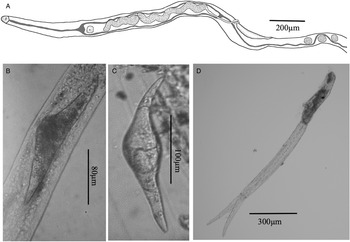
Diagnosis: Adult male (Fig. 1; measurements Table 3). Body uniform length except wider at gynecophoric canal and spatulate posterior. Tegument rugose except spinose ventral sucker and half inner surface of gynecophoric canal (Fig. 1A). Spines not observed on genital pore or oral sucker. Oral opening subterminal, ventral; intestinal bifurcation immediately anterior to ventral sucker; cecal reunion between the posterior external seminal vesicle and anterior to the gynecophoric canal (Fig. 1A), single caecum terminates close to the posterior end of the body. Testes spherical or slightly elliptical, beginning posterior to the gynecophoric canal arranged both in straight row or zig-zag between caecum, extending almost to end of reunited caecum. Seminal vesicle undulates, divided into external and internal portion occupying most space between ventral sucker and gynecophoric canal (Fig. 1A). Ejaculatory duct at posterior end of internal seminal vesicle, muscular until close to genital pore were thin-walled and terminates with muscular bulb. Also see Davis (Reference Davis2006a). Adult female (n = 1; measurements Table 3). Fragments of single female recovered, without distinguishable features. Eggs, like most visceral species in Clade Q (sensu Brant and Loker, Reference Brant and Loker2009), spindle-shaped, with one pole longer than other (Fig. 1B). Cercariae (Fig. 1C; measurements Table 4). Cercariae (n = 2) body 290–310 μm in length, two eyespots and large muscular anterior organ; tail stem 460–470 μm in length, two furcae 240–250 μm in length but finfolds not observed. No live specimens observed for flame cell counts. Upon emergence from snail, cercariae swim towards the strongest light source and attach to sides or bottom of well with their ventral sucker.
Morphology of Trichobilharzia longicauda (A) anterior portion of adult male, (B) eggs from feces, (C) cercaria from a natural infection of Austropeplea tomentosa.

Morphological comparisons of the adult worms and cercariae

OS, oral sucker; VS, ventral sucker; CR, cecal reunion; GC, gynaecophoric canal; ESV/ISV, external/internal seminal vesicle; exp, experimental.
Specimens from this study in bold. Measurements in micrometers unless otherwise designated.
Comparative measurements of cercariae

Specimens from this study in bold.
Remarks: Trichobilharzia longicauda can be distinguished from all the other described species of Trichobilharzia, and from the new species described in the present work, most notably by the length of the gynecophoric canal (1390–1470 μm). The gynecophoric canal is long relative to other species except for T. anatina Fain, Reference Fain1956 from Ruanda-Burundi (1300–1500 μm), which was found in the intestinal veins of Anas undulata. The cecal reunion, a relatively stable distinguishing feature (Fain, Reference Fain1956; Blair and Islam, Reference Blair and Islam1983; Horák et al., Reference Horák, Kolárová and Adema2002; Rudolfová et al., Reference Rudolfová, Hampl, Bayssade-Dufour, Lockyer, Littlewood and Horák2005; Brant and Loker, Reference Brant and Loker2009), is between the seminal vesicle and the gynecophoric canal in T. longicauda, whereas in T. anatina, it is located between the internal and external seminal vesicles. Unfortunately, there were no eggs recovered for T. anatina for comparison. The prevalence of T. longicauda in Ay. novaeseelandiae examined from Lake Wanaka was 91% (20/22) and 1.3% (13/1000) in Au. tomentosa. In 12 ducks both the nasal and the visceral species were present.
Type host (definitive): Aythya novaeseelandiae (Gmelin, 1789)
Site in definitive host: hepatic portal and mesenteric veins
Type host (intermediate): Austropeplea tomentosa (L. Pfeiffer, 1855)
Type locality: Bremner Bay, Lake Wanaka, New Zealand
Type specimen: Neotype an adult male MSB:Para:31803
Paratypes: fragments of males and females in ethanol and on slides MSB:Para:31802.
Vouchers: Adult worms-MSB:Para:24866, 31065; Cercariae-MSB:Para:29085, 24894, 24896, 24897; snail hosts-MSB:Host:23258, 21319, 21320.
All type and voucher specimens deposited in the Museum of Southwestern Biology Division of Parasites.
Etymology: The species is named after the original cercarial description, Cercaria longicauda, by Macfarlane (Reference Macfarlane1944).
Species: Trichobilharzia novaeseelandiae n. sp. Davis and Brant
Diagnosis: Adult male (Fig. 2; measurements Table 3). Body uniform length except at gynecophoric canal and spatulate posterior extremity. Tegument rugose except spinose oral and ventral sucker and inner surface of gynecophoric canal (Fig. 2A). Spines not observed on genital pore; oral opening subterminal, ventral; intestinal bifurcation immediately anterior to ventral sucker; cecal reunion between posterior external seminal vesicle and anterior to gynecophoric canal, single caecum terminates close to posterior end of body (Fig. 2A). Testes spherical or slightly elliptical beginning posterior to gynecophoric canal arranged in straight row extending almost to end of caecum. Seminal vesicle undulates, divided into external and internal portion occupying most of the area between ventral sucker and gynecophoric canal. Ejaculatory duct at posterior end of internal seminal vesicle, muscular until close to genital pore where thin-walled. Adult female (measurements Table 3). Fragments of females recovered, without distinguishable features. Eggs, as for most nasal species, sigmoid or boomerang shaped, with long polar ends (Fig. 2B and C). Cercariae (Fig. 2D; measurements Table 4). Cercaria (n = 3) body length 275–350 μm, two eyespots, large muscular anterior organ; tail stem length 375–470 μm, two furcae length 187–220 μm; finfolds not observed. No live specimens observed for flame cell counts. Upon emergence from snail, cercariae swim towards the strongest light source and attach to sides or bottom of well with their ventral sucker, and body flexed dorsally.
Morphology of Trichobilharzia novaeseelandiae n. sp. (A) anterior portion of adult male, (B) eggs in utero, (C) eggs from feces, (D) cercaria from a natural infection of Austropeplea tomentosa.

Remarks: Trichobilharzia novaeseelandiae n. sp. can be distinguished from six of the eight nasal species of Trichobilharzia described from Ruanda-Burundi and Australia by the position of the cecal reunion between the internal seminal vesicle and gynecophoric canal, vs between the internal and external seminal vesicles in four of the African species (T. nasicola Fain, Reference Fain1956; T. rodhaini Fain, Reference Fain1956; T. spinulata Fain, Reference Fain1956, T. duboisi Fain, Reference Fain1959; it was not observed in T. aureliani Fain, Reference Fain1956) and one Australian species (T. arcuata Islam, Reference Islam1986). The new species is closest to T. regenti Horák et al., Reference Horák, Kolárová and Dvořák1998 from Europe, T. aureliani Fain, Reference Fain1956 from Rwanda, and T. australis Blair and Islam, Reference Blair and Islam1983 from Australia. The new species is different from T. regenti by tail morphology, which is broadened, and coil shaped (see Fig. 1 in Horák et al., Reference Horák, Kolárová and Dvořák1998) and genetically (Fig. 3), otherwise they are morphologically very similar. The differences in adult male worms between this new species and T. australis and T. aureliani are not as distinguishable. The three species are quite similar in overall length/proportion and character of the gynecophoric canal, position of cecal reunion (except where observed), overall shape and size of the eggs; sigmoid/boomerang and location of spines. The overall proportional measurements for T. australis are different from the new species here in that the former are smaller and were measured from live specimens, which tend to be larger than fixed specimens. Measurements of the new species here were based on specimens preserved in both 80% ethanol and 10% formalin, and thus are proportionally smaller than live specimens. The prevalence of T. novaeseelandiae n. sp. in Ay. novaseeladiae examined from Lake Wanaka was 100% (12/12) and 1.3% (13/1000) in Au. tomentosa. In 12 ducks both the nasal and the visceral species were present.
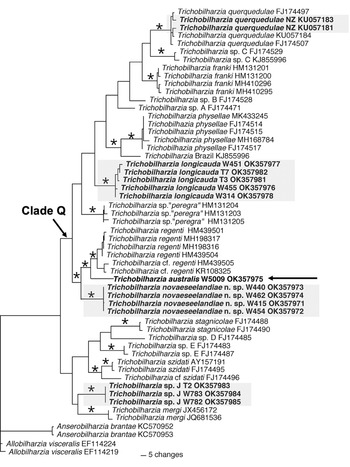
Phylogenetic tree based on cox1 sequences placing the New Zealand samples among available sequences of Trichobilharzia species. Specimens from this study are in bold and those from New Zealand are in grey boxes. Clade Q sensu Brant and Loker (Reference Brant and Loker2009). Black arrow points to the position of the Australian nasal species, relative to the new species from this study. The ‘*’ represents significant (values lower than 0.95 are not shown) posterior probability support for the Bayesian analysis. GenBank accession numbers follow the taxon names.

Type host (definitive): Aythya novaeseelandiae (Gmelin, 1789)
Site in definitive host: nasal mucosa
Type locality: Glendhu Bay, Lake Wanaka, New Zealand
Type host (intermediate) Austropeplea tomentosa (L. Pfeiffer, 1855)
Type locality: Bremner Bay, Lake Wanaka, New Zealand
Type specimens: Holotype MSB:Para:31072 that includes anterior part of male worm that ends about 20 testes posterior to the gynecophoric canal.
Paratypes: adult worm fragments MSB:Para: 31071
Vouchers: Adult worms-MSB:Para:25489, 31069; Cercariae-MSB:Para:24892, 24893, 25494, 31070; snail hosts-MSB:Host:21253, 21316, 21317.
All type and voucher specimens deposited in the Museum of Southwestern Biology Division of Parasites.
Etymology: The species is named both for the Latin for New Zealand as well as the specific epithet of the type host, Aythya novaeseelandiae.
Species: Trichobilharzia querquedulae (McLeod, 1937)
Remarks: Trichobilharzia querquedulae was found in 7/7 S. rhynchotis examined, a prevalence similar to that in its North American hosts (see Ebbs et al., Reference Ebbs, Loker, Davis, Flores, Veleizan and Brant2016). Mostly fragments of adult worms were recovered and slides were not made. The snail host remains unknown.
Host (definitive): Spatula rhynchotis (Latham, 1801)
Site in definitive host: hepatic portal and mesenteric veins
Locality: Lake Wanaka, New Zealand
Vouchers: Adult worms-MSB:Para:20792, 20793, 20794, 24887, 24888, 29072, 31066.
All type and voucher specimens deposited in the Museum of Southwestern Biology Division of Parasites
Taxon: Trichobilharzia sp. J
Diagnosis: (measurements Table 4). Cercaria (n = 3) body length 230–260 μm, two eyespots, large muscular anterior organ; tail stem length 310–330 μm, two furcae length 150–170 μm; finfolds not observed. No live specimens observed for flame cell counts and too few cercariae for reasonable images.
Remarks: This species of Trichobilharzia was found only as cercariae in the snail host. The behavior of these cercariae was not recorded. They were smaller than other cercariae of Trichobilharzia described from Australia and New Zealand, except for Trichobilharzia parocellata Islam and Copeman, Reference Islam and Copeman1986. Cercariae of T. parocellata were measured live by those authors, but if they had been measured in ethanol, the size might be more like that of the species found in New Zealand (Table 4). In the field, distinguishing this species from cercariae of T. novaeseelandiae n. sp. will be difficult as the overall size and proportions are similar. But the cercariae of T. longicauda overall is larger than this cercariae, most notably the length of the tail (Table 4). The prevalence of this species was 4/1000 (0.4%) Austropeplea tomentosa in Bremner Bay.
Host (intermediate): Austropeplea tomentosa (L. Pfeiffer, 1855)
Locality: Bremner Bay, Lake Wanaka, New Zealand
Vouchers: Cercariae-MSB:Para:24889, 24890, 24891, 24895. Snail hosts-MSB:Host:21315-21315, 21318.
All type and voucher specimens deposited in the Museum of Southwestern Biology Division of Parasites
Phylogenetic results
The phylogenetic results of both the mitochondrial cox1 (Fig. 3) and the nuclear 28S and ITS trees (nuclear DNA trees not shown) indicate that our samples from Australia and New Zealand came from four species of Trichobilharzia, three of which did not group with other species in the trees (Fig. 3). Trichobilharzia querquedulae from Spatula rhynchotis grouped with the other specimens of T. querquedulae from the Americas and South Africa as a monophyletic group (also see Ebbs et al., Reference Ebbs, Loker, Davis, Flores, Veleizan and Brant2016). Trichobilharzia longicauda and T. novaeseelandiae n. sp. formed unique monophyletic groups to the exclusion of any other genetic lineage available, thus supporting their status as distinct species, both falling within Clade Q (sensu Brant and Loker, Reference Brant and Loker2009). The species that occur in the nasal mucosa of waterfowl, T. regenti, T. cf. regenti, and the new species described here, T. novaeseelandiae n. sp. (Fig. 3) also form a clade. This clade also includes a sequence putatively from T. australis, which is distinct from the new species. The nasal species T. australis was first cycled through lab-reared Austropeplea lessoni in northeastern Australia (Blair and Ottesen, Reference Blair and Ottesen1979; Blair and Islam, Reference Blair and Islam1983). This species was also found in wild snails and used successfully to infect lab-reared ducks (Blair and Ottesen, Reference Blair and Ottesen1979). The fourth lineage from Lake Wanaka comprised only of cercariae, fell outside of Clade Q and clustered with T. stagnicolae, T. szidati and T. mergi but remains undescribed.
Pairwise comparisons of cox1 uncorrected p-distances among the species of Trichobilharzia are given in Table 5. This analysis involved 55 nucleotide sequences. All ambiguous positions were removed for each sequence pair (pairwise deletion option). The final dataset included 552 positions. Evolutionary analyses were conducted in MEGA X (Kumar et al., Reference Kumar, Stecher, Li, Knyaz and Tamura2018; Stecher et al., Reference Stecher, Tamura and Kumar2020). These values are used as a proxy for species delineations: at least within avian schistosomes uncorrected p-distances seem consistent across studies for intra- and interspecific comparisons. Most species differ from others by at least 10–13% different, except for the nasal species; T. novaeseelandiae n. sp. and T. regenti, which are 8% different and T. australis and T. regenti, which are only 5.4% different. A provisional value of <5% for partial cox1 sequences in schistosomes is often used where species designations might become questionable without further data (Vilas et al., Reference Vilas, Criscione and Blouin2005; Brant and Loker, Reference Brant and Loker2009; Ebbs et al., Reference Ebbs, Loker, Davis, Flores, Veleizan and Brant2016; Fakhar et al., Reference Fakhar, Ghobaditara, Brant, Karamian, Gohardehi and Bastani2016). Unfortunately, there were no morphologically diagnosable fragments of T. australis available to us.
The average uncorrected ‘p’ distances within among species of Trichobilharzia based on partial cox1 sequences

Samples from this study in bold. ‘–’ comparison was not calculated.
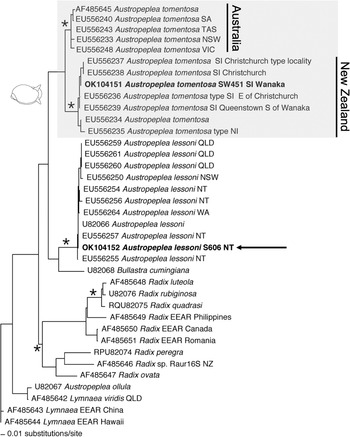
The cox1 did not amplify for any of the snail samples, and only two snails worked for the 16S (Fig. 4; also see Puslednik et al., Reference Puslednik, Ponder, Dowton and Davis2009 Fig. 4). There is still debate on the taxonomy of Austropeplea Cotton, 1942. However, Au. tomentosa is the type species and was originally described from New Zealand. Our New Zealand sequence (OK104151) grouped with sequences from specimens collected from the locality of Au. tomentosa (EU556236-37) in New Zealand (Puslednik et al., Reference Puslednik, Ponder, Dowton and Davis2009). Snails were not collected from the type locality of the putative T. australis, but specimens of Au. lessoni were available from Northern Territory, Australia (cox1 sequence OK104152), which grouped within the other conspecifics. Puslednik et al. (Reference Puslednik, Ponder, Dowton and Davis2009) had a specimen of Au. lessoni from the general area of the type locality for T. australis (EU556259), suggesting that the snail host was likely Au. lessoni, as earlier defined by morphological examination (Blair and Ottesen, Reference Blair and Ottesen1979; Blair and Islam, Reference Blair and Islam1983).
Phylogenetic tree based on mitochondrial 16S sequences placing the New Zealand snail sample within Lymnaeidae. Specimens from this study are in bold. Austropeplea tomentosa specimens are in the grey box that includes two clades, one with specimens from Australia (black arrow) and the other clade from New Zealand. The ‘*’ represents significant posterior probability support (up to 0.95) for the Bayesian analysis. GenBank accession numbers precede the taxon names. SA, South Australia; TAS, Tasmania; NSW, New South Wales; VIC, Victoria; QLD, Queensland; NT, Northern Territory; WA, West Australia; NZ, New Zealand; SI, South Island; NI, North Island.

Discussion
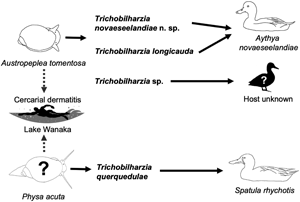
This is the first effort to characterize the life cycle, morphology and genetic diversity of avian schistosomes in New Zealand (Fig. 5). The diversity of Trichobilharzia in the snail host was notable since three of the four species found cycle through the same species of snail, Austropeplea tomentosa. It is not yet known what snail host T. querquedulae uses. In North America, this schistosome species cycles through Physa gyrina and P. acuta (Brant and Loker, Reference Brant and Loker2009). Although P. acuta, a widespread invasive snail (Ebbs et al., Reference Ebbs, Loker and Brant2018), has been found in New Zealand since at least the 1940s (Macfarlane, Reference Macfarlane1944; Featherston and McDonald, Reference Featherston and McDonald1988), thus far no infected snails have been found, in this or previous studies (Table 1). Based on the molecular phylogenetics, all four species of schistosomes were unequivocally placed within the genus Trichobilharzia (Fig. 3). It is also the case in Australia, that Au. lessoni is host to three described species of Trichobilharzia, two from the nasal tissues and one from the viscera (Macfarlane, Reference Macfarlane1952; Blair and Ottesen, Reference Blair and Ottesen1979; Blair and Islam, Reference Blair and Islam1983; Islam, Reference Islam1986). Morphology alone did not provide sufficient diagnosable features to recognize the species diversity in Lake Wanaka (Figs 1 and 2). Combinations of both adult and larval features, intermediate host use, and more significantly, genetic data, contributed to understanding the species diversity in the snails and ducks.
Life cycle of species of Trichobilharzia in Lake Wanaka.

The definitive hosts of the nasal species T. australis and T. novaeseelandiae n. sp. are Anseriformes (ducks, geese and swans) and for T. aureliani are Podicipediformes (grebes), but bird host-specificity is not known, except for T. regenti. Spanning Eurasia, several species of ducks, geese and swans are hosts for T. regenti or worms that are genetically very similar, but thus far other orders of birds examined did not have T. regenti (Rudolfová et al., Reference Rudolfová, Sitko and Horák2002, Reference Rudolfová, Hampl, Bayssade-Dufour, Lockyer, Littlewood and Horák2005; Jouet et al., Reference Jouet, Ferté, Depaquit, Rudolfová, Latour, Zanella, Kaltenback and Léger2008, Reference Jouet, Skírnisson, Kolárová and Ferté2010b, Maleki et al., Reference Maleki, Athari, Haghighi, Taghipour, Gohardehi and Tabaei2012; Skírnisson et al., Reference Skírnisson, Kolárová, Horák, Ferté and Jouet2012; Fakhar et al., Reference Fakhar, Ghobaditara, Brant, Karamian, Gohardehi and Bastani2016; Ashrafi et al., Reference Ashrafi, Nouroosta, Sharifdini, Mahmoudi, Rahmati and Brant2018). Possibly, specificity for the definitive host might separate T. novaeseelandiae n. sp. from T. aureliani in the absence of other recorded features. To date, there are no named, but one genetically confirmed species of Trichobilharzia from snails from an African country (Moema et al., Reference Moema, King and Rakgole2019). There have been three reports of putative Trichobilharzia sp. from Lymnaea natalensis from South Africa (Appleton, Reference Appleton1984 – Trichobilharzia type 1; Moema et al., Reference Moema, King and Baker2008) that were also responsible for causing HCD. Moema et al. (Reference Moema, King and Rakgole2019) genetically confirmed a species of Trichobilharzia from Lymnaea natalensis but provided only 28S sequence data and thus it is not possible to know to what species clade it might belong. However, in the 28S gene tree, the specimen from L. natalensis did not group in Clade Q (data not shown). Avian schistosomes usually have a narrow range of intermediate host snails, even if several congeners can serve as hosts. It might be that, in the absence of the preferred snail species, these schistosomes can use related species (e.g. Manzoli et al., Reference Manzoli, Saravia-Pietropaolo, Arce, Percara and Beldomenico2021), which could be the case for T. regenti (in Europe uses R. balthica) and T. franki (in Europe uses R. auricularia) which are also found in domestic and wild ducks in Iran (Fakhar et al., Reference Fakhar, Ghobaditara, Brant, Karamian, Gohardehi and Bastani2016; Ashrafi et al., Reference Ashrafi, Nouroosta, Sharifdini, Mahmoudi, Rahmati and Brant2018, Reference Ashrafi, Sharifdini, Darjani and Brant2021). Also, for avian schistosome species, as far as is known, rarely do species in more than one genus or family of snail serve as natural hosts. Thus, likely the schistosome species from Austropeplea may be distinct from those using species of Radix or Lymnaea, snails that are phylogenetically distant (Vinarski et al., Reference Vinarski, Aksenova and Bolotov2020). The definitive host of T. longicauda is Ay. novaeseelandiae, but it is not known if other ducks can also host this species, or the un-named cercaria species in this study. Species of Trichobilharzia have previously been found in visceral veins/liver of An. superciliosa, S. rhynchotis (likely T. querquedulae) and An. platyrhynchos in New Zealand, but were not described (Featherstone and McDonald, Reference Featherston and McDonald1988; Rind, Reference Rind1991; Davis, Reference Davis2006b). The duck species listed above can all be found feeding in the shallow waters where most of the snail hosts live.
The biogeography of species of Trichobilharzia is still a way from being understood until more specimens and their hosts, particularly from the African continent, are revealed. Certainly, one significant means of geographic movement for birds other than migration is introductions of ducks and geese for sport hunting. In New Zealand, Branta canadensis and Anas platyrhynchos were introduced as game birds starting in the early 1900s sourced from both the UK and the USA (Spurr et al., Reference Spurr, Coleman and Whenua2005; Dyer and Williams, Reference Dyer and Williams2010; Guay et al., Reference Guay, Williams and Robinson2015). These birds could have been sources of schistosomes at that time, though most of them were raised in captivity. In the UK, the prevalence of Trichobilharzia particularly in Anseriformes is not as well-known as in continental Europe, even though HCD in the UK has been reported (e.g. Fraser et al., Reference Fraser, Allan, Roworth, Smith and Holme2009; Morley, Reference Morley2009; Lawton et al., Reference Lawton, Lim, Dukes, Cook, Walker and Kirk2014). To date, only one species of avian schistosome (T. franki) has been confirmed in the UK from snails but there have been no reports from An. platyrhynchos or B. canadensis (Lawton et al., Reference Lawton, Lim, Dukes, Cook, Walker and Kirk2014). In the USA, to date there have been no nasal species recovered from waterfowl, but a visceral species (T. physellae) has been found in An. platyrhynchos (Brant and Loker, Reference Brant and Loker2009) and Anserobilharzia brantae has been recovered from B. canadensis (Brant et al., Reference Brant, Jouet, Ferté and Loker2013). What is notable is that most continents appear to have their own endemic species of Trichobilharzia but also at least one species that is more geographically widespread, most likely hosted by migratory birds.
Epidemiology of HCD on South Island of New Zealand
For this study, samples were collected in the same areas as previous workers (Macfarlane, Reference Macfarlane1944; Rind, Reference Rind1991; Featherston et al., Reference Featherston, Weeks and Featherston1988). Three species of Trichobilharzia utilizing Au. tomentosa were found. It is not possible to know if all three species were present when research was first conducted on Lake Wanaka. However, these three species each belongs to a separate clade, suggesting that they are endemic in Au. tomentosa in New Zealand. The single sample from Australia was most closely related to T. regenti, rather than to the nasal species from New Zealand. New samples that include a genetic characterization of species from Africa and more from Australia will weave a more comprehensive biogeographic history and confirm the presence of endemic species in Australia and New Zealand.
Macfarlane (Reference Macfarlane1944) stated that prior to the 1920s there were few complaints of HCD, and by 1925 there were several cases a summer, but usually restricted to Roy's Bay on Lake Wanaka. At the time of his study, cases were from the south end of Lake Wanaka, and it was assumed the definitive host was a vertebrate, likely a water bird. By 1949, Macfarlane (Reference Macfarlane1949) expanded his description of the aetiological agent, Cercaria longicauda, from Au. tomentosa and noted that the snails were associated with the aquatic plants, Isoetes sp. and Juncus sp., as were the ducks, Ay. novaeseelandiae and An. superciliosa, which spent most of the summer in those plant beds. About 40 years later, Featherston et al. (Reference Featherston, Weeks and Featherston1988), after extensive surveys, listed the conditions they felt were the most important in the transmission dynamics of HCD on Lake Wanaka: (a) snails Au. tomentosa more than 3 mm long; (b) an aquatic plant often associated with the presence of Au. tomentosa, Isoetes alpinus; (c) sediment layer on the leaves of the I. alpinus; and (d) presence of the scaup, Ay. novaeseelandiae, which rest in great numbers in such a habitat. Bays of Lake Wanaka in previous years that were parasite-free still had snails present, but the scaup were absent; and (e) prevalence in snails was highest when temperatures were over 13°C (Featherston and McDonald, Reference Featherston and McDonald1988; Featherston et al., Reference Featherston, Weeks and Featherston1988). Over time it was found that more and more snails were infected, which correlated with the scaup moving into those areas, perhaps in response to needing a refuge from the increased recreational use of the lake. However, Davis (Reference Davis2000) did not find that Au. tomentosa had a predilection for any plant species and found snails grazing in the absence of macroscopic plants. Though other species of schistosomes (unknown spp. of Dendritobilharzia, Ornithobilharzia) have been found in snails (Gyraulus sp.) and ducks in New Zealand, thus far only cercariae from Au. tomentosa have been implicated in outbreaks (Rind, Reference Rind1974, Reference Rind1991; Davis, Reference Davis2006b).
Conclusion
Four species of Trichobilharzia occur in ducks on Lake Wanaka. Three of the schistosome species use the same snail host, Austropeplea tomentosa. The New Zealand scaup, Aythya novaeseelandiae, was host to Trichobilharzia longicauda that is redescribed here and to a new species of nasal schistosome, T. novaeseelandiae n. sp. The New Zealand shoveler (Spatula rhynchotis) was also examined for both nasal and visceral schistosomes, but had only T. querquedulae, a species once thought to only occur in North American species of Spatula, but has now been found in New Zealand, Argentina and South Africa (Ebbs et al., Reference Ebbs, Loker, Davis, Flores, Veleizan and Brant2016). Only cercariae were obtained of the fourth species, and thus the bird host is unknown. Future efforts should be made to characterize the transmission dynamics of each species and its relative contribution to outbreaks of HCD.
Acknowledgements
Thank you for the cooperation at the New Zealand Fish and Game and Hawkes Bay District Council who facilitated the collections of ducks and snails.
Financial support
Field collections for this research received no specific grant from any funding agency, commercial or not-for-profit sectors and were mostly conducted by NED in New Zealand and DB in Australia. The University of New Mexico supported the work done in New Mexico through a National Science Foundation grant to SVB (DEB 1021427) and funds provided by the College of Arts and Sciences at UNM. Technical assistance at UNM Molecular Biology Facility was supported by NIH grant 1P20RR18754 from the Institute Development Award program of the National Center for Research Resources.
Conflict of interest
None.