Pharmacotherapeutic strategies for the management of paediatric heart failure are largely supported by extrapolation of adult data and clinician expertise. Therefore, the prescribing of unlicensed and off-label drugs is predominant in this setting.Reference Bajcetic, Jelisavcic and Mitrovic1–Reference Kirk, Dipchand and Rosenthal3 A recent Europe-wide survey suggests that this translates into substantial variability in clinical practice. This lack of standardisation is a potential threat to the safety and quality of the medical care provided.4, Reference Kennedy, Leathley and Hughes5
It is well known that conducting randomised clinical trials in the paediatric heart failure population poses many challenges and is often not possible.Reference Li, Colan and Sleeper6, Reference Rossano and Shaddy7 Hence it is vital to consider alternative approaches to achieve safe and effective therapy. In this regard, the potential of qualified opinion has been underused, with few structured debates and expert consensus documents having been published. However, insights of experts on an issue can be a valuable contribution for decision-making when evidence is scarce or contradictory.Reference Fick, Cooper and Wade8–Reference Jones and Hunter10
The Delphi technique is a method to enable structured group discussions and has previously been used in other fields of healthcare research.Reference Fick, Cooper and Wade8, Reference Gurvitz, Marelli and Mangione-Smith9, Reference Hasson, Keeney and McKenna11–Reference Keeney, Hasson and McKenna13 It is a means of “eliciting and refining group judgements” and “obtaining the most reliable consensus of opinion”Reference Dalkey14 that is based on the assumption that group opinion is more valid than individual opinion when the issue is one where exact knowledge is not available.Reference Keeney, Hasson and McKenna13 The key features of the method are the anonymity between participants with controlled feedback provided in a structured manner.Reference Diamond, Grant and Feldman15 It allows the inclusion of individuals across diverse locations while minimising the main shortcomings of traditional consensus methods: the influence of dominant individuals, irrelevant communications, and group pressure.Reference Dalkey and Helmer-Hirschberg16
The study presented here was conducted as part of the European Commission funded “Labelling of Enalapril from Neonates to Adolescents” project (https://www.lena-med.eu). Our aim was to conduct a formal discussion, using the Delphi technique, among an expert group of paediatric cardiology physicians, on controversial aspects regarding the pharmacological management of children with heart failure which had been predominantly identified through a previous Europe-wide survey. Special focus was placed on angiotensin-converting-enzyme-inhibitors. The intention was to gain an understanding of the experts’ opinions, encourage debate, facilitate consensus, and highlight areas of agreement and disagreement.
Materials and methods
Overall study design
The study was designed taking into consideration relevant literature on Delphi research methodology and publications applying this technique to health science research.Reference Fick, Cooper and Wade8, Reference Hasson, Keeney and McKenna11–Reference Keeney, Hasson and McKenna13, Reference Diamond, Grant and Feldman15, Reference Häder17–Reference Okoli and Pawlowski21 A two-round modified Delphi process design was chosen,Reference Häder17, Reference Hsu and Sandford19 whereby the panel of experts was given pre-selected items upon which to make a judgement.Reference Keeney, Hasson and McKenna13 This approach enables a greater efficiency in use of time than the traditional Delphi process, whilst reducing the risk of dropouts, and has been used extensively by others.Reference Fick, Cooper and Wade8, Reference Holt, Schmiedl and Thürmann12, Reference Medrano López, García-Guereta and Fernández Pineda20, Reference Hamzeh, Wamboldt and Weinberger22–Reference Meijer, Ihnenfeldt and Vermeulen24
Expert panel recruitment
The aim was to recruit an expert panel comprising 10–15 paediatricians with experience in the field of cardiology, preferably with representation of the four European geographical regions.Reference Fick, Cooper and Wade8, Reference Gurvitz, Marelli and Mangione-Smith9, Reference Okoli and Pawlowski21, Reference Delbecq, Ven and Gustafson25–27 Non-European experts were also considered. This panel size has been regarded as appropriate for Delphi processes where topics covered require experts with very specific knowledge.Reference Fick, Cooper and Wade8, Reference Gurvitz, Marelli and Mangione-Smith9, Reference Okoli and Pawlowski21, Reference Delbecq, Ven and Gustafson25–27 Physicians who had participated in the “European survey on the pharmacological management of paediatric heart failure”, or those known by the investigators via personal contact who were considered qualified for their knowledge and interest in the topic, were invited to participate via e-mail. Those invitees expressing their willingness to participate and who were available on the study dates participated in the study and formed the expert panel.
Questionnaire design and administration
Recommendations on survey and questionnaire design best practice were followed.Reference Keeney, Hasson and McKenna13, Reference Andres28, Reference Burns, Duffett and Kho29 Topics for the discussion were predominantly selected from areas of controversy identified in the “European Survey on the management of paediatric heart failure” – the paper where the results of this survey have been reported is available on open access in BMJ Paediatrics Open. The rationale for the selection of the contents is provided in Supplementary Table S1. These controversial topics were framed as statements – either affirmative or negative – containing a professional judgement or a clinical recommendation on any aspect of paediatric heart failure drug therapy. Participants were asked to rate their level of agreement with the survey statements by using 5-point Likert scales, the use of which is widely accepted.Reference Fick, Cooper and Wade8, Reference Holt, Schmiedl and Thürmann12, Reference Medrano López, García-Guereta and Fernández Pineda20, Reference Lozano, García-Cueto and Muñiz30 Each answer category was presented with a verbal label and a numeric descriptor: 1 = Strongly disagree, 2 = Disagree, 3 = Neither agree nor disagree, 4 = Agree, 5 = Strongly agree. A free text field in which participants could enter rationale and/or further comments to their answers accompanied each statement. Fourteen statements grouped under three categories were presented; Angiotensin-converting-enzyme-inhibitors: Considerations for optimal dosage; Angiotensin-converting-enzyme-inhibitors for the management of CHDs; Neurohumoral antagonists for the management of heart failure related to dilated cardiomyopathy. In addition, three demographic questions were posed. The questionnaire was peer reviewed at the investigators site. A pilot test was not deemed necessary since the questionnaire was largely based on a previously tested survey. Furthermore, wording from recognised guidelines was adopted when possible.
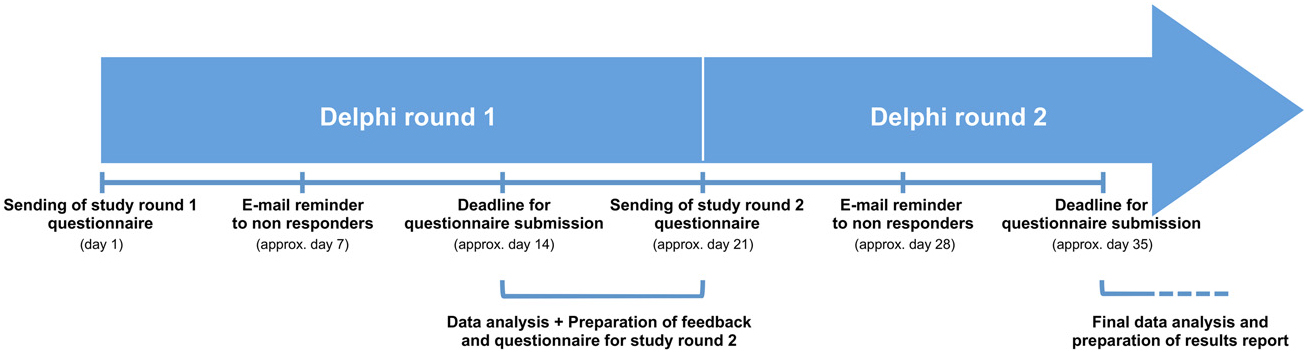
Prior to the beginning of the study, participants received written information about Delphi methodology and guidance on how to complete the process. The web-survey platform EvaSys® version 6.1 was used for the administration of the questionnaire, which was selected for its compliance with the European Union Data Protection Directive 95/46/EC. An individualised link to the questionnaire was sent by e-mail together with instructions on how to navigate through the survey. In the second study round, the experts were asked to re-evaluate those statements on which consensus had not been reached after the first round. Quantitative and qualitative feedback on the first round results accompanied each statement: a summary of Likert score rating, consensus evaluation, and rationale provided by participants supporting their responses.Reference Okoli and Pawlowski21, Reference Schmidt31 The participants’ own rating given to the statement in the previous round was not presented as part of the feedback.Reference Häder17 Additionally, the participants were provided with information – background or supporting evidence to statements – that could be relevant to facilitate the discussion. The identity of the experts in the panel remained unknown to one another throughout the study duration. A complete copy of the questionnaire can be found in Supplementary Figure S1. The study timeline is presented in Figure 1.
Study timeline.

Data collection, analysis, and interpretation
Data were collected between July and August 2015. To minimise errors during data processing, data extraction from the EvaSys® platform and preparation of ready-to-analyse data were conducted by two researchers independently, and the results were checked for consistency. Data analysis was performed with R® version 3.2.3 and R-Studio® version 099.465. Charts presented in this manuscript were created in Excel® v.16.10.
The level of consensus among experts on each of the statements to be judged was evaluated by calculating the mean 5-point Likert scale score and the corresponding 95% confidence interval after each study round. Consensus was defined as follows: Reference Fick, Cooper and Wade8, Reference Holt, Schmiedl and Thürmann12, Reference Medrano López, García-Guereta and Fernández Pineda20
Upper bounder of confidence interval <3: consensus exists among experts that a statement is false.
Lower bounder of confidence interval >3: consensus exists among experts that a statement is true.
Confidence interval includes the 3: no consensus exists among experts on whether a statement is or not true.
Ethics approval
This study was conducted in compliance with the European Union Data Protection Directive 95/46/EC and was approved by Institutional Ethics Committee and Data Protection Officer at the Heinrich-Heine-University Düsseldorf, Germany. Electronic informed consent was obtained from each participant via the EvaSys® platform.
Results
Study population
A total of 37 paediatricians with experience in the field of cardiology were invited to participate in the study. Of the 14 that agreed to take part, one did not return the completed questionnaire within the pre-established deadline in the first study round and was therefore excluded from the study; the remaining 13 physicians completed both rounds of the Delphi process and were finally considered for analysis. Experts from Austria (1), Belgium (1), Bosnia and Herzegovina (1), France (1), Germany (3), Greece (1), the Netherlands (1), Russia (1), Serbia (1), the United Kingdom (1), and the United States of America (1) participated. All four geographical regions of Europe were represented. Of the 13 participants, 12 had a working experience in the field of paediatric cardiology of more than 10 years; the remaining one participant had experience of between 5 and 10 years. All the physicians but one worked in a specific paediatric cardiology unit; the latter had retired but had 35 years’ experience of working in a university hospital.
Results of the Delphi process
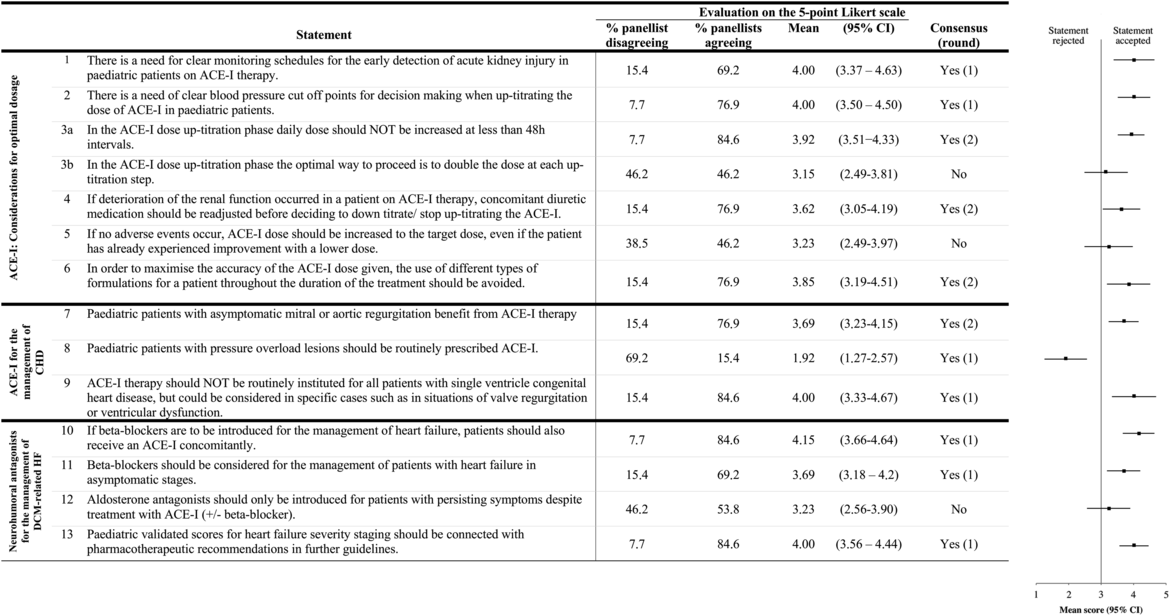
Overall, after the two rounds of questions, agreement on 11 of the 14 statements presented for discussion (79%) was achieved according to the pre-established criteria. In the first round of the process, consensus on 7 of the 14 statements was achieved, with six being accepted and one rejected. In the second study round, consensus on four further statements was achieved (all accepted). Agreement on the three remaining statements was not reached due to polarisation of opinions for and against the veracity of the phrases. Detailed global results – evaluation of statements on the 5-point Likert scale and the corresponding statistics – are presented in the table and in Figure 2. Figure 3 shows the distribution of opinions in the first and second study rounds on the four statements, upon which consensus was reached in the second study round.
Global results of the Delphi process. Likert scale: 1 = Strongly disagree, 2 = Disagree, 3 = Neither agree nor disagree, 4 = Agree, 5 = Strongly agree. ▪ Mean 5-point Likert scale score. ACE-I, angiotensin-converting-enzyme-inhibitor; CHD, congenital heart diseases; CI, confidence interval; DCM, dilated cardiomyopathy; HF, heart failure.

Statements upon which consensus was reached in the second study round scored in the 5-point Likert scale in the Delphi process rounds 1 and 2. ACE-I, angiotensin-converting-enzyme-inhibitor.

Discussion
A series of controversial aspects relating to paediatric heart failure therapy has been discussed in this Delphi study, and the opinions of an international group of 13 physicians with experience in the field of paediatric cardiology are reflected in this document. The expert panel showed consensus in their professional judgement on 11 of the 14 statements presented for discussion according to the pre-established criteria.
Statements upon which consensus was achieved highlight areas where closer views and common interests exist among the experts consulted. Some of those statements point to topics relevant to the standardisation of the therapy that the panel agreed were of importance: developing guidance on the approach towards adverse events in the context of angiotensin-converting-enzyme-inhibitors therapy, promoting the correlation of paediatric validated scores with therapeutic recommendations in further guidelines, and reducing heterogeneity associated with unlicensed angiotensin-converting-enzyme-inhibitors formulations.
Hypotension and deterioration of renal function are the most frequently reported adverse events related to angiotensin-converting-enzyme-inhibitors in paediatric heart failure patients.Reference van der Meulen, Dalinghaus and Burch32 However, no standardised criteria on how to best monitor patients or define critical cut-off values exist, and few specific recommendations for problem-solving when these adverse events occur have been published.Reference Kantor, Lougheed and Dancea2, Reference Taketomo, Hodding and Kraus33 Results of our previous survey indicate that paediatric patients are being subjected to variable approaches for managing these aspects (Supplementary Table S1). The results of the Delphi process showed agreement among the expert panel in the need to fill this gap (statements 1 and 2). While it is true that current paediatric data do not allow the generation of definitive recommendations, paediatric heart failure societies and working groups may be motivated to develop guidance that compiles the best knowledge available, to facilitate a standardised approach to therapy.
Agreement was also achieved on the relevance of linking treatment algorithms to validated paediatric heart failure severity scores (statement 13), which is not yet a standard. The use of self-developed or adult-adapted grading systems is frequent,Reference Kantor, Lougheed and Dancea2, Reference Kirk, Dipchand and Rosenthal3 and it seems that division of opinion exists among European paediatricians about their usefulness in everyday practice (Supplementary Table S1). Accurate grading of heart failure severity in children remains challenging, and paediatric-specific scoring systems that have been developed require further validation.Reference Ross34–Reference Hsu and Pearson37 However, despite limitations, promoting as far as possible the use of uniform paediatric-adapted definitions seems essential to move heart failure therapy into the realm of evidence-based medicine. This would facilitate the correct application of guideline recommendations, the evaluation of therapy-related outcomes, and the interpretation and performance of further research.
The results may also contribute to raising awareness of the potential consequences of the interchangeable use of different angiotensin-converting-enzyme-inhibitor formulations. The panel agreed on the importance of discouraging this practice (statement 6). It has been documented that unlicensed and manipulated preparations that are used to overcome the absence of licensed paediatric medicines are heterogeneous and may not be bioequivalent.Reference Mulla, Tofeig and Bu’Lock38, Reference Pabari, McDermott and Barlow39 Inconsistency in the rate and extent of absorption is likely to exist, and this may for example influence outcomes and cause variability in the duration of time needed to optimise therapy. In addition, the use of manipulated dosage forms can lead to inaccurate dosing. It is likely that many paediatric patients across Europe are exposed to this potential variability (Supplementary Table S1). This may also have an impact on the interpretation of published angiotensin-converting-enzyme-inhibitor efficacy and safety data, where information on the drug formulation and its administration is often not reported. The panel judgement supports the idea that the marketing of age-appropriate formulations would be beneficial.
The results also show specific therapeutic attitudes upon which consensus was achieved. These statements might trigger the sharing of data that are being recorded on a routine basis in clinical practice to evaluate the outcomes of agreed treatment strategies, which may help confirm their effectiveness and/or define best candidates for therapy. It has been recognised that large observational studies, databases, and registries, when well designed, could represent an alternative means by which to generate the much-needed clinical evidence.Reference Rossano and Shaddy7, Reference Gibbons, Gardner and Anderson40 The agreement on the veracity of these statements might also contribute to the efficient dissemination of relevant paediatric research to the physicians for whom this information is important, which has been found to be an area that needs to be improved.Reference Francke, Smit and de Veer41, Reference Zak, Hsu and Pemberton42 Three of these statements considered the role of angiotensin-converting-enzyme-inhibitors in the context of CHD. In their judgement, the panel discouraged routine use in patients with pressure overloading lesions (statement 8) and single ventricle physiology (statement 9). Even though the results of our previous survey suggest that the prescribing of angiotensin-converting-enzyme-inhibitors in single ventricle patients is still extensive (Supplementary Table S1), the authors of the Infant Single Ventricle Trial, the only large paediatric randomised controlled trial on angiotensin-converting-enzyme-inhibitors that has been published, concluded that their results did not support the routine use of enalapril in this scenario.Reference Hsu, Zak and Mahony43 The International Society for Heart and Lung Transplantation paediatric guideline recommendation in this regard, which we undertook as statement 9 for discussion, supports this conclusion.Reference Kirk, Dipchand and Rosenthal3 In contrast, the panel agreed in the second round of questions that children with valve regurgitation that are asymptomatic may benefit from angiotensin-converting-enzyme-inhibitor therapy (statement 7). Evidence indicates that adult patients with mitral and aortic regurgitation are good candidates for angiotensin-converting-enzyme-inhibitors only if symptoms and/or left ventricular dysfunction exist, and it seems that practice among European paediatricians is largely influenced by this (Supplementary Table S1). Data indicating benefit in paediatrics come from a small randomised controlled trial and several observational studies, all of which included only asymptomatic patients.Reference Alehan and Ozkutlu44–Reference Mori, Nakazawa and Tomimatsu46 This evidence is limited, but Li et al reported that a perceived lack of equipoise exists among paediatricians, which hinders the conduction of randomised controlled trials in this scenario.Reference Li, Colan and Sleeper6 Collaboration may contribute to the elucidation of patients’ subgroups whom would especially benefit.
The panel also agreed on the two statements regarding the use of beta-blockers in dilated cardiomyopathy-related heart failure. Consensus existed that beta-blockers should be considered in the therapy of asymptomatic children, and that they should be used in combination with an angiotensin-converting-enzyme-inhibitor (statements 10 and 11). In adults, a combination of beta-blocker with an angiotensin-converting-enzyme-inhibitor has proven benefit in asymptomatic patients with left ventricular dysfunction that have a history of myocardial infarction, although advantages when this is not the case are less clear and recommendations are not uniform.Reference Ponikowski, Voors and Anker47, Reference Yancy, Jessup and Bozkurt48 Paediatric data in this scenario are scarce and a marked division of opinion seems to exist among European paediatricians in this regard (Supplementary Table S1);Reference Alabed, Sabouni and Al Dakhoul49 however, the expert panel judgement supports the potential benefits of this practice.
The three non-consensus statements identified in this Delphi study may provide greater visibility of some aspects of clinical practice which have a high degree of disparity of opinions among physicians. Two of these are directly related to aspects of heart failure treatment that have great potential to influence the long-term benefits of therapy. The first relates to optimal angiotensin-converting-enzyme-inhibitor maintenance dose in paediatrics (statement 5). Some of the experts in the panel agreed that a target dose should be aimed for, while others considered that up-titration should be stopped once improvement is observed. This marked division of opinion is consistent with the results of our previous survey (Supplementary Table S1). Evidence in adults indicates that the efficacy of angiotensin-converting-enzyme-inhibitors in heart failure patients with left ventricular dysfunction in terms of mortality and hospitalisations reduction is closely related to dose level, and that these effects are explained by mechanisms that probably do not play an important role in the control of symptoms.Reference López-Sendón, Swedberg and McMurray50 Thus a response-based maintenance dose selection does not seem to be appropriate, and aiming towards the target doses used in pivotal clinical trials, or failing this, towards the highest tolerated dose, is recommended in adults.Reference Ponikowski, Voors and Anker47 On the other hand, unlike in adults, in paediatrics the origin of heart failure is very often multifactorial and not limited to ventricular dysfunction.Reference Hsu and Pearson37 No dose-effectiveness studies in paediatrics have established the existence of a target dose that produces benefits analogous to those that have been observed in adults and difficulties in achieving high angiotensin-converting-enzyme-inhibitor doses in the paediatric population have been reported.Reference Hsu, Zak and Mahony43 Clinicians may consider comparing outcomes in groups of patients treated according different strategies, which may help establish a common criterion to treat paediatric patients in the most effective way. The same approach would apply to the topic addressed in the second of these non-consensus statements, which relates to the timing of introduction of aldosterone antagonists (statement 12). Results of our previous survey (Supplementary Table S1) revealed that aldosterone antagonists are frequently prescribed to children as part of the initial therapy of symptomatic heart failure, perhaps for their potassium sparing diuretic. However, evidence in adults supports the use of low-dose aldosterone antagonists as add-on therapy in patients that remain symptomatic despite initial therapy to reduce mortality and hospitalisations.Reference Ponikowski, Voors and Anker47 Data in paediatrics in this regard are lacking. Some subgroups of paediatric patients have a marked poor prognosis, with a 5-year risk of death or cardiac transplantation of around 50%.Reference Towbin, Lowe and Colan51 It would therefore be prudent to maximise available expert knowledge to drive decisions regarding those treatment strategies.
Validity and limitations
The results of a Delphi process are based on a synthesis of the opinions of a group, meaning that from question to question, some of the individual experts would differ with the consensus view. Furthermore, “the existence of a consensus does not mean that the correct answer has been found”.Reference Hasson, Keeney and McKenna11 A Delphi process is not intended to provide definitive answers but is rather a means of maximising the benefits from having informed panels consider a problem.Reference Jones and Hunter10
No universally agreed guidelines on the use of the Delphi technique exist, but we have followed a thorough procedure for the design of the study and have reported with transparency all relevant methodological aspects. Characteristics of the expert panel members – paediatricians dedicated to cardiology, 92% working in hospital paediatric cardiology units and with more than 10 years of experience in the field with representation of all four regions of Europe – and the lack of dropouts in the second study round are positive indicators of the quality of our study.Reference Hsu and Sandford19 We asked 37 physicians to participate, assuming that only part of them would be willing or able to do it. The fact that only 35% of them finally agreed to be part of the expert panel does not compromise our study from the methodological point of view. The relevant response rate in a Delphi process, for its potential to bias the results, is that from the second study round with regard to the first round, which in our case was 100%. Even though it cannot be assured that a different group of physicians with expertise in paediatric cardiology would have produced the same results, findings from Duffield and Akins et al “indicate that the response characteristics of a small expert panel in a well-defined knowledge area are stable in light of augmented sampling”.Reference Akins, Tolson and Cole52, Reference Duffield53 Therefore, the larger the sample, the narrower the confidence interval determined based on this sample would have become. This implies that when considering our particular data, a larger expert panel would not have led to a different group decision concerning consensus/non-consensus statements.
This study has the limitations inherent to the Delphi technique.Reference Hasson, Keeney and McKenna11 It is also recognised that the study is limited by the simplified manner in which the statements presented for debate addressed topics of great complexity. An exhaustive questionnaire would have required considerable demands of time and effort to the participants, which would have compromised the feasibility of the study. The study participants were selected from different backgrounds to assure that no interest or pre-conceived opinion was likely to dominate. However, it should be noted that one of the participants was directly involved in a study whose results were very relevant to the discussion regarding the pertinence of angiotensin-converting-enzyme-inhibitors in single ventricle patients, and his opinion on that statement was not unexpected. Nevertheless, a different response by this participant would not have changed the global consensus results on that particular statement. Furthermore, one of the expert panel members was researcher in the “Labelling of Enalapril from Neonates to Adolescents” project and had been involved in previous discussions on study-relevant topics.
Conclusions
This Delphi process reflects the opinion of a 13-member expert panel of paediatricians experienced in cardiology. Consensus was achieved on 11 of the 14 statements addressing controversial aspects of paediatric heart failure therapy presented for discussion. Agreement existed on the importance of a set of topics relevant to the standardisation of therapy: developing guidance on the approach towards adverse events in the context of angiotensin-converting-enzyme-inhibitor therapy, promoting the correlation of paediatric validated scores with therapeutic recommendations in further guidelines, and reducing heterogeneity associated with unlicensed angiotensin-converting-enzyme-inhibitors formulations. Agreement was also achieved on discouraging routine use of angiotensin-converting-enzyme-inhibitors in single ventricle physiology and pressure overloading lesions, whereas the panel agreed that children with mitral or aortal regurgitation that are asymptomatic might benefit from therapy and that beta-blockers may be recommended for asymptomatic dilated cardiomyopathy patients. The marked division of opinion regarding the criterion according to which the optimal angiotensin-converting-enzyme-inhibitor maintenance dose should be established, and the role of aldosterone antagonists are remarkable, since the attitudes discussed in both statements have potential to influence the long-term benefits of therapy.
When evidence is scarce and contradictory, the insights of experts provide a valuable contribution to the decision-making process.Reference Fick, Cooper and Wade8–Reference Jones and Hunter10 The output from consensus approaches is rarely an end in itself, dissemination and further use of findings is the ultimate aim of such activities.Reference Jones and Hunter10 The external validation of results among specific expert groups may be an interesting next step. Our results might contribute to disseminate paediatric evidence available, especially with regard to angiotensin-converting-enzyme-inhibitors in single ventricle physiology, and serve to promote reducing unjustified variability in everyday practice. We have found areas of common thinking and motivation, which can provide a means of triggering scientific collaboration to cover the named areas of need, both in the form of data sharing in multicentre observational studies or through the creation of large databases to evaluate therapy outcomes and in developing consensus documents that approach specific topics in depth. Rather than producing any changes in clinical practice, the results can be seen as a guide for further research steps and a set of topics upon which scientific projects are more likely to be successfully implemented. The non-consensus statements might serve to give the topics discussed a greater visibility and encourage clinicians to compare outcomes in groups of patients treated according to different strategies, which may help establish the criterion to treat paediatric patients in the most effective way. Until therapeutic recommendations can be made on the basis of solid evidence derived from paediatric randomised controlled trials, we advocate making the best use of available knowledge. We hope this work will help raise awareness that, though not optimal, other research methods can contribute to advancing the goal of safe and effective heart failure pharmacotherapy in children.
Supplementary material
To view supplementary material for this article, please visit https://doi.org/10.1017/S1047951119000660.
Acknowledgements
We would like to thank all the physicians who formed the expert panel, who voluntarily participated, making the completion of this study possible. Among them are: Dr Zijo Begic (Department of Cardiology, Paediatric Clinic, Clinical Centre University of Sarajevo, Bosnia and Herzegovina), Prof. Damien Bonnet (Medical-Surgical Unit of Congenital and Paediatric Cardiology, Reference Centre Congenital Cardiac Malformations Complex – M3C, Necker-Enfants Malades Hospital, Paris, France), Dr Hans Breur (Department of Paediatric Cardiology, Paediatric Heart Centre, Wilhelmina Children’s Hospital/University Medical Center Utrecht), Prof. Dr Alfred Hager (Department of Paediatric Cardiology, German Heart Centre, Munich, Germany), Prof. Daphne T. Hsu (Department of Paediatric Cardiology, The Children’s Hospital at Montefiore, New York, United States of America), Prof. Ida Jovanovic (Department of Paediatric Cardiology, University Children’s Hospital, Belgrade, Serbia), Dr Françoise Mascart (Department of Paediatric Cardiology, Christian Hospital Centre Liege, Belgium), Prof. Dr Ina Michel-Behnke (Division of Paediatric Cardiology, Department of Paediatrics and Adolescent Medicine, Medical University of Vienna, Austria), Prof. Dr Thomas Paul (Department of Paediatric Cardiology, University Hospital Göttingen, Germany), Prof. Dinara Sadykova (Department of Paediatric Cardiology, Kazan State Medical University, Republican Children’s Clinical Hospital, Kazan, Russia), Prof. Dr Achim A. Schmaltz (Essen, Germany), Prof. Dr Spyridon Rammos (Department of Paediatric Cardiology and Adult with Congenital Heart Disease, Onassis Cardiac Surgery Centre Athens, Greece), and Dr Dirk Guy Wilson (Department of Paediatric Cardiology, University Hospital of Wales, Cardiff, United Kingdom). The results presented in this article are part of the PhD work of Ms Castro Díez, carried out at the Heinrich-Heine-University of Düsseldorf.
Financial Support
The research leading to these results has received funding from the European Union Seventh Framework Programme (FP7/2007-2013) under grant agreement n°602295 (LENA). The aim of the European grant funded “Labeling of Enalapril from Neonates to Adolescents” (LENA) project is to develop a safe, effective, and age appropriate formulation of enalapril, for the treatment of heart failure in patients aged from birth to 18 years (https://www.lena-med.eu).
Conflicts of Interest
None.
Ethical Standards
The authors assert that all procedures contributing to this work comply with the Helsinki Declaration of 1975, as revised in 2008, and has been approved by Institutional Ethics Committee and Data Protection Officer at the Heinrich-Heine-University Düsseldorf, Germany. This study was conducted in compliance with the European Union Data Protection Directive 95/46/EC. Informed consent was obtained from each participant.
Contributions
S.L. conceived the research idea. C.C. and S.L. contributed to the conception of the study. C.C., N.M., F.K., and H.S. contributed to the study design. Z.B., D.B., H.B., A.H., D.T.H., I.J., F.M., I.M.B., T.P., D.S., A.A.S., S.R., and D.G.W. formed the expert panel. C.C. and N.M. contributed to the experimental part. C.C., F.K., and N.M. contributed to the analysis of data. C.C., F.K., N.M., S.L., M.D., M.M., and I.J. contributed to the interpretation of the study results. C.C., N.M., and S.L. contributed to the elaboration of the study report. C.C. drafted the manuscript. J.W., S.L., H.S., N.M., F.H., M.D., I.J., M.B., and S.N.W. critically reviewed the manuscript. All the authors approved the final version to be submitted for publication.