Introduction
Erioderma pedicellatum (Hue) P. M. Jørg. (Pannariaceae) is an epiphytic cyanolichen found in humid coniferous forests of the temperate and boreal Northern Hemisphere. It has been classified as ‘Critically Endangered’ by the International Union for the Conservation of Nature (IUCN) (Scheidegger Reference Scheidegger2003). Currently, four disjunct regional populations are known: Atlantic Canada (Ahti & Jørgensen Reference Ahti and Jørgensen1971; Wiersma & Skinner Reference Wiersma and Skinner2011; Cameron & Toms Reference Cameron and Toms2016; Cornejo & Scheidegger Reference Cornejo and Scheidegger2016; Cornejo et al. Reference Cornejo, Nelson, Stepanchikova, Himelbrant, Jørgensen and Scheidegger2016), Norway (Ahlner Reference Ahlner1948; Holien et al. Reference Holien, Gaarder and Hapnes1995; Holien Reference Holien2016), Alaska (Nelson et al. Reference Nelson, Walton and Roland2009; Stehn et al. Reference Stehn, Nelson, Roland and Jones2013) and Russia (Stepanchikova & Himelbrant Reference Stepanchikova and Himelbrant2012). A population was historically known from Sweden but is now considered to be regionally extinct (Westling Reference Westling2015).
The Atlantic Canadian population contains c. 15 000 thalli (COSEWIC 2014), the majority of which are located on the island of Newfoundland (Goudie et al. Reference Goudie, Scheidegger, Hanel, Munier and Conway2011; Bowering et al. Reference Bowering, Wigle, Padgett, Adams, Cote and Wiersma2018) while a smaller population is known from Nova Scotia (Cameron & Toms Reference Cameron and Toms2016). In Norway, E. pedicellatum occurs in two locations: Nord-Trøndelag and Hedmark (Holien Reference Holien2016). Concentrated on a small group of Norway spruce (Picea abies), the Norwegian population of E. pedicellatum is estimated to contain just a few hundred thalli (H. Holien, personal communication). Both the Canadian and Norwegian populations have experienced a sharp decline over the last few decades as a direct result of increased levels of air pollution and timber harvesting (Goudie et al. Reference Goudie, Scheidegger, Hanel, Munier and Conway2011). Situated in and around the Denali National Park, the Alaskan population is considered to contain nearly 100 000 individuals (Stehn et al. Reference Stehn, Nelson, Roland and Jones2013).
The aim of our study is to understand the distribution, life stage patterns, and threats to the E. pedicellatum population in central Kamchatka. The first Asian population of E. pedicellatum was found in primeval spruce forests of the Kronotsky Nature Reserve, Levaya Schapina River basin, Mil'kovo District, Kamchatka, Russia in 2009 (Stepanchikova & Himelbrant Reference Stepanchikova and Himelbrant2012). Between 2014 and 2016, new locations in central Kamchatka were discovered on the slopes of the Nikolka Volcano as well as in the vicinities of the Kimitina and Karakovaya Rivers along the eastern slope and foot of the Sredinny Range (Tagirdzhanova et al. Reference Tagirdzhanova, Stepanchikova, Himelbrant and Vyatkina2016).
Methods
Study area
Stands of Yezo spruce (Picea jezoensis Carrière subsp. ajanensis (Fisch. ex Carrière) Silba) can be found between the Sredinny and Vostochny Mountain Ranges along the bottom slopes of the Central Kamchatka Depression (CKD). In Kamchatka, Yezo spruce forms two disjunct subpopulations, usually referred to as northern and southern ‘spruce islands’ (Dirksen Reference Dirksen2008; Neshataeva Reference Neshataeva2009; Fig. 1). The CKD is characterized by relatively cold winters (January average temperature of −21 °C, January absolute minimum temperature of −56 °C) and relatively warm summers (July average temperature of +15 °C, July absolute maximum temperature of 37 °C) with annual precipitation ranging from 300 to 500 mm (Kondratyuk Reference Kondratyuk1974).
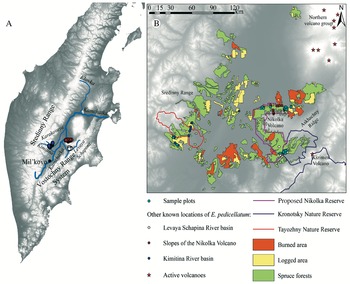
A, map of the Kamchatka Peninsula indicating known locations of Erioderma pedicellatum; B, distribution area of Picea jezoensis subsp. ajanensis in the southern ‘spruce island’ and its status (green: old-growth forests, yellow: logged areas, red: burnt areas) with sample plots and other known E. pedicellatum locations indicated by dots. Borders of present and proposed nature reserves are indicated by coloured lines.

Fossil pollen data from CKD (Dirksen et al. Reference Dirksen, Dirksen and Diekmann2013) suggest that the region served as a biological refuge that supported small conifer populations, indicating that present-day spruce forests probably have a relictual origin. Ground vegetation for the CKD is dominated by bryophytes, including Sphagnum spp., and a variety of herbaceous vascular flora. Forests are severely fragmented as a result of natural and anthropogenic disturbances (Eichhorn Reference Eichhorn2010), though they continue to harbour a high diversity of lichens and fungi (Man'ko & Voroshilov Reference Man'ko and Voroshilov1978; Neshataeva et al. Reference Neshataeva, Chernyagina, Czernyadjeva, Himelbrant, Kuznetsova and Kirichenko2003). Commercial forest harvesting in this area is estimated to have begun in the 1930s (Shamshin Reference Shamshin2005).
We collected material in three study areas which were known to host Erioderma pedicellatum (Tagirdzhanova et al. Reference Tagirdzhanova, Stepanchikova, Himelbrant and Vyatkina2016). Each of the study areas was situated within the southern ‘spruce island’ (Fig. 1); they belonged to forest types as described above.
1) The Levaya Schapina River basin is between 55°05′18″–10′45″N latitude and 159°50′20″–160°0′55″E longitude. We include here the south-eastern slope of the Askhachny Ridge, the S slope of Nikolka Volcano, and the Ipuin River valley within the Kronotsky Nature Reserve and vicinity. Askhachny is a mountain ridge belonging to the Vostochny Range System. The closest volcano to this study area is Kizimen. Known locations of E. pedicellatum found in this area are indicated in white (Fig. 1).
2) The northern slope of the Nikolka Volcano is between 55°23′31″–27′39″N latitude and 159°35′24″–160°3′14″E longitude including the banks of the Tolbachik River. Nikolka (1589 m a.s.l.) is a dead Pleistocene shield volcano. To the north this study area faces the recently active Shiveluch, Klyuchevskoy and Bezymyanny volcanoes. Known locations of E. pedicellatum found in this area are indicated in red (Fig. 1).
3) The basin of the Kimitina and Karakovaya Rivers on the eastern foot and slopes of the Sredinny Range is between 55°10′32″–20′27″N latitude and 158°32′42″–48′3″E longitude. This area is non-volcanic. Known locations of E. pedicellatum found in this area are indicated in blue (Fig. 1).
Field sampling
In total, 37 sample plots were surveyed for this study. In 2009, surveys of the spruce forests within the Levaya Schapina River basin in the Lazo part of the Kronotsky Nature Reserve began with the establishment of 14 sample plots, each 20 × 20 m (Stepanchikova & Himelbrant Reference Stepanchikova and Himelbrant2012). Erioderma pedicellatum was collected during the field trips in 2009. In 2015, the 2009 plots were resurveyed and a further seven sampling sites added. In 2016, 14 plots on the north slope of the Nikolka Volcano were surveyed together with two plots in the Kimitina River basin.
Plot locations within the sampling areas were selected using a stratified subjective approach: plots were subjectively placed within the represented topographic positions as determined by satellite imagery interpretation. The plot locations are shown in Fig. 1. Due to logistical limitations, we were able to survey only two plots in the Kimitina River basin study area. Further logistical limitations meant that the number of host trees and thalli observed was greater than those where measurements were taken, therefore when discussing the results, we make a distinction between observed, and measured, trees and thalli. Within plots, we censused trees, spruce saplings and deadwood, and noted the species composition of the associated ground vegetation. We examined each spruce tree and sapling for E. pedicellatum thalli from the ground to a height of c. 2 m, including bole and branches, both living and dead. We counted branches on which E. pedicellatum was present for each host tree and the number of thalli on each host branch. We measured 84 trees hosting E. pedicellatum. For each of those, we recorded diameter at breast height (dbh) and age. We also measured dbh and age for an equal number of spruce trees without E. pedicellatum (non-host trees). We selected non-host trees by randomly picking candidates from among the remaining trees within the same plot. To estimate the age of trees we used an increment borer or, when appropriate, counted the number of branch whorls around the trunk of each tree.
For each measured thallus, we recorded size (length and width), height above ground, condition (dead or alive) as well as height of the host branch, and the lichen life stage cohort according to Goudie et al. (Reference Goudie, Scheidegger, Hanel, Munier and Conway2011):
1) Juvenile 1 (J1), small thalli (≤3 mm2) that lack apothecia or primordial apothecia;
2) Juvenile 2 (J2), larger thalli (>3 mm2) that lack apothecia or primordial apothecia;
3) Adults (A), healthy thalli with apothecia or primordial apothecia, without symptoms of necrosis;
4) Necrotic (N), thalli securely attached, with visible necrosis (>3 mm2);
5) Necrotic loose (NL), thalli not securely attached to the substratum, often loosely adhering to other lichens or bryophytes;
6) Necrotic regenerating (NR), thalli displaying some degree of necrosis (>3 mm2) but with evidence of newly emerging growth generally along an edge of the thallus.
Statistical analyses
We applied a permutation method to evaluate differences between host and non-host trees (Legendre & Legendre Reference Legendre and Legendre1998) and used generalized linear regression to evaluate associations between Erioderma pedicellatum abundance and the age of phorophytes (McCullagh & Nelder Reference McCullagh and Nelder1989). For data preparation and mapping we used ArcGIS 10.4 software (Esri 2016). All statistical analyses were performed in R 3.3.0 (R Core Team 2013; RStudio 2012), using the packages ‘mgcv’ (Wood Reference Wood2006) and MASS (Ripley et al. Reference Ripley, Venables, Bates, Hornik, Gebhardt and Firth2015).
We used Landsat satellite images (NASA 2016) to ocularly detect spruce forests and deforested areas and to determine the rate of habitat loss. Ten images dating from 2006 to 2016 and additional images from 1999 were compared by combining Landsat 7 and 8 red channels from two images into a single image. We used simple linear regression to detect time-dependent trends in habitat loss (Rao & Toutenburg Reference Rao and Toutenburg1995). The total extent of occurrence of the population (EOO-Total) was calculated as a minimum convex polygon encompassing all known locations of E. pedicellatum in Kamchatka. These locations included 37 sample plots and 100 additional locations of the species for which we recorded only coordinates. Both sample plots and additional locations are shown in Fig. 1. The additional locations were discovered during fieldwork in the study areas. Since the spruce forests are severely fragmented, we also calculated EOO separately for each of the three study areas (EOO-Region). The area of occupancy (AOO-Region) of each study area was roughly estimated as the spruce-covered area within its extent of occurrence. The AOO of the whole population (AOO-Total) was calculated by summing the AOO of all study areas.
Results
Distribution and general patterns of occupancy and abundance
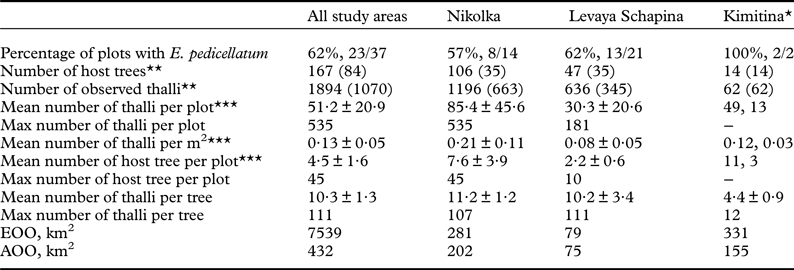
We observed 1894 Erioderma pedicellatum thalli on 167 trees among the 37 sample plots (Table 1, Fig. 1). The species occurred in up to 2/3 of surveyed plots on the Levaya Schapina River basin and the slopes of the Nikolka Volcano, and on both Kimitina River basin plots.
Erioderma pedicellatum abundance and occupancy characteristics in three study areas. EOO (which includes much non-target habitat) is a minimum convex polygon encompassing all known locations of E. pedicellatum. AOO is a spruce-covered area within EOO. Means are given ± 1SE.

* since only two plots from this area were studied, we provide only raw counts instead of calculating mean and maximum values.
** numbers in parentheses list how many host trees or thalli were measured.
*** including the unoccupied sample plots.
Abundance and occupancy characteristics of each study area are listed in Table 1.
Slopes of the Nikolka Volcano had the highest E. pedicellatum abundance, but with considerable variation as indicated by the high standard error of the mean: one plot had over 500 thalli while three sample plots contained only one thallus. The Kimitina River basin had the largest EOO-Region. Since the major part of the study area was not spruce-covered, the AOO-Region was much smaller and only the second largest after the AOO-Region of the slopes of the Nikolka Volcano. The Levaya Schapina River basin had the smallest AOO-Region, as well as EOO-Region. All EOO were calculated using sample plot locations plus 100 additional casual observations (Fig. 1).
Due to daylight restrictions, the number of host trees and thalli measured was fewer than observed (Table 1). For each host tree, we recorded one non-host tree from the same sample plot. The next two sections mostly report the results for the measured trees and thalli.
Ecological preferences
Erioderma pedicellatum was detected exclusively on the bark of Yezo spruce twigs in spruce forests with Larix cajanderi and Betula platyphylla, and with a ground vegetation of mixed bryophytes. We found the species within the altitudinal range of 82–479 m a.s.l. We found thalli on the bark of dead and, more rarely, living twigs at heights ranging from 36–195 cm above ground. We expected that E. pedicellatum would occur on the upper branches of mature trees. However, after careful examination of all fallen spruces, including ones with seemingly intact lichen epiphytes, we detected only two thalli growing on branches on the upper part of their host trees to a height of 4 m.
The 1070 measured lichen thalli occurred both on young or dwarf-stressed and large mature trees (min dbh = 1 cm, max dbh = 26·5 cm). The mean (± 1SE) dbh of stems of 84 measured host and 84 measured non-host trees was 8·9 ± 0·6 cm and 16·4 ± 1·4 cm, respectively. The mean age of host trees were 80·1 ± 4·1 years, and that of trees lacking E. pedicellatum was 93·4 ± 4·8 years. There was no statistically significant difference between the age of trees with regards to E. pedicellatum presence (P = 0·13); however, differences between dbh were marginally significant (P = 0·05).
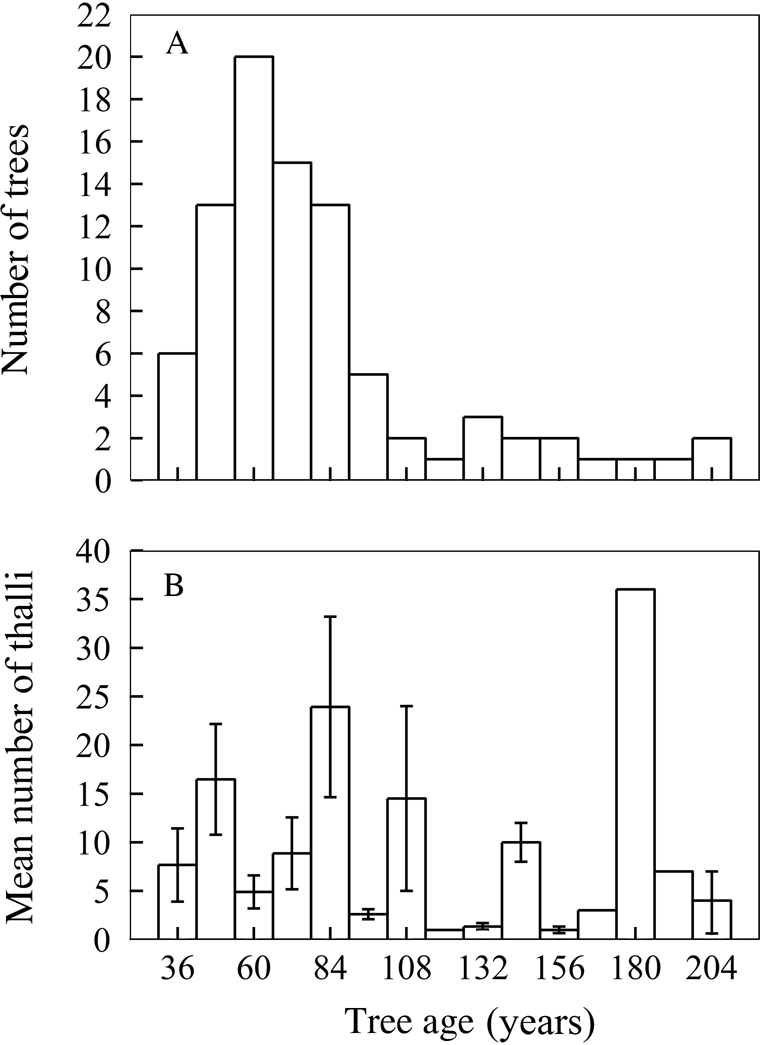
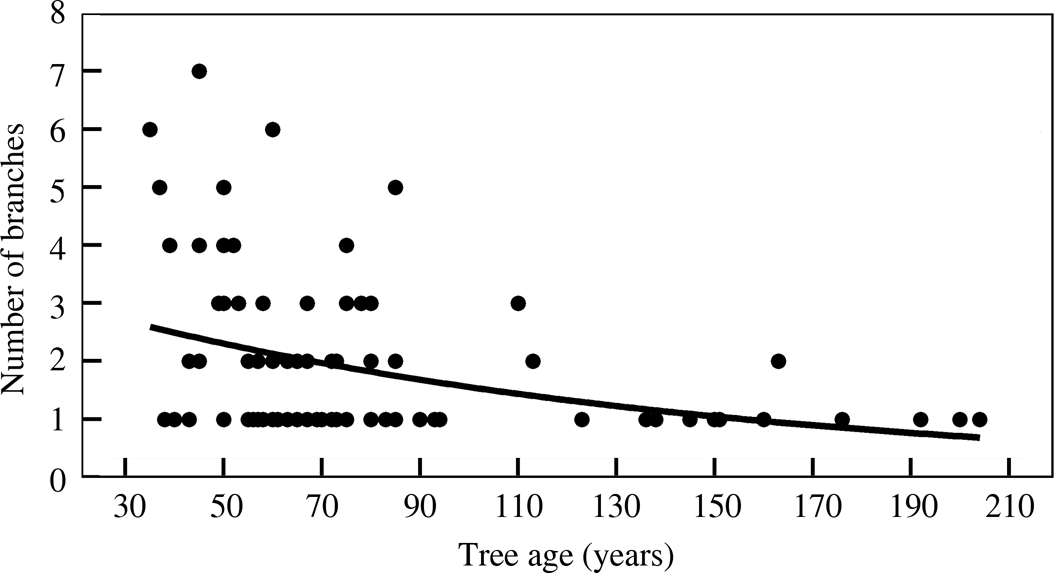
Trees hosting E. pedicellatum varied in age from 34–204 years (Fig. 2A). The lack of field data does not allow us to check whether the high occupancy of younger trees can be explained by the preferences of the species or by the fact that younger trees were more abundant than mature ones. High abundance (number of thalli per tree) was observed on younger trees with c. 80-year-old trees harbouring the highest number of thalli (Fig. 2B). For one 180-year-old tree we reported a very high number of thalli, though this tree should be considered as an outlier that was growing in a plot densely populated by E. pedicellatum. The number of branches hosting the species declines with the increasing age of a given tree (Fig. 3); note that this is because more than one branch hosting thalli of the species was found more frequently on younger host trees.
A, histogram of the age of colonized trees; B, mean number of Erioderma pedicellatum thalli per colonized tree depending on the age of the trees. Column width = 12 years.

Number of colonized tree branches per tree. The line indicates generalized linear regression (ln(branches) = 1·23-0·01 * age R2adj = 0·267, P<0·01).

Life stage and size structure of the population
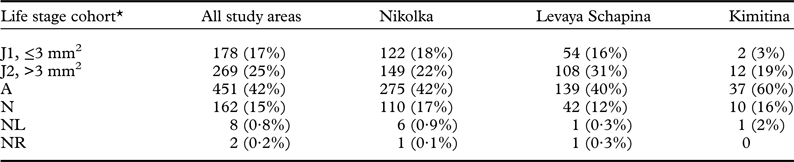
Only 1070 measured thalli were assessed for life stage and size. Adult thalli without symptoms of necrosis were the most abundant cohort across all study areas (Table 2). Juvenile thalli were second in abundance; the next most common cohort was necrotic individuals, but necrotic loose and necrotic regenerating thalli were quite rare. The plots in the Kimitina River basin had a lower proportion of juvenile thalli compared to the other study areas.
Numbers and proportions of different life stages of Erioderma pedicellatum across the study areas.

* According to Goudie et al. (2011). J1 and J2 = differently sized thalli lacking apothecia; A = fertile thalli with no signs of necrosis; N = necrotic thalli; NL = necrotic thalli loosely attached to the substratum; NR = necrotic thalli with signs of regeneration.
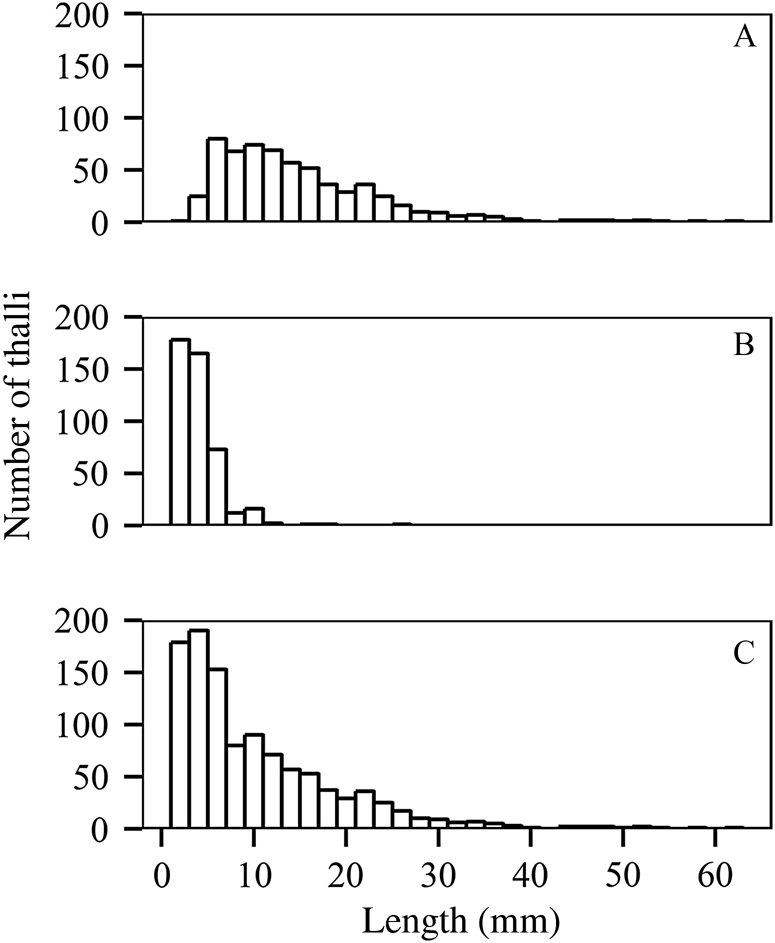
Size of measured thalli varied from 0·01 to 21·59 cm2. The minimum size among adult thalli was 0·12 cm2, the maximum size among juvenile thalli was 5·10 cm2 and size distributions showed a distinct right skew (Fig. 4). Juvenile thalli revealed the strongest right skew whereas adult thalli were closer to a symmetrical distribution. Apothecia typically appear on thalli when they reach 5–7 mm in length.
Histograms of size distribution of thalli of Erioderma pedicellatum. A, adult fertile thalli; B, juvenile infertile thalli; C, combined adult and juvenile categories. Column width = 2 mm.

Threat estimation and projected habitat loss
Currently, the total area of spruce forests in Kamchatka is 5655 km2 but only 717 km2 of this (c. 13%) has been set aside as protected land (Fig. 1). Our analysis of satellite image data suggests that 2900 km2 of spruce forests in Kamchatka have been lost due to forest harvesting and forest fires (Fig. 1). Based on these data, we estimate that c. 34% of spruce forests have been lost since the start of commercial forest harvesting. For this region of Kamchatka, the mean annual harvesting rate over the last decade was 7·5 ± 0·9 km2 per year and the loss of forest annually by logging varied from 4·3 to 12·8 km2 per year, accounting for 132 km2 loss between 1999 and 2016. The mean annual burned area was 37·6 ± 18·6 km2 accounting for 728 km2 of burned habitat between 1999 and 2016. Altogether 1423 km2 of fire-damaged forests were detected using recent satellite imagery.
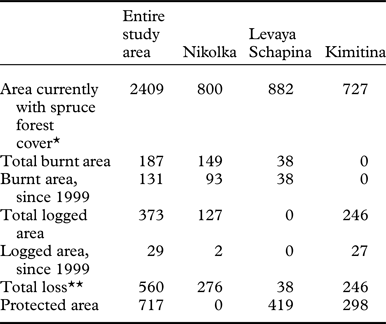
Habitat loss was highest on the slopes of the Nikolka Volcano, primarily due to frequent burns and logging on the volcanic slopes that have destroyed E. pedicellatum habitat, as confirmed by an examination of the remaining young spruces within the most recent clear-cuts (Table 3). Though a significant portion of spruce forests in the Kimitina River basin are included in the Tayozhny Nature Reserve, the surrounding area has been seriously damaged by ongoing timber harvesting.
Quantities of lost spruce forest and protected parts across the three study areas (km2).

* Total area of coherent spruce forests, parts of which were included in the EOO-Region.
** Damaged area (formerly spruce forests) adjacent to the present spruce forest
At the current rate of habitat loss, 450 ± 54 km2 of spruce forests will be logged and 2256 ± 1116 km2 will be burned during the next 60 years. An examination of the annual habitat loss rate during the last decade did not show any time-dependent trend (data not shown).
Discussion
In this study, we present the first detailed survey of the recently discovered Asian population of Erioderma pedicellatum from the Kamchatka Peninsula, Russia. We observed nearly 2000 thalli on 37 sample plots, which allows us to conclude that the Asian population is larger than both the Norwegian and Canadian populations. The larger area of occupancy of the Asian population compared to that reported for the Alaskan population by Stehn et al. (Reference Stehn, Nelson, Roland and Jones2013) and the higher thallus density (0·13 thalli per m2 in Kamchatka vs 0·04 thalli per m2 in Alaska) make it likely that the Asian population is the largest of the four known populations. Therefore, continuous monitoring of the Asian population is crucial for assessment of the global population's viability. We should note, however, that further surveys are needed in order to estimate the Asian population size. Notably, the real area of occupancy of the population cannot be determined until previously unexamined spruce stands are studied.
Considering its global range, E. pedicellatum is able to colonize different coniferous tree species and its substratum preferences are evidently different across each population. In Canada, E. pedicellatum primarily grows on the boles of Abies balsamea, whereas other populations occur on twigs of different spruce species (Holien Reference Holien2016). In Kamchatka, E. pedicellatum occurs exclusively in old-growth spruce forests where it grows on the bark of Yezo spruce twigs. Yezo spruce is the only spruce species occurring in Kamchatka. It is restricted to the CKD, where it forms two regional subpopulations, also known as northern and southern ‘spruce islands’. All known locations of E. pedicellatum belong to the southern ‘island’. Since the lichen diversity of the northern ‘island’ was described in detail in Neshataeva et al. (Reference Neshataeva, Chernyagina, Czernyadjeva, Himelbrant, Kuznetsova and Kirichenko2003), we suspect that the species might be absent from there. Some other lichen species occurring in the southern ‘island’ together with E. pedicellatum, such as Sticta limbata (Sm.) Ach., Pseudocyphellaria crocata (L.) Vain. s. lat, Nephroma helveticum Ach. and Usnea longissima Ach., are also not reported from the northern ‘island’ (Neshataeva et al. Reference Neshataeva, Chernyagina, Czernyadjeva, Himelbrant, Kuznetsova and Kirichenko2003; Stepanchikova & Himelbrant Reference Stepanchikova and Himelbrant2012; Tagirdzhanova et al. Reference Tagirdzhanova, Stepanchikova, Himelbrant and Vyatkina2016). The difference between the two spruce subpopulations in lichen diversity might be explained by the difference in climatic conditions and the history of landscape and plant community development (Neshataeva Reference Neshataeva2009).
Three areas occupied by E. pedicellatum are known in Kamchatka. The Levaya Schapina River basin is well protected, but this area has relatively low E. pedicellatum abundance and a small area of occupancy. The slopes of the Nikolka Volcano are characterized by the largest area of occupancy and a high abundance of E. pedicellatum. Even though this area hosts more than 50% of the known population, and thus hosts the largest portion of the Asian population known to date, it is not protected against logging. The Kimitina River basin area is the least studied and has the largest extent of occurrence. We suggest that this area should be targeted in future research efforts and surveys.
This Asian population is found in a very narrowly defined habitat and appears to depend on thin, dead branches situated in the lower canopy of living trees. Despite its preference for dead branches, E. pedicellatum appears to require a bark substratum and it was never found on the exposed wood of decorticated branches, unlike other epiphytic lichens such as Lobaria pulmonaria (L.) Hoffm. and Sticta limbata. Preference for the lower canopy might be due to microclimatic conditions which do not allow E. pedicellatum to colonize more sun- (or wind-) exposed regions of the canopy where conditions are generally less stable. This corresponds with the growth traits of E. pedicellatum in Newfoundland, where thalli predominantly grow on trunks and occur less than 2 m above the ground (Scheidegger Reference Scheidegger1998). We observed a smaller number of individuals on older trees. Presumably, as the lower branches of a maturing tree lose the bark and break off, the number of thalli living on this tree declines.
The high number of juvenile thalli accounted for in this study confirms a high reproduction and establishment rate. The observed percentage of juvenile thalli in the Asian population was 42%, a proportion that is much higher than the 26% observed in Nova Scotia (Cameron & Toms Reference Cameron and Toms2016) and 18% in Newfoundland (Goudie et al. Reference Goudie, Scheidegger, Hanel, Munier and Conway2011). Since our observation might have been skewed by false absences for small thalli, the real percentage of juvenile thalli might be even higher. Consecutive observations of these cohorts would help clarify mortality rates of different age classes of E. pedicellatum.
The main threat to the Asian population of E. pedicellatum is habitat loss, specifically with forest fires having the strongest impact (Fig. 1). Most forest fires in Kamchatka are the result of human activity, such as setting fires, sparks from machinery and neglecting campfires, whereas lightning and volcanic activity rarely cause forest fires (Efremov et al. Reference Efremov, Zakharenkov, Kopeikin, Kuzmichev, Smetanina and Soldatov2012). Due to microclimatic differences or locally heterogenous topography, a given landscape might respond to forest fires differently; for instance, ravines and valley bottoms are affected by fire less frequently than dry, flat areas (Romme & Knight Reference Romme and Knight1981). The argument could be made that E. pedicellatum habitat may be less prone to forest fires than the surrounding areas. However, our field observations suggest that forest fires affect E. pedicellatum habitat with similar frequency to the surrounding forest landscape. The relatively poor accessibility of slopes for firefighting operations allows for large-scale forest fires that can be very detrimental to populations of E. pedicellatum and its surrounding habitat. Clear-cut forestry taking place on the slopes of the Nikolka Volcano and in the Kimitina River basin is another cause of habitat loss. Natural regeneration of the spruce forests in Kamchatka is very slow. Pioneer tree species (birch and larch) are replaced by spruce 150 years after deforestation. More than 350 years are required for the re-establishment of the uneven-aged forest structure similar to the undisturbed forests (Man'ko & Voroshilov Reference Man'ko and Voroshilov1978). We have no evidence that E. pedicellatum is able to colonize secondary forests. The strict habitat requirements of the species suggest that recolonization might be possible only 350 years after a deforestation event.
Volcanic activity, specifically ash fall, has been shown to have a strong negative impact on spruce vitality and associated lichen communities (Grishin et al. Reference Grishin, del Moral, Krestov and Verkholat1996). Two of the three areas in our present study are affected by volcanic activity. The Levaya Schapina River basin is situated in the vicinity of the Kizimen Volcano, which last erupted in 2010–2012 (Dvigalo et al. Reference Dvigalo, Melekestsev, Shevchenko and Svirid2013). However, this eruption did not damage the population: despite a thin ash layer found on spruce branches in 2015, E. pedicellatum has survived. A similar ash layer was observed at the Nikolka Volcano during 2014–2016 fieldwork and seemed to have no effect on the E. pedicellatum population there. We are uncertain of the effect that a thicker ash layer would have on these populations since we lack the relevant data, though the sites historically have experienced more intense eruptions (Melekestsev et al. Reference Melekestsev, Ponomareva and Volynets1995).
Observations in Canada have shown that E. pedicellatum is sensitive to acidic precipitation (Maass & Yetman Reference Maass and Yetman2002). In Kamchatka, the level of air pollution is low in general, despite occasional volcanic activity, and detrimental levels of pollution were not found within local environments that could threaten E. pedicellatum populations (Jones et al. Reference Jones, Rose, Self, Solovieva and Yang2015).
Since it was shown that E. pedicellatum has strict habitat requirements and prefers cool and moist environments (Scheidegger Reference Scheidegger2003), the species may be particularly sensitive to recent climate change. All four known populations of E. pedicellatum are restricted to oceanic regions with a relatively cool and humid climate. The climate range of the Asian population, however, seems to differ from the other worldwide populations. The previously described populations were found in areas with cool summers, warm winters, and annual precipitation ranging from 700 mm in Alaska to 1600 mm in Atlantic Canada (Holien et al. Reference Holien, Gaarder and Hapnes1995; Cameron & Richardson Reference Cameron and Richardson2006; Stehn et al. Reference Stehn, Nelson, Roland and Jones2013). CKD, on the other hand, has a continental climate with larger seasonal variations in temperature and a lower precipitation rate (Kondratyuk Reference Kondratyuk1974). Worldwide habitat modelling might be used to further investigate differences and similarities in the climate ranges of the known populations.
Kamchatka is likely to harbour the world's largest population of E. pedicellatum. Protection of this population is essential for the global conservation of the species. With the current rate of habitat loss, 48% of spruce forests will be lost in 60 years, which corresponds to three generations of E. pedicellatum according to the estimate made by Maass & Yetman (Reference Maass and Yetman2002). Habitat loss is continuously affecting the Asian E. pedicellatum population and we predict a future decline of the population of the same rate. Implementation of a proposed Nikolka Reserve would of course help to mitigate habitat loss. According to the IUCN Red List Categories and Criteria, a population size reduction of more than 30% predicted to be met within the next three generations results in listing the taxon as ‘Vulnerable’ under criterion A3 (IUCN 2012). A relatively small and declining area of occupancy would support the species’ rank as ‘Endangered’; however, further studies are needed to clarify whether the current degree of fragmentation of the Asian population increases the risk of extinction.
We are sincerely grateful to all participants of the field investigations. We thank Lyudmyla Dymytrova for assistance with data analysis and Spencer Goyette and anonymous reviewers for valuable comments on the manuscript. Financial support was given by the Mohamed bin Zayed Species Conservation Fund (grant 162512330) and the Russian Foundation for Basic Research (grants 12–05–00631, 15–05–05505 and 15–05–05622 to V. Dirksen; 18-05-60093 to I. Stepanchikova and D. Himelbrant). The study was carried out within the framework of a research project (no. AAAA-A19-119020690077-4) of the Komarov Botanical Institute of the Russian Academy of Sciences.