Introduction
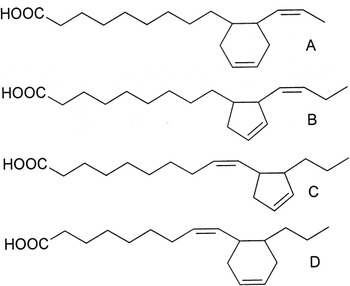
Heating oils and fats results in alterations of the structure of the fatty acids and in the formation of new compounds (Artman, Reference Artman1969). Among them, cyclic fatty acid monomers (CFAM) are formed from polyunsaturated fatty acids, i.e. linoleic and linolenic acids (Sébédio and Grandgirard, Reference Sébédio and Grandgirard1989). Cyclization of linolenic acid gives rise to 16 dienoic fatty acids with a mixture of C5- and C6-membered ring structures (Figure 1) (Dobson et al., Reference Dobson, Christie and Sébédio1996). Studies carried out on animals have shown that CFAM-18:3 cross the gastrointestinal border (Combe et al., Reference Combe, Constantin and Entressangles1981; Martin et al., Reference Martin, Caselli, Broquet, Juanéda, Nour, Sébédio and Bernard1997). When found in the sn-2 position of the triglycerides, CFAM are better and unselectively recovered into the lymph than when esterified in the sn-1 or -3 moieties of the glycerol backbone (Combe et al., Reference Combe, Constantin and Entressangles1981; Martin et al., Reference Martin, Caselli, Broquet, Juanéda, Nour, Sébédio and Bernard1997). CFAM are readily oxidized in vivo (Joffre et al., Reference Joffre, Roy, Bretillon, Pasquis, Sergiel, Loreau, Chardigny and Sebedio2004; Bretillon et al., Reference Bretillon, Loreau, Sebedio and Taran2006). CFAM were suspected to be the most toxic compounds formed in heated oils (Crampton et al., Reference Crampton, Common, Pritchard and Farmer1951, Reference Crampton, Common, Farmer, Berryhill and Wiseblatt1953 and Reference Crampton, Common, Farmer, Wells and Crawford1956). Indeed, using thermopolymerized oils, fractions partially purified containing CFAM or esters of CFAM, CFAM have been suspected to induce adverse effects including high mortality of the rat neonates (Crampton et al., Reference Crampton, Common, Pritchard and Farmer1951, Reference Crampton, Common, Farmer, Berryhill and Wiseblatt1953 and Reference Crampton, Common, Farmer, Wells and Crawford1956; Potteau, Reference Potteau1976; Sébédio et al., 1996).
Chemical structures of cyclic fatty acid monomers formed by cyclization of α-linolenic acid. Each of the four structures gives rise to four isomers, depending on the cis or trans configuration of the ring and on the Z- or E-configuration of the double bond along the lateral chain.

Nevertheless, none of the previous data on the toxicity have been obtained with CFAM fed as triacylglycerols that remain the major bioavailable source of lipids. For this reason, we aimed to re-evaluate the toxicity of CFAM during gestation by feeding female rats with 0.7% of CFAM as triacylglycerols.
Material and methods
Experimental diets
Chemical synthesis of triacylglycerols containing CFAM
Linseed oil was heated at 275°C during 12 h under nitrogen in order to generate large amounts of CFAM from induced cyclization of polyunsaturated fatty acids, including linolenic acid. CFAM formed from linolenic acid were subsequently purified and esterified to glycerol in order to produce triacylglycerols as previously described (Martin et al., Reference Martin, Caselli, Broquet, Juanéda, Nour, Sébédio and Bernard1997). Briefly, heated linseed oil was firstly saponified with potassium hydroxide. Free fatty acids including CFAM were extracted with solvents in acidic conditions. CFAM were purified from total free fatty acids with urea fractionation as previously described (Sébédio et al., Reference Sébédio, Prévost and Grandgirard1987). CFAM not included in urea crystals were further purified in silica column and eluted with a mixture of chloroform/acetone (85 : 15, v/v). The synthesis of triacylglycerols containing CFAM was based on the method developed by Kodali et al. (Reference Kodali, Atkinson, Redgrave and Small1987). CFAM (35 g) were heated for 4 h at 40°C under nitrogen in 200 ml of dichloromethane containing 5 g glycerol, 19.8 g 4-diamethylaminopyridine, 37 g dicyclohexylcarbodiimide, in a 3 Å molecular sieve, before adding 15 g of free fatty acids prepared from soya oil. After 4 h at 4°C and filtration, the solvent was evaporated under nitrogen. Hexane was added at 4°C in order to promote crystallization of dicyclohexylcarbodiimide. After filtration, the triacylglycerols were washed several times with acidic water until neutralization. The organic phase was then evaporated to dryness and the triacylglycerols were further purified in silica column and eluted with a mixture of hexane/diethylether (85 : 15, v/v). The solvents were evaporated to dryness and the triacylglycerols were stored under vacuum until use.
Preparation of the diets
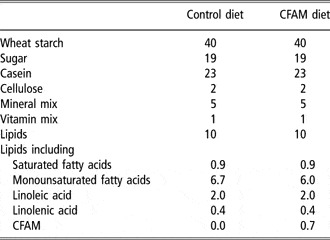
Sunflower oil, high-oleic acid sunflower oil and low-erucic acid rapeseed oil were mixed to prepare the lipid fraction of the control diet. Alternatively, the triacylglycerols containing the CFAM were added to prepare the CFAM diet. The control diet and the experimental CFAM diet were prepared according to the composition reported in Table 1, using a premix of all the ingredients except the lipid fraction prepared by UPAE (Unité de Préparation des Aliments Expérimentaux, Centre INRA, Jouy en Josas, France). The composition of the diets was chosen to fulfill the requirements of the animals during gestation, especially for the amount of protein.
Composition of the experimental diets fed to the animals during gestation

CFAM = cyclic fatty acid monomers.
The data are reported in g/100 g of diet. The extended composition of the mineral and vitamin mixes has been reported elsewhere (et al., Acar Reference Acar, Chardigny, Bonhomme, Almanza, Doly and Sebedio2002).
Animal experiment
The protocol was conducted following the Guidelines for the Care and Use of Experimental Animals and approved by the local ethical committee.
Male and female Wistar rats (Janvier, Le Genest Saint Isle, France) of 11 weeks of age were housed under controlled conditions of temperature (22 ± 1°C) and relative humidity (55% to 60%). A 12 h light–dark cycle (lights on 0700 to 1900 h) was maintained. The stage of the estrous cycle was assessed from vaginal washes using saline. The staging of the estrous cycle for each rat was based on a smear from these washings. Smears were stained with hematoxylin/eosin and examined by light microscopy. By examining the cells present in the smears we were able to determine whether the animal was in estrus, metestrus, diestrus or proestrus. In late proestrus, females were mated with males (three males and two females) for 1 night. The morning after, females were bred in individual cages. Females from the control group and the CFAM group were fed ad libitum with the control or CFAM diets, respectively. The animals from the food-restriction group were fed with the control diet, but food intake was restricted to that of the CFAM group. All animals had free access to tap water.
At day 20 of gestation, and 1 day after delivery, 4 to 6 females per group were weighed and sacrificed. Fetus and newborn rats were numbered, weighed and sacrificed. The number of newborn dead during the first day of life was recorded in the groups of animals sacrificed 1 day after delivery. Blood was collected to prepare plasma. Glycemia from the mothers and newborn was measured from the whole blood (OneTouch Ultra, Lifescan, Milpitas, CA, USA). Insulinemia was assessed using a commercial kit (Amersham Pharmacia Biotech).
Statistical analyses
Data were statistically analyzed by the Kruskal–Wallis test (NPAR1WAY procedure of SAS software; SAS Institute, Cary, NC, USA). Differences were considered as significant at P < 0.05.
Results and discussion
The purpose of our work was to re-evaluate the toxicity of CFAM derived from linolenic acid, that was previously suspected in rats (Crampton et al., Reference Crampton, Common, Pritchard and Farmer1951, Reference Crampton, Common, Farmer, Berryhill and Wiseblatt1953 and Reference Crampton, Common, Farmer, Wells and Crawford1956; Potteau, Reference Potteau1976; Sébédio et al., 1996). We performed the experiment by feeding pregnant rats with triacylglycerols containing CFAM. Therefore, these conditions can be considered as physiologically relevant in terms of bioavailability of the CFAM, on the contrary to those using semi-purified fractions of oils, or esters of CFAM (Crampton et al., Reference Crampton, Common, Pritchard and Farmer1951, Reference Crampton, Common, Farmer, Berryhill and Wiseblatt1953 and Reference Crampton, Common, Farmer, Wells and Crawford1956; Potteau, Reference Potteau1976; Sébédio et al., 1996).
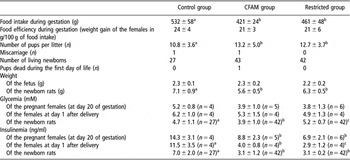
Feeding CFAM significantly reduced the food intake of the females by 20%, without lowering food efficiency (Table 2). Meanwhile, glycemia of the female rats, the number and weight of the fetus remained unchanged in the CFAM group compared with the control group (Table 2). On the contrary, 1-day-old rats born from females fed with the CFAM diet were significantly lighter than controls (−20%, Table 2), and their glycemia was reduced by 17% (Table 2).
Characteristics of the fetus, newborn and females fed during gestation with 0.7% of CFAM derived from linolenic acid

CFAM = cyclic fatty acid monomers.
Data are reported as means ± s.e. Values in rows with different superscript letters were significantly different at P < 0.05.
The most striking finding from our results is the tremendous reduction in insulinemia observed in the CFAM group compared with the control group, from −47% in females at day 20 of gestation to −70% in females at parturition and in newborn rats (P < 0.05, Table 2). Interestingly, the results of glycemia and insulinemia in the animals from the restricted group were similar to those of the CFAM group (Table 2). Those data suggested that low insulinemia in females and litters in the CFAM group were more likely the consequence of decrease of food intake during gestation than the endogenous effect of CFAM. Nevertheless, low insulinemia and low weight of the neonates in the CFAM and restricted groups were consistent with the literature (Holemans et al., Reference Holemans, Aerts and Van Assche2003). It must be pointed out that hypoinsulinemia and intrauterine growth restriction might predispose the offspring to the development of insulin resistance, cardiovascular disease, obesity and even overt diabetes in later life (Holemans et al., Reference Holemans, Aerts and Van Assche2003), which, however, may not be linked to a direct effect of dietary CFAM.
We are now able to show that dietary CFAM, even fed at high non-nutritional doses and as triacylglycerols, did not induce death of the pups within the first day of life, contradicting previous work done with purified fractions of oils containing CFAM or CFAM esters (Crampton et al., Reference Crampton, Common, Pritchard and Farmer1951, Reference Crampton, Common, Farmer, Berryhill and Wiseblatt1953 and Reference Crampton, Common, Farmer, Wells and Crawford1956; Potteau, Reference Potteau1976; Sébédio et al., 1996), whose bioavailability and toxicity per se remain questionable. Hypoinsulinemia and low growth of the pups may have been at the origin of the adverse effects of the CFAM, accounting in addition that other toxic compounds were likely present in the fractions and that higher doses of CFAM were used (up to 0.7% of the diet).
Based on present data and previous ones showing that oxidation and elimination are powerful processes for excretion of CFAM (Joffre et al., Reference Joffre, Roy, Bretillon, Pasquis, Sergiel, Loreau, Chardigny and Sebedio2004; Bretillon et al., Reference Bretillon, Loreau, Sebedio and Taran2006) and considering their low amounts in the diet (Sébédio and Grandgirard, Reference Sébédio and Grandgirard1989; Romero et al., Reference Romero, Cuesta and Snchez-Muniz2000), our data reinforce the assertion that cyclic fatty acids are not a major concern for human safety.
Acknowledgment
This work was supported by the Regional Council of Burgundy (France).