With the exploration of oil and gas resources extending towards complex wells, such as high-temperature ultra-deep wells, high-inclination wells and horizontal wells, the demand for oil-based drilling fluids (OBDFs) has surged due to their superior lubricity, thermal stability and contamination resistance (Li et al., Reference Li, Yang, Guan, Sun, Kuang and Chen2014; Aftab et al., Reference Aftab, Ismail, Ibupoto, Akeiber and Malghani2017; Luo et al., Reference Luo, Huang, Cui and Bai2025; Peng et al., Reference Peng, Bao, Yang, Pu and Xu2025). Consequently, researchers have developed various OBDF systems by optimizing their oil phases and treatment agents to improve performance under specific conditions, ranging from low-temperature deep-water environments to high-temperature formations (Zhuang et al., Reference Zhuang, Zhang, Wu, Zhang and Liao2017; Zhang et al., Reference Zhang, Xu, Christidis and Zhou2020; Silva et al., Reference Silva, Gois, Ramme, Castro Dantas, Barillas and Santanna2021; Qiao et al., Reference Qiao, Fu, Sun, Yu, Yang, Pan and Tong2023; Li et al., Reference Li, de Viguerie, Laporte, Berraud-Pache, Zhuang, Souprayen and Jaber2024; Wang et al., Reference Wang, Sun, Pan, Fu and Yang2025). In these systems, treatment agents, particularly emulsifiers and rheological modifiers, play a critical role, as their properties directly determine the overall performance of the OBDFs.
To further improve the performance of OBDFs, it is essential to understand the stabilization mechanisms of water-in-oil (W/O) emulsions. Previous studies have extensively investigated the factors influencing emulsion stability, such as the hydrophile–lipophile balance (HLB) value, oil-to-water ratio and salt concentration (Mohamed et al., Reference Mohamed, Sultan, Hussein and Al-Muntasheri2017; Wang et al., Reference Wang, Yang, Huang, Huang, Yang and Zhang2021; Gao & Li, Reference Gao and Li2023; Hong et al., Reference Hong, Zhao, Liu and Li2023). It is generally established that higher emulsifier concentrations lead to greater adsorption at the oil–water interface and a stronger interfacial film, thereby improving stability. Additionally, organoclays are known to stabilize emulsions by forming a three-dimensional network structure within the oil phase (Sun et al., Reference Sun, Huang, Jiang, Lyu, Liu and Dai2018; Wang et al., Reference Wang, Jiang, Fu, Yang, He and Dong2022; Liu et al., Reference Liu, Gates, Yang, Kurniawan and Zhou2024a; Aurelie et al., Reference Aurelie, Celine, Sophie, Bruno and Nicolas2025; Dorigon et al., Reference Dorigon, Pessoa, Neto, Silva, Soares and Curbelo2025). However, while the stability of deliberately formulated emulsions is well understood, there is a relative lack of study on the behaviour of foreign solid particles (Ling et al., Reference Ling, Haber, Graham, Aman, May, Fridjonsson and Johns2018; Balavi et al., Reference Balavi, Mahani and Ayatollahi2023), specifically drilling cuttings (e.g. bentonite), within W/O emulsions. Guo et al. (Reference Guo, Yang, Zhang, Zhang, Gao, Zhang and Zhang2020) confirmed that cetyltrimethylammonium bromide (CTAB)–silane co-modification can effectively improve the hydrophobicity and thermal stability of bentonite in OBDFs, while Li et al. (Li et al., Reference Li, Guo, Niu, Li, Cao and Yin2025) found that cationic surfactants can inhibit the dissolution of clay minerals under acidic conditions. However, both studies are limited to single-phase systems and do not address the emulsion interface or particle stabilization mechanisms.
In actual drilling operations, the intrusion of drilling cuttings into OBDFs is inevitable. These solid particles can significantly alter the rheology and stability of the system, potentially leading to abnormal viscosity increases, reduced lubricity and even downhole failures (Shen et al., Reference Shen, Sun, Lv, Li, Geng and Yang2023; Basfar et al., Reference Basfar, Shokry, Iqbal, Elkatatny and Alajmi2025; Madanchi & Mahani, Reference Madanchi and Mahani2025). The dispersion and sedimentation of drilling cuttings in the emulsion are fundamentally regulated by interfacial properties, which depend heavily on the type of surfactant adsorbed. Therefore, understanding the stabilization mechanism of drilling cuttings in W/O emulsions is of great significance for maintaining fluid performance and optimizing the drilling process.
This study aims to elucidate the core mechanisms by which surfactant type affects the stability of bentonite-stabilized emulsions. Five representative surfactants (Span80, OP-10, sodium dodecylbenzenesulfonate (SDBS), CTAB, betaine) with significant differences in HLB value, charge characteristics and molecular structure were selected for comparison, along with their compound systems. The particle size, wettability and dispersion state of bentonite in the W/O emulsions were characterized. The macroscopic stability of the system was evaluated using static observation and optical microscopy. Furthermore, zeta-potential, interfacial tension and contact angle measurements were conducted to analyse how the surfactants and their compound systems affect the stability of bentonite in W/O emulsions.
Experimental
Materials
All chemicals were of analytical grade unless otherwise stated. Solvent Green 7 was purchased from Tokyo Kasei Kogyo Co., Ltd. Bentonite and calcium stearate were obtained from Aladdin Reagent Co., Ltd. 5# white oil (chemical grade) was sourced from Jieyou Lubricant Co., Ltd. Span80, OP-10, SDBS and CTAB were purchased from Chengdu Colony Chemicals Co., Ltd. 3-Sulfopropyldodecyldimethylbetaine was obtained from Shanghai Marel. Deionized water was used for sample preparation.
Methods
Preparation of emulsions
First, 0.858 g of Span80 was added to 100 mL of white oil and stirred thoroughly using a magnetic stirrer (1000 rpm) to form the oil phase. Subsequently, 14 mL of this oil phase was mixed with 6 mL of deionized water and fully emulsified to prepare a primary W/O emulsion. Finally, 0.06 g bentonite was added to the emulsion, and the mixture was stirred at room temperature for 3 h to achieve complete dispersion.
Contact angle measurements
A small amount of bentonite powder was placed on a glass slide and compressed to create a smooth surface. The contact angles of the various bentonite samples with water in an air environment were measured using an Interface Parameter Integration Measurement System (KRUSS, Germany).
Microscopic images
An aqueous solution was prepared by dissolving the fluorescent indicator Solvent Green 7 (2.5 mM) in deionized water. Using this aqueous phase, a W/O emulsion, a bentonite suspension and a W/O emulsion containing bentonite were prepared. The concentration of bentonite was 0.3% (w/v), and the total volume of each system was 20 mL. Microscopic images were taken using a fluorescence microscope (LOT, Germany) equipped with a computerized image-processing system.
Sedimentation
Corresponding emulsions were prepared and placed in test tubes. Photographs were taken at 0, 0.5, 1.5 and 12 h.
Zeta-potential
The zeta-potential of bentonite particles dispersed in oil was determined using an Omni Multi-Angle Particle Size and High Sensitivity Zeta Potential Analyzer (Brookhaven Instruments, USA). Each system was measured in triplicate, and the mean value was utilized as the final data.
Viscometry
Viscosity was measured using a Brinell viscometer with a Rotor No. 18 at a rotational speed of 20 rpm for 3 min. Screen readings were recorded upon completion of the measurement process.
Results and discussion
The particle size and hydrophilicity of bentonite were characterized, with the results presented in Figs S1 & S2. The average particle size of bentonite dispersed in water is 1763.8 nm. The contact angles of bentonite with water are 18.2° in air and 39.4° in white oil, indicating that bentonite exhibits relatively strong hydrophilicity (Parolo et al., Reference Parolo, Pettinari, Musso, Sánchez-Izquierdo and Fernández2014). The dispersion state of bentonite in W/O emulsion is shown in Fig. S3. In the absence of bentonite, the water droplets in W/O emulsion are relatively large, with a size of ∼25 μm. Without oil, bentonite swells in water and forms clusters of small lumps. Upon the addition of bentonite to the W/O emulsion, a distinct layer of material is observed to adsorb onto the surface of the water droplets, and the droplet size decreases to ∼15 μm. This observation indicates that bentonite distributes at the water droplet surfaces and interacts with the surfactant to form a three-dimensional spatial structure at the oil–water interface (Pei et al., Reference Pei, Zheng, Zhang, Zhang and Zhao2022; Wang et al., Reference Wang, Zhu and Qian2023), thereby enhancing the interfacial film strength. Meanwhile, owing to the negatively charged surface of the bentonite (Yi et al., Reference Yi, Zhong, Mao, Li, Zhang and Dong2023), fine bentonite particles adsorb onto the droplet surfaces, increasing the electrostatic repulsion between droplets. As a secondary stabilization mechanism, this electrostatic repulsion further inhibits droplet aggregation and flocculation, complementing the steric-mechanical barrier provided by the interfacial film. Together, these effects synergistically improve the long-term stability of the emulsion (Yi et al., Reference Yi, Xu, Cao, Mao, He and Shi2024). As the primary stabilizer, the surfactant governs the construction of the bentonite-stabilized interfacial structure by modulating the interfacial tension, and the electrostatic repulsion induced by bentonite synergistically reinforces the structural stability. Accordingly, this study was designed to investigate the specific effects and underlying mechanisms of surfactants in such a composite stabilization system.
Effect of various surfactants on the stability of bentonite in emulsions
The same concentration (20 mM) of non-ionic surfactant (Span80 or OP-10), cationic surfactant (CTAB), anionic surfactant (SDBS) and amphoteric surfactant (betaine) was added to investigate the stability of the system. Macroscopic images obtained via the static method are shown in Fig. 1. Samples stabilized by Span80 or OP-10 exhibited no delamination over the static observation period, and no sedimentation of bentonite was observed, indicating that the bentonite remained stable in the corresponding emulsions. In contrast, samples stabilized by SDBS, CTAB or betaine underwent distinct phase separation into two layers, implying that bentonite was poorly dispersed in these emulsion systems. The system with the addition of CTAB showed the most precipitates of bentonite and was the most unstable.
Macroscopic images of bentonite dispersed in emulsions stabilized by (1) 3-sulfoprododecyldimethylbetaine, (2) CTAB, (3) SDBS, (4) OP-10 or (5) Span80 after standing for (a) 0 h, (b) 0.5 h or (c) 1.5 h.

Figure 1 Long description
The first image shows five test tubes labeled 1 to 5 containing bentonite emulsions at 0 hours. The second image shows the same test tubes at 0.5 hours. The third image shows the test tubes at 1.5 hours. Each tube contains a different surfactant: 3-sulfoprododecyldimethylbetaine, CTAB, SDBS, OP-10 and Span80. Over time, tubes 1, 2 and 3 show phase separation, while tubes 4 and 5 remain stable with no visible sedimentation.
Figure 2 presents the microscopic images of the fluorescently labelled aqueous phase. The emulsion formed with the addition of Span80 was confirmed to be a W/O emulsion, as the dispersed phase corresponded to the fluorescently labelled aqueous phase. In contrast, the continuous phase of the systems stabilized by the other four surfactants exhibited green fluorescence, indicating the formation of oil-in-water (O/W) emulsions. This difference can be attributed to the lower HLB value of Span80 (Table 1), which renders it more lipophilic, whereas the other four surfactants possess higher HLB values and are consequently more hydrophilic. Emulsions prepared with SDBS displayed the largest droplet size among all samples. Owing to the inherent instability of the systems stabilized by betaine or CTAB, the larger oil droplets readily underwent aggregation, and only a small number of smaller oil droplets were observed (Fig. 2a,b).
Microscopic images of bentonite dispersed in emulsions stabilized by various surfactants. (a) to (e) are bright-field images of samples stabilized by 3-sulfoprododecyldimethylbetaine, CTAB, SDBS, OP-10 and Span80, respectively. (a1) to (e1) are the corresponding fluorescence images.

Figure 2 Long description
The image A shows a bright-field microscopic view of bentonite dispersed in an emulsion stabilized by 3-sulfoprododecyldimethylbetaine. The image A subscript 1 shows the corresponding fluorescence image. The image B shows a bright-field view of bentonite in an emulsion stabilized by CTAB, with image B subscript 1 showing the fluorescence counterpart. The image C displays a bright-field view of bentonite in an emulsion stabilized by SDBS, with image C subscript 1 showing the fluorescence image. The image D shows a bright-field view of bentonite in an emulsion stabilized by OP-10, with image D subscript 1 showing the fluorescence image. The image E shows a bright-field view of bentonite in an emulsion stabilized by Span80, with image E subscript 1 showing the fluorescence image. Each pair of images is labeled with a scale bar indicating 10 micrometers.
Properties regarding the dispersion stability of bentonite in emulsions with various surfactants.

Table 1 Long description
The table compares the dispersion stability of bentonite in emulsions using different surfactants, focusing on stability rates, contact angles, interfacial tension, viscosity, and zeta-potential. Span80 and OP−10 are the most stable surfactants, both achieving 100% stability, with Span80 being a W/O type and OP−10 an O/W type. Span80 has the highest viscosity at 126.6 mPa·s, while OP−10 has the lowest interfacial tension at 2.90 mN·m−1 and the most negative zeta-potential at −106.0 mV. CTAB is the least stable with a 12.3% emulsification rate and a high contact angle of 81.6°. Betaine type and SDBS show less stability, with SDBS having a notably negative zeta-potential of −41.6 mV. The data suggests that surfactant type and properties like HLB and interfacial tension significantly influence emulsion stability.
The contact angle of bentonite treated with various surfactants as well as the interfacial tension and system viscosity were determined to investigate the underlying mechanism of influence. The results are summarized in Table 1. The contact angle between CTAB-adsorbed bentonite and water was 81.6°, indicating that the lipophilicity of bentonite was significantly enhanced and approached wetting reversal. The hydrophilicity of Span80-adsorbed bentonite was also markedly weakened. In contrast, bentonite adsorbed with OP-10, SDBS or betaine retained strong hydrophilicity. The oil–water interfacial tension values of the Span80 and OP-10 systems were considerably lower than those of the other groups, demonstrating their superior emulsifying capability relative to the other surfactants. In the W/O emulsion, Span80 reduced the hydrophilicity of bentonite, facilitating its distribution at the oil–water interface, and the corresponding system viscosity was much higher than that of the O/W emulsion. The viscosity of the O/W emulsion system containing OP-10-adsorbed bentonite was the lowest among all of the samples, yet the emulsion exhibited excellent stability. The viscosity values of O/W emulsion systems containing SDBS-, CTAB- or betaine-adsorbed bentonite were higher than that of the OP-10 system, but these systems showed poorer stability. This observation suggests that the higher viscosity of O/W emulsion systems correlates with inferior stability.
These stability differences cannot be fully explained by the dispersion stability of the particles in the oil phase alone. To explore the modifying effect of surfactants on the surface properties of bentonite, we measured its zeta-potential in white oil. In non-polar media, the particle charge is mainly derived from the adsorption of surfactants. Ionic surfactants (e.g. CTAB and SDBS) impart an electric charge to particles through their active ion adsorption. Non-ionic surfactants (e.g. Span80, OP-10) theoretically contribute little to the zeta-potential. However, the experimental measurements of Span80 and OP-10 also show high absolute values of zeta-potential (106 mV for OP-10 and 67.6 mV for Span80), which may be due to the presence of trace water impurities in non-polar systems or trace ion impurities (Lee et al., Reference Lee, Zhou and Behrens2018; Chen et al., Reference Chen, Lu, Ashani, Manica, Feng and Liu2021). It is generally accepted that a system exhibits good stability when the absolute value of the zeta-potential exceeds 30 mV. Based solely on the zeta-potential results, Span80, OP-10, SDBS and CTAB all contribute favourably to the dispersion stability of bentonite, whereas only the betaine surfactant fails to improve system stability. However, high zeta-potential (good particle dispersion) in the oil phase does not equate to the macroscopic stability of the final emulsion. For example, although SDBS and CTAB systems have high absolute zeta-potential values, their corresponding emulsion stability values are poor. The OP-10 system has the highest absolute potential while also showing the lowest viscosity and best stability. This clearly demonstrates that the synergistic effect of multiple factors such as the mechanical strength, interfacial tension and system rheology of the interface film is more critical to the final stability of an emulsion than simple electrostatic repulsion. Therefore, the dispersion stability of bentonite in emulsions containing various surfactants is a synergistic outcome of the aforementioned factors. Among these, interfacial tension and viscosity exert a more significant effect on the dispersion stability of bentonite than wettability and zeta-potential.
Effect of Span80 concentration on the stability of bentonite in W/O emulsions
Figure 3 illustrates the sedimentation behaviour of bentonite-based W/O emulsions with varying Span80 concentrations. At a surfactant concentration of 1 mmol L–1, a stable system could not be formed. However, as the Span80 concentration increased, the volume of the separated upper oil phase decreased. This indicates that higher Span80 concentrations increase the dispersion stability of bentonite in W/O emulsions.
Macroscopic images of bentonite dispersed in W/O emulsions stabilized by various Span80 concentrations of (1) 50 mmol L–1, (2) 20 mmol L–1, (3) 10 mmol L–1, (4) 5 mmol L–1 or (5) 1 mmol L–1 after standing for (a) 0 h, (b) 0.5 h, (c) 1.5 h or (d) 12 h.

Figure 3 Long description
The first image shows five test tubes labeled 1 to 5, containing bentonite dispersed in W/O emulsions at 0 hours. The second image displays the same test tubes after 0.5 hours. The third image shows the test tubes at 1.5 hours and the fourth image presents them after 12 hours. Each test tube represents a different Span80 concentration, affecting the sedimentation behavior over time.
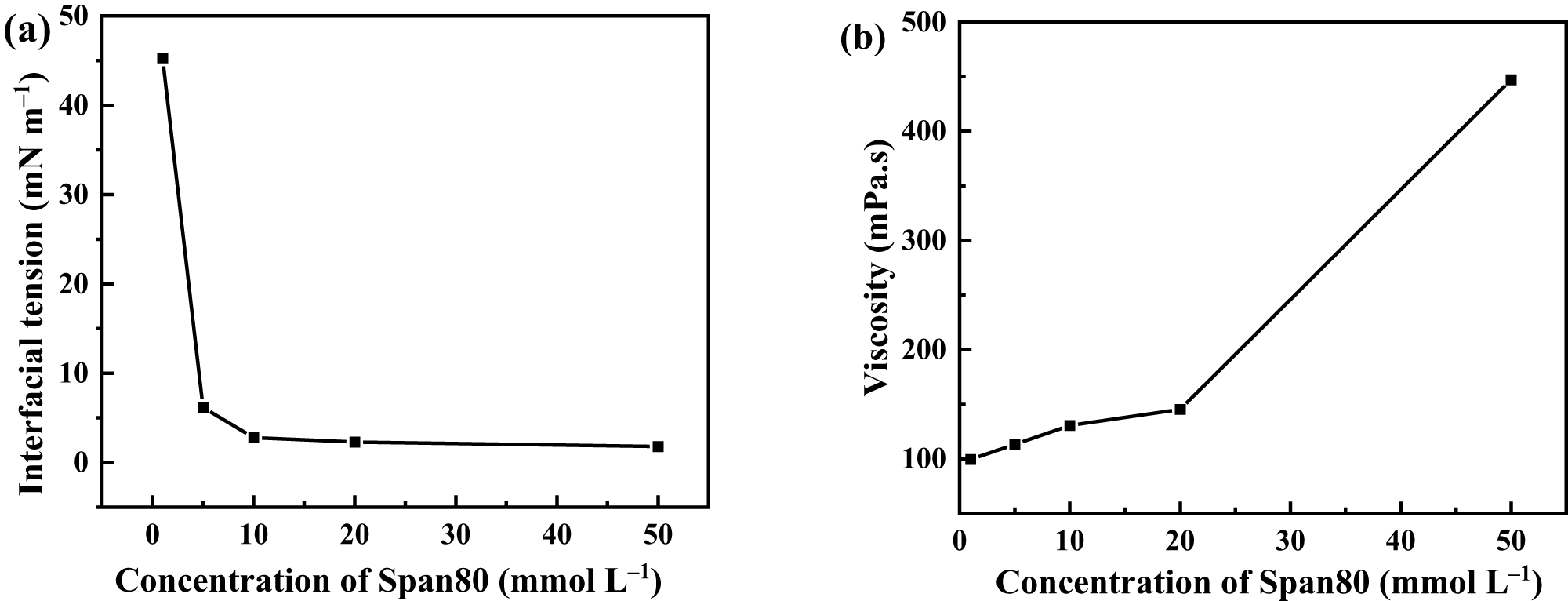
Interfacial tension and viscosity (Fig. 4), which are critical factors influencing the dispersion stability of bentonite in W/O emulsions, were measured. The addition of surfactant significantly reduced the oil–water interfacial tension. Consequently, the stability of the W/O emulsion improved as the surfactant concentration increased within the range of 0–50 mmol L–1. Concurrently, the viscosity of the emulsion system increased with greater Span80 concentrations. Generally, higher stability in W/O emulsions correlates with greater system viscosity (Ushikubo & Cunha, Reference Ushikubo and Cunha2014). This trend contrasts with that observed in O/W emulsion systems. This difference arises because oil typically possess greater viscosity than water. In W/O emulsions, oil acts as the continuous phase. Thus, a higher volume fraction of the oil phase contributes to increased overall viscosity. Conversely, in O/W emulsions, the continuous phase is water, which has lower viscosity. Therefore, increasing the water-phase content generally reduces overall viscosity. Consequently, variations in the composition of the continuous phase significantly affect the system’s rheological properties, leading to distinct viscosity trends in W/O and O/W systems (Shi et al., Reference Shi, Wang, Liu and Wang2018).
(a) Oil–water interfacial tension and (b) viscosity of the systems at various Span80 concentrations.

Figure 4 Long description
The image contains two graphs. Graph (a) displays interfacial tension in millinewton per meter on the y-axis against the concentration of Span80 in millimole per liter on the x-axis. The graph shows a sharp decrease in interfacial tension from 50 to around 10 millinewton per meter as the concentration increases from 0 to 10 millimole per liter, then stabilizes. Graph (b) presents viscosity in millipascal second on the y-axis against the concentration of Span80 in millimole per liter on the x-axis. The graph indicates a steady increase in viscosity from around 100 to 450 millipascal second as the concentration rises from 0 to 50 millimole per liter.
Effect of mixed surfactants on the dispersion stability of bentonite in emulsions
Numerous studies have demonstrated that emulsions stabilized by mixed surfactants exhibit improved stability due to synergistic effects (Binks et al., Reference Binks, Desforges and Duff2007; Pichot et al., Reference Pichot, Spyropoulos and Norton2010; Liu et al., Reference Liu, Liu, Hei, Shi, Guo, Li and Leng2024b). Accordingly, the dispersion stability of bentonite in emulsions stabilized by mixtures of calcium stearate and Span80 at various ratios was investigated, as illustrated in Fig. 5. Compared to the system stabilized by Span80 alone, the addition of calcium stearate resulted in an increased volume of the emulsion layer, indicating improved system stability. The emulsion exhibited optimal macroscopic stability and maximum viscosity at a mixing ratio of 1:1 (Table 2). Therefore, this ratio was identified as optimal. Additionally, CTAB and OP-10 were also combined with Span80 to further evaluate their effects on the stability of the bentonite–emulsion system.
Macroscopic images of bentonite dispersed in W/O emulsions stabilized by Span80 and calcium stearate at ratios of (1) 1:2, (2) 1:1, (3) 2:1 or (4) 1:0 after standing for (a) 0 h, (b) 0.5 h, (c) 1.5 h or (d) 12 h.

Figure 5 Long description
The image consists of four separate sections labeled as (a), (b), (c) and (d), each showing four test tubes numbered 1 to 4. Each section represents a different time interval: (a) 0 hours, (b) 0.5 hours, (c) 1.5 hours and (d) 12 hours. The test tubes contain bentonite dispersed in water-in-oil emulsions stabilized by Span80 and calcium stearate at different ratios. The appearance of the emulsions changes over time, indicating variations in dispersion stability. The test tubes are arranged in a consistent order across all sections, allowing for comparison of the emulsion stability at each time interval.
Viscosity of systems with various ratios of Span80 and calcium stearate.

Table 2 Long description
The table measures viscosity and shear force across different ratios of Span80 to calcium stearate. Viscosity is highest at 161.4 mPa·s for a 1:1 ratio, followed by 140.2 mPa·s at 2:1, 107.6 mPa·s at 1:2, and lowest at 103.8 mPa·s for 1:0. Shear force is highest at 31.96 dyne cm−2 for the 1:1 ratio, with other values being 28.39 dyne cm−2 at 1:2, 28.13 dyne cm−2 at 1:0, and 27.76 dyne cm−2 at 2:1. The 1:1 ratio shows the most significant increase in both viscosity and shear force, indicating a potential optimal balance between the two components.
The macroscopic stability of the emulsion system stabilized by mixed surfactants at a ratio of 1:1 is shown in Fig. 6. The stability of the system formed by mixing Span80 and CTAB is significantly lower than that of the system emulsified by Span80 alone. However, the stability of the systems formed by mixing Span80 with calcium stearate or OP-10 is substantially improved. The type of emulsion formed by these systems needed be determined. Through fluorescence microscopy images (Fig. 7), it was observed that W/O emulsions were formed when Span80 was mixed with CTAB or with calcium stearate as stabilizers. The droplet size of the emulsion emulsified by Span80 mixed with calcium stearate was the smallest (<10 μm), and the surface significantly adsorbed a large amount of bentonite. The droplet size of the emulsion emulsified by Span80 mixed with CTAB was the largest (>25 μm). When Span80 was mixed with OP-10 as a stabilizer, an O/W emulsion was formed, and the droplet size of this emulsion was also large.
Macroscopic images of bentonite dispersed in emulsions stabilized by various surfactants – (1) Span80, (2) Span80:CTAB 1:1, (3) Span80:calcium stearate 1:1 or (4) Span80:OP-10 1:1 – after standing for (a) 0 h, (b) 0.5 h, (c) 1.5 h or (d) 12 h.

Figure 6 Long description
The image shows four sets of emulsions stabilized by different surfactants, labeled as 1, 2, 3 and 4. Each set is displayed at four different time intervals: (a) 0 hours, (b) 0.5 hours, (c) 1.5 hours and (d) 12 hours. The emulsions are contained in transparent tubes, allowing observation of changes in stability and appearance over time. The tubes are arranged in a row for each time interval, showing the progression of the emulsion's stability and separation characteristics.
Microscopic images of bentonite-based W/O emulsions prepared with mixed surfactants at 1:1 ratios: (a) Span80, (b) Span80:CTAB, (c) Span80:calcium stearate and (d) Span80:OP-1. (a1) to (d1) are corresponding fluorescence images.

Figure 7 Long description
The image consists of two rows of microscopic images labeled (a) to (d). The top row shows bentonite-based emulsions prepared with mixed surfactants at a 1:1 ratio. Image (a) displays Span80, (b) shows Span80:CTAB, (c) depicts Span80:calcium stearate and (d) illustrates Span80:OP-1. Each image includes a scale bar indicating 10 micrometers. The bottom row presents corresponding fluorescence images for each emulsion type, labeled similarly from (a) to (d). These images highlight the droplet formations and surface characteristics of the emulsions under fluorescence microscopy, with scale bars also indicating 10 micrometers.
These results demonstrate that the stability of an emulsion not only depends on its type, but also is closely related to the interface film structure and particle interface behaviour. In this system, the HLB value cannot accurately predict the emulsion type, nor can it reflect the influence of the interface membrane structure and particle interface behaviour on stability. Specifically, in the Span80/CTAB system, although the W/O structure is formed, CTAB makes the surface of the clay particles change sharply from ‘lipophilic’ to ‘strongly hydrophilic’, resulting in fragile interfaces, coarse droplets (>25 μm) and poor stability. In the Span80/calcium stearate system, the two synergistically form a high-strength composite interface film, which can keep the droplets at a very small size (<10 μm) and lock the bentonite particles tightly at the interface, forming a dense ‘armour’ (Hong et al., Reference Hong, Rühs and Fischer2015; Nallamilli & Basavaraj, Reference Nallamilli and Basavaraj2017), hence its strong macroscopic and storage stability performance. In the Span80/OP-10 system, due to the hydrophilicity of OP-10, the HLB value of the system is significantly increased and finally an O/W emulsion is formed; the system nevertheless shows good long-term stability despite its large droplet size.
To reveal the dispersion stability of bentonite in emulsions, the viscosity and interfacial tension of various mixed surfactant systems were measured (Table 3). The system stabilized by mixing Span80 and CTAB exhibited the highest interfacial tension and reduced viscosity. Neither of these factors favours the dispersion of bentonite in W/O emulsions or system stability. Conversely, the viscosity and interfacial tension of the system stabilized by mixing Span80 and OP-10 decreased significantly, representing a profile conducive to stabilizing bentonite in O/W emulsions.
HLB value, viscosity and oil–water interfacial tension of various mixed surfactant systems.

Table 3 Long description
The table compares the HLB value, viscosity, and oil-water interfacial tension of various mixed surfactant systems. Span80:CTAB 1:1 has the highest HLB value of 10.05, indicating a more hydrophilic nature compared to other systems. Span80:calcium stearate 1:1 exhibits the highest viscosity at 62.10 mPa·s, suggesting a thicker consistency. It also has the lowest interfacial tension at 4.59 mN·m−1, which may imply better emulsification properties. Span80 alone has the lowest HLB value of 4.30, indicating a more lipophilic character. Span80:OP−10 1:1 has the lowest viscosity at 28.50 mPa·s, which could suggest a more fluid mixture. These variations highlight the impact of different surfactant combinations on the properties of the mixtures.
Compared with the method of stabilizing the properties of hydrophobic solid particles (e.g. hydrophobic bentonite) in classical studies (Binks et al., Reference Binks, Clint and Whitby2005), this study introduces the compounding strategy of Span80 and calcium stearate to achieve synergistic reinforcement of the interface structure. The innovation of this study is that calcium stearate and Span80 can produce synergistic effects, more effectively promote the adsorption and dense arrangement of the original bentonite particles at the interface and construct a composite interface film with significantly improved mechanical strength. The modest increase in system viscosity from 50.85 mPa·s (with only Span80) to 62.10 mPa·s provides direct rheological evidence for this interface-strengthening process.
The microscopic mechanism of this synergistic effect operates at two levels. At the structural level of the interface film, the long alkyl chains of calcium stearate complement Span80 to form a dense, highly viscoelastic composite interface film, which accounts for the system’s high viscosity and low interfacial tension. Regarding interactions with bentonite, Ca2+ ions from calcium stearate are specifically adsorbed onto the negatively charged bentonite surface. Their hydrophobic tails associate with the oil phase via Span80, strongly ‘anchoring’ the bentonite particles at the oil–water interface. This transforms the particles into effective interface stabilizers and forms a dense ‘particle armour’ on the surface of the emulsion droplets. Therefore, this study elucidates the microscopic mechanism that leads to excessive stabilization that may hinder downhole cutting removal while also providing a list of factors to avoid in drilling fluid formulation design.
Conclusions
This study systematically investigated the mechanisms by which surfactant type and mixture composition influence the stability of bentonite-containing emulsions. Surfactant type plays a pivotal role in the dispersion stability of bentonite in W/O emulsions. While non-ionic surfactants generally enhance stability, ionic surfactants tend to reduce it, with the cationic CTAB yielding the lowest stability. Increasing the Span80 concentration from 0 to 50 mmol L–1 improved bentonite stability in W/O emulsions, accompanied by an increase in system viscosity.
Notably, a 1:1 mixture of Span80 and calcium stearate exhibited excellent synergistic effects. This combination facilitated the formation of a high-strength, highly viscoelastic composite interfacial film and strongly anchored bentonite particles at the interface, thereby significantly enhancing both the micro- and macro-stability of the system. This mechanism clarifies the fundamental reasons why drilling cuttings often become overly stable and difficult to remove downhole. It provides a clear basis for optimizing drilling fluid formulation and establishes a theoretical foundation for developing targeted treatment agents that promote the directional desorption and controlled sedimentation of drilling cuttings.
Through the analysis of surfactant HLB values, oil–water interfacial tension, system viscosity, bentonite wetting angle and zeta-potential, it was determined that the HLB value of a single surfactant is the decisive factor in emulsion type, while interfacial tension is the dominant factor governing bentonite dispersion stability. For emulsions stabilized by mixed surfactants, the final stability depends on the mechanical strength of the interfacial film and the precise regulation of the interfacial behaviour of bentonites by surfactants. This study presents a theoretical basis for the design and construction of bentonite-based W/O emulsion systems. By optimizing surfactant compounding, enhancing interfacial film properties and regulating the interfacial behaviour of bentonite particles, a comprehensive and practical stability regulation scheme was established.
Supplementary material
The supplementary material for this article can be found at https://doi.org/10.1180/clm.2026.10029.
Financial support
This work was supported by Sichuan Science and Technology Program (2023NSFSC0922 and 2022NSFSC1217).
Competing interests
The authors declare none.