In some work places such as carwashes and restaurants where wages and tips are generally both low, workers’ income can rely upon tips. These tips, meant as a reward for good service, instead serve as a critical wage subsidy that brings workers’ wages just up to the legally mandated minimum wage. This system disproportionately impacts women and minorities and prevents some workers from coming forward to voice concerns fearing retaliation.Footnote 1
Introduction
In the restaurant sector of the United States, where the practice of tipping is axiomatic, there exists a two-tiered minimum-wage system consisting of the regular ‘minimum wage’ and the ‘tipped minimum wage’. The ‘tipped minimum wage’ is a sub-minimum wage paid by employers to tipped workers that is ostensibly designed to compensate tipped workers up to the regular minimum wage in the event of a shortfall in their tipped income below that level, but which does not otherwise oblige employers to pay above the compulsory base of the ‘tipped minimum wage’. The effect is to create a two-tier minimum wage system, and it is a highly contested element of employment and welfare policy in the United States (see McDonough, Reference McDonough2019). At both the Federal and State levels, it has become the focal point for an emerging discourse of labour struggle and reform across the expanding service sectors that dominate certain regions of the economy (Kapur, Reference Kapur2017). In 2018, Commissioner Reardon of the New York State Department of Labor (NYSDL) began a public hearing on the tipped minimum wage by stating that ‘Governor Cuomo has directed this agency to ensure that no workers are more susceptible to exploitation because they rely on tips to survive’ (Reardon, Reference Reardon2018). In December 2019, the Governor issued the Minimum Wage Order for Miscellaneous Industries and Occupations, following states such as California, Alaska, and Washington, toward creating one single minimum wage in place of the two-tiered system (Governor's Press Office, 2019). At the Federal level, the ‘Raise the Wage’ Bill, proposed to Congress in 2019, aims to raise the regular minimum wage to $15 an hour by 2024, and gradually to eliminate the ‘tipped minimum wage’ entirely. As a technical device, the ‘tipped minimum wage’ is evidently a problematic and controversial issue, and it is at the policy forefront of questions regarding labour control, neoliberalisation, industrial relations, social reproduction, immigration, capital accumulation, and the intersectional racing and gendering of social relations.
Tipping is an instructive and illuminating place to direct our sociological analyses, because the societal significance of the technique of tipping goes much further than the setting of the restaurant industry. Apparently a simple means of labour remuneration in determinate processes of production, tipping is actually a key device of social reproduction in general, and is thus marked with extraordinary societal importance. When stripped of context, the technical operation of tipping conforms very closely to the post-Fordist logic of work and economic organisation that is characteristic of neoliberal political economy (see Amin, Reference Amin1994; Piore and Sabel, Reference Piore and Sabel1984; Offe, Reference Offe1985; Lash and Urry, Reference Lash and Urry1987; Görz, Reference Görz1989). At the most strategic level, the early twenty-first century is witnessing a transformation in political economy across the capitalist core states away from accumulation by ‘expanded reproduction’ and toward a low-growth accumulation regime predicated on ‘accumulation by dispossession’ and ‘rent-seeking’ behaviours (Harvey, Reference Harvey2004; Hudson, Reference Hudson2012; Lapavitsas, Reference Lapavitsas2013; Andreucci et al., Reference Andreucci, García-Lamarca, Wedekind and Swyngedouw2017; Bin, Reference Bin2018; Welsh, Reference Welsh2019a, Reference Welsh2019b, Reference Welsh2020). This kind of zero-sum political economy makes for a profound transformation of work, employment, and labour relations into forms more appropriate to this political economy.
Our argument is that the neoliberal paradigm of political economy has proven surprisingly weak at sustaining rounds of capital accumulation (Harvey, Reference Harvey2005, Reference Harvey2010, Reference Harvey2015; Duménil and Lévy, Reference Duménil and Lévy2011), which in turn implies a long-term threat to the social reproduction of capitalist social relations. Consequently, a strategic imperative has emerged to realise more efficaciously the political pacification and economic mobilisation of labour that is required for more sustainable accumulation and thus of continued systemic reproduction. The object of this imperative is to realise a deepened and intensified real subsumption of labour Footnote 2 in the core states of the world-system (see Negri, Reference Negri1992: 92; Marx, Reference Marx1993: 400-1; Read, Reference Read2002), and it is toward this real subsumption that changes in the technical organisation of work need to be approached in our critical sociological analyses.
Work and labour control in this process of real subsumption are increasingly characterised by informalisation, internalisation and incentivisation in their technical logic. These are three succinct vectors through which we can grasp the real subsumption in emergent labour forms, and they are all exemplified brilliantly in the technique of tipping. The informalisation of work is evident in the migration of employment relations away from institutional settings, the deconstruction of politico-legal frameworks within which productive processes have been historically coordinated, the dismantling of the structures of welfare-state capitalism, the flexibilisation of worktimes, and the digitisation of previously physical or analogue relations in the work place. This informalisation of work constitutes one element in the neoliberal reorganisation of the mode of production that has aimed to restore accumulation processes by redefining the terms of the capital-labour relation. Internalisation alludes to the shift away from a disciplinary modality of labour control achieved through the externally imposed formation of habits and the spatial disposition of bodies that was typical of the factory, prison, schoolroom and barracks of the industrial paradigm (Foucault, Reference Foucault1991; Gill and Pratt, Reference Gill and Pratt2008; Rancière, Reference Rancière2012: 31; Andreescu, Reference Andreescu2016; Welsh, Reference Welsh2018). Internalised technique in labour control eschews the imposition of panoptic discipline and instead engenders a transformation in the subjectivity of the worker itself. Finally, incentivisation is the emphatic shift in capital’s modus operandi to seek the mobilisation of energy on the part of the worker, contriving techniques that situate the worker within a population by which they are ‘governed’ and through which their subjectivities are transformed into willing subjects (Deleuze and Guattari, Reference Deleuze and Guattari1983; Deleuze, Reference Deleuze1992; Lordon, Reference Lordon2014). The obedient worker is now the willing worker, and the imposition of command is replaced by the ‘free choice’ of the worker to labour for capital.
Through informalisation, internalisation and incentivisation, we can see how labour control delves into our subjectivities to achieve its objective of a more governable subjectivity (see Lazzarato, Reference Lazzarato, Virno and Hardt2006; Blackman et al., Reference Blackman, Cromby, Hook, Papadoulos and Walkerdine2008). We can perceive the heightened importance of ‘performance’ in work that is ‘willed’ (Butler, Reference Butler1990). We can understand why affectivity and emotion might be decisive conduits in work that play upon our internalised commitments and loyalties (Azar, Reference Azar2007b; Hardt, Reference Hardt1999, Reference Hardt, Clough and Halley2007; Hardt and Negri, Reference Hardt and Negri2000). We can grasp why work is necessarily more precarious (Butler, Reference Butler2006; Standing, Reference Standing2011); and we can acknowledge that the ‘choice’ to labour thusly might just as easily be described as ‘conative enslavement’ (Lordon, Reference Lordon2014).
As informalisation, internalisation and incentivisation have become increasingly relevant to the techniques of post-Fordist productive organisation, the technique of tipping has emerged as a highly effective and revealing exemplar of this logic. An analysis of tipping therefore has the potential to coordinate empirically our understanding of these vectors of labour control into both a rich and striking object of sociological insight regarding emergent work forms.
We contend that tipped work is once again becoming an increasingly prevalent form of remuneration beyond the conventional bounds of the hospitality industries, and that trends such as ‘uberisation’ threaten to normalise the tipping technique into many other spheres of productive and reproductive activity. Politically significant here is how techniques like tipping are part of a move toward forms of work closer to ‘personal services’ than to productive employment, resulting in a multiplication of what André Görz called The New Servants across the core states of the world-system (Görz, Reference Görz2012: 44-52; see also Lash and Urry, Reference Lash and Urry1987: 161-95; Bowman and Cole, Reference Bowman and Cole2009). Understanding why this shift is happening, as well as how this class is generated, controlled, exploited, and mobilised, is then an essential task for critical sociological analysis, and presents as a formidable undertaking for those interested strategically in social policy formation in this new context. If $30 per month is all it takes to define a tipped worker, one can see how innumerable forms of work could gravitate into the orbit of the tipping technique.
Given that it entails ‘performative’ and ‘emotional’ labour, service work generically is subject to a modality of management technique quite different from other labouring processes (Johnston and Sandberg, Reference Johnston and Sandberg2008; Brook, Reference Brook2009a, Reference Brook2009b, Reference Brook2013). This technique has been expressed simply as ‘the management of feeling to create a publicly observable facial and bodily display’ (Hochschild, Reference Hochschild1983: 7; see also McFadden, Reference McFadden2015), but as a requirement of paid employment and commodification of the self (Davis, Reference Davis2003). In the case of tipped workers, especially those in the restaurant industry, work requires a hyper-performance of emotional labour (see Azar, Reference Azar2007b). The typical assumption around emotional labour is that it is ‘sold for a wage’ (Hochschild, Reference Hochschild1983: 7). However, tipped work is not emotional labour exchanged for wages, but is rewarded with tips. Outside the wage form, tipping intensifies the effects of emotional labour on workers, as their income is directly related to the extent to which they can manage not only their feelings, but the feelings of customers too, leaving the worker in an extraordinarily precarious, vulnerable, and demanding position. It is no surprise that the majority of emotional labour is performed by women, extending their affective and emotion work from the reproductive space of the home into the realm of employment.
As a related subfield of service work, we have already witnessed an eruption of sociological interest in the ‘gig-economy’ (Snider, Reference Snider2018; Johnes, Reference Johnes2019). This term should be understood as service work characterised by instability, impermanence, flexibility, and with an orientation around performance. This interest is developing into a concern over its quality (Muntaner, Reference Muntaner2018; Torres, Reference Torres2018; Flanagan, Reference Flanagan2019), into discussion over how to classify the work done within it (Healy et al., Reference Healy, Nicholson and Pekarek2017), and into debate over the societal implications of this new modality of work and employment (Tran, Reference Tran2017). All of these developments are stimulating innovative critical analyses as the predicate for effective and progressive policy formation. Policy analyses will have to grasp the central importance of ‘technique’ in this transformation of labour control, and then link the forms of work emergent from such technique to the new global political economy, if effective and reflexive policy formation is to be conceived and put into practice. Though the future of the ‘gig economy’ is by no means determinate (Healy et al., Reference Healy, Nicholson and Pekarek2017), to understand the technical operation of tipping is perhaps to see many of our futures through a glass darkly (see Kalleberg, Reference Kalleberg2003), and to understand how it is implicated in the reproduction of exploitative, racist and sexist social relations immanent to neoliberal capitalism (Lowrey, Reference Lowrey2019; Ferdman, Reference Ferdman2016).
This means that, aside from its direct bearing on issues of policy formation in the service sector of the United States, the analysis of tipping is of great sociological import generally because of what it can reveal to us about developments outside the United States (i.e. United Kingdom), as well as more fundamental societal operations in the contemporary transformation of work and labour generally. Specifically, analysis of tipping as a technique of labour control can illuminate much in how social relations of exploitation, appropriation, and domination are reproduced intersectionally in neoliberal capitalism, by both transfiguring subjectivities and inscribing new lines of differentiation in the social relations of production and reproduction.
The aim here is to set out the contours of the policy problem of the ‘tipped minimum wage’, so as to make a further societal statement on tipping as a technique of labour control in the context of neoliberalism as a troubled regime of accumulation.
The problem of tipping
First, let us be clear on what tipping actually is. According to Daniele Archibugi, a ‘tip’ is defined as ‘the price, determined unilaterally by the customer, for a service received… It is not obligatory, and its amount is not fixed in advance, except by a social code’ (Reference Archibugi2004: 1). Commensurately, a ‘tipped employee’ is one who ‘engages in an occupation in which he or she customarily and regularly receives more than $30 per month in tips’ (USDL, 2019c). Whereas wages are fixed and allow a worker to depend on income, tips are something unfixed, flexible, and subject to arbitrary determination. They are then clearly a more precarious source of income than wages. Tipping in the United States is a customary and expected practice in various service industries, specifically within the restaurant sector, and constitutes the bulk of many restaurant workers’ incomes. It is not merely a marginal supplement to a regular waged income, as one would find in other societies (i.e. Europe). The general ideal around the use of a tipping system is that it incentivises workers to improve the quality of service provided and to increase the economic efficiency of work performed (Azar, Reference Azar2007a: 1917). However, the quality of service does not necessarily or proportionally effect the tip given in practice (Reference Azar2007a: 1924-1925), and service quality is contextually dependent upon a range of variables, from the type of establishment or disposition of patron in question to the cultural mores and economic environment of the geographical locale. The other aspect to tipping, often not discussed, is that it allows restaurant owners to pay their workers a lower wage, irrespective of categorically sweeping claims to the contrary, and understanding how and why this is the case will be at the core of this article.
Tipping is a prevalent custom across the United States, though it is becoming increasingly common in other economies across the core of the world-system. Focusing our analysis on the restaurant industry we find that, as of 2016, there are 2,600,500 persons employed as waiters or waitresses in the United States, along with 611,200 bartenders, according to the U.S. Bureau of Labor Statistics (USBLS, 2018, 2019a, 2019b). The three million tipped workers in the US restaurant industry are situated in a plural and heterogeneous restaurant landscape. High end restaurants are juxtaposed with more affordable chain restaurants, as well as so-called ‘mom and pop’ restaurants. This variable landscape, combined with the uneven tipped wage policies across the United States, creates a structure that exposes many to exploitative practices, especially in terms of gender, class, and race, whilst others enjoy more comfortable, remunerative, and secure circumstances. There is then a considerable variation in wages, tips, revenues, costs, etc., depending on the state, city, neighbourhood, cuisine, and clientele in which the tipped worker finds themselves.
How then can we understand the support for tipping and the tipped minimum wage policy? In keeping with neoliberal theory, tips are seen by agencies like The Heartland Institute or The Mises Institute as a device that provides freedom and choice in the spirit of entrepreneurialism and ‘free market’ ideology (Zahringer, Reference Zahringer2014; Federal News Network, 2018; Glans, Reference Glans2018).Footnote 3 It is seen to give choice to the customer, granting them the ‘freedom’ to leave a tip determined by what they think is appropriate as the purchaser of the service. Owners of restaurants are seen to be partially freed from the burdens of paid wages and red tape (Adams, Reference Adams2018), and are instead able to concentrate upon organisation and provision of overheads. Finally, the tipped workers themselves benefit from the provision of a space that liberates them from wage limitations, and frees them to enjoy greater returns on their productivity. The worker is given the opportunity to become a mini-entrepreneur who works a ‘space’,Footnote 4 and who can make tips well in excess of prospective wages, as long as they are good enough, work hard enough, and stay productive. While this rhetoric is doubtless connected to the ‘flexibilization of labour’ discourse (Felstead and Jewson, Reference Felstead and Jewson1999; Reilly, Reference Reilly2000), and so is congenial to the ears of those in business and other uncritical devotees of ‘free market’ ideology (i.e. Siebert, Reference Siebert1997), it is often in practice closer to the realities of ‘precarious’ and ‘contingent’ labour (see Gray, Reference Gray1995; Barker and Christensen, Reference Barker and Christensen1998; Kalleberg, Reference Kalleberg2003; Standing, Reference Standing2011). Across the economy as a whole, the beneficiaries of the practice of tipping constitute a minority, privileged by a range of factors including geography, sex, and race (Haley-Lock and Shah, Reference Haley-Lock and Shah2007: 488; Jayaraman, Reference Jayaraman2016: 9-10).
Studies funded by fiscally conservative think tanks, like the Employment Policies Institute or the Economic Self-Sufficiency Policy Research Institute, deny that a raising of the tipped minimum wage would deliver financial benefit to poor restaurant workers (see Sabia et al., Reference Sabia, Burkhauser and Mackay2018). Tasked politically with reducing the minimum wage generally, these studies arguably conform the terms of their analyses to their ideological and special interest objectives. For example, by replacing the individual with the household as the basic unit of analysis, Sabia et al. demonstrate that raising the tipped minimum wage would be a ‘poorly targeted policy to deliver income to poor restaurant workers’ (Reference Sabia, Burkhauser and Mackay2018: 637). Such an analytical move subsumes the individual into precisely those asymmetric social relations that the tipping technique relies upon for its subordinations and control. Vested interest studies do not (cannot) consider whether or not the very existence of the tipped minimum wage itself increases poverty levels. Whilst studies such as this focus on the manipulation of the tipped-minimum wage as an object of policy tinkering, our analysis advocates for the removal of the tipped minimum wage altogether, and thus of the matrix of social relations that it brings into being. Becoming stuck in the issue of its manipulation as a policy instrument, studies too often evade the powerful argument for its total abolition, a move that would obviate their carefully framed objections in a stroke. What is decisive is that the value of abolition becomes apparent only in the context of a critical perspective on tipping as a technique in general, something that is absent in vested interest studies.
Despite the sanguine portrayal of the practice, tipping actually brings with it an impressive historical legacy of inequality, disparity, and a particular asymmetry of power relations, not to mention a problematic relationship with the distinctively ‘modern’ logic of Society. It is an undemocratic means of control, for it creates a system of ‘distorted incentives’ that instrumentalise the individual (Archibugi, Reference Archibugi2004: 60), rather than treating them as ends in themselves (see Marcuse, Reference Marcuse2002; Fromm, Reference Fromm2003), and through which service is aligned with the wills of others (see Lordon, Reference Lordon2014), leaving the server without a clear and unambiguous structure on which to base their rights and recourse. It also devolves onto the server a large share of organisational labour usually left to the managerial and proprietorial levels, and it places the server into a divisive set of relations with other workers, both tipped and non-tipped.
Historically, tipping emerged in European societies as a way of compensating servants in Tudor England, at the early-modern intersection of the feudal and money economies, and spread in periods of economic downturn through the late nineteenth century and into the early twentieth century (Hill, Reference Hill1996: 64-92; Van den Eeckhout, Reference Van den Eeckhout2015). These were downturns that enlarged the ‘reserve army of labour’, introduced greater vulnerability and precarity into the labour force, and strengthened the structural position of the owners of capital and property in the economy. Many cafés, restaurants, salons, and bars exploited the greater availability of surplus labour and found that by providing/producing a space for tipped-labour to replace waged-labour, employers were able to escape the obligation of having to pay for labour (Van den Eeckhout, Reference Van den Eeckhout2015: 349-50), or at least to shift that burden on to others. One could see this as another historical example of the perennial tendency of capital to internalise profit and income, whilst externalising cost and risk.
Ironically, the transfer of the custom of tipping from Europe to the United States was not met positively, but was generally treated rather as a ‘despicable, undemocratic, and wholly un-American’ practice that was inconsistent with the egalitarian rhetoric of the Declaration of Independence and the mores of colonial society (Segrave, Reference Segrave1998: 5-6; Jayaraman, Reference Jayaraman2016: 33; Shanker, Reference Shanker2016). The infiltration of tipping to the United States in the nineteenth century primarily occurred through the hospitality and railroad industries. Employers fought to emplace and maintain tipping, because they employed many former slaves and argued that they should not have to pay former slaves wages, the reasoning being that as long as they were receiving tips, wages were not necessary (Jayaraman, Reference Jayaraman2016: 33-34). Tipping is also a significantly gendered custom, derived as it was from the early-modern enclosure of women (Federici, Reference Federici2004). Since then most domestic servants have been women, and presently nearly 70 percent of Servers are female (Hill, Reference Hill1996: 4-5; Allegretto and Cooper, Reference Allegretto and Cooper2014: 2), with that proportion rising as one moves down the income pyramid. A study by Adam-Smith, Norris and Williams reveals a similar trend of gender segregation in corresponding hospitality jobs in the UK (Adam-Smith et al., Reference Adam-Smith, Norris and Williams2003: 31). Historically, tipping is then a persistent and recurrent form of orchestrating the reproduction of labour in the United States that is intimately associated and embroiled in racist and sexist asymmetries, and which is imbricated into a wider historical legacy of servitude and subordination (see Cobble, Reference Cobble1992; Ferdman, Reference Ferdman2016). What is needed then are critical analyses on tipping, the policies which surround it, and the societal implications of those policies beyond the narrow concerns of business and public administration.
Whilst there is literature on tipping policy to be found on US Government websites, such as the U.S. Department of Labor and the U.S. Bureau of Labor Statistics, or from think-tank institutions like the Economic Policy Institute, they are limited in sociological scope. Likewise, while a few labour pressure groups, such as the Restaurant Opportunities Center United (ROC-United), have done extensive research on tipping and ‘tipped minimum wage’ policy that is informative, it lacks a theoretically articulate critique of social problems and does not reach the level of sociological analysis required for an academic literature on tipping. However, aside from a number of cursory and relatively descriptive pieces (i.e. Archibugi, Reference Archibugi2004), the academic sociological literature on tipping is surprisingly small and too often treats tipping as a normative ‘puzzle’ to be ‘solved’ (Azar, Reference Azar2007a). Critically effective policy research however can be built upon a number of pillars. Historical analyses are essential to understand the profound social logic operative in the tipping practice (see Van den Eeckhout, Reference Van den Eeckhout2015), as well as the socio-political agenda that they serve. Sociological analyses that work auto-ethnographically at the intersection of personal experience and critical theory can be especially propitious for the constitutive process of critical praxis that is informative of policy production (Dowling, Reference Dowling2007, Reference Dowling2012). Finally, Allegretto and Cooper (Reference Allegretto and Cooper2014) offer the point of departure in the loose policy-oriented literature around tipping, particularly around the question of the ‘tipped minimum wage’, and it is to this issue that we must now turn.
The ‘tipped minimum wage’
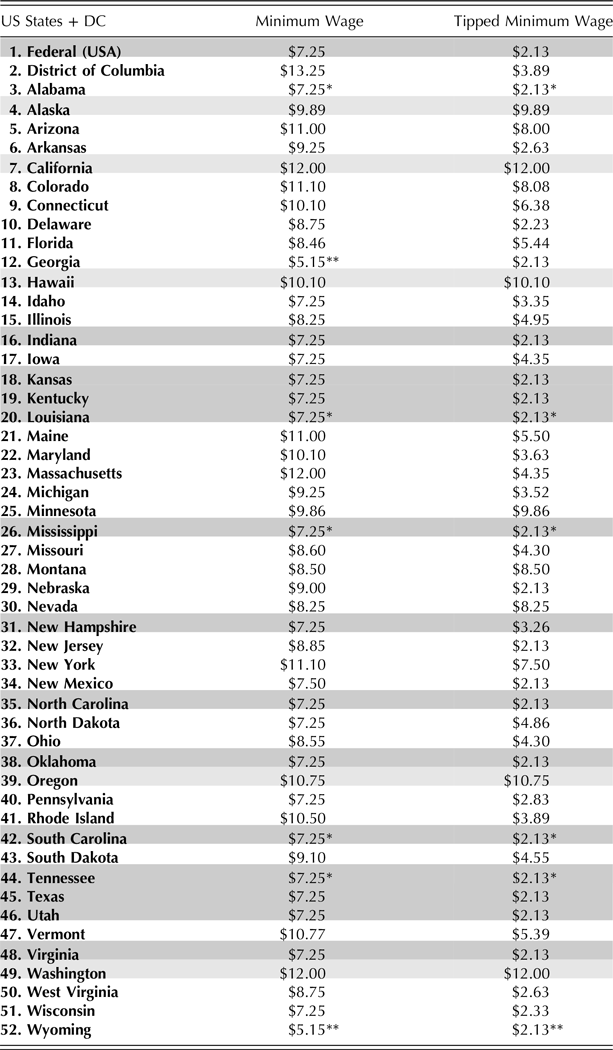
The parameters to tipping policy in the US are established essentially by the federal government, but individual states have some jurisdiction.Footnote 5 Minimum wage law is governed by the 1938 Fair Labor Standards Act (FLSA). This initially provided protection for government employees and those who worked in interstate commerce, but the law has exponentially expanded since then, and a 1966 Amendment to the FLSA widened its scope to encompass service workers, including restaurant workers (Allegretto and Cooper, Reference Allegretto and Cooper2014: 2). This in turn means that the minimum wage base is controlled predominantly by the federal government. States must at least meet the minimum established by the federal government, but states can elect to increase their minimum wage above this level. In addition to the regular minimum wage there is also a ‘tipped minimum wage’ for legally recognised ‘tipped workers’, creating a ‘two-tiered wage system’ in those sectors of the labour market (Allegretto and Cooper, Reference Allegretto and Cooper2014). The federal ‘tipped minimum wage’ stands currently at $2.13 per hour, as opposed to the regular federal minimum wage of $7.25 per hour (USBLS, 2018). We have used information from the Economic Policy Institute to compile a table which shows the various state minimum wages, both ‘tipped’ and ‘regular’ (see Table 1).Footnote 6
Federal and States’ ‘Minimum Wage’/‘Tipped Minimum Wage’

Source: Economic Policy Institute (2019) [accessed 14.01.2020].
Notes: Tipped Minimum Wage same as Federal Minimum.
 Minimum and Tipped Minimum Wage are the Same.
 Minimum and/or Tipped Minimum Wage Above Federal Minimum.
* State has no minimum, federal minimum applies by default.
** Workers not covered under Federal Labor Standards Act receive below federal minimum.
The ‘tipped minimum wage’ is used as a way to pay workers in order to benefit the employer under what is called a ‘tip credit’ system. The idea being that tips will make up the difference from the ‘tipped minimum wage’ of $2.13 an hour to the regular federal minimum wage of $7.25 an hour, a difference of $5.12 an hour. For example, a Server is paid the federal ‘tipped minimum wage’ of $2.13 an hour, with the assumption that their tips will be at least $5.12 per hour, thus taking the Server’s hourly income up to $7.25 per hour in total. The employer claims this $5.12 per hour as wages paid toward the employee via tips. In practice, this system relieves the owner of providing the full minimum wage to their employees. The logic behind this relief is that the employee is customarily receiving money for their work from customers in the form of tips and so the burden of a full minimum wage is unfair and economically deleterious for the employer. The FLSA §3(m) outlines the requirements of this ‘tip credit’ system. Below is an outline of the five requirements in the FLSA §3(m), and in addition to this an employer must inform any ‘tipped employee’ of these five requirements, either in written or in verbal form, in order to claim the ‘tip credit’ (FLSA: Fact Sheet #15):Footnote 7
1) The amount of cash wage [wage] the employer is paying a ‘tipped employee’ must be at least $2.13 per hour.
2) The additional amount claimed by the employer as a ‘tip credit’ cannot exceed $5.12 (the difference between the minimum required cash wage of $2.13 and the current minimum wage of $7.25).
3) The ‘tip credit’ claimed by the employer cannot exceed the amount of tips actually received by the ‘tipped employee’.
4) All tips received by the ‘tipped employee’ are to be retained by the employee except for a valid tip pooling arrangement limited to employees, who customarily and regularly receive tips.
5) The ‘tip credit’ will not apply to any ‘tipped employee’, unless the employee has been informed of these ‘tip credit’ provisions.
Naturally, restaurant owners with tight margins benefit from this $5.12 ‘tip credit’, by virtue of the lower labour costs it entails, and employer groups lobby intensely for its maintenance. How can we handle the problems with this ‘tip credit’ system? First, there are a number of problems with the ‘tip credit’ system as defined, which can be subject to critical scrutiny on its own terms.
Firstly, we call into question whether or not tipped employees are actually informed about the rules which surround the ‘tip credit’ system. One of the authors of this article has worked as a tipped employee in numerous locations over the course of sixteen years and has not once been informed of these five rules. Additionally, the FLSA requires that employers either post the minimum wage provisions in a visible area of the workplace or verbally inform employees of the provisions. However, there is no requirement to post this information in any language other than English. Given the large Spanish-only speaking labour force in the service sectors of the United States, it is easy to see how this requirement allows employers to abide by the rule to inform without adequately informing their employees in practice (Flores, Reference Flores2017).Footnote 8
Secondly, there is no clarity regarding whether or not this ‘tip-credit’ has a fixed unit of measurement. Is this credit applicable on an hourly, daily, or weekly basis. If a tipped worker is legally permitted to receive $2.13 per hour, how is the ‘tip credit’ applied (in what unit), if the worker does not make the full $5.12 to reach the minimum of $7.25 in a given hour? For example, if a server receives only $15 in tips for an eight hour shift, and earns their $2.13 tipped minimum wage for those eight hours, their total income for the day (tips plus wages) would be $32.04. If instead the server were to be paid the federal minimum wage for this same eight hour shift without tips, their income would be $58.00 for the day, a difference of $25.96. Are employers required to make up the difference of the ‘tip credit’ for this specific day, for every hour, or do they make up the difference at the end of the week? If the income for the rest of this work week is taken on average, and thus these low income days are considered to be irrelevant, a space for abusive practices is produced. According to the U.S. Department of Labor (2016) and the Economic Policy Institute (2017: 7-8), minimum wage laws indicate that the FLSA does define the work week for minimum wage workers as a seven day period, but they do not define when the tipped minimum wage differential must be paid, whether this is hourly, daily or weekly. In short, the tip-credit policy is crucially unclear in key areas, but is this merely a legal oversight or something essential to the informalisations of tipping as a technique? Whether the policy allows for a rolling accumulation of tips, or just for an average of tips weekly, the Server can be exposed to seriously precarious and unstable circumstances, and, as tipped workers often live ‘hand to mouth’ with a high propensity to consume income earned, this uncertainty and ambiguity can have significant impacts. Though general payday requirements are regulated through the FLSA (USDL, 2018), ‘Workweek’ and ‘Hours Worked’ do not specifically touch on the complexity of tipped workers’ wages and income (USDL, 2019a). This adds another layer of confusion to the tipping policy in the United States (U.S. Department of Labor, 2016).
A third problem with the ‘tip-credit’ system is that it is employers who report on the employees’ tips. The restaurant industry has one of the highest rates of wage theft in the US (Hallett, Reference Hallett2019: 100). According to a report by the Economic Policy Institute, tipped workers ‘are especially prone to suffer wage theft because of their separate treatment under the law [FLSA]’ (Economic Policy Institute, 2017: 7). Consequently, it is the tipped worker themselves who must keep track of the wage differentials that arise from the tipped minimum wage. Hallett points to instances not only of wage theft arising from this separate treatment under the law, but theft of workers’ tips as well (2019: 99-100). Employers can easily report false income for their employees, due to the fact that many tips are received in cash and record keeping is often informal. There is an obvious incentive to report false-tips, and it can prove quite lucrative for an employer to manipulate the $5.12 differential that they report for many employees over the course of many months. Additionally, it can also be difficult to prove that employers are not paying the ‘tip credit’ differential, when employees tips do not add up to the $7.25 minimum. One might assume it to be an uncommon occurrence, but in January of 2019 a restaurant called Max’s Pizza Inc. (New York) was found guilty of violating the tipped minimum wage law and of not paying their employees the necessary difference to reach the $7.25 federal minimum (USDL, 2019b). Instances such as this require the Federal Government, under the FLSA, to retrieve back wages for employees. However, if for some reason an employer has been stealing tips from their employees, the FLSA only requires restitution up to the $7.25 minimum wage to the Server, no more.Footnote 9
Lastly, the federal tipped minimum wage has been frozen at $2.13 per hour since 1991 (Allegretto and Cooper, Reference Allegretto and Cooper2014). According to Saru Jayaraman, the head of ROC-United, the National Restaurant Association (NRA) has much to do with this wage freeze. The NRA is a powerful association of restaurant owners and corporations. They have previously worked with restaurant groups such as Darden, whose holdings include a chain called The Olive Garden, and they boast a membership of over 500,000 other restaurant businesses, for whom they advocate. It also has a board membership ranging from the CEO of Wolfgang Puck Worldwide – a high-end restaurant group – to a member of the elite US Chamber of Commerce Committee of 100. This association has great lobbying power in the US Government, and is even referenced as a source of information on the USBLS Occupational Outlook Handbook on Waiters and Waitresses (2019a)!Footnote 10 The Policy Agenda on their website is focused specifically at benefitting restaurant owners,Footnote 11 with little mention of other perspectives. The influence of this association was made clear back in 1996, when Congress increased the regular minimum wage to $7.25 per hour on the understanding that the ‘NRA would not oppose a modest increase in the overall minimum wage, as long as the minimum wage for tipped workers would in turn stay frozen forever’ (Jayaraman, Reference Jayaraman2016: 8-9). The $2.13 per hour tipped minimum wage has been thus frozen for twenty-three years, and this policy has endured since to the direct benefit of large corporations and restaurant owners.
These are some of the problems with the ‘tipped minimum wage’ policy, and the ‘tip credit’ system, on their own terms. However, if we are to delve more critically into tipping as a technique of labour control, and into its societal implications, the problematisation of the ‘tip credit’ system has to go beyond the terms of the tipped minimum wage itself, and into the space that it creates. Understanding why that space exists and how it operates is something that can be explored through poststructuralist theory, and by the notion of intersectionality in particular.
Tipping and the intersectionality of exploitation
However valid the criticisms directed at the ‘tipped minimum wage’ policy might be, they do not address the more fundamental problem of tipping itself as a technique of labour control. It is to this problem that we must turn before concluding remarks.
Firstly, because of the impersonal, categoric, and statistical way in which tipping policy is mostly discussed, the great heterogeneity of social relations through which tipping operates is missed by policy researchers. When tipping research follows the categorical contours of social relations, such as race, gender, age, etc., the manifold complexity of how tipping activates these relations is not adequately brought out. Secondly, the space provided by the ‘tipped minimum wage’ produces more governable subjectivities in workers by the way that it internalises and informalises social relations of subordination and dependence, in order to incentivise greater labour surpluses toward accumulation.
Together, these two considerations require a sophisticated and versatile means of approaching the problem of tipping that is capable of coordinating the two into critical analysis. Gendering and racialising are simply the historically convenient idioms by which the heterogeneity characteristic of the restaurant industry is translated into strategies and tactics of labour control, and this coordination of categorical contours with political economic objectives is what is meant here by intersectionality.
Put simply, intersectionality supposes that ‘inequities are never the result of single, distinct factors’, but ‘are the outcome of intersections of different social locations, power relations and experiences’ (Hankivsky, Reference Hankivsky2014: 2). It operates on the premise that ‘oppression is not a singular process or a binary political relation, but is better understood as constituted by multiple, converging, or interwoven systems’ of subordination that overlap (Carastathis, Reference Carastathis2014: 304). It assumes ‘the concept of the simultaneity of [race, gender and class] intersection in people’s lives’ (Belkhir, Reference Belkhir2001: 146), and it is a mode of analysis ‘in which structures of domination are taken to be interactive rather than additive’ (Einspahr, Reference Einspahr2010: 15). Rather than a solution to the policy problem of tipping, intersectionality offers a ‘provisional concept’ for recasting the terms in which the problem can be engaged effectively, subtly, and critically without marginalising those not privileged in the policy discourse (Crenshaw, Reference Crenshaw1991: 1244-5). In contrast, one finds that ‘the separability of oppressions is premised on centring the essentialized experiences of relatively privileged members of oppressed groups’ (Carastathis, Reference Carastathis2014: 305; see also Harris, Reference Harris1990), and that is the largely unrecognised problem at the heart of the tipping policy debate today.
As we have seen, it is a crucial effect of the ‘tipped minimum wage’ that it introduces and perpetuates fragmentation within the labour force, such as in the restaurant industry, with concomitant effect upon organised labour movements. There is a popular myth which exists in the United States that tipped workers make a significant income from tips (Jayaraman, Reference Jayaraman2016). However, many workers in the restaurant industry are living at, near, or below poverty lines. Jayaraman points out that
there is a prevalent misconception among the public that the National Restaurant Association has painted, it is based on the fine dining male server earning an $18 an hour wage and living “the high life”. This painting is false, especially since two thirds of servers are women working in casual restaurants with an average hourly wage of $8.77 (Reference Jayaraman2016: 9-10).
Nearly 70 per cent of servers are women (Allegretto and Cooper, Reference Allegretto and Cooper2014). Shaw et al. reported that, of women workers in the serving occupation, 24.1 per cent were living in poverty and 26.4 per cent were living near poverty (Shaw et al., Reference Shaw, Hegewisch, Williams-Baron and Gault2016: 19). Tipped work is female-dominated and among the lowest paid occupations, and ‘women of color are overrepresented in low-wage, female-dominated occupations overall’ (Allegretto and Cooper, Reference Allegretto and Cooper2014: 26). It seems that the beneficiaries of the tipped minimum wage structure are employers, corporations, and to some extent male waiters working in fine dining restaurants.
Not only does the ‘tip credit’ system disproportionally harm women in terms of income but the reliance on tips without a stable base wage to depend upon exposes tipped women workers to significant instances of sexual harassment and other forms of dependence-induced abuse. The restaurant industry has the highest report rate of sexual harassment of any industry in the United States, and 90 per cent of women in the industry have reportedly experienced being sexually harassed (Johnson and Madera, Reference Johnson and Madera2018). The sub-minimum wage policy that dominates the restaurant industry leaves the ability to decide who gets paid, how much they get paid, and why they are paid to the subjective and arbitrary discretion of customers who too often see tipped workers as subordinates whom they can intimidate, make lewd remarks to, and even touch. The relation of dominance does not remain simply between the customer and tipped worker, but migrates into relations with co-workers and managers as well. A report published by ROC-United found that tipped workers were the victims of sexual harassment on greater levels than non-tipped workers, and that those tipped workers who received the federal tipped minimum wage of $2.13 an hour were more likely to be sexually harassed (ROC-United, 2014: 2). Moreover, it is unsurprising that levels of harassment increase further for transgender individuals (ROC-United, 2014: 19).
Tipping does not function therefore through a single axis of social relations, but through a complexity. The kind of ‘single-axis framework’ (Crenshaw, Reference Crenshaw1989: 139), around which the policy discourse on tipping has mostly concentrated, predicates the worker-employer relationship as almost the sole object of analysis, policy-formation, and political action, and foregrounds those privileged amongst servers in the implicit definition of that ‘single-axis’ relationship. In the early work on intersectionality, Kimberle Crenshaw herself made clear that ‘this focus on the most privileged group members marginalizes those who are multiply-burdened and obscures claims that cannot be understood as resulting from discrete sources of discrimination’ (Reference Crenshaw1989: 140). Instead, an intersectional analysis of tipping requires us to place the Server at the centre of a matrix of social relations that the tipping technique generates – its ‘space’ – and to recognise how that technique realises complex forms of oppression from multiple vectors. It is the lack of multidimensionality that prevents a more sophisticated understanding of the operation of tipping, and which intersectionality can open up to critical analysis in further research.
Concluding remarks
There are then two potential areas of sociological research on tipping policy to be developed. One on the ‘tipped minimum wage’ analysed critically within the parameters of the extant policy discourse, and another on tipping in general as a technique of social control. How can we conclude on these two aspects of the tipping question?
The tip credit system is vague and confusing at best, and lack of clarity combined with great variation in policy creates a structure which promotes exploitation and domination of individuals along the categorical contours of gender, race, and class, inter alia. The various minimum wage policies in the United States create a confusing and at times unnavigable terrain. This produces significantly different work environments and experiences for employees, and the difference between a standard minimum wage and a tipped minimum wage may have significant effects on workers in different regions. To put the matter starkly, the ‘tip credit’ system for a male waiter in an upscale New York City steakhouse might not be harmful, but the ‘tip credit’ system for a single mother working as a waitress in a rust belt town without many employment opportunities is something entirely different. Attempts to address the disparities that this system produces are being made by the non-profit organisation ROC-United (see Brady, Reference Brady, Milkman and Ott2014).
ROC-United has been fighting a campaign called ‘One Fair Wage’, which promotes the increase of the tipped minimum wage to the standard federal minimum wage. This campaign has met much confusion amongst both workers and the general public, as well as resistance from business opposition, for whom the worker fragmentation engendered by tipping is strategically decisive. This resistance focuses on the idea that ROC-United is moving to eliminate tipping, which is a highly contested position. There are many people who make more than the minimum wage in their position as a tipped worker, and so reducing their pay to the minimum wage would be highly undesirable to them. However, the One Fair Wage campaign does not suggest an elimination of tipping, but it does highlight how the combination of a sub-minimum wage and the predominant reliance on tips for income exposes many workers to significant exploitation and subordination. The confusions which surround these policies make them difficult to navigate and any campaign which aims to change this policy will have to deal with both the confusing policy topography and the political influence of a wealthy and powerful association of vested interests.
Extant policy discourse misses the bigger question of tipping itself, and more critical and theoretically articulate research needs to be integrated into social policy discourses on tipping and wages, and brought to bear upon policy debates, if the societal scope of the policy problems is to be properly considered. This second objective for a critical sociology on tipping has merely been indicated here, and further research is doubtless necessary.
So where does this leave us? Whilst valid and necessary critical intervention into the ‘tip credit’ system can be undertaken through the terms of the extant discourse on the ‘tipped minimum wage’, the latter question is one of much greater historical, political, and even philosophical bearing, despite its relative absence from the policy literature. If the societal implications of the technique of tipping are to be integrated into policy formation and analysis, then it is from this second area of research that it will come.
In terms of a clear policy prescription, we can start by separating the tipped minimum wage from the broader question of tipping in general. On this basis, we can affirm that abolition of the tipped minimum wage does not entail an abolition of tipping, and will not thereby endanger the relative prosperity of workers who are advantaged by the practice of tipping in terms of their immediate material self-interest. Abolishing the tipped minimum wage raises the income floor for those most vulnerable without removing the ceiling for other tipped workers. What it does do is to remove the tip credit system, the space the latter provides for abusive practices, and in doing so it will internalise employer costs into a formality that is more germane to democratic and legal oversight by government. As to the practice of tipping itself and the longer term interests of workers, whether material or immaterial, this highly complex and very political matter will require much deeper and extensive study.