Introduction
Traumatic brain injury (TBI) is a complex injury with highly variable outcomes. Following severe TBI many people are left with long-term disability, which can lead to the need for ongoing support and specialised accommodation. Survivors can experience negative physical, cognitive and emotional problems (Grauwmeijer, Heijenbrok-Kal, Haitsma, & Ribbers, Reference Grauwmeijer, Heijenbrok-Kal, Haitsma and Ribbers2012; Sloan et al., Reference Sloan, Callaway, Winkler, McKinley, Ziino and Anson2009; Sveen, Ostensjo, Laxe, & Soberg, Reference Sveen, Ostensjo, Laxe and Soberg2013), financial and work impacts (Johnstone, Mount, & Schopp, Reference Johnstone, Mount and Schopp2003), shrinking social supports (Tomberg, Toomela, Ennok, & Tikk, Reference Tomberg, Toomela, Ennok and Tikk2007) and challenging behaviours (Tam, McKay, Sloan, & Ponsford, Reference Tam, McKay, Sloan and Ponsford2015). These factors can reduce capacity for physical access and affordability of housing, and independent living, post injury (Brzuzy & Corrigan, Reference Brzuzy and Corrigan1996; Heinemann, Sokol, Garvin, & Bode, Reference Heinemann, Sokol, Garvin and Bode2002; van Baalen, Odding, & Stam, Reference van Baalen, Odding and Stam2008).
For adults living with severe TBI, their place of residence can have important consequences for both the individual and their support networks (Beer & Faulkner, Reference Beer and Faulkner2009). A place of residence that does not meet individual needs can negatively impact on independence, social integration, community participation, emotional adjustment and quality of life (Whiteneck, Gerhart, & Cusick, Reference Whiteneck, Gerhart and Cusick2004; Winkler, Callaway, Sloan, & Holgate, Reference Winkler, Callaway, Sloan and Holgate2015). Further, life changes such as transiting to a new residence can shape a person's identity and relationship with others, as well as impact on health care access and community integration (Cutchin, Owen, & Chang, Reference Cutchin, Owen and Chang2003; Metcalfe, Reference Metcalfe2006). Both residence type and location need to be considered carefully and re-evaluated to ensure health, support, social and lifestyle needs of TBI survivors are consistently met, and that any family support or caregiving is appropriate and sustainable (Baker, Barker, Sampson, & Martin, Reference Baker, Barker, Sampson and Martin2016; Winkler, Sloan, & Callaway, Reference Winkler, Sloan and Callaway2010b). To evaluate the frequency of transitions in residence and the setting of living environments for working aged adults, it is important to examine place of residence over time. Transitions to residential aged care or prisons where limited access to rehabilitation and medical reviews are available, needs to be monitored and addressed (Winkler et al., Reference Winkler, Sloan and Callaway2010b).
The mechanism by which a person sustains TBI can impact their ability to access health care, compensation and funding for equipment and support (Productivity Commission, 2011). Those with injuries covered by insurance can receive suitable accommodation and in-home services, which can facilitate timely transitions to a private residence from hospital/rehabilitation. However, non-compensable people might need to wait for availability of government funding for basic supports (e.g., attendant carers)(Productivity Commission, 2011).
With appropriate therapy (e.g., ongoing occupation therapy to facilitate functional independence, speech pathology to facilitate social interactions and neuropsychology and or clinical psychology to address cognitive, behavioural or emotional impediments) and support, survivors of TBI may continue to regain skills after injury. This may change their support and residential needs over time (Sloan et al., Reference Sloan, Callaway, Winkler, McKinley, Ziino and Anson2009). However, little is known about their long-term living arrangements and whether (and if so, what) changes in place of residence occur following injury and discharge from hospital. Penna et al. (Reference Penna, Novack, Carlson, Grote, Corrigan and Hart2010) longitudinally investigated place of residence in people living with moderate and severe TBI, but only followed-up those discharged from rehabilitation. While others have previously studied residence following TBI, most studies were cross-sectional and only examined place of residence immediately post discharge. Living arrangements prior to TBI, age, insurance status and injury severity were all associated with place of residence after hospital or rehabilitation discharge (Chen et al., Reference Chen, Zagorski, Parsons, Vander Laan, Chan and Colantonio2012; Cuthbert et al., Reference Cuthbert, Corrigan, Harrison-Felix, Coronado, Dijkers, Heinemann and Whiteneck2011; Eum et al., Reference Eum, Seel, Goldstein, Brown, Watanabe, Zasler and Glenn2014; Kim, Colantonio, Deber, & Vernich, Reference Kim, Colantonio, Deber and Vernich2006). A few studies, however, have focused on working age adults. Examining living arrangements over time in adults aged 16–64 years with severe TBI is important to gain insights into long-term residential needs of this group, which may differ from those of children and older adults. Such insights can inform residential planning and policy for optimal long-term outcomes in this age group, which comprise the majority of individuals with TBI. Therefore, this study aimed to describe place of residence over time and to examine factors associated with place of residence in working age adults with severe TBI.
Methods
The Victorian State Trauma Registry
The Victorian State Trauma Registry (VSTR) is a state-wide population-based registry for all major trauma cases in Victoria, Australia, used to monitor the performance and effectiveness of the Victorian State Trauma System. All eligible cases are included on the registry unless they choose not to take part, which is less than .4% of eligible participants (Cameron et al., Reference Cameron, Gabbe, McNeil, Finch, Smith, Cooper and Kossmann2005). Major trauma is defined as any of the following; death following injury, an Injury Severity Score (ISS) > 12, urgent surgery, or admission to intensive care for >24 hour (Cameron et al., Reference Cameron, Gabbe, McNeil, Finch, Smith, Cooper and Kossmann2005).
The VSTR routinely follows up all adult major trauma patients, who survive to hospital discharge by telephone interview to collect outcomes at six, 12 and 24 months post injury. Trained interviewers collected structured and standardised information using validated tools previously verified in injury and TBI research about self-reported functional status (Gabbe et al., Reference Gabbe, Simpson, Sutherland, Wolfe, Fitzgerald, Judson and Cameron2012; Wilson, Pettigrew, & Teasdale, Reference Wilson, Pettigrew and Teasdale1998), and return to work (Gabbe, Sutherland, Hart, & Cameron, Reference Gabbe, Sutherland, Hart and Cameron2010). Participants were also asked about their current residential status at each follow-up time point, and their responses were recorded into one of seven discrete categories. The interviews took approximately 5–10 minutes to complete. This information was collected directly from the injured person, unless they were unable to participate in the interview. In these cases, a proxy interview with the injured person's next of kin or designated carer was completed.
Participants
All cases of severe TBI, with a date of injury from January 2007 to December 2013, who were aged 16–64 years at the time of injury, were extracted for analysis from the VSTR. This age range represents working aged adults who comprise 67% of Victoria's population and have distinct health, social and financial profiles as compared to children and older adults which can impact on place of residence (Australian Bureau of Statistics, 2015). Severe TBI was defined as an Abbreviated Injury Scale (AIS) head ISS of greater or equal to three, using the AIS 2005–2008 update, and a Glasgow Coma Scale (GCS) score of three to eight (Association for the Advancement of Automotive Medicine, 2008). These criteria enable the identification of serious head injuries while excluding those with a poor conscious state unrelated to head injury (Grote, Bocker, Mutschler, Bouillon, & Lefering, Reference Grote, Bocker, Mutschler, Bouillon and Lefering2011; Teasdale & Jennett, Reference Teasdale and Jennett1974). An AIS severity score in the head region of greater or equal to three indicates a severe, critical or maximal head injury, and includes all intracranial injuries and most skull fractures (Walder, Yeoman, & Turnbull, Reference Walder, Yeoman and Turnbull1995). The GCS is a commonly used classification for severe TBI (Andelic et al., Reference Andelic, Anke, Skandsen, Sigurdardottir, Sandhaug, Ader and Roe2012; Zygun et al., Reference Zygun, Laupland, Hader, Kortbeek, Findlay, Doig and Hameed2005). The GCS score used in this analysis was the first recorded score on arrival to hospital. If this was missing, the first recorded GCS in the pre-hospital setting was used. As this study focused on residential outcomes of people with severe TBI, patients who died before hospital discharge were excluded. Ethics approval for this project was granted by the Monash University Human Research Ethics Committee.
At the follow-up interviews, the injured person's place of residence was recorded. Categories included: private residence without support services, private residence with support services, hospital, rehabilitation, nursing home, other aged care facility or another place of residence. ‘Other’ places of residence were recorded as free text, which were then coded for analysis. Support services were defined as services provided to the individual from external organisations, and therefore excluded support provided by family members. A validated global disability rating of the self-reported level of pre-injury disability in the week prior to injury (none, mild, moderate, marked or severe) was also collected at interview (Williamson, Gabbe, Sutherland, & Hart, Reference Williamson, Gabbe, Sutherland and Hart2012). Functional status was assessed using the Glasgow Outcome Scale-Extended (GOS-E). This scale measures patient or proxy reported self-care, communication, cognition, relationships, activities of daily living, work and study, social and recreational participation (Wilson et al., Reference Wilson, Pettigrew and Teasdale1998) to categorise function on a scale from one (death) to eight (upper good recovery) (Gabbe et al., Reference Gabbe, Simpson, Sutherland, Wolfe, Fitzgerald, Judson and Cameron2012; Williamson et al., Reference Williamson, Gabbe, Forbes, Wolfe, Sutherland and Cameron2011).
Procedures
Participant demographics including age at the time of injury and gender, injury event details, AIS diagnoses and GCS score, in-hospital outcomes, discharge type and other relevant information were extracted from the registry. The postcode of the participants’ contact address recorded at the last successful follow-up interview was mapped to the Index of Relative Socio-economic Advantage and Disadvantage (IRSAD) and the Accessibility/Remoteness Index of Australia (ARIA). The IRSAD is used to classify pre-injury levels of socio-economic status (Australian Bureau of Statistics, 2014) and ARIA to provide a measure of geographic remoteness (Department of Health and Aged Care, Information and Research Branch, 2001). The Charlson Comorbidity Index (CCI) was used to classify the severity of pre-existing health conditions (Charlson, Pompei, Ales, & MacKenzie, Reference Charlson, Pompei, Ales and MacKenzie1987). Overall injury severity was measured using the ISS (Baker, O'Neill, Haddon, & Long, Reference Baker, O'Neill, Haddon and Long1974) and the presence of associated injuries was obtained from AIS diagnoses codes.
The primary outcome measure was the place of residence at follow-up. To establish factors associated with place of residence, this outcome was dichotomised as ‘private residence’ and ‘other destination’ with ‘private residence’ representing those in a house with or without support services. Age was categorised into five groups (16–25, 26–35, 36–45, 46–55, 56–64 years) for analysis to aid interpretation of the findings. The cause of injury was collapsed into the three most common causes (transport related, falls, and struck by or collision with a person or object) and an ‘other’ cause category. Intentional events were categorised as interpersonal violence or self-harm events, while unintentional events were transport-related, high or low falls, or other. The destination following discharge from the acute hospital was categorised as private residence, inpatient rehabilitation facility and subacute facility (inpatient care for stable patients not requiring intensive treatments or monitoring, e.g., nursing home or hostel). Compensation status was classified into two categories: compensable (those covered by the Transport Accident Commission (TAC) or WorkSafe Victoria) and non-compensable. The TAC and WorkSafe Victoria are the no-fault third party insurers for road transport and work-related injury in Victoria, Australia and provide compensation for medical treatment, rehabilitation, disability, income replacement and long-term support services. For people who experience neurotrauma, including TBI, compensation schemes can provide lifetime supports including payment for assisted accommodation, respite care, equipment, attendant care and/or supported community services.
Analysis
Data were summarised using percentages for categorical variables and mean and standard deviation, or median and interquartile range for continuous variables, depending on their distribution. Factors associated with place of residence following TBI were identified based on previous research (Brzuzy & Corrigan, Reference Brzuzy and Corrigan1996; Chan et al., Reference Chan, Doctor, Temkin, MacLehose, Esselman, Bell and Dikmen2001; Chen et al., Reference Chen, Zagorski, Parsons, Vander Laan, Chan and Colantonio2012; Cuthbert et al., Reference Cuthbert, Corrigan, Harrison-Felix, Coronado, Dijkers, Heinemann and Whiteneck2011; Eum et al., Reference Eum, Brown, Watanabe, Zasler, Goldstein, Seel and Glenn2016; Penna et al., Reference Penna, Novack, Carlson, Grote, Corrigan and Hart2010).
To compare groups (followed up vs. not followed up, private residence with extra support vs. private residence with no extra support) we used the chi-square (χ2) test for categorical variables and Mann–Witney and independent t-tests were used on continuous variables, depending on data distributions. To examine factors associated with place of residence following severe TBI and changes over time, a modified Poisson model was fitted with a random effect for the participant. A robust variance estimator was used to account for over-dispersion. Relative risk (RR) and confidence intervals (CI) were calculated. Variables with a p-value of ≤.15 on univariate testing were included in the multivariable model. All variables were included in the model except gender, intent, IRSAD and other injuries. For all other analyses, a p-value less than .05 was considered significant. All analyses were performed using Stata Version 13 (StataCorp College Station, Texas, USA).
Results
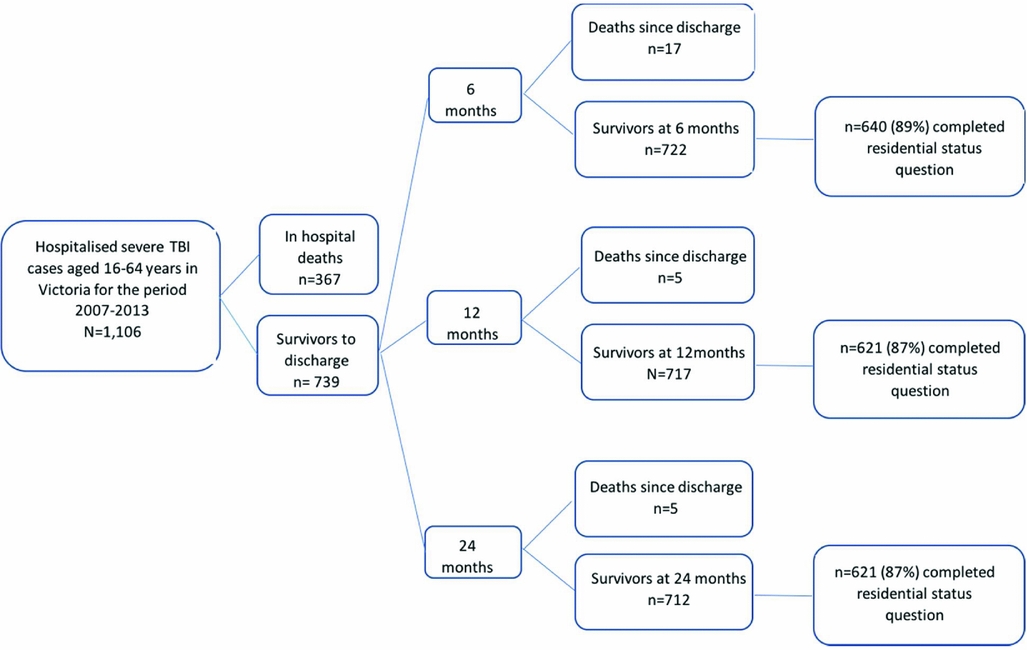
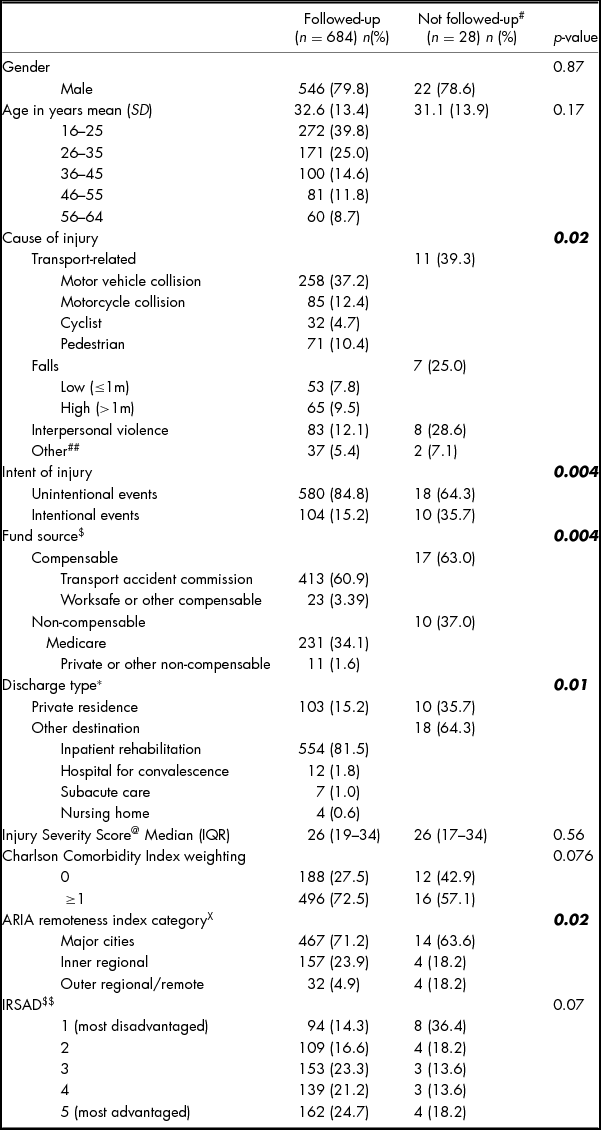
There were 1106 hospitalised cases of severe TBI in Victoria in patients aged 16–64 years, of which 739 (67%) survived to hospital discharge (Figure 1). Twenty-seven people died following hospital discharge in the first 2 years after injury. These cases were excluded from further analysis. Of the 712 cases included, 28 people did not respond to the follow-up question about place of residence at any time point, and were therefore considered lost to follow-up. There were no differences in age, gender, CCI, or ISS between participants successfully followed up and those lost to follow-up (Table 1).
Flow of participants in the study.

Profile of Responders and Non-Responders (n = 712)

Note: Values in bold are considered significant.
# Low numbers in this group prevented subcategory breakdowns.
## Other includes horse-related; submersion or drowning; other threat to breathing; poisoning – other or unspecified substance; firearm; cutting, piercing object; other specified external cause; and unspecified external cause.
Missing data: $n = 7; *n = 4; @n = 1; Xn = 34; $$=33.
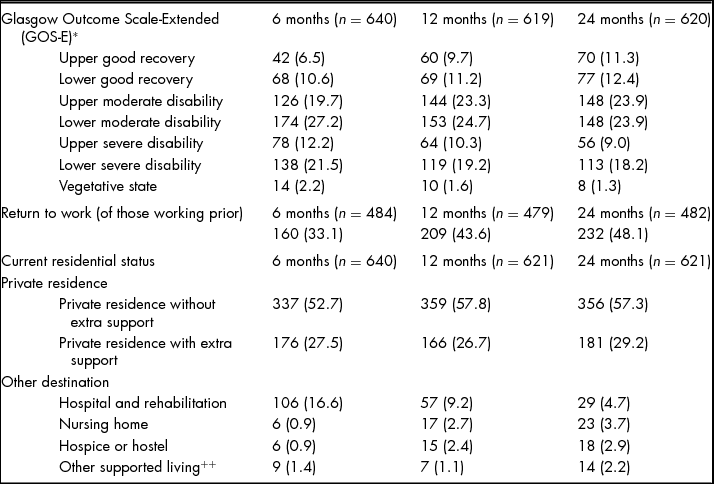
Participants were mostly male, young, compensable and living in major cities at the time of injury (Table 1). The high proportion of males in the cohort (80%) is comparable to the severe TBI population in Victoria (72%) (Beck, Bray, Cameron, Cooper, & Gabbe, Reference Beck, Bray, Cameron, Cooper and Gabbe2016). Most participants were injured in road traffic crashes, falls or through inter-personal violence. The majority of participants were recorded as having CCI weight of at least one or more. Most participants were discharged from hospital to an inpatient rehabilitation facility, with only a small proportion discharged directly to a private residence (Table 1). At 6 months post injury, the majority of participants resided at a private residence. A similar pattern was evident at 12 months and 24 months post injury (Table 2). The proportion of participants returning to work post injury increased over the follow-up period. Many participants reported a favourable outcome of moderate disability (GOS-E score 5 or 6) or good functional recovery (GOS-E score 7 or 8) at 6 months (64%), 12 months (69%) and 24 months (72%) (Table 2).
Functional Outcomes, and Work and Residential Status of People with TBI at Time Points Post Injury

* Missing data: n = 2 at 12 months; n = 1 at 24 months.
++ Other supported living includes: respite care, assisted accommodation, prison and transitional care.
Extra Support When Living at a Private Residence
The majority of participants resided at a private residence without extra support over the follow-up period (Table 2). The proportion of participants living at a private residence with extra support remained stable at 6, 12 and 24 months (Table 2). However, differences existed between compensable and non-compensable participants at a private residence. At 6 months post injury, 30% of compensable participants lived at a private residence with extra support, compared with 23% of non-compensable participants (χ12 = 8.0, p = .005). Similarly, at 24 months post injury, 32% of compensable participants lived at a private residence with extra support, compared with 22% of non-compensable participants (χ12 8.6, p = .003).
Living at a Private Residence or at Another Destination
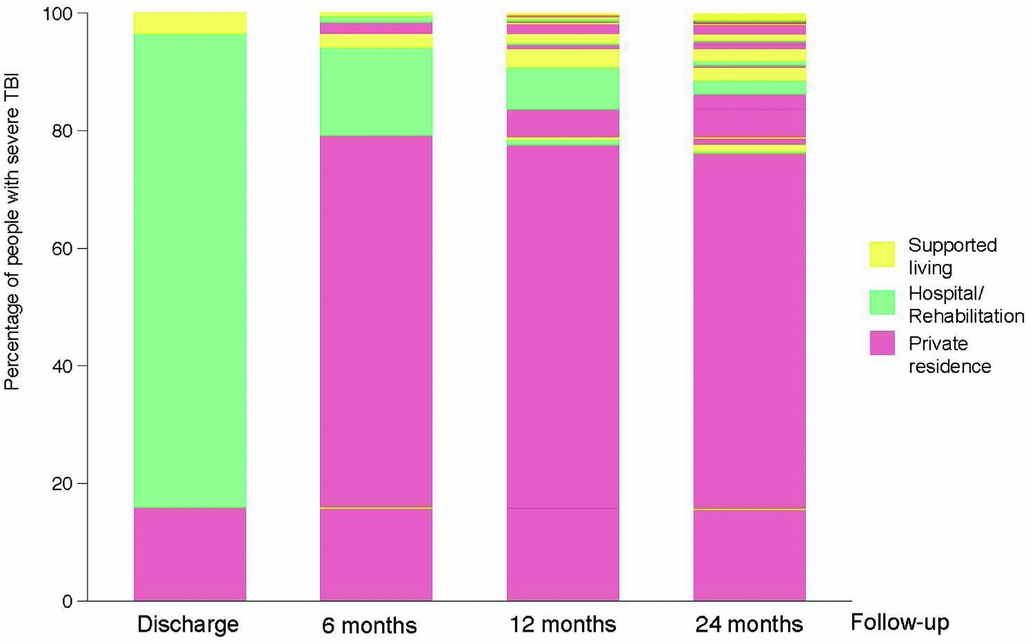
At discharge, of the participants who went directly to a private residence (16%), nearly all remained at the private residence over the study period (6 months 99%, 12 months 100% and 24 months 99%) (Figure 2). Of the participants discharged to another hospital or rehabilitation (81%), at 6 months post injury, the majority moved to a private residence (78%), a small proportion remained in hospital/rehabilitation (19%) and 3% had moved to supported living.
Distribution of the residential status of working age adults with severe TBI at discharge, 6, 12 and 24 months.

Of the participants in hospital/rehabilitation at discharge and at 6 months post injury, by 12 months this group had split into three groups: residing at a private residence (31%), supported living arrangements (21%) or remaining in hospital/rehabilitation (48%). For the group residing at a private residence at 12 months, all of these participants remained at the private residence at 24 months (100%). For those in hospital/rehabilitation at 12 months, 31% remained in hospital/rehabilitation at 24 months, while 31% were in supported living and 36% were at a private residence. Of the group in supported living at 12 months, a large proportion remained in supported living at 24 months post injury (68%) (Figure 2).
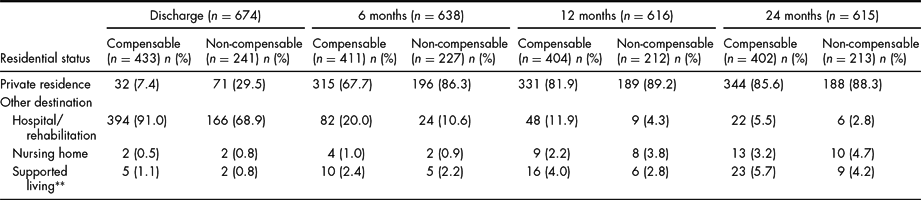
Differences were evident between compensable and non-compensable injured persons (Table 3). At discharge, a higher proportion of non-compensable participants (30%), compared to compensable (7%), lived at a private residence (χ12 = 58.5, p < .001). By 6 months post injury, 86% of non-compensable participants lived at a private residence, compared with 68% of compensable participants (χ12 = 8.6, p = .003). At 12 months post injury, a higher proportion of non-compensable participants (89%), compared to compensable (82%), lived at a private residence (χ12 = 5.5, p = .019). By 24 months post injury there were no significant differences between the proportions of compensable and non-compensable injured persons living at a private residence (Table 3).
Residential and Compensation Status of People with Severe TBI at Time Points Post Injury

**Incudes subacute facilities, hospice, hostel, prison, assisted accommodation, respite and transitional care.
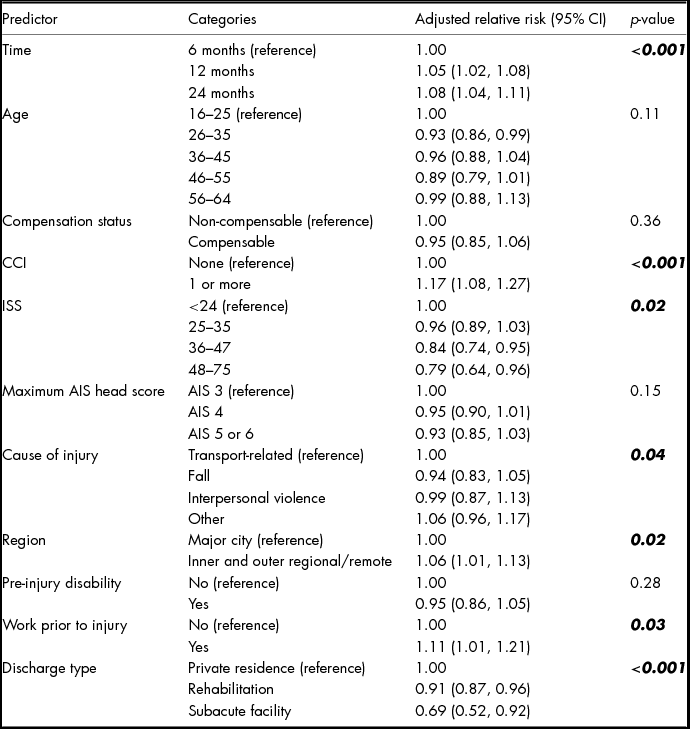
Multivariable analyses (Table 4) revealed that participants were more likely to be residing at a private residence at 12 and 24 months post injury compared to 6 months post injury. Overall, a CCI weight of one or more, working or studying prior to injury, and not living in a major city were positively associated with living at a private residence. Increasing ISS or being discharged to rehabilitation or a subacute facility was negatively associated with living at a private residence. Further, those injured in a fall or by interpersonal violence were less likely to be residing at a private residence.
Predictors of Residing at a Private Residence – Results of Modified Poisson Multivariable Analysis

Note: Values in bold are considered significant.
Discussion
In this population-based study, we found that following discharge from hospital/rehabilitation, there was little change in the place of residence over the 2-year follow-up period. Those discharged to a private residence, generally remained at a private residence, and those discharged to supported living mostly remained in this accommodation type. Overall, only a small proportion of working age adults resided in supported accommodation.
Working or studying prior to injury, comorbidities and living outside a major city were all positively associated with living at a private residence in the first 2 years after injury. Previous research has indicated that people living in rural communities report having good social and community connections (Australian Institute of Health and Welfare (AIHW), 2014). Such connections could offer support to enable people with severe TBI to live at a private residence (Baker et al., Reference Baker, Barker, Sampson and Martin2016). Alternatively, it is also possible that people living in rural areas were disadvantaged by a lack of accommodation options, as compared to their metropolitan counterparts (Harrison et al., Reference Harrison, Hunter, Thomas, Bordy, Stokes and Kitzman2016). Additionally, people living in rural settings could have lacked care coordination from health professionals to navigate health and disability systems in rural areas over time needed to access alterative accommodation (Solovieva & Walls, Reference Solovieva and Walls2014). Those working or studying prior to injury tended to be younger and may have well-developed independent living skills, such as resourcefulness and problem solving, which assist with living at a private residence post injury. Furthermore, paid work prior to the injury could have provided the financial resources required to afford in-home supports as well as a range of residential options with which to transition (e.g., own a residence, rental accommodation), suggesting social inequity for those with less economic resources.
While Brzuzy and Corrigan (Reference Brzuzy and Corrigan1996) found current and previous employment not to be associated with living alone or with parents in young adults with moderate to severe TBI, our study examined a broader age range and more residential options. Our results also demonstrated the presence of comorbidities to be associated with living at a private residence. It is possible that family members or persons with TBI had previous experience in managing pre-existing comorbid conditions. This experience could have provided the resources, resilience and skills needed to manage complex care, enabling the person with TBI to live at a private residence. Altogether, these findings likely reflect the role and importance of support services and networks (such as family and the community), as well as independent living skills (or potential to develop these skills (Sloan et al., Reference Sloan, Callaway, Winkler, McKinley, Ziino and Anson2009)), for living at a private residence following severe TBI.
Living at a private residence after injury was associated with longer time post injury. In our study and others, the longer the time post-discharge, the more likely people with severe TBI were to return a private residence (Eum et al., Reference Eum, Seel, Goldstein, Brown, Watanabe, Zasler and Glenn2014; Penna et al., Reference Penna, Novack, Carlson, Grote, Corrigan and Hart2010). Following a severe TBI, improvements in physical and cognitive function can be slow, but gains are possible even years after the initial injury in appropriate living environments (Sloan et al., Reference Sloan, Callaway, Winkler, McKinley, Ziino and Anson2009). A return to living at a private residence in the 2-year follow-up period likely reflects gains in function and independence over time. For compensable participants, return to a private residence later was likely because of ready access to funded rehabilitation. Compensable status has been previously confirmed as an important factor when discharging trauma patients to rehabilitation (Kimmel et al., Reference Kimmel, Holland, Lannin, Edwards, Page, Bucknill and Gabbe2017).
Few studies have longitudinally examined residence following TBI. Penna et al. (Reference Penna, Novack, Carlson, Grote, Corrigan and Hart2010) followed-up people living with TBI at 1, 2 and 3 years post injury, and reported changes in residence across the 5 years, with the most significant changes taking place in the first year post injury. The differences in findings from our study are likely due to varying follow-up time-points, the inclusion of moderate TBI in Penna et al.’s study, and our analysis of a broader population, which included all patients discharged from hospital rather than only those discharged from rehabilitation.
Similar to those living at a private residence, once in supported living, most remained in this type of accommodation. Those discharged to, and residing in supported living at 6 or 12 months post injury, largely remained at 24 months post injury. Minimal transitioning from private or supported living residences could suggest that the place of residence was meeting the individual's need for support (Nalder et al., Reference Nalder, Fleming, Foster, Cornwell, Shields and Khan2012). Alternatively, it could also suggest social inequities for those with severe TBI as they lack opportunity to flexibly choose and manage their place of residence for their lifestyle, comparative to people without disability (Beer & Faulkner, Reference Beer and Faulkner2009). Difficulty gaining employment post TBI could preclude the ability to earn sufficient income to afford a change in residence (van Velzen, van Bennekom, Edelaar, Sluiter, & Frings-Dresen, Reference van Velzen, van Bennekom, Edelaar, Sluiter and Frings-Dresen2009).
In our study, those with more severe injuries or not discharged directly to a private residence were less likely to reside at a private residence in the first 2 years after injury. More severe injuries could result in discharge to a rehabilitation facility or supported living owing to lower physical, social and cognitive function post TBI (Eum et al., Reference Eum, Seel, Goldstein, Brown, Watanabe, Zasler and Glenn2014; Eum et al., Reference Eum, Brown, Watanabe, Zasler, Goldstein, Seel and Glenn2016; van Baalen et al., Reference van Baalen, Odding and Stam2008) and ongoing high care needs, preventing a transition to a private residence. While participants could have been moving between different types of supported living, an inability to move away from supported living could reflect family members’ reluctance or inability to care for a person with low function at home (Eum et al., Reference Eum, Brown, Watanabe, Zasler, Goldstein, Seel and Glenn2016), an absence of family supports and/or a lack of progress during the follow-up period with regaining independent skills. Furthermore, most people in our study reported moderate to severe functional disability, and some sustained other serious injuries. It is possible that this functional disability further impacted physical access and affordability of housing required, and therefore choice of place of residence following TBI (Heinemann et al., Reference Heinemann, Sokol, Garvin and Bode2002).
For those less likely to reside at a private residence, the type of supported living environment for working age adults with severe TBI and high-level needs is important for optimising quality of life. Inappropriate supported living environments, such as institutionalised living/residential aged care, can restrict choices in daily activities, and result in social isolation and exclusion from community life (Winkler et al., Reference Winkler, Sloan and Callaway2010b). Appropriate living environments are necessary for self-determination, opportunities for choice and to ensure equity for people with disabilities (Winkler, Farnworth, Sloan, Brown, & Callaway, Reference Winkler, Farnworth, Sloan, Brown and Callaway2010a).
Our findings, together with the results of previous studies (Cuthbert et al., Reference Cuthbert, Corrigan, Harrison-Felix, Coronado, Dijkers, Heinemann and Whiteneck2011; Kim et al., Reference Kim, Colantonio, Deber and Vernich2006), revealed that of those living at a private residence, a higher proportion of compensable, than non-compensable, participants received extra support at 6 and 24 months post injury. These findings further confirm the need for greater equity in services and residential options among those with severe TBI. People with TBI eligible for financial support through compensation typically have a range of accommodation choices and receive in-home support services beyond what is publically funded through federal and state based health and disability services (Winkler et al., Reference Winkler, Farnworth, Sloan, Brown and Callaway2010a). Non-compensable patients might need to wait for availability of government funding for basic supports (e.g., attendant carers) (Productivity Commission, 2011).
For non-compensable people, the Australian government has recently introduced the National Disability Insurance Scheme (NDIS) to improve access to long-term allied health and other disability supports. Once fully implemented, the NDIS should provide reasonable and necessary supports relating to disability, which may include human supports, assistive technology or provision of home modifications or supported accommodation (National Disability Insurance Scheme, 2016). However, as it is not expected that the NDIS will be fully implemented in Victoria until late 2020, the impact of the NDIS on reducing social inequities for those with disabilities remains unknown. In the interim, the needs of those unable to access the NDIS are typically met by state-based disability services, often coupled with informal or family caregiving (McIntyre, Fleming, Foster, & Tweedy, Reference McIntyre, Fleming, Foster and Tweedy2017; Sloan et al., Reference Sloan, Callaway, Winkler, McKinley, Ziino and Anson2009). Overreliance on informal care givers to provide care, however, can result in care-giver stress, which in turn can negatively impact on those being cared for (Degeneffe, Reference Degeneffe2001).
Limitations
The strengths of this study are the use of the population based VSTR to investigate the residential status of working age adults with severe TBI over 6 years. Most previous studies were not population based, investigated moderate and severe TBI together despite their diverse needs, and included older adults. Further, many studies examined discharge destination only from the point of inpatient rehabilitation, subsequently excluding those who did not go to rehabilitation.
However, the study has some limitations. There were significant differences between responders and non-responders in our data for compensation status, cause of injury, intent, location and discharge type, although these were accounted for in the modelling. Differences between responders and non-responders were also present in a previous study longitudinally examining TBI and residential status (Penna et al., Reference Penna, Novack, Carlson, Grote, Corrigan and Hart2010). This study was not designed to identify causal relationships, but only associations. Generalisation of these results could be problematic as the compensation schemes described are particular to one state in Australia, and the post-discharge residential options and entry criteria for services and support may differ between states and countries. There are potentially a number of other factors that may influence residential status that were not collected by the VSTR, such as caregiver perceptions, social support, household income, prior living arrangements and psychological factors. Future research could focus on these factors to determine their role and interaction. Additionally, given the heterogeneity of the population of people with severe TBI, future research should explore issues faced by those living in a private residence, as it is possible that people with severe TBI and their co-residents have faced numerous challenges. These could include restricted finances precluding access to paid care to support independence within or outside the home, limited access to community, social and leisure activities resulting in social isolation, or limited choices of or difficulty getting along with co-residents. Finally, it is possible transitions in residential status occurred between follow up time points.
Conclusion
This population-based study demonstrated little change in living arrangements for working age adults with severe TBI over a 2-year study period. At 2 years post injury, 87% of people with severe TBI lived at a private residence, 5% resided in hospital or rehabilitation and 4% lived in a nursing home. The remaining participants resided in supported accommodation (4%). Of those living at a private residence, a higher proportion of compensable, than non-compensable, participants received extra support. While the majority of cases were living at a private residence at 2 years post injury a number of working age adults with severe TBI lived in aged care facilities or had been unable to transition out of inpatient hospital or rehabilitation settings. Longer follow-up is needed to understand whether improvements in these groups could facilitate a transition to more age-appropriate, home-like settings and whether change in residence may further influence outcomes over time.
Acknowledgements
The Victorian State Trauma Outcome Registry and Monitoring (VSTORM) group is thanked for the provision of VSTR data. The authors also thank Pam Simpson for statistical advice.
Financial Support
The Victorian State Trauma Registry (VSTR) is a Department of Health and Human Services, State Government of Victoria and Transport Accident Commission funded project. Dr. Ben Beck received salary support from the National Health and Medical Research Council (NHRMC) Australian Resuscitation Outcomes Consortium (Aus-ROC) Centre of Research Excellence (Grant number 1029983). Professor Belinda Gabbe was funded by an Australian Research Council Future Fellowship during the preparation of this manuscript (Grant number FT170100048).
Conflicts of Interest
SB has no conflicts of interest to disclose. BB has no conflicts of interest to disclose. LC has no conflicts of interest to disclose. JP has no conflicts of interest to disclose. BG has no conflicts of interest to disclose.
Ethical Standards
The authors assert that all procedures contributing to this work comply with the ethical standards of the relevant national and institutional committees on human experimentation and with the Helsinki Declaration of 1975, as revised in 2008.