ADVANTAGES OF METAGENOMICS TO STUDY ENVIRONMENTAL SAMPLES
Historically, investigation of microbial communities has been performed using culture-based methodologies. However, less than 1% of bacterial species in environmental communities are thought to be culturable on standard laboratory growth media (Amann et al., Reference Amann, Ludwig and Schleifer1995). To overcome these limitations, a metagenomic approach was suggested to characterize total microbial community DNA (including viruses, prokaryotes and eukaryotes) (Handelsman et al., Reference Handelsman, Rondon, Brady, Clardy and Goodman1998). Such techniques have revealed unprecedented taxonomic and functional diversity in aquatic and terrestrial habitats (Rondon et al., Reference Rondon, August, Bettermann, Brady, Grossman, Liles, Loiacono, Lynch, MacNeil, Minor, Tiong, Gilman, Osburne, Clardy, Handelsman and Goodman2000; Venter et al., Reference Venter, Remington, Heidelberg, Halpern, Rusch, Eisen, Wu, Paulsen, Nelson, Nelson, Fouts, Levy, Knap, Lomas, Nealson, White, Peterson, Hoffman, Parsons, Baden-Tillson, Pfannkoch, Rogers and Smith2004; Sogin et al., Reference Sogin, Morrison, Huber, Mark Welch, Huse, Neal, Arrieta and Herndl2006). Metagenomics encompasses two types of study – whole genome shotgun (WGS) sequencing of all the genes in the microbial community or those targeting a single, taxonomically important gene (e.g. 16S rDNA for bacteria) (Gilbert & Dupont, Reference Gilbert and Dupont2011). Whole genome shotgun sequencing studies generally fall into one of three categories: (1) vector cloning and sequencing studies in which community DNA is cloned into a fosmid, cosmid, or bacterial artificial chromosome (BAC) and the library is screened for particular genes of interest, usually for a particular species or group; (2) Sanger sequencing-based shotgun metagenomic studies in which community DNA is cloned into a vector and randomly sequenced for assembly and/or annotation; and (3) next-generation shotgun sequencing studies that utilize sequencing-by-synthesis technology to generate millions of sequence reads without the need for cloning (Gilbert & Dupont, Reference Gilbert and Dupont2011). In contrast, amplicon sequencing does not encompass the sequencing of total environmental DNA, and is not viewed by many as a metagenomic method in the strict sense. However, the ability to exploit millions of sequence reads to characterize thousands of species has revealed unprecedented diversity in marine samples and may represent a more promising alternative to assess ecosystem health and public health risks than previous culture-based or molecular methods (Unno et al., Reference Unno, Jang, Han, Kim, Sadowsky, Kim, Chun and Hur2010; Gibbons et al., Reference Gibbons, Caporaso, Pirrung, Field, Knight and Gilbert2013; Staley et al., Reference Staley, Gould, Wang, Phillips, Cotner and Sadowsky2014a).
Early applications of metagenomics to assess marine biodiversity
The study of marine biodiversity and biogeography was among one of the first applications of a metagenomics-based approach, utilizing the traditional Sanger method to sequence millions of small inserts from clone libraries (Venter et al., Reference Venter, Remington, Heidelberg, Halpern, Rusch, Eisen, Wu, Paulsen, Nelson, Nelson, Fouts, Levy, Knap, Lomas, Nealson, White, Peterson, Hoffman, Parsons, Baden-Tillson, Pfannkoch, Rogers and Smith2004; Rusch et al., Reference Rusch, Halpern, Sutton, Heidelberg, Williamson, Yooseph, Wu, Eisen, Hoffman, Remington, Beeson, Tran, Smith, Baden-Tillson, Stewart, Thorpe, Freeman, Andrews-Pfannkoch, Venter, Li, Kravitz, Heidelberg, Utterback, Rogers, Falcón, Souza, Bonilla-Rosso, Eguiarte, Karl, Sathyendranath, Platt, Bermingham, Gallardo, Tamayo-Castillo, Ferrari, Strausberg, Nealson, Friedman, Frazier and Venter2007; Wilhelm et al., Reference Wilhelm, Tripp, Givan, Smith and Giovannoni2007; Yutin et al., Reference Yutin, Suzuki, Teeling, Weber, Venter, Rusch and Béjà2007). An early study conducted in the Sargasso Sea identified 1800 genomes, including 48 unknown bacterial taxa and ~70,000 novel genes, using novel bioinformatics techniques for metagenomic assembly (Venter et al., Reference Venter, Remington, Heidelberg, Halpern, Rusch, Eisen, Wu, Paulsen, Nelson, Nelson, Fouts, Levy, Knap, Lomas, Nealson, White, Peterson, Hoffman, Parsons, Baden-Tillson, Pfannkoch, Rogers and Smith2004). This study was followed by the Global Ocean Sampling (GOS) expedition to the north-west Atlantic to the eastern Pacific Oceans (Rusch et al., Reference Rusch, Halpern, Sutton, Heidelberg, Williamson, Yooseph, Wu, Eisen, Hoffman, Remington, Beeson, Tran, Smith, Baden-Tillson, Stewart, Thorpe, Freeman, Andrews-Pfannkoch, Venter, Li, Kravitz, Heidelberg, Utterback, Rogers, Falcón, Souza, Bonilla-Rosso, Eguiarte, Karl, Sathyendranath, Platt, Bermingham, Gallardo, Tamayo-Castillo, Ferrari, Strausberg, Nealson, Friedman, Frazier and Venter2007), which revealed previously unprecedented diversity and heterogeneity within and between marine ecosystems using >7 million sequence reads. The GOS dataset was subsequently used to demonstrate a relatively ubiquitous and consistent distribution of aerobic, anoxygenic, photosynthetic bacteria among marine habitats, and these results suggested that environmental conditions may explain geographic variations in the relative abundance of this group (Yutin et al., Reference Yutin, Suzuki, Teeling, Weber, Venter, Rusch and Béjà2007). Similarly, a comparison of the genome sequence of a SAR11 marine alphaproteobacterium to the Sargasso Sea dataset revealed a high degree of conservation among core functional genes within this group, despite several hypervariable genome regions potentially associated with biogeographic variation (Wilhelm et al., Reference Wilhelm, Tripp, Givan, Smith and Giovannoni2007). These classical studies revealed the power of metagenomics-based approaches to reveal previously unknown organisms and to greatly expand the scope of microbial biodiversity and biogeography studies.
Here, we review the applications of metagenomics-based approaches, with a focus on emerging next-generation sequencing strategies, to the study of aquatic ecosystems, the computational advances associated with increasingly larger datasets, and current limitations to this rapidly expanding field of research.
NEXT-GENERATION SEQUENCING INVESTIGATION OF AQUATIC ECOSYSTEMS
In response to the success of early metagenomics studies, several next-generation sequencing (NGS) platforms have been developed that are able to produce 105–107 sequence reads of short-to-intermediate length (approximately 30–500 nt) using massively parallel sequencing approaches (Margulies et al., Reference Margulies, Egholm, Altman, Attiya, Bader, Bemben, Berka, Braverman, Chen, Chen, Dewell, Du, Fierro, Gomes, Godwin, He, Helgesen, Ho, Irzyk, Jando, Alenquer, Jarvie, Jirage, Kim, Knight, Lanza, Leamon, Lefkowitz, Lei, Li, Lohman, Lu, Makhijani, McDade, McKenna, Myers, Nickerson, Nobile, Plant, Puc, Ronan, Roth, Sarkis, Simons, Simpson, Srinivasan, Tartaro, Tomasz, Vogt, Volkmer, Wang, Wang, Weiner, Yu, Begley and Rothberg2005). The most popular of these platforms are the 454-FLX (Roche), Genome Analyzer (Illumina) and SOLiD (Applied Biosystems) systems. The primary differences among these platforms are the sequence length and number of sequence reads achieved, although more detailed comparisons of these systems, including reaction chemistries and costs per sample, have been reviewed (Mardis, Reference Mardis2008). These approaches have greatly reduced the cost and increased the speed at which metagenomics-based approaches can be applied, without the need for the construction of extensive clone libraries, as can be seen by the exponential increase in the amount of sequence data uploaded to public repositories, such as the Sequence Read Archive (SRA) at the National Center for Biotechnology Information (Figure 1).
Recent accumulation of sequence data in the Sequence Read Archive at the National Center for Biotechnology Information (http://www.ncbi.nlm.nih.gov/sra/).

Exploration of the ‘rare biosphere’
Among the first applications of NGS was an amplicon-sequencing study of deep sea water masses in the North Atlantic Ocean (Sogin et al., Reference Sogin, Morrison, Huber, Mark Welch, Huse, Neal, Arrieta and Herndl2006). This study, which targeted the V6 region of the 16S rDNA, revealed that bacterial communities in the deep sea were comprised of a small number of dominant taxa, but that much of the phylogenetic diversity was contained in a high number of taxa at low abundance, which was termed the ‘rare biosphere’. This finding was supported by a study published 3 years later that assessed the variation in bacterial community structure over a 1-year period in the English Channel (Gilbert et al., Reference Gilbert, Field, Swift, Newbold, Oliver, Smyth, Somerfield, Huse and Joint2009). Among 12 samples collected, a small fraction (0.5% of >17,000 unique sequences) of sequence reads represented 50% of the total sequence reads from each sample, and 78% of the operational taxonomic units (OTUs) identified were only found in a single sample. Furthermore, this study demonstrated seasonal variation, primarily among dominant OTUs, that were associated with changes in temperature as well as phosphate and silica concentrations (Gilbert et al., Reference Gilbert, Field, Swift, Newbold, Oliver, Smyth, Somerfield, Huse and Joint2009).
Study of the English Channel over a 6-year period further confirmed that variation in seasonal parameters, especially day length, better explained variation in bacterial community structure than did trophic interactions, measured as protozoan and metazoan biomass (Gilbert et al., Reference Gilbert, Steele, Caporaso, Steinbrueck, Reeder, Temperton, Huse, McHardy, Knight, Joint, Somerfield, Fuhrman and Field2012). Furthermore, these seasonally driven shifts resulted in strongly reproducible patterns in variation of community structure. Similar NGS studies targeting the 16S rDNA in riverine systems have similarly revealed seasonally recurrent patterns in bacterial community structure (Crump & Hobbie, Reference Crump and Hobbie2005; Staley et al., Reference Staley, Gould, Wang, Phillips, Cotner and Sadowsky2015a). Conversely, a recent study of the viral biogeography using the Pacific Ocean Virome dataset concluded that seasonal parameters were less important in shaping viral assemblages than were parameters such as depth and proximity to shore (Hurwitz et al., Reference Hurwitz, Westveld, Brum and Sullivan2014). However, despite apparent variation both among dominant bacterial taxa as well as within the rare biosphere, deeper sequencing – increasing sequencing depth from a few thousand reads to several million – has revealed that there may potentially be a globally conserved marine microbial seed bank (Gibbons et al., Reference Gibbons, Caporaso, Pirrung, Field, Knight and Gilbert2013).
Results of these studies are highly suggestive that, even given the wealth of new information regarding the biodiversity and biogeography already obtained using NGS methods, future improvements in sequencing technologies may yield even more valuable insights into the microbial ecology of aquatic and other diverse ecosystems.
Evaluation of water quality and public health risk
Recently, NGS metagenomics methods have been employed to assess potential public health risks related to anthropogenic impacts on surface waters as well as to evaluate how these practices are influencing microbial community structure in these ecosystems and other recreational biomes such as beach sands (see the article by Solo-Gabriele et al., in this issue). The scope of these studies has ranged from the identification and characterization of previously unidentified viruses and bacteria, which may pose a health risk to humans or livestock, to evaluating the effects of eutrophication from agricultural runoff on total microbial community structure. In addition, these methods have been used to determine sources of faecal pollution to surface waters. While these metagenomic techniques have allowed for more thorough characterization of previously unknown species in these studies, they remain limited by a lack of genomic data among these, often uncultured, groups as well as a paucity of metadata to explain community variation and allow meaningful comparisons between datasets.
IDENTIFICATION OF POTENTIAL PATHOGENS
Catfish farming in the Mississippi Delta accounts for more than 50% of farmed catfish in the USA (Tucker, Reference Tucker1996). However, freshwater bodies such as catfishing ponds represent important vectors for interspecies disease transmission due to the wide variety of interactions between humans, wildlife and the surface water. A metagenomic study of four catfish ponds utilized 454 pyrosequencing to identify 48 sequences that were found to belong to the viral family Asfarviridae (Wan et al., Reference Wan, Barnett, Cunningham, Chen, Yang, Nash, Long, Ford, Blackmon, Zhang, Hanson and He2013). The only known member of this family prior to this study was the African swine fever virus. While the authors did not conclude that this represented a definite health risk associated with these novel viruses, the study was the first to identify members of this virus family in North America. They suggested that further study was necessary to evaluate the pathogenic potential of these viruses.
APPLICATION TO SUSTAINABILITY EFFORTS
Due to the scarcity of water in many regions of the world, the use of alternative water supplies to support rapid population growth remains a key component of sustainable agricultural practices (Levine & Asano, Reference Levine and Asano2004). Reclaimed water has been proposed as an alternative source of non-potable water for purposes including agricultural irrigation. However, because it is an end-product of wastewater treatment, there are concerns regarding the possibility of pathogen transmission. While the concentration of virus-like particles in reclaimed water is ~1000-fold higher than in potable water (Rosario et al., Reference Rosario, Nilsson, Lim, Ruan and Breitbart2009), metagenomic analysis revealed that most of these particles in both water types (46% in potable water and >50% in reclaimed water) did not have matches in existing databases, suggesting that they were novel. In addition, no viruses that did match database entries matched viruses known to be pathogenic to humans, but members of Siphoviridae were proposed as markers for faecal pollution. Similar to the catfish pond study, however, further study will be necessary to evaluate the host-specificity and pathogenic potential of the novel viruses identified.
Differences in the bacterial community of surface vs ground water have been investigated to determine the effects of different water sources on the bacterial community associated with the surfaces of tomatoes (Telias et al., Reference Telias, White, Pahl, Ottesen and Walsh2011). Surface waters are exposed to a number of human, animal, and climate impacts that may result in the spread of pathogens when surface waters are applied directly to crops. Communities in groundwater had significantly higher relative abundances of Betaproteobacteria than did more diverse surface waters. However, no differences were observed in bacterial communities in the phyllosphere, the total above ground portion of plants, of tomatoes treated with different water types, and it was found that these communities were dominated by members of the Gammaproteobacteria (Telias et al., Reference Telias, White, Pahl, Ottesen and Walsh2011). Furthermore, >90% of sequence reads were shared among all phyllosphere samples. Despite these results, the authors were unable to conclude that fruits treated with surface waters were completely safe due to the possibility of sequencing errors and an inability to identify OTUs at the species level.
APPLICATIONS FOR WATER QUALITY MONITORING
Runoff from agricultural practices is known to increase concentrations of nitrogen, phosphorus and other nutrients in surface waters, including rivers, lakes and coastal marine waters. Evaluation of the total microbial community of a freshwater Mediterranean lagoon that was eutrophic as a result of primarily agricultural impacts revealed that it was distinctly different from previously characterized freshwater systems (Ghai et al., Reference Ghai, Hernandez, Picazo, Mizuno, Ininbergs, Díez, Valas, DuPont, McMahon, Camacho and Rodriguez-Valera2012). Notably, ultramicrobacteria, specifically lineages of Actinobacteria and Alphaproteobacteria, that comprise well-known, ubiquitous freshwater lineages were minority members in this system. Furthermore, the genus Polynucleobacter, a member of the Betaproteobacteria, which is cosmopolitan in freshwater systems, was also absent. Instead, the community was dominated by cyanobacteria, in particular Synechococcus spp. Prevalence of cyanobacteria among eutrophic freshwater bodies was expected, yet the near absence of other major freshwater groups in this system was unusual. Results of this study highlight the potential detrimental effects of high levels of agricultural runoff on bacterial communities and water quality.
Similarly, the role of specific types of anthropogenic impacts in contributing nutrients (e.g. nitrogen and phosphorus) and chemicals (e.g. pharmaceuticals and agrochemicals), as well as in altering the bacterial community structure, have been investigated in the Mississippi River in Minnesota (Staley et al., Reference Staley, Unno, Gould, Jarvis, Phillips, Cotner and Sadowsky2013, Reference Staley, Gould, Wang, Phillips, Cotner and Sadowsky2014a, Reference Staley, Gould, Wang, Phillips, Cotner and Sadowskyb). Initial results revealed that, despite various land coverage types throughout the study area, a core microbiome persisted over a reach of >400 km, such that ~90% of sequence reads were shared among the 10 sites sampled (Staley et al., Reference Staley, Unno, Gould, Jarvis, Phillips, Cotner and Sadowsky2013). Furthermore, bacterial communities at sampling sites could be grouped based on major surrounding land cover type (i.e. developed, forested or agricultural), suggesting that runoff from specific types of anthropogenic activities resulted in specific shifts in bacterial community structure.
Investigation of local and regional microbial community dynamics in the Mississippi River, in Minnesota, revealed that local variations were primarily linked to within-community dynamics, but regional changes could be associated with variations in specific nutrient concentrations, specifically total dissolved carbon and dissolved solids (Staley et al., Reference Staley, Gould, Wang, Phillips, Cotner and Sadowsky2014a). Furthermore, increases in the relative abundances of specific orders were associated with broadly characterized land cover types. In addition, while the distributions of the majority of functional genes were conserved throughout the Mississippi River in Minnesota, there was slight variation in functional traits of bacterial communities between two basins that were surrounded by primarily agricultural vs primarily urban land cover (Staley et al., Reference Staley, Gould, Wang, Phillips, Cotner and Sadowsky2014b). Results of these studies highlight the utility of metagenomic-based approaches to investigate taxonomic and functional variation as it relates to water quality, potential public health risk, and ecosystem health and sustainability at both local and regional scales.
MICROBIAL SOURCE TRACKING
Traditional indicators of water quality, in terms of risk to public health, have relied on culture-based enumeration of indicator bacteria (e.g. Escherichia coli and enterococci), which have failed to serve as a robust marker for the presence of pathogens due, in part, to their ubiquity among non-human sources (Harwood et al., Reference Harwood, Staley, Badgley, Borges and Korajkic2014). In light of this obstacle, metagenomic approaches have proven useful in microbial source tracking (MST) studies, offering more specific characterization of sources of faecal contamination by comparing faecal microbial communities to those in the water column (Unno et al., Reference Unno, Jang, Han, Kim, Sadowsky, Kim, Chun and Hur2010, Reference Unno, Di, Jang, Suh, Sadowsky and Hur2012; Newton et al., Reference Newton, Bootsma, Morrison, Sogin and McLellan2013). The first implementation of metagenomic-based source tracking, PyroMiST (Unno et al., Reference Unno, Di, Jang, Suh, Sadowsky and Hur2012), employed existing subroutines and available software (i.e. cd-hit) as well as Perl script automation in a web-based interface to identify sources of faecal contamination from 16S rDNA sequence data. However, in order to accommodate advances in the recent expansion of NGS technologies, including longer read lengths and variation between platforms (e.g. 454 and Illumina), it was necessary to develop a more flexible pipeline to identify sources.
SourceTracker, a subroutine implementable in the R software package [http://www.r-project.org], has since been developed to offer more flexibility in determining the contribution of known sources to an environmental community using taxonomic marker genes (Knights et al., Reference Knights, Kuczynski, Charlson, Zaneveld, Mozer, Collman, Bushman, Knight and Kelley2011). While the use of this subroutine is not limited to MST studies in recreational water quality, it has been successfully utilized to identify, and to some extent quantify, sewage contamination in surface waters (Newton et al., Reference Newton, Bootsma, Morrison, Sogin and McLellan2013; Shanks et al., Reference Shanks, Newton, Kelty, Huse, Sogin and McLellan2013). Moreover, this technology has been an adjunct to determining potential health risks associated with recreational water.
Metagenomic characterization of functional diversity
Taxonomic marker genes do not provide information regarding the distribution of functional traits. However, based on the known distributions of core genes among prokaryotic lineages, phylogenetic trees can be constructed from functional genes that closely resemble those built from taxonomically relevant sequences (Segata & Huttenhower, Reference Segata and Huttenhower2011). This suggests that taxonomic information alone may also be used to infer the distribution of functional genes on the basis of phylogenetic relationships. A recently developed subroutine, PICRUSt (phylogenetic investigation of communities by reconstruction of unobserved states), has been developed to infer functional traits for prokaryotes using 16S rDNA sequence data and the GreenGenes reference database (Langille et al., Reference Langille, Zaneveld, Caporaso, McDonald, Knights, Reyes, Clemente, Burkepile, Vega Thurber, Knight, Beiko and Huttenhower2013). Functional inferences from PICRUSt were significantly correlated with shotgun metagenomic data from the Human Microbiome Project as well as from soils and a hypersaline microbial mat (Langille et al., Reference Langille, Zaneveld, Caporaso, McDonald, Knights, Reyes, Clemente, Burkepile, Vega Thurber, Knight, Beiko and Huttenhower2013). However, the accuracy of these inferences in diverse environmental habitats, such as soils and waterways, requires further validation as these environments contain structurally and functionally diverse microbiota (Staley et al., Reference Staley, Gould, Wang, Phillips, Cotner and Sadowsky2014b).
Due to the complexity of microbial communities, novel genes are unlikely to be successfully detected and characterized using WGS NGS data. However, functional metagenomic studies to characterize patterns in functional trait distribution as well as novel functional genes for traits (e.g. antibiotic resistance and heavy metals) remain promising areas of study (Torres-Cortés et al., Reference Torres-Cortés, Millán, Ramírez-Saad, Nisa-Martínez, Toro and Martínez-Abarca2011; Staley et al., Reference Staley, Gould, Wang, Phillips, Cotner and Sadowsky2014c, Reference Staley, Johnson, Gould, Wang, Phillips, Cotner and Sadowsky2015b). To this end, the study of marine metagenomics has allowed for the discovery of novel enzymes that catalyse the formation of potentially useful metabolites (Barone et al., Reference Barone, De Santi, Palma Esposito, Tedesco, Galati, Visone, Di Scala and De Pascale2014). Traditionally, marine metagenomic studies aimed at discovery of novel bioactive compounds have relied on the functional or sequence-based screening of large clone libraries (see reviews: Kennedy et al., Reference Kennedy, Marchesi and Dobson2008; Barone et al., Reference Barone, De Santi, Palma Esposito, Tedesco, Galati, Visone, Di Scala and De Pascale2014; Reen et al., Reference Reen, Gutiérrez-Barranquero, Dobson, Adams and O'Gara2015), with few exploiting NGS approaches. However, Woodhouse et al. (Reference Woodhouse, Fan, Brown, Thomas and Neilan2013) recently applied tag-encoded pyrosequencing as well as whole genome shotgun sequencing of the microbiome of Australian sponges to assess the diversity of non-ribosomal peptide synthetase and polyketide synthase genes. Using the tag-encoded approach, this group demonstrated the utility of using conserved domains in conjunction with NGS to identify genes involved in natural biosynthesis.
COMPUTATIONAL ADVANCES FOR METAGENOMIC ANALYSIS
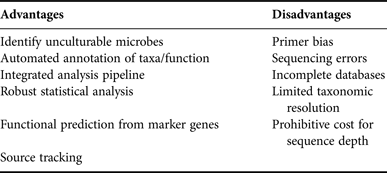
The emergence of NGS technologies brought about a requirement to develop computational approaches to process and analyse the massive volumes of data generated. Advantages and limitations of these tools are outlined in Table 1. Preliminary computational tools, originally designed to handle <104 sequence reads, such as LIBSHUFF (Singleton et al., Reference Singleton, Furlong, Rathbun and Whitman2001) and ARB (Ludwig et al., Reference Ludwig, Strunk, Westram, Richter, Meier, Buchner, Lai, Steppi, Jobb, Förster, Brettske, Gerber, Ginhart, Gross, Grumann, Hermann, Jost, König, Liss, Lüssmann, May, Nonhoff, Reichel, Strehlow, Stamatakis, Stuckmann, Vilbig, Lenke, Ludwig, Bode and Schleifer2004) were encumbered by the computational demands of the emerging datasets, and their limited functionality. Moreover, performing one or a few functions, made them difficult to integrate. As a result, software programs such as mothur and QIIME (Quantitative Insights into Microbial Ecology) have become popular applications to process and analyse taxonomic marker genes (Schloss et al., Reference Schloss, Westcott, Ryabin, Hall, Hartmann, Hollister, Lesniewski, Oakley, Parks, Robinson, Sahl, Stres, Thallinger, Van Horn and Weber2009; Caporaso et al., Reference Caporaso, Kuczynski, Stombaugh, Bittinger, Bushman, Costello, Fierer, Peña, Goodrich, Gordon, Huttley, Kelley, Knights, Koenig, Ley, Lozupone, McDonald, Muegge, Pirrung, Reeder, Sevinsky, Turnbaugh, Walters, Widmann, Yatsunenko, Zaneveld and Knight2010). These programs employ a pipeline of subroutines – a series of computational steps to perform multiple functions – for joining paired-end sequence reads (i.e. forward and reverse sequences), quality control procedures (e.g. quality trimming and chimera removal), sequence alignment, OTU clustering, and taxonomic assignment using standard reference databases such as GreenGenes, SILVA or the Ribosomal Database Project (RDP) (DeSantis et al., Reference DeSantis, Hugenholtz, Larsen, Rojas, Brodie, Keller, Huber, Dalevi, Hu and Andersen2006; Pruesse et al., Reference Pruesse, Quast, Knittel, Fuchs, Ludwig, Peplies and Glockner2007; Cole et al., Reference Cole, Wang, Cardenas, Fish, Chai, Farris, Kulam-Syed-Mohideen, McGarrell, Marsh, Garrity and Tiedje2009). Statistical tools for analysis of complex datasets have also been incorporated into these programs allowing more thorough and complex analyses of ecological datasets.
Computational advantages and limitations of software and subroutines developed for analysis of next-generation sequencing data.
Similar to NGS of taxonomic marker genes, results of WGS sequencing studies were also initially difficult to interpret due to the increased computational requirements. Metagenomic Analyzer (MEGAN) software was developed specifically to deal with the computation of NGS shotgun sequences, bypassing the limitations of extensive sequence assembly from environmental sequence data and the lower abundance of phylogenetically relevant marker genes (Huson et al., Reference Huson, Auch, Qi and Schuster2007). The Community Cyberinfrastructure for Advanced Marine Microbial Research and Analysis (CAMERA) was developed as an online repository for sequence and metadata, and integrates existing and emerging bioinformatics tools for the analysis of metagenomic data originally incorporating analytical packages and workflows used for the Global Ocean Sampling (GOS) expedition (Seshadri et al., Reference Seshadri, Kravitz, Smarr, Gilna and Frazier2007). The program compares sequence reads against a reference database and outputs the results for exploration using a graphical interface. Similarly, web servers like the Metagenomics RAST (MG-RAST) have also been developed where data can be uploaded and stored, and taxonomic and functional annotations are performed automatically (Meyer et al., Reference Meyer, Paarmann, D'Souza, Olson, Glass, Kubal, Paczian, Rodriguez, Stevens, Wilke, Wilkening and Edwards2008). While these tools have facilitated analysis of datasets of previously unprecedented depth and coverage, they each have their unique advantages and disadvantages.
Metagenomic studies to date have been carried out primarily from a descriptive, data discovery perspective, with a focus on what is in an environmental sample and how diversity, as well as the presence and abundance of community members or functional genes, change between samples and habitats. Ordination techniques such as principal coordinate analysis (PCoA) and non-metric multidimensional scaling (NMDS) have enabled visualization of these complex datasets to facilitate these studies. In fact, one of the main drawbacks of these studies is the enormous datasets generated and the inability to view all the data in an easily interpretable format. Network-based approaches have also been developed to allow visual comparisons from complex metagenomic shotgun and taxonomic marker datasets (Mitra et al., Reference Mitra, Gilbert, Field and Huson2010; Larsen et al., Reference Larsen, Field and Gilbert2012). Statistical software packages such as STAMP (Statistical Analysis of Metagenomic Profiles) have been developed to clearly summarize statistical trends allowing meaningful biological inferences to be made from these complex data (Parks & Beiko, Reference Parks and Beiko2010). The recent and continuing decline in the cost of NGS will soon allow for better sample replication, enabling more powerful statistical comparisons, and the generation of terabase datasets that will allow for a better quantitative assessment of taxa and genes present in the environment (Gilbert & Dupont, Reference Gilbert and Dupont2011).
COMPUTATIONAL LIMITATIONS TO METAGENOMIC ANALYSES
Prior to 2006, metagenomics studies were limited to clone-based studies and Sanger sequencing, and the relatively high cost of sequencing (~$500 per Mb) restricted the size of these early datasets, as well as replication efforts for robust statistical comparisons (Kircher & Kelso, Reference Kircher and Kelso2010; Temperton & Giovannoni, Reference Temperton and Giovannoni2012). These methods were subject to PCR amplification and cloning biases. Next-generation sequencing methods have greatly reduced the costs associated with generating larger volumes of sequence data, and have, to some extent, alleviated bias associated with cloning (Wooley et al., Reference Wooley, Godzik and Friedberg2010). However, PCR primer bias remains an intrinsic limitation and this issue, coupled with shorter sequence read lengths, can significantly affect the diversity inferred from NGS data (Youssef et al., Reference Youssef, Sheik, Krumholz, Najar, Roe and Elshahed2009). In addition, next-generation sequences are subject to error due to DNA polymerases, chimera formation and sequencing errors (Kircher & Kelso, Reference Kircher and Kelso2010; Patin et al., Reference Patin, Kunin, Lidstrom and Ashby2013). Bias and error can be reduced by improving reaction chemistries, reducing PCR cycle numbers, using well-designed primer sets, and refining the quality of reagents. However, computational approaches must also be considered to account for these errors as well as difficulties arising from the massive volumes of data generated.
The intrinsic problem of sequencing error is mitigated in single organism genomic sequencing by sequence assembly and high coverage depth (Goldberg et al., Reference Goldberg, Johnson, Busam, Feldblyum, Ferriera, Friedman, Halpern, Khouri, Kravitz, Lauro, Li, Rogers, Strausberg, Sutton, Tallon, Thomas, Venter, Frazier and Venter2006); however, taxonomic marker surveys using NGS methods are prone to overestimation of diversity resulting from sequence error (Kunin et al., Reference Kunin, Engelbrektson, Ochman and Hugenholtz2010). Early analysis of sequence errors in a NGS dataset has shown that exclusion of sequences containing ambiguous bases (Ns) and primer or barcode mismatches reduces the sequence error rate in the dataset to less than that of Sanger sequencing while retaining >90% of sequence reads (Huse et al., Reference Huse, Huber, Morrison, Sogin and Welch2007). Subsequent studies have shown that a 2% pre-clustering step and OTU binning at ≤97% similarity greatly reduced inflated diversity estimates associated with sequencing error (Huse et al., Reference Huse, Welch, Morrison and Sogin2010; Kunin et al., Reference Kunin, Engelbrektson, Ochman and Hugenholtz2010). In addition, several computational approaches, such as UCHIME (Edgar et al., Reference Edgar, Haas, Clemente, Quince and Knight2011), have been developed to identify and remove chimeric sequence reads (Wooley & Ye, Reference Wooley and Ye2009).
Despite these processing steps to improve sequence quality, inherent bias and limitations still exist when using small subunit rRNA genes for taxonomic surveys. Due to fundamental differences in rDNA sequences, prokaryotes and eukaryotes must be sequenced separately. Among prokaryotes, utilization of the 16S rDNA presents unique challenges in that species resolution can be difficult as a result of the highly conserved nature of this gene (Gürtler & Stanisich, Reference Gürtler and Stanisich1996). Furthermore, a single cell can contain up to 15 copies of rDNA and copies may be heterogeneous within the same genome, further complicating species identification and accurate quantification of taxonomic abundances (Klappenbach et al., Reference Klappenbach, Saxman, Cole and Schmidt2001). Finally, even when universal primers are used for amplification, it is unlikely that all members of a certain group (e.g. bacteria or archaea) will be amplified due to the higher diversity of these domains (Davenport & Tümmler, Reference Davenport and Tümmler2013).
For WGS studies of environmental samples, sequencing coverage is often extremely low, thus it is difficult to discern individual genomes within a community due to differences in relative abundances of highly diverse organisms. The first, Sanger-sequencing-based, metagenomic studies had some success using single genome sequence assemblers to build contigs, contiguous sequence fragments, from metagenomic data, owing to relatively small numbers of sequence reads and longer read lengths compared with NGS methods (Venter et al., Reference Venter, Remington, Heidelberg, Halpern, Rusch, Eisen, Wu, Paulsen, Nelson, Nelson, Fouts, Levy, Knap, Lomas, Nealson, White, Peterson, Hoffman, Parsons, Baden-Tillson, Pfannkoch, Rogers and Smith2004; Rusch et al., Reference Rusch, Halpern, Sutton, Heidelberg, Williamson, Yooseph, Wu, Eisen, Hoffman, Remington, Beeson, Tran, Smith, Baden-Tillson, Stewart, Thorpe, Freeman, Andrews-Pfannkoch, Venter, Li, Kravitz, Heidelberg, Utterback, Rogers, Falcón, Souza, Bonilla-Rosso, Eguiarte, Karl, Sathyendranath, Platt, Bermingham, Gallardo, Tamayo-Castillo, Ferrari, Strausberg, Nealson, Friedman, Frazier and Venter2007). However, the large number and small read length of NGS reads limit the effectiveness of sequence assembly by these methods (Wooley et al., Reference Wooley, Godzik and Friedberg2010). Large amounts of nearly identical sequences and the possibility of assembling sequences from different OTUs require a different assembly strategy that has been met by several new programs such as IDBA-UD and meta-VELVET (Namiki et al., Reference Namiki, Hachiya, Tanaka and Sakakibara2012; Peng et al., Reference Peng, Leung, Yiu and Chin2012), which take into account short sequence reads and uneven coverage due to differences in OTU abundance. Nevertheless, there is still a trade-off between assembly, which can reveal novel genes or species not previously described, and read mapping without assembly, which allows semi-quantitative inferences (Davenport & Tümmler, Reference Davenport and Tümmler2013).
While NGS costs have declined compared with Sanger sequencing, complete metagenomic characterization of highly diverse environmental samples remains limited by the prohibitive cost required (Gilbert & Dupont, Reference Gilbert and Dupont2011; Knight et al., Reference Knight, Jansson, Field, Fierer, Desai, Fuhrman, Hugenholtz, van der Lelie, Meyer, Stevens, Bailey, Gordon, Kowalchuk and Gilbert2012). Even with the recent advances in sequencing technology, <0.000001% of the metagenome in seawater is estimated to have been sequenced based on average genome sizes and bacterial density in a one litre sample (Gilbert & Dupont, Reference Gilbert and Dupont2011). Furthermore, 4–5 × 10¹⁴ bp and 3 × 10¹⁵ bp of sequence data are estimated as the requirement for 1× coverage of a one litre seawater and one gram soil sample, respectively (Gilbert & Dupont, Reference Gilbert and Dupont2011; Knight et al., Reference Knight, Jansson, Field, Fierer, Desai, Fuhrman, Hugenholtz, van der Lelie, Meyer, Stevens, Bailey, Gordon, Kowalchuk and Gilbert2012). To accomplish this sequencing depth, >800 and approximately 5000 full runs would be required on an Illumina HiSeq2000 platform, at a cost of tens of millions of dollars currently (Caporaso et al., Reference Caporaso, Lauber, Walters, Berg-Lyons, Huntley, Fierer, Owens, Betley, Fraser, Bauer, Gormley, Gilbert, Smith and Knight2012). However, 6× to 8× coverage is considered the standard to ensure adequate representation of all of the genomes in the community (Akondi & Lakshmi, Reference Akondi and Lakshmi2013), further increasing costs and effort. Thus, analyses of complex environments at the degree of coverage needed may need to wait for the development of new, even less expensive, sequencing technology.
Regardless of the type of sequencing study performed, the taxonomic and functional annotations that result are dependent on the databases used. Databases are known to have a compositional bias, favouring sequences from easily culturable and accessible organisms (Pignatelli et al., Reference Pignatelli, Aparicio, Blanquer, Hernández, Moya and Tamames2008). The quality of the assemblies and the application used for gene or taxonomic annotation can have significant effects on the percentage of reads annotated as well as the accuracy of the prediction (Mavromatis et al., Reference Mavromatis, Ivanova, Barry, Shapiro, Goltsman, Mchardy, Rigoutsos, Salamov, Korzeniewski, Land, Lapidus, Grigoriev, Richardson, Hugenholtz and Kyrpides2007). Furthermore, the completeness of the database dramatically influences the classification of sequences, and taxonomic and functional composition of samples may change depending on the version of the database used, even among recently updated databases (Pignatelli et al., Reference Pignatelli, Aparicio, Blanquer, Hernández, Moya and Tamames2008). These changes primarily result from the assignment of previously unclassified reads to newly sequenced taxa. However, sequencing of closely related species can also result in shifts in assignment (Pignatelli et al., Reference Pignatelli, Aparicio, Blanquer, Hernández, Moya and Tamames2008).
PERSPECTIVES
The studies reviewed here, highlight the efficacy of employing metagenomics approaches in the study of environmental samples, specifically water samples, to better characterize biodiversity, biogeography, the effects of anthropogenic impacts, and potential public health risk. Development of new computational tools to process and analyse NGS data has facilitated the identification of previously unidentified microorganisms, some of which may have important public health implications. Furthermore, more thorough characterization of microbial communities is facilitating better interpretations regarding which practices are important in shaping bacterial community structure. Despite recent advances, drawbacks to these methods still exist, including sequencing error as well as biases and gaps in reference databases favouring easily culturable microorganisms. Further advances in technology and metagenomics studies will allow microbial ecologists and physiologists to fill these knowledge gaps and thus provide a more complete understanding of the interaction between anthropogenic practices, the environment and microbial communities.
ACKNOWLEDGEMENTS
Funding for this work was provided, in part, by the Minnesota Environment and Natural Resources Trust Fund as recommended by the Legislative-Citizen Commission on Minnesota Resources (LCCMR).
CONFLICTS OF INTEREST
The authors declare that they have no conflicts of interest.